Monthly Archives: June 2008

iPhone + UAVs + Crisis Response

The year I spent at the University of California at Berkeley was one of the best times of my life. So I’m thrilled that this project, reported by Wired, was made in the Berkeley Republic. In fact, I’m not at all surprised that Cal students are behind the initiative since it completely violates the terms of the Apple Software Developer Kit agreement, “applications may not be designed or marketed for real-time route guidance; automatic or autonomous control of vehicles, aircraft, or other mechanical devices; dispatch or fleet management; or emergency or life-saving purposes.”

As the title suggests, the Berkeley project enables an individual to remotely control the flight trajectory of a UAV and to take pictures all from the iPhone interface. The video below is definitely worth watching. See my other blog here on the use of UAVs for conflict early warning and response.

Still on the subject of the iPhone is the question whether of whether or not the next generation iPhone is suitable for emergency management. Gav’s blog kicked off a conversation that continued on the Humanitarian ICT list serve where several colleagues chimed in with some of the iPhone’s advantages and disadvantages. One of the concerns echoed repeatedly stems from the issue regarding Apple’s terms of agreement. However, as the Berkeley students have demonstrated, some may get away with crossing Steve Jobs. In any case, of particular interest to me are the location-aware social networking applications being developed for the iPhone SDK such as Loopt, which lets you see whether your contacts are in the vicinity.

Patrick Philippe Meier

Dialup Radio for Communication in Conflict Zones?

I blogged about Tad Hirsch‘s TXTmob project back in April and spoke to him this week about his Dialup Radio project. The intuitive web-based interface allows anyone to upload brief radio-style audio files to make them available via phone along with the option of using different menu options. For example, one could broadcast news about electoral-related violence in difference cities and towns across Zimbabwe: “For today’s news on Bulawayo, press 1, for news on Gweru, press 2,” etc.

Dialup Radio has been designed specifically to meet the needs of human rights activists in the developing world. The system can be installed locally or may be operated across national borders. Particular attention has been paid to system security and to minimizing costs of operation

The Dialup Radio project is currently being used in Zimbabwe where independent radio stations have been outlawed. Other tactics include copying broadcasts on cassette tapes and disseminating the tapes widely among taxi and long-distance bus drivers across the country. Indeed, the best place to get accurate reporting in Zimbabwe may very well be from a taxi driver. I certainly found this to be the case while in Nairobi following the December 2007 presidential elections and the ensuing violence.

Patrick Philippe Meier

Crisis Mapping Zimbabwe

As a doctoral research fellow with the Harvard Humanitarian Initiative (HHI), Jennifer Leaning and I are pursuing applied research on crisis mapping to identify innovative approaches that can be scaled up to maximize impact. The following initiatives are two projects of potential interest.

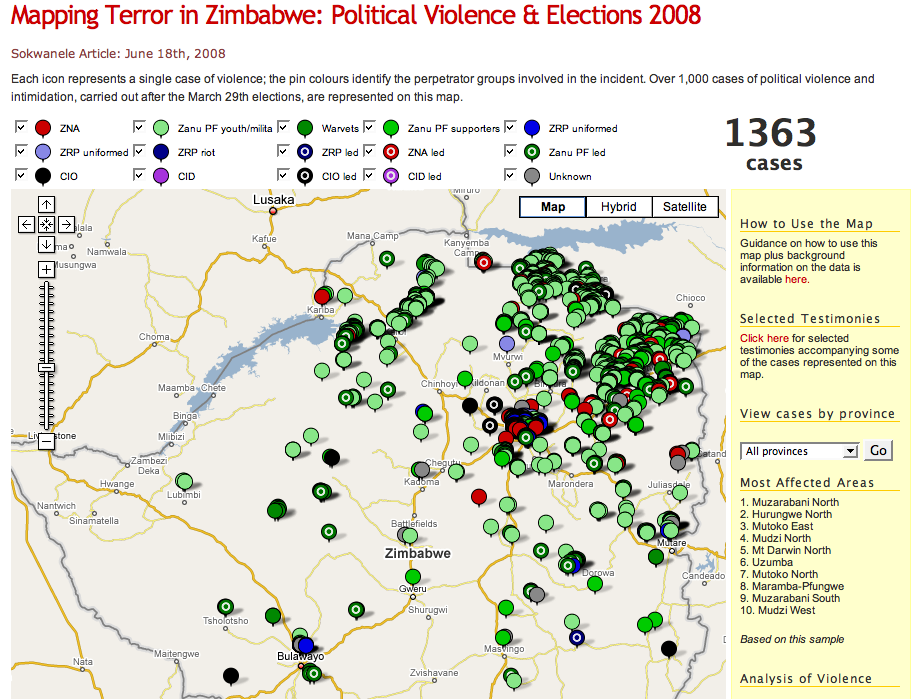
Sokwanele follows in the footsteps of Ushahidi in providing a web-based interface to map election-related violence in Zimbabwe. The design is simple and self-explanatory. Each incident is associated with the identity of the perpetrating party, e.g., Zanu youth.

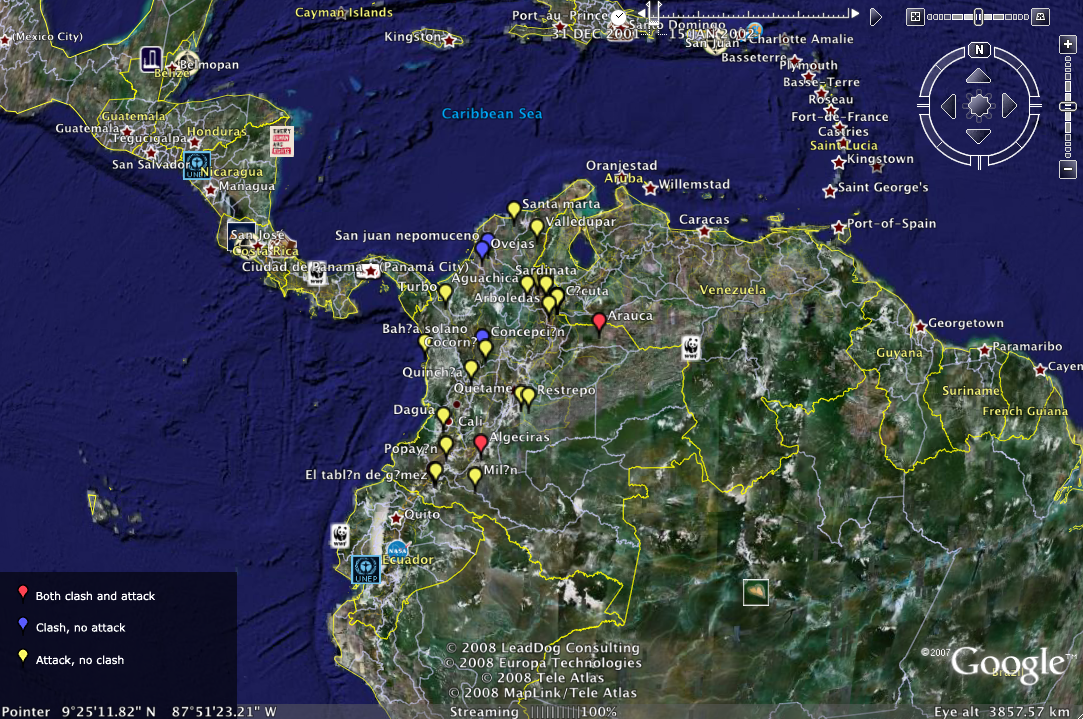
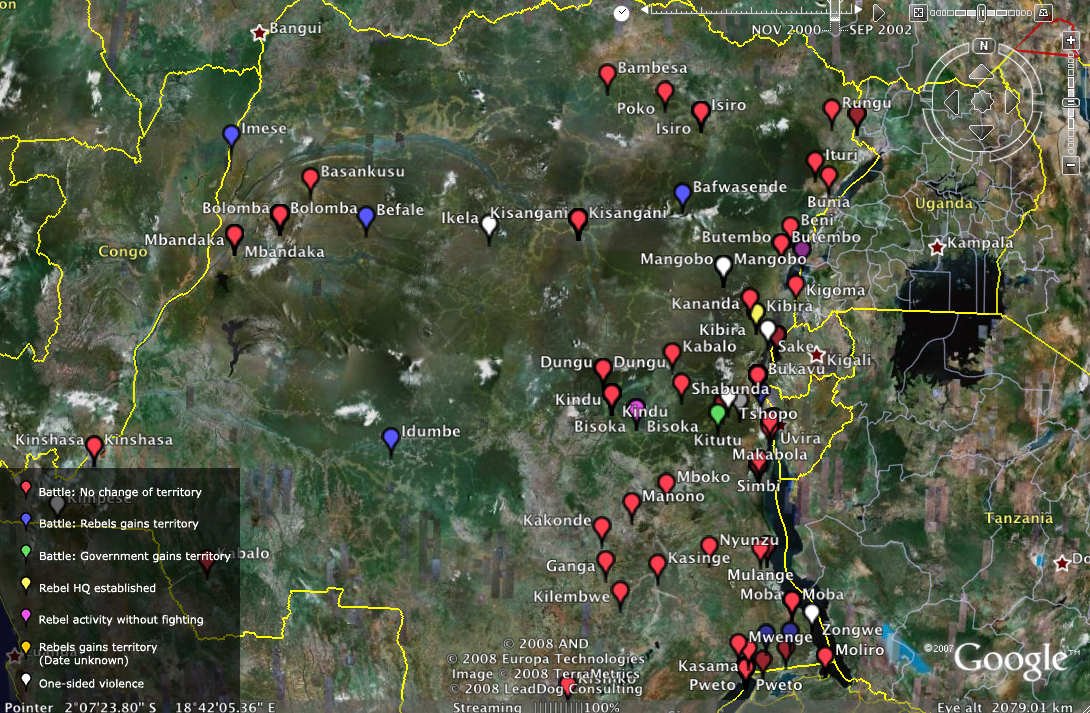
It would be particularly useful to have a time-animation functionality in order to depict any patterns in the spread of the violence as this could reveal tactics of perpetrators. A colleague and I created crisis maps for Colombia and the DRC back in July 2007 using Google Earth (KML). We added the time-bar functionality and visualized the data over time, immediately taking note of distinct patterns. The underlying conflict data was drawn from the Conflict Analysis Resource Center (CERAC) in Bogota and from the Peace Research Institute, Oslo (PRIO) respectively, both of which I have been affiliated with as a researcher. Clicking on the pictures below will provide you with a full-screen shot of the interface.

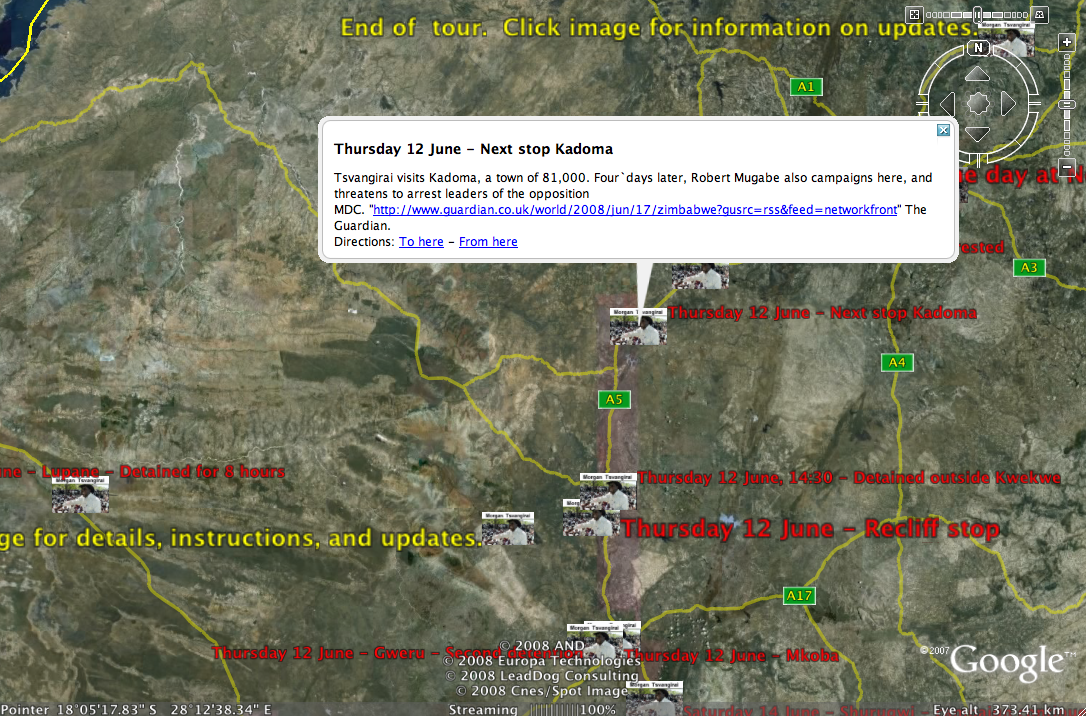
Another crisis map of Zimbabwe depicts Morgan Tsvangirai’s campaign “with information on campaign stops, detentions by police, vehicle impoundments, and references to all information from on-line news sources.” The Google Earth KML file is regularly updated.

The question that remains for me is what methods can be used to measure the impact these projects are having?

Patrick Philippe Meier

China, Olympics and Satellite Imagery

Will international attention on the Beijing Olympics impact the government’s policy on censorship? Some argue that the Olympics create a unique window of opportunity for digital activists while others maintain that Beijing’s grip on information communication is more effective than ever. The recent 2008 study, Access Denied: The Practice and Policy of Global Internet Filtering, states that “China institutes by far the most extensive filtering regime in the world, with blocking occurring at multiple levels of the network and spanning a wide range of topics.” Little surprise then that neither Chinese Google Maps nor Microsoft’s Chinese Virtual Earth include high resolution satellite imagery of China.

I was therefore amused to learn from Stefan Geens that China’s national broadcasting television (CCTV) is inadvertently providing full access to high-resolution satellite imagery of China via a website that maps the location of football stadiums for Euro 2008.

As Stefan concludes:

Once you’re zoomed in on an Austrian stadium, there is nothing keeping you from heading on over to China and zooming in on your house or keeping tabs on the People’s Army.

In other words, the Chinese state’s own broadcasting organization thinks that the state-mandated censorship of maps is useless and in need of circumventing. This example also illustrates the ease with which such circumventing can be achieved, and the long-term futility of restricting access to mapping tools from behind the Chinese firewall.

I’m waiting to hear back from a colleague based in China to find out whether the map is still fully accessible within the country.

Patrick Philippe Meier

Tracking Genocide by Remote Sensing

The Remote Sensing Project at Yale University’s Genocide Studies Program has just released a 50-page Working Paper entitled “Tracking the Genocide in Darfur: Population Displacement as Recorded by Remote Sensing.” The Project also has studies on Timor-Leste and Rwanda. The Darfur report uses satellite imagery of vegetation from 1998 through 2007 in the regions of Darfur most impacted by the genocide. The analysis shows that natural vegetation coverage is steadily recovering albeit not as a result of increased rainfall but of,

the abrupt change in land use directly related to the systematic violence committed by Sudanese government and militia forces against the peoples of Darfur. In an agriculture-based society, this vegetation rebound resulted from the loss of livestock and the inability to farm, caused by human displacement and the destruction of subsistence resources from 2003 to 2007.

The Working Paper demonstrates that a direct correlation exists between the displacement of local populations and the looting of livestock, as depicted in the rebound of vegetation coverage and vigor. To be sure, the returning vegetation is not a result of intensified agrarian activities but of depopulation.

The research also shows that,

it is possible to study the influences of climate and land use on a fragile environment using remote sensing applications. For future research into the prevention of genocide, these types of applications can be useful in understanding and quantifying the factors contributing to environmental strains that can cause violence associated with competition for diminishing resources. If preventive measures can be implemented and enforced based on an understanding of these factors, it might be possible to avoid acts of genocide.

This was in fact the underlying motivation behind my work on the Horn of Africa’s Conflict Early Warning and Response Network (CEWARN), which monitors cross-border pastoral conflict. Recognizing that tracking political, economic and social factors was insufficient for conflict early warning, I turned to the regional organization’s Climate Prediction and Applications Center (ICPAC) for GIS data on vegetation, forage and rainfall; the assumption being that environmental factors influence pastoral conflict and therefore could potentially serve as early warning indicators.

Preliminary statistical analyses of the data suggest that aggravating behavior, along with a reduction in peace initiatives and reciprocal exchanges, is associated with an escalation in pastoral conflict, particularly when coupled with an increase in vegetation that may provide cover for organized raids. We therefore recommend that conflict early warning systems integrate both response options and salient environmental indicators into their analyses to better deal with the complexity of the relationships between pastoral conflict and the environment in an era of climate change.

The results of my study were recently published in the Journal of Political Geography:

P. Meier et al. (2007). “Environmental Influences on Pastoral Conflict in the Horn of Africa,” Journal of Political Geography, 26:716-735.

One lesson to be drawn from the Yale study in terms of crisis mapping and prevention of mass atrocities is that we should redouble our efforts to pursue a more systematic and rigorous research agenda that focuses explicitly on multi-modal pattern analysis of proxy indicators.

Patrick Philippe Meier