Category Archives: Crisis Mapping

Crisis Mapping, Dynamic Visualization and Pattern Recognition

My interest in dynamic networks and data visualization dates back several years. Indeed, one of the reasons I participated in the Santa Fe Institute’s (SFI) Complex Systems Summer School (CSSS) back in 2006 was precisely because of my long-time interest in applying this area of research to conflict analysis. But it wasn’t until recently that I began to connect those dots to my current research on crisis mapping and pattern recognition in complex emergencies.

Below is one rendering of a dynamic network that I used when co-teaching a  graduate seminar on “Managing Complex Systems” in Fall 2007. The visualization depicts flight patterns across the US. I used this simply to illustrate that certain patterns emerge when data is visualized geographically and temporally across multiple scales.

Another example is the dynamic rendering of information flow in the Blogosphere. I’ve included a picture below but the video for this animation is also worth watching. What does this have to do with crisis mapping? The point is to provide comparable visual renderings of dynamic conflict data at multiple levels of analysis, both spatially and temporally. When doing so, potential patterns and linkages can emerge. Mapping the “fluid dynamics” of conflict, or contagion effects, can be particularly insightful.

One really stunning rendering of a dynamic network was recently posted on the BBC’s technology news site. Using satellite imagery and ground breaking computer imaging we can for the first time visualize stunning patterns that emerge across the UK as seen from the sky. Like the flight tracking video above, this short BBC video is also highly worth watching.

These examples may serve as worthy goals for the new field of crisis mapping analytics, or CMA. It remains to be seen whether we can pull this off. More importantly, however, the question is whether this exercise will get us any closer to saving lives in complex emergencies.

Patrick Philippe Meier

NearMap Better Than Google Maps for Crisis Mapping?

NearMap, a geospatial media company bought out by Ipernica this week, claims that its “breakthrough technology enables photomaps to be updated much more frequently than other providers such as Google Earth, which can be many months out of date.”

NearMap’s technology enables very high resolution aerial photomaps with multiple angle views to be created at a fraction of the cost of traditional solutions… For the first time, people will be able to see the environment change over time, as NearMap’s online photomaps allow users to move back and forward month by month to see changes occur, such as the construction of a home or development of a new road. [And] with NearMap’s revolutionary approach to high resolution photomaps, it has achieved its objective of a 20-fold operating cost reduction over current industry practices.

Ipernica says that NearMap’s ultimate goal is to cover over 20 percent of the world’s population (700 cities) with photomaps updated at least on a monthly basis.According to Ipernica, NearMap has fully automated the process of creating very high definition photomaps and has developed a complete chain of technologies to address these challenging requirements.

If NearMap (or a competing company) broadens its scope to rural populations, the technology could be a particularly useful tool for the purposes of data collection and crisis mapping.

Patrick Philippe Meier

Citizen Communications In Crisis

I recently spoke with Professor Leysia Palen at the University of Colorado, Boulder, about her Crisis Informatics research project and followed up by reading her co-authored paper entitled: “Citizen Communications in Crisis: Anticipating a Future of ICT-Supported Public Participation” published in 2007. The focus of Leysia’s publication overlaps with my previous blog entry on the intersection of citizen journalism (Global Voices) and conflict early warning/response.

Leysia provides a valuable and insightful sociological perspective that is often lacking in our own field.  Indeed, the sociology of disaster includes a public with its own impetus for participation that conventional conflict early warning/response systems rarely consider. Following are some excerpts from her paper that I found pertinent and interesting:

  • ICT in disaster contexts will give further rise to improvised activities and temporary organizations with which formal response organizations need to align.
  • The role held by members of the public in disaster—a role that has always been characterized as one of high involvement by disaster sociologists throughout the nearly century-long history of disaster research—is becoming more visible, active, and in possession of greater reach than ever seen before.
  • Our stance is that the old, linear model for information dissemination of authorities-to-public relations-to-media is outmoded, and will be replaced—at least in practice—by one that is much more complex. Peer communications technologies are a critical piece of these emergent information pathways.
  • Disaster social scientists have long documented the nature of post-disaster public participation as active and largely altruistic. “First responders” are not, in practice, the trained professionals who are deployed to a scene in spite of the common use of that term for them; they are instead people from the local and surrounding communities.
  • People are natural information seekers, and will seek information from multiple sources, relying primarily on their own social networks—friends and family—to validate and interpret information coming from formal sources, and then to calculate their own response measures.
  • The possibilities for public participation are expanding with increased access to the Internet and the wide diffusion of mobile technology—mobile phones, text  and multimedia messaging, and global positioning devices. This technology in the hands of the people further pushes on boundaries between informal and formal rescue and response efforts, and has enabled new media forms that are broadly known as citizen journalism.
  • For example, wikis enable broad participation in the creation and dissemination of information. Some visual wikis use mapping technology for linking textual or photographic information to representations of physical locations, thereby documenting, for example, the extent of damage to a specific neighborhood. Recent disasters show how people, whom we already know will seek information from multiple sources during uncertain conditions, have fueled the proliferation and utility of these sites. In this way, the public is able to take not only a more active part in seeking information, but also in providing information to each other, as well as to formal response efforts.
  • Emerging ICT-supported communications in crisis will result in changing conditions that need to be addressed by the formal response. ICT-supported citizen communications can spawn, often opportunistically, information useful to the formal response effort. Citizen communications can also create new opportunities for the creation of new, temporary organizations that help with the informal response effort. The idea of emergent or ephemeral organizations that arise following disaster is not at all new; in fact, it is one of the hallmarks of disaster sociology, and supports the need for communities to be able to improvise response under uncertain and dynamic conditions. ICT-supported communications, however, add another powerful means by which this kind of organization can occur. No longer do people need the benefit of physical proximity to coordinate and serendipitously discover each other.
  • Implications for Relief Efforts: As the reach of response extends to a broader audience with ICT, how will the formal response effort align with, support and leverage wider community response? Relief work—the provision of food, shelter and basic necessities—already largely arises out of volunteerism through either grassroots efforts or managed through official channels.

Patrick Philippe Meier

Crisis Mapping and Data Visualization

I’ve written on “Crisis Mapping Analytics” before but the subject warrants more attention. When I looked into developing conflict maps for FAST back in 2004, I realized that the conflict early warning community was simply following in the footsteps of the disaster management community. The latter have been developing all sorts of crisis maps for decades.

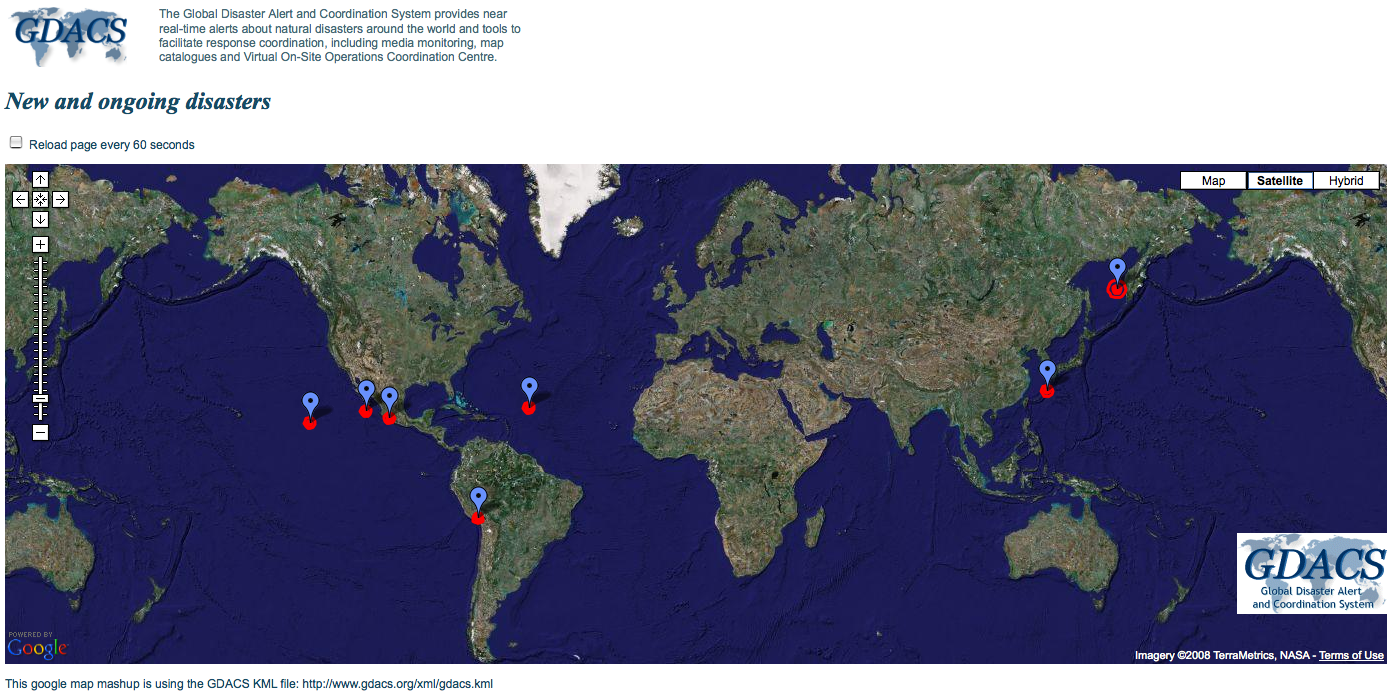
Why the lag? Most likely because the majority of conflict data is not geo-referenced (beyond the country level, or admin 1). We’ve also been more interested in the temporal dimension of conflict forecasting rather than the spatial dimension—even though the latter can reveal important spatial patterns useful for  temporal forecasting. In any case, the disaster community continues to be in the lead vis-a-vis crisis mapping. Of course, they have the advantage of drawing on a wide network of physical sensors around the world to monitor spatially and in real time such hazards as earthquakes, hurricanes, etc. See for example the real-time updated maps by GDACS and Havaria below.

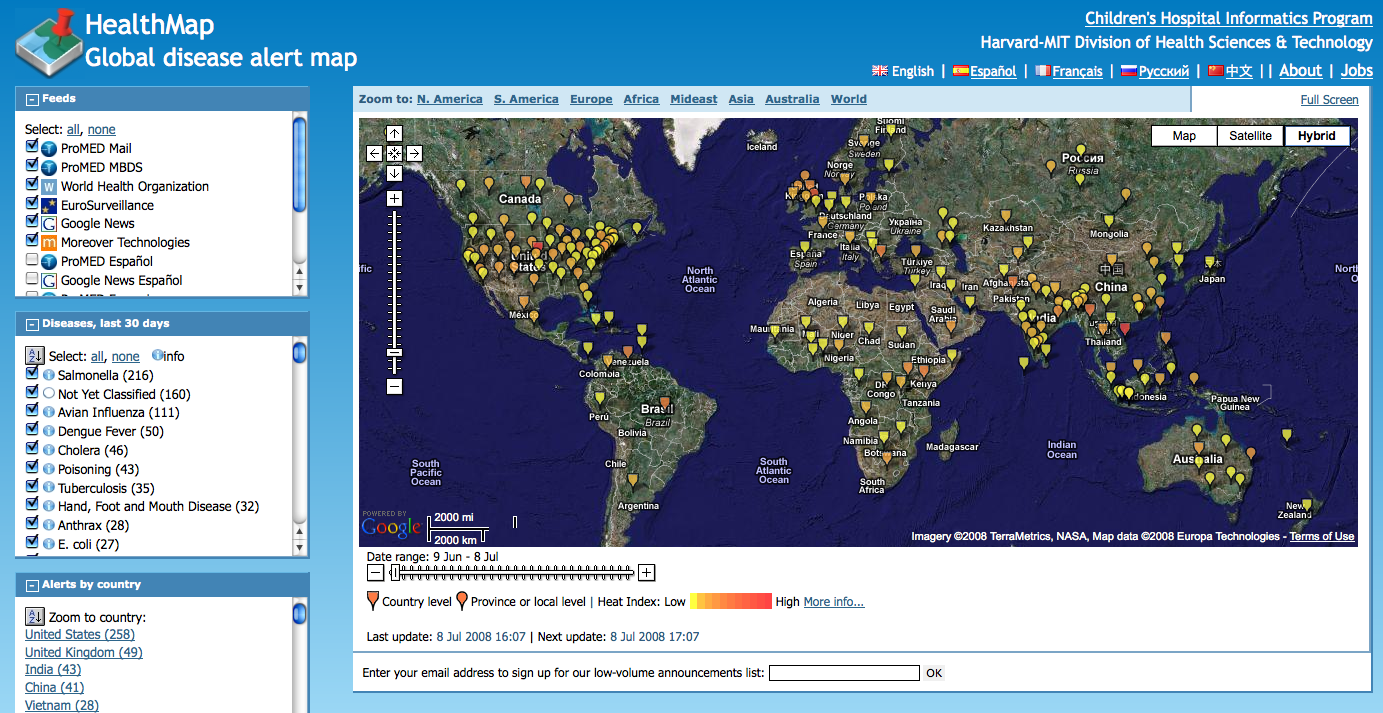
The latest in these developments is HealthMap, which is supported by Google.org’s Predict and Prevent Initiative. As reported by Wired, the underlying algorithm parses text from Google News and the World Health Organization to populate the map.

But that’s not all, the algorithm also parses discussion groups, filtering the information and boiling it down into mapped data which can be used to track new disease outbreaks.

HealthMap goes beyond the standard mashup and is more like a small-scale implementation of the long-awaited semantic web. […]

In a study published this March in the Journal of the American Medical Informatics Association, the researchers found that their automated classification system was accurate 84 percent of the time. Algorithm improvements have pushed accuracy close to 90 percent now, according to the researchers. […]

Right now, the researchers are focused on adding more sources, particularly in other languages, as well as improving their methodologies.

Freifeld and Brownstein are looking into using more social media sources, but they’ve encountered a problem that most internet users are already familiar with: There’s too much noise.

“We have certainly explored looking at more free and noisier sources like blogs and things like Twitter,” Freifeld said. “But they pose the problem of capturing a good quality signature from all that stuff.”

Is the conflict early warning/response field likely to follow suite?

Back in 2006, Google.org head Larry Brilliant told Wired.com about his vision for a service that looks a lot like HealthMap.

“I envision a kid (in Africa) getting online and finding that there is an outbreak of cholera down the street. I envision someone in Cambodia finding out that there is leprosy across the street,” Brilliant said.

Healthmap is not quite there yet vis-a-vis spatial resolution but the question is whether a similar platform for (micro) conflict monitoring would bridge the warning-response gap if it could be operationalized?

Patrick Philippe Meier

Crisis Mapping DRC

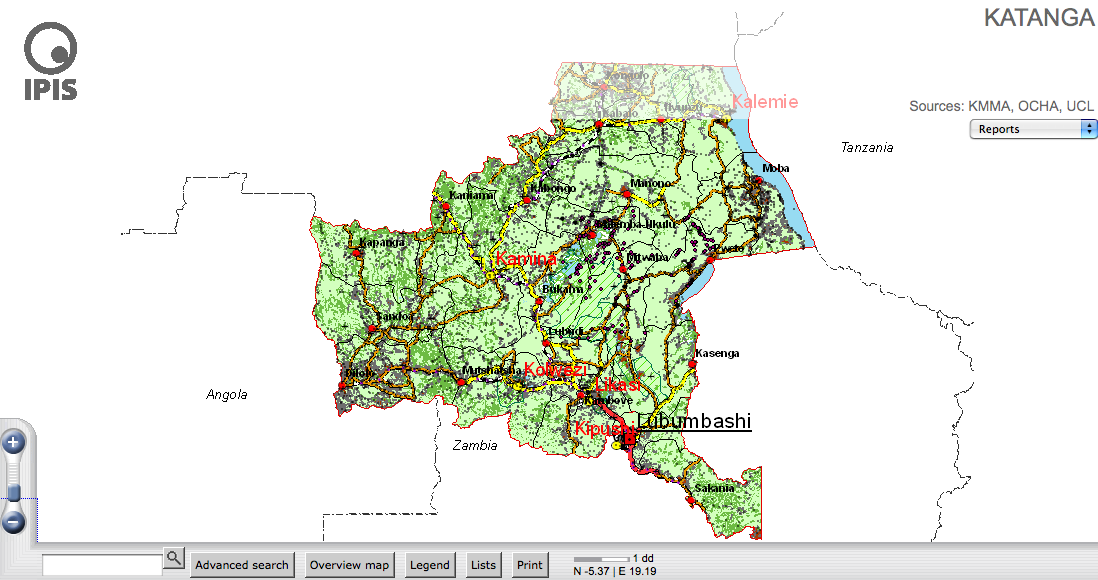
The International Peace Information Service (IPIS) provides another interesting approach to crisis mapping:

Mapping interests in conflict areas: Katanga reports on the presence of (ex-) combatants in the Congolese province of Katanga, in other words, the armed men who participated in the consecutive Congo wars. It tries to answer the questions who they are, where they are quartered, why they are quartered there and what should be done to prevent them from causing security problems. It relates to the situation in March-April-May 2007 and focuses on two conflicting parties: the “Forces Armées de la République Démocratique du Congo” (FARDC) and the Mayi-Mayi militias.

  • You can change the level of detail on the maps by zooming in or out. The maps are available at three different scales: 1:7,500,000 (initial view), 1:3,000,000 and 1:1,000,000. To zoom in or out, move the scroll slide (in the bottom left corner) up or down, or just move the mouse wheel up or down. For clarity reasons some map elements are hidden while viewing at a large scale but revealed after zooming in.
  • You can easily navigate through the map by dragging it with the mouse pointer. After a double click, the clicked-on position is displayed in the centre of the map.
  • The maps feature an advanced geographical search function that locates strings of characters.
  • When clicking the ‘Overview’ button a useful overview map appears in an extra window at the top left corner of the screen .
  • A legend is provided for each map.
  • You can search thematically for data by clicking the ‘Lists’ button. The map will centre on the requested map element and automatically a table will appear with additional information on the map element.
  • The same additional information on map elements can be retrieved by clicking on the item directly on the map itself (the arrow of your mouse cursor should change in a hand first).
  • Can blogging about culture and non-political issues invite more credibility for bloggers? Cultural issues are not a threat to governments, this could be an entry point.

Patrick Philippe Meier

Crisis Mapping Analytics and Pattern Recognition

Traditional conflict analysis indicators have ranged from low per capita GNI and ethnic diversity to high youth unemployment and restricted political rights. These indicators are generally drawn from government statistics, which are rarely updated more than once a year. This national-level data is useful for understanding “why, when and how conflict originate,” but the data is actually “less useful in explaining or predicting when or how violent interactions will occur…” (1).

In other words, recognizing patterns in structural data is inherently difficult since the aggregate nature of such data means that intra-annual and sub-national data variation is particularly muted. In sum, one cannot solely rely on the statistics produced by leading international development agencies to monitor potential for conflict escalation.

Location, location, location. The purpose of crisis mapping is to shift away from structural and tabular conflict analysis towards more dynamic, real-time and geo-referenced modeling. Think of Serious Gaming such as “A Force More Powerful” or “Food Force” only with real spatial data on real actors and in quasi-real time—a.k.a. reality mining.

Reality Mining” is a relatively new concept pioneered by MIT.

[The term] defines the collection of machine-sensed environmental data pertaining to human social behavior. This new paradigm of data mining makes possible the modeling of conversation context, proximity sensing, and temporospatial location throughout large communities of individuals. Mobile phones (and similarly innocuous devices) are used for data collection, opening social network analysis to new methods of empirical stochastic modeling.

This approach facilitates in-situ pattern recognition and simulation by capturing “the view from below,” which means we need to rethink what constitutes an indicator since the underlying data sets required are not readily available. However, the recent study, “Tracking Genocide using Remote Sensing,” shows the untapped potential of remote sensing technology and data to identify patterns in humanitarian crises.

An analogy worth noting here is the field of earthquake physics. Geophysicists have long struggled to predict the place and time of major earthquakes by drawing on seismic data, rock composition and fault lines. A few weeks ago, however, NASA scientists revealed that they could be on the verge of a break through in their efforts to forecast conflict.

Researchers say they have found a close link between electrical disturbances on the edge of our atmosphere and impending quakes on the ground below. Just such a signal was spotted in the days leading up to the recent devastating event in China.

Of course, human behavior and social systems are also highly complex systems. But we are creatures of habit and conditioned by social norms, or patterns. Tactics employed by perpetrators are none other than patterns. If violence is organized, there is pattern. Just this month, the journal Nature published findings from a research project that drew on mobile phone data from 100,000 individuals in a European country “and found that most follow very predictable routines. Knowing those routines means that you can set probabilities for them, and track how they change” (2).

Clearly, accessing mobile phone data in conflict zones is not presently feasible, and may not be for a while. However, location-aware social networking technology may provide new data not heretofore available. Remote sensing and GIS data may also capture proxy indicators that reveal underlying patterns and their associated probabilities in future conflict situations. The point is that as new consumer-based location-aware information communication technologies become more widespread, new data sets may become available. Besides, as the Tracking Genocide study evidently shows, geo-referenced, time-stamped data sets already exists.

Making sense of this data is admittedly no small feat. But initiatives such as Sense Networks, a new software company in New York, is seeking to do just that. The company recently released Macrosense, “a tool that applies complex statistical algorithms to sift through the growing heaps of data about location and to make predictions or recommendations on various questions…” (3). We’re note quite there yet vis-a-vis conflict analysis, but the concept of crisis mapping is becoming increasingly talked about in the humanitarian technology community. Crisis mapping is also gaining donor attention, as evidenced by the momentum behind Ushahidi.

The new field of Crisis Mapping Analytics (CMA) is in its infancy and requires a strong academic base, such as Harvard University, to serve as an incubator. Ultimately, the success of CMA resides on whether or not this methodology is more effective in galvanizing early and effective response, both top-town and bottom-up. Moreover, prediction alone will rarely ensure effective response. Just like disaster management in the case of earthquakes, preparedness and contingency planning at the local level will continue to be key for crisis response to save lives.

Patrick Philippe Meier

iPhone + UAVs + Crisis Response

The year I spent at the University of California at Berkeley was one of the best times of my life. So I’m thrilled that this project, reported by Wired, was made in the Berkeley Republic. In fact, I’m not at all surprised that Cal students are behind the initiative since it completely violates the terms of the Apple Software Developer Kit agreement, “applications may not be designed or marketed for real-time route guidance; automatic or autonomous control of vehicles, aircraft, or other mechanical devices; dispatch or fleet management; or emergency or life-saving purposes.”

As the title suggests, the Berkeley project enables an individual to remotely control the flight trajectory of a UAV and to take pictures all from the iPhone interface. The video below is definitely worth watching. See my other blog here on the use of UAVs for conflict early warning and response.

Still on the subject of the iPhone is the question whether of whether or not the next generation iPhone is suitable for emergency management. Gav’s blog kicked off a conversation that continued on the Humanitarian ICT list serve where several colleagues chimed in with some of the iPhone’s advantages and disadvantages. One of the concerns echoed repeatedly stems from the issue regarding Apple’s terms of agreement. However, as the Berkeley students have demonstrated, some may get away with crossing Steve Jobs. In any case, of particular interest to me are the location-aware social networking applications being developed for the iPhone SDK such as Loopt, which lets you see whether your contacts are in the vicinity.

Patrick Philippe Meier

Crisis Mapping Zimbabwe

As a doctoral research fellow with the Harvard Humanitarian Initiative (HHI), Jennifer Leaning and I are pursuing applied research on crisis mapping to identify innovative approaches that can be scaled up to maximize impact. The following initiatives are two projects of potential interest.

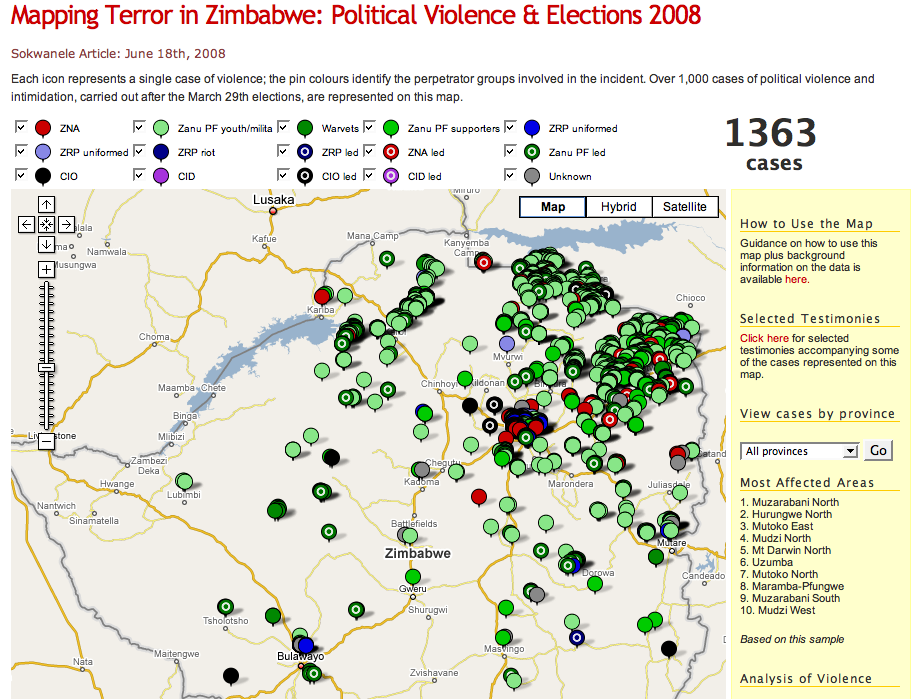
Sokwanele follows in the footsteps of Ushahidi in providing a web-based interface to map election-related violence in Zimbabwe. The design is simple and self-explanatory. Each incident is associated with the identity of the perpetrating party, e.g., Zanu youth.

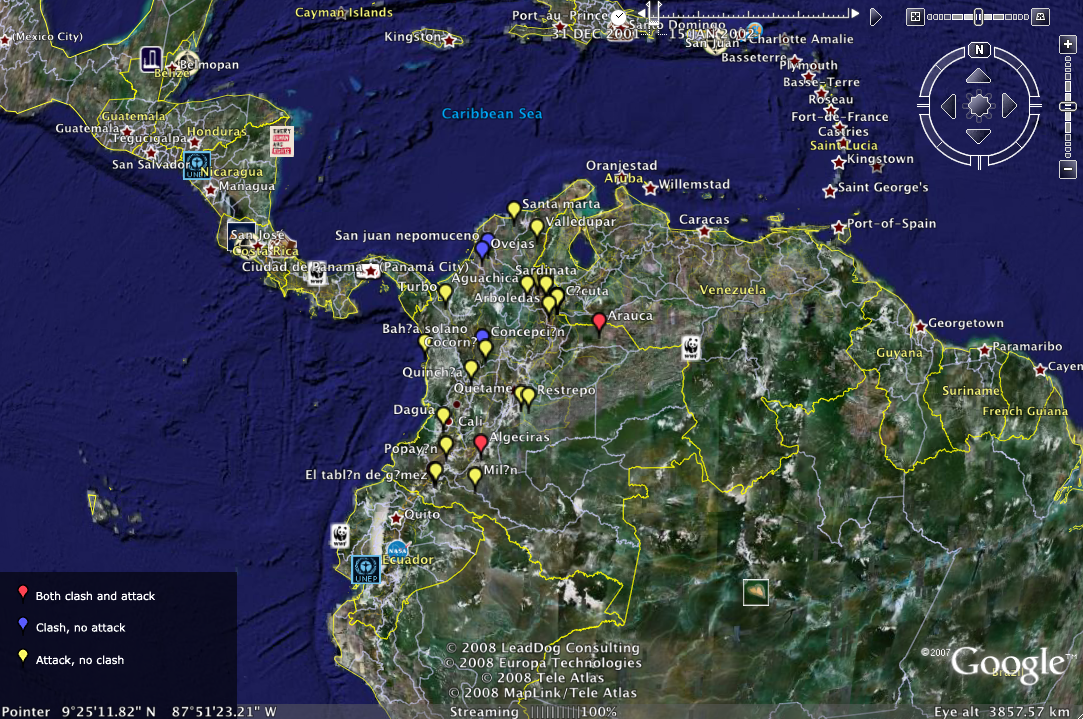
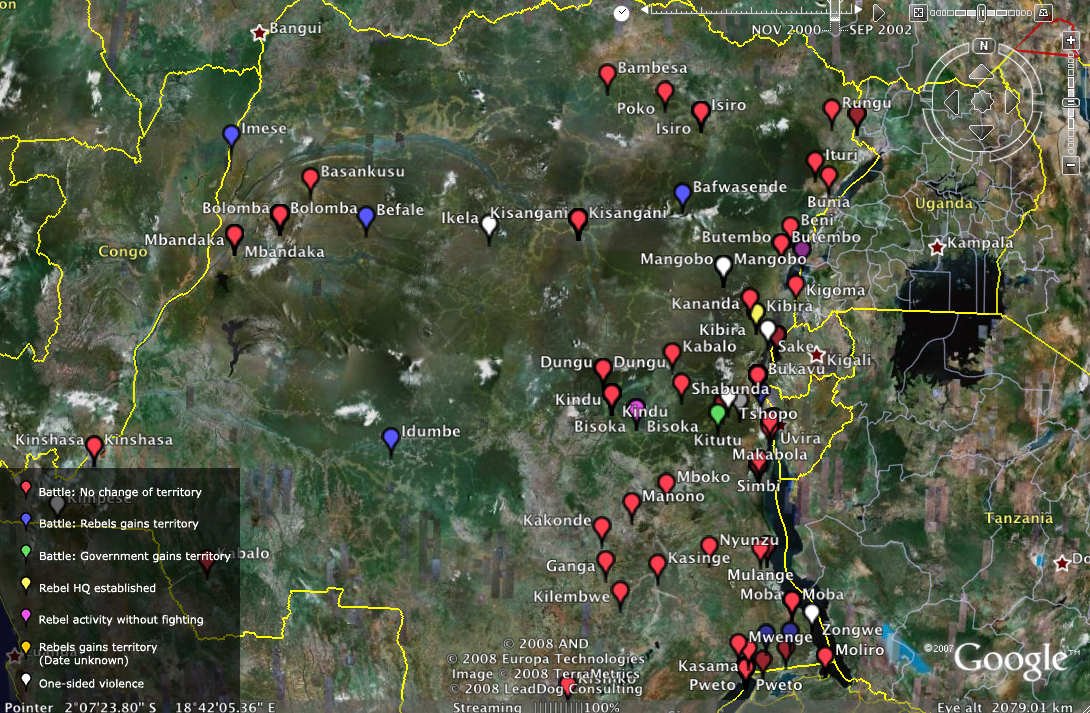
It would be particularly useful to have a time-animation functionality in order to depict any patterns in the spread of the violence as this could reveal tactics of perpetrators. A colleague and I created crisis maps for Colombia and the DRC back in July 2007 using Google Earth (KML). We added the time-bar functionality and visualized the data over time, immediately taking note of distinct patterns. The underlying conflict data was drawn from the Conflict Analysis Resource Center (CERAC) in Bogota and from the Peace Research Institute, Oslo (PRIO) respectively, both of which I have been affiliated with as a researcher. Clicking on the pictures below will provide you with a full-screen shot of the interface.

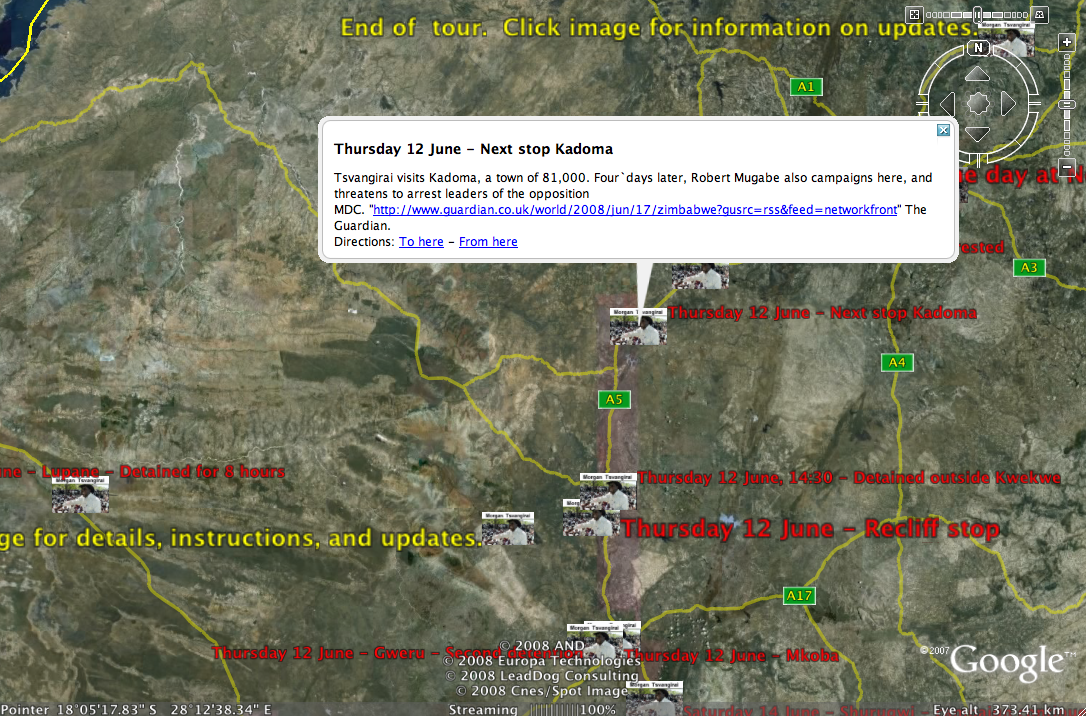
Another crisis map of Zimbabwe depicts Morgan Tsvangirai’s campaign “with information on campaign stops, detentions by police, vehicle impoundments, and references to all information from on-line news sources.” The Google Earth KML file is regularly updated.

The question that remains for me is what methods can be used to measure the impact these projects are having?

Patrick Philippe Meier

China, Olympics and Satellite Imagery

Will international attention on the Beijing Olympics impact the government’s policy on censorship? Some argue that the Olympics create a unique window of opportunity for digital activists while others maintain that Beijing’s grip on information communication is more effective than ever. The recent 2008 study, Access Denied: The Practice and Policy of Global Internet Filtering, states that “China institutes by far the most extensive filtering regime in the world, with blocking occurring at multiple levels of the network and spanning a wide range of topics.” Little surprise then that neither Chinese Google Maps nor Microsoft’s Chinese Virtual Earth include high resolution satellite imagery of China.

I was therefore amused to learn from Stefan Geens that China’s national broadcasting television (CCTV) is inadvertently providing full access to high-resolution satellite imagery of China via a website that maps the location of football stadiums for Euro 2008.

As Stefan concludes:

Once you’re zoomed in on an Austrian stadium, there is nothing keeping you from heading on over to China and zooming in on your house or keeping tabs on the People’s Army.

In other words, the Chinese state’s own broadcasting organization thinks that the state-mandated censorship of maps is useless and in need of circumventing. This example also illustrates the ease with which such circumventing can be achieved, and the long-term futility of restricting access to mapping tools from behind the Chinese firewall.

I’m waiting to hear back from a colleague based in China to find out whether the map is still fully accessible within the country.

Patrick Philippe Meier

Tracking Genocide by Remote Sensing

The Remote Sensing Project at Yale University’s Genocide Studies Program has just released a 50-page Working Paper entitled “Tracking the Genocide in Darfur: Population Displacement as Recorded by Remote Sensing.” The Project also has studies on Timor-Leste and Rwanda. The Darfur report uses satellite imagery of vegetation from 1998 through 2007 in the regions of Darfur most impacted by the genocide. The analysis shows that natural vegetation coverage is steadily recovering albeit not as a result of increased rainfall but of,

the abrupt change in land use directly related to the systematic violence committed by Sudanese government and militia forces against the peoples of Darfur. In an agriculture-based society, this vegetation rebound resulted from the loss of livestock and the inability to farm, caused by human displacement and the destruction of subsistence resources from 2003 to 2007.

The Working Paper demonstrates that a direct correlation exists between the displacement of local populations and the looting of livestock, as depicted in the rebound of vegetation coverage and vigor. To be sure, the returning vegetation is not a result of intensified agrarian activities but of depopulation.

The research also shows that,

it is possible to study the influences of climate and land use on a fragile environment using remote sensing applications. For future research into the prevention of genocide, these types of applications can be useful in understanding and quantifying the factors contributing to environmental strains that can cause violence associated with competition for diminishing resources. If preventive measures can be implemented and enforced based on an understanding of these factors, it might be possible to avoid acts of genocide.

This was in fact the underlying motivation behind my work on the Horn of Africa’s Conflict Early Warning and Response Network (CEWARN), which monitors cross-border pastoral conflict. Recognizing that tracking political, economic and social factors was insufficient for conflict early warning, I turned to the regional organization’s Climate Prediction and Applications Center (ICPAC) for GIS data on vegetation, forage and rainfall; the assumption being that environmental factors influence pastoral conflict and therefore could potentially serve as early warning indicators.

Preliminary statistical analyses of the data suggest that aggravating behavior, along with a reduction in peace initiatives and reciprocal exchanges, is associated with an escalation in pastoral conflict, particularly when coupled with an increase in vegetation that may provide cover for organized raids. We therefore recommend that conflict early warning systems integrate both response options and salient environmental indicators into their analyses to better deal with the complexity of the relationships between pastoral conflict and the environment in an era of climate change.

The results of my study were recently published in the Journal of Political Geography:

P. Meier et al. (2007). “Environmental Influences on Pastoral Conflict in the Horn of Africa,” Journal of Political Geography, 26:716-735.

One lesson to be drawn from the Yale study in terms of crisis mapping and prevention of mass atrocities is that we should redouble our efforts to pursue a more systematic and rigorous research agenda that focuses explicitly on multi-modal pattern analysis of proxy indicators.

Patrick Philippe Meier