Category Archives: Digital Activism

Social Web: Digital Methods for the Study of Protest Content

Richard Rogers gave what I thought was the most interesting talk of the conference on the social web and networked political protests thus far. Richard is particularly interested in “web epistemology” and asks whether the transfer (or application) of social scientific methods to the online environment dilutes the value of the ensuing findings? Owing to the problem of exhaustiveness, findings may become “indicators” as opposed to “grounded theory.”

picture-11

So what methods exist for the study of online protest content? How do we study links, websites, search engines and social networking sites.

  • Links can be studied using hypertext theory; small worlds; paths; and social networks. When we browse online we collect digital information from link to link thereby authoring a story, we leave a digital trace, a narrative that can be studied.
  • Websites can be studied by assessing usability; eye tracking heat maps; site optimization. Increasingly, browsing has led to searching. For example, Google once used to have a directory on it’s home page. No longer.
  • Search Engines can be studied as dark web matter since no search engine is able to connect to the entire world wide web. Users are looking at fewer and fewer results displayed by search engines. In fact, studies suggest we very rarely look beyond the first 20 results of an online search. One can also capture and study results generated by search engines. Such research shows both the stability and volatility of the web.
  • Social networking sites can be studied by focusing on characteristics of profiles, which have become what one might call “post-demographics”. Richard used the ElFriendo.com website to display the profile characteristics of “friends” of Obama and McCain. These characteristics tend to cluster, with Obama friends sharing the same favorite movies and TV shows, for example; and McCain friends sharing interests that have little overlap with those of Obama friends.

In conclusion, Richard asks whether virtual worlds are really that virtual as they increasingly import and reflect characteristics from the offline world? Should we continue using the term virtual world? I’m really eager to read up on Richard’s excellent research.

Patrick Philippe Meier

Social Web: Ideological Orientation and Online Strategies

More from the conference on the social web and networked political protests.

Ralf Lindner gave an interesting presentation on “Models of Democracy and Internet-based Communication: How Ideological Orientations Shape Online-Strategies of Parties and Interest Groups.” Ralf builds on previous qualitative empirical analysis of internet-based  communication strategies of eight Canadian intermediary organizations. His research demonstrates that online-communication patterns in terms of campaign styles largely correlate with the political actors’ basic ideological orientations, operationalised by the fundamental democratic visions championed by these organisations.

In other words, ideological orientations are an important factor in the processes of adopting communication technologies for the purposes of political communication. While Ralf’s case study focuses on Canada, I think  the recent US presidential elections demonstrated the same tendencies.

Patrick Philippe Meier

Social Web: An Empirical Analysis of Networked Political Protests

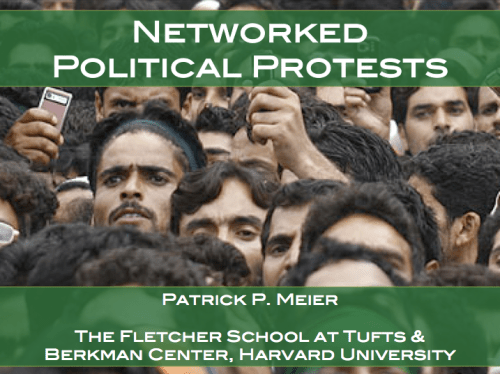
I kicked off the first panel presentation of the conference on the social web and networked political protests by introducing the preliminary quantitative findings of my dissertation research. The question I ask in the first part of my dissertation is whether the rapid diffusion of information communication technology has had any statistically significant impact on anti-government protests in countries under repressive rule? Or do authoritarian regimes maintain the upper hand? My  research was funded by Harvard University’s Berkman Center’s and my presentation is available on Slideshare.
picture-2

While there are many qualitative case studies out there and numerous anecdotes, the question that motivates my interest in this research is whether all these instances of digital activism actually add up to anything.  For example, DigiActive systematically documents instances of digital activism around the world, sharing best practices and lessons learned. But few studies (if any) seek to quantify the impact of the information revolution on state-society relations in repressive contexts.

Berkman Center fellow Victoria Stodden and I recently carried out a large-N quantitative study on the impact of ICT diffusion on World Bank measures of democracy and governance. While we drew on data from 180 countries, we also took a subset of these countries, namely autocracies, and tested whether an increase in Interent access and mobile phones had any impact on one indicator in particularly, political stability. We found that both variables, Internet and mobile phones, were statistically significant, and negative, with the mobile phones coefficent being larger the Internet coefficient. This would suggest that mobile phones have more of a disruptive impact on repressive regimes.

One question that naturally follows is what form that immediate instability takes? Does the rapid diffusion of communication tools facilitate the organization, mobilization and coordination of anti-government protests, which then contributes to political instability? I decided to find out whether new communication technologies do lead to more frequent protests. Please see the Slideshare presentation for specifics on the regression analysis (thanks to Dr. Stodden and Dr. Woodard for their assistance on the quantitative analysis). As my research is still ongoing and my findings preliminary, I hesitate to make any definite conclusions. With this caveate in mind, here are the tentative results.
picture-3

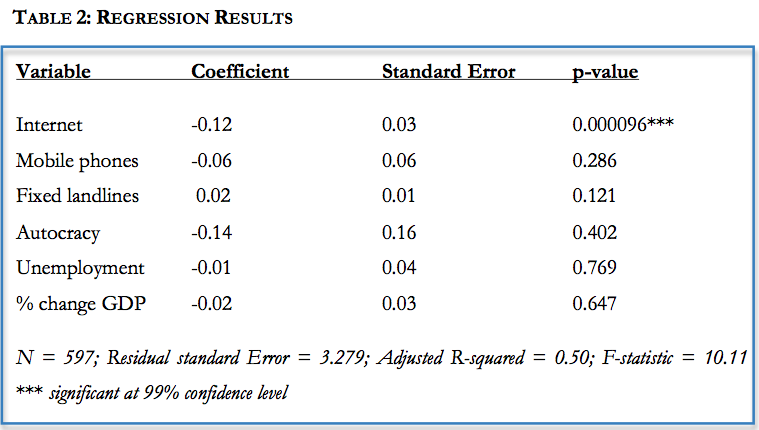
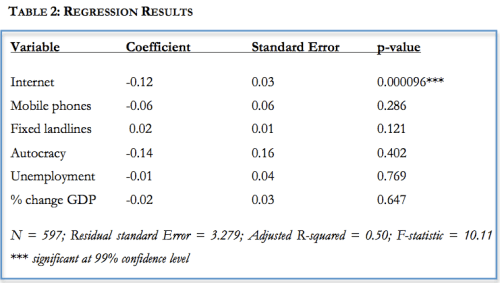
Somewhat surprisingly, the results suggest that an increase in the number of Internet users in countries under repressive rule leads to a decrease in the number of protests. Perhaps even more surprising is the fact that mobile phones turned out to have no statistically significant impact on the frequency of protests. The reason I find these findings surprising is that Internet access in repressive environments is extremely limited compared to mobile phones.
picture-4

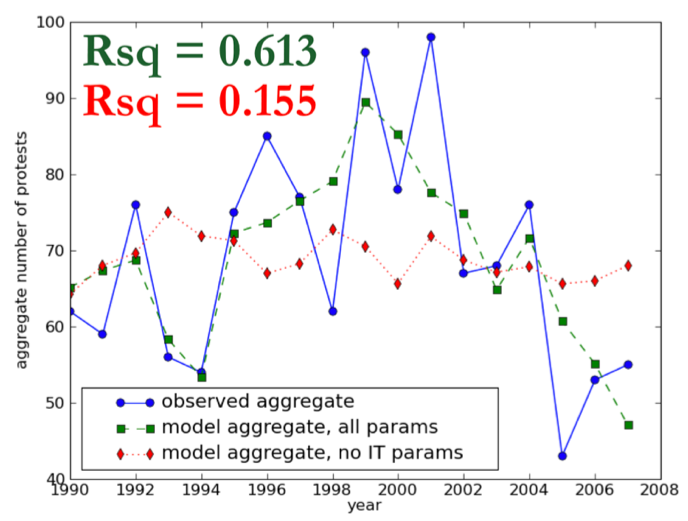
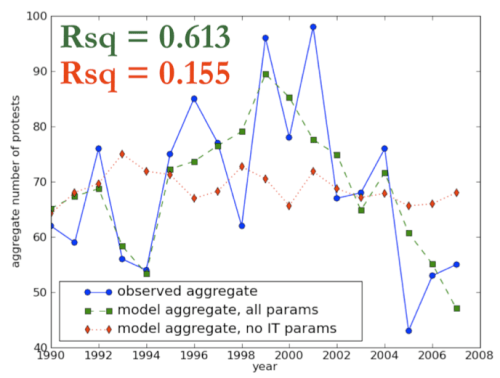
The above results are equally surprising. The blue curve is a time series of observed political protests. The green curve is my complete model which includes ICT independent variables as well as my political and economic control variables. The red curve represents the model without the ICT variables. The large difference between the two adjusted R squared figures is rather striking, not to mention that an R squared of 0.613 seems rather high.

In sum, I’m rather skeptical about these results and specifically asked my fellow participants for their feedback. One colleague rightly mentioned that frequency of protests does not provide information on the magnitude of protests—an issue I noted in my dissertation proposal. The same colleague recommended that I include literacy rates as a control variable while Professor Dieter Rucht expressed his concern about the quality of the protest dataset I am drawing on.

The dataset was developed using automated natural language parsing of Reuters news wires. Although Professor Rucht mistakenly assumed that I am using the KEDS dataset, his remarks on the nature of media reporting still hold. There is a considerable amount of literature out there on media bias, which I have reviewed for my dissertation research, and which Professor Rucht echoed. In particular, he is concerned that as Reuters opens new offices in a particular country, this might lead to “over reporting” of protest events compared to other countries. Interestingly enough, however, the frequency of protests in the 22 countries I analyzed goes down with time.

In any case, these kinds of concerns are precisely why my dissertation takes a nested analysis approach, or a mixed method approach. The first part of my research seeks to carry out a large-N quantitative study while the second part entails field based research to carry out qualitative comparative case studies on the impact of ICTs in repressive environments. Whether qualitative findings support my quantitative ones remains to be seen. In the meantime, I plan on running additional regressions and models to double-check my findings.

Patrick Philippe Meier

Social Web: Towards Networked Political Protests – Keynote

I’m in Frankfurt, Germany for two days to participate in a conference on networked political protests hosted by the University of Siegen (agenda in PDF). The conference is taking place in the new Artur-Woll-Haus, one of Germany’s most energy efficient buildings which also draws on a unique architectural style from the 1920s that shies away from straightlines. In fact, Artur-Woll-Haus from the inside looks distinctly like three sea-farring ships turned upside down.

Really neat!

img_0009

Professor Dieter Rucht gave the Keynote address on “Protest Mobilization in the Age of Social Web” which was an excellent, sceptical overview of the current state of the debate between proponents of Web 2.0 and skeptics. Professor Rucht is Germany’s leading scholar on the topic and his current research seeks to assess the web’s relevance with respect to progressive social movements, particularly in terms of increasing political education, empowering citizens and furthering the process of democratization.

He criticized our field’s tendency to focus only on “stunning success stories” which create high (and arguably at times) unfounded expectations. These success stories are the exception, not the rule. Professor Ruch reminds us that the Internet serves progressive groups as well as their opponents, with the latter becoming increasingly sophisticated in their technical abilities.

picture-1

While I largely agreed with most of what Professor Rucht had to say, some of his comments did surprise me. For example, he argued that the Internet hardly serves to mobilize new constituents. I find that hard to believe. Even more surprising was his comment on the Obama campaign, which he argued was not a social movement. Professor Rucht maintains that the campaign strategy was centrally controlled and orchestrated by a small group of individuals who simply happened to be awash with vast sums of money. What Professor Rucht fails to recognize, however, is that the only way the Obama campaign was able to tap into so much money was precisely because it created an effective social movement!

Another comment that through me off has to do with his take on mass mobilization in the past compared to present day. “Mass mobilization was also effecient before the era of the Internet. To be sure, the Internet is not a necessary condition for mass protests, it is simply a facilitator.” I basically agree with the second part of his statement but take issue with the first, particularly because Professor Rucht does not even define what he means by efficient. Does he mean efficient in terms of cost and time? Efficient relative to the tools of the time? Making sweeping statements is fine to provoke discussion, but at least we should take care to cleary define our terms!

In any case, I do agree with the general gist of Professor Rucht’s keynote address and while I don’t share the extent of his skepticism, I find it healthy. It is true that the Internet cannot replace physical protests in the streets. What is less evident to me, however, is whether Professor Rucht is correct in claiming that the rise of the social web and networked political protests is not changing the existing constellation of political power between large and small groups.

Patrick Philippe Meier

Tactical Tech: Maps for Advocacy

Tactical Tech recently released it’s Maps for Advocacy guide, which is a must-read for those new to the field of crisis mapping. The guide is an excellent collection of user scenarios and mini case studies that span a diverse range of fields and technologies.

My main concern with Tactical Tech’s research on mapping for advocacy has to do with impact evaluation, or lack thereof. It’s one thing to describe a crisis mapping project, the tools involved and purpose, but it’s quite another to evaluate whether the project had any impact, whether it’s replicable and/or why it may not have been effective.

Crisis mapping is a new field with projects proliferating in multiple directions. But there are few feedback loops in place that enable us to learn from any impact these projects may have had. Anecdotal evidence is a start, but hardly sufficient to build a case for crisis mapping and advocacy.

Patrick Philippe Meier

Tactical Tech’s new Mobile-in-a-Box

One of the self-organized sessions I attended at MobileActive ’08 was led by Tactical Tech. The session introduced the group’s new toolkit, Mobiles in-a-box: Tools and Tactics for Mobile Advocacy. The kit is a “collection of tools, tactics, how-to guides and case studies designed to inspire advocacy organisations and present possibilities for the use of mobile telephony in their work.”

Given my dissertation research on the tactical uses of technology by repressive regimes and resistance movements, I was very much looking forward to reading through the tool kit on my way back to Boston. Tactical Tech’s work also overlaps with my interest in strategic nonviolence and digital activism, two topics that I have given presentations and lectures on over the years.

Not surprisingly, most of the toolkit’s points on security issues are identical to some of the lessons learned in the field of conflict early warning and humanitarian response. One point of contention, however, is that according Mike Grenville, it is not sufficient to simply turn off a mobile phone to prevent the device’s location from being tracked, one must also remove the phone’s batteries. The toolkit does not make this suggestion even though the guide does cite Mike’s work. I wonder who’s right, anyone know?

Perhaps the most interesting piece of information I learned by reading the toolkit is the following:

Each image that you make [sic] on your phone automatically contains details of the location, along with details of the date, time adn type of camera or phone used; this is part of the JPG standard, teh file format most commonly used for digital images. […] Tools are available which enable this ‘hidden’ information to be viewed and, in most cases, stripped out before the image is forwarded […]. You can download a freeware tool called JPEG stripper which will remove the ‘metadata’ from your images.

The kit is without doubt an important contribution to the field and serves as a valuable resource to new activists interested in using mobile phones for advocacy. The key word here being “new”. What is really missing is a strong link with the advanced tactics and scenarios developed within the field of nonviolent action and associated lessons learned. While I have written about this before, I am repeatedly struck by the (particularly unhelpful) gulf that exists between the fields of digital activism and strategic nonviolence, which is one of the main reasons why I joined DigiActive.

It is important that the community of digital activists spend some serious time learning about the field and practice of strategic nonviolence. This means reading the literature, understanding historical and contemporary case studies, participating in nonviolent action trainings and meeting counterparts engaged in strategic nonviolence. Fear not, I’m telling my colleagues in the strategic nonviolence field the same thing about digital activists. But what we need is to cross-fertilize expertise in both fields is to organize a two-day workshop that brings both communities together to discuss tactics, tactics and tactics.

I will do my best to make this happen in 2009. However, this will only work via partnerships and collaboration. DigiActive already has links with the International Center on Nonviolent Conflict (ICNC). Perhaps Tactical Tech and Digital Democracy might want to contribute their expertise?

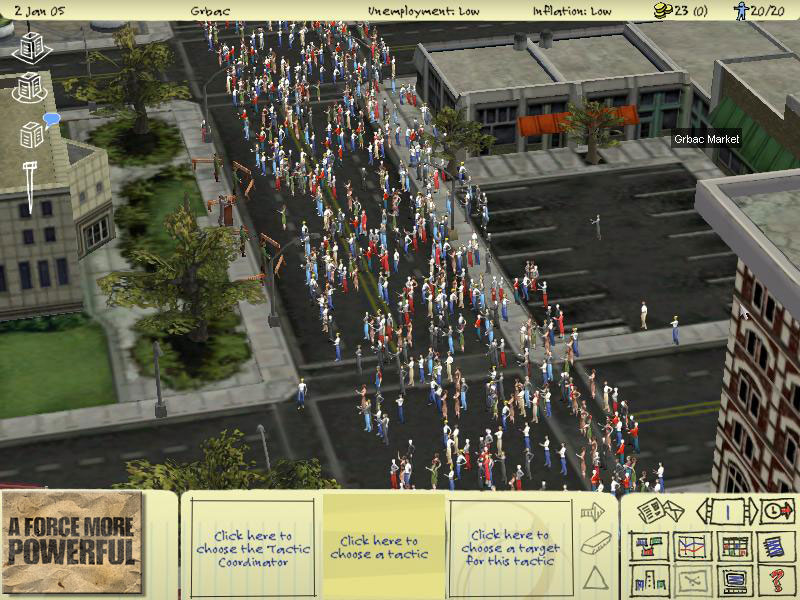
In the meantime, I’d like to recommend that my colleagues in the field of digital activism and tactical technology start playing “A Force More Powerful.”

Patrick Philippe Meier

Tactical Tech’s new Mobile-in-a-Box

One of the self-organized sessions I attended at MobileActive ’08 was led by Tactical Tech. The session introduced the group’s new toolkit, Mobiles in-a-box: Tools and Tactics for Mobile Advocacy. The kit is a “collection of tools, tactics, how-to guides and case studies designed to inspire advocacy organisations and present possibilities for the use of mobile telephony in their work.”

Given my dissertation research on the tactical uses of technology by repressive regimes and resistance movements, I was very much looking forward to reading through the tool kit on my way back to Boston. Tactical Tech’s work also overlaps with my interest in strategic nonviolence and digital activism, two topics that I have given presentations and lectures on over the years.

Not surprisingly, most of the toolkit’s points on security issues are identical to some of the lessons learned in the field of conflict early warning and humanitarian response. One point of contention, however, is that according Mike Grenville, it is not sufficient to simply turn off a mobile phone to prevent the device’s location from being tracked, one must also remove the phone’s batteries. The toolkit does not make this suggestion even though the guide does cite Mike’s work. I wonder who’s right, anyone know?

Perhaps the most interesting piece of information I learned by reading the toolkit is the following:

Each image that you make [sic] on your phone automatically contains details of the location, along with details of the date, time adn type of camera or phone used; this is part of the JPG standard, teh file format most commonly used for digital images. […] Tools are available which enable this ‘hidden’ information to be viewed and, in most cases, stripped out before the image is forwarded […]. You can download a freeware tool called JPEG stripper which will remove the ‘metadata’ from your images.

The kit is without doubt an important contribution to the field and serves as a valuable resource to new activists interested in using mobile phones for advocacy. The key word here being “new”. What is really missing is a strong link with the advanced tactics and scenarios developed within the field of nonviolent action and associated lessons learned. While I have written about this before, I am repeatedly struck by the (particularly unhelpful) gulf that exists between the fields of digital activism and strategic nonviolence, which is one of the main reasons why I joined DigiActive.

It is important that the community of digital activists spend some serious time learning about the field and practice of strategic nonviolence. This means reading the literature, understanding historical and contemporary case studies, participating in nonviolent action trainings and meeting counterparts engaged in strategic nonviolence. Fear not, I’m telling my colleagues in the strategic nonviolence field the same thing about digital activists. But what we need is to cross-fertilize expertise in both fields is to organize a two-day workshop that brings both communities together to discuss tactics, tactics and tactics.

I will do my best to make this happen in 2009. However, this will only work via partnerships and collaboration. DigiActive already has links with the International Center on Nonviolent Conflict (ICNC). Perhaps Tactical Tech and Digital Democracy might want to contribute their expertise?

In the meantime, I’d like to recommend that my colleagues in the field of digital activism and tactical technology start playing “A Force More Powerful.”

Patrick Philippe Meier

Hackers 4 Resistance at Mobile Active ‘08

I attended a rather entertaining session on pirating telephony during the third and final day of Mobile Active ’08. What I took away from this session is the untapped potential of white hat hackers. “White hat” refers to ethical hackers as compared to black hat hackers. I think it’s time that digital activists, human rights activists and those engaged in training resistance groups to use nonviolent tactics around the world work more closely with white hat hackers.

There are a number of quasi-legal hacks that could provide invaluable support to some of the work we’re engaged in, particularly with respect to projects carried out in repressive environments. In an ideal world, we would have a group white hat hackers coming together to form an informal consulting group that some of us could approach with specific projects. If you know of any such group, please do give me a shout!

Patrick Philippe Meier

Digital Democracy at Mobile Active ‘08

Emily Jacobi and Mark Belinsky with Digital Democracy are doing phenomenal work in Burma. Their presentation in Jo’burg provided an overview of their projects in the region.

Some of the most interesting observations they made included the following:

  • Activists within Burma smuggle out pictures taken using their mobile phones using flash drives, so that fellow activists in neighboring countries to upload to the web.
  • There is a correlation between access to the Internet and self-identification as activists.
  • A change in communication policy in Burma is most likely to come from pressures by Chinese businessmen who carry out extensive business (trips) to Burma and who are increasingly frustrated by connectivity issues and cost.


I had the opportunity to hang out with Emily and Mark quite a bit over the three-day conference and I’m really excited by the work they’ve been doing and will begin doing in other countries. They were two of the most interesting new friends I made at MobileActive. I’m eager to follow their work and to explore potential areas for collaboration with DigiActive.

Patrick Philippe Meier

DigiActive at Mobile Active ‘08

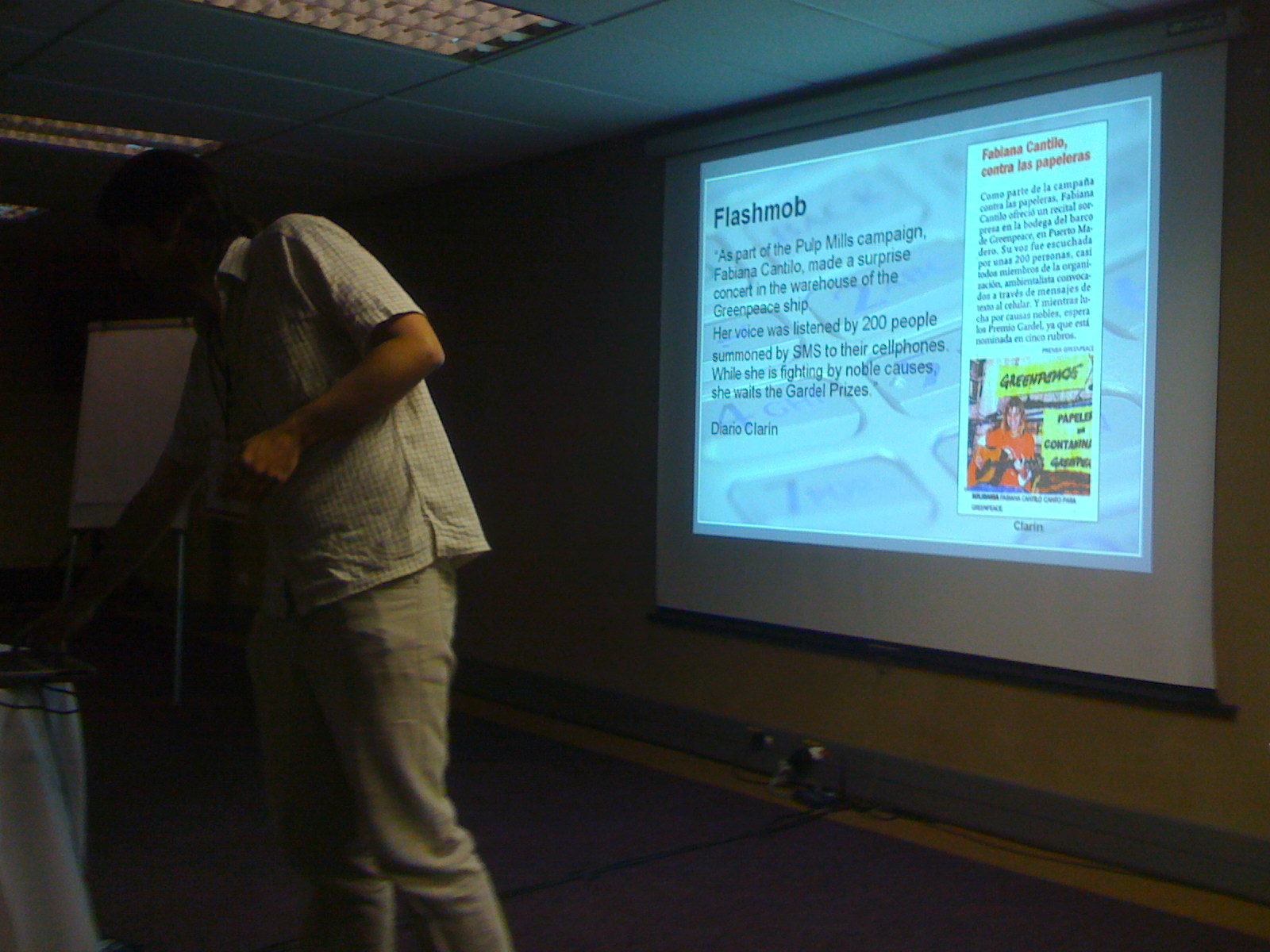
I was very kindly invited by Katrin Verclas to co-lead a workshop on mobile technology for advocacy and activism for Mobile Active 2008. Perhaps the best part about this was meeting and getting to know my fellow co-leader Hernan Nadal and his work with Greenpeace in Argentina. Hernan gave a really interesting presentation on mobile phone facilitated advocacy campaigns he has carried out with Greenpeace. I highly recommend checking out his slides here.

My presentation provided an overview of DigiActive, an all-volunteer group dedicated to empowering grassroots individuals and communities to maximize their political impact using digital technology. The first half of my presentation focused on examples of activists using the following tools in repressive environments:

  • Mobile technology to organize and mobilize protests
  • Camera phones to document human rights abuses
  • Microblogging tools to bridge mobile and cyber activism

The second half of my presentation addressed challenges such as personal security, costs and dissemination. On the latter point, one observation worth keeping in mind is that identifying distributed public spheres in countries with repressive regimes is critical for disseminating information. For example, while much is centralized in repressive environments, the transportation network tends to be more decentralized. These channels are important sources for disseminating and distributing information. For example, taxis in Cuba and long-distance bus drivers in Zimbabwe.

The slides of my presentation, which figured as a feature on Slideshare’s homepage are available here.

Patrick Philippe Meier