Category Archives: Digital Activism

Global Voices Summit: The End-User Perspective

Robert Guerra is particularly interested in the perspective of end-users. Namely, what technologies do people really use? What challenges do they encounter? What recommendations can we formulate? Robert used Cuba as a case study to address these questions.

For Internet access, one needs to go to government-run or mobile-phone company Internet cafes. These are often closed and include physical surveillance. There is only one Internet cafe where registration is not required but the wait is often up to two hours to get a free machine. Access to the Internet is via dial-up, hence very slow. Key tracing and related spy software are on all Internet cafe machines in Cuba. This makes Torbrowser and Psiphon somewhat useless. USB sticks can be used but not all machines may allow for USB access.  For a blog specfically on the use of USBs in Cuba, please click here. The connection in Cuban universities is particularly slow given the small bandwidth and large number of users. Internet access is available at international hotels but at exhorbitant prices. Not only is there technical surveillance, but also very widespread human surveillance.

RSF

Robert’s recommendations include taking a bottom-up approach: consult local users; needs assessment; technical assessment (internet & security issues). Provide skills training and training materials. Monitor and assess sustained use.

The Q & A session included additional recommendations such as the use VPNs and trust building. Some teenagers in Cuba have also set up long distance WIFI to play Internet games but some of these have been shut down and these teenagers are not in the least inclined to blog. Bringing in foreign trainers can put trainees in danger. In my opinion, this is where the field of nonviolent action has alot to offer in terms of providing strategies, lessons learned and best practices on how to manage one’s immediate security environment from a hands-on, operational and tactical perspective. So my recommendation would be for more cross-disciplinary dialogue between activist bloggers, nonviolent movements, technology designers and technology developers.

Patrick Philippe Meier

Global Voices Summit: Torbrowser and Psiphon

Chris Walker works with InterNews Europe and the Tactical Technology Collective. He is also leading the project NGO-in-a-box. He is also a fellow alum of The Fletcher School. Chris gave an overview of Torbrowser and Psiphon.

Torbrowser is also available as an add-on to Firefox. One challenge associated with Torbrowser is that it is a large file to download, although you can download the software in parts. Since there is considerable technical and human surveillance in closed regimes, Torbrowser has been made to look like a regular browser such as Internet Explorer.

Psiphon is a censorship circumvention solution that allows users to access blocked sites in countries where the Internet is censored. psiphon turns a regular home computer into a personal, encrypted server capable of retrieving and displaying web pages anywhere. One advantage of psiphon is that now software needs to be downloaded. YouTube videos can also be uploaded securely.

Patrick Philippe Meier

Global Voices Summit: Tor and Blocking-Resistance

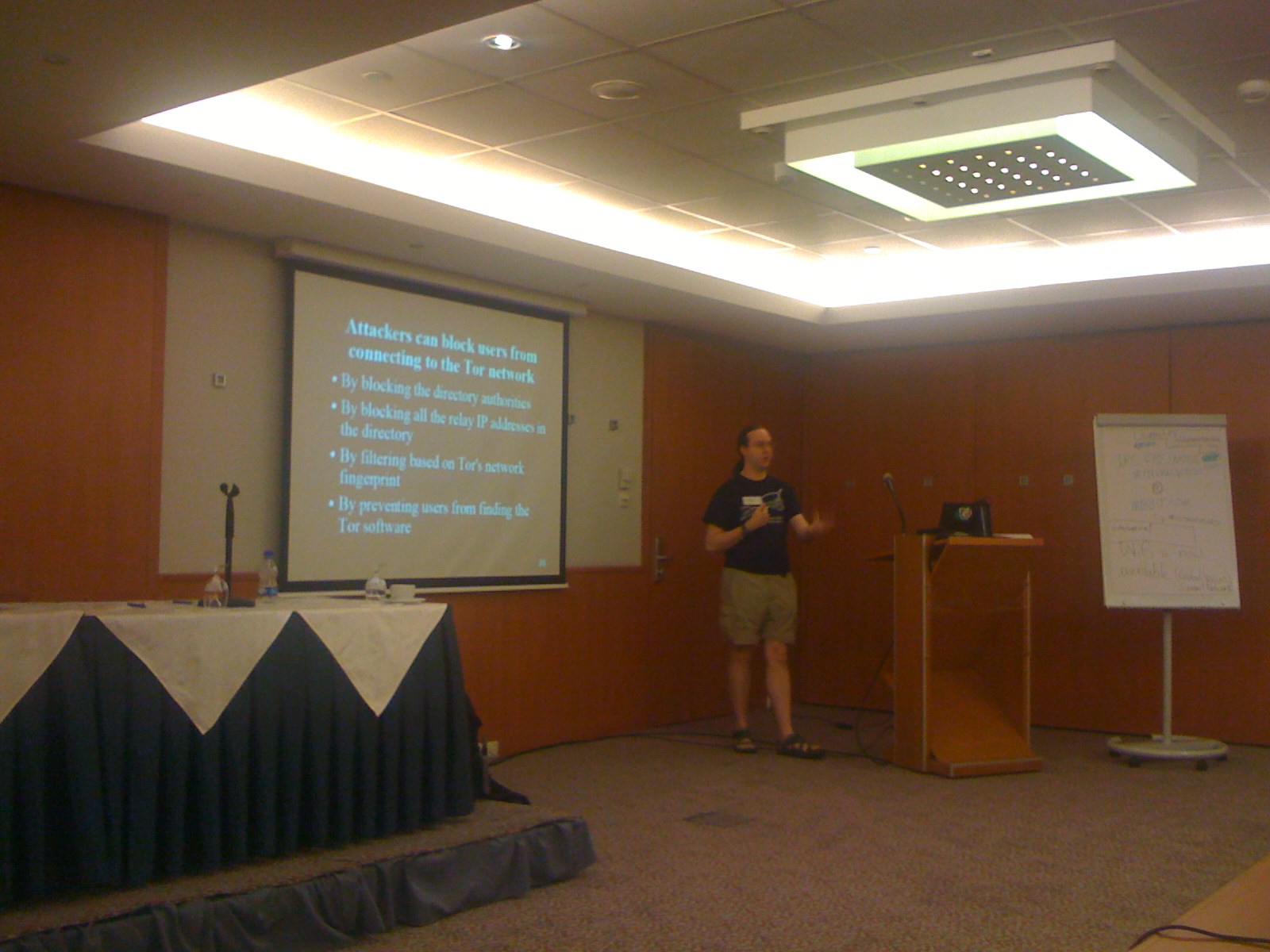
Roger Dingledine gave a presentation on Tor, software that lets a user request and view Web pages without revealing the location of your computer to the site. Tor allows packages to be bounced multiple relays so that no one relay knows who is visiting a particular site. The user establishes time-sensitive encryption keys between each relay. There are two pieces to all these “proxying” schemes. A relay component: building circuits, sending traffic over them, getting the encryption right. A discovery component: learning what relays are available.

Attackers can block users from connecting to the Tor network by, for example, blocking all the relay IP addresses in the Tor directory; by filtering based on Tor’s network fingerprint; by preventing users from finding the Tor software. After six years, the Chinese government finally got around to blocking the TorProject.org website two weeks ago.

Attackers seek to restrict the flow of embarassing and opposing information such as rights violations, corruption, opposition movements, etc. Complete blocking is not the goal of attackers, it’s not even necessary. Similarly, there is no need to shut down or block every circumvention tool. They only need to block ones that are popular and effective (the ones that work), and those that are highly visible.

In designing blocking-resistance software, some important design factors need to be kept in mind. There is little reprisal against passive consumers of information. Procducers and distributors of information are in greater danger. Governments have economic, political, social incentives not to block the whole Internet. But they can tolerate some collateral damage.

At the same time, China’s filtering system is practically maxed out. There is not much more content they can parse and filter. In other words, network firewalls has limited CPU capacity. So it’s possible to blend in. In terms of data security, what is often more useful is tactical security measures, rather than strictly technical security issues. In my opinion, this is where the field of nonviolent action has much to contribute.

Tor gives three anonymity properties:

  1. A local network attacker can’t learn, or influence, your destination.
  2. No single router can link you to your destination.
  3. The destination, or somebody watching it, can’t learn your location.

Tor is highly sustainable, with thousands of volunteers and a completely open source philosophy. The software has an established user base of hundreds of thousands of people around the world. Ordinary citizens, activists, corporations, law enforcement, etc, all use Tor. This diversity of users means that Tor is virtually guaranteed to survive. Anonymity is useful for censorship-resistance as well. Roger likened the race against government surveillance as an arms race, an analogy I’ve also used in my dissertation research.

Patrick Philippe Meier

Global Voices Summit: Detecting Internet Filtering

The leading expert on Internet filtering, Nart Villeneuve, gave the second presentation. He provided an overview on strategies to deal with filtering.

  • Distinguish between errors and actual censorship;
  • https is encrypted, not subject to key word filtering;
  • Test root domain name before testing entire path;
  • Some websites can be blocked because they include an image or other file from a blocked website;
  • in addition to checking website, check IP address; websites often have multiple IP addresses, not all IP addresses may be blocked; sub-domain names can also have different IP addresses;
  • Some blocked websites are not blocked when you remove the www prefix;
  • For DNS tampering, you can use a remote DNS server such as opendns.com;
  • If an IP address is blocked, which is easily done, checking for this can be done using http://tracetp.sourceforge.net;
  • If filtering proxies is taking place, compare http headers, sometimes you get a 200, 403 and 302. Filtering software often have unique identifying headers;
  • Looking at source code of the page can give you information on the category that a particular website has been blocked under. several reverse IP tools can also be used;

Patrick Philippe Meier

Global Voices Summit: Future of Internet Filtering

The who’s who of online political activism is here today to compare notes on their efforts to create more transparent and accountable governments across the world. Not surprisingly, the average age in the room must be late 20’s to early 30’s. A small number of prominent bloggers missing from today’s gathering weren’t able to travel to Budapest because of visa problems and/or security issues. Rob Farris, Director of Research at the Berkman Center, began the conversation by discussing the future of Internet and filtering and the role for activists in documenting filtering. The presentation is based on the new study, Access Denied: The Rise of Global Internet Filtering.

The following methods (amongst others) are used to restrict speech on the net:

  • Intellectual property law;
  • Licensing and id requirements;
  • Arrest and intimidation;
  • Filtering, monitoring and surveillance;
  • Hacking;
  • Cost, however is the biggest problem.

Somewhat surprisingly, Israel, Japan, France and Australia are four countries that are increasingly engaged in Internet censorship.

  • In China, self-censorship (censorship 2.0) is becoming more problematic than filtering.
  • In Belarus, a new law on media and extremism is presenting more barriers for free speech on the net. In Japan, mobile phone censorship is on the rise.
  • In Thailand, as in many countries with closed regimes, it is actually illegal according to their constitutions to censor the web, so they are breaking their own laws.
  • In the US, it is no longer possible to decide on censorship on a case by case basis. There is no due process since scale is a problem. It is virtually almost impossible to solve, especially with social media.
  • In Saudi Arabia, the Internet was introduced only after the regime had censorship tools in place.
  • In Turkey, YouTube is blocked since they do not have the technology to block individual clips.

One general finding is that countries that engage in one kind of filtering are increasingly engaged in other forms of filtering. One ongoing question is whether non-democratic regimes engage in regional cooperation, collusion in filtering. A challenge that continues is how we convince policy makers not to censor the web, especially since the response will be, “What about child pornography? Violence? Hate speech?” One strategy might be to go after child pornographers in a different way. Perhaps automated filtering using transparent methods might be best. Is this a battle that political activists want to fight?

YouTube now has a system to geo-locate and block clips. Is this what we want? YouTube negotiating with Thailand directly? In China, as in other countries, national alternatives to YouTube are appearing, which the state has direct control over. Is this a trend that will continue? A Balkanization of social media blocking? Rob closed his presentation by introducing Herdict, a tool (coming soon) to track filtering around the world. Ethan Zuckerman added that he hopes one of the outcomes of today’s conversation will be a strong alliance among bloggers to render more transparent government censorship of the net.

Patrick Philippe Meier

Berkman: Methodology and Empirical Evidence

The final panel of the Berkman Center‘s conference addressed the issue of methodology and empirical evidence in the study of the Internet and Democracy. Victoria Stodden and Corinna di Gennaro introduced the panel by outlining three core questions:

  • How do we formulate testable hypotheses?
  • What existing theories can we build on?
  • What are appropriate methodologies?

Michael Best gave the first presentation on various methodological approaches. He began by making a distinction between democracy and Democracy. The former is people-centric while the latter is state-centric.  Michael defines the relationship between the two as follows: democracy in the absence of Democracy. The distinction provoked a serious of questions and discussions. Do we mean bottom-up versus top-down? Informal versus the formal? Are the terms mutually distinct? Are we better off thinking of a spectrum? As far as we know, there is no theory of everthing vis-a-vis the study of Internet and Democracy that relates small d and big D democracy.

Quantitative studies (with K. Wade) suggest that a 1% increase in networks associates with a point increase on the democracy scale.  Over the 1990s the Internet came to explain ten times more variations in levels of democratization. There is no statistically significant correlation between Internet usage and democracy in the Middle East and Asia regions. In his work, Michael combines natural language parsing with time series analysis and stylostatistical analysis.

Another research question Michael is pursuing is how new interactive media can help to reconcile and heal a nation such as Liberia. A pressing challenge is how to reach out to rural Liberians. The project developed a rural interactive mobile multi-media kiosk that can be added to the back of a 4×4. See TRCofliberia.org for further information.

Victoria Stodden is doing research to understand the relationship between Internet diffusion and democracy. The first stage of her research focuses on the Middle East and country-level analyses. The most reliable and consistent source of ICT data is from the International Telelcommunication Union (ITU), an organization that surveys local federal governments. On democracy data, the Freedom House data has a lot of inertia in that there is minimal variation in that dataset. The best source seems to be the World Bank Governance indicators. In particular, these include “Voice and Accountability” and “Rule of Law”.

Her analysis suggests that beyond a particular threshold of “Rule of Law”, the amount of mobile phone use (per 100 inhabitants) takes off. The threshold figure appears to be 40 users per 100. Internet use appears to accelerate faster with an increase in “Rule of Law” figures. She also measured the World Bank’s “Voice and Accountability” indicator against mobile phone use and Internet use.

The presentation prompted numerous backs-and-forths on the reliability of the data and the challenges of concluding certain trends. These are the same challenges that the conflict analysis field has faced over the past 5 years. Using macro-level aggregate data means making a host of assumptions regarding what these measurements mean vis-a-vis the questions we are asking. As long as we are transparent about these assumptions, there is no harm in proceeding with country-year econometric analysis. Ultimately, however, these studies need to be completemented with process-tracing methods and field-based qualitative research. This nested analysis approach is the one I am taking for my dissertation research.

Patrick Philippe Meier

Berkman: Internet, Democratization and Authoritarian Regimes

I moderated the final panel of the day, which focused on the impact of the Internet on democratization and authoritarian regimes. Gwendolyn Floyd and Joshua Kauffman led the first presentation. Gwendolyn and Joshua recently returned from a field study in Cuba and emphasized the importance of working in developing countries in order to seek insight into the possible future scenarios of the information society in repressive contexts.

The exchange of non-state information in Cuba occurs at the extremities of informality. Indeed, distributed public spheres are facilitated by the distributed transportation network, i.e., taxis and buses. Clandestine libraries also exist. Because of limited ICTs and access, people have built their own antennas and satellite dishes (hidden under a potato bag as one picture revealed). Crackdowns and confiscations of satellite dishes and any connected technologies recently have recently occurred. This was because the state noticed that the youths began combing their hair differently, which they concluded could only be happening if they were exposed to (illegal)  satellite television channel(s).

There is Internet in Cuba, all through satellite. There is also a large parallel market that operates vis-a-vis  ICTs. When Joshua and Gwendolyn were in Cuba they decided to put a sign up “Free Internet Access Available Here” in a marginalized neighborhood. People knew what the Internet was and suggested they take the sign down with haste lest they get in trouble. Flash drives are also widely used to share non state-controlled information.

So Gwendolyn and Joshua have developed a device that allows for the rapid copying of flash drives without the need for a computer. This means that data on flash drives can be copied during a taxi ride, for example. The device also includes a small LCD screen and a built-in speaker. It can be operated using batteries and/or solar power. In addition, the device can be plugged into a television to watch video clips since there are virtually no computers in Cuba while one in five Cubans own a TV.

DigiActive.org

Gwendolyn and Joshua also spoke about Cuba’s University of Information Science (UCI), the largest university in Cuba with some 10,000 students. The university is a direct extension of the state, which uses surveillance as market research on public opinion which they can then respond to without acknowledging the  existance of the surveillance infrastructure. Students work on developing technologies and software for surveillance purposes, such as pattern recognition of visual images. For example, one project extracts headline information from CNN broadcasts by recognizing any text that might be displayed on the screen. This technology proved key in disseminating a YouTube video of (non-UCI) students challenging government officials directly at a university talk.

It was particularly insightful to learn the selection criteria for students accepted to the program: (1) highly developed computer and analytical skills; (2) lack of world knowledge and interest in world affairs. Students are also kept on campus six days a week. The presenters are working on a follow up project to introduce the technology in Burma. The challenge, like in Cuba, is twofold: (1) how to extract sensitive information, and (2) how to create and maintain a secure network of sensitive information.

One of the important findings from their research in Cuba was that people are not prepared to take on the responsibility that comes with democratic action and activism simply because the idea is particularly foreign to Cubans given the long history of state control. Understanding the local culture and history is absolutely critical before introducing any type of “liberating technology.” In Cuba’s case, the question is how to promote small “d” democracy? How does one ready a people for small “d” participation? Another question is whether technology that facilitates information dissemination increases incentives to engage in activist events because of the assurance that these will be widely distributed?

John Kelly‘s work blends social network analysis, content analysis and statistics to render complex online networks more visible and understandable. John began his presentation by showing the different structures/typologies/clusters of blogospheres in different languages. Which of the network structures might reveal more democratic societies? Individual blogs can also be color coded to represent different ideologies and attitudes to public issues. See my previous blog entry on the Iranian blogosphere here. John asks whether it is possible to have an online democratic society operate within an offline repressive regime?

John compared the network structure of the Iranian and Russian blogospheres that showed evident differences in structure. The former was more mixed while the latter clearly more clustered. His network visualization software also depicts how the networks appear differently depending on where blogs are blocked or not within the countries in question. More detailed characteristics of individual blogs can also be depicted as a social network, such as age, areas of interest and so on. Of particular interest are blogs that critize the current goverment. Key word social network rendering can also be visualized, such as blogs that use terms such as democracy, Palestine etc.

During the Q & A session, it was argued that the Blogosphere is not representative of any nation state in terms of age, gender, economic status, education, etc. On the other hand, even if Blogospheres are characterized by the participation of elites, the number of different elites and arguments/ideologies can serve as a good sign of democracy in (virtual) action.

Patrick Philippe Meier

Berkman: E-Mobilization and Participation

The third panel of the Berkman Conference on Internet and Democracy was started with a presentation by Marshall Ganz on lessons learned from traditional approaches to mobilization and how these compare with new methods. Some of the main points I took away from Michael’s presentation and the question & answer session follow.

  • Individual liberty, equality and collective capacity are three fundamentals of democracy.
  • Transformation and exchange are more important than aggregation of individual interests and values.
  • So what kind of institutional arrangements promote individual liberty, equality and collective capacity and how can/does the Internet facilitate this process?
  • Social movements arise from purposeful actors to form new partnerships, common values and collective action. There is often confusion between social movements and fads.
  • The role of leadership is a process whereby individuals are inspired to respond creatively and with a common purpose in the face of uncertainty.
  • Social movements mobilize individuals through tiers of leaders. Martin Luther King was not the only leader in the civil rights movements. The traditional perception of social movements led by one characteristic leader is misplaced. Social movements are not completely decentralized either.
  • Leadership is not about command and control but rather about mobilization.
  • Social action must be understood both in strategic and motivational terms.
  • YouTube has allowed for the sharing of people-interest stories, which tend to be more credible than deliberate, structured political commercials and
  • While the Internet provides for anonymity, this undermines the sharing of experiences and common values.
  • While the dramatic reduction in networked communication has been discussed at some length, the motivational factor has not. The narrative, the common purpose and inspiration to act must be present in order to encourage individuals to turn to the Internet to seek further information and form social groups. Networked communication facilitates the dissemination of the narrative.
  • Q & A: Mobilization patterns on the Internet are different from those in good old traditional social movements. So how much from traditional social movement theory and practice apply?

Helen Margetts gave a presentation on the Internet and the logic of collective action. vis-a-vis petitions Helen carrried out an experiment by drawing on the behavior of some 50 individuals (students and non-students). She used a  treatment group and control group in order to measure differential impact. The first group received information about a petition and who else had signed the petition. Group 2 received no information.

The results show that treatment had some effect on signing, with 64% of the treatment group signing the petition versus 54% for the control group. However, the analysis yielded results that were not statistically significant. However, when the petition is signed by large number of individuals (> 1 million) significantly more people signed when in receipt of information. For a ‘middle’ number of signers, significantly fewer individuals followed up and signed the petition themselves. For low number (< 12), the effect of additional information had no effect on whether or not individuals would then sign the petition.

Some of Helen’s additional points that I found interesting are included below.

  • The Internet reduces costs of participation but also seems to reduce collective action problems. But what is the mechanism by which this process ensues?
  • Can the Internet provide the social pressure necessary to ensure effective collective action?

Beth Kolko on gave her talk on “Participation: Diverse Modes, Media and Communities.” Beth is particulalry interested in thinking about participation in what she humbly terms “alternative ways.” In reality, her talk was extremely insightful and an important reality check for scholars interested in measuring the impact of the information revolution on social, political and/or economic participation. She provides a far more rigorous approach to what participation really means vis-a-vis ICTs and “micro-democracy,” i.e., democracy with a small ‘d’.

Beth thus emphasizes the difference between Internet access versus Internet use; information versus communication tools/information. Even when individuals in developing countries have access to computers,  this does not necessarily mean that they use these computers to access the Internet. It is critical that we understand how frequently individuals use the Internet, what sites or programs they access  (video clips, chat rooms, emails, browsing for fun, reading news etc.), and where they access the Internet from, i.e., a public or private space. The accessing of government websites is virtually nil in some  countries with repressive regimes. Additional parameters that provide insights on the impact of ICTs on micro-democracy include the length of mobile phone use versus Internet browsing.

These are important points, especially for scholars who work with quantitative data to study the impact of ICT diffusion. Number of computers, number of Internet users, etc., are not necessarily appropriate proxies for some of the studies being carried out. Just like in conflict analysis and conflict early warning, it is vitally important that we get “the view from below.”

Patrick Philippe Meier

Berkman: Political Parties and Elections

The second panel kicked off with a presentation by Rachel Gibson and Stephen Ward entitled: “Reinventing the Party? The Role of ICTs in Party Politics.” For this research, Rachel and Stephen examined the influence of ICTs on parties campaigns and organizational change, drawing on cross-national research in five European countries. The new era of campaigning is characterized by increased personalization, targeting, and shift towards informalizing politics. Interactivity and decentralization/fragmentation are also defining features. The assumption is that the effect of ICTs on party systems is enhanced pruralism via lowered costs and fewer edited communication.

The general conclusion is normalization. Major parties still pre-dominate (content/connectivity) although it is a more equal communications medium for minor parties than TV, radio, and print. New media “widens” rather than levels the communication playing field. Some questions still remain, however. Are ICTs extending the reach of political parties? Are they deepening engagement? Are they flattening hierarchies?

Extending reach of parties? ICTs as a recruitment tools? Increases in efficiency, marketing; collapsing geo boundaries; reaching new audiences.

Deepening engagement: ICTs as actvist tools? Online recruitment is becoming the most important method but is replacement rather than an additional method. Overall, most survey evidence suggests those who engage online are already politically active.  That being said, there is some potential to reach beyond usual suspects (especially students) but dependent on, the issues, methods and style of engagement (viral marketing/humor is important). ICTs also generate additional participatory spaces; networking and enabling activists.

Flattening hierarchies: ICTs as democratic tools? Is activism deepening? Only ICTs most used by already active (super activists?) to engage further; more educated/informed activist & supporters; but, online joiners relatively passive? Networked individualism – increasing connections but weak ties?

Are ICTs changing parties? They encouraging low intensity participation. ICTs are used to enhance profile of leaders; erode traditional geographical collective structures; creatie new communities of interest around personalities & issues; beginn to reshape parties & impact on party democracy but outcome depends on indiviudal party (goals and culture).

In conclusion, parties adopted cautious approaches to new ICTs; ICTs accelerated some trends that pre-date Interent (personalization, invidividualism); Renewal via ICTs unlikely since technology alone does not address fundamental disatisfaction with parties. However, ICTs may well be beginning to reshape and reconfigure party organizations; No one-size-fits-all model, American patterns will not necessarily be replicated globally.

Urs Gasser gave the second presentation. His interest is on political participation in advanced democracies, such as Switzerland where there are half-a-dozen elections per year. Urs gave the project SmartVote as an example, which provides information for citizens (users) with matches to candidates running for elections. SmartVote is basically a sophisticated profile matching tool. In 2007, over 85% of candidates running in elections participated in SmartVote by answering a questionnaire of some 70 questions.

The most surprising finding is on the impact of traditional media vis-a-vis the success of SmartVote. One question is how this will impact political parties since this service matches individal candidates, not parties, with citizen preferences. The cultural factor turns out to be particularly important to the success of SmartVote. The website could also be used as an accountability tool by going back to the information posted by candidates  following the elections.

Patrick Philippe Meier

Berkman: Networked Public Sphere and Media

The first panel at the Berkman Center’s conference on Internet and Democracy in Budapest, Hungary, was launched with an engaging presentation by Lance Bennett on youth civic engagement and new, participatory media. Lance clearly showed how traditional notions of what constitutes a citizen is changing. The focus today is on on lifestyle politics and affiliation rather than static membership. Some examples of youth-based, online  initiatives include Puget Sound Off and Your Revolution. The latter is a Facebook application that allows you to register to vote straight from your profile. The application also allows you to invite your friends to register and to connect with other groups, projects and conversations.

Michael Xenos gave the second panel presentation on new mediated deliberation. The problems of traditional deliberation is that the “space” for dialogue is constructed with a limited role for non-experts. Michael poses the following question: how do blogs compare to traditional news outlets in terms of serving mediated deliberation? For example, amount of coverage, constructed debate and deliberative opportunities? He presented the findings from his current research that reviewed the New York Times stories on Alito and the reaction of this coverage in the Blogosphere. Using content analysis and regression analysis Michael concludes that the Times coverage appears to be “event-based” in comparison with the “information-based” nature of blog discussions. Independent patterns of discourse emerge in Blogs. Some questions for future research include: how can we compare the editorial decisions of a networked system to those made by traditional editors and news outlets? How can we further trace the indirect effects of online deliberation?

Bruce Etling gave the final presentation on the Berkman Center’s new Media Cloud Project in order to address the following research questions:

  • Is there greater autonomy of the individual, and has that led to greater empowerment? (This question relates to the spirit of my blog, i.e., iRevolution)
  • Have the gatekeepers really been removed, or just repalced by a new set?
  • Who determines who is allowed to speak, how open is the space really?
  • Has something enw occured? is a new type of political behavior made possible by the effective distributed collaboration allowed by the interent?
  • How does filtering for accreditation and political relevance occur?
  • Agenda setting and meme tracking: where did the story start, who started it, when?
  • Amplification: when did story go viral, where, and how was it amplified; when did it die?
  • Iran: what issues are allowed to be discussed in the blogsphere v newspapers?

Patrick Philippe Meier