Tag Archives: Human Rights

Conference – New Challenges for Human Rights Communications

HURIDOCS

I was just invited to participate on a panel at the Human Rights Information and Documentation Systems, International (HURIDOCS) Conference in Geneva, February 25-27, 2009.

The panel will be part of Plenary IV: Trends in Information Technology and Human Rights. The other panelists include my good friend Lars Bromley from AAAS and:

  • Florence Devouard, Chair Emeritus of the Wikimedia Foundation
  • Dan Brickley, developer of Semantic Web technologies
  • Jan Kleijsen, Director of Human Rights Standard Setting, Council of Europe

Lars will also be leading a workshop on “Satellite Imagery and Mapping” which I look forward to attending. I also plan to attend Sam Gregory’s workshop on “Video Advocacy“. Sam is the Program Director of Witness.

I plan to sit in on Plenary III entitled: Drawing Together the Common Information Needs. I’m particularly interested in uses of satellite imagery by the International Criminal Court (ICC) and have had several conversations on this with my colleague Russ Schimmer based on his remote sensing work in Darfur.

Another perk of attending this conference is that the LIFT Conference will be taking place on the same days at the same location. So I really hope to attend some of the LIFT panels if time permits.

Patrick Philippe Meier

Roundtable: Human Rights and Technology

I was recently invited by USAID to participate in a closed meeting with global activists promoting human rights. The roundtable was described to me as follows:

We are having a high-level event in Washington and we are hoping you can participate. It will be very small, with only 2025 people, and we are seeking someone who can speak to best practices and the future of human rights blogging at an awards ceremony honoring international human rights bloggers. Either Secretary of State Rice or Administrator Fore of USAID will be in attendance.

The organizers wanted an independent academic and avid blogger with a good understanding of human rights monitoring and digital activism. I accepted the invitation since the roundtable would be an opportunity to brainstorm about the challenges and opportunities of blogging for political activism and human rights advocacy.

I was initially not going to blog about this event given some of the sensitivities involved, but as it turns out President Bush had a public meeting with the activist bloggers right before our roundtable (which is why we started almost an hour late). The White House meeting was covered by Jackson Diehl of the Washington Post. The organizers of the roundtable thus encouraged me to blog about the event (although I still have some reservations about the public nature of all this).

bloghouse

The roundtable was attended by the above activist bloggers (now residents of the US) and several representatives from USAID, the State Department, the National Security Council (NSC) and Department of Defense (DOD). Clearly, I was the only non-USG, non-dissident blogger around the table, which made sense since I was invited to provide an independent perspective to the conversation. Consider this blog post as an extension of that invitation.

After some formal introductions, we were each given about five minutes to present our perspectives on the issue of human rights and blogging. Only ten minutes were available for Q&A. Here are some of my personal, independent reactions, to the roundtable:

  • I was surprised how often Russia was referred to as the Soviet Union;
  • The introductory remarks placed too much faith in technology as the solution. There was little discussion about tactics and overall strategy;
  • The reference to the platform developed by the MIT Center for the Future of Civic Media (C4)  to enable activists to communicate securely and anonymously was not entirely accurate. First, the project is being designed for reporters, not activists, and second, the platform has not  been built yet;
  • One of the blogger activists said that US rhetoric vis-a-vis the support of human rights was less helpful than direct action, i.e., applying pressure via leverage of trade, etc;
  • Another activist said that his network does not want US material or financial support, only moral support;
  • The blogger from Iran (now living in the US), noted that the regime was spending some $60 million to try and control the proliferation of jokes sent by SMS that makes fun of the president and ruling officials;
  • When a USG official asked about the use of mobile phones for political activism, one blogger replied that the best way to help repressive regimes is to use mobile phones. I echoed his concerns by pointing out that mobile phones can be a liability because (1) they can be tracked, i.e., geo-located; (2) encrypted SMS is still not the standard; (3) address books are not encrypted or easily deletable which means that confiscated mobile phones can place hundreds in danger.

The meeting was cut short because it started late, so there was actually little time for brainstorming. Below are my (independent) concerns about the meeting and the future of human rights and political activism. They may not jive with the US Government’s take on these issues, but then again, I know that they wanted someone independent in the room to get as many different perspectives on the topic of human rights and technology. For this, the organizers have my utmost respect.

  • I don’t think that the US Government should be publicly meeting with human rights bloggers, especially the leading dissident, political activist bloggers because this makes life more difficult and more dangerous for the majority of citizen journalists and digital activists still living in repressive regimes; note that the invited bloggers all live in the US;
  • While repressive regimes need no excuse to crack down on bloggers/journalists, they often do using accusation of ties to the US government when in fact there are none. So why make it any easier for them to do so by having dissident bloggers who live in the US pose with President Bush?
  • Some argue that most activists feel their best hope for any nominal protection is to be as public as possible about their high-level meetings. But these activists already live in the US, they have already been granted asylum and therefore are not in as much danger as their colleagues still living under repressive rule. So while the bloggers who met with President Bush won’t be arrested since they live in the US, my concern is for those dissident bloggers who are risking their lives every day to influence change in their own countries;
  • Dissident bloggers tend to be political activists and/or former reporters. They are not tech savvy. In fact, when I asked a blogger sitting next to me at the meeting for their email address, they gave me a yahoo email address. This particular blogger was the only one in the group who still lives in their original country to which they were returning to the following day. I told the blogger that I would not be emaling them on that address and that they should set up a hushmail address as soon as possible;
  • Activist bloggers are in dire need of training in digital activism so that they can ensure both personal and data security; I was truly shocked about the yahoo email address;
  • Echoing what fellow bloggers have told me in the past, not everyone blogs. Bloggers are not the only voice of the people. Speaking out is only part of the problem; more of a challenge is being heard. This presents a catch-22 since a successful activist blogger who manages to be heard will usually present themselves as a target by the regime.

In closing, I don’t think the White House should be publicly supporting dissident bloggers. Instead, the USG should be promoting human rights and principles of free speech in general. If the USG wants some policy guidance on this, I would refer them to the general approach taken by the International Center for Nonviolent Conflict (ICNC). In particular, I would consider learning from the successful US policy regarding the support of the Otpor student movement against Milosevic.

Again, I realize my views may not align with the USG officials who participated in the roundtable, but again, I was invited specifically to provide an independent perspective and to blog about it, which, to their credit, is an important element of policy making—diversity of opinions, that is. I look forward to contributing more of my thoughts in any future meetings.

Patrick Philippe Meier

Politics 2.0 Conference: Keynote Speakers

I am in London this week blogging live from Politics 2.0: An International Conference.

The conference kicked off with two Keynote speakers:

  • Robin Mansell: Head of Department of Media and Communications at LSE and co-Director of PhD program;
  • Helen Margetts: Professor of Society and Internet at the Oll.

Looking at the other keynote speakers lined up for the rest of the conference, it’s really refreshing to have panels that are far more gender balanced than the majority of conferences I’ve been to.

Professor Mansell introduce her presentation on “The Light and Dark Side of Web 2.0” but asking what Marx would say about the social web. User-generated contend means that the user/citizen is now co-producer, and co-owner of the means of production. The flip side, however, is that the information generated is less trustworthy and risk avoidance more prevalent among participants.

Professor Mansell also noted that historically, shifts in power have been partial and often local, in their consequences; we should expect the same in the Web 2.0 age. Scarce resources in this age include data/information management capabilities and time. In other words, actors seek control of difficult to replicate assets. In conclusion, Professor Mansell emphasized the need for further empirical. When asked what areas needed the most intention, she replied that the impact of Web 2.0 on human rights had the most pressing need for empirical study. To this send, see my blog entries on Human Rights 2.0 here and here.

I need to run to the next panel on social network analysis of blogospheres but just wanted to note one of Professor Margetts concluding points: “Ignore young people at your own peril.” This point is worth emphasizing since those adopting the latest distributed, decentralized and mobile ICTs are young people. Given that quantitative studies in the political science literature on civil wars argue that youth bulges potentially increase both opportunities and motives for political violence. Will the increasingly rapid diffusion of ICTs dampen this potentiality? Will the ICTs mediate tensions towards more nonviolent action?

Patrick Philippe Meier

Human Rights 2.0: What’s in a Name?

A thousand thanks to Sanjana at ICT4Peace for his kind recommendation of my blog, I am truly grateful! Thank you Sanjana!

Sanjana also took the time to reflect on my recent blog entry entitled Human Rights 2.0 and raised some important questions and concerns. Indeed, Sanjana has a wealth of practical experience in securing fundamental rights of peoples and communities at risk with the use of technology. I very much value his insights and checks on reality, which our ICT working group at the OCHA 5+ Symposium greatly benefited from.

Sanjana asks for a definition of what I mean by Human Rights 2.0:

Perhaps the term requires a more precise definition that I encourage Patrick to provide. What would Human Rights 1.0 for example be in contradistinction to Human Rights 2.0? And what are the markers that one has upgraded to Human Rights 2.0? And say for example that initiatives similar to Eyes on Darfur are able to prevent wide-scale massacres, but are powerless to prevent the arbitrary violence against citizens by repressive governments or the continued violation of language rights (with significant implications on the larger human rights context). Would that still be Human Rights 2.0?

And concludes,

For me, buzzwords du jour are less important than the meaningful empowerment of those whose lives are on the line when it comes to HR protection and who don’t have time to become experts in ICT. That’s our job. We all get a high when we see HR activists use our technology – they simply trust the system to deliver results they could not have otherwise achieved, in a manner and media of their own choosing and design. The underlying technology is, for them, invisible and unimportant. What matters is not Human Rights 2.0, but about being as much of a pain in the arse as possible to those who violate human rights, by recording for posterity and with as much detail as possible, crimes against humanity and human decency.

I fully agree with Sanjana’s observations–indeed, who would not? Yes, Human Rights 2.0 is certainly a buzzword and I must confess (with head bowed in shame) that I enjoy the “creative writing” and entertaining analogies that Thomas Friedman is known for, e.g., “The Lexus and the Olive Tree“. That doesn’t mean I agree with most of his arguments.

In any case, yes, buzzwords are less important than the meaningful empowerment of those whose lives are on the line. Again, I hope that goes for all of us committed to civilian protection and human rights. Moreover, I fully share Sanjana’s conviction that what matters is to be as much of a pain in the backside to those who violate human rights as possible. Indeed, this is exactly how I answer questions from friends and colleagues regarding the topic of my dissertation: “Basically, I’m interested in how to [annoy] repressive regimes as much as possible using ICTs.”

So defining Human Rights 2.0 may really be more of an academic or theoretical exercise than one might care for. The purpose of my blog entry was simply to showcase a few hands-on projects that seek to employ technologies in innovative and practical ways. So while I would rather converse about the merits and challenges of those projects than seek a definition that meets the larger audience’s approval, here is my attempt nevertheless (with the understanding that I agree with all the qualifications articulated by Sanjana in his response).

My understanding of Web 2.0 is that it is a Social Web, and by that I mean a Read/Write Web, where user-generated content and peer-to-peer communication begins to eclipse traditional sources of information, ownership and communication architectures. (To this end, I’m a big fan of Yochai Benkler and his work on “The Wealth of Networks“). My use of Human Rights 2.0 is founded on the concept of people-centered human rights monitoring and protection. This approach is necessarily tied to my background in conflict early warning/response as well as my interest in nonviolent resistance and the potential of iRevolutions. To this end, I offer the following definition inspired from disaster early warning/response:

The objective of Human Rights 2.0 is to use ICTs to empower individuals and communities threatened by violence to act in sufficient time and in an appropriate manner so as to reduce the possibility of personal injury and loss of life.

The next step, as I recommended to AI during my conversations, is to provide local communities with access to the information depicted in very high resolution satellite imagery.

My use of the term Human Rights 2.0 highlights the potential contribution that new means/access to technologies can bring to the field of human rights, and does not imply a significant and irreversible process, let alone a Hegelian dialectic. Web 2.0 technology and related ICTs are not available or widespread in many countries around the world. At least this has been my experience while working in Morocco, the Western Sahara, Tunisia, the Gambia, Congro-Brazzaville, the Sudan, Uganda, Kenya, Ethiopia and most recently in Timor-Leste.

This partly explains my frustration with Ivory Tower thinking, which has gotten me to vent on more occasions (here and here) than I’d like to recall.

Patrick Philippe Meier

Human Rights 2.0: What’s in a Name?

A thousand thanks to Sanjana at ICT4Peace for his kind recommendation of my blog, I am truly grateful! Thank you Sanjana!

Sanjana also took the time to reflect on my recent blog entry entitled Human Rights 2.0 and raised some important questions and concerns. Indeed, Sanjana has a wealth of practical experience in securing fundamental rights of peoples and communities at risk with the use of technology. I very much value his insights and checks on reality, which our ICT working group at the OCHA 5+ Symposium greatly benefited from.

Sanjana asks for a definition of what I mean by Human Rights 2.0:

Perhaps the term requires a more precise definition that I encourage Patrick to provide. What would Human Rights 1.0 for example be in contradistinction to Human Rights 2.0? And what are the markers that one has upgraded to Human Rights 2.0? And say for example that initiatives similar to Eyes on Darfur are able to prevent wide-scale massacres, but are powerless to prevent the arbitrary violence against citizens by repressive governments or the continued violation of language rights (with significant implications on the larger human rights context). Would that still be Human Rights 2.0?

And concludes,

For me, buzzwords du jour are less important than the meaningful empowerment of those whose lives are on the line when it comes to HR protection and who don’t have time to become experts in ICT. That’s our job. We all get a high when we see HR activists use our technology – they simply trust the system to deliver results they could not have otherwise achieved, in a manner and media of their own choosing and design. The underlying technology is, for them, invisible and unimportant. What matters is not Human Rights 2.0, but about being as much of a pain in the arse as possible to those who violate human rights, by recording for posterity and with as much detail as possible, crimes against humanity and human decency.

I fully agree with Sanjana’s observations–indeed, who would not? Yes, Human Rights 2.0 is certainly a buzzword and I must confess (with head bowed in shame) that I enjoy the “creative writing” and entertaining analogies that Thomas Friedman is known for, e.g., “The Lexus and the Olive Tree“. That doesn’t mean I agree with most of his arguments.

In any case, yes, buzzwords are less important than the meaningful empowerment of those whose lives are on the line. Again, I hope that goes for all of us committed to civilian protection and human rights. Moreover, I fully share Sanjana’s conviction that what matters is to be as much of a pain in the backside to those who violate human rights as possible. Indeed, this is exactly how I answer questions from friends and colleagues regarding the topic of my dissertation: “Basically, I’m interested in how to [annoy] repressive regimes as much as possible using ICTs.”

So defining Human Rights 2.0 may really be more of an academic or theoretical exercise than one might care for. The purpose of my blog entry was simply to showcase a few hands-on projects that seek to employ technologies in innovative and practical ways. So while I would rather converse about the merits and challenges of those projects than seek a definition that meets the larger audience’s approval, here is my attempt nevertheless (with the understanding that I agree with all the qualifications articulated by Sanjana in his response).

My understanding of Web 2.0 is that it is a Social Web, and by that I mean a Read/Write Web, where user-generated content and peer-to-peer communication begins to eclipse traditional sources of information, ownership and communication architectures. (To this end, I’m a big fan of Yochai Benkler and his work on “The Wealth of Networks“). My use of Human Rights 2.0 is founded on the concept of people-centered human rights monitoring and protection. This approach is necessarily tied to my background in conflict early warning/response as well as my interest in nonviolent resistance and the potential of iRevolutions. To this end, I offer the following definition inspired from disaster early warning/response:

The objective of Human Rights 2.0 is to use ICTs to empower individuals and communities threatened by violence to act in sufficient time and in an appropriate manner so as to reduce the possibility of personal injury and loss of life.

The next step, as I recommended to AI during my conversations, is to provide local communities with access to the information depicted in very high resolution satellite imagery.

My use of the term Human Rights 2.0 highlights the potential contribution that new means/access to technologies can bring to the field of human rights, and does not imply a significant and irreversible process, let alone a Hegelian dialectic. Web 2.0 technology and related ICTs are not available or widespread in many countries around the world. At least this has been my experience while working in Morocco, the Western Sahara, Tunisia, the Gambia, Congro-Brazzaville, the Sudan, Uganda, Kenya, Ethiopia and most recently in Timor-Leste.

This partly explains my frustration with Ivory Tower thinking, which has gotten me to vent on more occasions (here and here) than I’d like to recall.

Patrick Philippe Meier
Human Rights 2.0: Eyes on Darfur

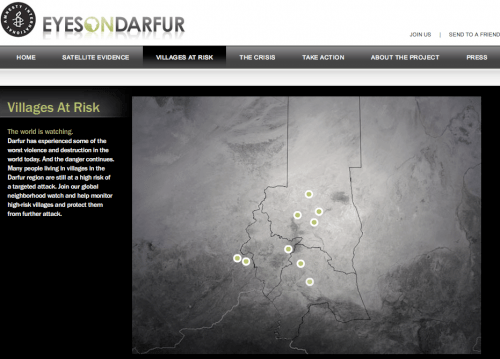
Amnesty International (AI) is taking human rights monitoring to a whole new level, metaphorically and literally speaking. The organization’s “Eyes on Darfur” project leverages the power of high-resolution satellite imagery to provide unimpeachable evidence of the atrocities being committed in Darfur – enabling action by private citizens, policy makers and international courts. Eyes On Darfur also breaks new ground in protecting human rights by allowing people around the world to literally “watch over” and protect twelve intact, but highly vulnerable, villages using commercially available satellite imagery.

I met with AI today to learn more. The human rights organization sends government officials these images on a regular basis to remind them that the world is watching. The impact? The villages monitored by AI have not been attacked while neighboring ones have. According to AI, there have also been notable changes in decisions made by the Bashir government since “Eyes on Darfur” went live a year ago. Equally interesting is that AI has been able to track the movement of the Janjaweed thanks to commercially available satellite imagery. In addition, the government of Chad cited the AI project as one of the reasons they accepted UN peacekeepers.

The American Association for the Advancement of Science (AAAS) is also leading a Human Rights and Geospatial Technologies project. So I also sat with them to learn more (September 2007). NGOs in Burma provided AAAS with information concerning attacks on civilians carried out by government forces in late 2006 and early 2007. AAAS staff reviewed these reports and compared them with high-resolution satellite images to identify destruction of housing and infrastructure and construction of new military occupation camps. The result is available in these Google Earth Layers. AAAS has provided comparable layers for Sudan, Chad, Lebanon and Zimbabwe. And this is just the tip of the iceberg.

AI is venturing on a 3-year project to provide satellite imagery to monitor forced displacement for early detection and advocacy. AAAS is developing a user-friendly web-based interface to let the NGO community know in real time where commercial satellites are positioned and what geographical areas they are taking pictures of. The interface includes direct links to the private companies operating these satellites along with contact and pricing information. AAAS believes this tool will enable the NGO community to make far more effective use of satellite imagery and to serve as a deterrent against repressive regimes choosing to commit mass atrocities.

The European Commission’s Joint Research Center (JRC) out of Ispra, Italy is also engaged in phenomenal work using satellite imagery. I first met with the JRC in 2004 and more recently in October 2007. The Center has developed automated models for change detection that are far more reliable than previously thought possible. Using pattern detection algorithms, the JRC can detect whether infrastructure has been destroyed, damaged, built or remained unchanged. They are now applying these models to monitor changes in refugee camps worldwide. The advantage of the JRC’s models is that they don’t necessarily require high resolution satellite imagery.

The same team at the JRC has also developed models to approximate population density in urban areas such as the Kibera slums out of Nairobi. Using satellite pictures taken at different angles, the team is able to construct 3D models of infrastructure such as individual buildings and houses. Thanks to these models they are able to approximate the size of these structures and thus estimate the number of inhabitants.

While AI and AAAS have been collaborating on some of these projects, the JRC has not been connected to this work. I therefore organized a working lunch during the OCHA +5 Symposium in Geneva last Fall to connect AAAS, the JRC, the Feinstein Center and the USHMM. My intention is to catalyze greater collaboration between these organizations and projects so we can upgrade to Human Rights 2.0.

Patrick Philippe Meier