Category Archives: Digital Activism

Wag the Dog, or How Falsifying Crowdsourced Data Can Be a Pain

I had the pleasure of finally meeting Robert Scoble in person at Where 2.0 last week. We had a great chat about validating crowdsourced information, which he caught on camera below. In the conversation, I used Wag the Dog as an analogy for Ushahidi‘s work on Swift River. I’d like to expand on this since open platforms are obviously susceptible to “information vandalism”, ie, having false data deliberately entered.

The typical concern goes something like this: what if a repressive regime (or non-state group) feeds false information to an Ushahidi deployment? As I’ve noted on iRevolution before (here, here and here), Swift River collects information from sources across various media such as SMS, Twitter, Facebook Groups, Blogs, Online News, Flickr and YouTube. In other words, Swift River pulls in visual and text based information.

So where does Wag the Dog come in? Have a look at this scene from the movie if you haven’t watched it yet:

If an authoritarian state wanted to pretend that rioters had violently attacked military police and submit false information to this effect in an Ushahidi deployment, for example, then what would that effort entail? Really gaming the system would probably require the following recipe:

  1. Dozens of  pictures of different quality from different types of phones of fake rioters taken from different angles at different times.
  2. Dozens of text messages from different phone using similar language to describe the fake riots.
  3. Several dozens of Tweets to this same effect. Not just retweets.
  4. Several fake blog posts and Facebook groups.
  5. Several YouTube videos of fake footage.
  6. Hacking national and international media to plant fake reports in the mainstream media.
  7. Hundreds of (paid?) actors of different ages and genders to play the rioters, military police, shopkeepers, onlookers, etc.
  8. Dozens of “witnesses” who can take pictures, create video footage, etc.
  9. A cordoned off area in the city where said actors can stage the scene. Incidentally, choreographing a fight scene using hundreds actors definitely needs time and requires rehearsals. A script would help.
  10. Props including flags, banners, guns, etc.
  11. Ketchup, lots of ketchup.
  12. Consistent weather. Say a repressive state decides to preemptively create this false information just in case it might become useful later in the year. If it was raining during the acting, it better be raining when the state wants to use that false data.

Any others you can think of? I’d love to expand the recipe. In any case, I think the above explains why I like using the analogy of Wag the Dog. If a repressive state wanted to fabricate an information ecosystem to game an Ushahidi install, they’d have to move to Hollywood. Is Swift River a silver bullet? No, but the platform will make it more of pain for states to game Ushahidi.

Patrick Philippe Meier

Sentiment Analysis of Haiti Text Messages (Updated)

The field of sentiment analysis is one that I’ve long been interested in. See my previous post on the use of sentiment analysis for early warning here. So when we began receiving thousands of text messages from Haiti, I decided to ask my colleagues at the EC’s Joint Research Center (JRC) whether they could run some of their sentiment analysis software on the incoming SMS’s.

The 4636 SMS initiative in Haiti was a collaboration between many organizations and was coordinated by Josh Nesbit of FrontlineSMS. The system allowed individuals in Haiti to text in their location and urgent needs. These would then be shared with some of the humanitarian actors on the ground and also mapped on the Ushahidi-Haiti platform, which was used by first responders such as the Marine Corps.

Here’s how the JRC in partnership with the University of Alicante carried out their analysis on the incoming SMS’s:

As many individual words are ambiguous (e.g. the word ‘help’ probably predominantly indicates a negative situation, but it may also be positive, as in “help has finally arrived”), they looked at the most frequent word groups, or word n-grams (sizes 2 to 5 words). Out of these, they identified about 100 n-grams that they felt are (high) negative or (high) positive. These were added to the sentiment analysis tool.

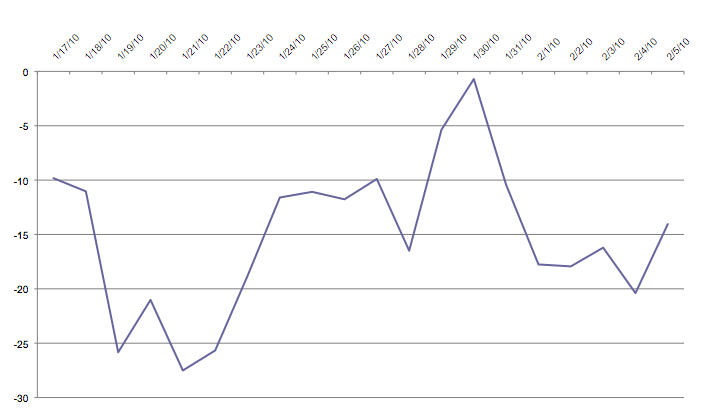
The graph below depicts the changing sentiment reflected in the SMS data between January 17th and February 5th.

Sentiment Analysis of Haiti SMS’s

There is, of course, no way to tell whether the incoming text messages reflect the general feeling of the population. It is also important to emphasize that the number of individuals sending in SMS’s increased during this time period. Still, it would be interesting to go through the sentiment analysis data and identify what may have contributed to the peaks and troughs of the above graph.

Incidentally, the lowest point on this graph is associated with the date of January 21. The data reveals that a major aftershock took place that day. There are subsequent reports of trauma, food/water shortages, casualties, need for medication, etc., which drive the sentiment analysis scores down.

—

Update 1: My colleague Ralf Steinberger and the Ushahidi-Haiti group is looking into the reasons behind the spike around January 30th. Ralf notes the following:

I checked the news a bit, using the calendar function in EMM NewsExplorer (http://emm.newsexplorer.eu/). I checked both the English and the French news for the day. One certainly positive news item accessible to Haitians on that day was that Haiti leaders pointed to progress. Another (French) positive news item is that the WFP (PAM) put in place a structured food aid system aiming at feeding up to 2 million people via women only. People were given food coupons (25kg of rice per family), starting Saturday 30.1.

Ralf also found that many of the original SMS’s received on that day had not been translated into English. So we’re looking into why that might have been. Hopefully we can get them translated retro-actively for the purposes of this analysis.

Update 2: Josef Steinberger from JRC has produced a revised sentiment analysis graph through to mid March.

—

This kind of sentiment analysis can be done in real-time. In future deployments where SMS becomes the principle source to communicate with disaster affected populations, using this kind of approach may  eventually provide an overall score for how the humanitarian community is doing.

Patrick Philippe Meier

From Clinton to Ushahidi-Haiti to Digital Repression and Back

I’m grateful to the State Department for having invited me to attend Secretary Hillary Clinton’s recent speech in DC on Net Freedom. Little did I know before the event that Secretary Clinton was about to tie my main professional and scholarly interests in one speech. As my Fletcher colleague put it:

Before starting her important speech on Net Freedom (which is directly related to the topic of my dissertation), Clinton spoke about the disaster in Haiti. She specifically referred to the critical role that communication networks played in the immediate aftermath of the quake and also noted that,

“The technology community has set up interactive maps to help us identify needs and target resources. And on Monday, a seven-year-old girl and two women were pulled from the rubble of a collapsed supermarket by an American search-and-rescue team after they sent a text message calling for help.”

She was clearly referring to the interactive maps launched by Ushahidi, Open Street Map (OSM) and Sahana as well as the free “4636” SMS number that Ushahidi and partners set up with the support of the State Department. Haitians can send a text to 4636 to report their location and urgent needs. These SMS’s are translated into English and mapped in near real-time on Ushahidi-Haiti.

Secretary Clinton then transitioned to the topic of Net Freedom with the following comment,

“There are more ways to spread more ideas to more people than at any moment in history. And even in authoritarian countries, information networks are helping people discover new facts and making governments more accountable.”

Towards the middle of her speech, Clinton emphasized the Obama Administration’s interest in placing new media and digital technologies “in the hands of people who will use them to advance democracy and human rights […].” The next steps articulated by Clinton:

“That’s why today I’m announcing that over the next year, we will work with partners in industry, academia, and nongovernmental organizations to establish a standing effort that will harness the power of connection technologies and apply them to our diplomatic goals. By relying on mobile phones, mapping applications, and other new tools, we can empower citizens and leverage our traditional diplomacy. We can address deficiencies in the current market for innovation.”

I was particularly pleased to hear more reference to mobile phones and mapping applications. In closing, Clinton wrapped up with the following comment:

“So let me close by asking you to remember the little girl who was pulled from the rubble on Monday in Port-au-Prince. She’s alive, she was reunited with her family, she will have the chance to grow up because these networks took a voice that was buried and spread it to the world. No nation, no group, no individual should stay buried in the rubble of oppression. We cannot stand by while people are separated from the human family by walls of censorship. And we cannot be silent about these issues simply because we cannot hear the cries.”

This is when my Fletcher colleague sent out that Tweet:

It would certainly appear that the answer to Brian’s question is “Yes!”

My dissertation focuses on the role of new media and digital technology in popular resistance against authoritarian rule. And I happen to be the Director of Crisis Mapping at Ushahidi, which is why I launched the Ushahidi-Haiti platform two hours after the earthquake. The more I work on crisis mapping, the more I experience firsthand the applications for digital activism. And the more I work on digital activism in non-permissive environments, the more I realize how important some of the tactics are for crisis mapping.

In sum, every day that passes provides more and more evidence that this is the space I currently belong in; the intersection between communication technology, interactive mapping, digital activism and nonviolent civil resistance.

Patrick Philippe Meier

Cyberconflict and Global Politics: New Media, War, Digital Activism

Athina Karatzogianni has just edited another informative book, this one on “Cyberconflict and Global Politics.” I blog-reviewed her previous book on “The Politics of Cyberconflict” here after meeting Athina at Politics 2.0 back in 2008. This blog posts consists of book notes for my dissertation research.

Athina authors the first chapter on “New Media and the Reconfiguration of Power in Global Politics.” Some relevant excerpts:

  • The information revolution is altering the nature of conflict by strengthening network forms of organization over hierarchical forms.
  • Dissidents against governments are able to use a variety of Internet-based techniques […] to spread alternative frames for events and a possible alternative online democratic sphere. An example of dissidents’ use of the Internet is spamming e-magazines to an unprecedented number of people within China, a method which provides recipients with ‘plausible deniability.’

The second chapter authored by Hall Gardner addresses “War and the Media Paradox.”

  • While the prospects of instant communication had been hailed as a means to prevent conflict and to help negotiate an end to disputes and wars […] one of the major paradoxes is that a number of media inventions are actually helping to cause, if not perpetuate, social and political conflict in general.
  • In China […] just prior to the Tiananmen Square repression in June 1989, it had been the transistor radio that provided alternative views to those of the government.

The third chapter on “The Internet as a weapon of war” is primarily focused on news and as such is not directly relevant to my research. Chapter 4 on “Transparency and Accountability in the Age of Cyberpolitics” by Maori Touri has an interesting reference to Kant:

  • The impact of transparency and publicity on human behavior is hardly new with Kant being amongst the first to argue that the principlesof human action could be ethical only if they were public.

The fifth chapter by Michael Dartnell addresses “Web Activism as an Element of Global Security.”

  • While the World Wide Web and information technologies (IT) that emerged over the past decade have a transformative impact on global security, neither they nor the expectations that they arouse are unique to our time. In “The Radio as an Apparatus of Communication”, Bertolt Brecht argued that

The radio would be the finest possible communication apparatus in public life […] if it knew how to receive as well as transmit, how to let the listener speak as well as hear, how to bring him into a relationship instead of isolating him.

  • As James Katz and Ronald Rice suggest, ‘although the Internet has not led to any political revolutions, it has supported and encouraged them (as have—and do—the phone and fax)’ (Katz and Rice 2002:352).
  • Web activism is a form of electronic direct action in which previous one-way media are superseded by global communications devices. […]. As Miekle notes, ‘Internet activism is largely about raising awareness of the issues concerned, and this means more coverage than the purely online’ (Miekle 2002:26).
  • The telegraph […] was an innovation that facilitated European imperialism and helped consolidate global dominance.
  • Instead of a tool for revolutionary transformation, Web activism is a powerful new method for political organizations of all stripes in precise circumstances that favor their messages.
  • The evaluation [of the impact of IT on IR] needs to be conducted in a variety of ways since the impacts are in fact a diverse body of content.

Chapter 6 on “The Laws of the Playground” is not relevant to my research nor is chapter 7 on “Information Warfare Operations within the Concept of Individual Self-Defense”. Chapters 8 and 9 are interesting but not directly informative for my dissertation: “The Internet and Militant Jihadism”, and “How Small are Small Numbers in Cyberspace?” Chapter 10 focuses on a case study of Sri Lanka while Chapter 11 draws on the case study of Women in Black.

Chapter 12 by Graham Meikle is on “Electronic Civil Disobedience and Symbolic Power.”

  • Electronic Civil Disobedience [ECD] is a key example of the Internet’s capacity to enable users to exercise what Castells terms ‘counter-power’—’the capacity by social actors to challenge and eventually change the power relations institutionalized in society’ (2007:248).
  • However, the discourse of ECD is contested, and where its proponents seek to align it with the civil disobedience tradition of Thoreau, Gandhi and Martin Luther King, it is frequently implicated in other discourses: in the concept of ‘hactivism’; in the concept of ‘netwar’; and in debates about terrorism.
  • [In 1994, the Critical Art Ensemble] aligned the concept of electronic civil disobedience with the widely-understood principles of traditional civil disobedience […]. There were continuities […] such as the use of trespass and blockades as central tactics. However, there were also discontinuities, such as the de-emphasizing of mass participation in favor of decentralized, cell-based organization [and] that electronic civil disobedience should be surreptitious, in the hacker tradition.
  • Where practitioners of civil disobedience have been transparent about their opposition [… the Critical Art Ensemble] argued for a clandestine approach, proposing electronic disobedience as ‘an underground activity that should be kept out of the public/popular sphere (as in the hacker tradition) and the eye of the media’ (CAE 2001: 14).
  • [There is a dilemma for activists] in that while the news media are drawn to novelty and disruption, their coverage is also more likely to focus on that very novelty and disruption than on the underlying issues or causes involved, which may in fact work against the activist cause (Scalmer 2002:41).
  • [One challenge for activists] is not just to formulate new strategies and tactics appropriate to a shifting mediascape, but to recognize the ongoing need to create a careful vocabulary for discussing those tactics and strategies.
  • ‘The information revolution is favoring and strengthening network forms of organization, often giving them an advantage of hierarchical forms. The rise of networks means that power is migrating to nonstate actors, because they are able to organize into sprawling multiorganizational networks […] more readily than can traditional, hierarchical, state actors. This means that conflicts may increasingly be waged by ‘networks’, perhaps more than by ‘hierarchies’. It also means that whoever masters the network form stands to gain the advantage’ (Arquilla and Ronfeld 2001a: 1).

The final two chapters focus on a case study of the European Social Forum and capitalism respectively.

Patrick Philippe Meier

Twitter in Iran: Where I disagree with Will Heaven vs Josh Shahryar

Will Heaven of the Daily Telegraph and EA‘s Josh Shahryar have been engaged in a battle of words on the role of Twitter in Iran. I think the battle has now drawn to a close. Given the popularity of my previous post on “Where I disagree with Morozov and Shirky on Digital Activism,” I thought I’d continue the series, which also helps me keep track of my notes for my dissertation.

————

It all started on December 29th when Will published this article in the Daily Telegraph:

Iran and Twitter: the fatal folly of the online revolutionaries

Which he followed up with this blog post, still on the Daily Telegraph:

Iran’s brutal regime won’t be toppled by Twitter and the niceties of social media

This provoked the following response from Josh (the page may be down):

Twitter Revolution 101: Get Your Facts Right

Will in turn replied to Josh’s post with one of his own:

My response to Twitterati: stop putting Iranian lives at risk

Finally, unless I’ve missed another exchange, Josh posted this closing response yesterday:

Iran & Twitter: Last Words on The Hell of Heaven

————

I copied and pasted this lengthy exchange in a Word document (available here) and did a word count. The debate generated over 7,500 words. That’s about 12 pages, single-space of font-size 10 text. I’ve re-read this document several times and I’m not quite sure what the debate ultimately amounts to. They both make very good points but neither is willing to concede that.

In my opinion, the contentious exchange stems from the use of the word “revolution” and the subsequent arms-race of anecdotes that all too often causes more confusion than clarity. When Will uses the term, “there has been no revolution in Iran,” he implies a political revolution whereas Josh—on several occasions—clearly states that he’s talking about a revolution in information dissemination: “That Revolution is about awareness, not provoking a political revolt or helping it directly.”

In any case, here are my individual comments on their exchange.

My Response to Will

Will: It’s deluded to think that “hashtags”, “Tweets” and “Twibbons” have threatened the regime for a second.

Really? Then why would the regime or sympathetic elements within Iran try to shut it down?

Will: Here’s the other thing “social media experts” will forget to tell you: dictatorships across the world now use their own tools to hunt down online protesters.

I would like to challenge Will to find one “social media expert” who forgets that digital repression is real. Please see my previous blog post on this.

Will: And it is foolish to think that their use [Tor, Freebase] guarantees safety: if the Revolutionary Guard were to find someone using the software, the consequences would be dire.

Both Will and Josh are fixated on technology at the expense of tactics. I think they’d find this guide on how to communicate securely in repressive environments of interest. There needs to be more cross-fertilization between civil resistance strategies and digital activism tactics. See this post for more.

And before either fault me for making the above guide public, all the information in said-guide is already public and available online. Repressive regimes may very well be aware of most of the tactics and technologies used, but just like chess, this doesn’t mean one side can defeat the other at every game.

Will: When you consider the danger posed to Iranians by online participation – compared with what online participation has achieved – the overall result is hardly tangible, and certainly not worth the risks which have been undertaken.

True, perhaps, but a little too passive a statement for my tastes. Those risks are not static, they can be reduced; hence the guide. And hence the need for more education and training in digital activism around the world. See Tactical Tech‘s excellent work in this area, for example.

One other point that Will overlooks (understandably since he doesn’t live in the US) is the stunning shift in perception that took place in the minds of Americans when viewing Iran’s post-election protests. Prior to the elections, the word Iran would generally evoke the following: “Nuclear weapons”, “Kill the Great Satan”, etc. But after young Iranians took to the streets and the protests were documented on Twitter, Facebook and Flickr, many Americans finally realized that “the other” was perhaps not that different. The shift in mindset was huge.

My Response to Josh

I largely agree with Josh’s take on the role of Twitter in Iran although I see why it’s easy for Will to carefully select one or two arguments and push back. In any case, I do take issue with this comment:

Josh: The fact that Iranians are dying is not the fault of Westerners. It is not even a fault. It is a sacrifice that Iranians must make to gain their freedom.

The Responsibility to Protect (R2P) suggests that state sovereignty is contingent on a state protecting it’s citizens. A regime that kills some 400 citizens in response to street protests should hardly have the right to remain sovereign. There should be a Chapter 7 UN mandate with 20,000 observers in Iran to prevent any more violence. Realistically though, I don’t know what the solution to this crisis is, but I do feel that we’re all responsible for the bloodshed.

I definitely disagree with Josh’s implication that revolutions require death and destruction. “Be smart, don’t be dead” is what I tell political activists. There are very good reasons why nonviolent action is called “A Force More Powerful.” Digital activists really need to get up to speed on nonviolent civil resistance tactics and strategies just as the latter need to get up to speed on how to communicate more securely in repressive environments.

Patrick Philippe Meier

Breaking News: Repressive States Use Technologies to Repress!

I kid you not: repressive regimes actually have the nerve to use technologies to repress! Who would’ve guessed?! Nobody could possibly have seen this one coming. I mean, this shocking development is completely unprecedented in the history of state repression. Goodness, how did these repressive regimes even come up with the idea?!

Yes, that was sarcasm. But I never cease to be amazed by the incredible hullabaloo generated by the media every time a new anecdote pops up on a repressive regime caught red handed with digital technology. Just stunning. It’s as if world history started yesterday.

I hate to state what should be obvious but repressive states also used technology to repress in 2009, and in 2008, 2007, 2006, 2005, 2004, 2003, 2002, 2001 … You get the point. Hint: tech-based repression doesn’t start in 1984 either, try a little earlier. As Brafman and Beckstrom point out,

All phone calls were routed through Moscow [during the time of the Soviet Union]. Why? The Kremlin wanted to keep tabs on what you were talking about–whether plotting to overthrow the government or locating spare parts for your tractor. The Soviets weren’t the first, or the last, to keep central control of communication lines. Even the Roman empire, though spread around the world, maintained a highly centralized transportation system, giving rise to the expression ‘All roads lead to Rome’ (52).

Why the media continues to treat digital repression as a surprise is beyond me. Repressive states have used technologies for hundreds of years. So someone please tell me why repressive regimes wouldn’t use new technologies as well? Because they’re new? No, that’s probably not it. Wait, because they’re cheap? Or effective? Darn, I don’t know, what’s the answer? Is this a trick question?

As Evgeny Morozov notes,

There is, of course, nothing surprising about it: why wouldn’t governments be doing this? After all, there are many smart techies working for the governments as well – and sometimes they even believe in and like what they are doing.

But you still come across the typical comment “I told you so!” on Twitter, blogs, etc., “I told you that repressive states would use technology to repress!” And so the anecdotes keep flying and the “oooh’s” and “aaah’s” keep coming. The media freaks out, everyone gets excited. And the next day is exactly the same since the media thrives on repetitive soundbites, especially very catchy (preferably one-word) soundbites, which explains why I increasingly feel like I’m stuck in digital groundhog day.

If I had more time, I’d write a blog post entitled “10 Easy Steps to Writing the Best Anecdote on Digital Repression Ever” along the lines of Evgeny’s fun post on “10 Easy Steps to Writing the Scariest Cyberwarfare Article Ever.” But my post would be a lot shorter:

1) Find an anecdote in the mainstream media;
2) Formulate a blockbuster title ending with an exclamation mark;
3) Preface your post with a note that no one but you anticipated this to happen;
4) Quote at least one full paragraph on the anecdote from another source;
5) For extra credit, create your own new one-word soundbite;
6) Conclude with a few snarky lines about how this clearly refutes all the dumb hype on digital technologies.

Some applaud the media’s focus on digital repression. They are grateful to the media for countering the Utopian hype. Fair enough, but this refrain is quickly becoming an excuse to spew out more anecdotes instead of contributing solid analysis. Moreover, the media is largely responsible for promoting the techno-Utopian hype to begin with. This inevitably triggers an arms race of anecdotes, which only leads to mutually assured confusion. But don’t panic, we’ve always got our catchy one-word soundbites to clear things up!

So here’s a practical thought: why doesn’t someone aggregate and code all these anecdotes to analyze them and look for trends? I realize that’s a little harder than writing up daily blog posts on the latest anecdotes so why not do this together? Lets set up an open spreadsheet to keep track of digital repression event-data. Then, when we have 6 months or more of event-data for a particular country, lets analyze this data so we can actually say something more informative about the dynamics of digital repression.

Come to think of it, Global Voices Advocacy, Herdict and the OpenNet Initiative are already doing a lot of this information collection, and very well. Still, it would be great if they could turn this information into event-data and expand beyond the Internet to include mobile phones and other digital technologies. Something along these lines, perhaps.

This won’t answer all our questions, but it would give us the underlying event-data to study digital repression at the tactical level over time. (Would asking daily data updates be too much?).

The next step would be to do the same for “digital liberation”, i.e., capturing event-data on how/when/where civil society groups evade digital repression. Analyzing both datasets would allow us to get a grasp on the cat-and-mouse dynamics that may characterize the race between digital activists and repressive states. I think the analysis would show that states are more often than not reactive. But who knows. Such is life in data hell.

Patrick Philippe Meier

The Starfish and the Spider: 8 Principles of Decentralization

“The Starfish and the Spider: The Unstoppable Power of Leaderless Organizations” by Ori Brafman and Rod Beckstrom is still one of my favorite books on organizational theory and complex systems.

The starfish represents decentralized “organizations” while the spider describes hierarchical command-and-control structures. In reviewing the book, the Executive Chairman of the World Economic Forum wrote that “[it has] not only stimulated my thinking, but as a result of the reading, I proposed ten action points for my own organization.”

The Starfish and the Spider is about “what happens when there’s no one in charge. It’s about what happens when there’s no hierarchy. You’d think there would be disorder, even chaos. But in many arenas, a lack of traditional leadership is giving rise to powerful groups that are turning industry and society upside down.” The book draws on a series of case studies that illustrate 8 Principles of Decentralization. I include these below with short examples.

1. When attacked, a decentralized organization tends to become even more open and decentralized:

Not only did the Apaches survive the Spanish attacks, but amazingly, the attacks served to make them even stronger. When the Spanish attacked them, the Apaches became even more decentralized and even more difficult to conquer (21).

2. It’s easy to mistake starfish for spiders:

When we first encounter a collection of file-swapping teenagers, or a native tribe in the Arizona desert, their power is easy to overlook. We need an entirely different set of tools in order to understand them (36).

3. An open system doesn’t have central intelligence; the intelligence is spread throughout the system:

It’s not that open systems necessarily make better systems. It’s just that they’re able to respond more quickly because each member has access to knowledge and the ability to make direct use of it (39).

4. Open systems can easily mutate:

The Apaches did not—and could not—plan ahead about how to deal with the European invaders, but once the Spanish showed up, Apache society easily mutated. They went from living in villages to being nomads. The decision didn’t have to be approved by headquarters (40).

5. The decentralized organization sneaks up on you:

For a century, the recording industry was owned by a handful of corporations, and then a bunch of hackers altered the face of the industry. We’ll see this pattern repeat itself across different sectors and in different industries (41).

6. As industries become decentralized, overall profits decrease:

The combined revenues of the remaining four [music industry giants] were 25 percent less than they had been in 2001. Where did the revenues go? Not to P2P players [Napster]. The revenue disappeared (50).

7. Put people into an open system and they’ll automatically want to contribute:

People take great care in making the articles objective, accurate, and easy to understand [on Wikipedia] (74).

8. When attacked, centralized organizations tend to become even more centralized:

As we saw in the case of the Apaches and the P2P players, when attacked decentralized organizations become even more decentralized (139).

Patrick Phillipe Meier

Where I Disagree with Morozov vs Shirky on Digital Activism

Prospect Magazine just published the final back-and-forth between Evgeny Morozov and Clay Shirky on digital activism. The debate followed Evgeny’s cover story in Prospect published last November, which I responded to (and disagreed with) at length here: Why Dictators Love the Web or: How I Learned to Stop Worrying and Say So What?! And here: Digital Activism and the Puffy Clouds of Anecdote Heaven.

I enjoyed reading the final exchange between Morozov and Shirky. Here’s where I agree and disagree with both authors.

Agree with Morozov

  • Growing Internet censorship in Iran is a logical reaction from a “rational-thinking” government concerned with possible revolution.
  • Only focusing on who controls communication networks may not be terribly helpful since Iran has other ways to control the internet. “One unfortunate consequence of limiting our analysis of internet control to censorship only is that it presents all authoritarian governments as technophobic and unable to capitalise on new technologies,” which is hardly the case.

Disagree with Morozov

  • Protests are not necessarily rare in repressive states. According to a study in 2006, “group protests in China have risen at a rate of at least 17% a year.” In 2005, there were an estimated 241 group protests per day. In Pakistan, local Field Monitors with Swisspeace coded 54 individual protests during 2007. Compare this with Reuters coverage of Pakistan, which only reported 7 protests that same year. If it’s not in the news does not mean it’s not happening.
  • The regime in Tehran may very well have the ability to turn off mobile phone coverage in public places where protests are organized but remember those things called land line telephones? Iran has 24.8 million of those (2008 est.) and is ranked 12th (above South Korea and Canada) in number of land line phones (ref). And besides, we’ve clearly seen that mobile phones are increasingly used for more than just communication. The tragic video footage of Neda (along with hundreds of other pictures) were all captured on mobile phones.
  • The fact that the Iranian regime has become more authoritarian following the post-elections  protests does not automatically imply the regime has become stronger. As I have written elsewhere, citing Brafman and Beckstrom’s The Starfish and the Spider: “when attacked, centralized organizations tend to become even more centralized.” A more centralized and paranoid regime, however, doesn’t mean a more powerful regime. Greater repression is a typical reaction by a threatened regime during a revolution and often before a change of power.
  • The increased repression can also backfire. As mentioned in this previous blog post, “Backfire occurs when an attack creates more support for or attention to what/who is attacked. Any injustice or norm violation can backfire on the perpetrator.” For further research on this issue, I recommend reading this piece on “Repression, Backfire and the Theory of Transformative Events,” by David Hess and Brian Martin.
  • One should also take into consideration the organizational topology of resistance movements. Brafman and Beckstrom argue that “when attacked, a decentralized organization tends to become even more decentralized.” This may make it more difficult for the regime to identify and crack down on the resistance movement in Iran.
  • I don’t think Burma serves as a valid comparison with Iran. In addition, the fact that there were no major democratic changes in Burma following the Saffron revolution in 2007 hardly means that the situation has been static since. I recently spoke with two colleagues who were in Burma a few months ago and was taken aback by some of the changes they observed.
  • Morozov asks what is to be gained if the ability to organize protests is matched or even overpowered by the ability to provoke, identify and arrest the protesters and possible future dissidents? A good question but one that seems to assumes a static and linear state of affairs. As I have argued elsewhere, tactical innovation, organizational learning and technological change means that this is unlikely.

Agree with Shirky

  • Just like the Protestant Reformation was shaped by the printing press, the Iranian protests were and is being shaped by social media, rather than simply Twitter. Perhaps “the real revolution was the use of mobile phones, which allowed the original protesters to broadcast their actions to other citizens and to the wider world with remarkable speed and immediacy.”
  • I’m including the following paragraphs in full as they are relevant to my dissertation research. For me the key words here are “synchronized public.”

“The basic hypothesis is an updated version of that outlined by Jürgen Habermas in his 1962 publication, The Structural Transformation of the Public Sphere: an Inquiry into a Category of Bourgeois Society. A group of people, so Habermas’s theory goes, who take on the tools of open expression becomes a public, and the presence of a synchronised public increasingly constrains undemocratic rulers while expanding the rights of that public (the monarchies of Europe, in Habermas’s telling, become authoritarian governments within the contemporary scenario).

Put another way, even taking into account the increased availability of surveillance, the net value of social media has shifted the balance of power in the direction of Iran’s citizens. As Evgeny notes, however, that hypothesis might be wrong. Or, if it is right, the ways in which it is right might be minor, or rare, or take decades to unfold.

  • Iran is unlikely to become a permanent Burma since “the kind of information shutdown required to keep all forms of public assembly from boiling over will be beyond the authorities in Iran.”

Disagree with Shirky

  • On the Habermas reference to the “synchronized public”, Shirky overlooks the fact that a centralized, command-and-control organization is likely to have the upper hand on synchronization. He also forgets that repressive regimes do not face the same collective action problem that resistance movements face (c.f. information cascades). Granted, the “public” may be quicker in adapting to relatively rapid and small-albeit-important changes in the political environment but this needs to be tested in more depth.
  • Shirky agrees with Evgeny regarding the possibility that Iran may move towards the Burmese model of steady control. Put this way, I also agree with the possibility that the sun may not rise tomorrow. Neither Shirky, Morozov or myself are Iran specialists or have any inside information on the internal politics of the country. So best not to rely on any of us for expert political commentary on Iranian politics.

Patrick Philippe Meier

Where I Stand on Digital Activism

Journalists, activists, students, donors and most recently a millionaire investment banker have all recently asked me where I stand on Digital Activism. More precisely, the popular question is: Who is going to win? And by that, they refer to the cat-and-mouse dynamics that characterize the digital battle between repressive regimes and civil resistance movements.

My personal opinion (a.k.a. untested hunch) is that this cat-and-mouse game is bound to continue for some time. That said, I ultimately think that repressive regimes will eventually lag behind the adoption and application of innovative methods and technologies. I also think that resistance movements that employ digital technologies will continue to have a first-mover advantage, even if that advantage is short-lived.

Why? Because of Organizational Theory 101. It is well known in the study of complex systems and network dynamics that organizational typologies for command and control structures do not adapt very well to rapidly changing environments. On the other hand, relatively decentralized forms of organization are typically more nimble and adaptable. Decentralized networks are often first movers, which give them a temporary albeit important advantage. They have more feedback loops.

As I wrote in 2006 conference paper (citing Bazerman and Watkins 2004),

Feedback mechanisms enable an organization to manage the complexity of their internal and external environments in four important ways. They allow an organization to: (1) scan the environment and collect sufficient information; (2) integrate and analyze information from multiple sources; (3) respond in a timely manner and observe the results; and (4) reflect on what happened and incorporate lessons-learned into the “institutional memory” of the organization, in order to avoid repetition of past mistakes.

In contrast, hierarchical structures require the executive to rely on others to scan information. Excellent communication “between floors” is therefore critical. In the process of communication, however, “organizational members filter information as it rises through hierarchies” and “those at the top inevitably receive incomplete and distorted data [and] overload may prevent them from keeping up-to-date with incoming information.” This limits the organization’s ability to adapt and change, and “any organization that is not changing is a battlefield monument.”

Furthermore, as Brafman and Beckstrom have shown in The Starfish and the Spider, “when attacked, a decentralized organization tends to become even more open and decentralized.” This means that government crackdowns against resistance movements tend to make the latter more decentralized and harder to track down.

I often use the cat-and-mouse game analogy but perhaps a better analogy is the spider and the starfish. Even if an arm of the starfish is cut off, it will regenerate. Not so with the spider, which has a centralized nervous system. As Brafman and Beckstrom write, “A starfish is a neural network–basically a network of cells. Instead of having a head, like a spider, the starfish functions as a decentralized network.” Of course, resistance movements are not completely decentralized; they need only be more decentralized relatively to repressive regimes.

Notice that I have not referred to technology a single time in this blog post about Digital Activism. That’s because my take on the competition between the spider and starfish ultimately rests on organizational dynamics, not technology.

Organization is a formidable force in social systems and natural systems. The only difference between a water droplet and solid ice is organization—the way the molecules are organized. Asymmetric warfare is possible because of organizational differences. I highly recommend reading this book by my colleagues Shultz and Dew (2006): Insurgents, Territories, Militias: Warriors of Contemporary Combat to understand the power of organization.

So this is ultimately where I stand on Digital Activism and what I wrote over a year ago in my dissertation proposal. We can go on all we want with anecdotal acrobatics but I personally think that doing so is simply barking up the wrong tree and missing the forest for the trees.

Patrick Philippe Meier

Digital Activism and the Puffy Clouds of Anecdote Heaven

Evgeny replied in style to my way-too-long response to his piece in Prospect on: “Why Dictators Love the Web.” At least someone read my entire post, thanks Evgeny! As I wrote in my first response, the great thing about Evgeny is that “he’ll test your logic and poke (nay, drill) as many trenches as he can into your argument.” So if you want to see this in action, do read his concise reply.

First things first, though: his piece is accessible by subscription only. I happened to be in London and picked up a copy of Prospect at Heathrow last night, which made for pleasant reading on the flight back. But our back-and-forth won’t make much sense until you read his original piece and judge it for yourself.

Second, the following comment by Evgeny is probably the most stupefying: “For someone so obsessed with data, Patrick has produced no data at all to counter any of my arguments. I am all for data, but as long as academics like Patrick don’t produce any, we won’t be talking data any time soon.”

  • Uno: Evgeny knows full well that I’m collecting data for my dissertation research to test whether access to new media and technology challenges the balance of power between repressive regimes and resistance movements. As it happens, I’m currently writing from Stanford University where I’ll be presenting the results of my new large-N quantitative study based on a new dataset put together over the past 6 months. This new dataset includes 18 years worth of time series data for 38 repressive regimes based on 10 different variables. Uhhhhhhhhh, so if producing 684 data points is not producing any data, then  perhaps I do belong in anecdote heaven with Evgeny.
  • Due: My formal dissertation committee is in the process of reviewing my data and analysis. I also expect to get some solid feedback from professors and PhD students at Stanford this afternoon. When I’m assured that my analysis of the data is correct, I’ll blog about it and ask for feedback from iRevolution readers. I’m not about to start countering Evgeny’s anecdotes until I’m sure my data-driven analysis is sound. There’s enough hype in this field as it is, and an “anecdote for an anecdote leaves everyone confused.”
  • Tre: Evgeny also knows full well that my previous quantitative study, which included data on 22 authoritarian states, was presented at the International Studies Association (ISA) Conference in February of this year since my blog post on that presentation is why he got in touch with me in the first place. In fact, I shared a copy of my paper with him at the time along with an early copy of a quantitative study I co-authored for the Berkman Center that tested the impact of technology on indicators of governance for 180 countries and separately for autocratic states.

So, let me just say goodness gracious: how can Evgeny possibly say I have produced no data or analysis? I’m analyzing my latest dataset, and I’m doing so carefully. When I have some preliminary conclusions, then of course I’ll put all of them forward to support and/or counter some of Evgeny’s anecdotes.

Will these be conclusive or definitive? Of course not, but at least they’ll be based on some empirical data and quantitative analysis. Is the data perfect? No, no dataset is. Will the regression analysis be sufficient? Of course not, which is why this analysis only constitutes the first part of my dissertation research. The second part will draw on applied social science methodologies to carry out qualitative comparative case study analysis based on the results from the quantitative study. Oh, and by the way, I’d rather be obsessed with data than anecdotes.

Anecdotes Inside...

I hope this sets the record straight. Now, lets go back to Anecdote Heaven. Evgeny hasn’t replied to most of my criticisms because, well, my response was really long (some 3,000 words) and he probably has better things to do, like write a book on all this (can’t wait to respond to that!). So please keep this in mind since I can only reply to the points he has chosen to reply to—something called selection bias, which actually sums up the biggest problem I have with the “field” of digital activism.

1. On Analogue Activism and Torture vs. Hacking: Evgeny misses the point. What I’m countering is his selection bias of certain anecdotes to make sweeping statements like “analogue activism was pretty safe.” It’s these kind of sweeping statements based on select anecdotes that I have a problem with. Torture is nothing new. Governments have tortured individuals for centuries to get information. So now they get phone numbers. Great. Before they got lists of street addresses. Great. So what? White hat hackers and some professional activists do the same against repressive governments (more anecdote acrobatics, anyone?).  I do concede that there is a network effect, but the effect can be in both directions. I completely agree that digital activists are facing a steep learning curve; hence the need to focus on tactics, strategies and technologies in equal measure.

2. Professional Activists and Regular Internet Users: I’m glad that Evgeny makes the distinction between professional activists and amateur (?) activists. But he doubts that regular users of the Internet in places like Russia, China or Iran have ever heard of Nathan Freitias’s Guardian project or are going to use those services anytime soon. That’s because the Guardian is not available yet. Evgeny notes the power of networks from the dictator’s perspective but doesn’t seem to award the same potential to transnational activist networks vis-à-vis the spread of new technologies and tactics. I wonder whether the analogy with professional journalists and citizen journalists is appropriate here. As tools for digital activism become cheaper, easier and safer to use, amateur activists may stand to gain in important ways (note this is simply a hypothesis, not a claim!).

3. Lohmann’s 1994 paper on Information Cascades: Yes indeed, the political science paper triggered an important body of scholarship. And yes, even the great Clay drew on the paper for his popular book. So my reply here is aimed at both Evgeny and Clay: why draw on a 15-year old paper that focuses on a 20-year old case study to make a point about new media, digital technologies, and networked communications? Lohmann’s paper is an important piece (which I highly recommend reading), but it would have been more appropriate to dig into more recent papers that cite Lohmann to determine whether her arguments are indeed applicable to today’s world. As Clay notes in Here Comes Everybody, “we now have communications tools that are flexible enough to match our social capabilities, and we are witnessing the rise of new ways of coordination action that take advantage of that change.” Was this true of 1989, or even 1994?

4. The Muslim Brotherhood and Other Groups: The fact that extremist (civil society) groups are using technology to fill the vacuum left by the state is a well-known fact. These groups are going to benefit from and use technology regardless of whether or not Western governments promote “Civil Society 2.0”. The Muslim Brotherhood and such groups are typically way more advanced in their use of technology than what a “Civil Society 2.0 Marshall Plan” might offer. Goodness, basic media literacy in civil society would already be an important step forward. What I’m getting at is that we’re hardly going to teach extremists anything new by implementing digital activism programs in developing countries.

5. Russia, Estonia and Georgia: Oh good, Evgeny agrees that the state is losing control to decentralized networks.

6. The Number of Internet Users is Meaningless: Oh this is good, I’m going to keep this quote for later use. Let me just quote Clay Shirky instead:  “If you want to organize the work of even dozens of individuals, you have to manage them.  As organizations grow into the hundreds or thousands, you also have to manage the managers, and eventually to manage the managers’ managers.  Simply to exist at that size, an organization has to take on the costs of all that management.” Evgeny argues that the regular folk won’t be using censorship circumvention tactics and technologies “and it’s the regular folk which [sic] matters most when you need to build a mass movement.” Like I said in my reply, the number of Internet users in China (and, by the way, Tor users as well) is increasing, not decreasing. Access to technology, even in places like Burma, is increasing, not decreasing (apologies for the anecdote droppings). Technology is becoming simpler, not more difficult to use; cheaper, not more expensive. Perhaps states are losing control to decentralized networks in part because these networks are expanding and including more regular folk?

7. Guess we won’t be continuing that conversation then.

8. FOSS and Ushahidi: Seems like I did misunderstand Evgeny’s point here, which actually is “that donors have no good ways of identifying/supporting talented new media entrepreneurs without ruining their incentives to innovate.” This is a new field, we’re learning as we go along, so of course we don’t have all the answers, nor do we claim to. But I’d love to get Evgeny’s thoughts on how donors can improve on this front. On a related note, Evgeny challenges me to go visit the offices of NGOs working in New Media in Eastern Europe to see how much they benefit from the “culture of innovation” unleashed by FOSS. I’d love to, Evgeny, any chance you could hook me up with some funding? And, for the purposes of countering selection bias, could I also visit other places like Kenya, India, etc.?

Patrick Philippe Meier