Category Archives: Digital Activism

Peer Producing Human Rights

Molly Land at New York Law School has written an excellent paper on peer producing human rights, which will appear in the Alberta Law Review, 2009. This is one of the best pieces of research that I have come across on the topic. I highly recommend reading her article when published.

Molly considers Wikipedia, YouTube and Witness.org in her excellent research but somewhat surprisingly does not reference Ushahidi. I thus summarize her main points below and draw on the case study of Ushahidi—particularly Swift River—to compare and contrast her analysis with my own research and experience.

Introduction

Funding for human rights monitoring and advocacy is particularly limited, which is why “amateur involvement in human rights activities has the potential to have a significant impact on the field.” At the same time, Molly recognizes that peer producing human rights may “present as many problems as it solves.”

Human rights reporting is the most professionalized activity of human rights organizations. This professionalization exists “not because of an inherent desire to control the process, but rather as a practical response to the demands of reporting-namely, the need to ensure accuracy of the information contained in the report.” The question is whether peer-produced human rights reporting can achieve the same degree of accuracy without a comparable centralized hierarchy.

Accurate documentation of human rights abuses is very important for building up a reputation as a credible human rights organization. Accuracy is also important to counter challenges by repressive regimes that question the validity of certain human rights reports. Moreover, “inaccurate reporting risks injury not only to the organization’s credibility and influence but also to those whose behalf the organization advocates.”

Control vs Participation

A successful model for peer producing human rights monitoring would represent an important leap forward in the human rights community. Such a model would enable us to process a lot more information in a timelier manner and would also “increase the extent to which ordinary individuals connect to human rights issues, thus fostering the ability of the movement to mobilize broad constituencies and influence public opinion in support of human rights.”

Increased participation is often associated with an increased risk of inaccuracy. In fact, “even the perception of unreliability can be enough to provide […] a basis for critiquing the information as invalid.” Clearly, ensuring the trustworthiness of information in any peer-reviewed project is a continuing challenge.

Wikipedia uses corrective editing as the primary mechanism to evaluate the accuracy of crowdsourced information. Molly argues that this may not work well in the human rights context because direct observation, interviews and interpretation are central to human rights research.

To this end, “if the researcher contributes this information to a collaboratively-edited report, other contributors will be unable to verify the statements because they do not have access to either the witness’s statement or the information that led the researcher to conclude it was reliable.” Even if they were able to verify statements, much of human rights reporting is interpretive, which means that even experienced human rights professionals disagree about interpretive conclusions.

Models for Peer Production

Molly presents three potential models to outline how human rights reporting and advocacy might be democratized. The first two models focus on secondary and primary information respectively, while the third proposes certification by local NGOs. Molly outlines the advantages and challenges that each model presents. Below is a summary with my critiques. I do not address the third model because as noted by Molly it is not entirely participatory.

Model 1. This approach would limit peer-production to collecting, synthesizing and verifying secondary information. Examples include “portals or spin-offs of existing portals, such as Wikipedia,” which could “allow participants to write about human rights issues but require them to rely only on sources that are verifiable […].” Accuracy challenges could be handled in the same way that Wikipedia does; namely through a “combination of collaborative editing and policies; all versions of the page are saved and it is easy for editors who notice gaming or vandalism to revert to the earlier version.”

The two central limitations of this approach are that (1) the model would be limited to a subset of available information restricted to online or print media; and (2) even limiting the subset of information might be insufficient to ensure reliability. To this end, this model might be best used to complement, not substitute, existing fact-finding efforts.

Model 2. This approach would limit the peer-production of human rights report to those with first-hand knowledge. While Molly doesn’t reference Ushahidi in her research, she does mention the possibility of using a website that would allow witnesses to report human rights abuses that they saw or experienced. Molly argues that this first-hand information on human rights violations could be particularly useful for human rights organizations that seek to “augment their capacity to collect primary information.”

This model still presents accuracy problems, however. “There would be no way to verify the information contributed and it would be easy for individuals to manipulate the system.” I don’t agree. The statement: “there would be no way to verify the information” is an exaggeration. There multiple methods that could be employed to determine the probability that the contributed information is reliable, which is the motivation behind our Swift River project at Ushahidi, which seeks to use crowdsourcing to filter human rights information.

Since Swift River deserves an entire blog post to itself, I won’t describe the project. I’d just like to mention that the Ushahidi team just spent two days brainstorming creative ways that crowdsourced information could be verified. Stay tuned for more on Swift River.

We can still address Molly’s concerns without reference to Ushahidi’s Swift River.

Individuals who wanted to spread false allegations about a particular government or group, or to falsely refute such allegations, might make multiple entries (which would therefore corroborate each other) regarding a specific incident. Once picked up by other sources, such allegations ‘may take on a life of their own.’ NGOs using such information may feel compelled to verify this information, thus undermining some of the advantages that might otherwise be provided by peer production.

Unlike Molly, I don’t see the challenge of crowdsourced human rights data as first and foremost a problem of accuracy but rather volume. Accuracy, in many instances, is a function of how many data points exist in our dataset.

To be sure, more crowdsourced information can provide an ideal basis for triangulation and validation of peer produced human rights reporting-particularly if we embrace multimedia in addition to simply text. In addition, more information allows us to use probability analysis to determine the potential reliability of incoming reports. This would not undermine the advantages of peer-production.

Of course, this method also faces some challenges since the success of triangulating crowdsourced human rights reports is dependent on volume. I’m not suggesting this is a perfect fix, but I do argue that this method will become increasingly tenable since we are only going to see more user-generated content, not less. For more on crowdsourcing and data validation, please see my previous posts here.

Molly is concerned that a website allowing peer-production based on primary information may “become nothing more than an opinion site.” However, a crowdsourcing platform like Ushahidi is not an efficient platform for interactive opinion sharing. Witnesses simply report on events, when they took place and where. Unlike blogs, the platform does not provide a way for users to comment on individual reports.

Capacity Building

Molly does raise an excellent point vis-à-vis the second model, however. The challenges of accuracy and opinion competition might be resolved by “shifting the purpose for which the information is used from identifying violations to capacity building.” As we all know, “most policy makers and members of the political elite know the facts already; what they want to know is what they should do about them.”

To this end, “the purpose of reporting in the context of capacity building is not to establish what happened, but rather to collect information about particular problems and generate solutions. As a result, the information collected is more often in the form of opinion testimony from key informants rather than the kind of primary material that needs to be verified for accuracy.”

This means that the peer produced reporting does not “purport to represent a kind of verifiable ‘truth’ about the existence or non-existence of a particular set of facts,” so the issue of “accuracy is somewhat less acute.” Molly suggests that accuracy might be further improved by “requiring participants to register and identify themselves when they post information,” which would “help minimize the risk of manipulation of the system.” Moreover, this would allow participants to view each other’s contributions and enable a contributor to build a reputation for credible contributions.

However, Molly points out that these potential solutions don’t change the fact that only those with Internet access would be able to contribute human right reports, which could “introduce significant bias considering that most victims and eyewitnesses of human rights violations are members of vulnerable populations with limited, if any, such access.” I agree with this general observation, but I’m surprised that Molly doesn’t reference the use of mobile phones (and other mobile technologies) as a way to collect testimony from individuals without access to the Internet or in inaccessible areas.

Finally, Molly is concerned that Model 2 by itself “lacks the deep participation that can help mobilize ordinary individuals to become involved in human rights advocacy.” This is increasingly problematic since “traditional  ‘naming and shaming’ may, by itself, be increasingly less effective in its ability to achieve changes state conduct regarding human rights.” So Molly rightly encourages the human rights community to “investigate ways to mobilize the public to become involved in human rights advocacy.”

In my opinion, peer produced advocacy faces the same challenges as traditional human rights advocacy. It is therefore important that the human rights community adopt a more tactical approach to human rights monitoring. At Ushahidi, for example, we’re working to add a “subscribe-to-alerts” feature, which will allow anyone to receive SMS alerts for specific locations.

P2P Human Rights

The point is to improve the situational awareness of those who find themselves at risk so they can get out of harm’s way and not become another human rights statistic. For more on tactical human rights, please see my previous blog post.

Human rights organizations that are engaged in intervening to prevent human rights violations would also benefit from subscribing to Ushahidi. More importantly, the average person on the street would have the option of intervening as well. I, for one, am optimistic about the possibility of P2P human rights protection.
Patrick Philippe Meier

Democratic Effects of the Internet: Latest Findings

Jacob Groshek from Iowa State University just published his large-N quantitative study on the “Democratic Effects of the Internet” in the International Communication Gazette. I’m particularly interested in this study given it’s overlap with my own dissertation research and recent panel at ISA 2009. So thanks to Jacob for publishing and to my colleague Lokman Tsui at the Berkman Center for letting me know about the article as soon as it came out.

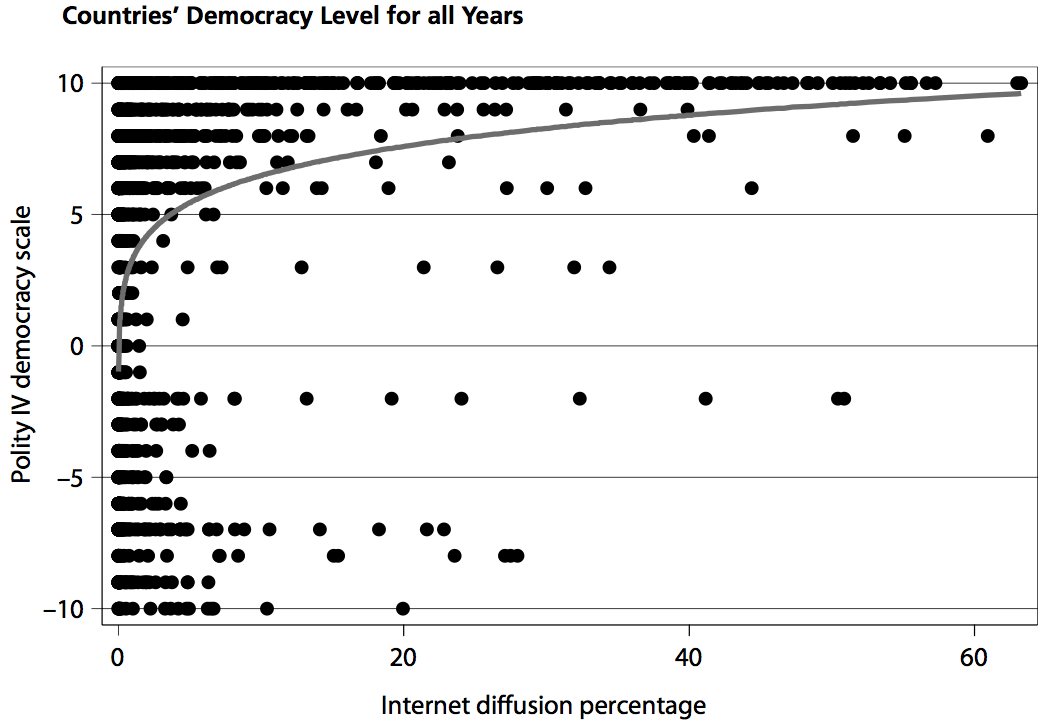
Using macro-level panel data on 152 countries from 1994 to 2003 and multi regression models, Jacob found that “increased Internet diffusion was a meaningful predictor of more democratic regimes.” This democratic effect was greater in countries that were at least partially democratic where the Internet was more prevalent. In addition, the association between Internet diffusion and democracy was statistically significant in “developing countries where the average level of sociopolitical instability was much higher.”

The author thus concludes that policy makers should consider the democratic potential of the Internet but be mindful of unintended consequences in countries under authoritarian rule. In other words, “the democratic potential of the Internet is great, but that actual effects might be limited because Internet diffusion appears conditional upon national-level democracy itself.”

Introduction

While many like Al Gore have professed that information and communication technologies (ICTs) would “spread participatory democracy” and “forge a new Athenian age of democracy,” the lessons of history suggest otherwise. Media system dependence theory maintains that ICTs, “including the Internet, are unlikely to drastically alter asymmetric power and economic relations within and between countries specifically in the short term.”

Others counter that ICTs are “nonetheless vital to democracy and the process of democratization.”For example, both Jefferson and de Tocqueville remarked that a catalyst for American democracy was the free press. While most communication technologies over the last hundred years have failed to fulfill their predicted impact, the Internet is considered special and different. The Internet is “the most interactive and technologically sophisticated medium to date, which enhances user reflexitivity in terms of user participation and generated content and thus has a greater likelihood of affecting change.”

According to media system dependency theory, the framework used in this study, there are two scenarios in which media diffusion may demonstrate micro- and macro-level effects. First, the greater the centralization of specific information-delivery functions, the greater the societal dependency on that media. Second, “as media diffusion and dependency increase over time, the potential for mass media messages to achieve a broad range of cognitive, affective and behavioral effects [is] further increased when there is a high degree of structural instability in the society due to conflict and change.”

Data

The author selected 1994-2003 because “the public launch of the Internet is generally marked around 1994, following the introduction of the Mosaic web browser in 1993 and at the time of writing, 2003 was the latest available year for much of the data.”

  • Socio-political variables included population, urbanism, education, resources, media development, sociopolitical instability, accountability of governors (democracy), gross national income (GNI) and the Human Development Index (HDI), which was included to place countries in developmental categories. While other studies use gross national product (GNP) per capita, Jacob employs GIN per capita, “which is a similar but updated version of GNP that has become the standard for measuring countries’ wealth.”
  • For social instability measures, Jacob used the weighted conflict index found in the Bank’s Cross-Polity Time-Series Database, which represents “an index of domestic stress” used to “approximate domestric stress as a function of sociopolitical instaiblity. “In terms of this study, increased domestic stress was identified as one of the key sociopolitical conditions, namely instability, that might engender a greater democratic effect as a result of the increased diffusion of […] media technologies.” This variable includes codings of assassinations, general strikes, guerrilla warfare, government crises, riots, revolutions, and anti-government desmonstrations.
  • The ICT variables included in the study were Internet diffusion per 100 and a combined figure of televisions and radios divided by popluation figures available from the International Telecommunication Union (ITU). The author did not include newspaper figures because “recent trends in declining newspaper readership suggest newspaper circulation figures may no longer accurately represent mass media development.”
  • The democracy data was drawn from the Polivy IV database, specifically the ‘Polity 2’ democracy score, which is “often recognized for its validity, sophistication and comprehensiveness.” Jacob also notes that factor analyses of the data showed that the Polity 2 scores “load highly (over .90 for all years in this study) with Freedom House (2005) government accountability figures, which have been used previously […].” Note that Jacob used the Polity 2 score with a one-year time lag.
  • The 152 countries were chosen on the basis of their inclusion in many existing databases. The author omitted countries if 15% or more of the data was missing for any category or year. For countries included with missing figures, “mean substitution at the country level was used for each missing case per variable.” It would be helpful if Jacob had noted the number of countries for which mean substitutions was used.

Binary regional and time operators were also added as part of specifying fixed effects regression models.” Like several previous studies, the author did not include government control of the press because an important collinearity problem with democracy measures. “

Method

Jacob used multiple regression models to test his hypothesis that Internet diffusion has democratic effects.  a number of potential causal arguments. He also used fixed effects panel regression to control for time and region-specific effects, omitted variables bias and heteroskedasticity problems. “Specifically, the fixed effects models controlled for unobserved variables that differed across time but did not vary across state.”

Findings

The figure below fits a fractional polynomial (linear-log) regression line to a scatterplot of all countries for all years. Of the most non-democratic countries in 2003 (Belarus, Bahrain, Kuwait, Qatar, Singapore and the United Arab Emirates), only Bahrain showed an increase in the Polity 2 democracy measure. In Belarus, the democracy measure fell dramatically during the 10-year time period despite the fact that the important increase in Internet users by 2003.

While Jacob doesn’t draw on the Open Net Initiative (ONI) research on censorship, the group’s 2008 empirical study “Access Denied” does demonstrate an important global rise in Internet filtering. In other words, repressive regimes are becoming increasingly savvier in their ability to regulate the impact Internet diffusion within their borders.

internetdemocracy1

When taken together, Jacob’s findings suggest that “the democratizing effect of the Internet is severely limited among non-democratic countries.” In addition, Jacob’s results suggest that higher levels of sociopolitical instability in “developing countries proved to be just as important in cultivating a democratic effect as the increased diffusion of Internet.” Another interpretation might be that, “sociopolitical instability may contribute to more apparent levels of Internet effects, even when presented with seemingly inconsequential levels of diffusion” that characterize developing countries.”

This is a surprising finding regardless of the interpretation. At the same time, however, Jacob should have noted that empirical studies in the political science literature have debated the destabilization effects of democratization. See Mansfield and Snyder (2001) for example. In addition, the political transitions literature does note the importance of mass social protests and nonviolent civil resistance in sustainable transitions to democracy. See Stephan and Cherdowith (2008) and my recent findings on the impact of ICTs on the frequency of protests in repressive regimes.

Conclusion

Jacob’s empirical research is an important contribution to the study of ICTs and impact on society, both from a development context—developing versus developed countries—and regime type—democratic versus nondemocratic.

Patrick Philippe Meier

New Tactics in Human Rights

I’ve been wanting to read “New Tactics in Human Rights: A Resource for Practitioners” for a while and finally found the time on the flight back from Geneva. I would definitely recommend reading New Tactics (PDF). The report combines some of my main interests: nonviolent civil resistance, tactical early warning and response, civilian protection, preparedness, technology and complex systems.

I really appreciate the group’s serious focus on tactics since most human rights organizations seem to focus more on grand strategy and advocacy—and this at the expense of tactics.

Tactical innovation is critical to the successful implementation of human rights around the globe. By expanding our thinking both tactically and strategically, the human rights community has the opportunity to be more effective.

There is often a pattern to human rights abuses—they occur in predictable places under predictable circumstances. Recognizing those patterns and disrupting them can be key to protecting human rights.

While intervention tactics are often associated with protest and resistance, some of the most dramatic successes in ending human rights abuses have resulted from negotiation and persuasion.

The report includes numerous tactics and operational examples. I summarize 5 below. I also include a brief note on self-protection and a brief conclusion.

Serbia

Tactic: Protecting arrested demonstrators by protesting outside police stations where they are being detained. This tactic was employed by the anti-Milosevic student resistance movement, Otpor, in Serbia.

Otpor put substantial time and effort into building a strong, extensive and loyal network that could be mobilized quickly. Extensive planning outlined who would call whom and exactly what each person was to do after the arrests, so that the second demonstration would follow the arrests almost instantaneously. Most contact information for the network was stored on individual members’ mobile phones, so that the police could not seize or destroy the information.

West Bank

Tactic: maintaining a physical presence at the site of potential abuse to monitor and prevent human rights violations. Machsom Watch in the West Bank uses the presence of Israeli women to protect Palestinians passing through Israeli checkpoints to ensure their rights are respected.

Monitors who witness abuses make detailed reports and publish them on their website. They invite journalists, politicians and others to join them at the checkpoints. And they wear tags that read in Arabic “No to the checkpoints!” This show of support is heartening to many Palestinians, who may not have a positive image of Israelis.

Northern Ireland

Tactic: using mobile phones to create a network of communication that can stop violence before it escalates. Like any conflict, there are people on both sides who want to prevent the escalation of violence. So the Interaction Belfast group identified leaders in each community who want to prevent violence and provided them with needed information.

During events that are likely to cause violence […] the network plans ahead to monitor key areas. Volunteers recognize that they are able to intervene most effectively in cases of ‘recreational violence’— youth seeking excitement or responding to rumors […].

When volunteers see or hear of crowds gathering [in potential areas of conflict], or hear of rumors of violence about to occur on the other side, they call their counterparts […]. Volunteers calm crowds on their own sides before the incidents become violent. Since the program began, the phone network has both prevented violence and provided communities on both sides of the interface with more accurate information when violence does occur.

Turkey

Tactic: creating a single mass expression of protest based on a simple activity that citizens can safely carry out in their own homes. This tactic was used by the “Campaign of Darkness for Light” in Turkey, which mobilized some 30 million people to flick their lights on and to protest against government corruption.

With many citiznes afraid to participate in political action, organizations needed a tactic of low personal risk that would overcome the sense of isolation that comes with fear.

Organizers initially proposed that citizens turn off their lights for one minute each night.  […]. By the second week, communities began to improvise, initiating different street actions, including banging post and pans. By the time organizers halted the action, the campaign had gone on for more than a month.

Burundi

Tactic: Using the power of the media to send targetted messages to people in a position to end abuses. In this example, journalists in Burundi used radio broadcasts to persuade key leaders to end human rights abuses occurring in hospitals. They secretely interviewed detainees and broadcast their testimonies. “The broadcasts included messages targetted to specific groups and invididuals who had the power to fix the situations.”

Self-Protection

Unfortunately, the report’s 2-page section on “Self-Care: Caring for Your Most Valuable Resource,” is not as well developed as the others. The report could have drawn more extensively from civil resistance training and digital activism. There is also much to be learned from survivor testimonies and security training manuals from field based UN-agencies operating in places like Somalia.

Conclusion

That aside, I think the New Tactics group is doing some of the most exciting research in thiearea of tactics for civilian protection for communities at risk. I highly recommend spending time on their website and browsing through the rich materials they provide.

Patrick Philippe Meier

Project Cybersyn: Chile 2.0 in 1973

My colleague Lokman Tsui at the Berkman Center kindly added me to the Harvard-MIT-Yale Cyberscholars working group and I attended the second roundtable of the year yesterday. These roundtables typically comprise three sets of presentations followed by discussions.

Introducing Cybersyn

We were both stunned by what was possibly one of the coolest tech presentations we’ve been to at Berkman. Assistant Professor Eden Medina from Indiana University’s School of Informatics presented her absolutely fascinating research on Project Cybsersyn. This project ties together cybernetics, political transitions, organizational theory, complex systems and the history of technology.

cybersyn_control_room

I had never heard of this project but Eden’s talk made we want to cancel all my weekend plans and read her dissertation from MIT, which I’m literally downloading as I type this. If you’d like an abridged version, I’d recommend reading her peer-reviewed article which won the 2007 IEEE Life Member’s Prize in Electrical History: “Designing Freedom, Regulating a Nation: Socialist Cybernetics in Allende’s Chile” (PDF).

Project Cybersyn is an early computer network developed in Chile during the socialist presidency of Salvador Allende (1970–1973) to regulate the growing social property area and manage the transition of Chile’s economy from capitalism to socialism.

Under the guidance of British cybernetician Stafford Beer, often lauded as the ‘father of management cybernetics’, an interdisciplinary Chilean team designed cybernetic models of factories within the nationalized sector and created a network for the rapid transmission of economic data between the government and the factory floor. The article describes the construction of this unorthodox system, examines how its structure reflected the socialist ideology of the Allende government, and documents the contributions of this technology to the Allende administration.

The purpose of Cybersyn was to “network every firm in the expanding nationalized  sector of the economy to a central computer in Santiago, enabling the government to grasp the status of production quickly and respond to economic crises in real time.”

Heartbeat of Cybersyn

Stafford is considered the ‘Father of Management Cybernetics” and at the heart of Stafford’s genius is the “Viable System Model” (VSM). Eden explains that “Cybersyn’s design cannot be understood without a basic grasp of this model, which played a pivotal role in merging the politics of the Allende government with the design of this technological system.”

VSM is a model of the organizational structure of any viable or autonomous system. A viable system is any system organised in such a way as to meet the demands of surviving in the changing environment. One of the prime features of systems that survive is that they are adaptable.

vsm

Beer believed that this five-tier, recursive model existed in all stable organizations—biological, mechanical and social.

VSM recursive

Synergistic Cybersyn

Based on this model, Stafford’s team sought ways to enable communications among factories, state enterprises, sector committees, the management of the country’s development agency and the central mainframe housed at the agency’s headquarters.

Eventually, they settled on an existing telex network previously used to track satellites. Unlike the heterogeneous networked computer systems in use today, telex  networks mandate the use of specific terminals and can only transmit ASCII characters. However, like the Internet of today, this early network of telex machines was driven by the idea of creating a high-speed web of information exchange.

Eden writes that Project Cybersyn eventually consisted of four sub-projects: Cybernet, Cyberstride, Checo and Opsroom.

  • Cybernet: This component “expanded the existing telex network to include every firm in nationalized sector, thereby helping to create a national network of communication throughout Chile’s three-thousand-mile-long territory. Cybersyn team members occasionally used the promise of free telex installation to cajole factory managers into lending their support to the project. Stafford Beer’s early reports describe the system as a tool for real-time economic control, but in actuality each firm could only transmit data once per day.”
  • Cyberstride: This component “encompassed the suite of computer programmes written to collect, process, and distribute data to and from each of the state enterprises. Members of the Cyberstride team created ‘ quantitative flow charts of activities within each enterprise that would highlight all important activities ’, including a parameter for ‘ social unease ’[…]. The software used statistical methods to detect production trends based on historical data, theoretically allowing [headquarters] to prevent problems before they began. If a particular variable fell outside of the range specified by Cyberstride, the system emitted a warning […]. Only the interventor from the affected enterprise would receive the algedonic warning initially and would have the freedom, within a given time frame, to deal with the problem as he saw fit. However, if the enterprise failed to correct the irregularity within this timeframe, members of the Cyberstride team alerted the next level management […].”
  • CHECO: This stood for CHilean ECOnomy, a component of Cybersyn which “constituted an ambitious effort to model the Chilean economy and provide simulations of future economic behaviour. Appropriately, it was sometimes referred to as ‘Futuro’. The simulator would serve as the ‘government’s experimental laboratory ’ – an instrumental equivalent to Allende’s frequent likening of Chile to a ‘social laboratory’. […] The simulation programme used the DYNAMO compiler developed by MIT Professor Jay Forrester […]. The CHECO team initially used national statistics to test the accuracy of the simulation program. When these results failed, Beer and his fellow team members faulted the time differential in the generation of statistical inputs, an observation that re-emphasized the perceived necessity for real-time data.
  • Opsroom: The fourth component “created a new environment for decision making, one modeled after a British WWII war room. It consisted of seven chairs arranged in an inward facing circle flanked by a series of projection screens, each displaying the data collected from the nationalized enterprises. In the Opsroom, all industries were homogenized by a uniform system of iconic representation, meant to facilitate the maximum extraction of information by an individual with a minimal amount of scientific training. […] Although [the Opsroom] never became operational, it quickly captured the imagination of all who viewed it, including members of the military, and became the symbolic heart of the project.

Outcome

Cybersyn never really took off. Stafford had hoped to install “algedonic meters” or early warning public opinion meters in “a representative sample of Chilean homes that would allow Chilean citizens to transmit their pleasure or displeasure with televised political speeches to the government or television studio in real time.”

[Stafford] dubbed this undertaking ‘ The People’s Project ’ and ‘ Project Cyberfolk ’ because he believed the meters would enable the government to respond rapidly to public demands, rather than repress opposing views.

As Cybersyn expanded beyond the initial goals of economic regulation to political-structural transformation, Stafford grew concerned that Cybersyn could prove dangerous if the system wasn’t fully completed and only individual components of the project adopted. He feared this could result in “result in ‘ an old system of government with some new tools … For if the invention is dismantled, and the tools used are not the tools we made, they could become instruments of oppression.” In fact, Stafford soon “received invitations from the repressive governments in Brazil and South Africa to build comparable systems.”

Back in Chile, the Cybernet component of Cybersyn “proved vital to the government during the opposition-led strike of October 1972 (Paro de Octubre).” The strike threatened the government’s survival so high-ranking government officials used Cybernet to monitor “the two thousand telexes sent per day that covered activities from the northern to the southern ends of the country.” In fact, “the rapid flow of messages over the telex lines enabled the government to react quickly to the strike activity  […].”

The project’s telex network was subsequently—albeit briefly—used for economic mapping:

[The] telex network permitted a new form of economic mapping that enabled the government to collapse the data sent from all over the country into a single report, written daily at [headquarters], and hand delivered to [the presidential palace]. The detailed charts and graphs filling its pages provided the government with an overview of national production, transportation, and points of crisis in an easily understood format, using data generated several days earlier. The introduction of this form of reporting represented a considerable advance over the previous six-month lag required to collect statistics on the Chilean economy […].

Ultimately, according to Stafford, Cybersyn did not succeed because it wasn’t accepted as a network of people as well as machines, a revolution in behavior as well as in instrumental capability. In 1973, Allende was overthrown by the military and the Cybersyn project all but vanished from Chilean memory.

Patrick Philippe Meier

Digital Democracy in Burma

My colleagues Emily Jacobi and Mark Belinsky from Digital Democracy gave an excellent guest lecture yesterday. They presented their findings from their Burma project to undergraduate students in my digital democracy course co-taught with Josh Goldstein. There excellent slides are available on Slideshare here.

Mark and Emily began their presentation with a reference George Orwell who served in Burma as a military officer. It is striking that every Burmese who has read Orwell claims the author wrote not one but three books on Burma: Burmese DaysAnimal Farm and 1984.

Here are just a few insights from the two-hour presentation that I found particularly interesting:

  • Based on 90+ surveys carried out, Mark and Emily found that young Burmese who had access to the Internet were more likely to identify themselves as activists.
  • The Bangladeshi cell phone network extends well into Burma so activists can use phones from Bangladesh to relay information.
  • Monks have access to the Internet and to mobile phones because the Junta provided them the technology as part of alms giving.

Mark and Emily shared some fascinating anecdotes on digital activism in Burma based on their field research. Some are somewhat sensitive and not blog-able but others are less so yet equally eye opening. For example, Mark recounts a visit to a Burmese refugee camp along the Bangladeshi-Burma border:

I had five minutes of idle time and so decided to check my Facebook page using my mobile phone. I was soon approached by one of the refugees who looked on curiously. Before I could explain, the person enquired, “Do you wiki?” I was stunned as he pulled out a much fancier phone and proceeded to show me his favorite Wikipedia pages which were on fancy sports cars.

Patrick Philippe Meier

Digital Resistance and the Orange Revolution

My colleague Joshua Goldstein recently researched the role of digital networked technologies in the Ukranian Orange Revolution (PDF). There are few case studies out there that address both digital activism and civilian resistance, i.e., digital resistance, so what follows is a detailed summary of Josh’s report for the Berkman Center along with some of my own research.

Introduction

Compared to the other three panel presentations, this study takes a narrative case study approach and focuses on a single case study, the role of the Internet and mobile phones during the Orange Revolution.

For Josh, one of the most fascinating questions about the Orange Revolution is how the Internet became such an influential tool when only 4% of the population was online? Even though such a small percentage of the population had Internet access, “the Orange Revolution may have been the first in history to be organized largely online.”

Theory

To understand what contributed to this digital revolution, Josh draws on the Two-Step Flow Theory developed by sociologists Katz and Lazardsfeld (1955), which delineates a ‘two step’ information path. The first is the direct path between mass media and the general public. The second path is among elite opinion makers who strongly influence public opinion.

According to Josh,

This theory helps delineate how a relatively small group of activists and citizen journalists helped create a distinct information environment that challenged the narrative presented by state sanctioned media.

In the Ukraine, both the rise of citizen journalism and  influential opinion makers from the opposition were in large part consequences  of the widespread self-censorship that existed in the country.

‘Self censorship was not enshrined in law, but it was well known that oligarchs owned all of the major television stations. Station managers received temnyky, unsigned directives from the President’s office that urged them to cover the news in a particular way. Managers knew that if they did not please the ‘key viewer,’ the President and his regime, they would be in danger of losing their jobs.

As Josh notes, however, Channel 5 was the notable exception. The small television station had been bought by members of the opposition to promote an independent view on Ukranian politics. Although Channel 5 only available to 30% of the population, the station became well known for it’s alternative view on domestic affairs.

In addition, citizen opposition journalism posed a central challenge to the semi-autocratic regime. However, Josh writes that the Ukranian public already recognized the Internet as a legitimate news source. Online news sites including Pravda, Obozrevatel and ProUA, were well already well known. Moreover, they were a “hybrid between citizen and professional media [since] they were predominantly staffed by professional journalists but often received low pay or were motivated by changing the Ukranian landscape.”

To build on his theoretical framework, Josh also draws on Stephen Bandera’s empirical study on political participation during the Orange Revolution. The results of this study revealed that “Ukranians who use the Internet were more likely to be online political citizens than their American counterparts.”

Lastly, Josh recognizes that technologies alone do not explain the success of the Orange Revolution:

The ability to diffuse tension through humor and satire was crucial to the success of the Orange Revolution. […] Every joke and pun created by this community of activists and directed at [the regime] further drew attention to the vastly different information environments and political futures that the two candidates represented.

Case Studies

Josh draws on two case studies to test out his theoretical framework. The first is Maidan and the second Para.

Maidan was a group of tech-savvy pro-democracy activists who used the Internet as a tool to support their movement. Maidan in Ukranian means public square and Maidan’s website features the slogal “You CAN chnage the world you live in. And you can do it now. In Ukraine.”

The main activity of Maidan was election monitoring and networking with other pro-democracy organizations around Eastern Europe. Maidan hosted around 27 election monitoring trainings, in nearly every Ukranian region, with support from Serbia’s Otpor movement. […] In the year leading up to the election, Maidan trained 500 Ukranians to observe the election. This evidence collected […] was central to proving the existence of massive election fraud.

However, the founder of Maidan argues that “websites cannot produce an activist organization.” As Josh explains, it was crucial for Maidan to frequently host real world meetings as their membership base increased. The human element was particularly important. This explains why Maidan encouraged users to disclose their identity whenever possible.

Maidan was not a completely decentralized organization. The community benefited from centralized leadership that developed the organization’s culture, controlled its assets and provided the strategy to achieve desired goals. The Maidan experience thus demonstrates a hybrid organization.

In sum, the Internet was clearly a vital, multi-faceted tool for Maidan. The Internet facilitated outreach, training, awareness raising, fundraising and marketing. At the same time, centralized, top-down leadership was necessary to accomplish the organization’s goals.

Pora, meaning “It’s Time” in Ukranian, was a well-organized group of  pro-democracy volunteers that “emerged as an information sharing campaign and during the elections morphed into coordinators of mass protest centered around tent cities in towns throughout Ukraine. The grassroots movement took its inspiration from Serbia’s Otpor movements as well as “older civic movements in Hungary and Czechoslovakia.”

The organization described it’s raison d’être as follows:

Under conditions of far-reaching censorship and absence of independent media, the main idea of Pora is the creation of alternative ‘mass media,’ in which volunteers deliver election-related information ‘from hand to hand’ directly to people throughout the Ukraine.

Pora promoted “the active use of modern communication systems in the campaign’s management,” and “mobile phones played an important role for mobile fleet of activists.” According to Pora’s post-election report, “a ssytem of immedate dissemination of information by SMS was put in place and proved important.” In addition, “some groups provided the phones themselves, while others provided SIM cards, and most provided airtime.”

The Internet also played a role in Pora’s campaign by providing rapid reporting in a way that no other medium could. As tent cities across the Ukraine became the sign of the revolution,

The news feed from the regions [became] vitally important. Every 10 to 15 minutes another tent city appeared in some town or other, and the fact was soon reported on the air. News from the region was read by opposition leaders on Maidan to millions of listeners in the streets of Ukraine.

While the government certainly saw the Internet as a threat, the government had not come to consensus regarding the “legal and political frameworks it would use to silence journalists that published openly on this new medium.” Ukrainian law considered the Internet to be a “peer-to-peer communication tool and not a mass media platform,” which explains why “online sites were able to blossom” and why many online journalists unlike mainstream journalists were free from the threat of defamation charges.

In addition to new technologies, the grassroots movement also “successfully leveraged traditional methods of spreading information [such as] print products (leaflets, brochures, stickers, and small souvenirs), public activities and demonstration, visual representations (posters and graffiti), media presentations (clips and interviews), and periodicals.”

Josh argues that these activities make the Orange Revolution one of the earliest examples of what Steven Mann calls “sousveillance,” meaning, “the monitoring of authority figures by grassroots groups, using the technologies and techniques of surveillance.” In short, Pora’s campaign represents the clearest link between the small percentage of Ukranian elite who were online and the general public.

Findings

Josh concludes that the Internet and mobile phones proved to to be effective tools for pro-democracy activists.

First, the Internet allowed for the creation of a space for dissenting opinions of ‘citizen journalists’ in an otherwise self-cencosred media environment.

Second, pro-democracy activists used the convergence of mobile phones and the Internet to coordinate a wide range of activities including election monitoring and large-scale protests.

In sum, Josh observes that “pro-democracy forces used the Internet and mobile phones more effectively than the pro-government forces, such that in this specific time and place these technologies weighed on the side of democracy.” Nevertheless, as Ned Rossiter cogently points out,

Technology certainly does not make possible a direct democracy, where everyone can participate in a decision, nor representative democracy where decision makers are elected; nor is it really a one-person-one-vote referendum style democracy. Instead it is a consultative process known as ‘rough consensus and running code.’

This points to a larger question for further research, which forms the basis for my dissertation:

Are these tools inherently conducive to the expansion of civic engagement and democratization or will authoritarian governments adapt the technology to their own advantage?

My Own Conclusion

One very interesting anecdote not reported in Josh’s report demonstrates the real power of traditional media. Natalia Dmytruk worked for the Ukraine’s state-run television news program as an interpreter of sign language for the hearing-impaired. As the revolution picked up momentum, she decided she couldn’t lie anymore and broke from the script with the following message:

I am addressing everybody who is deaf in the Ukraine. Our president is Victor Yushchenko. Do not trust the results of the central election committee. They are all lies. . . . And I am very ashamed to translate such lies to you. Maybe you will see me again…

According to a Washington Post article at the time, “Dmytruk’s live silent signal helped spread the news, and more people began spilling into the streets to contest the vote.”

Overall, what really strikes me about Josh’s peace is the very real convergence between civil resistance and digital activism, or digital resistance. Citizen journalists and digital activists participated in civil resistance trainings across the country, courtesy of Otpor. The use of humor and puns directed at the regime is a classic civil resistance tactic.

I spoke with Josh just yesterday about his research on the Orange Revolution and he was adamant that one of key reasons that explains the success of the revolution has to do with the fact that “the protesters were very well trained and very good at protesting… very, very good.”

This highlights just how critical training in civil resistance is. Digital activists need to acquire the tactical and strategic know-how developed over decades of civil resistance movements. Otherwise, tactical victories by digital activists may never translate into overall strategic victory for a civil resistance movement.

Patrick Philippe Meier

ISA 2009: Panel on ICTs, Human Rights, Activism and Resistance

I just chaired a very productive panel at the International Studies Association (ISA) on the impact of ICTs on human rights, political activism and resistance.

ISApanel

The panel featured the following presentations:

  • Lucía Liste Muñoz and Indra de Soysa onThe Blog vs Big Brother: Information and Communication Technologies and Human Rights, 1980-2005.
  • Fabien Miard on “Call for Power? Mobile Phones as Facilitators of Political Activism.”
  • Patrick Meier on “iRevolutions: The Impact of ICTs on Protest Frequency in Repressive Contexts.” [slideshare]

Presentations

I’ve already blogged about each of the papers individually (see links above) so what follows are points from some of the presentations that I found particularly interesting. I also include the superb feedback that our discussant Professor Dan Drezner from The Fletcher School provided along with a summary of the productive Q&A session we had.

  • Muñoz and de Soysa: Their results show that Internet access leads to increasing respect of human rights by governments. This is true of both democracies and authoritarian regimes.
  • Joshua Goldstein: The role that Safaricom (a private telecommunications company) had in seeking to prevent and/or mitigate the election violence is unprecedented. Not only did the company refuse switch of the SMS network as per the government’s request, the company also sent out broadcast SMS to call on restraint and civic behavior.

Feedback to Panelists

Dan Drezner provided the following feedback:

  • The papers were definitely panel material as they all address important issues related to ICTs that overlap in very interesting ways. So overall, this was great set of papers and presentations, and panelists ought to make sure they read and learn from each others’ papers.
  • Most of the large-N papers blatantly seek to identify a positive correlation between ICT and human rights, political activism, digital resistance, etc. A less biased way to approach the research would be to formulate the question as follows: “How do ICTs benefit the State?”
  • Patrick should expand his set of countries beyond the 22 countries.
  • The dynamic between states and society vis-a-vis repression and circumvention may be an evolutionary one based on learning behavior.
  • The papers should treat ICTs not as independent variables but as an interactive variable with factors such as unemployment. In other words, the question should be: to what extent does ICT interact with other variables that we know ought to trigger protests?
  • The studies should separate anti-foreign protests from anti-government protests.
  • The large-N analyses should include more control variables such as dummy varibales for elections and wars.
  • The studies should also seek to assess the relationship between ICTs and the magnitude of protests and not only the frequency of protests.
  • The papers do not take into account the role of the Diaspora in helping to mobilize, organize and coordinate protests.

Response to Feedback

Here I only respond the feedback relevant to my paper and presentation:

  • On the bias towards finding a statistical relationship and expanding the number of countries in my study, I disagreed with Professor Drezner. I specifically chose the 22 countries in my dataset because the regimes in these countries are actively using ICTs to censor, repress, monitor and block information. So if anything, the cards are stacked against resistance movements when it comes to these countries. Hence my not planning to expand the dataset to include additional countries. Professor Drezner agreed on both points.
  • I completely agree on the evolutionary dynamic, which I described in my dissertation proposal and which explains why I often refer to the dynamic as a cyber game of cat-and-mouse.
  • I’m not entirely sold on treating ICTs as an interactive variable but will explore this nonetheless.
  • Agreed on the suggestion that anti-foreign protests be treated seperately since these protests are often organized by repressive regimes.
  • I fully agree on adding more control variables including elections, wars and population.
  • I concur with the point made about the magnitude of protests but this information is hard to come by. More importantly, however, the dataset I’m using is based on Reuters newswires and the reason I’m using this data is because Reuters is highly unlikely to report on low-level protests but rather on protests that have a national impact. So the dataset serves as a filter for large-scale protests and hence magnitude.
  • Very good point about the diaspora.

Q&A Session

We had an excellent set of questions from the audience which prompted a rich conversation around the following topics:

  • Repressive regimes learning from one another about how to use ICTs for censorship, repression, monitoring, etc. and resistance movement learning from each other.
  • The side to first acquire and apply new technology generally gets a head start, but this prompts the other side, e.g., the State to catch up and regain the upper hand.
  • Who are the users of these technologies? Demographics, gender, age, etc, should be important factors in the study of ICTs, State and society.
  • One member of the audience was a policy maker with the British government and  wanted to know what role Western governments should  play vis-a-vis digital activism.
  • The issue of civil resistance and the intersection with digital activism came up repeatedly in the discussion. Understanding one without the other is increasingly meaningless.

Patrick Philippe Meier

ISA 2009: Digital Technologies in Kenya’s Post Election Crisis

The fourth presentation at the ISA panel that I’m chairing will feature research by Joshua Goldstein and Juliana Rotich on the role of digital networked technologies during Kenya’s post-election violence (PDF). Blog posts on the other three presentations are available here on human rights, here on political activism and here on digital resitance.

Introduction

Josh and Juliana pose the following question: do mobile phones and the Internet promote transparency and good governance or do they promote hate speech and conflict? The authors draw on the 2007-2008 Kenyan presidential elections to assess the impact of digitally networked technologies, specifically mobile phones and the Internet, on the post-election violence.

This study is an important contribution to the scholarly research on the impact of digital technology on democracy since the majority of the existing literature is largely written through the lens of established, Western democracies. The literature thus “excludes the experience of Sub-Saharan Africa, where meaningful access to digital tools is only beginning to emerge, but where the struggle between failed state and functioning democracy are profound.”

Case Study

Josh and Juliana draw on Kenya as a case study to assess the individual impact of mobile phones and the Internet on the post-election violence. The mobile phone is the most widely used digital application in Kenya and the rest of Africa. The low cost and ease of texting explains how quickly “hate SMS” began circulating after Kenya’s election day. Some examples of the messages texted:

Fellow Kenyans, the Kikuyu’s have stolen our children’s future… we must deal with them in a way they understand… violence.

No more innocent Kikuyu blood will be shed. We will slaughter them right here in the capital city. For justice, compile a list of Luo’s you know… we will give you numbers to text this information.

The authors are concerned about the troubling trend of hate SMS in East Africa citing a violent icident in neighboring Uganda that was organized via SMS to protest the government’s sale of a forest to a company. As they note, “mass SMS tools are remarkably useful for organizing this type of explicit, systematic, and publicly organized campaign of mob violence.”

However, the authors also recognize that “since SMS, unlike radio, is a multi-directional tool, there is also hope that voices of moderation can make themselves heard.” They point to the response taken by Michael Joseph, the CEO of Kenya’s largest mobile phone provider Safaricom when he was asked by government officials to consider shutting down the SMS system:

Joseph convinced the government not to shut down the SMS system, and instead to allow SMS providers to send out messages of peace and calm, which Safaricom did to all nine million of its customers.

Josh and Juliana also note that tracking and identifying individuals that promote hate speech is relatively easy for governments and companies to do. “In the aftermath of the violence, contact information for over one thousand seven hundred individuals who allegedly promoted mob violence was forwarded to the Government of Kenya.” While Kenya didn’t have a law to prosecute hate SMS, the Parliament has begun to create such a law.

The Internet in Kenya was also used for predatory and civic speech. For example, “the leading Kenyan online community, Mashahada, became overwhelmed with divisive and hostile messages,” which prompted the moderators to “shut down the site, recognizing that civil discourse was rapidly becoming impossible.”

However, David Kobia, the administrator of Mashahada, decided to launch a new site a few days later explicitly centered on constructive dialogue. The site, “I Have No Tribe,” was successful in promoting a more constructive discourse and demonstrates “that one possible response to destructive speech online is to encourage constructive speech.”

Mobile phones and the Internet were combined by Ushahidi to crowdsource human rights violation during the post-election violence. The authors contend that the Ushahidi platform is “revolutionary for human rights campaigns in the way that Wikipedia is revolutionary for encyclopedias; they are tools that allow cooperation on a massive scale.” I have already blogged extensively about Ushahidi here and here so will not expand on this point other than to emphasize that Ushahidi was not used to promote hate speech.

Josh and Juliana also draw on the role of Kenya’s citizen journalists to highlight another peaceful application of digital technologies. As they note, Kenya has one of the richest blogging traditions in sub-Saharan Africa, which explains why,

Kenyan bloggers became a critical part of the conversation [when] the web traffic from within Kenya shot through the roof. The influence ballooned further when radio broadcasters began to read influential bloggers over the airwaves, helping them reach […] 95% of the Kenyan population.”

When the Government of Kenya declared a ban on live news coverage on December 30, 2007, Kenyan bloggers became indispensable in their role as citizen journalists. […] Blogs challenged the government’s version of events as they unfolded.

[…] Further, Blogs became a critical source of information for Kenyans in Nairobi and the diaspora. Rumors spread via SMS were dispelled via an online dialogue that took place on blogs and in the comments section of blogs.

Conclusion

When we talk about the ‘networked public sphere,’ we are usually referring to a Western public sphere; one that facilitates public discourse, increased transparency and positive cooperation. However, as the case study above demonstrates, the narrative is more involved when we talk about an African or Kenyan ‘networked public sphere.’ Indeed, the authors conclude that digital networked technologies catalyzed both “predatory behavior such as ethnic-based mob violence and civic behavior such as journalism and human rights campaigns.”

Several questions remain to be addressed in further research. Namely, how important is a vibrant blogosphere to promote positive applications of digital technologies in times of crises? Are networked digital technologies like Ushahidi more susceptible to positive uses than predatory uses? And finally, how does the Kenya case compare to others like the Orange Revolution in the Ukraine?

Patrick Philippe Meier

ISA 2009: Digital Technologies in Kenya’s Post Election Crisis

The fourth presentation at the ISA panel that I’m chairing will feature research by Joshua Goldstein and Juliana Rotich on the role of digital networked technologies during Kenya’s post-election violence (PDF). Blog posts on the other three presentations are available here on human rights, here on political activism and here on digital resitance.

Introduction

Josh and Juliana pose the following question: do mobile phones and the Internet promote transparency and good governance or do they promote hate speech and conflict? The authors draw on the 2007-2008 Kenyan presidential elections to assess the impact of digitally networked technologies, specifically mobile phones and the Internet, on the post-election violence.

This study is an important contribution to the scholarly research on the impact of digital technology on democracy since the majority of the existing literature is largely written through the lens of established, Western democracies. The literature thus “excludes the experience of Sub-Saharan Africa, where meaningful access to digital tools is only beginning to emerge, but where the struggle between failed state and functioning democracy are profound.”

Case Study

Josh and Juliana draw on Kenya as a case study to assess the individual impact of mobile phones and the Internet on the post-election violence. The mobile phone is the most widely used digital application in Kenya and the rest of Africa. The low cost and ease of texting explains how quickly “hate SMS” began circulating after Kenya’s election day. Some examples of the messages texted:

Fellow Kenyans, the Kikuyu’s have stolen our children’s future… we must deal with them in a way they understand… violence.

No more innocent Kikuyu blood will be shed. We will slaughter them right here in the capital city. For justice, compile a list of Luo’s you know… we will give you numbers to text this information.

The authors are concerned about the troubling trend of hate SMS in East Africa citing a violent icident in neighboring Uganda that was organized via SMS to protest the government’s sale of a forest to a company. As they note, “mass SMS tools are remarkably useful for organizing this type of explicit, systematic, and publicly organized campaign of mob violence.”

However, the authors also recognize that “since SMS, unlike radio, is a multi-directional tool, there is also hope that voices of moderation can make themselves heard.” They point to the response taken by Michael Joseph, the CEO of Kenya’s largest mobile phone provider Safaricom when he was asked by government officials to consider shutting down the SMS system:

Joseph convinced the government not to shut down the SMS system, and instead to allow SMS providers to send out messages of peace and calm, which Safaricom did to all nine million of its customers.

Josh and Juliana also note that tracking and identifying individuals that promote hate speech is relatively easy for governments and companies to do. “In the aftermath of the violence, contact information for over one thousand seven hundred individuals who allegedly promoted mob violence was forwarded to the Government of Kenya.” While Kenya didn’t have a law to prosecute hate SMS, the Parliament has begun to create such a law.

The Internet in Kenya was also used for predatory and civic speech. For example, “the leading Kenyan online community, Mashahada, became overwhelmed with divisive and hostile messages,” which prompted the moderators to “shut down the site, recognizing that civil discourse was rapidly becoming impossible.”

However, David Kobia, the administrator of Mashahada, decided to launch a new site a few days later explicitly centered on constructive dialogue. The site, “I Have No Tribe,” was successful in promoting a more constructive discourse and demonstrates “that one possible response to destructive speech online is to encourage constructive speech.”

Mobile phones and the Internet were combined by Ushahidi to crowdsource human rights violation during the post-election violence. The authors contend that the Ushahidi platform is “revolutionary for human rights campaigns in the way that Wikipedia is revolutionary for encyclopedias; they are tools that allow cooperation on a massive scale.” I have already blogged extensively about Ushahidi here and here so will not expand on this point other than to emphasize that Ushahidi was not used to promote hate speech.

Josh and Juliana also draw on the role of Kenya’s citizen journalists to highlight another peaceful application of digital technologies. As they note, Kenya has one of the richest blogging traditions in sub-Saharan Africa, which explains why,

Kenyan bloggers became a critical part of the conversation [when] the web traffic from within Kenya shot through the roof. The influence ballooned further when radio broadcasters began to read influential bloggers over the airwaves, helping them reach […] 95% of the Kenyan population.”

When the Government of Kenya declared a ban on live news coverage on December 30, 2007, Kenyan bloggers became indispensable in their role as citizen journalists. […] Blogs challenged the government’s version of events as they unfolded.

[…] Further, Blogs became a critical source of information for Kenyans in Nairobi and the diaspora. Rumors spread via SMS were dispelled via an online dialogue that took place on blogs and in the comments section of blogs.

Conclusion

When we talk about the ‘networked public sphere,’ we are usually referring to a Western public sphere; one that facilitates public discourse, increased transparency and positive cooperation. However, as the case study above demonstrates, the narrative is more involved when we talk about an African or Kenyan ‘networked public sphere.’ Indeed, the authors conclude that digital networked technologies catalyzed both “predatory behavior such as ethnic-based mob violence and civic behavior such as journalism and human rights campaigns.”

Several questions remain to be addressed in further research. Namely, how important is a vibrant blogosphere to promote positive applications of digital technologies in times of crises? Are networked digital technologies like Ushahidi more susceptible to positive uses than predatory uses? And finally, how does the Kenya case compare to others like the Orange Revolution in the Ukraine?

Patrick Philippe Meier

ISA 2009: Mobile Phones and Political Activism

The second presentation at the ISA panel that I’m chairing will feature research by Fabien Miard on mobile phones as facilitators of political activism (see previous post for first presentation). Fabien will be sharing the findings from his recent MA thesis (PDF), which I have read with great interest.

Introduction

Fabien’s research examines whether the number mobile phones affect political activity by drawing on a large-N quantitative study. This is an area in much need of empirical analysis since “little systematic research beyond loose collections of case studies has been done so far.” Furthermore, as I have noted in my own dissertation research, the vast majority of social science research on information and communication technologies (ICTs) is focused on the impact of the Internet exclusively.

Data

The large-N study draws on the proprietary Cross-National Time-Series Data Archive (CNTS) for data on three forms of political activism: anti-government demonstrations, riots and major government crises. This dataset is derived from articles published in the New York Times (NYT). The data on the number of mobile phone subscribers is provided by the International Telecommunication Union (ITU). Control variables include: GDP per capita and population. The data he used spanned 191 countries between 1991-2006 but “a third of these dropped out due to missing values.”

Analysis

Fabien uses negative binomial regression (with one year time lag) to test whether the number of mobile phone subscribers is a statistically significant predictor of political activism.

The results indicate that mobile density has no significant effect on anti-government demonstrations when the control variables are included. The same is true when using riots or major government crises as dependent variables. GDP per capita is small and insignificant except for riots, where it has a significant negative effect. Population has an effect on all three variants of political activism variables.

Conclusion

Fabien therefore concludes that mobile connectivity is neither negatively nor positively associated with political activism. This implies that existing case studies “are overrated and that generalization by means of a global comparative case study is not possible.” He suggests that future quantitative research  take into account the following two recommendations:

  • Compare the impact of mobile phones on democratic versus oppressive regimes;
  • Analyze the combined impact of mobile phones and the Internet in addition to traditional technology variables;

These suggestions are spot on. One large-N quantitative study that I recently co-authored at the Berkman Center takes the first recommendation into account by comparing the impact of Internet and mobile phone users on measures of governance and democracy in both democratic and autocratic regimes (stay tuned for a blog post on this).

In my own dissertation research, I plan to compare the impact of Internet and mobile phone users on protests frequency in highly repressive versus midly repressive regimes. I also take into account Fabien’s second recommendation by adding Internet users and landlines. Furthermore, I include unemployment rate as a control variable which Fabien omits in his analysis.

Patrick Philippe Meier