Category Archives: Digital Activism

Global Voices Summit: NGOs and Local Activists

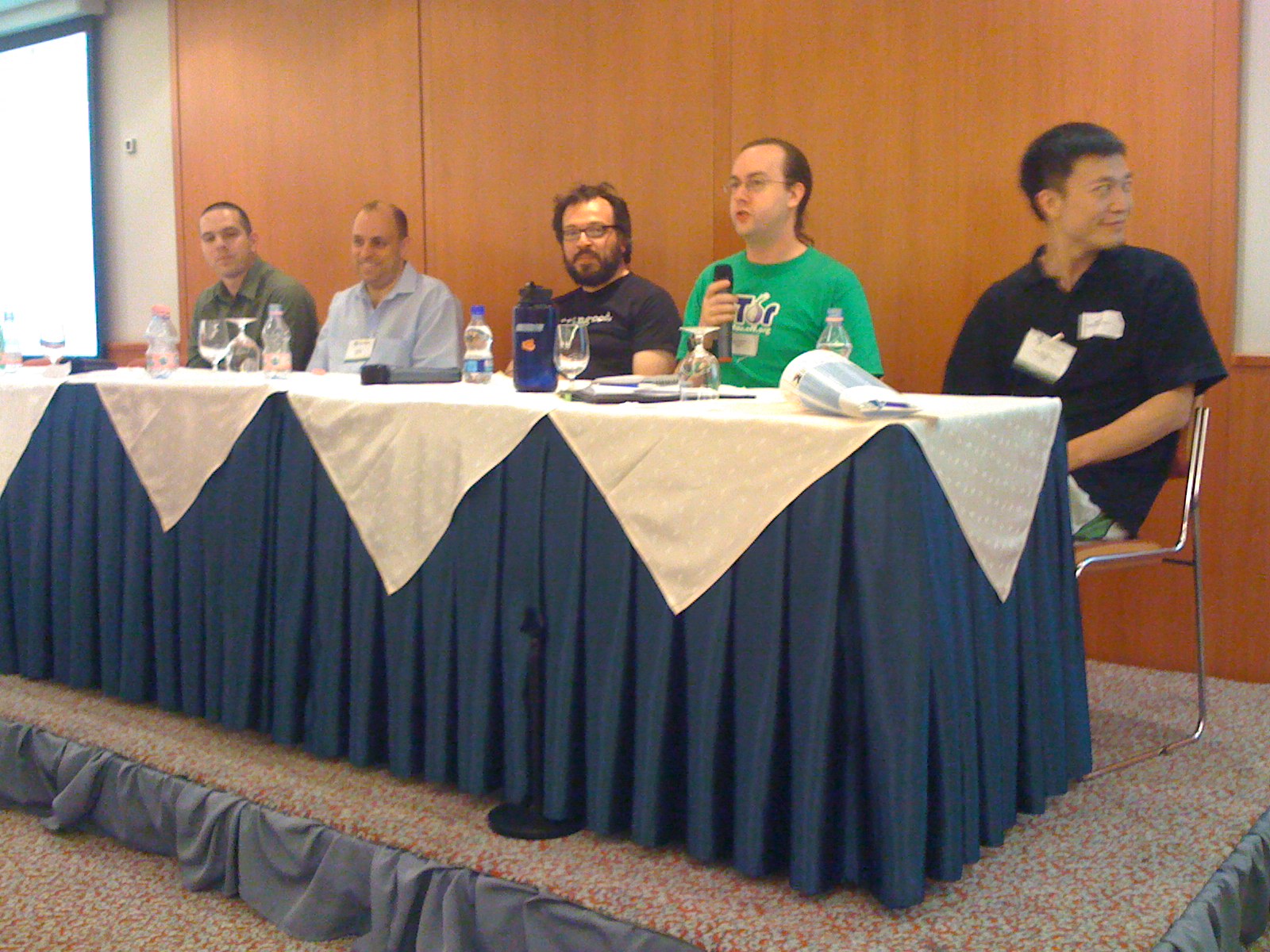
The final panel of the first day included representatives from Human Rights Watch, Reporters without Borders, Hands Across the Mideast Support Alliance, Amnesty International and Global Voices.

Some notes:

  • We can support activists by informing them of their legal rights;
  • Need to connect with local and national human rights NGOs;
  • Find allies within the ICT ministries to help prevent censorship from taking place;
  • Respond quickly to censorship; develop tools to detect more quicly and providing tools to host mirror sites;
  • Framing a campaign or issue is fundamentally important. When campaigning in the West, we need to frame issues in such a way that they are relevant to them;
  • Training is important as technical issues are not always resolved remotely;
  • Many advocates rely mostly on email, IM and mobiles, and less so on the Internet
  • Riseup.net
  • Pidgin.im
  • Taking a technical solution to what is otherwise a social issue is a problem;
  • Forthcoming book: The Blogging Revolution (September 2008);

Patrick Philippe Meier

Global Voices Summit: Frontline Activists, Tools and Knowledge

The fourth panel addresses the challenge of providing people with the tools they need to circumvent web filtering and other methods of online censorship. Digital activists and technology experts from China, Cuba and the US shared their insights.

Some notes:

  • Part of the arms race is between us and US corporations;
  • The use of censorship circumvention and anonymity technology is global;
  • There are circumvention, anonymity and hybrid tools;
  • Everyone’s Guide to By-Passing Internet Censorship
  • Digital Security for Human Rights Defenders
  • Three walls to digital activism: free access (technology), free speech (poliitcs) and free thinking (education);
  • Digital Nomad is a non-profit group that provides services for co-location of hosting; CMS software installation; Fast responses to the Great Firewall; Marketing with social media;
  • The Chinese government blocks some key words in domain names/URLs (me: how about using domain names similar to major multinational companies operating in China, e.g., IBM, Microsoft, etc);
  • Governments are increasingly savvy in their ability to block emails with specific key words;
  • We need to localize both the software tools and the training manuals;
  • We need to share best practices vis-a-vis tools and tactics to decrease vulnerabilities;
  • Vaultletsoft.com allows for sending of emails that expire (can no longer be read) after a specified amount of time;
  • The Internet perceives censorship as damage and will work around;
  • Web 2.0 tools are actually quite centralized;
  • Tor does NOT encrypt emails, so always, always use https

Patrick Philippe Meier

GLobal Voices Summit: Living with Censorship

The third panel included digital activists based in China, Bangladesh, Sudan, Thailand, Syria, Middle East and North Africa.

Notes from the panel follow.

  • Original legal proposal in Thailand for punishing computer-related crime included the death penalty; this has now been changed to a 20-year jail sentence;
  • Regimes in Middle East and North Africa are concerned about (possible) shift in power brought about by the Internet;
  • Iran bans fast internet to cut West’s influence;
  • Some websites in the Middle East have two links on their homepage, “Click here to Enter” and “Click here to access our website when it gets blocked”; the latter including a tutorial on how to access censored websites;
  • Based on the results of a survey in the Middle East, 24% of Internet users who participated in the survey said they did not use circumvention tools because they did not know how.
  • Accessing the web is limited by blocking and censorship, but most importantly by the digital divide, both between and within countries;
  • Following Sichuan earthquake in China, blogger groups became NGOs;
  • In Bangladesh, authorities issue notcie to ISPs to provide list of all subscribers with names, address, and connection details; share the admin password of Internet gateway servers;
  • The endgame of all censorship is self-censorship;
  • Any solution to the problem of censorship has to be much more than technical, much more than legal (me: maybe nonviolent action?);
  • Blogosphere in Ethiopia particularly vibrant through to 2006 but government then blocked blogspot; number of blogs have virtually dwindled to a stop;
  • Free Tariq campaign in Syria failed because it did not address the people locally; most importantly because “freedom of speech” was not a priority for the peope; Struggle to convince people that freedom of speech;

Patrick Philippe Meier

Global Voices Summit: Citizen Media and Online Free Speech

DigiActive’s Mary Joyce moderated the second panel of the Summit that included bloggers from Egypt, Morocco, Hong Kong, Singapore and Iran.

The main points from the presentations:

  • Newspapers in Egypt have stolen blog content and printed them;
  • Blogger criticizing Libyan leader Gaddafi was forced shut down her blog;
  • Mobile phone credit via Mpesa was more important than money in Kenya’s post-election period;
  • There was a lot of self-censorship in the Blogosphere during the violence in Kenya;
  • Using Twitter via mobile phone costs credit with every text message;
  • For Ory Okolloh, not being anonymous was an advantage;
  • In Singapore, the relatively high standard of living makes people more willing to accept censorship;
  • Use of camera phones to film police injustice and corruption spreading in Morocco;
  • Moroccan activist imprisoned and tortured for putting fake profile of Prince’s brother on Facebook; when interrogated, he was asked, “Why did you invent Facebook?”
  • Recent social protests in Sidi Ifni were repressed by police forces; the Moroccan government initially denied that anything had occured, but the incident was well covered by camera phones with numerous videos posted on YouTube. The government then had to conceded that there had been some unrest;
  • Iranian officials announced in 2006 that some 10 million Internet sites are blocked by government agencies.
  • Anti-Bush and anti-war American blogs and sites are filtered in Iran; while Neoco pro war blogs with Iran are not filtered.

Patrick Philippe Meier

Global Voices Summit: Toward a Global Anti-Censorship Network

The first panel of the summit included presentations by activists in Belarus, Japan, Egypt and Pakistan.

Some of the main points I took away from the panel discussion:

  • Censorship is not good for business;
  • The key in anti-censorship tools is simplicity, ease of use;
  • Blogs not frequently blocked in Egypt, but torture used to induce self-censorship;
  • The stakes for governments are too high to allow for a free Internet in Egypt;
  • Digital activism cannot be separated from the main struggle for democracy;
  • Are bloggers above the law? Should we always support them?
  • Mobile phone content (lifestyle, religion, political issues) is already being filtered in Japan;
  • Bill passed into law in Japan to oblige pre-installaltion national standard-based filtering software;
  • Companies in Japan pushing against censorship since some games being blocked;
  • Some argue Japan will be left behind if censorship spreads;
  • Japanese not concerned about government, but rather other citizens who engage in troubling activities on the net;
  • Pkblogs.com is a site that allows you to access blogs on blogspot if they are blocked by India, Pakistan, Iran and China;
  • Vid.pk is a local alternative to YouTube in Pakistan;
  • SMS activism and Twitter used in Pakistan; but what they really needed was an SMS forwarding and broadcasting service;
  • In Pakistan, Blog via Frontline SMS, but Frontline was complicated to set up; international SMS migth be more expensive but would be easier;
  • pkLongMarch.blogspot.com is an event based live SMS / Email blogging site;
  • In Pakistan, to really reach the people one must tap mobile content and SMS.

Patrick Philippe Meier

Global Voices Summit: Welcome & Introduction

Ethan Zuckerman and Rebecca MacKinnon launched the 2-day Summit by sharing the origins of Global Voices.

Sami Ben Gharbia gave the first presentation on digital activism, emphasizing the new power combination of camera phones, YouTube and blogs.

“YouTube plus the Blogosphere is a dangerous combination for repressive regimes.” Videos have led to arrests of policemen in Morocco and Egypt. But both blogs and YouTube can be blocked.

But you can email your blog entry to your Blogger account and have that posted across dozens of different social network media.

Collaboration between activists across the world is very real. Sami showed an impressive Google Map depicting the technologies and tactics of numerous digital activists learning from each other to bypass.

Patrick Philippe Meier

Global Voices Summit: Small Group Discussions

We broke into several groups to discuss the following issues in more depth:

  1. NGOs and activists: the need for better coordination.
  2. Understanding, fighting and bypassing online censorship.
  3. Digital security and privacy for online activists and bloggers.

I participated in Group 2 and took the following notes (apologies that I don’t have time to structure them):

  • Blogs untouched in the Sudan
  • When is content filtered automatically or manually?
  • Australian government recently proposed to censor ‘terrorist’ websites, which could be a slippery slope. At the same time, Australia’s government is democratic, which means the specific sites being blocked would be made transparent. Plus, the government would be susceptible to votes, unlike other regimes such as Sudan.
  • In Yemen, a proxy was used to provide aggregator news, then opened it up to everyone but then flooded with porn.
  • Access flicker firefox extension, developed by Iranian artist that can allow access to mirror site of flicker in countries where site is blocked. Problem, firefox not as popular in developing world; maybe IE skin?
  • Access flicker not attacked because few people using tool.
  • Ideally, prove to government that no matter what you do, the information will always get out.
  • if news sites blocked, next step is to aggregate and sent out by email.
  • Gmail highly unlikely to get blocked given wide use by private sector and government officials. Gmail can be secured with https, has SSL certificate; one of few web emails that does not put IP stamp.
  • Could Google set up satellite network, like Thuraya but for internet; would this end censorship?
  • Google should offer SSL for searches, https on all searches; but could still identify size of package retrieved and figure out website content being accessed.
  • There are two “arms race,” technology and learning under cover.
  • Evolution and learning effect; government will not learn all tricks over night.
  • Needs to be a human element, work on the ground, socially, needs to be a human element.
  • Flip side of filtering is surveillance.
  • In Russia, LiveJournal used, but users didn’t know site tracked by Moscow.
  • Encourage pursuit of legal means in addition to technical means.
  • To confront censorship, needs to prove it’s happening;
  • Can pursue legally? Yes, Pakistan, but only if not high profile; costing $5K for legal representation for person sued for speaking against company not based in Pakistan.
  • Who should be the actors providing pressure on governments to name/shame them? US to set up office/list for countries censoring Internet. Will this even be helpful?
  • Ideally, ask Musharaf on public TV about online censorship.
  • how about office within UN? for Pakistan, UN = US; UNESCO has focus on freedom of expression;
  • Yemen allowing extremists website to share info on building bombs; at same time censoring journalist sites.
  • State department had originally wanted to set up system for Chinese to report human rights abuses directly to US government; was dropped;
  • Circumvention technology is only fall back; but in terms of making a basic change, the legal option should be pursued further; but would it matter if you can take it to court and have any impact?
  • Google Accelerator is actually a backdoor VPN.
  • People are the weak link, not technology; train people.

Patrick Philippe Meier

Global Voices Summit: Fund for Cyber Activism?

Paul Maasen is with Hivos, a Dutch non-governmental organization inspired by humanist values. Hivos has supported a number of important blog initiatives including GlobalVoices and Rooz online and Kloop.

Hivos’ Media, Information and Communication programme (MIC) aims to empower citizens in development countries  – especially the poor and the marginalized and the organisations that support them – to express their voices and make them heard. Hivos takes the view that access to information and knowledge can improve the position of the poor.

There is a recognition that more needs to be done for cyber activists/dissidents on the ground. Would a fund for cyber activism be useful? If so, what are the problems that cyber activists run into?

In Thailand, digital dissidents that were arrested but when a campaign was mounted to call attention to their imprisonment the impact was limited. This was because those incarcerated were somewhat shy about having their names disseminated. So the local cultural element of publicity is an important factor. On a different note, how much international interest is there in a blogger being arrested? Especially one people don’t know, can’t pronounce their name or even locate their country on a map.

One suggestion might be to have a  rotating rapid response fund so imprisoned bloggers can pay bail. Another might be to provide representation by human rights lawyers. In Morocco, getting a company to agree to host a website to promote a campaign is a huge issue, as is bandwidth and cost. One participant blogger revealed that his network is current developing a hosting service where censored bloggers can post host their blogs and engage in campaigns to free bloggers. The service should be available later this year. There is also a considerable amount of overlap between the journalism field and bloggers. The former have a number of services that cater towards supporting journalists. At the same time, one powerful idea is to figure out how to mobilize local networks in galvanizing campaigns to respond to imprisoned bloggers.

There is a need to learn more about individual, local success stories. If each blogger participant could write up a couple paragraphs, DigiActive could then collate the stories and make them available on DigiActive. I recently returned from setting up a community-based conflict early warning/response system in Timor-Leste where we have included a rapid response fund for local communities to engage in projects that have a direct impact on preventing escalating conflict. Community groups send in applications and short funds are meant to be quickly disbursed. This practice has worked well in another community-based early warning system in Kyrgyzstan. Both projects in Timor-Leste and Kyrgyzstan were funded by the International Forum on Election Systems.

Two bloggers, who have been imprisoned for their blog activity, added their two cents to the discussion. One mentioned that the regime in his country is virtually ignorant about the Internet is. The other blogger expanded on the issue of campaigns to free bloggers and how these can sometimes backfire.

Patrick Philippe Meier

Global Voices Summit: Empowering Citizens’ Voices

Xiao Qiang gave a presentation on how to develop reward mechanisms for grassroots bloggers in politically risky societies. While Chinese government censorship is not technologically perfect but it is nevertheless successful because of the political, off-line pressures and disincentives. Where there is strong government control and political expression is risky, activists increasingly find indirect was to spread information, e.g., through satires, sarcastic jokes, etc.

Censors are not as fast nor as creative as grassroots activists. The former are doing their job, the latter are following a cause. The aggregation nature of the Internet is significant. We should also keep our pulse on the latest commercial technology developments and think about what tools could be applied for activist purposes.

What motivates people to be digital activists? This question was addressed directly to the participants. One blogger at the conference said that in his country, individuals became more active “because of the stupidity of the government.” However, he mentioned that there is no support network for activists when the government cracks down. Another blogger mentioned that it is important to identify and build on the dynamism that already exists in a country. A third blogger suggested more effective blogging, methods such as contributing one picture with just 160 characters of text as a blog entry. One blogger added that aggregators (of blogs) were an important incentive for people to read and write blogs. Aggregators of videos and pictures are also impotant. These can then be shared on Facebook and other social networking tools.

Ethan Zuckerman summarized the discussion by pointing out that the existing of a social network, an aggregator platform and the contribution of (technology) experts are important factors that movitate individuals to become digital activists.

Patrick Philippe Meier

Global Voices Summit: Empowering Citizens’ Voices

Xiao Qiang gave a presentation on how to develop reward mechanisms for grassroots bloggers in politically risky societies. While Chinese government censorship is not technologically perfect but it is nevertheless successful because of the political, off-line pressures and disincentives. Where there is strong government control and political expression is risky, activists increasingly find indirect was to spread information, e.g., through satires, sarcastic jokes, etc.

Censors are not as fast nor as creative as grassroots activists. The former are doing their job, the latter are following a cause. The aggregation nature of the Internet is significant. We should also keep our pulse on the latest commercial technology developments and think about what tools could be applied for activist purposes.

What motivates people to be digital activists? This question was addressed directly to the participants. One blogger at the conference said that in his country, individuals became more active “because of the stupidity of the government.” However, he mentioned that there is no support network for activists when the government cracks down. Another blogger mentioned that it is important to identify and build on the dynamism that already exists in a country. A third blogger suggested more effective blogging, methods such as contributing one picture with just 160 characters of text as a blog entry. One blogger added that aggregators (of blogs) were an important incentive for people to read and write blogs. Aggregators of videos and pictures are also impotant. These can then be shared on Facebook and other social networking tools.

Ethan Zuckerman summarized the discussion by pointing out that the existing of a social network, an aggregator platform and the contribution of (technology) experts are important factors that movitate individuals to become digital activists.

Patrick Philippe Meier