Tag Archives: repressive regimes

FSI09: The Future of Civil Resistance

The final presentation at the Fletcher Summer Institute (FSI) for the Advanced Study of Nonviolent Conflict focused on the future of nonviolent conflict. This future depends largely on the quality of our thinking.

There is a surprising development of civil resistance. To be sure, the frequency of occurrences is accelerating. At the same time, a consensus on concepts and dynamics is also surfacing. The definition of civil resistance which is gaining traction is as follows:

Civil resistance is a type of political action that relies on the use of non-violent methods. It is largely synonymous with certain other terms, including ‘non-violent action’, ‘non-violent resistance’, and ‘people power’. It involves a range of widespread and sustained activities that challenge a particular power, force, policy or regime—hence the term ‘resistance’. The adjective ‘civil’ in this context denotes that which pertains to a citizen or society, implying that a movement’s goals are ‘civil’ in the senes of being widley shared in a society; and it generally denotes that the action concerned is non-military or non-violent in charachter.

This definition is taken from the forthcoming book “Civil Resistance & Power Politics: The Experience of Non-violent Action from Ghandhi to the Present” edited by Adam Roberts and Timothy Garton Ash.

nvabook

Civil resistance will increasingly be the preferred strategy for countering repression. This is due to the better success/failure ratio of civil resistance and the fact that nonviolent transitions have a more democratic outcome.

Skill of civil resistance will become increasingly ascendant over restrictive conditions. They will be less limited by the brutality of the regime. In addition, they will be less constrained by low civil society development. Hence the need for training in civil resistance.

Foreign policy elites will increasingly recognize civil resistance as a contest without a predetermined outcome. To this end, we need to do the following:

  • End the sterile debate on whether to engage or not to engage rather than who to engage with;
  • End the distinction between hard and soft power;
  • Better understanding of the varieties of assistance to opposition movements;
  • Create norms for requests for assistance rather than right to protect.

In conclusion, we are neither at “the end of history” nor “the return of history.” The advancement of civil resistance puts us at “the end of the return of history.” So how do we accelerate this process?

Patrick Philippe Meier

FSI09: Civil Resistance in Democracies

The fourteenth presentation at the Fletcher Summer Institute (FSI) for the Advanced Study of Nonviolent Conflict focused on movements and elections. The talk was given by none other than Professor Doug McAdam from Stanford University. I’m a big fan McAdam’s research and have cited his work in my dissertation research.

What is absolutely stunning in the social movement literature is the almost complete lack of reference to the role of elections. Likewise, the literature on elections virtually ignores the role of social movements. These academic silos reminded of my dissertation proposal in which I note that the nonviolent civil resistance virtually ignores the role of communication technology.

There are five dynamic links between social movements and elections:

  • Elections as a social movement tactic
  • Proactive electoral mobilization
  • Reactive electoral mobilization
  • Elections shaping the longer-term waxing and waning of movement fortunes
  • Party polarization via social movement pressures

The standard explanation for social movement mobilization, known as political process theory (PPT), emphasizes the role of political opportunities, mobilizing structures, and framing processes, along with protest cycles and contentious repertoires. Movements can use an electoral strategy to manage political transitions. Social movements can also become part of important coalitions in the election process.

One of the most brilliant campaign strategies, according to McAdam, is Freedom Summer in 1964.

“This was a campaign in Mississippi launched to register as many African American voters as possible, which up to that time had almost totally excluded black voters. The project was organized by the Council of Federated Organizations (COFO), a coalition of four established civil rights organizations: the National Association for the Advancement of Colored People (NAACP), the Congress of Racial Equality (CORE), the Southern Christian Leadership Conference (SCLC) and the Student Nonviolent Coordinating Committee (SNCC), with SNCC playing the lead role.”

One participant noted that at times social movements (e.g., indigenous movements in Mexico and Guatemala) explicitly boycotts elections or at the very least deliberately do not place any importance in the electoral process. I don’t think this necessarily contradicts McAdam’s point, those indigenous movements did have a strategy—one of non-engagement.

The way I see it, elections are critical processes in any case. As McAdam explains, “elections do create a moment when mobilization is more or less legitimate, they provide a cover.” More fundamentally, I would crystallize the importance of elections around the notion of predictability. In other words, elections are scheduled events and provide an anchor around which resistance movements can plan and prepare for.

Patrick Philippe Meier

FSI09: Repressive Strategies, Democratic Assistance & Civil Resistance

The thirteenth presentation at the Fletcher Summer Institute (FSI) for the Advanced Study of Nonviolent Conflict focused on international efforts to assist, defend and advance democratic development. The talk also focused on the strategies implemented by repressive regimes to prevent uprisings.

There are a number of issues that arise in democratic assistance:

  • Is supporting democratic parties in advance of elections assistance or intervention?
  • Fine line between democracy promotion and “picking sides”
  • Difficult to identify who the democrats are
  • Risk of futility: lost causes
  • Risk of misuse of aid by corrupt and sincere actors; need to monitor.
  • Risk of supporting Western-oriented NGOs to the exclusion of more authentic groups.
  • Where does the initiative come from, the donor or the recipient?

The Color Revolutions

There are several well known successes in civil resistance movements. But to really understand what makes movements successful requires that we clearly understand why some movements failed, such as Burma 1990, Belarus 2006, Zimbabwe 2008. Iran is as yet undetermined.

There are some external conditions facilitating color revolutions:

  • Democratic leverage: susceptibility to Western/democratic pressure as a result of economic or security ties.
  • Relative lack of reciprocal leverage on West.
  • Linkages: economic, geopolitical, social, communication and transnational civil societies.

Linkages make repression more costly by:

  • Heightening Western attention and stakes.
  • Increasing the prospect that Western governments will impose costs.
  • Creating democratic constituencies with a stake in democratic reform.
  • Strengthening demo actors in relation to autocrats.

The authoritarian backlash: Authoritarian learning. These regimes do the following:

  • Preempt the favorable conditions for mass mobilization to bring about democratic change.
  • Study and learn from other successful color revolutions. They have thus developed a number of counter-strategies.
  • Restrict alternative political space more aggresively.
  • Foment divisions among the political opposition.
  • Forbid/criminalize the receipt of international grants by independent media and NGOs. This has placed a devastating role.
  • Sever international democratic ties.
  • Forbid international observation of elections.
  • Forbid or harass domestic election monitoring.
  • Shut down mobile networks, SMS, post-election, as crisis builds.
  • Preemptively seize control of public spaces, block access for mass ralies; utilize force early and brutally.
  • Redeploy security forces to ensure loyalty.
  • Import and deploy powerful Internet monitoring and filtration systems.
  • Borrowing and cooperation among authoritarian regimes.

Iran Conditions

There are favorable conditions and still some space for political pluralism. There are high levels of information and education. There is some unification of opposition. There are regime splits, unpopular incumbent. Extensive capacity is using new technologies.

There are however unfavorable conditions. Lack of a parallel vote tabulation to “prove” election fraud. Regime control of security forces so far. The regime is has the technical skill and capacity to monitor and block information. There is little Western leverage.

Tipping factors in Iran include:

  • Courage, commitment, strategy of opposition leadership
  • Opposition ability to craft and sustain campaign of non-violent civil resistance, vs “returning to normal”
  • Further regime splits: where will the clerifcal establishment (Qom) and various security branches come down?
  • Battle of information technology between regime and opposition: repression or evasion? Liberation technology: increasing use of Internet, cell phones, SMS and new social media?

Patrick Philippe Meier

FSI09: Media and Nonviolent Conflict

The twelfth presentation at the Fletcher Summer Institute (FSI) for the Advanced Study of Nonviolent Conflict focused on the role of the media in civil resistance. The media can be a powerful force in supporting the principles of a nonviolent struggle. At the same time, the media can also frame issues in a very unhelpful way.

I should say that the tactics and strategies below are core to the field of digital activism. DigiActive provides training on how to use new media to frame your message and how to connect with mainstream media. One needs to set an “agenda of resistance” in all media interventions.

irancartoon

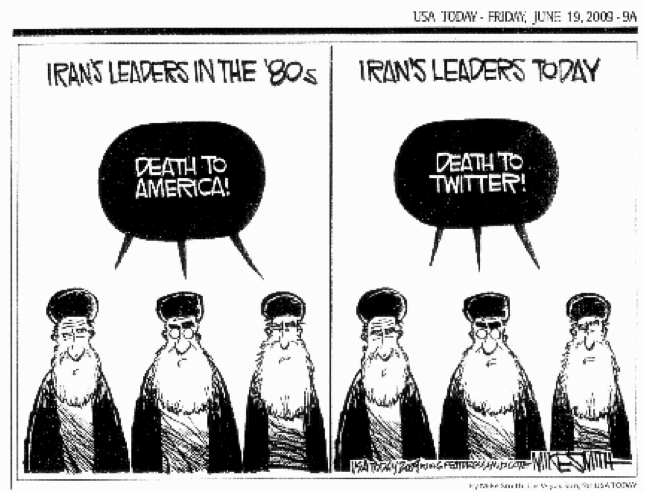
News framing is like a picture frame; new influences what people think and feel about but also influences what people do not think about. Words activate particular frames of seeing. The challenge for activists is to “mediatize” your own conflict.This means framing the conflict at home and abroad. Getting your values and vision across can substantially change the strategic balance of your struggle

In order to interact with the media, nonviolent movements have to understand what journalists need:

  • Clear, molded messages: What are you trying to say?
  • For clearly targeted audiences: Whom are you trying to reach? Your first audience is us in the press.
  • With a local angle or news-peg: Why does it matter to me?
  • Promotion is key: Storytelling is story selling double meaning.

Journalists in essence perform two functions: verification and justification. The challenge for the activists’ organization is to be able to feed both these appetites:

  • Capacity to deliver the event/development journalists can themselves witness;
  • Capacity to provide the “justifiable” sources and commentators.

Being able to provide both enables the nonviolent activist to trade in the media market at some competitive advantage.

What makes a good story?

  • Information: what do people need to know? Why does a story matter to me?
  • Human appeal: News is people, who they are, what they want, and how they get it. Issues need a human face.
  • Buzz factor: what are people talking about? News is deviation from norm. Mode of delivery matches message. Nonviolence is often a deviation from the norm.

One participant asked whether the story of Neda in Iran helps or hurts the civil resistance? On the one hand, Neda has come to frame the current struggle. On the other hand, it does demonstrate that the regime is cracking down and may help spread fear. CNN turned the story of Neda into a story on “how CNN covers the Neda story” as opposed to the story behind Neda.

Don’t fight the media, figure them out:

  • Understand who covers what
  • Target your media audience: TV? Radio? Print? Internet?
  • Make relationships, maintain them (not just when news breaks)
  • Understand news cycles
  • Pitch the right reporter at the right time
  • Mold the message say it simply
  • Personify your story: we cover people, not issues
  • Keep deadlines in mind
  • Know how journalists see their competition

Get your story out on the Internet: Why? How?

  • Reach a new audience
  • Free distribution
  • Increase your numbers
  • Get feedback
  • Meet allies
  • Signal adversaries
  • Raise money
  • Pitch to journalists
  • Great blogs have new posts several times a day

In conclusion, understand what makes a story; remember who you’re trying to reach and how; treat the press like an ally, not an enemy; technology is your friend (but use it safely/securely); develop flexibility in your ability to get your message to people.

Patrick Philippe Meier

FSI09: Law, Justice and Nonviolent Conflict

The eleventh presentation at the Fletcher Summer Institute (FSI) for the Advanced Study of Nonviolent Conflict focused on Rule of Law and Justice in nonviolent action. This was an interesting talk on the commonalities between the strategies in nonviolent conflict and post-conflict constitution making, e.g., participatory and inclusive approaches increase legitimacy.

The presentation on Rule of Law was somewhat technical and formalistic, which was actually very helpful for those of us not well versed in this area. The process of constitution making is not one I’m familiar with but the discussion reminded me of a colleague’s interesting in setting up a platform to “crowdsource” a constitution.

The topic of Truth Commissions was also presented. These are often referred to Truth and Reconciliation Commissions. The reconciliation process is often not possible so seeking to establish co-existence is frequently preferable.

There are three primary intersections between nonviolent movements and the legal/justice process in post-conflict scenarios:

  1. Movement’s goals/vision of tomorrow;
  2. Indivisibility of means and ends;
  3. Relationship with security forces.

Some important questions thus follow

  • In what specific ways can a nonviolent campaign smooth the way for transnational justice while simultaneously contributing to the likelihood of success for the movement?
  • What kinds of goals would specifically be included in a manifesto/vision of tomorrow?

Patrick Philippe Meier

FSI09: Rechanneling Militancy in Nonviolent Struggle

The ninth presentation at the Fletcher Summer Institute (FSI) for the Advanced Study of Nonviolent Conflict focused on the issue of terrorism. In particular, the talk discussed how terrorism works and why it fails. Is terrorism an effective means at achieving a stated objective?

Terrorism is almost entirely psychological; it is about changing people’s minds and perception. So terrorism always requires an audience.

How terrorism works

  • “Propaganda of the Deed” – directed at supporters and potential supporters; action speak louder than words; this is the moment, join the revolution.
  • “Provoking repression” – directed at governments, people will turn on their governments when the latter over-react.
  • “Asset to liability shift” – directed at populations and governments; increase the perceived “price” (in financial but also political terms) of a policy.

There are two examples of terrorism being successful particularly because the conditions were “right” so to speak. The first is the anti-colonial movement in Algeria. The second is the creation of Israel, i.e., the terrorist activities against the British.

Why terrorism fails

  • People are more resilient than terrorist assume. The longer a terrorism campaign goes on, the more people get used to it and become more resilient.
  • People rarely blame the government. People do not turn on the government for not preventing the terrorism.
  • All governments are not paper tigers. Government do not step down and readily give in to terrorist demands. Governments are not easily dislodged as terrorists sometimes assume.

Terrorists often face dilemmas, they can:

  • Carry on but risk losing momentum, such as ETA.
  • Escalate and risk turning the people against them, such as Al Qaeda in Iraq.

While this was an interesting presentation, I was hoping to learn more about concrete tactics/actions nonviolent movements can use to dissuade potential new recruits from joining terrorist groups. In any case, here are good reads I recommend on this general topic:

Patrick Philippe Meier

FSI09: Backfire, Legitimacy & Dividing Loyalties in Civil Resistance

The eight presentation at the Fletcher Summer Institute (FSI) for the Advanced Study of Nonviolent Conflict focused on the issue of security forces. One of the guiding questions for this presentation was: In what circumstances can nonviolent movements reduce the legitimacy of security forces in the eyes of the population?

Giving water and food to security forces is a tactic that often works to at least lower tensions and aggression. But one must be very careful about the assumptions made with regards to how security forces might react to various tactics.

Getting repeatedly arrested may provide some advantages, as was noted by colleagues in the Otpor movement. They would start getting know the police officers and wardens, and the building this interpersonal relationships that proved important as the resistance scaled up.

Backfire occurs when an attack creates more support for or attention to what/who is attacked. Any injustice or norm violation can backfire on the perpetrator. This concept relates to Gene Sharp‘s “political jiu-jitsu“:

Political jiu-jitsu is one of the special processes by which nonviolent action deals with violent repression. By combining nonviolent discipline with solidarity and persistence in struggle, the nonviolent actionists cause the violence of the opponent’s repression to be exposed in the worst possible light. This, in turn, may lead to shifts in opinion and then to shifts in power relationships favorable to the nonviolent group. These shifts result from withdrawal of support for the opponent and the grant of support to the nonviolent actionists.

What are the real preferences of the security forces? These will never be monolithic and fully in line with the regime, i.e., preferences will be differential.  What are the risks in expressing those preferences if you’re part of the security? Security forces don’t always obey:

  • Philippines, 1986
  • Serbia, 2000
  • Ukraine, 2004

When and how do security forces choose to disobey? Developing relationships (usually covert) with leadership and officers was a tactic used in Serbia. In Egypt, activists told police they understood that they had orders to follow and simply asked that they simply not hit them as hard. Developing relationships with ordinary soldiers/police during action is an area that requires further exploration.

Dividing the oppressor is another tactic. So is campaigning for the end of conscription. In apartheid South Africa, the South Africa Defense Force (SADF) was the last line in the defense of apartheid and the 1983 End the Conscription Campaign (ECC) struck at the heart of this powerful force.

“Conscripts were not our enemy… we should serve their interests, ‘pull’ them away from the SADF rather than antagonize or ‘push’ them.”

The ECC also used branding, logos, posters, T-shirts, music concerts, kite flying, etc. But was the ECC successful? There were no high-level defections and the campaign was banned in 1988. However, it continued in different form and the number of conscripts who refused to serve. They were being flown to fight in Angola and were increasingly resistant to do so.

One participant noted that the gulf between members of a nonviolent movement and security officers are often culture, linguistic, etc. The case of Tibet is an example. When there are similarities, emphasizing those is an appropriate tactic. But when there are only differences, can accentuating those differences help the nonviolent movement?

Patrick Philippe Meier

FSI09: Economic Context of Nonviolent Resistance

The seventh presentation at the Fletcher Summer Institute (FSI) for the Advanced Study of Nonviolent Conflict focused on the economic vulnerabilities of different authoritarian states.

There are different types of repressive states:

  • Development state
    • Developmental ideology
    • Mixed economy with interventionist state
    • Constrained but partially autonomous civil society
  • Totalitarian state
    • Development ideology
    • State ownership of means of production
    • Mobilized but non-autonomous civil society
  • Rentier state
    • Lack of development ideology
    • State as arena for private gain
    • Disorganized civil society

The pillars of regime survival include legitimacy, political support and coercion. Each of these exist at different levels in the three types of state described above. For example, in rentier states have low legitimacy, narrow political support and high coercion.

How do states generate economic revenues?

  • Direct sources
    • Taxes
    • State ownership of production
    • Rents (natural resources, foreign aid, corruption, etc)
  • Indirect sources
    • Domestic and/or foreign private investment
    • Migrant remittances

One participant noted the important role of organized crime, which is missing from the framework presented. I completely agree with this comment. We’ve seen the rise in organized crime in Mexico, Colombia, Guinea Bissau and Liberia, among other countries.

What are the implications for the social contract? What sources of income require broad, narrow and little/no domestic collaboration?

  • Broad domestic collaboration
    • Taxes
    • Competitive private investment
  • Narrow domestic collaboration
    • Political corruption
    • State owned enterprises
    • Monopolistic private investment
  • No domestic collaboration
    • Natural resource rents
    • Foreign aid
    • Migrant remittances

States rely on these types of revenues to various degrees. For example, development states are highly dependent on private investment; totalitarian states rely most heavily on state ownership; and rentier states have relatively high dependence on rents. States use these revenues to create legitimacy, build political coalitions and bolster the military, for example.

Economic factors can affect thresholds at which citizens join democratic opposition. To be sure, minor changes in individual thresholds can unleash explosive growth in public opposition. I was surprised that the notion of “information cascades” was not included in the presentation. Nor was the idea of the “dictator’s dilemma,” which I addressed in this previous post.

In any case, here’s an excerpt from a paper by Professor Dan Drezner that explains information cascades:

“An informational cascade takes place when individuals acting in conditions of uncertainty strongly condition their choices on what others have done previously.  More formally, an information cascade is a situation in which every actor, based on the observations of others, makes the same choice independent of his/her private information signal.

In repressive societies, information cascades often lead citizens to acquiesce to government coercion, even if a broad swath of the public would prefer coordinated action.  Citizen coordination and mobilization  is highly unlikely among risk-averse actors unless there is some assurance that others will behave similarly.  At the same time, however, an exogenous shock that triggers spontaneous acts of protest can also trigger a reverse in the cascade.  This explains why repressive societies often appear stable and yet without warning can face a massive scaling up of protests and civic action.

A little bit of public information can reverse a long-standing informational cascade that contributed to citizen quiescence.  Even if people may have previously chosen one action, seemingly little information can induce the same people to choose the exact opposite action in response to a slight increase in information. The spread information technology increases the fragility of information cascades that sustain the appearance of authoritarian control.”

In terms of strategies for activists:

  • Identify the regime’s points of economic vulnerability on the revenue and expenditure side;
  • Seek to lower individual thresholds by raising the costs of coercion for the regime while de-legitimizing the regime;
  • Construct appropriate strategic alliances.

How does one engage in nonviolent conflict in rentier states? How does expand the nonviolent battlefield? There are two levels of analysis here: local/national and international. However, the international component is not a replacement for activities going on at the grassroots level.

In the case of Timor-Leste‘s nonviolent action, international actors were able to help support the cause. But if the political transition turned violent, then the international community would not be able to publicly support their cause.

Another strategy is to go after multinational companies operating in repressive regimes. Exposing the complicity of their business in these countries, which regimes depend on, is one way exploit some of their existing vulnerabilities.

An interesting example, along these lines, is the Genocide Intervention Network ‘s (GIN) ranking system DarfurScores.org that grades Members of Congress on how well they’ve been addressing the genocide via legislation. This was presented last month by the head of GIN. Many congress persons got in touch with GIN to ask how they could increase their Darfur scores.

Another interesting example is Karma Bank.

Patrick Philippe Meier

FSI09: Failed States and Civil Resistance

My former Professor Richard Shultz gave the fourth presentation at the Fletcher Summer Institute (FSI) for the Advanced Study of Nonviolent Conflict 2009.

Shultz placed his presentation into context by noting that he has radically changed his syllabi and created new courses in order reflect the changing global security. While security traditionally focused on armed groups, we are now focusing increasingly on non-state armed groups and more recently on non-state non-armed groups. Furthermore, violence is a subset of force. In other words, nonviolence is another force that needs to be studied within the context of failed states and civil resistance.

Authority, according to Professor Shultz is based on two characteristics: legitimacy and coercion. He addressed these within the context of strong states and weak states on the one hand and strong societies and weak societies on the other.

There are two types of strong states: those based on strong institutions of coercion not restricted by law; versus those in which the population grants or agrees that the government needs strong institutions of coercion and extraordinary powers. Whether a society is strong or weak depends on how legitimate they view the state. This produces a framework with 4 quadrants or cells (e.g., strong state, strong society).

Not surprisingly, the framework prompted discussions on whether the notions of legitimacy, consent, coercion, etc., were really so clear cut. One participant noted that whether or not a state’s institutions of coercion or strong or weak depends on what period of history we’re interest in. Also, if coercive institutions are “weak”, that may actually be due to the fact that society was able to foster political transition. Finally, states are not monolithic, the strength of states and societies will vary substantially within a country’s territorial borders.

I had hoped that the presentation would be more linked to the topic of civil resistance. For example, how do civil resistance strategies and tactics need to change depending on which cell a state falls in? Moreover, I had hoped that the presentation would address how one might engage in civil resistance in failed states, such as Somalia.

Patrick Philippe Meier

An Analytical Framework to Understand Twitter’s use in Iran?

The digital activism and resistance witnessed in Iran go to the heart of my dissertation research, which asks whether the information revolution empowers coercive regimes at the expense of resistance movements or vice versa? Iran is one of my case studies for my upcoming field research in addition to Burma, Tunisia and Ukraine.

Introduction

There have been a number of excellent blog posts on the intersection between technology and resistance in Iran, and especially on the use of Twitter. The mainstream press is also awash with references to Twitter’s role. For example, Agence France Presse (AFP) recently cited my research in this piece entitled “Twitter Streams Break Iran News Dam.”

However, what I haven’t seen in the blogosphere and mainstream press is the application of an analytical and theoretical framework to place Twitter’s use in Iran into context.

For example, just how important is/was Twitter’s role vis-a-vis the mobilization and organization of anti-government protests in Iran? We can draw on anecdotes here and there but this process is devoid of any applied social science methodology.

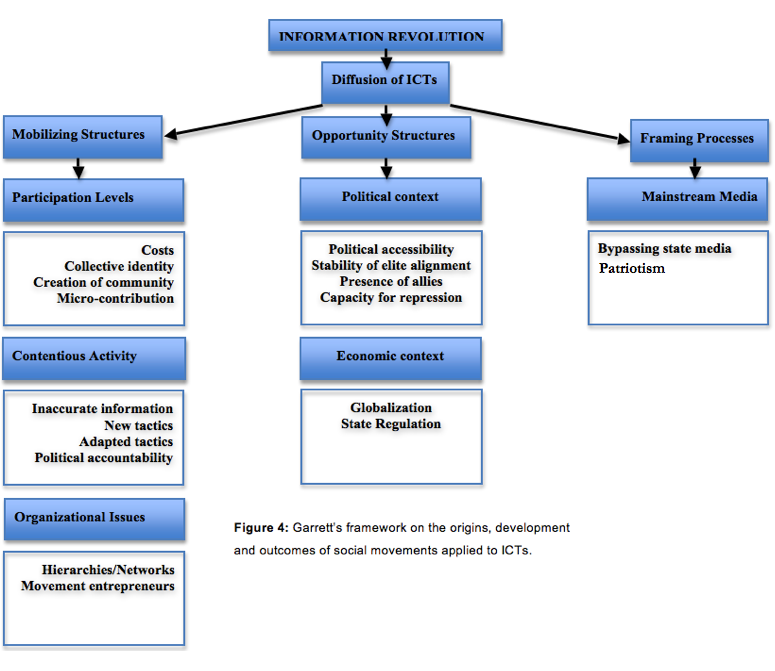
This post seeks to shed light on how, when and why information and communication technologies (ICTs) are used by resistance movements in repressive environments. The framework I draw on (summarized below) is informed by Kelly Garrett’s excellent publication on “Protest in an Information Society: A Review of the Literature on Social Movements and New ICTs” (2006).

Framework

The framework seeks to “explain the emergence, development and outcomes of social movements by addressing three interrelated factors: mobilizing structures, opportunity structures and framing processes”  within the context of ICTs. (The figure below is excerpted from my dissertation, hence the figure 4 reference).

PhDFramework

  • Mobilizing Structures are the mechanisms that facilitate organization and collective action. These include social structures and tactical repertoires.
  • Opportunity Structures are conditions that favor social movement activity. For example, these include factors such as the state’s capacity and propensity for repression.
  • Framing Processes are “strategic attempts to craft, disseminate, and contest the language and narratives used to describe a movement.”

These three factors should be further disaggregated to facilitate analysis. For example, mobilizing structures can be divided into categories susceptible to the impact of ICTs:

  • Participation levels (recruitment);
  • Contentious activity;
  • Organizational issues.

These sub-indicators are still to broad, however. Take, for example, participation levels; what is participation a function of? What underlying mechanisms are facilitated or constrained by the wider availability and use of ICTs? Participation levels may change as a function of three factors:

  • Reduction of participation costs;
  • Promotion of collective identity;
  • Creation of community.

These activities are of course not mutually exclusive but often interdependent. In any case, taking the analysis of ICTs in repressive environments to the tactical level facilitates the social science methodology of process tracing.

Application

We can apply the above framework to test a number of hypotheses regarding Twitter’s use in Iran. Take Mobilizing Structures, for example. The following hypothesis could be formulated.

  • Hypothesis 1: The availability of Twitter in Iran increased participation levels, contentious activity and organizational activity.

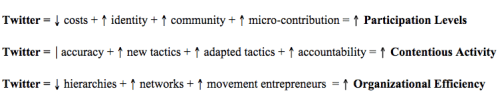
Using process tracing and the above framework, one could test hypothesis 1 as follows:

hypo1

These causal chains, or “micro theories,” are posited with the “⎥” marker to signify that the causal relationship is contended. The direction of the arrows above reflects the theoretical narratives extracted from the theoretical framework presented above. Note that the above “micro” theories are general and not necessarily reflective of Twitter’s use in Iran.

Iran Case Study

When the arrows are tallied, the results suggest the following general theory: there is a direct and positive relationship between the impact of Twitter and the incidents of protests and riots. The next step is to test these “micro theories” in the context of Iran by actually “weighting” the arrows. And of course, to do so comparatively by testing the use of Twitter relative to the use of mobile phones and the Internet. Furthermore, the results of this hypothesis testing should be compared to those for Opportunity Structures and Framing Processes.

I plan to carry out field research to qualitatively test these hypotheses once the first phase of my dissertation is completed. The first phase is a large-N quantitative study to determine whether increasing access to ICTs in repressive regimes is a statistically significant predictor of anti-government protests.

Patrick Philippe Meier