Tag Archives: Ushahidi

ISA 2009: Digital Technologies in Kenya’s Post Election Crisis

The fourth presentation at the ISA panel that I’m chairing will feature research by Joshua Goldstein and Juliana Rotich on the role of digital networked technologies during Kenya’s post-election violence (PDF). Blog posts on the other three presentations are available here on human rights, here on political activism and here on digital resitance.

Introduction

Josh and Juliana pose the following question: do mobile phones and the Internet promote transparency and good governance or do they promote hate speech and conflict? The authors draw on the 2007-2008 Kenyan presidential elections to assess the impact of digitally networked technologies, specifically mobile phones and the Internet, on the post-election violence.

This study is an important contribution to the scholarly research on the impact of digital technology on democracy since the majority of the existing literature is largely written through the lens of established, Western democracies. The literature thus “excludes the experience of Sub-Saharan Africa, where meaningful access to digital tools is only beginning to emerge, but where the struggle between failed state and functioning democracy are profound.”

Case Study

Josh and Juliana draw on Kenya as a case study to assess the individual impact of mobile phones and the Internet on the post-election violence. The mobile phone is the most widely used digital application in Kenya and the rest of Africa. The low cost and ease of texting explains how quickly “hate SMS” began circulating after Kenya’s election day. Some examples of the messages texted:

Fellow Kenyans, the Kikuyu’s have stolen our children’s future… we must deal with them in a way they understand… violence.

No more innocent Kikuyu blood will be shed. We will slaughter them right here in the capital city. For justice, compile a list of Luo’s you know… we will give you numbers to text this information.

The authors are concerned about the troubling trend of hate SMS in East Africa citing a violent icident in neighboring Uganda that was organized via SMS to protest the government’s sale of a forest to a company. As they note, “mass SMS tools are remarkably useful for organizing this type of explicit, systematic, and publicly organized campaign of mob violence.”

However, the authors also recognize that “since SMS, unlike radio, is a multi-directional tool, there is also hope that voices of moderation can make themselves heard.” They point to the response taken by Michael Joseph, the CEO of Kenya’s largest mobile phone provider Safaricom when he was asked by government officials to consider shutting down the SMS system:

Joseph convinced the government not to shut down the SMS system, and instead to allow SMS providers to send out messages of peace and calm, which Safaricom did to all nine million of its customers.

Josh and Juliana also note that tracking and identifying individuals that promote hate speech is relatively easy for governments and companies to do. “In the aftermath of the violence, contact information for over one thousand seven hundred individuals who allegedly promoted mob violence was forwarded to the Government of Kenya.” While Kenya didn’t have a law to prosecute hate SMS, the Parliament has begun to create such a law.

The Internet in Kenya was also used for predatory and civic speech. For example, “the leading Kenyan online community, Mashahada, became overwhelmed with divisive and hostile messages,” which prompted the moderators to “shut down the site, recognizing that civil discourse was rapidly becoming impossible.”

However, David Kobia, the administrator of Mashahada, decided to launch a new site a few days later explicitly centered on constructive dialogue. The site, “I Have No Tribe,” was successful in promoting a more constructive discourse and demonstrates “that one possible response to destructive speech online is to encourage constructive speech.”

Mobile phones and the Internet were combined by Ushahidi to crowdsource human rights violation during the post-election violence. The authors contend that the Ushahidi platform is “revolutionary for human rights campaigns in the way that Wikipedia is revolutionary for encyclopedias; they are tools that allow cooperation on a massive scale.” I have already blogged extensively about Ushahidi here and here so will not expand on this point other than to emphasize that Ushahidi was not used to promote hate speech.

Josh and Juliana also draw on the role of Kenya’s citizen journalists to highlight another peaceful application of digital technologies. As they note, Kenya has one of the richest blogging traditions in sub-Saharan Africa, which explains why,

Kenyan bloggers became a critical part of the conversation [when] the web traffic from within Kenya shot through the roof. The influence ballooned further when radio broadcasters began to read influential bloggers over the airwaves, helping them reach […] 95% of the Kenyan population.”

When the Government of Kenya declared a ban on live news coverage on December 30, 2007, Kenyan bloggers became indispensable in their role as citizen journalists. […] Blogs challenged the government’s version of events as they unfolded.

[…] Further, Blogs became a critical source of information for Kenyans in Nairobi and the diaspora. Rumors spread via SMS were dispelled via an online dialogue that took place on blogs and in the comments section of blogs.

Conclusion

When we talk about the ‘networked public sphere,’ we are usually referring to a Western public sphere; one that facilitates public discourse, increased transparency and positive cooperation. However, as the case study above demonstrates, the narrative is more involved when we talk about an African or Kenyan ‘networked public sphere.’ Indeed, the authors conclude that digital networked technologies catalyzed both “predatory behavior such as ethnic-based mob violence and civic behavior such as journalism and human rights campaigns.”

Several questions remain to be addressed in further research. Namely, how important is a vibrant blogosphere to promote positive applications of digital technologies in times of crises? Are networked digital technologies like Ushahidi more susceptible to positive uses than predatory uses? And finally, how does the Kenya case compare to others like the Orange Revolution in the Ukraine?

Patrick Philippe Meier

Web4Dev: Innovation Track Day 2

The second day of the Innovation Track at Web4Dev focused on monitoring and evaluation. Robert Kirkpatrick from InSTEDD, Erik Hersman from Ushahidi and Christopher Strebel from UNESCO each gave a presentation.

Robert introduced InSTEDD’s Mesh4X and GeoChat which I’ve already blogged about here so won’t expand on. But Robert also introduced a new project I was not aware of called Evolve. This tool helps to synthesize data into actionable information, to collaborate around diverse data streams to detect, analyze, triage and track critical events as they unfold.

Erik introduced Ushahidi and described our increasing capacity to crowdsource eyewitness crisis data. However, the challenge is increasingly how to consume and make sense of the incoming data stream. There were thousands of Tweets per minute during the Mumbai attacks. Ushahidi is working on Swift River to explore ways to use crowdsourcing as a filter for data validation.

Christopher Strebel introduced GigaPan, a robotic camera that captures gigapixel images. The tool was developed for the Mars Rover program to take very high resolution images of Mars. UNESCO is introducing the technology for education purposes. I’m not sure I’m entirely convinced about this project; not just because the camera costs $300-$400 but because I don’t see what such a sophisticated  tool adds over regular cameras in terms of education and participation.

In any case, while I found all three presentations interesting, none of them actually addressed the second topic of today’s workshop, namely evaluation. I spent most of December and January working with a team of monitoring and evaluation (M&E) experts to develop a framework for a multi-year project in Liberia. I can conclude from this experience that those of us who don’t have expertise in M&E have a huge amount to learn. Developing serious M&E frameworks is a rigorous process.

Patrick Philippe Meier

Web4Dev: Innovation Track Day 1

I lived in New York for about four years so it’s good to be back for a few days to  participate in UNICEF’s Web4Dev conference with colleagues from Ushahidi, Development Seed, InSTEDD, Open Street Map and Digital Democracy.

Clay Shirky moderated the Innovation Track, which focused addressed the issue of access to innovation and participation. The panel included presentations by himself, Steve Vosloo and Grant Cambridge. We then self-organized into half-a-dozen working groups to address specific issues and identify potential solutions within 2-3 year horizon.

ClayShirky

Steve Vosloo from South Africa gave the first presentation. Steve is a Shuttleworth Foundation Communications and Analytical Skills Fellow. The main thrust of his presentation was that access to participation is more important than simply having access to information.”Participation fosters Peer-to-Peer (P2P) learning across both time and space.”

This statement resonates particularly well with me as I recently presented the concept of P2P capacity building to a donor interested in fostering a conflict early warning/response ecosystem in Liberia (which I will blog about in the near future). Steve’s remark about there being a wealth of information at the Bottom of the Pyramid (BoP) also resonated. When we talk about access to information, we have to ask ourselves access for who? For the BoP or for us? We are too often egocentric in answering this question.

Ushahidi’s Erik Hersman asked the first question following Steve’s talk. Should we be introducing new tools or going with consumer tools? I agree with Steve’s answer: both. If what we are offering is addressing the need of the BoP, then that’s what matters.

A representative from the French Development Agency asked whether moving to the mobile web meant scrapping the work they had done with regards to Internet access via the PC? Steve replied there is only one Web. The PC web and mobile web are one and the same. The Web is the glue that holds everything together.

Clay Shirky gave the second presentation and focused on different topologies of communication. He suggests that communication between people builds social capital. This means that using pre-existing consumer-based communication tools is important. Groups that use such tools for social communication (situated and informal) are going to communicate more effectively during crises.

In terms of sharing information that is communicated, Clay suggests there is a bias towards sharing. If sharing is made the default option on an information communication platform, then well over 90% of participants will share. This is a particularly important point for humanitarian information systems.

Clay shared the difference between the Center for Disease Control (CDC) and Google’s Flu surveillance project with respect to information communication. What the CDC does is not bio surveillance but rather bio accounting.  This is an excellent analogy to use for conflict early warning systems. The majority of conventional early warning systems are more accounting tools than surveillance tools given the time lag between documentation and dissemination.

Lastly, Clay made a point about moving towards a communication typology in which the different nodes are mobile phones, web servers, radios, etc. This is exactly the project design I recently presented to a donor: cloud computing for humanitarian early warning and response.

Grant Cambridge from The Meraka Institute gave the third presentation. Grant gave us a reality check vis-a-vis access in rural villages in South Africa. There are huge challenges such as maintenance; theft of copper and optical fibres is a frequent issue, for example.

Grant’s group thus developed “The Digital Doorway” a robust single, multi-terminal systems. The platform includes open content, focusing on education, maths, science and games. There are 200 Doorways across South Africa. The platforms are operational 24/7 and some sites are used around the clock.The Meraka Institute deployed the Doorway in many communities where computers had never been heard of.

But after 7 days, children developed the language and vocabulary to describe what they were doing. For example, they had no word for icon, so they made one. The kids ended up teaching themselves about how to use the Doorway. This promotes group learning. Teachers have had to switch off the Doorways because kids would skip school.The Doorways also include a feedback feature where users can provide feedback to the developers.

In conclusion, Grant reiterated the fact that access to info does not apply inclusion and Internet access doesn’t imply learning.

Patrick Philippe Meier

Crowdsourcing Honesty?

I set an all-time personal record this past week: my MacBook was dormant for five consecutive days. I dedicate this triumph to the delightful friends with whom I spent New Year’s. Indeed, I had the pleasure of celebrating with friends from Digital Democracy, The Fletcher School and The Global Justice Center on a Caribbean island for some much needed time off.

Ariely

We all brought some good reading along and I was finally able to enjoy a number of books on my list. One of these, Dan Ariely’s “Predictably Irrational” was recommended to me by Erik Hersman, and I’m really glad he did. MIT Professor Ariely specializes in behavioral economics. His book gently discredits mainstream economics. Far from being rational agents, we are remarkably irrational in our decision-making, and predictably so.

Ariely draws on a number of social experiments to explicate his thesis.

For social scientists, experiments are like microscopes or strobe lights. They help us slow human behavior to a frame-by-frame narration of events, isolate individual forces, and examine those forces carefully and in more detail. They let us test directly and unambiguously what makes us tick.

In a series of fascinating experiments, Ariely seeks to understand what factors influence our decisions to be honest, especially when we can get away with dishonesty. In one experiment, participants complete a very simple math exercise. When done, the first set of participants (control group) are asked to hand in their answers for independent grading but the second set are subsequently given the answers and asked to report their own scores. At no point do the latter hand in their answers; hence the temptation to cheat.

In this experiment, some students are asked to list the names of 10 books they read in high school while others are asked to write down as many of the Ten Commandments as they can recall prior to the math exercise. Ariely’s wanted to know whether this would have any effect on the honesty of those participants reporting their scores? The statistically significant results surprised even him: “The students who had been asked to recall the Ten Commandments had not cheated at all.”

In fact, they averaged the same score as the (control) group that could not cheat. In contrast, participants who were asked to list their 10 high school books and self-report their scores cheated: they claimed grades that were 33% higher than those who could not cheat (control group).

What especially impressed me about the experiment […] was that the students who could remember only one or two commandments were as affected by them as the students who remembered nearly all ten. This indicated that it was not the Commandments themselves that encouraged honestly, but the mere contemplation of a moral benchmark of some kind.

Ariely carried out a follow up experiment in which he asked some of his MIT students to sign an honor code instead of listing the Commandments. The results were identical. What’s more, “the effect of signing a statement about an honor code is particularly amazing when we take into account that MIT doesn’t even have an honor code.”

In short, we are far more likely to be honest when reminded of morality, especially when temptation strikes. Ariely thus concludes that the act of taking an oath can make all the difference.

I’m intrigued by this finding and it’s potential application to crowdsourcing crisis information, e.g., Ushahidi‘s work in the DRC. Could some version of an honor code be introduced in the self-reporting process? Could the Ushahidi team create a control group to determine the impact on data quality? Even if impact were difficult to establish, would introducing an honor code still make sense given Ariely’s findings on basic behavioral psychology?

Patrick Philippe Meier

International News Coverage in a New Media World

I just had the pleasure of participating in a fascinating panel discussion on the decline of the foreign correspondent and the rise of citizen journalist. The event was hosted by the Institute for Public Diplomacy and Global Communications at George Washington University (GWU) and supported by the Broadcasting Board of Governors (BBG).

Jeffrey Hirschberg from BBG gave the opening remarks and GWU Professor Steve Roberts moderated the panel, which included Loren Jenkins, Senior Foreign Editor at NPR, Professor Sherry Ricchiardi, Senior Writer at the American Journalism Review (AJR) and Professor at Indian University’s School of Journalism, Bob Dietz with the Committee to Protect Journalists (CPJ), and myself.

Where to begin? I was definitely the only one on the panel without a formal background in journalism, possibly the only blogger, probably the only one with a YouTube account and most likely the only panelist on Twitter. Inevitably, then, I brought a slightly different perspective, but more importantly, I had the opportunity to learn a lot from my fellow panelists and to understand their perspective on the decline of foreign reporting. It was a truly rich conversation.

Professional journalists engaged in international news are increasingly concerned about the possibility of misinformation and manipulation that may originate from citizen journalists, e.g., through blogs, Twitter, etc. In my opinion, one of the defining roles of the mainstream media is to distinguish between fact and fiction, which means that they play an even more important role in the digital age. The question of journalist standards was also raised, or the lack thereof. within citizen journalism In my opinion, as international news reporting declines and citizen journalists continue to fill the void, the public will expect and come to demand that the latter meet some of the same standards practiced by mainstream media.

Having had the opportunity to interact with numerous bloggers with Global Voices and beyond, I emphasized the fact that reputation for many bloggers is everything. Her or his readership is a function of the person’s reputation and hence credibility and accountability. Over time, as Lauren mentioned, we come to “get to know” and trust a blogger even if we never meet in person. Journalists investigate stories by interviewing sources, there is no reason to discount citizen journalists as valuable sources.

The challenge of validating sources and information is not a new one. There is a trade off between volume of information and the ability to verify that information. This trade off, or continuum, becomes even more acute in rapidly changing situations like the recent carnage in Mumbai.

What we need to keep in mind, however, is that we each have different demands or needs for validity. If you found yourself in downtown Mumbai during the terrorist attacks, you would rather know about rumors spread via Twitter than not. Why? Because at least you’d be able to take precautionary measures should the rumor prove to be true.

Watching the unfolding tragedy from thousands of miles away in the comfort of our own homes, we have less need for expediency, we just want to know what really happened, the facts. However, our demand for facts and rigorous validation should not overshadow the fact that rumors and unverified reports from unknown sources can save lives.

Steve asked Bob whether his work on the protection of journalists should be expanded to citizen journalists. In his response, Bob preempted an important point I had planned to make; namely that the line between citizen journalism and digital activism is becoming increasingly blurred. In the past, documenting human rights abuses and broadcasting this documentation was rarely done by one individual. Today, thanks to YouTube, documenting events is the same as broadcasting events, which is alot about what advocacy is.

This is why it is increasingly important for citizen journalists in repressive environments to interact with digital activists and individuals engaged in strategic nonviolence. As a a fellow blogger of mine recently remarked about her experience covering the post-election violence in Kenya, there is a distinction between being able to speak out and being heard. In most contexts, the former is far easier than the latter. However, if you start being heard, and a government or regime starts to pay attention to what you are blogging, you become a target. It’s a catch 22. Bloggers need to learn from digital activists and strategic nonviolence movements about how to stay safe and how to make maximum use technology to get their message out.

I drew on several examples to highlight the important contribution that citizen journalists are making around the world, from Global Voices to Witness.org. I also highlighted HHI‘s recent work on crisis mapping Kenya to compare mainstream media reports with citizen journalism reports and crowdsourcing reports (via Ushahidi). In the context of Mumbai, I pointed to the incredible speed with which a Wikipedia page was created and maintained fully up to date, with some 900 edits taking place within the first 21 hours of the event. No mainstream media outfit could possibly mimic this crowdsourcing approach without reaching out to citizen journalists.

On Global Voices, I highlighted the important role they are playing in translating (and analyzing) a lot of local news (and other blogs) into English. With the decline in foreign reporting, mainstream media’s role in translating news will also decline. The amount of volume produced by Global Voices during the Mumbai attacks was trully stunning.

I brought up Witness.org because much of the conversation between panelists focused on print media, and how easy it was to mislead readers. Doctoring pictures, let alone footage, is not as easy. The case of Reuters and the doctored photograph of Israeli rockets firing on Lebanon is an exception and far from the rule. It is a very isolated incident when one considers the massive number of pictures printed every day in the mainstream press. Furthermore, I argued thanks to built-in cameras in mobile phones, dozens of different individuals can each take pictures of an event, which serves as a verification mechanism. We don’t need fewer citizen witnesses armed with cameras, we need more.

Two final points, or rather open ended questions for further discussion. First, if we are moving towards a more hyper-local approach to media reports, and if this happens across the globe, then why the concern? Isn’t someone’s local media another’s foreign media? Second, having counted Noam Chomsky’s Manufacturing Consent: The Political Economy of the Mass Media as one of my all time favorite books, how is the media changing now that the political economy is completely changing?

Patrick Philippe Meier

Covering the DRC – opportunities for Ushahidi

This blog entry was inspired by Ory’s recent blog post on “Covering the DRC – challenges for Ushahidi.” The thoughts that follow were originally intended for the comments section of Ushahidi’s blog but they surreptitiously morphed into a more in depth reflection. First, however, many thanks to Ory for taking the time to share the team’s experience in the DRC over the past few weeks.

Much of what Ory writes resonates with my own experience in conflict early warning/response. While several factors contribute to the challenge of Ushahidi’s deployment, I think one in particular regrettably remains a constant in my own experience: the link to early response, or rather the lack thereof. The main point I want to make is this: if Ushahidi addresses the warning-response gap, then Ushahidi-DRC is likely to get far more traction on the ground than it currently is.

To explain, if Ushahidi is going to provide a platform that enables the crowdsourcing of crisis information, then it must also facilitate the crowdsourcing of response. Why? For otherwise the tool is of little added value to the individuals who constitute said crowd, ie, the Bottom of the Pyramid (BoP) in conflict zones. If individuals at the BoP don’t personally benefit from Ushahidi, then they should not be spending time/resources on communicating alerts. As one of my dissertation committee members, Peter Walker wrote in 1991 vis-a-vis famine early warning/response systems in Africa:

It must be clearly understood that the informants are the most important part of the information system. It is their information […] upon which the rest of the system is based […]. The informant must be made to feel, quite rightly, that he or she is an important part of the system, not just a minion at the base, for ever giving and never receiving.

In 1988 (that’s write ’88), Kumar Rupesinghe published a piece on disaster early warning systems in which he writes that civil society has

… a vital role to play in the development of a global, decentralized early warning system. They now need the capacity to build information systems and to provide the basis for rapid information exchange. In general [civil society] will have to confront the monopolization of information with a demand for the democratic access to information technology.

Information on local concerns must be available to the local structures in society. The right to be informed and the right to information have to find entry into international discussions.

Ushahidi’s crowdsourcing approach has the potential to reverse the monopolization of information and thereby create a demand for access to conflict information. Indeed, Ushahidi is starting to influence the international discourse on early warning (forthcoming reports by the EC and OECD). However, it is the mobile crowdsourcing of response that will create value and thereby demand by the BoP for Ushahidi.

Put it this way, Twitter would be far less useful if it were limited to one (and only one) global website on which all tweets were displayed. What makes Twitter valuable is the ability to select specific feeds, and to have those feeds pushed to us effortlessly, using Twhirl or similar programs, and displayed (in less than 141 characters) on our computer screens in real time. At the moment, Ushahidi does the equivalent of the former, but not the latter.

Yet the latter is precisely where the added value to the individual lies. An NGO may be perfectly content with Ushahidi’s current set up, but NGOs do not constitute the BoP; they are not the “fundamental unit” of crowdsourcing—individuals are. (Just imagine if Wikipedia entries could only be written/edited by NGOs).

This mismatch in fundamental units is particularly prevalent in the conflict early warning/response field. NGOs do not have the same incentive structures as individuals. If individuals in at-risk communities were to receive customized alerts on incidents in/near their own town (if they themselves send alerts to Ushahidi), then that response presents a far more direct and immediate return on investment. Receiving geo-specific alerts in quasi real-time improves situational awareness and enables an individual to take a more informed decision about how to respond to the alerts. That is added value. The BoP would have an incentive, empowerment, to crowdsource crisis information.

Here’s a scenario: if an individual texts in an alert for the first time, Ushahidi should: (1) contact that person as soon as possible to thank them for their alert and, (2) ask them what SMS alerts they would like to receive and for what town(s). I guarantee you this person will spread the word through their own social network and encourage others to send in alerts so that they too may receive alerts. (Incidentally, Erik, this is the strategy I would recommend in places like Jos, Nigeria).

In summary, while the Ushahidi team faces a multitude of other challenges in the DRC deployment, I believe that addressing the early response dimension will render the other challenges more manageable. While the vast majority of conflict early warning systems are wired vertically (designed by outsiders for outsiders), the genius of Ushahidi is the paradigm shift to horizontally wired, local early warning/response, aka crowdsourcing.

In a way, it’s very simple: If Ushahidi can create value for the BoP, the client base will necessarily expand (substantially). To this end, Ushahidi should not be pitched as an early warning system, but rather as an early response service. This is one of the reasons why I am trying hard to encourage the operationalization of mobile crisis mapping.

Crisis Mappers Meeting

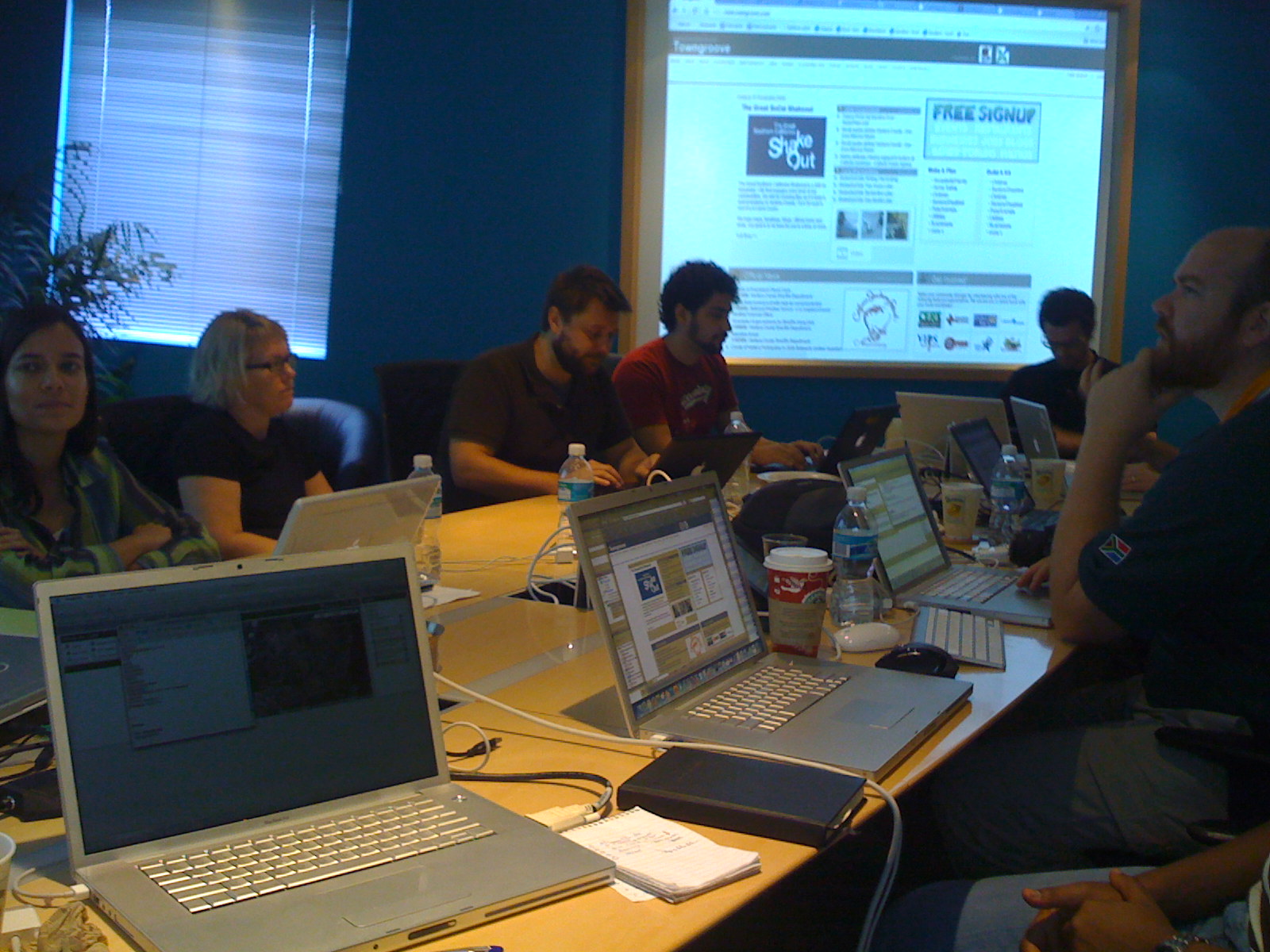
Our first CrisisMappers meeting took place in Orlando, Florida this past weekend. The meeting brought together a small group of tech professionals who are at the very cutting edge of crisis mapping. It truly was a powerhouse. Ushahidi, Development Seed, NiJEL, Emergencity, GeoCommons, InSTEDD, In.itiative and the Harvard Humanitarian Initiative (HHI). This meeting was mostly self-funded and scheduled on a Saturday. The fact that everyone showed up is a clear testament to the commitment we all have to pushing the new field of crisis mapping forward to the next frontier.

img_0001

Andrew Turner gave a typical tour de force presentation on some of the most exciting tech-innovations in mapping. I highly recommend viewing his slide show presentations available on Slideshare here. I gave the second introductory talk and chose to highlight two major themes in the future of crisis mapping: Mobile Crisis Mapping (MCM) and Crisis Mapping Analytics (CMA).

The former focuses on our understanding of dynamic mapping platforms as communication tools. In other words, all our communication tools should be fully integrated within our dynamic mapping platforms. Imagine a Google Map interface from which I can receive geo-referenced text messages and forward those messages by SMS broadcast or email right back to the field, without ever having to navigate away from the map. InSTEDD’s GeoChat is a good example of what I have in mind.

Understanding mapping platforms as communication tools poses two challenges common to communication in crisis zones. The first is connectivity while the second is data security. In terms of connectivity, we urgently need to move towards meshed-networked peer-to-peer communication that obviates the need for cell phone towers. As for encryption, SMS encryption should be the default setting on all our communications. Anything less is simply unsatisfactory.

I’ve written about Crisis Mapping Analytics before, so won’t go into detail here. I just want to point out that as our crisis mapping platforms continue to crowdsource data, we will need to make sense of this information in terms of trends over both space and time. We are still far from having any user friendly  point-and-click statistical tools for identifying such trends.

Since I was the only token humanitarian-wanna-be-geek at the meeting, I closed my introductory talk with the following three reminders: (1) if our crisis mapping tools work in humanitarian crises, they’ll work anywhere; (2) we need to identify methods and metrics to evaluate the impact of our crisis mapping platforms; (3) if you don’t keep your crisis mappers as simple as Fisher Price, they are unlikely to be adopted by the humanitarian community; call it the Fisher Price Theory of Crisis Mapping.

Let me expand on the latter point. What our colleagues in the tech-world need to keep in mind is that the vast majority of our partners in the field have never taken a computer science or software engineering course. Most of my humanitarian colleagues have done a Master’s degree in Humanitarian Affairs, International Development, etc. I guarantee you that 99.9% of these graduate programs do not include any seminar on humanitarian information management systems let alone computer science.

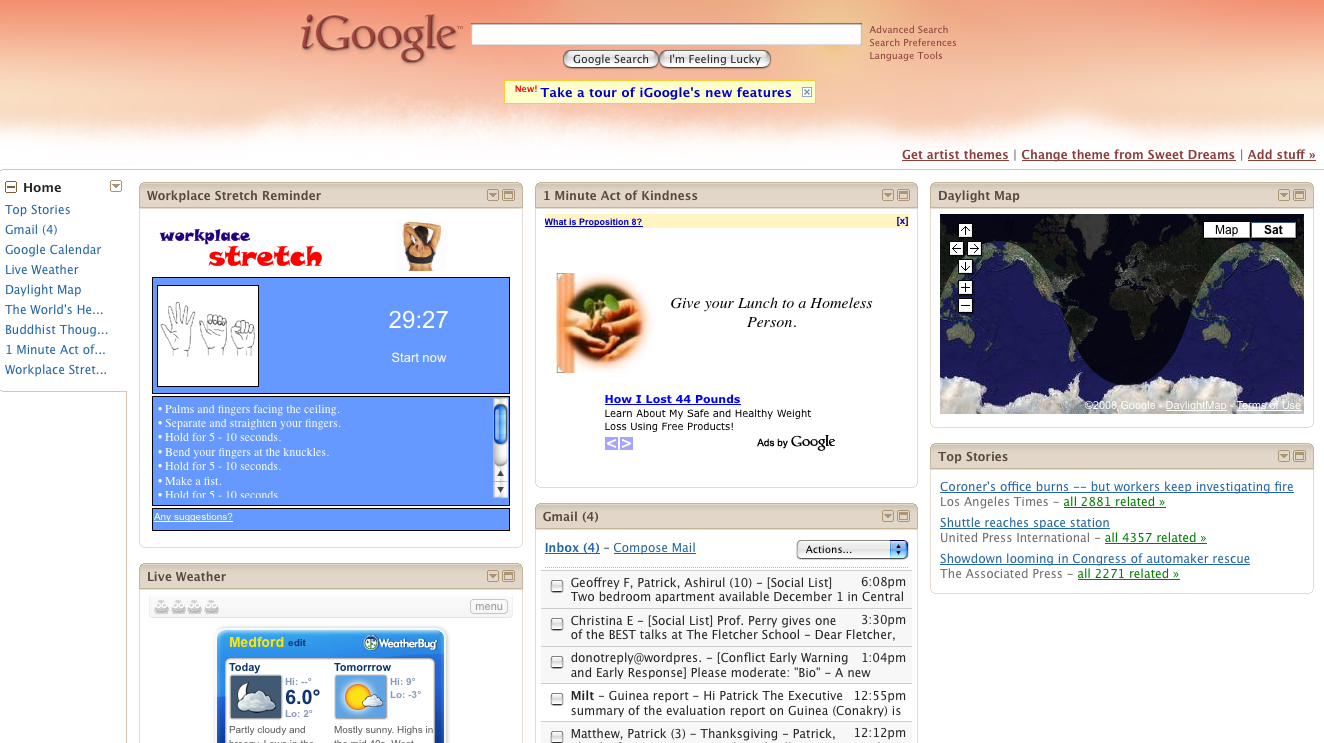
The onus thus falls on the techies to produce the most simple, self-explanatory, intuitive interfaces. What we in the humanitarian field want are interfaces as simple as computer games. We want software packages that are simply plug-and-play. Say an iGoogle approach which allows us humanitarians to import various “widgets” such as 2-way SMS broadcasting, wiki-mapping, etc.

picture-13

The rest of the CrisisMappers meeting was dedicated to a series of thought-provoking presentations on individual crisis mapping projects that each organization is working on. I shan’t attempt a summary here but shall close with the following. I had the good fortune of sitting next to Ushahidi’s David Kobia during the meeting. At one point, he turns to me and motions to his laptop screen: “Look, just got a text message from someone in the DRC.”

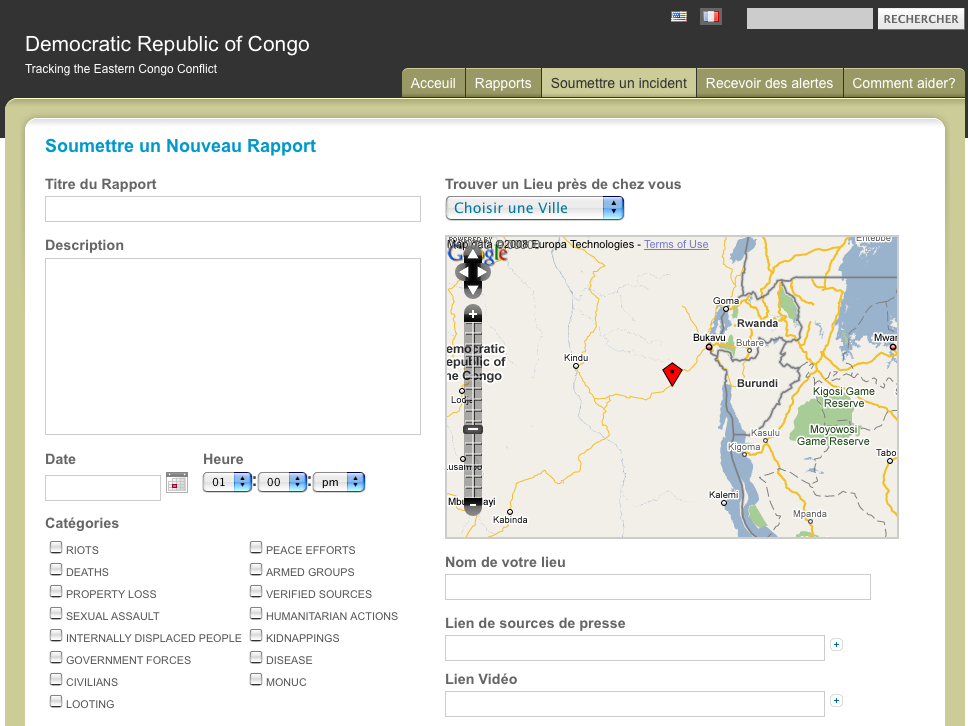
David was pointing to Ushahidi’s admin interface, and indeed, someone on the ground had gotten wind of Ushahidi’s new deployment and had texted the dedicated Ushahidi DRC number. The texter was expressing her/his concern that the DRC site was in English which posed problems for French speakers. The text message itself was in French. The Ushahidi team has been working diligently on a French version of the interface and are nearly finished. David asked me if I might be able to reply (in French) to the person and let them know that the completed interface will be ready next week. I did so, and pointed the texter to the “French Flag” icon on the Ushahidi DRC interface.

picture-32

Here’s what I find particularly neat about this exchange. First, here we were sitting in a conference room in Florida on a Saturday afternoon getting a text message from someone in the DRC interested in reporting events using Ushahidi’s DRC platform. Second, the admin interface that David had up set up was simple and clear to understand. Third, David had included two optional buttons to send one-click replies to the text messages he receives: (1) please send us more information on the event; (2) please send us more information on the location event. Simple yet elegant. After I finished typing my reply to the sender of the text message, I clicked on send and off went my message, right back to the field. All this took place in less than five minutes.

Patrick Philippe Meier

Crisis Mapping Kenya’s Election Violence

Are citizen journalists playing an increasingly important role in documenting violent conflict and human rights violations? I posed this question during the 2008 Global Voices Summit and answered affirmatively—but without more than a hunch and rather limited anecdotal evidence. Paul Curion took issue and David Sasaki recommended that someone carry out an empirical study.

I appreciated David’s practical recommendation and decided to pursue the project since the topic overlaps with the Conflict Early Warning and Crisis Mapping project I’ve been working on at the Harvard Humanitarian Initiative (HHI). Supported by Humanity United, the project seeks to explore the changing role and impact of information communication technology in crisis early warning and humanitarian response.

Seeing that I was in Nairobi visiting my parents during the election violence, I chose Kenya as a case study to assess the role of citizen journalists in crisis environments as compared to the mainstream media. My colleagues Kate Brodock, Briana Kramer and I used event-data analysis to code reports of violent and peaceful events as documented by about a dozen citizen journalist bloggers between December 27, 2007 and January 27, 2008.

We did the same for mainstream media, ranging from print media (national newspapers) to radio and television programs. I also included the Ushahidi data because I wanted to carry out a three way comparison between mainstream news media, citizen journalism and a dedicated crowdsourcing platform.

We then created a Google Earth layer to visualize the data over time and space. Below is a YouTube video I created of the animation (for slower Internet connections). Here is the Google Earth layer (KMZ). The data can also be visualized on Google Maps here.

Yellow icon = mainstream news reports; Blue icon = citizen journalism blogs; Green icon = Ushahidi reports.

A dynamic time line is also available below. The interactive time line depicts the number of daily reports produced by mainstream news, citizen journalists and Ushahidi over the 30-day period of study.

Our preliminary findings:

  • Mainstream media reported actual death count before citizen journalists; however, on many accounts, mainstream media did not report on incidents leading to actual deaths, i.e., early warning signs;
  • Citizen journalist reports and Ushahidi reports did not overlap geographically with mainstream media reports;
  • Citizen journalists tended to report as soon as violence started, well before mainstream media;
  • The number of comments on citizen journalist blogs increased during the 30-day period, or during particular periods of violence;
  • The comment section was also used as a medium for real-time updating;
  • Many citizen journalist bloggers used real-time updates sent to them via SMS, primarily from rural areas;
  • Citizen journalism reports declined after the launch of Ushahidi;
  • Ushahidi reports document an important number of violent events not reported by the mainstream media and citizen journalists;
  • Contrary to news media and citizen journalist reports, Ushahidi data always had specific location information;
  • Ushahidi reports also covered a wider geographical area than both mainstream news and citizen journalist bloggers.

For further information on our project’s methodology and sources, please see this short powerpoint presentation (PDF) which we have also uploaded on Slideshare. For more on crisis mapping, please see this page. For additional information on the role of digital technology during Kenya’s post election violence, see this narrative-based analysis (PDF) by my two colleagues Josh Goldstein and Juliana Rotich.

We look forward to receiving as much feedback as possible so we can improve our methodology and analysis in future case studies. We’re especially keen to have others interpret the dynamics displayed in the animation above. In the meantime, please contact me if you’d like to join the team and contribute to our next case study, which will be of Georgia.

To cite this research, please use: Meier, Patrick and Kate Brodock (2008). “Crisis Mapping Kenya’s Election Violence: Comparing Mainstream News, Citizen Journalism and Ushahidi.” (Harvard Humanitarian Initiative, HHI, Harvard University: Boston). URL: https://irevolution.wordpress.com/2008/10/23/mapping-kenyas-election-violence

Patrick Philippe Meier

Crisis Mapping Kenya’s Election Violence

Are citizen journalists playing an increasingly important role in documenting violent conflict and human rights violations? I posed this question during the 2008 Global Voices Summit and answered affirmatively—but without more than a hunch and rather limited anecdotal evidence. Paul Curion took issue and David Sasaki recommended that someone carry out an empirical study.

I appreciated David’s practical recommendation and decided to pursue the project since the topic overlaps with the Conflict Early Warning and Crisis Mapping project I’ve been working on at the Harvard Humanitarian Initiative (HHI). Supported by Humanity United, the project seeks to explore the changing role and impact of information communication technology in crisis early warning and humanitarian response.

Seeing that I was in Nairobi visiting my parents during the election violence, I chose Kenya as a case study to assess the role of citizen journalists in crisis environments as compared to the mainstream media. My colleagues Kate Brodock, Briana Kramer and I used event-data analysis to code reports of violent and peaceful events as documented by about a dozen citizen journalist bloggers between December 27, 2007 and January 27, 2008.

We did the same for mainstream media, ranging from print media (national newspapers) to radio and television programs. I also included the Ushahidi data because I wanted to carry out a three way comparison between mainstream news media, citizen journalism and a dedicated crowdsourcing platform.

We then created a Google Earth layer to visualize the data over time and space. Below is a YouTube video I created of the animation (for slower Internet connections). Here is the Google Earth layer (KMZ). The data can also be visualized on Google Maps here.

Yellow icon = mainstream news reports; Blue icon = citizen journalism blogs; Green icon = Ushahidi reports.

A dynamic time line is also available below. The interactive time line depicts the number of daily reports produced by mainstream news, citizen journalists and Ushahidi over the 30-day period of study.

Our preliminary findings:

  • Mainstream media reported actual death count before citizen journalists; however, on many accounts, mainstream media did not report on incidents leading to actual deaths, i.e., early warning signs;
  • Citizen journalist reports and Ushahidi reports did not overlap geographically with mainstream media reports;
  • Citizen journalists tended to report as soon as violence started, well before mainstream media;
  • The number of comments on citizen journalist blogs increased during the 30-day period, or during particular periods of violence;
  • The comment section was also used as a medium for real-time updating;
  • Many citizen journalist bloggers used real-time updates sent to them via SMS, primarily from rural areas;
  • Citizen journalism reports declined after the launch of Ushahidi;
  • Ushahidi reports document an important number of violent events not reported by the mainstream media and citizen journalists;
  • Contrary to news media and citizen journalist reports, Ushahidi data always had specific location information;
  • Ushahidi reports also covered a wider geographical area than both mainstream news and citizen journalist bloggers.

For further information on our project’s methodology and sources, please see this short powerpoint presentation (PDF) which we have also uploaded on Slideshare. For more on crisis mapping, please see this page. For additional information on the role of digital technology during Kenya’s post election violence, see this narrative-based analysis (PDF) by my two colleagues Josh Goldstein and Juliana Rotich.

We look forward to receiving as much feedback as possible so we can improve our methodology and analysis in future case studies. We’re especially keen to have others interpret the dynamics displayed in the animation above. In the meantime, please contact me if you’d like to join the team and contribute to our next case study, which will be of Georgia.

To cite this research, please use: Meier, Patrick and Kate Brodock (2008). “Crisis Mapping Kenya’s Election Violence: Comparing Mainstream News, Citizen Journalism and Ushahidi.” (Harvard Humanitarian Initiative, HHI, Harvard University: Boston).
URL: http://irevolution.net/2008/10/23/mapping-kenyas-election-violence

Patrick Philippe Meier

Crisis Mapping at Mobile Active ‘08

Erik Hersman (Ushahidi), Robert Kirkpatrick (InSTEDD) and Christopher Fabian (UNICEF) led an excellent panel on mobile technology in disasters and crises. Erik gave an superb presentation on Ushahidi 2.0 due to be released in the coming weeks. The functionalities that the Ushahidi team has added to the platform are just spot on and really well thought through. I’m very excited for the open source tool to get out into public hands very soon. In the meantime, I will be helping the team test the upgraded tool over the coming weeks.

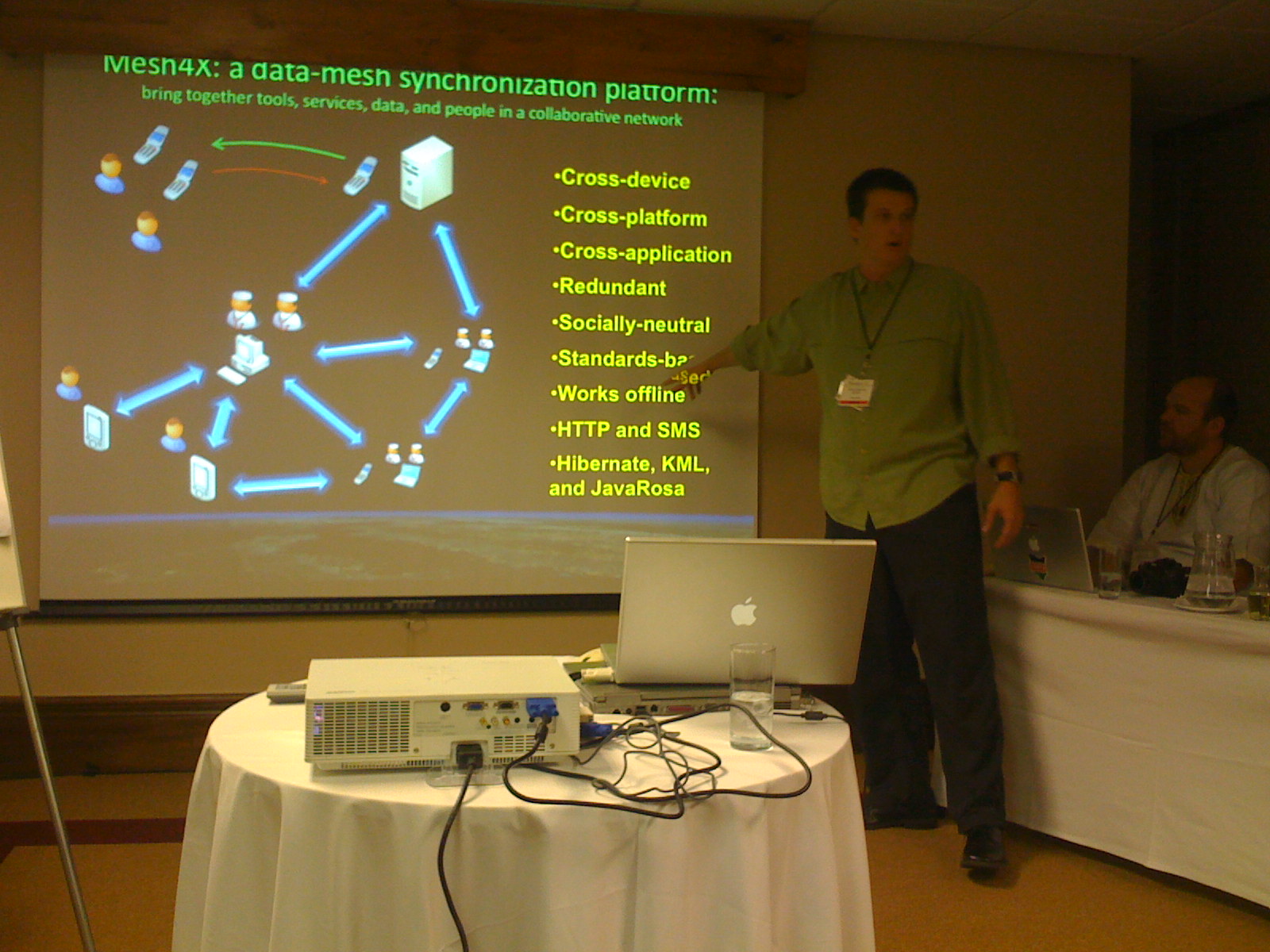
Robert gave a more technical-oriented presentation on InSTEDD’s latest toy, Mash4X. While I think I grasped the basics and ultimate purpose of the new tool, much of the platform’s description was rather technical. Robert did mention to me later on that they (InSTEDD) are still trying to hit the right notes when they present their work to a non-technical audience. I suggested he give more basic examples, real-world scenarios in which the tool could be used. Robert also showed screenshots of GeoChat which he had described to me back in November 2007.

Christopher presented some of the projects UNICEF is engaged in such as the development of a new laptop computer that can be used in crisis environments. He emphasized the importance of collaborating with groups like Ushahidi and InSTEDD.

Patrick Philippe Meier