We’re well into hurricane season here in Haiti but good luck finding a map on hurricane shelters and evacuation routes. One UN agency was supposed to update a 2007 map but then dropped the ball. Another agency thought they’d take on the task but now there are legal concerns since only the government has the right to decide on official emergency routes and shelters. The result? A highly vulnerable population remains largely unprepared for what many expect will be a busy hurricane season.
Creating country wide maps of hurricane shelters and evacuation routes is obviously no easy task. Or is it? If we adopt the typical top down mentality, then yes, we’re talking about just a handful of people being charged with a huge project that will take them weeks to carry out. With this approach, the maps will completed well after the end of hurricane season. Great.
What if we distributed the task and crowdsourced the maps? We could use the 2007 map of hurricane shelters as a starting point and send out targeted text messages to hundreds of mobile phone users near each of these shelters asking them to report on the condition of each shelter and the access routes. We could triangulate the responses for validation purposes. This could be done tomorrow by using a free short code just like we did during the disaster response operations earlier this year. Since the lottery is big in Haiti, this could serve as an incentive: “timely and accurate replies will qualify you for a raffle.” DigiCel has already conducted SMS raffles in the past, so there is a precedent.
The SMS replies could then be analyzed over the weekend and the results shared with local radio stations early next week. The latter could then broadcast this information on a daily basis. In the meantime, government and UN officials could conduct site visits to improve the shelters and evacuation routes.
An on-line competition could also be launched to have volunteers use Google Earth and other web-based resources to identify areas of land that are elevated in case of flooding. These volunteers could also trace viable roads/paths that lead to and from these areas and mark places that may be vulnerable to landslides and other hazards.
What about the fact that only the government has the legal right to do this? Big deal. The system is not working so it’s time to disrupt it. Would you rather have a crowdsourced disaster preparedness plan now or a government certified plan after the hurricane season? I’m tempted to ask this during tomorrow’s BarCamp Haiti which I am co-organizing with the Haitian tech company Solutions and the Ushahidi Haiti Project.
This is the first of two blog posts inspired by Clay Shirky’s new book “Cognitive Surplus: Creativity and Generosity in a Connected Age.” Clay disagrees with the notion that new communication tools craft new behaviors. I agree. “What if we’ve always wanted to produce [media] as well as consume, but no one offered us that opportunity?”
Technology has long limited our behavior as a gregarious, mobile species, not created new ones. “Many of the unexpected uses of communication tools are surprising because our old beliefs about human nature were so lousy.” We thought that “sharing was inherently rather than accidentally limited to small, tight-knit groups.”
So when we come across a surprising new application of technology, “instead of asking Why is this new?” which produces a technology centric answer, “we can [and should] ask Why is it a surprise?” The technology deficit (my own term) has long constrained our behaviors.
Lets take our favorite Caveman from the Geico commercials, for example. The technology deficit during those days meant that our caveman was constrained to static cave paintings. But surely Caveman would have preferred the Web to share his group’s story (or buy cheap mammoth insurance) rather than a darkly-lit cave with limited access. In fact, Flickr would have been perfect for Caveman. Another constraint with caves is the limited space for comments. Caves represent a technology deficit that prevented preferred behavior.
Lets take my friend Ma Al Eineen as an other example. I met Sheikh Ma Al Aineen, the grandson of the Blue Sultan of the Sahara, on the Western Sahara border with Mauritania some 10 years ago. He loved joking about how the cell phone was the perfect technology for nomads. Did cell phones cause nomadic behavior amongst nomads? No, nomads have always been nomadic and the fixed land line phone restricted that behavior.
This leads me to the following point: bounded crowdsourcing (which I blogged about here) is an accident caused by technology deficits. Information wants to be open but it’s been bounded by technology and power trips. “Bounded crowdsourcing” is nothing new. Indeed, restricting information flows has been the “default setting” for thousands of years. So why use the new term “bounded crowdsourcing” then?
As Clay notes, “the privilege of establishing what value the default is set at is an act of power and influence.” The use of the adjective bounded is thus as much of normative statement as it is a descriptive one. Crowdsourcing is information collection unrestricted by technology and entrenched interests. It is the norm, the “original” default setting. Anything that deviates from this is the result of tech deficits and/or of power interests.
My colleague Anahi Ayala recently started a blog called “Diary of a Crisis Mapper.” I highly recommend it. Her latest blog post on Ushahidi-Chile relates some intriguing detective work that all started with the following tweet:
The Tweet was mapped on Ushahidi-Chile. You’ll note in the discussion forum part of this report that a volunteer (Annette) updated the alert by adding that the person had been rescued. She did this after seeing a Tweet from @biodome10 saying that he had been rescued. This is when I emailed Anahi (on February 27th) to ask whether she could try and confirm this case.
It turns out the person behind the Twitter handle @biodome10 was pretending to be Gerry Fraley, a journalist with the Dallas Morning News. Biodome10 even used Gerry Fraley’s own profile picture on their Twitter profile. It also turns out that @biodome10 has a history of disseminating false information. But this first Tweet set in motion an intriguing series of events.
Someone in Chile saw the Tweet and actually called the police to report that a person was trapped under a building at that address. Anahi did some online detective work and found out that “the police decided to send 3 trucks from the fire dept, 30 cops from the rescue department, and the chief of Security in person to the address to save the person in question (see James’s blog on this, and also reported from @criverap from Twitter).”
Anahi followed this lead further:
It was Saturday night in Santiago and even if there had been one of the worst earthquake of the last 25 years, life was still going on. So it was for Dinamarca Pedro and Vargas Elba, a couple that was celebrating that night its 39 wedding anniversary. Of course, there was not much to celebrate, so at 11pm Pedro and Elba were preparing to go to bed. They lived in Lautaro 1712, Santiago, Chile.
When the door was open by force by police, carabineros and detectives, with the chief of Security in person leading the operation, the couple almost had a heart attack. No person to rescue, only an old couple which is going to remember its 39 anniversary for the rest of its life! (reported on Las Ultima Noticias Newspaper on the 1st of March 2010).
That’s not all, @biodome10 sent out a second false Tweet the following day, which was also mapped on Ushahidi-Chile:
Again the police mobilized to the location after seeing the Tweet on Twitter. When they arrived at the scene, there were no collapsed buildings in that part of the city, so they promptly left. This time though, the Tweet actually ended up on hundreds of t-shirts as part of a fund raising campaign for the Red Cross.
As Anahi writes:
Both those tweets were false. Now we know that because we know that Biodome10 was posting false information. But the Chilean police didn’t have the time and the resources to verify this information. They had priorities: go and save people as quickly as possible. They wasted time two times following both those twitter messages, while they could have been use this time to save other people in danger. Biodome10 was not only playing with social networks and Twitter, he was playing with people’s life.
At the same time, though, Anahi notes that she was able to do all her detective work right from her laptop by just accessing the web:
[…] crowd sourcing verification of information works. I have been able to find all those information just by sitting on my desk in NYC/Boston. Others have done investigations for me. I have been just collecting people’s tweets, read their blogs, and put together all the information. The fact that different people, from different parts of the world have been investigating by themselves this issue, has given me the possibility to find out that Biodome10 was a liar, independently from his identity and to be sure that the two reports we posted on our Ushahidi map were actually false.
To this end, Anahi advises groups that crowdsource crisis information to set up a verification team that can use crowdsourcing to verify information. This is precisely the principle behind Swift River, using crowdsourcing and natural language processing to crowdsource the filter. As Anahi remarks, “Crowd sourcing verification of information in this case worked. True, it was too late, especially for the police dept in Santiago, but next time we all will be ready.”
Hopefully they’ll be ready and using Swift River since the point of Swift River is to help groups validate information in near real-time. In fact, had Swift River been used during Chile, those two Tweets by @biodome10 would have received the lowest scores because there was only one “witness” reporting the incidents. Of course, Swift River is not a silver bullet as I have already elaborated on here. But we must be careful not to despair because of two false Tweets. They represent 0.0016% of all the reports mapped on Ushahidi-Chile, and they were subsequently verified.
As Dave Warner noted at a panel on USIP Mobile Phones and Afghanistan last week, “Snipers in Afghanistan use roads. Does that mean we should go and tear up all the roads?” Of course not.
I have 3 take-aways from these anecdotes:
I wouldn’t be surprised if there were grounds to take legal action against @biodome10. This should send a signal to others who want to play with people’s lives during disasters.
The Tweets were verifiable by anyone with an Internet connection, the main challenge was time not verifiability.
Both Tweets could have been verified more quickly by others on site had they gotten wind of the information. They could easily have gone down the street and taken a picture showing that there was a wedding anniversary at the first location and intact buildings at the second. They could prove the date by including a picture of the day’s newspaper in the photographs.
In sum, I’m still of the opinion that greater connectivity can lead to greater self-correction. The detective work can be crowdsourced, my dear Watson.
The use of crowdsourcing may be relatively new to the technology, business and humanitarian sectors but when it comes to statistics, crowdsourcing is a well known and established sampling method. Crowdsourcing is just non-probability sampling. The crowdsourcing of crisis information is simply an application of non-probability sampling.
Lets first review probability sampling in which every unit in the population being sampled has a known probability (greater than zero) of being selected. This approach makes it possible to “produce unbiased estimates of population totals, by weighting sampled units according to their probability selection.”
Non-probability sampling, on the other hand, describes an approach in which some units of the population have no chance of being selected or where the probability of selection cannot be accurately determined. An example is convenience sampling. The main drawback of non-probability sampling techniques is that “information about the relationship between sample and population is limited, making it difficult to extrapolate from the sample to the population.”
There are several advantages, however. First, non-probability sampling is a quick way to collect way to collect and analyze data in range of settings with diverse populations. The approach is also a “cost-efficient means of greatly increasing the sample, thus enabling more frequent measurement.” In some cases, the non-probability sampling may actually be the only approach available—a common constrain in a lot of research, including many medical studies, not to mention Ushahidi Haiti. The method is also used in exploratory research, e.g., for hypothesis generation, especially when attempting to determine whether a problem exists or not.
The point is that non-probability sampling can save lives, many lives. Much of the data used for medical research is the product of convenience sampling. When you see your doctor, or you’re hospitalized, that is not a representative sample. Should the medical field throw away all this data based on the fact that it constitutes non-probability sampling. Of course not, that would be ludicrous.
The notion of bounded crowdsourcing, which I blogged about here, is also a known sampling technique called purposive sampling. This approach involves targeting experts or key informants. Snowball sampling is another type of non-probability sampling, which may also be applied to crowdsource of crisis information.
In snowball sampling, you begin by identifying someone who meets the criteria for inclusion in your study. You then ask them to recommend others who they may know who also meet the criteria. Although this method would hardly lead to representative samples, there are times when it may be the best method available. Snowball sampling is especially useful when you are trying to reach populations that are inaccessible or hard to find.
A project like Mission 4636 and Ushahidi-Haiti could take advantage of this approach by using two-way SMS communication to ask respondents to spread the word. Individuals who sent in text messages about persons trapped under the rubble could (later) be sent an SMS asking them to share the 4636 short code with people who may know of other trapped individuals. When the humanitarian response began to scale during the search and rescue operations, purposive sampling using UN personnel could also have been implemented.
In contrast to non-probability sampling techniques, probability sampling often requires considerable time and extensive resources. Furthermore, non-response effects can easily turn any probability design into non-probability sampling if the “characteristics of non-response are not well understood” since these modify each unit’s probability of being sampled.
This is not to suggest that one approach is better than the other since this depends entirely on the context and research question.
Ushahidi is the name of both the organization (Ushahidi Inc) and the platform. This understandably leads to some confusion. So let me elaborate on both.
Ushahidi the platform is a piece of software, not a methodology. The Ushahidi platform allows users to map information of interest to them. I like to think of it as democratizing map making in the style of neogeography. How users choose to collect the information they map is where methodology comes in. Users themselves select which methodology they want to use, such as representative sampling, crowdsourcing, etc. In other words, Ushahidi is not exclusively a platform for crowdsourcing. Nor is Ushahidi restricted to mapping crisis information. A wide range of events can be mapped using the platform. Non-events can also be mapped, such as football stadiums, etc.
The platform versus methodology distinction is significant. Why? Because new users often don’t realize that they themselves need to think through which methodology they should use to collect information. Furthermore, once they’ve chosen the methodology, they need to set up the appropriate tools to collect information using that methodology, and then collect.
For example, if a user wants to collect election data using representative sampling, they will need to ensure that they select a sample of polling stations that are likely to be representative of the overall population in terms of voting behavior. They will then need to decide whether they want to use SMS, email, phone calls, etc., to relay that information. Next, they’ll want to hire trusted monitors and train them on what and how to report. But none of this has anything to do with Ushahidi the platform.
Here’s an analogy: Microsoft Word won’t tell me what methodology to use if I want to write a paper on the future of technology. That is up to me, the author, to decide. If I don’t have any training in research methods and design, then I need to get up to speed independently. MS Word won’t provide me with insights on research methods. MS Word is just the platform. Coming back to Ushahidi, if an organization does not have adequate expertise, staff, capacity, time and resources to deploy Ushahidi, that is not the fault of the platform.
In many ways, the use of Ushahidi will only be as good as the organization or persons using the tool.
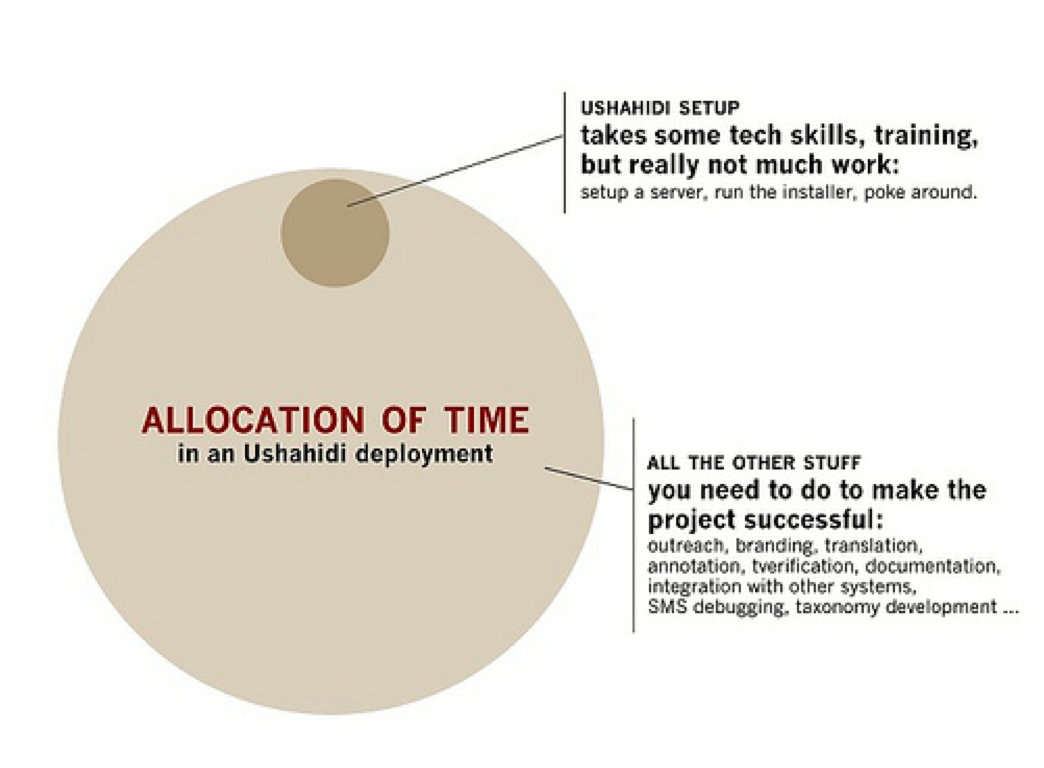
Ushahidi is only 10% of the solution (graphic by Chris Blow)
As my colleague Ory aptly cautioned: “Don’t get too jazzed up about Ushahidi. It is only 10% of the solution.” The other 90% is up to the organization using the platform. If they don’t have their act together, the Ushahidi platform won’t change that. If they do and successfully deploy the Ushahidi platform, then at least 90% of the credit goes to them.
Ushahidi the organization is a non-profit tech company. The group is not a humanitarian organization. We do not take the lead in deployments. In the case of Haiti, I launched the Ushahidi platform at The Fletcher School (where I am a PhD student) and where graduate students (not Ushahidi employees) created a “live” map of the disaster for several weeks. The Ushahidi tech team provided invaluable technical support around the clock during those weeks. It was thus a partnership led by The Fletcher Team.
We do not have a comparative advantage in deploying platforms and our core mission is to continue developing the Ushahidi platform. On occasion, we partner on select projects but do not take the lead on these projects. Why do we partner at all? Because we are required to diversify our business model as part of the grant we received from the Omidyar Network. And I think that’s a good idea.
My colleague Ankit Sharma at the London School of Economics (LSE) recently sent me his research paper entitled “Crowdsourcing Critical Success Factor Model” (PDF). It’s definitely worth a read. Ankit is interested in better understanding the “dynamic and innovative discipline of crowdsourcing by developing a critical success factor model for it.” He focuses specifically on mobile crowdsourcing and does a great job unpacking the term.
Ankit first reviews four crowdsourcing projects to inform the development of his critical success model: txtEagle, Ushahidi, Peer Water Exchange and mCollect. He then notes the crucial difference between outsourcing and crowdsourcing. The latter’s success is dependent on the scale of crowd participation. This means that incentives need to tailored to recruit the most effective collaborators while “the motive of the crowd needs to be aligned with the long term objective of the crowdsourcing initiative.” To this end, Ankit defines successful crowdsourcing in terms of participation.
Ensuring participation requires that the motives of the of the crowd be directly aligned with the long term objectives of the crowdsourcing initiative. “Additionally, to promote participation the users must use and accept the technology of crowdsourcing.” Ankit draws on Heeks and Nicholson (2004), Carmel (2003) and Farrell (2006) to develop the following model.
The five peripheral factors above “affect the motive alignment of the crowd which is the prime determinant of success of the crowdsourcing initiative. It is assumed to directly affect user participation. The success of the initiative is expected to bring in more participation. Hence, the relationship between motive alignment and crowdsourcing success is bidirectional in the model.”
Vision and Strategy: “The coherence of the initiative’s vision and strategy with the aspirations of the crowd ensures that the crowd is willing to participate in it.”
Human Capital: The skills and abilities that the crowd possesses is a determinant of successful crowdsourcing. The more skillful and able the crowd is, “the less effort required by the crowd to make a meaningful contribution to the initiative.”
Infrastructure: “Crowdsourcing requires abundant, reliable and cheap telephone or mobile access for its communication needs in order to ensure participation of the crowd.”
Linkages and Trust: Crowdsourcing initiatives all involve a time or information cost for the crowd, which is why developing the trust factor is critical. Proper linkages can also “add a substantial trust aspect to the crowdsourcing initiative.”
External environment: “The macroeconomic environment comprising of the governance support, business environment, economic environment, living environment and risk profiles are important determinants of the success of the crowdsourcing initiative.”
Motive alignment: “Motive alignment of the crowd may be defined as the extent to which crowd is able to associate with long term objective of crowdsourcing initiative thereby encouraging its wider participation.” The table below explains how the peripheral factors effect the motive alignment of the crowd.”
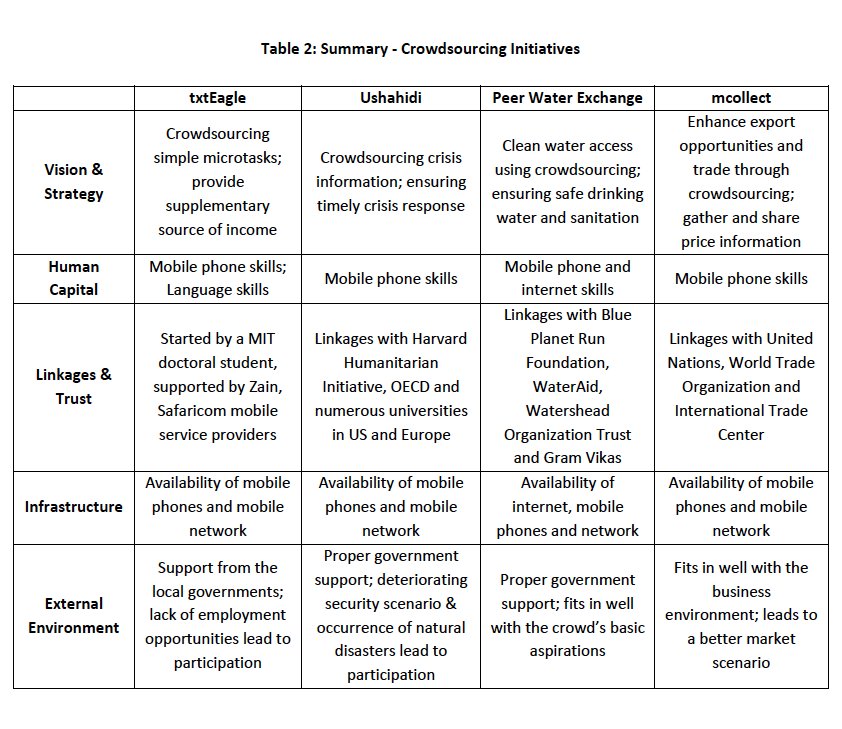
Ankit applies his matrix to the four case studies cited earlier. This yields the following summary:
Based on this analysis, Ankit argues that for crowdsourcing projects to succeed it is “critical that the crowd is viewed as a partner in the initiative. The needs, aspirations, motivations and incentives of the crowd to participate in the initiative must remain the most important consideration while developing the crowdsourcing initiative. The practitioners must understand the crowd motivation and align their goals according to it.” In an ideal scenario, Ankit notes that technology must be “optimally usable” without the need to provide training and assistance. Successful crowdsourcing initiatives also require an “aggressive marketing and public relations plan.”
The main question I look forward to discussing with Ankit is this: what level of crowd participation is sufficient for a crowdsourcing initiative to be deemed successful? Should this be a percentage? e.g., the % of a given population participating in the crowdsourcing project. Or should the number be an absolute number? This is not an academic question. Who decides whether a crowdsourcing project is successful and based on what grounds?
I’ve been meaning to write this blog post since February when I presented Ushahidi to BBC, CNN, UK Guardian and Channel4 in London. A session we just had at Foo Camp East made me realize it’s high time I write this.
The idea I pitched to CNN et al. was as follows: use a dedicated Ushahidi smart phone app that allows anyone to be a real-time iReporter. You download the app and allow CNN to know your location (although you can decide whether that’s within a 10-mile, 1-mile, 100 yards etc radius). As the CNN newsroom gets wind of a new potentially news-worthy incident, they just press the “red button”.
This red button sends out a message to all mobile iReporters within, say, 100 yards of where the incident took place asking them to take a quick picture if they happen to be just around the block. These users—turned volunteer CNN citizen journalists—can then be mobilized to report in near real-time. They could send in geo-referenced pictures annotated with comments and video footage of unfolding events.
I think this kind of app would appeal to many would-be citizen journalists. It costs nothing, just download to your smart phone so that if you ever find yourself at the right place at the right time then you know your breaking news picture may make it to CNN. There could be additional incentives like the number of reports you’ve submitted to CNN following a request. In other words, you could turn this into a quasi-competition or game. Yearly awards could be given out.
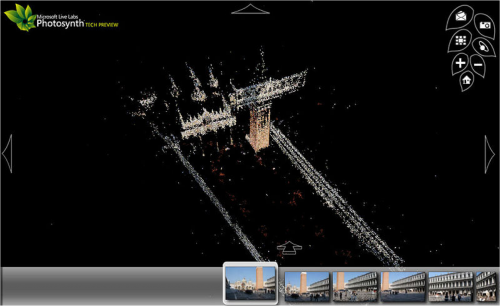
Ideally, you’d have a dozen citizens respond to the red button call, scrambling to be the first on site to take the picture, or to be the one who takes the best picture of the incident. This would allow CNN to triangulate the incoming information, possibly creating a Photosynth product updated in real-time. Comments (ie, captions that come with the pictures) could also be cross-validated for reliability purposes. Here’s a 3D rendering of Venice using Photosynth:
One other use-case for this Ushahidi mobile app would be for users to submit pictures/reports without being solicited by CNN. In fact, more often than not, these mobile iReporters are likely to be the first to break the news of an incident to CNN—rather than the other way around. Once an iReporter does this and CNN receives the geo-located picture, they can press the red button to mobilize other would-be iReporters to the scene.
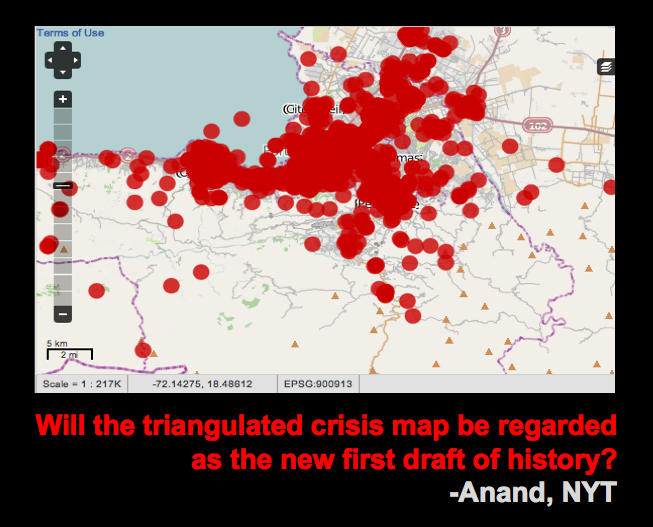
This is why I love citing the Ushahidi article that my New York Times colleague Anand wrote up earlier this year. The screen shot below from the Ushahidi-Haiti deployment literally illustrates the reasoning behind Anand’s question: “Will the triangulated crisis map be regarded as the new first draft of history?” The beauty of crowdsourcing is that it opens the floodgates of information. This means more and more witnesses can capture evidence of the same historical events unfolding. In other words, there is overlap and the triangulated map becomes possible.
The key word for me in Anand’s quote is “draft”. History is now a draft, not a finished product, but a work in progress—and one that is now written (and corrected) by the crowd. Anand adds, “They say that history is written by the victors. But now, before the victors win, there is a fresh chance to scream out, with a text message that will not vanish.” I’d go even further and say that the crowd can now be the victors by being mobile iReporters.
Think of these smart phone apps as the “seismographs” for crises. This allows users to form a veritable real-time, real-space human sensor web—or as Secretary Clinton describes it, “a new nervous system for the planet.”
Of course there are liability issues with mobilizing the masses to write the first draft(s) of history. So disclaimers will be necessary. For example, do not try and cover a story if this places in you physical danger or psychological harm. You’d probably have to give up all rights to the picture/text you submit, but at least you’d have your name credited on CNN.
Patrick Ball and I had a series of long email exchanges this past week on the much talked-about-issue of crowdsourcing versus representative sampling. It’s an old issue that keeps coming up. But there’s really no debate, in my opinion. Crowdsourced data is not necessarily representative. That really should not be breaking news.
Also, it is worth repeating that Ushahidi is a platform, not a methodology. So an election-monitoring organization like the National Democratic Institute (NDI) could certainly generate representative polling data using Ushahidi by applying random sampling methods, for example. I already blogged about this several months ago in a post titled “Three Common Misconceptions About Ushahidi.” So I’m not going to rehash this here. Instead, I’d like to take a more “philosophical” approach.
In a “Theory of Justice,” the philosopher John Rawls introduces the “veil of ignorance“, a thought-experiment designed to determine the morality of a certain issue. The idea goes something like this: imagine that you have to decide on the morality of an issue before you are born, i.e., you stand behind a veil of ignorance as you don’t know where you will be born, what race, with what kind of family, etc.
As put by John Rawls himself … “no one knows his place in society, his class position or social status; nor does he know his fortune in the distribution of natural assets and abilities, his intelligence and strength, and the like.”
For example, in the imaginary society, you might or might not be intelligent, rich, or born into a preferred class. Since you may occupy any position in the society once the veil is lifted, this theory encourages thinking about society from the perspective of all members. The veil of ignorance is part of the long tradition of thinking in terms of a social contract.
What does this have to do with crowdsourcing? If you were standing behind this metaphorical veil of ignorance, would you outlaw the crowdsourcing of crisis information on the basis that the data may not be representative? Or would you still like to receive SMS alerts from crowdsourced information? The text messages sent to Ushahidi-Haiti by Haitians in life-and-death situations were not necessarily statistically representative, but they saved lives.
I just gave a TEDx talk and my presentation played off a recent blog post of mine entitled “Wag The Dog, or How Falsifying Crowdsourced Information can be a Pain.” I introduced some new ideas and angles to the topic so here is basically a blog post version of the presentation.
We all know that open crowdsourcing platforms are susceptible to information vandalism, i.e., false information deliberately used to mislead. For example, if an Ushahidi platform were used in Iran, the government there could start reporting events to Ushahidi that never happened; perhaps events that suggest protesters attacked first and that riot police were just acting in self defense. But, I’m going to argue that falsifying crowdsourced information can actually be a pain. And I’m going to use the analogy of “Wag the Dog” to explain why. If you haven’t watched the movie, the story is based on a White House Administration that pretends a war has broken out in Albania to divert public opinion and hopefully increase the President’s ratings prior to re-election.
Here’s a 30 second highlight on how they created a fake war:
In a way, Wag the Dog already happened for real. Except the story was called “The War of the Worlds” and it was played as a radio broadcast in 1938. “War of the Worlds” is drama about a Martian invasion of Earth. What was particularly fun about this radio broadcast was that the first 2/3 of the 1-hr long story was just a series of simulated news bulletins. And the story ran uninterrupted, ie, without commercials. So many radio listeners in the US freaked out, thinking a real invasion was taking place!
The panic this caused even made it on the front page of the New York Times! Clearly, pulling of a Wag-the-Dog in the 1930s was a piece of cake!
And that’s because the information ecosystem looked something like this in the 1930s. Largely disconnected and broadcast only, ie, one-to-many. Can anyone point out an important node that should be included in this ecosystem? That’s right, the newspaper. But the paper would not have been printed at the speed that the radio broadcast was taking place to help counter fears; unlike today, of course, thanks to online news.
Today’s information ecosystem obviously looks little different. Many-to-many, peer-to-peer, 2-way, real-time information and communication technologies. Now, we might argue that this kind of ecosystem makes it easier for repressive regimes to game since the system is closely integrated and interoperable, which means information can propagate very quickly. Secretary Clinton recently called our information ecosystem the new nervous system of the planet. But then again, these diverse sources of user-generated content could also make it easier to triangulate and filter out false information.
For example, in the case of Iran, the high volume of pictures and videos posted on Flickr and YouTube made it rather difficult for the government to claim nothing was happening. Information blockades are likely to join the Berlin Walls of history. Today, you can get pictures of the same incident from three different camera phones, in addition to tweets and text messages, etc.
This is what Ushahidi is about, aggregating crisis information across different media and mapping that information in near real time to improve transparency, accountability and coordination.
Take the Ushahidi-Haiti map, for example. Crowdsourcing crisis information on Haiti allowed us to map several thousand incidents over just a few weeks, which actually saved lives on the ground. The incidents we mapped came from a myriad of sources: thousands of text messages directly from Haiti, hundreds of Tweets, information from Facebook Groups, online media, live Skype chats with the Search and Rescue Teams in Port-au-Prince, list serves, radio, you name it. Volunteers at The Fletcher School mapped this information in near real-time for several weeks and first responders used the map to save lives.
Check out this animation of the events unfolding from just a few hours after the quake.
What you see are events “overlapping” and clustering, ie, on several occasions we get two or more text messages from different numbers reporting the same event. And then a Tweet with similar information, for example. The crowdsourcing of crisis information allows us to triangulate and validate information thanks to the reporting coming from a myriad of sources in near real-time. This would hardly have been possible in the 1930s, which is what prompted my colleague Anand at the New York Times to write an article on our work and ask,
They say that history is written by the winners, will future history be written by the crowd?
Ushahidi’s crowded map of Haiti reminded me of Photosynth. Taking hundreds crowdsourced pictures and “stitching” them together to reproduce historical monuments. In 3D no less!
Here’s a quick 20 second video demo:
So the question is, can Ushahidi become the “ALLsynth” by stitching together crowdsourced crisis information across many different types of media? Ushahidi platforms have been deployed hundreds of times across the world. Here are just four examples.
From mapping the Swine Flu outbreak to reporting on the war in Gaza, to citizen-powered election monitoring in India and disaster response in the Philippines. Would stitching together these hundreds of platforms amount to creating an ALLsynth? What would it take to game an ALLsynth?
As I mentioned in my Wag the Dog post, perhaps some of the following:
Dozens of pictures from as many different camera phones of an event that never happened.
Text messages using different wording to describe an event that never happened.
Tweets (not retweets!).
Fake blog posts, Facebook groups and Wikipedia entries.
Fake video footage. Heck, you’d probably want to hack the international media and plant a fake article in the New York Times home page.
If you really want to go all out, you’d want to get hundreds of (paid?) actors like in The Truman Show.
You’d likely want to cordon off an entire area of the city or city outskirts.
Then you’d want to choreograph a few fight scenes with these actors.
A few rehearsals would probably be in order too.
Oh and of course props, plus lots of ketchup if you want things to look like they went badly.
In other words, you’d probably want to move to Hollywood to fabricate all this… That said, there’s another way that repressive regimes could deal with an unwanted Ushahidi platform, like this one being used by Sudanese civil society groups in the Sudan to monitor the elections currently taking place. We found out yesterday from our Sudanese colleagues that the site was no longer accessible in the Sudan (see official press release here in PDF). Blocking and censoring websites is really easy for governments to do, and we expected that Sudan would be no different.
So our Sudanese colleagues have been working with their tech-savvy friends to circumvent the censorship and continue mapping election irregularities—this is my applied dissertation research in action, I just never thought that my own actions would influence the data. They set up a mirror site under an different domain name. This may become a cyber-game-of-cat-and-mouse, there is plenty of precedents for this: civil society finds a loophole, which is then blocked by the state, which prompts the search for another loophole, etc, etc. I expect that repressive regimes may eventually give up on blocking websites given the likely futility. Instead, they may try to game the platforms by falsifying crowdsourced information.
But as I have just argued, falsifying crowdsourced information can be a pain. So if repressive regimes start pouring money into their domestic film industries, particularly in blue screen technology, you’ll know why, and this is what you can expect to happen next:
Guest blog post: Bart Stidham is an enterprise architect committed to bringing positive change to the world via better information systems architecture. He has served as CTO of four companies including one of the largest communications companies in the world, been a senior executive at Accenture, and served as CIO of the largest NGO funded by USAID. He is an independent consultant and can be found in Washington, DC when he is not traveling.
This blog post builds off of and supports Patrick Meier’s previous post on developing an SMS Code of Conduct for Humanitarian Response. Patrick raises many important issues in his post and it is clear that with the success of Ushahidi-Haiti it is likely we will see a vast increase in the use of similar SMS based information management systems in the future. While the deployment of such systems and all communications systems is likely to be orderly and well structured in normal circumstances, it is likely that during crises such order may break down and these systems may negatively impact one another. For this reason I applaud Patrick’s effort to raise this issue but my hope is that the “normal order” imposed by governments and societies will help prevent the potential disruption of communications systems from occurring in disasters, emergencies, and crises.
I believe Patrick’s concerns are best discussed in the larger issue of frequency spectrum management. This is a huge issue and one that needs substantial education within the entire response space. It is a growing problem across each and every communications system not just in crises but also globally as we humans desire to communicate more in more ways and with more devices. There are limits to the amount of information that can be “pushed” through any communications system and those limits increasingly have to do with the laws of physics, not just the design of the systems.
The electromagnetic frequency spectrum (EF) is the basis of all wireless communication. We started our use of it the late 1800s with the first use of radio. Long ago we exhausted the entire spectrum and are now trying to find ways to reuse parts of it more efficiently. However it is critical that we protect this “public commons” on which so many of our communications systems depend.
Every communications system needs a “physical channel” and this varies widely but they all share some common characteristics. One is the problem of “collisions” which are bad because that means that the information is not delivered successfully. As humans using the physical channel of sound and speech we encounter this in our normal conversations whenever we meet in groups. A simple example of a collision is when two or more people are talking loudly over each other with the result being that no one understands what either is saying.
There are multiple ways to deal with collisions and every communications system must manage collisions or the system collapses. One way is to have a token and you are only allowed to talk if you hold the token. This method of managing communications was used brilliantly by various Native American tribes when discussing heated issues such as war – if you are not in possession of the peace pipe (the token) you are not allowed to speak. This forces everyone to listen to what you are saying and to politely take turns speaking. It is passed back and forth and everyone gets a turn. There are several types of network architecture that use this exact method for avoiding collisions.
Another method is collision avoidance by assigning each speaker a window of time to speak in. This is roughly the approach used by GSM for instance. Yet another method is collision detection where you allow for a certain statistical overlap and all parties know that the last “conversation” collided with another and the information was lost. The system then corrects the problem. This is not as efficient but is easy to do and cheap to implement. This is what Ethernet uses.
Finally as systems are deployed and interact with each other in a certain physical space they need to divide up the space. This can be done by frequency or cables or physical area or by time or all of the above.
In our discussion SMS are best likened to frequencies (although this is not an exact analogy). The advantage of them is that no two NGOs can ever end up with the same long code as this is handled by the carriers and their agreements. Internationally no two carriers can ever issue the same phone number or long code globally. If all NGOs stuck with long codes or full phone numbers we could avoid the problem Patrick is rightly concerned with.
NGOs and other organizations can problematically and mistakenly issue the same short code within a geographic area and we should all be concerned about this exactly as Patrick is. This problem can happen because short codes are for humans – not for the system itself. If the carriers are using different underlying cell phone technologies they can both issue the same short code and neither will interfere technically with the other one. Unfortunately it could have disastrous consequences for the socialization of the short codes to the local or larger population if they cross either technical or geographic lines. This is a problem largely unique to SMS and the plethora of technologies,carriers, bands (or frequencies) that can be deployed in a large physical area and the fact that short codes are for human convenience.
Right now there are 14 frequency bands just within the GSM voice system (thankfully quad band phones support all the widely used ones) and another 14 for data (furthermore the data “bands” actually cover a huge range of frequencies). This is why it is possible to have within one region, country or city with two “overlapping” short codes on two or more different carriers – the codes will each work only on the carrier that operates on that actual GSM frequency band. The system doesn’t care but it can be confusing to us humans.
Another thing Patrick has raised as a concern is actually “subject matter frequency” overlap (or collisions) and the confusion that can result to us simpleminded humans.
It makes no difference how many SMS codes are used as long as they are long codes OR if private and on short codes. The only time there is a problem is when two groups set up short codes that become public (meaning they are advertised in some way to the general public) as “the right number for X” where X is the same subject matter area.
In order to speed response many countries do NOT follow the US 911 system which uses a single short number for all emergencies. For instance Austria uses no less than 9 “short code” voice numbers each for a separate emergency type. That’s great if you live there and have them all memorized and know that for extreme sports there is a number just for “alpine rescue” to get your friend off some ledge that he crashed into in his para-glider. It speeds vital response and gets the right team dispatched in the least time. It does however require a massive amount of public education.
In the US the government decided to have a “one number fits all” system. This was in response to the fact that previously we had thousands of local numbers for each fire and police department, hospital and ambulance service. Without a local phone book it wasn’t possible to know who to call in an emergency. We designed the 911 system as a way to solve this problem and looped all three major responders into the one system. This was then deployed on a county by county basis across the US. There is no national 911 system. The system scales by dividing itself into small geographic sections.
SMS systems tend to be larger in size because SMS carriers are geographically larger that the old local phone POP (point of presence) that became the basis of the US 911 system. Another major concern for SMS design is the total carrying capacity of the carrier SMS system itself. SMS is NOT designed to be use for “one to many” messages. That was never part of the design and the system can be knocked out if the overall limits of the system are exceeded. At that point the SMS systems themselves collapse under the load and start failing and can cause a cascade failure of the entire carrier network in a region – this means that SMS can knock out voice. It does appear that such a failure occurred in Haiti to one of the local carriers that implemented an SMS emergency broadcast system in conjunction with an NGO so this is a real problem.
Getting back to Patrick’s identified concern – we should be worried when multiple SMS “subject channels” are socialized via the mass media and it confuses the public. In Haiti that didn’t happen because there was only one due largely to the work and efforts of the 4636 Haiti.Ushahidi community.
I believe in the future that is also unlikely to happen because I hope the mass media outlets will simply refuse to say “use any of the following SMS codes for health and these for x and y and z.” I think they won’t do this haphazardly. Doing so (meaning confusing the public) could endanger their (mass media) operating license from the host country.
Furthermore countries and cities are typically aware of this whole discussion and carefully control the distribution of short codes (but this does vary widely from region to region). The country that issues the carrier the license to operate the infrastructure is the ultimate authority for this and reserves the right to yank someone off the air or kick them out of the country for failure to follow the rules. Frequency spectrum must be managed for the greater public good or the classic “crisis of the commons” will result. This is the concern Patrick has brought to light.
One can not and should not assume that the rules, laws and policies we (individuals) are used to operating under in our home country apply elsewhere. The term “sovereign nation” means exactly that – they set their own laws concerning how things operate – including technology and communications systems. For instance WiFi is NOT WiFi everywhere and a WiFI router sold in Japan is illegal to operate in the US.
Some well meaning but largely uneducated NGOs deployed systems in Haiti that badly broke rules, laws, policies, etc and the Government of Haiti (and the US Government on behalf of the Haitian Government) was very polite to them. They stepped all over local businesses and disrupted them. Had this happened in the US the FCC would have issued huge fines to them – fines that likely would drive them out of business – and for good reason. They are exploiting the “public commons” for their own advantage. Whether they meant to or not is irrelevant just as ignorance of the law is no excuse.
In the past most responders to such emergencies were large NGOs with trained communications teams that knew they must coordinate their use of various communications platforms with each other or everyone would suffer. In this past this was easy and obvious because NGOs, governments and businesses made extensive use of UHF and VHF radios for communications. Because these systems were voice based it was obvious when you had a problem and when someone was on your assigned frequency. Furthermore you frequently had the opportunity to yell at them over that same communications system.
In the era of digital communications systems we no longer have the ability to yell at anyone and in fact both the designed legal and official user and the illegal user may be unaware that they are colliding and causing both systems to fail. This is a huge problem because it means that both parties have no way to know even know they are interfering with each other much less how or where to resolve the problem.
In conclusion, I applaud Patrick’s efforts as he has raised an important issue that all NGOs that respond to emergencies (both in the US and abroad) must to be aware of. Education is critical. Please tell your organization that they must contact and coordinate with the official frequency manager, typically the local government’s communications agency or ministry, prior to deploying any communications equipment. Failing to do so is typically illegal and can have grave consequences in emergencies, crises and disasters.
I thrive when working across disciplines, building diverse cross-cutting coalitions to create, translate and apply innovative strategies driven by shared values. This has enabled the 20+ organizations I’ve worked with, and those I’ve led, to accelerate meaningful and inclusive social impact.
Which is why I've been called a social entrepreneur and a translational leader by successful innovators. President Clinton once called me a digital pioneer, while recent colleagues describe me as kind, dedicated, values-driven, authentic, creative, ethical, and impactful.











 iRevolutions
