
Category Archives: Digital Activism

Human Rights 2.0: Eyes on Darfur

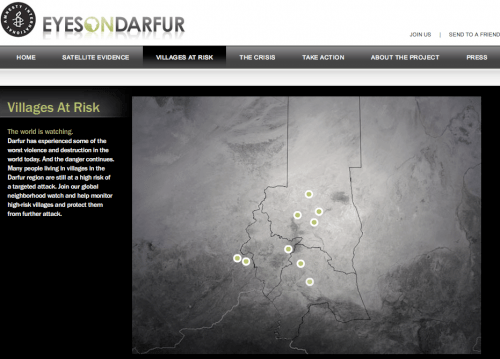
Amnesty International (AI) is taking human rights monitoring to a whole new level, metaphorically and literally speaking. The organization’s “Eyes on Darfur” project leverages the power of high-resolution satellite imagery to provide unimpeachable evidence of the atrocities being committed in Darfur – enabling action by private citizens, policy makers and international courts. Eyes On Darfur also breaks new ground in protecting human rights by allowing people around the world to literally “watch over” and protect twelve intact, but highly vulnerable, villages using commercially available satellite imagery.

I met with AI today to learn more. The human rights organization sends government officials these images on a regular basis to remind them that the world is watching. The impact? The villages monitored by AI have not been attacked while neighboring ones have. According to AI, there have also been notable changes in decisions made by the Bashir government since “Eyes on Darfur” went live a year ago. Equally interesting is that AI has been able to track the movement of the Janjaweed thanks to commercially available satellite imagery. In addition, the government of Chad cited the AI project as one of the reasons they accepted UN peacekeepers.
The American Association for the Advancement of Science (AAAS) is also leading a Human Rights and Geospatial Technologies project. So I also sat with them to learn more (September 2007). NGOs in Burma provided AAAS with information concerning attacks on civilians carried out by government forces in late 2006 and early 2007. AAAS staff reviewed these reports and compared them with high-resolution satellite images to identify destruction of housing and infrastructure and construction of new military occupation camps. The result is available in these Google Earth Layers. AAAS has provided comparable layers for Sudan, Chad, Lebanon and Zimbabwe. And this is just the tip of the iceberg.

AI is venturing on a 3-year project to provide satellite imagery to monitor forced displacement for early detection and advocacy. AAAS is developing a user-friendly web-based interface to let the NGO community know in real time where commercial satellites are positioned and what geographical areas they are taking pictures of. The interface includes direct links to the private companies operating these satellites along with contact and pricing information. AAAS believes this tool will enable the NGO community to make far more effective use of satellite imagery and to serve as a deterrent against repressive regimes choosing to commit mass atrocities.

The European Commission’s Joint Research Center (JRC) out of Ispra, Italy is also engaged in phenomenal work using satellite imagery. I first met with the JRC in 2004 and more recently in October 2007. The Center has developed automated models for change detection that are far more reliable than previously thought possible. Using pattern detection algorithms, the JRC can detect whether infrastructure has been destroyed, damaged, built or remained unchanged. They are now applying these models to monitor changes in refugee camps worldwide. The advantage of the JRC’s models is that they don’t necessarily require high resolution satellite imagery.

The same team at the JRC has also developed models to approximate population density in urban areas such as the Kibera slums out of Nairobi. Using satellite pictures taken at different angles, the team is able to construct 3D models of infrastructure such as individual buildings and houses. Thanks to these models they are able to approximate the size of these structures and thus estimate the number of inhabitants.

While AI and AAAS have been collaborating on some of these projects, the JRC has not been connected to this work. I therefore organized a working lunch during the OCHA +5 Symposium in Geneva last Fall to connect AAAS, the JRC, the Feinstein Center and the USHMM. My intention is to catalyze greater collaboration between these organizations and projects so we can upgrade to Human Rights 2.0.

Patrick Philippe Meier

It’s the Economy 2.0, you Geek

The Chinese government spent 8 years and $700 million to build the Great Firewall, a system that monitors and censors Internet communication. As Wired recently noted, “virtually all internet contact between China and the rest of the worlds is routed through a very small number of fiber-optic cables that enter the country at only three points.” This coupled with Cisco technology enables the Chinese authorities to physically monitor all incoming and outgoing Internet traffic.

The Great Chinese Firewall is not designed to be invincible, however. In fact, one of the reasons why the Chinese government has to “allow some exceptions to its control efforts—even knowing that many Chinese citizens will exploit the resulting loopholes” is to “keep China in business” (Wired). For example, “many of China’s banks, foreign businesses and manufacturing companies, retailers, and software vendors rely on virtual private networks (VPNs) and proxy servers […] to survive” (The Atlantic). VPNs and proxy servers also “happen to be” two dependable alternatives to evading government censorship. “This is the one area in which China literally cannot afford to crack down. Foreign companies are the backbone of its export economy, and without VPNs they just couldn’t do their work” (Wired).

Wall

The same is true of other ICTs such as mobile phones and SMS text messages. More than 20 million SMS messages are sent every day in Iran alone. Furthermore, the Washington Post writes that,

“As each new technology has spread, the region’s authoritarian governments have tried to fight back. They have sent censors to license fax machines and block dissident Web sites, and they have pushed government-friendly investors to buy and manage satellite channels. But the Gulf’s monarchies have not yet figured out whether or how to control text message channels. If they do, they will sorely disappoint the region’s profit-engorged cell phone companies, whose stock prices have soared as phone and messaging use has exploded. About 55 percent of Kuwaitis and a third of Saudis now own cell phones, according to mobile service providers, and growth rates show no sign of slacking.”

There is increasing empirical evidence that economic growth is in part a function of greater access to global information flows (economics 2.0). However, authoritarian states that wish to exploit the economic possibilities of the information revolution will have to make increasingly difficult choices: “any state that permits Internet or cellular phone use for commercial possibilities will face difficulties in perfectly censoring undesirable communication or halting all attempts at political co- ordination” (Drezner 2006).

So the real question is not whether the repressive state is more technicaly savvy. No, the salient question is how much longer the coercive state can in fact afford to enforce control given the state’s growing dependency on the information economy? For example, The Atlantic writes that, “about 70 percent of Internet users in the United States have used the Web to shop. How will the proliferation of credit cards in China affect the government’s ability to monitor Internet activity?”

It’s easy to slip into technological determinism and focus entirely on James Bond super gadgets like the Great Chinese Firewall. But come on, it’s the Economy 2.0, you geeks!

Patrick Philippe Meier

It’s the Economy 2.0, you Geek

The Chinese government spent 8 years and $700 million to build the Great Firewall, a system that monitors and censors Internet communication. As Wired recently noted, “virtually all internet contact between China and the rest of the worlds is routed through a very small number of fiber-optic cables that enter the country at only three points.” This coupled with Cisco technology enables the Chinese authorities to physically monitor all incoming and outgoing Internet traffic.

The Great Chinese Firewall is not designed to be invincible, however. In fact, one of the reasons why the Chinese government has to “allow some exceptions to its control efforts—even knowing that many Chinese citizens will exploit the resulting loopholes” is to “keep China in business” (Wired). For example, “many of China’s banks, foreign businesses and manufacturing companies, retailers, and software vendors rely on virtual private networks (VPNs) and proxy servers […] to survive” (The Atlantic). VPNs and proxy servers also “happen to be” two dependable alternatives to evading government censorship. “This is the one area in which China literally cannot afford to crack down. Foreign companies are the backbone of its export economy, and without VPNs they just couldn’t do their work” (Wired).

Wall

The same is true of other ICTs such as mobile phones and SMS text messages. More than 20 million SMS messages are sent every day in Iran alone. Furthermore, the Washington Post writes that,

“As each new technology has spread, the region’s authoritarian governments have tried to fight back. They have sent censors to license fax machines and block dissident Web sites, and they have pushed government-friendly investors to buy and manage satellite channels. But the Gulf’s monarchies have not yet figured out whether or how to control text message channels. If they do, they will sorely disappoint the region’s profit-engorged cell phone companies, whose stock prices have soared as phone and messaging use has exploded. About 55 percent of Kuwaitis and a third of Saudis now own cell phones, according to mobile service providers, and growth rates show no sign of slacking.”

There is increasing empirical evidence that economic growth is in part a function of greater access to global information flows (economics 2.0). However, authoritarian states that wish to exploit the economic possibilities of the information revolution will have to make increasingly difficult choices: “any state that permits Internet or cellular phone use for commercial possibilities will face difficulties in perfectly censoring undesirable communication or halting all attempts at political co- ordination” (Drezner 2006).

So the real question is not whether the repressive state is more technicaly savvy. No, the salient question is how much longer the coercive state can in fact afford to enforce control given the state’s growing dependency on the information economy? For example, The Atlantic writes that, “about 70 percent of Internet users in the United States have used the Web to shop. How will the proliferation of credit cards in China affect the government’s ability to monitor Internet activity?”

It’s easy to slip into technological determinism and focus entirely on James Bond super gadgets like the Great Chinese Firewall. But come on, it’s the Economy 2.0, you geeks!

Patrick Philippe Meier

Operation Vula: ICT versus Apartheid

The African National Congress (ANC) went under ground in the 1960s as a result of the apartheid government’s crackdown on political opposition. Nelson Mandela and some other leaders of the ANC were caught and sent to prison. The rest escaped to neighboring countries where they continued to operate covertly. But it was not until the 1980s that Operation Vula was crafted.

The plan provided for the first time effective and secure communication channels between the ANC’s exiled leadership and the military wing inside South Africa. “Members of the movement report that the development of the encrypted communication system was key to Operation Vula’s success” [1]. The system was built by activists who taught themselves computer programming and encryption. They first used an Oric 1 computer to experiment with encryption techniques:

Oric 1

This British computer was very popular in Europe during the early 1980s and only cost £100 when it was released. The Oric operated at 1 MHz and had just 16 KB of RAM but proved that secure communication lines could be established. Tim Jenkin, Vula’s technical wizard, therefore decided to invest in a more expensive machine, the Commodore 64.

Commodore 64

The commodore offered more memory (64 KB RAM) and ran at 1.02 MHz. Between 1983 and 1985, the C64 dominated the market, outselling both PCs and Apples. Some 30 million units were sold before production was discontinued in 1994. It was thanks to the C64 that Tim and his colleague Ron Press were able to make the system much easier to use by integrating menu-based operation. In 1987, Tim and Ron turned to the IBM PC which was available as a light laptop. This was the platform that the ANC eventually deployed in the resistance movement.

At first, Tim and Ron tried using the telephone network to exchange messages by computer but the noise and echoes of the international lines made this difficult. So they built their own device and connected the computers to a machine that could talk DTMF, i.e., dual-tone multifrequency. While this effort also did not succeed when tested on international lines, it led them to chance upon an acoustic coupler modem. Just like the DTMF device, the modem produced sound without being linked to another computer over the telephone network.

“Unlike a conventional modem, which would only generate audio signals when connected to another modem over a telephone line, the DTMF-based system operated asynchronously, producing sounds without waiting for a response from a remote device. In order to transmit the message, a sender would record the audio on tape and then play the recording back into a telephone handset. At the other end, the recipient would record the incoming message and then play it back for the receiving computer to decode. As a result, the sender’s computer and the telephone did not have to be in the same location. This was a significant benefit because it meant that operatives could use any telephone, including a pay phone, to transmit their messages” [2].

But when the ANC first field tested the system, an underground operative realized that coin-operated payphones could not be used to pick up messages. Why? Because the sounds of coins dropping through the slot were too disruptive. Luckily, South African telecom had just introduced a pilot program to test card-operated pay phones, which provided the solution for the ANC movement. In short, many believe that ICT was a necessary, if not sufficient, condition for Vula’s success.

“This story suggests that the capabilities of the Vula communication system, on which the ability to circumvent government repression depended, were strongly influenced by rapid incremental innovation in the microcomputer industry. Predictions based on the technologies available in 1984, when system development began, would have been profoundly misguided. Social movement analyses that treat technology as though it were static, ignoring the steady stream of innovations large and small, cannot accurately capture their influence on the political environment” [3].

Intrigued? Check out this excellent piece by Garrett and Edwards (2007): “Revolutionary Secrets: Technology’s Role in the South African Anti-Apartheid Movement,” Social Science Computer Review, 24(4).

Patrick Philippe Meier

Iraq goes Mobile

There was little difference between the Internet and the regular postal mail system when Saddam Hussein was in power. Emails would be sent to a central monitoring unit which would screen the content and determine whether to forward it on to the intended recipient. According to Ameer, the replies to these emails were also censored and would sometimes take weeks to get through, if ever. As for the few Internet cafes that existed (in hotels), communication was regularly monitored and some websites blocked.

This recalls the days of the Soviet Union where centralization was also taken to an extreme. As Brafman and Beckstrom note, if someone in Siberia made a phone call to a comrade living just a hundred miles away, the call would be routed through Moscow. In fact, all phone calls were routed through Moscow. Evidently, the Soviets weren’t the first and certainly not the last to impose central control of communication lines. The expression “All roads lead to Rome” reflected the Roman Empire’s highly centralized transportation system, which in a way was also the information super roadway of the day.

Iraq had no mobile phone network prior to the US invasion, and as Ameer notes, even satellite phone were banned. Today, there are three mobile networks and a dozen Internet Service Providers, which means millions of users. And despite the violence, ISPs continue to roll out Internet and modern telephony systems across the war torn country. Is an Iraqi Smart Mob potentially in the making?

Patrick Philippe Meier

GSM versus People Power in Africa

Let’s force GSM tariffs down. Join a mass protest switch off ur fone on fri sept 19 ’03. They’ll lose millions. It worked in US & Argentina. Spread Dis txt.

It’s been close to 5 years since the Great GSM Boycott in Nigeria. Some claim that up to 75% of mobile phone users switched off their phones on 9/13 in widespread protests that were regarded as much of a charge against the Nigerian state as it was a statement of protest vis-a-vis the country’s corrupt telecommunication companies. Many disaffected users even drew parallels between the activities of the phone companies and those of oil companies which operate in the country’s delta region and are known for conniving with the Nigerian state.

Following the boycott, the companies set off on a charm offensive to win back their clientèle after acknowledging that a substantial number of customers did switch off their phones. The companies did give in to a number of customer demands but found other ways to compensate for the drop in revenue (by shifting additional costs to users). An important positive impact of the boycott was the noticeable increased determination of the National Communications Commission to enforce the sector’s basic regulations.

One question in particular came to mind when reading Odabare’s account of the Great Boycott: If a tactic as basic as switching off a mobile phone apparently worked in the US, Argentina and Nigeria, then why haven’t we seen additional copycat tactics since that have proved successful?

Patrick Philippe Meier

iRevolution or Control-Alt-Delete?

The Information Revolution has brought us iPods, iPhones and iRevolutions. What are iRevolutions? They are what SmartMobs do. Think about it, what do you get when you give activists engaged in nonviolent social resistance increasingly decentralized, distributed and mobile technologies? That’s right, an iRevolution. Just like iPods and iPhones have empowered their owners by rendering them more autonomous and by increasing the number of buttons they can press, so has the Information Revolution empowered local activists and transnational networks—albeit to circumvent control and censorship by coercive states, i.e., by pressing their buttons.

Clearly, the information revolution has dramatically reduced the costs of networked communications. However, does this enable civil society to more effectively mobilize action, influence centralized regimes and to get out of harm’s way when the regimes decide to crack down? Or are states becoming increasingly savvy in their ability to control the flow of information?

The general consensus based on a recent study is that coercive states now have the upper hand in using ICT to control and suppress politically sensitive information such as human rights abuses. However, the literature on the information revolution and its impact on state-society relations is not consistent. Current studies suffer from two important limitations that cast sufficient doubts on the conclusion that coercive states have the upper hand in the information revolution.

First, the terms “information revolution” and “Internet” are used interchangeably throughout the literature even though: (i) the majority of studies generally focus on the Internet exclusively, and (ii) the information revolution includes additional means of communication, such as mobile phones. In other words, the literature focuses almost exclusively on assessing the effect of the Internet instead of evaluating the aggregate impact of the information revolution on antagonistic state-society relations.

Second, the two terms are purposefully not differentiated on the basis that the predominant feature of the information society is the spread of the Internet. While this is true of the most industrialized democratic societies, it is not the case for the majority of developing countries experience conflict and/or repressive regimes. Indeed, mobile phones are the most widely spread ICT in developing countries and also the technology of choice for activist networks in these countries.

So who will win this cat-and-mouse game? I don’t know. But then again, that’s why I’m doing a dissertation on this topic.

Patrick Philippe Meier

SMS = Secure Messaging Service = iRevolution?

WirelessWeek: Analysts predicted SMS revenues of up to $80 billion worldwide in 2007, with the number of text messages expected to reach a whopping 1.8 trillion by 2010.

CellTrust was founded in 2006 by a group of Internet security experts who wanted to place security high on the mobile agenda taking a proactive approach. This week, they rolled out SecureSMS, the first global secure SMS Gateway. Users can now meet security compliance standards with a cost effective solution providing military strength encryption. The service includes a remote wipe API which means that when a handset is lost or stolen, the user can remotively wipe the handset. The secure SMS Gateway is available in 160 countries worldwide.

This is precisely the technology that I’ve been waiting for and with the revenue stream in the billions of dollars, it’s only a matter of time before sending encrypted texts messages becomes standard operating procedures for Smart Mobs and nonviolent movements alike. SecureSMS may soon be synomimous with the iRevolution. Will this change the balance of power between repressive regimes and social resistance networks? Or will coercive states find a way to block this kind of functionality? Stay tuned.

Patrick Philippe Meier

iRevolution: Reporting Live and Undercover?

While video footage of the riots in Tibet did leak out, it was nevertheless limited and there were often delays. The Nokia N95, however, can stream live video from the phone to the Internet. So imagine, writes Andy Carvin, “if the protestors were able to webcast their protests – and the ensuing crackdowns – live over their phones using China’s GSM network? The video would stream live and get crossposted via tools like YouTube, Seesmic and Twitter, spreading the content around so it can’t be snuffed.”

Andy asks: what about the need for securing anonymity during transmission? Surfers can hit the waves whenever they choose to since software such as TOR allows them to remain anonymous by causing their online communications to bounce through a random series of relay servers around the world.

For example, let’s say you’re in Beijing and you publish a blog the authorities don’t like. If you just used your PC as usual and logged into your publishing platform directly, they could follow your activities and track you down. With Tor, you hop-scotch around: your PC might connect to a server in Oslo, then Buenos Aires, then Miami, then Tokyo, then Greece before it finally connects to your blogging platform. Each time you did this, it would be a different series of servers. That way, it’s really difficult for authorities to trace your steps.

The question Andy poses is when (or whether) Tor or related software projects will (or can) adapt their services to meet the mobile needs of activist networks and nonviolent movements? Taking a different angle, the question I would raise is whether video encryption might be render the need for anonymity less pressing?

Several techniques are available the most and the one that makes the most sense here given our security concerns is the “Cut & Rotate” approach. This scrambling method cuts each scanned line into pieces and reassembles them in a different order. The advantage of this technique compared to others is that it provides a compatible video signal, gives an excellent level of data security, as well as good decode quality and stability. The disadvantage, however, is that the technique requires specialized scrambling equipment. That said, a good example of this system is the Viewlock II & micro-Viewlock II:

The micro-Viewlock II is battery operated with low current drain and is designed for highly covert applications, such as body-worn video surveillance. So my question is whether hardware rather than software such as Tor might be a potential path to consider?

Patrick Philippe Meier