Category Archives: Digital Activism

Tactical Survival in El Salvador

The story of El Salvador is one that gets little attention in the mainstream media on conflict early warning and operational response. Indeed, the story surfaces instead in the sociology and nonviolence literature. The best study on countering attack in El Salvador is Barton Meyer‘s “Defense Against Aerial Attack in El Salvador” published in 1994. Brian Martin, a prolific author in the field of nonviolent action, drew on Meyer’s case study in his excellent book on “Technology for Nonviolent Struggle” published in 2001. Finally, Casey Barrs, a Senior Protection Fellow, who has carried out substantial research in civilian protection, brought the story to my attention in 2006.

From Martin:

To survive bombing from El Salvador’s air force, both civilians and guerrillas developed and used a range of methods. No sophisticated warning systems were available, so people had to develop their own skills in detecting and identifying aircraft. When spotter planes were seen, people froze in place so they wouldn’t be seen; any moving target was subject to attack. When the spotter plane changed course, people would seek shelter, sometimes setting off a firecracker to warn others.

Concealment was widely used. Leafy trees were grown next to houses to hide them. Houses that were partly destroyed were left unrepaired to hide the fact that they were still being lived in. At the sound of aircraft, fires were quickly doused; alternatively, underground ovens were used with long tunnels to absorb smoke. Radio transmissions were not used by guerrillas to avoid being intercepted. Peasants wore dark clothing to avoid detection. They grew crops whose colour was not readily noticeable from the air and crops that were hidden by other plants.

Shelters were built and disguised. Natural features, such as forests and ravines, were also used for shelter. Guerrillas built extensive tunnel systems. In areas subject to frequent attack, shelter drills were carried out. When the government army invaded following air attack, guerrillas often would lead an evacuation of the
population, returning later.

The guerrillas, in the face of heavy air attack, dispersed their forces to groups of 4 to 15 fighters spread out over hundreds of meters. Larger units would have been more vulnerable to air power. The dispersed fighters were concentrated only for attacks or briefly at night. Another tactic was to deploy the guerrillas very near to government troops, where aerial attack might harm the government’s own soldiers.

As well as methods of surviving attack, other techniques of struggle were used, such as broadcasting reports of deaths or injuries of civilians due to air attack. Such human rights appeals were highly effective, and would be even more so in the context of a purely nonviolent resistance.

There is a great need for many more studies like that of Meyers, as well as a need to circulate the findings to people who can use them. Unfortunately, the contemporary field of disaster studies has neglected the study of war as a disaster. One factor behind this may be that most war disasters occur in poor countries whereas disaster studies are largely carried out in the rich countries which sponsor and provide weapons for these wars.

As well as knowing how to respond to aerial attack, there are many other areas in need of investigation, including firearms, landmines, biological agents, chemical weapons and nuclear weapons. A first step would be to provide basic technical information that is accessible to nonspecialists and which can be used to provide a realistic assessment of dangers and possibly to expose uses of the weapons.

My iRevolution question: some 14 years later, how can at-risk communities today use ICTs to get out of harm’s way? Conflict prevention can no longer afford to be a non cross-disciplinary effort. We in the conflict early warning community have much to learn from lessons learned in nonviolent action and tactical survival. For more examples of survival tactics in conflict, please see my previous blog entry and this piece by Casey Barrs.

Patrick Philippe Meier

Tactical Survival in Conflict

An OCHA report on “the response strategies of internally displaced people found that their information-gathering systems were often highly developed and far superior to those of the humanitarian community.” So the task at hand is not to develop new tactics for survival but rather to learn from those who have survived and perished in conflict. As a seasoned practitioner with Medecins sans Frontiers stated,

“People will continue to survive as best they can, relying more on their own communities and traditional networks than on [us] … it is not the fault of the displaced persons and refugees, but our system for providing protection and assistance that does not work. They have, after all, had to learn the hard way what it takes to survive.

Sadako Ogata and Amartya Sen echo this sentiment when they write,

“The empowerment of internally displaced persons has not received enough attention, despite the crucial role [they] play in meeting their own needs and influencing the course of conflict. In many situations internally displaced persons develop survival and coping strategies. In some, they and host communities develop self-defense units to ensure that people have time to flee.

To this end, studying and disseminating testimonies of those who survive violence can provide important insights into the numerous tried and true survival tactics. Luck may at times play a role in survival stories. But to quote the French scientist Louis Pasteur, “in the field of observation, chance favors only the prepared mind.” In any event, luck can be turned into knowledge, and knowledge into future tactics.

As Casey Barrs writes, communities in crises can learn from survival testimonies; “learn what dispersed and hidden livelihoods look like. They can be shown how they might dismantle their village homes and build temporary huts near their fields as the Vietnamese sometimes did in the face of American airpower. Or use crop colors and canopies that are less noticeable from the air, as Salvadoran peasants sometimes planted.” Understandably, “no sophisticated warning systems were available, so people had to develop their own skills in detecting and identifying aircraft.”

The following short testimonies are taken from the extensive research on civilian protection and humanitarian tactical training carried out by Casey Barrs.

East Timor, 1990s: “When we hid, we always hid in the forest. There were no more villages; the Indonesian Army had burned them all down. Each family hid by itself. We were more secure if we separated into many places in a given area, rather than all camping in one restricted area. There were a few hundred people with us altogether.”

Belorussia, 1940s: “Our camp was spread out in sections over an area of ten kilometers; special scouts would ride over the area to maintain contact between the difficult subunits … we remembered the Biblical phrase ‘should one part of the camp be attacked and overcome, the other part will remain.’ This strategy was used by our forefathers.”

Burma 1990s: “The armed opposition in Burma built early warning systems for civilians to monitor the risks of government attack. Monitoring systems can be as simple as a rotating networks of villagers taking up strategic outlook positions and sending runners to inform neighbors if troops are approaching. However, more advanced early warning systems utilize the radio transmitters of the armed opposition forces to prepare villagers for evacuation.”

El Salvador 1970s: “Salvadorans sometimes did their own preemptive migrations in order to outflank military sweeps. These defensive movements were called guindas. In groups ranging from a few dozen to as many as two or three hundred” the people hid during the day and moved at night, sometimes repeating this for a few weeks. Civilians would also set off firecrackers to warn others when they saw spotter planes. Said one observer, ‘they’re human radar, practical and self-taught; who knows how to do it, but they know that there’ s going to be a military operation.”

Uganda 1990s: “The residents of some threatened villages in Northern Uganda climb the mountainsides each night and sleep under animal hides tanned to look like rocks. Dig underground rooms for supplies and services adjunct to the encampment.”

The iRevolution question: what role can ICTs play in empowering local communities to help them get out of harm’s way?

Patrick Philippe Meier

Blackberry Burried by India?

I just spoke with a colleague at RIM/Blackberry who mentioned that the Indian news is abuzz in response to the government’s demand that they be granted access to all calls and emails from every Blackberry in the country. RIM has some 400,000 Blackberry users in India which is an important source of revenue. Indeed, Blackberry users in India spend some $28/month; the global average is $22 and the average mobile phone user in India only spends some $5 a month.

BBerry

The government argues that these measures are a question of national security given fears of terrorism in the country. The security agencies have therefore asked that Blackberry deposit its decryption keys or allow communications to be intercepted. The latest news is that India’s ministry of telecommunications has requested RIM to put up servers in India, which would help securities agencies monitor the services.

In my opinion, all this does is send a message to potential terrorists not to use Blackberries.

Patrick Philippe Meier

Human Rights 2.0: What’s in a Name?

A thousand thanks to Sanjana at ICT4Peace for his kind recommendation of my blog, I am truly grateful! Thank you Sanjana!

Sanjana also took the time to reflect on my recent blog entry entitled Human Rights 2.0 and raised some important questions and concerns. Indeed, Sanjana has a wealth of practical experience in securing fundamental rights of peoples and communities at risk with the use of technology. I very much value his insights and checks on reality, which our ICT working group at the OCHA 5+ Symposium greatly benefited from.

Sanjana asks for a definition of what I mean by Human Rights 2.0:

Perhaps the term requires a more precise definition that I encourage Patrick to provide. What would Human Rights 1.0 for example be in contradistinction to Human Rights 2.0? And what are the markers that one has upgraded to Human Rights 2.0? And say for example that initiatives similar to Eyes on Darfur are able to prevent wide-scale massacres, but are powerless to prevent the arbitrary violence against citizens by repressive governments or the continued violation of language rights (with significant implications on the larger human rights context). Would that still be Human Rights 2.0?

And concludes,

For me, buzzwords du jour are less important than the meaningful empowerment of those whose lives are on the line when it comes to HR protection and who don’t have time to become experts in ICT. That’s our job. We all get a high when we see HR activists use our technology – they simply trust the system to deliver results they could not have otherwise achieved, in a manner and media of their own choosing and design. The underlying technology is, for them, invisible and unimportant. What matters is not Human Rights 2.0, but about being as much of a pain in the arse as possible to those who violate human rights, by recording for posterity and with as much detail as possible, crimes against humanity and human decency.

I fully agree with Sanjana’s observations–indeed, who would not? Yes, Human Rights 2.0 is certainly a buzzword and I must confess (with head bowed in shame) that I enjoy the “creative writing” and entertaining analogies that Thomas Friedman is known for, e.g., “The Lexus and the Olive Tree“. That doesn’t mean I agree with most of his arguments.

In any case, yes, buzzwords are less important than the meaningful empowerment of those whose lives are on the line. Again, I hope that goes for all of us committed to civilian protection and human rights. Moreover, I fully share Sanjana’s conviction that what matters is to be as much of a pain in the backside to those who violate human rights as possible. Indeed, this is exactly how I answer questions from friends and colleagues regarding the topic of my dissertation: “Basically, I’m interested in how to [annoy] repressive regimes as much as possible using ICTs.”

So defining Human Rights 2.0 may really be more of an academic or theoretical exercise than one might care for. The purpose of my blog entry was simply to showcase a few hands-on projects that seek to employ technologies in innovative and practical ways. So while I would rather converse about the merits and challenges of those projects than seek a definition that meets the larger audience’s approval, here is my attempt nevertheless (with the understanding that I agree with all the qualifications articulated by Sanjana in his response).

My understanding of Web 2.0 is that it is a Social Web, and by that I mean a Read/Write Web, where user-generated content and peer-to-peer communication begins to eclipse traditional sources of information, ownership and communication architectures. (To this end, I’m a big fan of Yochai Benkler and his work on “The Wealth of Networks“). My use of Human Rights 2.0 is founded on the concept of people-centered human rights monitoring and protection. This approach is necessarily tied to my background in conflict early warning/response as well as my interest in nonviolent resistance and the potential of iRevolutions. To this end, I offer the following definition inspired from disaster early warning/response:

The objective of Human Rights 2.0 is to use ICTs to empower individuals and communities threatened by violence to act in sufficient time and in an appropriate manner so as to reduce the possibility of personal injury and loss of life.

The next step, as I recommended to AI during my conversations, is to provide local communities with access to the information depicted in very high resolution satellite imagery.

My use of the term Human Rights 2.0 highlights the potential contribution that new means/access to technologies can bring to the field of human rights, and does not imply a significant and irreversible process, let alone a Hegelian dialectic. Web 2.0 technology and related ICTs are not available or widespread in many countries around the world. At least this has been my experience while working in Morocco, the Western Sahara, Tunisia, the Gambia, Congro-Brazzaville, the Sudan, Uganda, Kenya, Ethiopia and most recently in Timor-Leste.

This partly explains my frustration with Ivory Tower thinking, which has gotten me to vent on more occasions (here and here) than I’d like to recall.

Patrick Philippe Meier

Human Rights 2.0: What’s in a Name?

A thousand thanks to Sanjana at ICT4Peace for his kind recommendation of my blog, I am truly grateful! Thank you Sanjana!

Sanjana also took the time to reflect on my recent blog entry entitled Human Rights 2.0 and raised some important questions and concerns. Indeed, Sanjana has a wealth of practical experience in securing fundamental rights of peoples and communities at risk with the use of technology. I very much value his insights and checks on reality, which our ICT working group at the OCHA 5+ Symposium greatly benefited from.

Sanjana asks for a definition of what I mean by Human Rights 2.0:

Perhaps the term requires a more precise definition that I encourage Patrick to provide. What would Human Rights 1.0 for example be in contradistinction to Human Rights 2.0? And what are the markers that one has upgraded to Human Rights 2.0? And say for example that initiatives similar to Eyes on Darfur are able to prevent wide-scale massacres, but are powerless to prevent the arbitrary violence against citizens by repressive governments or the continued violation of language rights (with significant implications on the larger human rights context). Would that still be Human Rights 2.0?

And concludes,

For me, buzzwords du jour are less important than the meaningful empowerment of those whose lives are on the line when it comes to HR protection and who don’t have time to become experts in ICT. That’s our job. We all get a high when we see HR activists use our technology – they simply trust the system to deliver results they could not have otherwise achieved, in a manner and media of their own choosing and design. The underlying technology is, for them, invisible and unimportant. What matters is not Human Rights 2.0, but about being as much of a pain in the arse as possible to those who violate human rights, by recording for posterity and with as much detail as possible, crimes against humanity and human decency.

I fully agree with Sanjana’s observations–indeed, who would not? Yes, Human Rights 2.0 is certainly a buzzword and I must confess (with head bowed in shame) that I enjoy the “creative writing” and entertaining analogies that Thomas Friedman is known for, e.g., “The Lexus and the Olive Tree“. That doesn’t mean I agree with most of his arguments.

In any case, yes, buzzwords are less important than the meaningful empowerment of those whose lives are on the line. Again, I hope that goes for all of us committed to civilian protection and human rights. Moreover, I fully share Sanjana’s conviction that what matters is to be as much of a pain in the backside to those who violate human rights as possible. Indeed, this is exactly how I answer questions from friends and colleagues regarding the topic of my dissertation: “Basically, I’m interested in how to [annoy] repressive regimes as much as possible using ICTs.”

So defining Human Rights 2.0 may really be more of an academic or theoretical exercise than one might care for. The purpose of my blog entry was simply to showcase a few hands-on projects that seek to employ technologies in innovative and practical ways. So while I would rather converse about the merits and challenges of those projects than seek a definition that meets the larger audience’s approval, here is my attempt nevertheless (with the understanding that I agree with all the qualifications articulated by Sanjana in his response).

My understanding of Web 2.0 is that it is a Social Web, and by that I mean a Read/Write Web, where user-generated content and peer-to-peer communication begins to eclipse traditional sources of information, ownership and communication architectures. (To this end, I’m a big fan of Yochai Benkler and his work on “The Wealth of Networks“). My use of Human Rights 2.0 is founded on the concept of people-centered human rights monitoring and protection. This approach is necessarily tied to my background in conflict early warning/response as well as my interest in nonviolent resistance and the potential of iRevolutions. To this end, I offer the following definition inspired from disaster early warning/response:

The objective of Human Rights 2.0 is to use ICTs to empower individuals and communities threatened by violence to act in sufficient time and in an appropriate manner so as to reduce the possibility of personal injury and loss of life.

The next step, as I recommended to AI during my conversations, is to provide local communities with access to the information depicted in very high resolution satellite imagery.

My use of the term Human Rights 2.0 highlights the potential contribution that new means/access to technologies can bring to the field of human rights, and does not imply a significant and irreversible process, let alone a Hegelian dialectic. Web 2.0 technology and related ICTs are not available or widespread in many countries around the world. At least this has been my experience while working in Morocco, the Western Sahara, Tunisia, the Gambia, Congro-Brazzaville, the Sudan, Uganda, Kenya, Ethiopia and most recently in Timor-Leste.

This partly explains my frustration with Ivory Tower thinking, which has gotten me to vent on more occasions (here and here) than I’d like to recall.

Patrick Philippe Meier

Mapping the Persian Blogosphere (Updated)

Harvard’s Berkman Center has just released a fascinating study on the politics and culture of the Persian Blogosphere.

Berkman’s social network analysis reveals four major network clusters (with identifiable sub-clusters) in the Iranian blogosphere. The authors have labeled the four clusters as 1) Secular / Reformist, 2) Conservative / Religious, 3) Persian Poetry and Literature, and 4) Mixed Networks.

Surprisingly, a minority of bloggers in the secular/reformist pole appear to blog anonymously, even in the more politically-oriented part of it; instead, it is more common for bloggers in the religious/conservative pole to blog anonymously.

Blocking of blogs by the government is less pervasive than we had assumed. Most of the blogosphere network is visible inside Iran, although the most frequently blocked blogs are clearly those in the secular/reformist pole. Given the repressive media environment in Iran today, blogs may represent the most open public communications platform for political discourse. The peer-to-peer architecture of the blogosphere is more resistant to capture or control by the state than the older, hub and spoke architecture of the mass media model.

So are we likely to witness iRevolutions in Iran?

In authoritarian regimes, networked communications can allow participants to get around state control. As an example, Radio B92 in Serbia simply broadcast through the Internet after the government attempted to shut it down. In Iran, satellite TV, Internet based radio stations, cell phones, and other Internet based tools are difficult if not impossible for the regime to control. Costs are generally high for regimes that limit access and connectivity. The Internet will not lead automatically to liberal, open public spheres in authoritarian regimes, but it will make it harder to control and more costly for authoritarian states to do so. […]

Early conventional wisdom held that bloggers were all young democrats critical of the regime, but we found conversations including politics, human rights, poetry, religion, and pop culture. Given the repressive media environment and high profile arrests and harassment of bloggers, one might not expect to find much political contestation taking place in the Iranian blogosphere. And yet oppositional discourse is robust. […]

In conclusion, the authors essentially pose the same question that I am exploring for my dissertation:

The question at hand is not whether the Iranian blogosphere provides a Samizdat to the regime’s Politburo, but whether the new infrastructure of the social nervous system, which is changing politics in the US and around the world, will also change politics in Iran, and perhaps move its hybrid authoritarian/democratic system in a direction that is more liberal in the sense of modes of public discourse, if not necessarily in a direction that is more liberal in the sense of political ideology.

Berkman’s next step should be to move from static network analysis to dynamic analysis. The topology of the network itself over time should reveal other interesting insights. I would recommend they look up Mark Newman at the Santa Fe Institute. Another software program for networks analysis that I would suggest they use is one used to model foodweb dynamics in 3D. This clip demonstrates the program’s features.

Update: I just met with Josh Goldstein, a researcher at the Berkman Center who contributed to this study. Josh was interested in getting more of my thoughts on possible next steps regarding future research using social network analysis (SNA). I suggested they track network parameters (such as degree centrality) over time and find explanations for changes over time. In other words, plot the number of edges that each node (blogger) is connected to over time. For example, how does degree centrality change within the different clusters identified by Berkman after a terrorist events, i.e, events exogenous to the network? Recent research suggests that blogs display a power law relationship between frequency and magnitude, i.e., there are many nodes with few edges, and few nodes with many edges. Does the Persian blogosphere follow this distribution? Why or why not? Does the slope of the power law distribution become flatter or steeper following crises events? Again, why or why not? What social science explanations account for changes in network topologies over time?

Patrick Philippe Meier

Mobile Spying Software Sophistication

Computerworld New Zealand reports that spying programs for mobile phones are likely to grow in sophistication and stealth as the business around selling the tools grows.

There is increasing evidence that money from selling the tools will create a stronger incentive for more accomplished programmers to get into the game, which could make the programs harder to detect. The prediction follows what has happened with the malware writers in the PC market. Many hackers are now in the business of selling easy-to-use tools to less technical hackers rather than hacking into PCs themselves.

One of the latest tools on the market is Mobile SpySuite, which some believe is the first spy tool generator for mobiles. It sells for US$12,500. The number of mobile spyware programs pales in comparison to the number of such programs available for PCs. However, mobile spying programs are harder to track, since security companies don’t see as many samples circulating on the internet as they do of malicious software for PCs.

Some of the more well-known spy programs are Neo-call and FlexiSpy. Neo-call is capable of secretly forwarding SMS (Short Message Service) text messages to another phone, transmitting a list of phone numbers called, and logging keystrokes. FlexiSpy has a neat, web-based interface that shows details of call times, numbers and SMSes, and it can even use a phone’s GPS (Global Positioning System) receiver to pinpoint the victim’s location.

I’m not too worried though, SecureSMS would have those forwarded SMS texts encrypted. And besides, as SpySuite increases it’s market share, this will increase customer demand for tighter data security. Companies like CellTrust will move in and offer anti-spying tools. And so on, and so on. In other words, we’re likely to see the dynamic observed vis-a-vis PCs, i.e., the basic dynamic of evolutionary biology: adaptation.

Patrick Philippe Meier

The Empire Strikes Back

The “Rebel Alliance” is clearly not the only beneficiary of the information revolution. Today’s Wired reports that U.S. military officials seeking to boost the nation’s cyberwarfare capabilities are looking beyond defending the Internet: They are developing ways to launch virtual attacks on enemies.

“What do we consider to be an act of war in cyberspace?” asked Lt. Gen. Robert J. Elder Jr., who heads the Air Force’s cyberoperations command. “The military is not going to tend to do that (use virtual strike capabilities) until you cross some line that constitutes an act of war.”

…

As the military increasingly relies on networks and computer systems to communicate and coordinate conventional operations, the U.S. Air Force is planning to establish by October a Cyber Command for waging a future war that is fought not only by land, sea and air but also in cyberspace.

…

Already, the Chinese government has been suspected of using the Web to break into computers at the Defense Department and other U.S. agencies in what was dubbed Operation Titan Rain. Since 2001, Chinese “hacktivists” have organized attacks on and defaced U.S. Web sites to oppose what they call the imperialism of the United States and Japan.

…

Forensics capabilities also are being developed to identify who is attacking, even if the attacker tries to hide by spoofing the identity of packets and rerouting them through intermediary computer servers. That way, the United States can make a credible threat of retribution.

Stay tuned for the next episode: Return of the Jedi?

Patrick Philippe Meier

Getting Tactical with Technology

Why is conflict early warning and nonviolent action erroneously assumed to be conceptually and operationally distinct in the practice conflict prevention? Isn’t communication central to the effectiveness of both early warning and nonviolent action? Yes it is.

Planning, preparedness and tactical evasion, in particular, are central components of strategic nonviolence: people must be capable of concealment and dispersion. Getting out of harm’s way and preparing people for the worst effects of violence requires sound intelligence and timely strategic estimates, or situation awareness.

Unlike conventional early warning systems, nonviolent groups make use survival tactics and mobile communication technologies instead of endless security council meetings and academic databases. To this end, studying and disseminating testimonies of those who survive violence can provide important insights into numerous tried and true survival tactics. Luck may at times play a role in survival stories. But to quote the French scientist Louis Pasteur, “in the field of observation, chance favors only the prepared mind.”

From survival testimonies communities in crises can “learn what dispersed and hidden livelihoods look like. They can be shown how they might dismantle their village homes and build temporary huts near their fields as the Vietnamese sometimes did in the face of American airpower. Or use crop colors and canopies that are less noticeable from the air, as Salvadoran peasants sometimes planted.” Understandably, “no sophisticated warning systems were available, so people had to develop their own skills in detecting and identifying aircraft” (See Barrs 2006).

Today, local communities are increasingly making use of ICTs to get out of harm’s way. From Iraqis using Google Earth to avoid the bloodshed in Baghdad, the Burmese underground using radios and mobile phones to monitor the movement of soldiers, and the SMS revolution in the Philippines that deposed the Estrada regime, one can only expect what I call the iRevolution to continue full steam ahead. Indeed, evidence of human rights abuses in Tibet was available on the web within hours, both in the form of blogs and video footage. Amnesty International’s “Eyes on Darfur” regularly sends Sudanese government officials satellite imagery depicting their complicity in the genocide. The next logical step will be to provide local communities with this information.

Patrick Philippe Meier

Human Rights 2.0: Eyes on Darfur

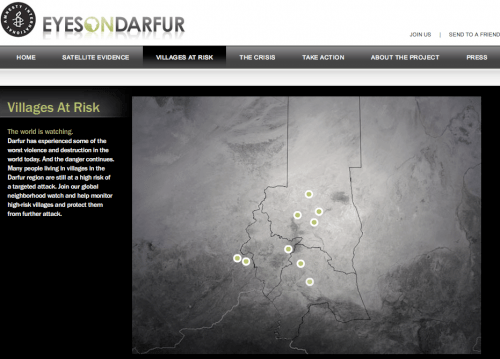
Amnesty International (AI) is taking human rights monitoring to a whole new level, metaphorically and literally speaking. The organization’s “Eyes on Darfur” project leverages the power of high-resolution satellite imagery to provide unimpeachable evidence of the atrocities being committed in Darfur – enabling action by private citizens, policy makers and international courts. Eyes On Darfur also breaks new ground in protecting human rights by allowing people around the world to literally “watch over” and protect twelve intact, but highly vulnerable, villages using commercially available satellite imagery.

I met with AI today to learn more. The human rights organization sends government officials these images on a regular basis to remind them that the world is watching. The impact? The villages monitored by AI have not been attacked while neighboring ones have. According to AI, there have also been notable changes in decisions made by the Bashir government since “Eyes on Darfur” went live a year ago. Equally interesting is that AI has been able to track the movement of the Janjaweed thanks to commercially available satellite imagery. In addition, the government of Chad cited the AI project as one of the reasons they accepted UN peacekeepers.

The American Association for the Advancement of Science (AAAS) is also leading a Human Rights and Geospatial Technologies project. So I also sat with them to learn more (September 2007). NGOs in Burma provided AAAS with information concerning attacks on civilians carried out by government forces in late 2006 and early 2007. AAAS staff reviewed these reports and compared them with high-resolution satellite images to identify destruction of housing and infrastructure and construction of new military occupation camps. The result is available in these Google Earth Layers. AAAS has provided comparable layers for Sudan, Chad, Lebanon and Zimbabwe. And this is just the tip of the iceberg.

AI is venturing on a 3-year project to provide satellite imagery to monitor forced displacement for early detection and advocacy. AAAS is developing a user-friendly web-based interface to let the NGO community know in real time where commercial satellites are positioned and what geographical areas they are taking pictures of. The interface includes direct links to the private companies operating these satellites along with contact and pricing information. AAAS believes this tool will enable the NGO community to make far more effective use of satellite imagery and to serve as a deterrent against repressive regimes choosing to commit mass atrocities.

The European Commission’s Joint Research Center (JRC) out of Ispra, Italy is also engaged in phenomenal work using satellite imagery. I first met with the JRC in 2004 and more recently in October 2007. The Center has developed automated models for change detection that are far more reliable than previously thought possible. Using pattern detection algorithms, the JRC can detect whether infrastructure has been destroyed, damaged, built or remained unchanged. They are now applying these models to monitor changes in refugee camps worldwide. The advantage of the JRC’s models is that they don’t necessarily require high resolution satellite imagery.

The same team at the JRC has also developed models to approximate population density in urban areas such as the Kibera slums out of Nairobi. Using satellite pictures taken at different angles, the team is able to construct 3D models of infrastructure such as individual buildings and houses. Thanks to these models they are able to approximate the size of these structures and thus estimate the number of inhabitants.

While AI and AAAS have been collaborating on some of these projects, the JRC has not been connected to this work. I therefore organized a working lunch during the OCHA +5 Symposium in Geneva last Fall to connect AAAS, the JRC, the Feinstein Center and the USHMM. My intention is to catalyze greater collaboration between these organizations and projects so we can upgrade to Human Rights 2.0.

Patrick Philippe Meier