Category Archives: Digital Activism

How to Use Facebook if You Are a Repressive Regime

As it happens, the main country case studies for my dissertation are Egypt and the Sudan. I’ll have to write a whole lot more given the unprecedented events that have taken place in both countries since January 25th. As many iRevolution readers know, my dissertation analyzes how access to new information and communication technologies changes the balance of power between repressive regimes and popular resistance movements. This means I’m paying close attention to how these regimes leverage tools like Facebook.

The purpose of this blog post is not to help repressive regimes use Facebook better, but rather to warn activists about the risks they face when using Facebook. Granted, many activists already know about these risks, but those I’ve been in touch with over the past few weeks simply had no idea. So what follows is a brief account of how repressive regimes in North Africa have recently used Facebook to further their own ends. I also include some specific steps that activists might take to be safer—that said, I’m no expert and would very much welcome feedback so I can pass this on to colleagues.

We’ve seen how Facebook was used in Tunisia, Egypt and the Sudan to schedule and organize the recent protests. What we’ve also seen, however, is sophistication and learning on the part of repressive regimes—this is nothing new and perfectly expected with plenty of precedents. The government in Tunis was able to hack into every single Facebook account before the company intervened. In Egypt, the police used Facebook to track down protesters’ names before rounding them up. Again, this is nothing new and certainly not unprecedented. What is new, however, is how Sudan’s President Bashir leveraged Facebook to crack down on recent protests.

The Sudanese government reportedly set up a Facebook group calling for protests on a given date at a specific place. Thousands of activists promptly subscribed to this group. The government then deliberately changed the time of the protests on the day of to create confusion and stationed police at the rendez-vous point where they promptly arrested several dozen protestors in one swoop. There are also credible reports that many of those arrested were then tortured to reveal their Facebook (and email) passwords.

And that’s not all. Earlier this week, Bashir called on his supporters to use Facebook to push back against his opposition. According to this article from the Sudan Tribune, the state’s official news agency also “cited Bashir as instructing authorities to pay more attention towards extending electricity to the countryside so that the younger citizens can use computers and internet to combat opposition through social networking sites such as Facebook.”

So what are activists to do? If they use false names, they run the risk of getting their accounts shut down without warning. Using a false identity won’t prevent you from falling for the kind of mouse trap that the Bashir government set with their fabricated Facebook page. Using https won’t help either with this kind of trap and I understand that some regimes can block https access anyway. So what to do if you are in a precarious situation with a sophisticated repressive regime on your back and if, like 99% of the world’s population, you are not an expert in computer security?

1. Back-up your Facebook account: Account –> Account Settings –> Download your information –> Learn more. Click on the Download button.

2. Remove all sensitive content from your Facebook page including links to activist friends, but keep your real name and profile picture. Why? So if you do get arrested and are forced to give up your password, you actually have something to give to your aggressors and remain credible during the interrogation.

3. Create a new Facebook account with a false name, email address and no picture and minimize incriminating content. Yes, I realize this may get you shut down by Facebook but is that as bad as getting tortured?

4. Create an account on Crabgrass. This social networking platform is reportedly more secure and can be used anonymously. A number of activists have apparently switched from Facebook to Crabgrass.

6. If you can do all of the above while using Tor, more power to you. Tor allows you to browse the web anonymously, and this is really important when doing the above. So I highly recommend taking the time to download and install Tor before you do any of the other steps above.

5. Try to validate the authenticity of a Facebook group that calls for a protest (or any in-person event for that matter) before going to said protest. As the Sudan case shows, governments may increasingly use this tactic to arrest activists and thwart demonstrations.

6. Remember that your activist friends may have had their Facebook accounts compromised. So when you receive a Facebook message or a note on your wall from a friend about meeting up in person, try to validate the account user’s identity before meeting in person.

If you have additional recommendations on how to use Facebook safely, or other examples of how repressive regimes have leveraged Facebook, please do add them in the comments section below for others to read and learn. Thank you.

Access to Mobile Phones Increases Protests Against Repressive Regimes

I recently shared a draft of my first dissertation chapter which consists of a comprehensive literature review on the impact of Information and Communication Technologies (ICTs) on Democracy, Activism and Dictatorship. Thanks very much to everyone who provided feedback, I really appreciate it. I will try to incorporate as much of the feedback as possible in the final version and will also update that chapter in the coming months given the developments in Tunisia and Egypt.

The second chapter of my dissertation comprises a large-N econometric study on the impact of ICT access on anti-government protests in countries under repressive rule between 1990 and 2007. A 32-page draft of this chapter is available here as a PDF. I use negative binomial regression analysis to test whether the diffusion of ICTs is a statistically significant predictor of protest events and if so, whether that relationship is positive or negative. The dependent variable, protests, is the number of protests per country-year. The ICT variables used in the model are: Internet users, mobile phone subscribers and number of telephone landlines per country-year. The control variables, identified in the literature review are percentage change in GDP, unemployment rate, the degree of autocracy per country-year, internal war and elections.

A total of 38 countries were included in the study: Algeria, Armenia, Azerbaijan, Bahrain, Belarus, Burkina Faso, Burma, China, Cote d’Ivoire, Cuba, DRC, Egypt, Gabon, Guinea, India, Iran, Iraq, Jordan, Kazakhstan, Kenya, Malaysia, Morocco, Pakistan, Philippines, Russia, Saudi Arabia, Singapore, Sudan, Syria, Tajikistan, Thailand, Tunisia, Turkey, Ukraine, United Arab Emirates, Uzbekistan, Venezuela and Zimbabwe. I clustered these countries into 4 groups, those with relatively (1) high and (2) low levels of ICT access; and those with (3) high and (4) low levels of protests per country-year. The purpose of stratifying the data is to capture underlying effects that may be lost by aggregating all the data. So I ran a total of 5 regressions, one on each of those four country groups and one on all the countries combined.

All five negative binomial regression models on the entire 18-year time panel for the study data were significant. Of note, however, is the non-significance of the Internet variable in all models analyzed. Mobile phones were only significant in the regression models for the “Low Protest” and “High Mobile Phone Use” clusters. However, the relationship was negative in the former case and positive in the latter. In other words, an increase in mobile phone users in countries with relatively high ICTs access, is associated with an increase in the number of protests against repressive regimes. This may imply that social unrest is facilitated by the use of mobile communication in countries with widespread access to mobile phones, keeping other factors constant.

These findings require some important qualifications. First, as discussed in the data section, the protest data may suffer from media bias. Second, the protest data does not provide any information on the actual magnitude of the protests. Third, economic data on countries under repressive rule need to be treated with suspicion since some of this data is self-reported. For example, authoritarian regimes are unlikely to report the true magnitude of unemployment in their country. ICT data is also self-reported. Fourth, the data is aggregated to the country-year level, which means potentially important sub-national and sub-annual variations are lost. Fifth and finally, the regression results may be capturing other dynamics that are not immediately apparent given the limits of quantitative analysis.

Qualitative comparative analysis is therefore needed to test and potentially validate the results derived from this quantitative study. Indeed, “perhaps the best reason to proceed in a qualitative and comparative way is that the categories of ‘democracy’ and ‘technology diffusion’ are themselves aggregates and proxies for other measurable phenomena” (Howard 2011). Unpacking and then tracing the underlying causal connections between ICT use and protests requires qualitative methodologies such process-tracing and semi-structured interviews. The conceptual framework developed in Chapter 2 serves as an ideal framework to inform both the process-tracing and interviews. The next chapter of my dissertation will thus introduce two qualitative case studies to critically assess the impact of ICTs on state-society relations in countries under repressive rule. In the meantime, I very much welcome feedback on this second chapter from iRevolution readers.

Maps, Activism and Technology: Check-In’s with a Purpose

“Having a real-time map, complete with satellite photos, of where everyone is at any one moment is almost as good as having your own helicopter overhead — maybe better, if you can distract the crew of the helicopter.”

As recently announced on the Ushahidi blog, the group is launching a check-in service a la Foursquare called “Crowdmap : Check-In’s” or just CI for short. I’m excited by the different applications that a free and open-source check-in-with-a-purpose platform can have for social impact. In this blog post, I’ll share some ideas on how activists might use CI for popular nonviolent movements when the service is launched next month at SxSW 2011. I will also highlight another very cool project called Sukey, which was just launched in the UK.

Services like Foursquare provide a location-based mobile social networking platform that allows users to check-in at different venues to earn points and connect with friends. CI will work in a similar way but will allow users to create their very own “Foursquares”. This means that CI’s can be project- or group-specific, i.e., bounded to certain networks. Users will decide themselves where and what kind of points and badges to award to members of their CI network.

This quick check-in service has obvious applications for students coordinating nonviolent protests, especially when they need to rapidly adapt to a changing situation. I this saw again recently in Egypt when pro-Mubarak thugs were swarming certain avenues of downtown Cairo. I recall seeing a picture shared on Twitter with tactical drawings suggesting where anti-Mubarak protestors should position themselves as a result. This was drawn on a screenshot taken from satellite imagery of an area in the center of Cairo. (I spent an hour trying to find the original picture again but to no avail, so if you know which one I’m referring to, please get in touch. The one below is for illustration only).

With Internet and cell phone networks back up, protesters could use a check-in service to let others know where the thugs are being sighted and to recommend different locations to retreat or advance to. This would be a like a geo-tagged status update that could also be shared on your Facebook page or Twitter feed (minding the security implications). In addition, one could have pre-designated tags like “Thugs here”, “Don’t go here”, “Evacuate” etc., to avoid having to type when checking in. Call it the Q-CI feature, quick check-in’s.

These alerts or status updates could then be embedded geographically, something like geo-caching. So if I happen to check in within a hundred meters of someone who just recently updated their CI status as “evacuate”, I would get an immediate pop-up message showing me these nearby updates. Someone helping to coordinate the protests remotely from a laptop could quickly embed areas (rather than points) as  no-go zones if one or more updates show up with the tag “evacuate” at a given venue. Integrating Ushahidi’s new geometry mapping feature would make this possible.

A related project that I really like comes from the same student group in the UK that used live tactical mapping for protest swarming last year. The team has since designed and launched their very own mobile check-in platform to facilitate tactical maneuvering during demonstrations, keep protesters safe and avoid kettling:

“Kettling, also known as containment or corralling, is a police tactic for the management of large crowds during demonstrations or protests. It involves the formation of large cordons of police officers who then move to contain a crowd within a limited area. Protesters are left only one choice of exit, determined by the police, or are completely prevented from leaving” (1).

The project, called Sukey, is an excellent example of Maptivism. The name comes from the nursery rhyme: “Polly put the kettle on, Sukey take it off again.”

All you have to do is point your smart phone browser (it doesn’t have to be an iPhone!) to http://www.sukey.org/a to access the tactical map. The screenshot above is from their entertaining and helpful tutorial which you can access here. I really like the use of their simple “safety compass” which gives you immediate situational awareness about which direction safety (and danger) lies. The compass is specific to your GPS location and is updated in real-time as new reports are submitted by activists. These reports can be shared with all the other protesters and appear in the red box below the map.

If you don’t have a smart phone, Sukey relays updates via their Twitter feed which users can subscribe to via SMS thanks to Twitter’s SMS-following service. All you need to do is text “follow @sukeysms” to 8644. What if you forgot your phone at home? One protester noted that “Everyone who was getting the Sukey updates was telling everyone who wasn’t what was happening.”

As an unhappy security analyst recently noted,

“The proliferation of highly capable handheld ‘smartphones’ now makes it easy for protest organizers to communicate by voice, text and images, even with real-time video. The protesters may have more watchers and observation points than the police, and actually outpace the police in quantity and quality of intelligence. Having this kind of information available has made it possible for disrupters to create decoy incidents to draw resources away from where they are needed most. Having a real-time map, complete with satellite photos, of where everyone is at any one moment is almost as good as having your own helicopter overhead — maybe better, if you can distract the crew of the helicopter.”

Protesters claim they successfully avoided police kettling this week by using Sukey. If you’d like to learn more, I highly recommend this excellent piece by the UK Guardian on the project. I think Ushahidi can learn a lot from this group so I will be meeting with the team in London next month. In the meantime, I’m really looking forward to SxSW and Sukey II. In a future post, I’ll describe how check-in’s-with-a-purpose platforms can also be used for humanitarian relief and disaster response.

Using a Map to Bear Witness in Egypt #Jan25

[Cross-posted from the Ushahidi blog]

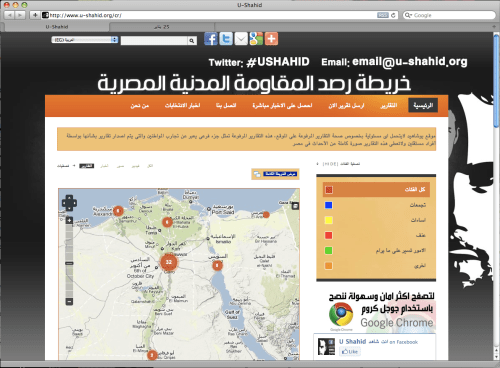
The Cairo-based Development and Institutionalization Support Center (DISC) has just launched their #U-Shahid map below. DISC previously used the Ushahidi platform to monitor the country’s Parliamentary Elections last November and December  (see this post for more info). This means they already know the technology and have a trained network of active crisis mappers that can verify reports before they are mapped.

The events in Egypt over the past two weeks have been nothing short of unprecedented. The Mubarak regime clamped down on many forms of communication including the Internet, cell phones and SMS. There were also reports of landline phones being blocked. The word still go out, however. And with Internet access now restored, the map will get out as well just as it did in the Sudan over the past few days.

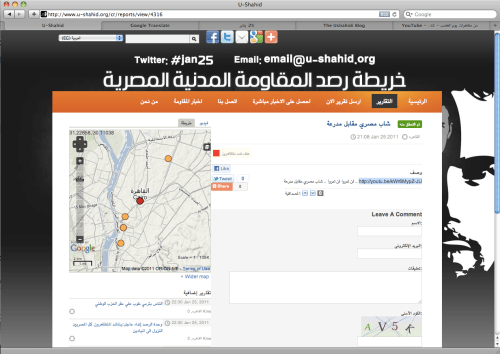
DISC has mapped some 50 reports based on events that took place over the past week. Take this report below, for example, which includes a YouTube video of protests. The map includes dozens of categories, including Riots, Breaking and looting, Arrests, Violence against protesters, Spraying water and Firing tear gas, for example.

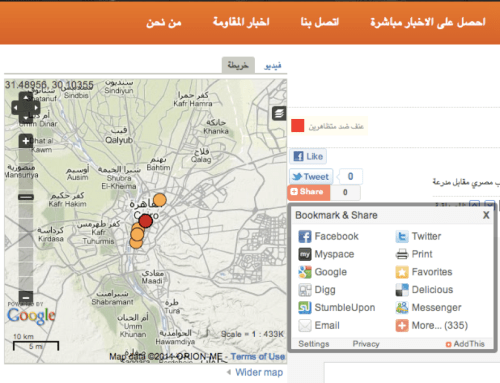
Notice how DISC has made it very easy to share information on individual events by allow direct Tweeting, Facebook posting, etc.

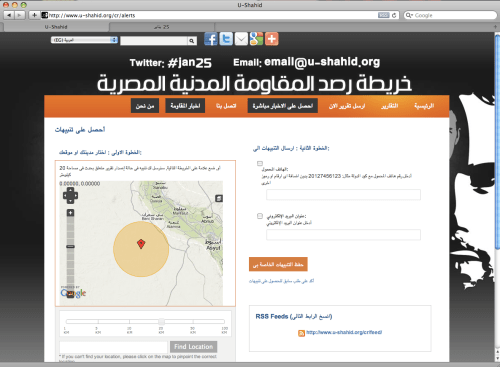
The group has also enabled the subscribe to alerts feature, which allows individuals to automatically get reports sent to their email and cell phone.

Since Egypt just got back online, we expect the map to receive more reports in the coming days. Perhaps the group may also end up using the dedicated Ushahidi smart phone apps to distribute the mapping further.

The Arabic Network for Human Rights Information (ANHRI) launched this Jan 25th CrowdMap in Cairo days before the regime shut down Internet access. It hasn’t been updated since but there are now discussions about reactivating the map to provide information on the location of ATMs, for example.

An ongoing and pressing concern about these maps (and others) is of course security. Crisis maps can depict important information that can be used for good and ill. We hope local groups that use these tools in non-permissive environments take every precaution possible when doing so as repressive regimes are becoming more sophisticated in electronic surveillance.  To learn more about communicating safely in such situations, we recommend some of the following links:

Crisis mapping is redefining the way we think about maps. Today’s maps are alive and dynamic. They are not hard copy static objects like this historical map of Ancient Egypt dating from 1,450 BC. Maps, like books, were written by the winners, the elite. They reflected and projected power. They depicted a fixed reality through one lens.

Today’s crisis maps can give voice to the distributed voiceless. They integrate tools like email, SMS, Twitter, Facebook, YouTube, Flickr, etc. What does this all add up to? “Will the triangulated crisis map be regarded as the new first draft of history?” asks New York Times journalist Anand Giridharadas. He considers some of the implications in this excellent piece,

“They say that history is written by the victors. But now, before the victors win, there is a fresh chance to scream out, with a text message that will not vanish. What we would know about what passed between Turks and Armenians, between Germans and Jews — and indeed would it have happened at all — if each of them had had a chance to declare and be heard saying: ‘I was here, and this is what happened to me?'”

Facebook https is now live for Sudan

A very big thank you to the team at Facebook for allowing users in the Sudan to access Facebook securely. Instead of using the regular http:// access to the site, using https:// means that your connection is securely encrypted. This prevents malicious users from spying on your account and seeing your password, for example. This is why all online banking websites use https, as does Google with gmail. Tunisia in many ways set the precedent. Read this excellent account on the inside story of how Facebook responded to Tunisian hacks.

As we have seen in many situations, Facebook is often used by activists to schedule and coordinate mass action. This is equally true of the Sudan, with this Jan30 Facebook group, which now has over 17,000 members. However, in my recent Skype conversations with a number of Sudanese activists, I’ve realized that many of them didn’t know that the Tunisian government (for example) had been able to hack into Facebook accounts. While using https is not a complete panacea, it definitely is a step in the right direction re communicating securely in repressive environments. I’ve also encouraged colleagues to switch to using Hushmail for email communication.

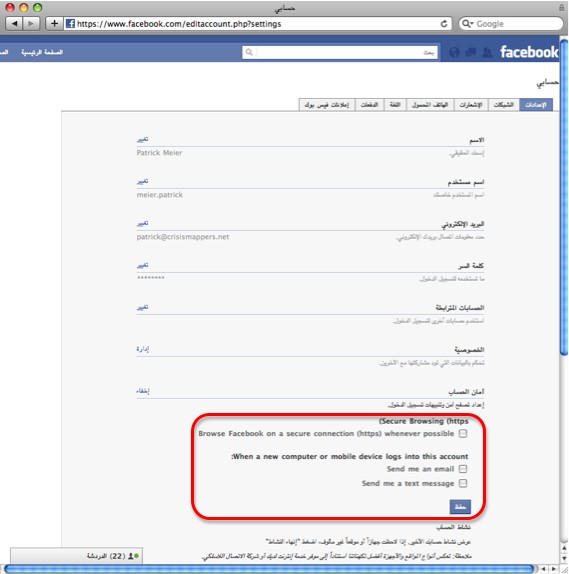
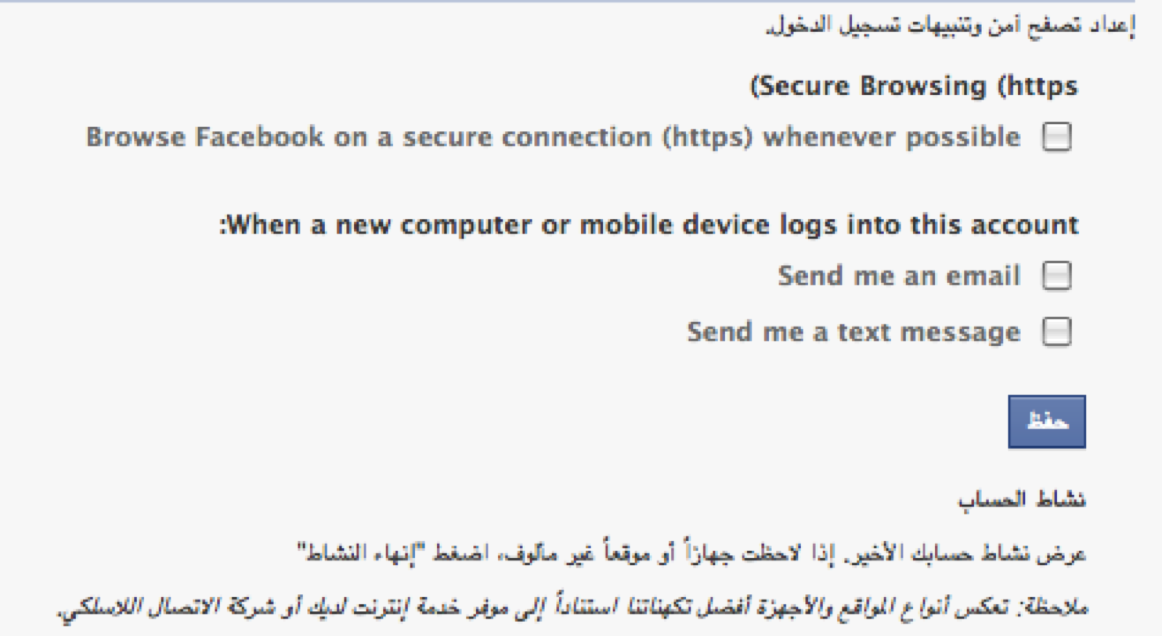
So for colleagues in the Sudan, to set up https:// access, go to “My Account” then “Settings” and then “Account Security.” Here’s the equivalent in the Arabic interface:

You should click on “Browse Facebook on a secure connection (https) whenever possible” and also on “Send me an email” that way you get sent an automated email when a new computer or mobile phone logs into your account. If you have any questions, feel free to add them in the comments section of this blog.

Here are some other steps you can take to use Facebook more securely:

1. Do not share sensitive info on FB
2. User passphrases instead of passwords
3. Change you name, or at least do not provide your full name on FB*
4. Do not use a picture of yourself for your FB profile picture
5. Logout of FB when not using the site

* Use this with caution as it violates FB’s terms of service and if someone is targeting you, they can report you to FB. Also do not give FB your identification if asked (@JillianYork).

Again, using https and following these five steps is no guarantee that your account won’t be hacked, but it maximizes your chances of using Facebook more safely. If you have any security tips to share, please add them in the comments section of this blog post.

A big thank you once again to Facebook. I emailed them (via another colleague) with my concerns regarding Sudanese activists and they responded in a just a matter of hours. Facebook is also in the process of rolling this https option out for all their users worldwide.

Civil Resistance: Early Lessons Learned from Sudan’s #Jan30

Sudanese activists in Khartoum have shared early reflections on how they can improve their efforts. These lessons are applicable to others engaged in civil resistance and are therefore shared below.

Source 1:

There was insufficient clear communication leading up to the first protest, which led to the first mistake since NCP members were able to fake a delay of the event which mean that we lost a considerable number of our protesters.

The timing of the protest was also off.  You can not except an average Sudanese citizen to protest on the 30th of January after he just got his salary. The satisfaction of that will cover up the feeling of injustices and humiliation. So if a date is set up, it should be the 15th, 16th or 17th (the depression days in the Sudanese dictionary). Also, we can not except protesters to participate in something like this at 11:00am or 11:30am when every body is either in the middle of their job or on the way to it.

And we forget the main factor: the youth. Most of them are students that constrained with lecture attendance sheets: the Sudanese universities are very extreme in that matter since 2005 and students are failed out of class by teachers for skipping more than 25% of lectures, which means they would need to repeat the course or the whole year). So the time should change to 2:00pm or 2:30pm.

In the matter of using Facebook as our only connection yes we can recruit youth and talk to them about the problem that they are facing but in order to transfer from Facebook to the Sudanese reality you need a prepared arena, i.e., at least 50% of the city residents need to know what you will do before you do it. So I suggest more communication with the public before a month at least from the event and this needs creativity and persuasiveness.

Source 2:

… I met two friends and went up the road towards the presidential place at the end of the street. There was massive policemen presence and young people wandering around. I knew that they were confused about where the demonstration would begin. People did not know who were with them and who were against them. When we got closer to cross of Baladiya street with Qasar, people were running away, we kept moving and we saw people in plain clothes with policemen beating four persons, they were about 20 policemen and those  people in plain clothes, armed with stick and pipe, beating very hard those four persons, on chest, head and arms. This scene discouraged people to demonstrate, and of course that was the message security forces were trying to send.

Source 3:

We were very much predictable to the NCP members, we shouldn’t underestimate them in that matter we are dealing with people who have experience in destroying events like this cause the Sudanese didn’t change their ways in that matter since 1985 when they where the one’s who applied them with the rest of the parties… I have many thoughts about how we could work this event out. We also need someone from Egypt to tell us more about organizing and monitoring then we can readjust it to fit Sudan case.

There are some good resources (in Arabic) for activists in the Sudan and the Arab World (please contact me if you’d like copies):

  • Nonviolent Struggle – 50 Crucial Points.
  • Twitter for Activism.

There is also a Crowdmap on the protests in Khartoum which activists are contributing to.

How I’m following the developments in Egypt (Updated)

How to follow a 21st century revolution. What sources am I missing?

Twitter

Live Video

Live Stream

Aggregator

ICTs, Democracy, Activism and Dictatorship: Comprehensive Literature Review

Building on my previous post with respect to Howard Philip’s “Origin of Dictatorship and Democracy,” I’ve completed a draft of my dissertation chapter which comprises a comprehensive literature on the impact of Information and Communication Technologies (ICTs) on Democracy, Activism and Dictatorship. This is a 54-page document (17,000+ words)  which I believe represents the most up-to-date and in-depth review of the literature currently available. The chapter reviews both the quantitative and qualitative literature in this space.

You can download the chapter here (PDF).

I’m actively looking for feedback to make the chapter even stronger and more useful to scholars and practitioners interested in this space. So please do add any recommendations you may have in the comments section below. Thank you very much!

The Digital Origins of Dictatorship and Democracy

I defended my dissertation proposal in early 2008 but the majority of the literature most relevant and helpful to my doctoral research surfaced in 2009 and 2010. So I’m rather grateful to the PhD program at The Fletcher School for letting me run with my chosen dissertation topic given the limited empirical literature to draw on back then.

The best new book I’ve come across since my proposal is Philip Howard’s “The Digital Origins of Dictatorship and Democracy: Information Technology and Political Islam,” which was published just a few months ago. Howard seeks to answer the following question: “What is the causal recipe for democratization, and are information technologies an important ingredient?” More specifically, “The goal of this book is to analyze the ways in which new information technologies have contributed to democratic entrenchment or transition in countries with large Muslim communities.”

Howard demonstrates that “technology diffusion has had a crucial causal role in improvements in democratic institutions” and “that technology diffusion has become, in combination with other factors, both a necessary and sufficient cause of democratic transition or entrenchment.” Howard concludes: “Clearly the Internet and cell phones have not on their own caused a single democratic transition, but it is safe to conclude that today, no democratic transition is possible without information technologies.”

The book is getting superb reviews, and that is absolutely no surprise. This is truly the best book I’ve read on the topic of my dissertation thus far. Why? Howard’s research design and mixed-methods approach is by far the most rigorous one in the literature to date. I therefore plan to dedicate a few blog posts to summarize Howard’s approach and findings, starting here with the book’s prologue: “The Revolution in the Middle East will be Digitized,” which focuses on the Green Revolution in Iran. Below are some excerpts and commentary that reflect some of the key arguments from this first section of the book.

One of the main roles that information and communication technologies (ICTs) played in Iran was dissemination, which had a second-order effect on increasing levels of participation both in the streets and online.

“Opposition campaign managers in Iran consistently say that such Internet applications allow them to get messages out as never before and thereby organize bigger and bigger campaign rallies. Without access to broadcast media, savvy opposition campaigners turned social media applications like Facebook from minor pop culture fads into a major tool of political communication.”

“During the protests, even the most apolitical bloggers covered the demonstrations, and traffic at the dominant blogs swelled [and] social networking applications […] allowed even small enclaves to create content and reconnect with friends and family in Iran.”

“It does not matter that the number of bloggers, twitterers, or internet users may seem small, because in a networked social moment only a few ‘brokers’ need to be using these tools to keep everyone up to date.”

“These are the communication tools for the wealthy, urban, educated elites whose loyalties or defection will make or break authoritarian rule. Indeed, it is probably more useful to evaluate applications such as Twitter through the communities they support, rather than through tool features. […] Social movement scholars write that elite defection usually marks the end of an authoritarian regime.”

“In some ways the regime’s response was decidedly old media: expelling foreign correspondents, blocking phone lines, preventing the publication of daily newspapers, and accusing enemy governments of spreading misinformation.”

“They did not count on the large number of Iranians eager to submit their own content to international news agencies, and, perhaps more important, they did not realize that large numbers of Iranians would use social media to share their own personal stories of beatings, tear gas inhalation, and protest euphoria with each other.”

“Cyberactivism is no longer the unique provenance of isolated, politically motivated hackers. It is instead deeply integrated with contemporary social movement strategy and accessible to computer and mobile phone users with only basic skills: it is a distinguishing feature of modern political communication and a means of creating the élan that marks social change.”

Like Malcom Gladwell, Howard also addresses the role of strong and weak-ties in digital activism. To learn more about Gladwell’s point of view (and mine) regarding the question of social ties, please see my previous blog post here.

“Millions of people took to the streets in the week after the election results were announced and certainly not all were using Twitter. The majority of them, however, were responding to both strong and weak network ties and to the digital technologies designed to maintain those ties.”

“The unprecedented activation of weak social ties brought the concerns of disaffected youth, cheated voters, and beaten protesters to the attention of the mullahs. The result was a split within the ruling establishment on how to deal with the insurgency, how to proceed with counting ballots, and how to credibly authorize Ahmadinejad to take power.”

Howard’s balanced approach to the impact of ICTs on democracy is one of the main strengths of his book.

“So the country has one of the world’s most vibrant social media communities and the most concentrated broadcast media system in the Muslim world. Why, then, has the digital revolution in Iran not had the type of clear political outcomes or institutional consequences seen in other authoritarian regimes?”

“The answer, in part, is that while such information technologies have become a fundamental infrastructure for journalists and civil society groups, they are a necessary but not sufficient causal condition for contemporary regime change. So based on real-world experience, what is the causal recipe for democratization, and are information technologies an important ingredient?”

“In the language of fuzzy sets ways, Iran’s postelection insurgency was almost an example of a digital revolution. In is unlikely that protests would have lasted as long, raised so much international support, and had such an impact on domestic politics had it not been for mobile phones and the internet. The internet did not cause the insurgency, and it is probably a truism to say that no contemporary democratic revolution in the Middle East will happen without the internet. In times of political crisis, banal tools for wasting time, like Twitter and YouTube, become the supporting infrastructure of social movements. As one ethnic Azeri blogger told me, the regime has learned that the Internet makes collective action possible.”

“Technology alone does not cause political change—it did not in Iran’s case. But it does provide new capacities and impose new constraints on political actors. New information technologies do not topple dictators; they are used to catch dictators off-guard.”

That last paragraph resonates with me and relates to this idea of information cascades that Dan Drezner has written about here. The momentary window of opportunity that reversals information cascades offer can be used to catch dictators off-guard. This explains why preparedness and training is important.

So what ultimately was the actual impact of the 2009 protests? According to Howard,

“Digital media sustained protests well beyond what pundits expected. Indeed, this new information infrastructure gave social movement leaders the capacity not only to reach out to sympathetic audiences overseas but also to reach two important domestic constituencies: rural, conservative voters who had few connections to the urban chaos; and the clerical establishment.”

“Most important, the Internet gave the social movement access to the clerical establishment through weak ties of social networks that connected mullahs to Iranians on the street.”

“Iran’s street protests failed to topple their government. But just as important, the world’s most technologically advanced censors failed to manage the government’s election crisis. And the region’s dictators have a new concern: their own tech-savvy, disaffected youth.”

“The world has seen interest in change expressed from within Iran, and this may prove to be the most destabilizing outcome of the protests. The regime’s brutalities streamed around the globe. The world saw the dissent; the regime knows the world saw the dissent.”

This idea of shared awareness appeals to me a lot, not least because of my work on the Ushahidi platform since the tool—when used correctly—can generate shared awareness. But why is shared awareness even important in this context?

As Shirky recently noted here, “social media tools provides participants with ’shared awareness,’ the ability of each member of a group to not only understand the situation at hand but also understand that everyone else does, too.” Dan Drezner takes it one step further, arguing here that, “the ability of the state to repress can evaporate […] at moments when a critical mass off citizens recognizes their mutual dissatisfaction with their government.”

For me, one of the most salient points that Howard makes in the prologue to this book is this: “The initial conditions for social movement organizing are very different from those of the pre-internet era.” Here are some other key take-aways:

“In contemporary systems of political communication, citizens turn to the Internet as a source of news and information in times of political crisis. It is not only that online social networking services are influential as a communications media; rather, they are now also a fundamental infrastructure for social movements. And the Internet globalizes local struggles.”

“Information and communication technologies are the infrastructure for transposing democratic ideals from community to community. They support the process of learning new approaches to political representation, of testing new organizational strategies, and of cognitively extending the possibilities and prospects for political transformation from one context to another.”

“But it would be a mistake to tie any theory of social change to a particular piece of software. In the summer of 2009 the Iranian insurgency was very much shaped by several digital communication tools, which allowed social movements within the country to organize protests and exchange information and made it possible for those groups to maintain contact with the rest of the world.”

“Traditional radio and televised appeals did not figure in the mobilization, and they are not very important to understanding what happened in Iran last summer.”

“If new information technologies such as mobile phones and the Internet provided the communications infrastructure for mobiliza- tion, was the lack of democratic transition a technological or social failing?”

This last question is spot on and for me the correct way to phrase the debate on digital activism in repressive environments. The question can also be applied to deployments of the Ushahidi platform, i.e., is the lack of impact of an Ushahidi deployment a technological or social failing?

Howard makes a number of points in his prologue that made me think about the Ushahidi and SwiftRiver platforms. For example,

“Authoritarian regimes always conduct propaganda battles over broadcast media. But what is the regime countermeasure for the chilling effects of a plea from someone in your social network who has been a victim of police brutality?”

“Rafsanjani developed a plan for ad hoc exit polling by mobile phones. Deliberative democracy theorists argue that independent exit polling is a key logistical feature of healthy election practices. This probably explains why disabling mobile phone services is so important for discouraging any organized measurement of how rigged a contemporary election may be.”

“Specialty Persian news channels in Los Angeles received hundreds of digital videos daily, and YouTube became the repository for the digitally captured, lived experiences of the chaotic streets of Tehran. On June 20, Neda Agha-Soltan was shot dead at a demonstration, and her death was caught on several mobile phone cameras.”


Impact of Technology on Democracy and Activism: Findings from Multiple Statistical Studies

Chapter 2 of my dissertation consists of a literature review on the impact of the Internet and mobile phones on democracy and activism. The first part of this literature view focuses specifically on analyzing the results from all the peer-reviewed quantitative studies that currently exist on the topic. The second part reviews more micro-level qualitative research. Part 1 is available here as a 7-page PDF. Part 2 will be available shortly.

Here is the list of studies reviewed in Part 1:

Eyck, Toby. 2001. “Does Information Matter? A research note on information technologies and political protest,” Social Science Journal, 38(2001): 147-160.

Howard, Philip. 2010. The Digital Origins of Dictatorship and Democracy: Information Technology and Political Islam. (Oxford University Press: Oxford, England).

Groshek, Jacob. 2010. “A Time-Series, Multinational Analysis of Democratic Forecasts and Internet Diffusion,” International Journal of Communication, 4(2010): 142-174.

Groshek, Jacob. 2009. “The Democratic effects of the Internet, 1994-2003: A Cross-National Inquiry of 152 countries,” The International Communication Gazette, 71(3): 115-136.

Meier, Patrick. 2011. “The Impact of the Information Revolution on Protest Frequency in Repressive Contexts,” doctoral dissertation, The Fletcher School, Tufts University.

Miard, Fabien. 2009. “Call for Power: Mobile Phones as Facilitators of Political Activism,” paper presented at the 50th Annual Convention of the International Studies Association (ISA), February 2009, New York.

I’m particularly keen on getting feedback on my draft, especially if you think I’ve missed a statistical study or find any errors in my analysis. Thank you.