Tag Archives: Civil resistance

FSI09: Strategic Planning & Tactical Choices in Civil Resistance

This was my favorite presentation yet at the Fletcher Summer Institute (FSI) for the Advanced Study of Nonviolent Conflict 2009. However, WordPress totally wiped my post half-way through the talk when I tried to save the draft. Grrr. Lesson learned, draft blog posts in a text editor first.

Hardy Merriman‘s excellent presentation drew from Gene Sharp‘s 198 nonviolent tactics, which he classified into three categories: Protest and Persuasion (shift perception); Noncooperation (shift behavior, particularly effective when scaled); and Nonviolent intervention (shift status quo). Tactics can be classified in other ways as well. For example, they can be categorized into intended outcomes; or into concentration and dispersion tactics.

Planning and strategizing is imperative. Many movements fail because they were poorly planned and/or sequenced. In addition, brave actions that get media attention but result in the activist’s arrest are not advised. Tactical innovation is critical such as alternative leadership. This means adapting and keeping the asymmetric advantage.

An interesting conversation ensued regarding the process of defining strategy, operations and tactics in a nonviolent movement.  Unlike the hierarchical, top-down process in the military, resistance movements need to front load the conversation on strategy, to set up a planning committee and de-federalize the decision-making process vis-a-vis operations and tactics. Indeed, these decisions need to be made locally to tap into local knowledge and know-how.

How does one evaluate civil resistance movements? Assess whether tactics advance operational goals and whether the latter converge towards the established strategy. The best case scenario is to devise a series of tactics that don’t appear to be coherent by the adversary but ultimately come together to accomplish the movement’s operational goals and strategy.

The use of technology was also addressed. How does new technology help a civil resistance movement? Does it make tactical decisions easier or more difficult? One participant noted that sometimes one cannot not use these technologies, particularly in countries where physical assembly is illegal.

Another participant cautioned that tactical autonomy is potentially restricted with instant communication between activists engaged in street action and those coordinating the action. He noted a case he was involved in several years ago when he and colleagues took over a police station and secured the police radio equipment. Police officers in the streets who tried to radio for instructions were unable to and were not sure what to do.

One participant also mentioned that activists can use government surveillance to their advantage by spreading misinformation.

The topic of young people came up as well in the context of technology. Young people are often more tech savvy than adults and also early adapters of technology. One participant thus opined that the side with the young people is likely to win over the side without young people.

Another participant referred to the popular book “The Starfish and the Spider” to contrast the organizational structure of repressive regimes versus resistance movements. I’ve got some good notes on this book, so do email me if you’d like a copy of my notes. I’m glad that this book came up as it delves into one of my other passions, the study of complexity science and complex systems.

Patrick Philippe Meier

FSI09: Geopolitical Constraints vs Opportunities in Civil Resistance

This is the second presentation at the Fletcher Summer Institute (FSI) for the Advanced Study of Nonviolent Conflict 2009. The presentation focuses on “The Geopolitical Constraints and Opportunities for Civil Resistance.” Note that you can also follow #FSI09 on Twitter.

The thesis of this talk is that changes in geopolitical forces accelerate the frequency of nonviolent conflict. (My question is whether this claim is even falsifiable?).

The use of nonviolent strategies is ascendant and nonviolent movements are influenced by geopolitical forces. Geopolitics describes international politics in geographic terms, i.e., “the term has applied primarily to the impact of geography on politics.”

The weakened role of the state in international politics may in part explain the rise of civil resistance. (Note that I disagree with the argument that states are less significant actors). Fundamental trends in communication technologies and the global media may also explain this rise. In addition, the notion of “soft power” is in line with the strategies and tactics employed in resistance movements.

Perhaps the most compelling argument for me vis-a-vis the rise of nonviolent resistance is the promotion of democracy via global institutions and norms; the focus on democratic peace theory and civil society networks. That said, I’m still not sure how drawing on geopolitics as a framework to situate and explain civil resistance adds to our understanding of nonviolent conflict.

Moreover, as one participant noted, shouldn’t we frame the question as follows: how do social movements influence geopolitics, rather than vice versa?

In any case, I’m glad to note that much of the conversation generated by the presentation focused on the impact of communication technology on geopolitics while keeping a healthy dose of skepticism. One participant made a comment that I make all the time; namely that networks of activists are more likely to learn and adapt to changes in technology than centralized, hierarchical regimes are.

Somewhat surprisingly, the concept of the dictator’s dilemma was overlooked.

The dictator’s dilemma suggests that globalization has produced a lucrative global information economy that repressive regimes are interested in exploiting. However, as they gear the domestic economy to take advantage of the information economy, they give up some control on how technology is used within their borders.

One final note, I think there is an evolutionary dynamic at play, just like there is with warfare. We describe Al Qaeda’s approach as fourth generation warfare, i.e., decentralized tactics, since this give the group an asymmetric advantage over a more centrlaized military power such as the US.

In other words, Al Qaeda’s approach make logical sense. In this same way, perhaps more movements recognize that nonviolent civil resistance is indeed a Force More Powerful.

Patrick Philippe Meier

FIS09: Introduction to Civil Resistance

My notes on the opening presentation at the Fletcher Summer Institute (FSI) for the Advanced Study of Nonviolent Conflict 2009. You can also follow #FSI09 on Twitter.

Using the term “nonviolence” is often unhelpful and counterproductive. The term denotes an ethical stance that opens up all kinds of philosophical debates. Instead of using this adjective, we should use the verb “civil resistance” which denotes the use of highly disruptive actions by the many against the few.

Some quotes

“Power concedes nothing and it never will. Find out just what any people will quietly submit to, and you have found out the exact measure of injustice and wrong which will be imposed upon them,  and these will continue until they are resisted.” – Frederick Douglass

“Any people anywhere, being inclined and having hte power, have the right to rise up, and shake off the existing government, and form a new one that suits them better.” – Abrahm Lincon

Leo Tolstoy predicted that “public opinion” would change the “whole structure of life” making violence “superfluous”.

“England can hold India only by consent. We can’t rule it by the sword.” – Sir Charles Innes

“The sudden dramatic breakdown of power that ushers in  revolutions reveals in a flash how civil obedience-to laws, to rulers, to institutions – is but the outward manifestation of support and consent.” – Hannah Arendt

Gandhi was not shy about using direct analogies to violent conflict, he referred to “nonviolent weapons” such as active interference, protests and resignations. Gene Sharp added the following categories: Protest/Persuasion; Noncooperation; Intervention.

Depriving the oppressor of consent reduces his legitimacy. The refusal to cooperate increases the costs of holding control. The legitimacy of the system drops while costs of maintaining the status quo increases, which prompts enforcers of the system to doubt its endurance (and possibly switch sides).

Nonviolent force was a key factor in 50 of the 67 political transitions between 1970-2005. However, there have been failures in nonviolent action, the most spectacular of which was Tienanmen. Nonviolent action often fails when it has not been planned.

Emergent properties of civil resistance

The following are key emergent properties that each activist should understand and practice.

  • Consent
    • Confers legitimacy
    • Recasts the idea of power
    • Creates space to resist.
  • Reason
    • Respect the citizen’s mind
    • Stimulates creative thinking
    • Persuasion, not coercion
    • Signals honestly, credibility
    • Instills “reason to believe”.
  • Self-Rule
    • Swaraj (ruling yourself)
    • “Constructive work”
    • Self-organization
    • Planning
    • Nonviolent discipline.
  • Representation
    • Acertaining and presenting people’s grievances
    • Listening, delegating and inviting participation
    • Humility, not hierarchy
    • Solidarity of all, not heroism of the few.
  • Resilience
    • Tactical mobilization, strategic sustainability
    • Momentum-driving action
    • Existential stakes: identifying with the cause
    • Certitude of faith in eventual success.
  • Force
    • Strategic/tactical skills
    • Target foe’s capacities
    • Disperse initiative
    • Divide loyalty structure
  • Transformation
    • No monolithic enemies
    • From destruction to debate
    • Justice only by rule of law
    • Everyone as stakeholder
    • Ends reflected in means

There are still those who argue for political violence. These arguments boil down to two points:

  • Necessary as a means to an end. “Oppression cannot be demolished except in a hail of bullets.” Bin Laden
  • Virtuous, as redemption or apotheosis. “Death is truth.” Bin Laden

Proponents of violence always have to find ways to justify death. But death is simply not popular. Nevertheless, there is a market for terror. However, a new study of 323 violent and nonviolent campaigns, 1900 to 2006: violence campaigns succeeded in 26% of cases; Nonviolent campaigns succeeded in 53% of cases.

Questions & Answers

One participant from a repressive country emphasized how important it is to make friends with the security forces, they are not the real enemy, they are simply following orders. If you prevent them from following orders, they get into trouble. So let them know you understand that and simply ask that they do not hit, push, beat as hard as they can. On the contrary, ask them to beat lightly and even pretend.

Nonviolent tactics are also being adopted by groups that do not seek to advance democratic principles and human rights. Does this pose a problem for the future of nonviolent action if repressive regimes begin using nonviolent tactics to repress? Not necessarily since a  repressive regime would not be able to scale these tactics. For these tactics to have impact, they must be viewed by the majority as legitimate and necessary.

In a case like Gaza, how does one increase the appeal of nonviolent action when everyone is armed? The mainstream media and citizen journalists can change the frame of the “logic” of violence. In my opinion, we need more gendered analysis of armed violence. Clearly, the concepts of masculinity and violence are closely tied. Perhaps nonviolence is perceived as more feminine? How do we change this?

A participant emphasized the need to equate civil resistance as guerrilla warfare without the violence. In other words, military discipline is integral to the success of nonviolent action.

One participant countered the argument that violence is attractive. People often turn to violence because they’ve witnessed violence, because they are driven by vengeance. However, fear also drives fear and paralysis. I would add a cost-benefit angle to this. Some groups in the Sudan have turned to organized violence because their options vis-a-vis other livelihoods have virtually vanished, in part because of the ecological crisis.

Patrick Philippe Meier

Digital Resistance and the Orange Revolution

My colleague Joshua Goldstein recently researched the role of digital networked technologies in the Ukranian Orange Revolution (PDF). There are few case studies out there that address both digital activism and civilian resistance, i.e., digital resistance, so what follows is a detailed summary of Josh’s report for the Berkman Center along with some of my own research.

Introduction

Compared to the other three panel presentations, this study takes a narrative case study approach and focuses on a single case study, the role of the Internet and mobile phones during the Orange Revolution.

For Josh, one of the most fascinating questions about the Orange Revolution is how the Internet became such an influential tool when only 4% of the population was online? Even though such a small percentage of the population had Internet access, “the Orange Revolution may have been the first in history to be organized largely online.”

Theory

To understand what contributed to this digital revolution, Josh draws on the Two-Step Flow Theory developed by sociologists Katz and Lazardsfeld (1955), which delineates a ‘two step’ information path. The first is the direct path between mass media and the general public. The second path is among elite opinion makers who strongly influence public opinion.

According to Josh,

This theory helps delineate how a relatively small group of activists and citizen journalists helped create a distinct information environment that challenged the narrative presented by state sanctioned media.

In the Ukraine, both the rise of citizen journalism and  influential opinion makers from the opposition were in large part consequences  of the widespread self-censorship that existed in the country.

‘Self censorship was not enshrined in law, but it was well known that oligarchs owned all of the major television stations. Station managers received temnyky, unsigned directives from the President’s office that urged them to cover the news in a particular way. Managers knew that if they did not please the ‘key viewer,’ the President and his regime, they would be in danger of losing their jobs.

As Josh notes, however, Channel 5 was the notable exception. The small television station had been bought by members of the opposition to promote an independent view on Ukranian politics. Although Channel 5 only available to 30% of the population, the station became well known for it’s alternative view on domestic affairs.

In addition, citizen opposition journalism posed a central challenge to the semi-autocratic regime. However, Josh writes that the Ukranian public already recognized the Internet as a legitimate news source. Online news sites including Pravda, Obozrevatel and ProUA, were well already well known. Moreover, they were a “hybrid between citizen and professional media [since] they were predominantly staffed by professional journalists but often received low pay or were motivated by changing the Ukranian landscape.”

To build on his theoretical framework, Josh also draws on Stephen Bandera’s empirical study on political participation during the Orange Revolution. The results of this study revealed that “Ukranians who use the Internet were more likely to be online political citizens than their American counterparts.”

Lastly, Josh recognizes that technologies alone do not explain the success of the Orange Revolution:

The ability to diffuse tension through humor and satire was crucial to the success of the Orange Revolution. […] Every joke and pun created by this community of activists and directed at [the regime] further drew attention to the vastly different information environments and political futures that the two candidates represented.

Case Studies

Josh draws on two case studies to test out his theoretical framework. The first is Maidan and the second Para.

Maidan was a group of tech-savvy pro-democracy activists who used the Internet as a tool to support their movement. Maidan in Ukranian means public square and Maidan’s website features the slogal “You CAN chnage the world you live in. And you can do it now. In Ukraine.”

The main activity of Maidan was election monitoring and networking with other pro-democracy organizations around Eastern Europe. Maidan hosted around 27 election monitoring trainings, in nearly every Ukranian region, with support from Serbia’s Otpor movement. […] In the year leading up to the election, Maidan trained 500 Ukranians to observe the election. This evidence collected […] was central to proving the existence of massive election fraud.

However, the founder of Maidan argues that “websites cannot produce an activist organization.” As Josh explains, it was crucial for Maidan to frequently host real world meetings as their membership base increased. The human element was particularly important. This explains why Maidan encouraged users to disclose their identity whenever possible.

Maidan was not a completely decentralized organization. The community benefited from centralized leadership that developed the organization’s culture, controlled its assets and provided the strategy to achieve desired goals. The Maidan experience thus demonstrates a hybrid organization.

In sum, the Internet was clearly a vital, multi-faceted tool for Maidan. The Internet facilitated outreach, training, awareness raising, fundraising and marketing. At the same time, centralized, top-down leadership was necessary to accomplish the organization’s goals.

Pora, meaning “It’s Time” in Ukranian, was a well-organized group of  pro-democracy volunteers that “emerged as an information sharing campaign and during the elections morphed into coordinators of mass protest centered around tent cities in towns throughout Ukraine. The grassroots movement took its inspiration from Serbia’s Otpor movements as well as “older civic movements in Hungary and Czechoslovakia.”

The organization described it’s raison d’être as follows:

Under conditions of far-reaching censorship and absence of independent media, the main idea of Pora is the creation of alternative ‘mass media,’ in which volunteers deliver election-related information ‘from hand to hand’ directly to people throughout the Ukraine.

Pora promoted “the active use of modern communication systems in the campaign’s management,” and “mobile phones played an important role for mobile fleet of activists.” According to Pora’s post-election report, “a ssytem of immedate dissemination of information by SMS was put in place and proved important.” In addition, “some groups provided the phones themselves, while others provided SIM cards, and most provided airtime.”

The Internet also played a role in Pora’s campaign by providing rapid reporting in a way that no other medium could. As tent cities across the Ukraine became the sign of the revolution,

The news feed from the regions [became] vitally important. Every 10 to 15 minutes another tent city appeared in some town or other, and the fact was soon reported on the air. News from the region was read by opposition leaders on Maidan to millions of listeners in the streets of Ukraine.

While the government certainly saw the Internet as a threat, the government had not come to consensus regarding the “legal and political frameworks it would use to silence journalists that published openly on this new medium.” Ukrainian law considered the Internet to be a “peer-to-peer communication tool and not a mass media platform,” which explains why “online sites were able to blossom” and why many online journalists unlike mainstream journalists were free from the threat of defamation charges.

In addition to new technologies, the grassroots movement also “successfully leveraged traditional methods of spreading information [such as] print products (leaflets, brochures, stickers, and small souvenirs), public activities and demonstration, visual representations (posters and graffiti), media presentations (clips and interviews), and periodicals.”

Josh argues that these activities make the Orange Revolution one of the earliest examples of what Steven Mann calls “sousveillance,” meaning, “the monitoring of authority figures by grassroots groups, using the technologies and techniques of surveillance.” In short, Pora’s campaign represents the clearest link between the small percentage of Ukranian elite who were online and the general public.

Findings

Josh concludes that the Internet and mobile phones proved to to be effective tools for pro-democracy activists.

First, the Internet allowed for the creation of a space for dissenting opinions of ‘citizen journalists’ in an otherwise self-cencosred media environment.

Second, pro-democracy activists used the convergence of mobile phones and the Internet to coordinate a wide range of activities including election monitoring and large-scale protests.

In sum, Josh observes that “pro-democracy forces used the Internet and mobile phones more effectively than the pro-government forces, such that in this specific time and place these technologies weighed on the side of democracy.” Nevertheless, as Ned Rossiter cogently points out,

Technology certainly does not make possible a direct democracy, where everyone can participate in a decision, nor representative democracy where decision makers are elected; nor is it really a one-person-one-vote referendum style democracy. Instead it is a consultative process known as ‘rough consensus and running code.’

This points to a larger question for further research, which forms the basis for my dissertation:

Are these tools inherently conducive to the expansion of civic engagement and democratization or will authoritarian governments adapt the technology to their own advantage?

My Own Conclusion

One very interesting anecdote not reported in Josh’s report demonstrates the real power of traditional media. Natalia Dmytruk worked for the Ukraine’s state-run television news program as an interpreter of sign language for the hearing-impaired. As the revolution picked up momentum, she decided she couldn’t lie anymore and broke from the script with the following message:

I am addressing everybody who is deaf in the Ukraine. Our president is Victor Yushchenko. Do not trust the results of the central election committee. They are all lies. . . . And I am very ashamed to translate such lies to you. Maybe you will see me again…

According to a Washington Post article at the time, “Dmytruk’s live silent signal helped spread the news, and more people began spilling into the streets to contest the vote.”

Overall, what really strikes me about Josh’s peace is the very real convergence between civil resistance and digital activism, or digital resistance. Citizen journalists and digital activists participated in civil resistance trainings across the country, courtesy of Otpor. The use of humor and puns directed at the regime is a classic civil resistance tactic.

I spoke with Josh just yesterday about his research on the Orange Revolution and he was adamant that one of key reasons that explains the success of the revolution has to do with the fact that “the protesters were very well trained and very good at protesting… very, very good.”

This highlights just how critical training in civil resistance is. Digital activists need to acquire the tactical and strategic know-how developed over decades of civil resistance movements. Otherwise, tactical victories by digital activists may never translate into overall strategic victory for a civil resistance movement.

Patrick Philippe Meier

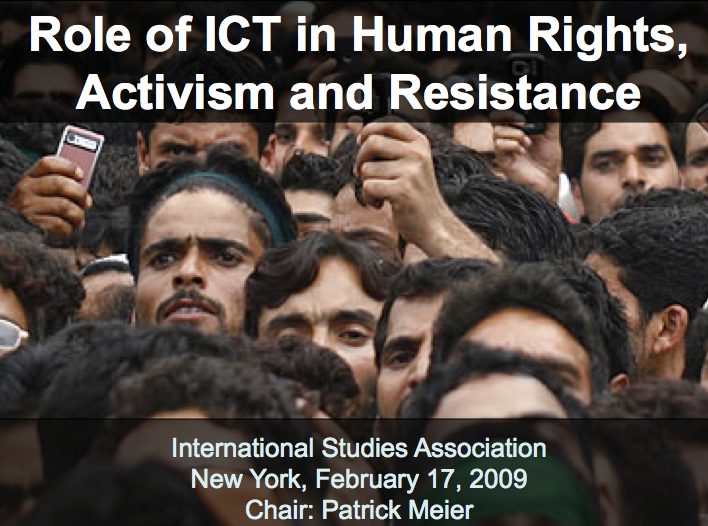
ISA 2009: Panel on ICTs, Human Rights, Activism and Resistance

I just chaired a very productive panel at the International Studies Association (ISA) on the impact of ICTs on human rights, political activism and resistance.

ISApanel

The panel featured the following presentations:

  • Lucía Liste Muñoz and Indra de Soysa onThe Blog vs Big Brother: Information and Communication Technologies and Human Rights, 1980-2005.
  • Fabien Miard on “Call for Power? Mobile Phones as Facilitators of Political Activism.”
  • Patrick Meier on “iRevolutions: The Impact of ICTs on Protest Frequency in Repressive Contexts.” [slideshare]

Presentations

I’ve already blogged about each of the papers individually (see links above) so what follows are points from some of the presentations that I found particularly interesting. I also include the superb feedback that our discussant Professor Dan Drezner from The Fletcher School provided along with a summary of the productive Q&A session we had.

  • Muñoz and de Soysa: Their results show that Internet access leads to increasing respect of human rights by governments. This is true of both democracies and authoritarian regimes.
  • Joshua Goldstein: The role that Safaricom (a private telecommunications company) had in seeking to prevent and/or mitigate the election violence is unprecedented. Not only did the company refuse switch of the SMS network as per the government’s request, the company also sent out broadcast SMS to call on restraint and civic behavior.

Feedback to Panelists

Dan Drezner provided the following feedback:

  • The papers were definitely panel material as they all address important issues related to ICTs that overlap in very interesting ways. So overall, this was great set of papers and presentations, and panelists ought to make sure they read and learn from each others’ papers.
  • Most of the large-N papers blatantly seek to identify a positive correlation between ICT and human rights, political activism, digital resistance, etc. A less biased way to approach the research would be to formulate the question as follows: “How do ICTs benefit the State?”
  • Patrick should expand his set of countries beyond the 22 countries.
  • The dynamic between states and society vis-a-vis repression and circumvention may be an evolutionary one based on learning behavior.
  • The papers should treat ICTs not as independent variables but as an interactive variable with factors such as unemployment. In other words, the question should be: to what extent does ICT interact with other variables that we know ought to trigger protests?
  • The studies should separate anti-foreign protests from anti-government protests.
  • The large-N analyses should include more control variables such as dummy varibales for elections and wars.
  • The studies should also seek to assess the relationship between ICTs and the magnitude of protests and not only the frequency of protests.
  • The papers do not take into account the role of the Diaspora in helping to mobilize, organize and coordinate protests.

Response to Feedback

Here I only respond the feedback relevant to my paper and presentation:

  • On the bias towards finding a statistical relationship and expanding the number of countries in my study, I disagreed with Professor Drezner. I specifically chose the 22 countries in my dataset because the regimes in these countries are actively using ICTs to censor, repress, monitor and block information. So if anything, the cards are stacked against resistance movements when it comes to these countries. Hence my not planning to expand the dataset to include additional countries. Professor Drezner agreed on both points.
  • I completely agree on the evolutionary dynamic, which I described in my dissertation proposal and which explains why I often refer to the dynamic as a cyber game of cat-and-mouse.
  • I’m not entirely sold on treating ICTs as an interactive variable but will explore this nonetheless.
  • Agreed on the suggestion that anti-foreign protests be treated seperately since these protests are often organized by repressive regimes.
  • I fully agree on adding more control variables including elections, wars and population.
  • I concur with the point made about the magnitude of protests but this information is hard to come by. More importantly, however, the dataset I’m using is based on Reuters newswires and the reason I’m using this data is because Reuters is highly unlikely to report on low-level protests but rather on protests that have a national impact. So the dataset serves as a filter for large-scale protests and hence magnitude.
  • Very good point about the diaspora.

Q&A Session

We had an excellent set of questions from the audience which prompted a rich conversation around the following topics:

  • Repressive regimes learning from one another about how to use ICTs for censorship, repression, monitoring, etc. and resistance movement learning from each other.
  • The side to first acquire and apply new technology generally gets a head start, but this prompts the other side, e.g., the State to catch up and regain the upper hand.
  • Who are the users of these technologies? Demographics, gender, age, etc, should be important factors in the study of ICTs, State and society.
  • One member of the audience was a policy maker with the British government and  wanted to know what role Western governments should  play vis-a-vis digital activism.
  • The issue of civil resistance and the intersection with digital activism came up repeatedly in the discussion. Understanding one without the other is increasingly meaningless.

Patrick Philippe Meier

Impact of ICTs on Repressive Regimes: Findings

My dissertation focuses on the impact of digital resistance on nonviolent political transitions. Digital resistance is a term I use to describe the convergence between civilian resistance and digital activism in countries with repressive regimes. I’ve finally completed the quantitative part of my research and would be very grateful to get as much feedback as possible on the findings so I can write up a final draft in the comings weeks and start planning the field research.

Introduction

The question driving my dissertation research is whether digital resistance poses a threat to authoritarian rule? In other words, are the tactics associated with nonviolent civilian resistance movements greatly enhanced by access to modern information communication technologies (ICTs) such as mobile phones and the Web? Or are repressive regimes becoming increasingly savvy in their ability to regulate the impact of the information revolution within their borders?

If I could turn my research into a Hollywood Blockbuster, the title would probably be: “Repression 2.0 versus Revolution 2.0: A Cyber Game of Cat-and-Mouse.”

There are many anecdotes on both sides of the cyber trenches, each asserting tactical victory over the other. But what do all these anecdotes add up to? Can they be quantified to determine what the final score on the scoreboard will read?

Methodology

One way to answer this question is to test whether the diffusion of information communication technology—measured by increasing numbers of Internet and mobile phone users—is a statistically significant predictor of anti-government protests after controlling for other causes of protests. If a positive and statistically significant relationship exists between protest frequency and access to ICT, then one might conclude that the information revolution empowers civil resistance movements at the expense of coercive regimes. If a negative relationship exists, one might deduce that repressive governments have the upper hand.

I used correlation analysis and negative binomial regression analysis on 22 countries between 1990-2007. These countries were selected because their regimes have the technical capacity to repress information. Five regression models were run. The first model included all 22 countries. The second and third model split the countries between high and low levels of protests. The fourth and fifth models split the countries between high and low numbers of mobile phone users.

Findings

This cluster approach was used to minimize the possibility of cancelation effects and to facilitate case study selection for further qualitative research. The cluster of countries with low levels of protests resulted in a statistically significant albeit negative relationship between the number of mobile phone users and protest frequency. This means that an increase in the number of mobile phone users is associated with a decrease in protest frequency.

The cluster of countries with high levels of mobile phones produced a statistically significant and positive relationship between the number of mobile phone users and protest frequency. In other words, an increase in the number of mobile phones is associated with an increase in the number of protests. The other two country clusters, “high protests” and “low mobile phones,” did not produce a statistically significant result for mobile phone use. The number of Internet users was not significant for any of the five models.

The results may suggest that the information revolution empowers civil resistance movements at the expense of repressive regimes in countries with relatively high levels of access to technology. On the other hand, repressive regimes appear to maintain the upper hand in countries with low levels of protest.

Presentation

I’ve written up the findings in this paper (PDF), which I am presenting next week at the International Studies Association (ISA) convention in New York. The paper is part of a panel I organized and will be Chairing on:

“The Changing Role of ICT in Political Activism, Resistance and Human Rights.”

My fellow panelists are presenting the following papers:

  • Fabien Miard on “Mobile Phones as Facilitators of Political Activism.”
  • Joshua Goldstein on “The Role of Digital Networked Technologies in the Ukrainian Orange Revolution.”
  • Lucia Munoz & Indra de Soysa on “The Blog vs Big Brother: Communication Technologies and Human Rights, 1980-2005.”

The chair of my dissertation committee, Professor Daniel Drezner from The Fletcher School, will be the discussant for the panel. Needless to say, I’m really looking forward to this panel. Stay tuned as I’ll be blogging the presentations, discussant feedback and Q&A next Tuesday.

Patrick Philippe Meier

Impact of ICTs on Repressive Regimes: Findings

My dissertation focuses on the impact of digital resistance on nonviolent political transitions. Digital resistance is a term I use to describe the convergence between civilian resistance and digital activism in countries with repressive regimes. I’ve finally completed the quantitative part of my research and would be very grateful to get as much feedback as possible on the findings so I can write up a final draft in the comings weeks and start planning the field research.

Introduction

The question driving my dissertation research is whether digital resistance poses a threat to authoritarian rule? In other words, are the tactics associated with nonviolent civilian resistance movements greatly enhanced by access to modern information communication technologies (ICTs) such as mobile phones and the Web? Or are repressive regimes becoming increasingly savvy in their ability to regulate the impact of the information revolution within their borders?

If I could turn my research into a Hollywood Blockbuster, the title would probably be: “Repression 2.0 versus Revolution 2.0: A Cyber Game of Cat-and-Mouse.”

There are many anecdotes on both sides of the cyber trenches, each asserting tactical victory over the other. But what do all these anecdotes add up to? Can they be quantified to determine what the final score on the scoreboard will read?

Methodology

One way to answer this question is to test whether the diffusion of information communication technology—measured by increasing numbers of Internet and mobile phone users—is a statistically significant predictor of anti-government protests after controlling for other causes of protests. If a positive and statistically significant relationship exists between protest frequency and access to ICT, then one might conclude that the information revolution empowers civil resistance movements at the expense of coercive regimes. If a negative relationship exists, one might deduce that repressive governments have the upper hand.

I used correlation analysis and negative binomial regression analysis on 22 countries between 1990-2007. These countries were selected because their regimes have the technical capacity to repress information. Five regression models were run. The first model included all 22 countries. The second and third model split the countries between high and low levels of protests. The fourth and fifth models split the countries between high and low numbers of mobile phone users.

Findings

This cluster approach was used to minimize the possibility of cancelation effects and to facilitate case study selection for further qualitative research. The cluster of countries with low levels of protests resulted in a statistically significant albeit negative relationship between the number of mobile phone users and protest frequency. This means that an increase in the number of mobile phone users is associated with a decrease in protest frequency.

The cluster of countries with high levels of mobile phones produced a statistically significant and positive relationship between the number of mobile phone users and protest frequency. In other words, an increase in the number of mobile phones is associated with an increase in the number of protests. The other two country clusters, “high protests” and “low mobile phones,” did not produce a statistically significant result for mobile phone use. The number of Internet users was not significant for any of the five models.

The results may suggest that the information revolution empowers civil resistance movements at the expense of repressive regimes in countries with relatively high levels of access to technology. On the other hand, repressive regimes appear to maintain the upper hand in countries with low levels of protest.

Presentation

I’ve written up the findings in this paper (PDF), which I am presenting next week at the International Studies Association (ISA) convention in New York. The paper is part of a panel I organized and will be Chairing on:

“The Changing Role of ICT in Political Activism, Resistance and Human Rights.”

My fellow panelists are presenting the following papers:

  • Fabien Miard on “Mobile Phones as Facilitators of Political Activism.”
  • Joshua Goldstein on “The Role of Digital Networked Technologies in the Ukrainian Orange Revolution.”
  • Lucia Munoz & Indra de Soysa on “The Blog vs Big Brother: Communication Technologies and Human Rights, 1980-2005.”

The chair of my dissertation committee, Professor Daniel Drezner from The Fletcher School, will be the discussant for the panel. Needless to say, I’m really looking forward to this panel. Stay tuned as I’ll be blogging the presentations, discussant feedback and Q&A next Tuesday.

Patrick Philippe Meier

Gene Sharp, Civil Resistance and Technology

Major civil nonviolent campaigns are twice as likely to lead to sustainable democratic transitions than violent campaigns. This conclusion comes from a large-N statistical study carried out by my colleague Maria Stephan (PhD Fletcher ’06) and Erica Chenoweth. Recently published in International Security, the study notes that civil resistance movements have achieved success 55% of the time while only 28% of violent campaigns have succeeded.

Another colleague, Chris Walker (MALD Fletcher ’07), wrote in his excellent Master’s Thesis that “techniques associated with strategic nonviolent social movements are greatly enhanced by access to modern information communication technologies, such as mobile telephony, short message service (SMS), email and the World Wide Web, among others.”

It stands to reason, then, that increasing access to modern communication technologies may in turn up the 55% success rate of nonviolent campaigns by several percentage points. To this end, the question that particularly interests me (given my dissertation research) is the following: What specific techniques associated with civil resistance can tactical uses of modern communication technologies amplify?

This is the question I recently posed to Dr. Peter Ackerman—another Fletcher Alum (PhD ’76) and the founding Chair of the International Center for Nonviolent Conflict (ICNC)—when I described my dissertation interests. When Peter suggested I look into Gene Sharp’s work on methods of nonviolent action, I replied “that’s exactly what I intend to do.”

In The Politics of Nonviolent Action, Gene identifies 198 methods of nonviolent protest and persuasion. The majority of these can be amplified by modern communication technologies. What  follows is therefore only a subset of 12 tactics linked to applied examples of modern technologies. I very much welcome feedback on this initial list, as I’d like to formulate a more complete taxonomy of digital resistance and match the tactic-technologies with real-world examples from DigiActive’s website.

  • Quickie walkout (lightning strike): Flashmob
  • Hiding, escape, and false identities: Mobile phone, SMS

Do please let me know (in the comments section below) if you can think of other communication technologies, Web 2.0 applications, examples, etc. Thanks!

Patrick Philippe Meier

Digital Resistance: Between Digital Activism and Civil Resistance

The fields of digital activism and civil resistance are converging. In fact, they must if either is to remain effective. Repressive regimes are becoming increasingly savvier in their ability to employ information technologies to censor, monitor and intercept communication. These regimes also have recourse to nontechnical means of coercion such as intimidation, imprisonment and torture. To this end, the future of political activism in repressive environments belongs to those who mix and master both digital activism and civil resistance—digital resistance.

Digital activism brings technical expertise to the table while civil resistance offers rich tactical and strategic competence. At the same time, however, the practice of digital activism is surprisingly devoid of tactical and strategic know-how. In turn, the field of civil resistance lags far behind in its command of new information technologies for strategic nonviolent action. This means, for example, that digital activists are often unprepared to deal with violent government crackdowns while those engaged in civil resistance remain unaware that their communication is traced.

ICNC_Fletcher

It is therefore imperative that both communities participate in joint trainings and workshops to address the gaps that currently exist. This is why I am introducing the study of civil resistance to DigiActive and why I’d really like to provide digital activism training at the 2009 Fletcher Institute for the Advanced Study of Nonviolent Conflict. I am happy to report that both communities are eager to exchange lessons learned and best practices. The purpose of this blog post is thus to further cross-fertilize both fields of practice.

I have gone through my growing library of books on nonviolent conflict to identify specific references to communication and technology. Unfortunately, there were few references. Indeed, as Brian Martin (2001) remarked, “searching through writings on nonviolence, there is remarkably little attention to technology, so it is worth mentioning those few writers who deal with it.”

Gene Sharp is considered by many as one of the most influential scholars in the field of civil resistance. His book, Waging Nonviolent Struggle, is a must-read for anyone interested in strategic nonviolent action. The following are excerpts that I found relevant to digital resistance.

Arguments are often made in favor of secrecy in nonviolent struggles in order to surprise the opponents and to catch them unprepared to counter the resistance actions. This is of dubious validity [since] modern communications technologies makes secrecy very difficult to maintain.

Yes and no. Repressive regimes are becoming increasingly savvy in their ability to intercept and block dissident communications but civilian resisters can take important precautions to ensure secrecy and anonymity in their communications. These precautions comprise both technical and tactical measures. DigiActive seeks to integrate both in its trainings.

The participants need to feel constantly part of a much larger movement that gives them, personally, support and strength to continue their resistance. They need to feel that others continue in solidarity with them. This is helped by regular contacts and demonstrations of ‘togetherness.’

Clearly, communications technologies can help foster solidarity as recently witnessed during the anti-FARC protests organized using Facebook. In some contexts, like Egypt, mass meetings, marches or symbols of unity are not permitted by the regime. Indeed, it is forbidden for more than three people to congregate. The Internet can provide a safer space for resistance movements to meet. Again, however, there are important technical and tactical ways to remain safe in cyberspace (and mobilespace).

How can we help accelerate the evolution of digital resistance? One possibility, as outlined by Gilliam de Valk (1993), is to identify and prioritize proposals for research. Gilliam’s book, Research on Civilian-Based Defence, describes in detail 24 areas for major research projects into civilian resistance. While Martin (2001) notes that most of the 24 projects are social rather than technological, two in particular stand out:

  • Collection of information about technologies of repression and what can be done to opposed them.
  • An examination of the influence of the new information technologies on the capacity for both repression and social defense.

As Director for Applied Research at DigiActive, a global all-volunteer initiative, I intend to make these two areas of research a priority for 2009. To this end, I invite scholars and activists to contribute their thoughts and research on digital resistance. Please stay tuned for a future post on the intersection between digital resistance and Clay Shiry’s work on “The Power of Organizing without Organization.”

Patrick Philippe Meier

Tactical Tech’s new Mobile-in-a-Box

One of the self-organized sessions I attended at MobileActive ’08 was led by Tactical Tech. The session introduced the group’s new toolkit, Mobiles in-a-box: Tools and Tactics for Mobile Advocacy. The kit is a “collection of tools, tactics, how-to guides and case studies designed to inspire advocacy organisations and present possibilities for the use of mobile telephony in their work.”

Given my dissertation research on the tactical uses of technology by repressive regimes and resistance movements, I was very much looking forward to reading through the tool kit on my way back to Boston. Tactical Tech’s work also overlaps with my interest in strategic nonviolence and digital activism, two topics that I have given presentations and lectures on over the years.

Not surprisingly, most of the toolkit’s points on security issues are identical to some of the lessons learned in the field of conflict early warning and humanitarian response. One point of contention, however, is that according Mike Grenville, it is not sufficient to simply turn off a mobile phone to prevent the device’s location from being tracked, one must also remove the phone’s batteries. The toolkit does not make this suggestion even though the guide does cite Mike’s work. I wonder who’s right, anyone know?

Perhaps the most interesting piece of information I learned by reading the toolkit is the following:

Each image that you make [sic] on your phone automatically contains details of the location, along with details of the date, time adn type of camera or phone used; this is part of the JPG standard, teh file format most commonly used for digital images. […] Tools are available which enable this ‘hidden’ information to be viewed and, in most cases, stripped out before the image is forwarded […]. You can download a freeware tool called JPEG stripper which will remove the ‘metadata’ from your images.

The kit is without doubt an important contribution to the field and serves as a valuable resource to new activists interested in using mobile phones for advocacy. The key word here being “new”. What is really missing is a strong link with the advanced tactics and scenarios developed within the field of nonviolent action and associated lessons learned. While I have written about this before, I am repeatedly struck by the (particularly unhelpful) gulf that exists between the fields of digital activism and strategic nonviolence, which is one of the main reasons why I joined DigiActive.

It is important that the community of digital activists spend some serious time learning about the field and practice of strategic nonviolence. This means reading the literature, understanding historical and contemporary case studies, participating in nonviolent action trainings and meeting counterparts engaged in strategic nonviolence. Fear not, I’m telling my colleagues in the strategic nonviolence field the same thing about digital activists. But what we need is to cross-fertilize expertise in both fields is to organize a two-day workshop that brings both communities together to discuss tactics, tactics and tactics.

I will do my best to make this happen in 2009. However, this will only work via partnerships and collaboration. DigiActive already has links with the International Center on Nonviolent Conflict (ICNC). Perhaps Tactical Tech and Digital Democracy might want to contribute their expertise?

In the meantime, I’d like to recommend that my colleagues in the field of digital activism and tactical technology start playing “A Force More Powerful.”

Patrick Philippe Meier