Tag Archives: Digital Activism

How To Communicate Securely in Repressive Environments

Update: The information below is now out of date, please do not blindly rely on the strategies and technologies listed!

Important: Please check the excellent comments provided by iRevolution readers below for additional tactics/technologies and corrections. The purpose of this blog post was to inform and elicit feedback so thank you very much for improving on what I’ve written!

FYI – I tried keep an up-to-date guide based on the comments below but was too busy to continue. Please see this link (Doc).

I’m preparing to give a presentation at The Fletcher Summer Institute for the Advanced Study of Nonviolent Conflict (FSI 2009). The focus of my presentation will be on digital security, i.e., how to communicate safely and securely in repressive, non-permissive environments. I’d be very grateful for feedback on the information below.

Introduction

Core to effective strategic nonviolent action is the need to remain proactive and on the offensive; the rationale being that both the resistance movement and repressive regime have an equal amount of time allocated when the show-down begins. If the movement becomes idle at any point, this may give the regime the opportunity to regain the upper hand, or vice versa. The same principle is found in Clausewitz’s writings on war.

Nonviolent resistance movements are typically driven by students, i.e., young people, who are increasingly born digital natives. With expanding access to mobile phones, social networking software and online platforms for user-generated content such as blogs, the immediate financial cost of speaking out against repressive regimes is virtually nil. So resistance movements are likely to make even more use of new communication technology and digital media in the future. In fact, they already are.

At the same time, however, the likelihood and consequences of getting caught are high, especially for those political activists without any background or training in digital security. Indeed, recent research by Digital Democracy research suggests that organizational hierarchies are being broken down as youth adopt new technologies. While this empowers them they are also put at risk since they don’t tend to be as consequence-conscious as their adult counterparts.

Empire Strikes Back

It is no myth that repressive regimes are becoming increasingly more savvy in their ability to effectively employ sophisticated filtering, censoring, monitoring technologies (often courtesy of American companies like Cisco) to crack down on resistance movements. In other words, political activists need to realize that their regimes are becoming smarter and more effective, not dumber and hardly clueless.

That said, there are notable—at times surprising—loopholes. During the recent election violence in Iran, for example, facebook.com was blocked but not facebook.com/home.php. In any case, repressive regimes will continue to block more sites impose information blockades because they tend to view new media and digital technologies as a threat.

Perhaps technologies of liberation are a force more powerful?

In order to remain on the offensive against repressive regimes, nonviolent civil resistance movements need to ensure they are up to speed on digital security, if only for defense purposes. Indeed, I am particularly struck by the number of political activists in repressive regimes who aren’t aware of the serious risks they take when they use their mobile phones or the Internet to communicate with other activists.

Adaptive Learning

One way to stay ahead is to make the learning curve less steep for political activists and to continually update them with the latest tested tactics and technologies. To be sure, one way to keep the upper hand in this cyber game of cat-and-mouse is to continue adapting and learning as quickly as possible. We need to ensure that feedback mechanisms are in place.

There are clearly trade-offs between security and convenience or usability, particularly in the context of technologies. As DigiActive notes in the graphic below, the most secure tactics and technologies may not be the most convenient or easy to deploy. Most political activists are not tech-savvy.

This means that digital activists need to design tactics and technologies that are easy to learn and deploy.

The tactics and technologies listed in the next sections fall into all four different quadrants to one extent or another. It is important that political activists at minimum master the easy and convenient digital security tactics and technologies identified in this blog post.

ACmatrix

Recall that both sides are allocated an equal amount of time to plan and execute their operations. Accelerating the learning process is one way for activist networks to remain pro-active and stay ahead of the curve. This is in part is the role that DigiActive seeks to play. Unlike the hierarchical, centralized structures of repressive regimes, networks have more flexibility and feedback loops, which make them more adaptable.

The normative motivation behind my research on digital resistance is based on the recognition by “many scholars and practitioners […] that the techniques associated with strategic nonviolent social movements are greatly enhanced by access to modern information communication technologies, such as mobile telephony, short message service (SMS), email and the World Wide Web, among others” (Walker 2007).

The potential to leverage those techniques is what makes Digital Security so important to integrate in the strategic and tactical repertoire of civil resistance movements.

Digital Security

I define digital security (DS) in the context of digital resistance as the art and science of staying safe when communicating in non-permissive environments. The reason I call it both an art and a science is to emphasize that both tactics and technology play an important role in staying safe when facing repression.

So the DS framework I want to propose is two-pronged: tactics vs. technology, and safety vs. security. I call it the 4-square approach for obvious reasons:

4square

  • DS tactics: these can be “technology free” tactics as well as tactics that apply communication technology.
  • DS technologies: these include both high-tech and low-tech technologies that are designed to improve safe and secure communication in repressive environments.
  • Personal safety: in this context refers to physical, personal safety when communicating in non-permissive environments.
  • Data Security: refers to the security of the data when communicated from one devise to another.

As the graphic above suggests, personal safety and data security are a function of both tactics and technologies. For example, data security is best ensured when combining tactics and technologies.

What follows is a list of tactics and technologies for communicating safely and securely in repressive environments. The list is divided into technology categories and the bullet points are listed in order of relative convenience and easy to more complicated but more secure.

Note that the information below is in no way meant to be exhaustive, so pleasedo send suggestions! (See also the conclusion for a list of reference and suggestions on further reading).

Digital Security Tactics

As mentioned above, DS tactics come as both technology-free tactics and tactics that relate to communication technology. For example, making sure to pay for a sim card in cash and out of sight of security cameras is a technology-free tactic  that increases the chances of staying safe. Removing the batteries from your mobile phone to prevent it from being geo-located is a tactic that relates to the technology and also increases your safety.

DS tactics can also improve data security when communicating information. “Sneakernet” is a technology-free tactic to share information. The term is used to describe tactics whereby the transfer of electronic information such computer files is done by physically carryingremovable media such as hard drives and disk drives. In contrast, using encryption software for mobile phones is a tactic that uses technology. The communication may be intercepted by eavesdroppers but they may be unable to decipher the message itself.

These tactics are listed below along with a number of other important ones. Please keep in mind that tactics are case- and context-specific. They need to be adapted to the local situation.

  • Mobile Phones
    • Purchase your mobile phone far from where you live. Buy lower-end, simple phones that do not allow third-party applications to be installed. Higher-end ones with more functionalities carry more risk. Use cash to purchase your phone and SIM card. Avoid town centers and find small or second-hand shops as these are unlikely to have security cameras. Do not give your real details if asked; many shops do not ask for proof of ID.
    • Use multiple SIM cards and multiple phones and only use pay-as-you go options; they are more expensive but required for anonymity.
    • Remove the batteries from your phone if you do not want to be geo-located and keep the SIM card out of the phone when not in use and store in separate places.Use your phone while in a moving vehicle to reduces probability of geo-location.
    • Never say anything that may incriminate you in any way.
    • Use code.
    • Use Beeping instead of SMS whenever possible. Standard text messages are visible to the network operator, including location, phone and SIM card identifiers. According to this recent paper, the Chinese government has established 2,800 SMS surveillance centers around the country to monitor and censor text messages. The Chinese firm Venus Info Tech Ltd sells real-time content monitoring and filtering for SMS.
    • Use fake names for your address book and memorize the more important numbers. Frequently delete your text messages and call history and replace them with random text messages and calls. The data on your phone is only deleted if it is written over with new data. This means that deleted SMS and contact numbers can sometimes be retrieved (with a free tool like unDeleteSMS. Check your phone’s settings to see whether it can be set to not store sent texts messages and calls.
    • Eavesdropping in mobile phone conversations is technically complicated although entirely possible using commercially available technology. Do not take mobile phones with you to meetings as they can be turned into potential listening/tracking devices. Network operators can remotely activate a phone as a recording device regardless of whether someone is using the phone or whether the phen is even switched on. This functionality is available on US networks.
    • Network operators can also access messages or contact information stored on the SIM card. If surveillance takes place with the co-operation of the operator, little can be done to prevent the spying.
    • Mobile viruses tend to spread easily via Bluetooth so the latter should be turned off when not in use.
    • Using open Bluetooth on phones in group situations, e.g., to share pictures, etc., can be dangerous. At the same time, it is difficult to incriminate any one person and a good way to share information when the cell phone network and Internet are down.
    • Discard phones that have been tracked and burn them; it is not sufficient to simply destroy the SIM card and re-use the phone.
  • Digital Cameras
    • Keep the number of sensitive pictures on your camera to a minimum.
    • Add plenty of random non-threatening pictures (not of individuals) and have these safe pictures locked so when you do a “delete all” these pictures stay on the card.
    • Keep the battery out of the camera when not in use so it can’t be turned on by others.
    • Practice taking pictures without having to look at the view screen.
  • Computers/Laptops
    • Use passphrases for all your sensitive data.
    • Keep your most sensitive files on flash disks and find safe places to hide them.
    • Have a contingency plan to physically destroy or get rid of your computer at short notice.
  • Flash disks
    • Purchase flash disks that don’t look like flash disks.
    • Keep flash disks hidden.
  • Email communication
    • Use code.
    • Use passphrases instead of passwords and change them regularly. Use letters, numbers and other characters to make them “c0mpLeX!”. Do not use personal information and changer your passphrases each month. Do not use the same password for multiple sites.
    • Never use real names for email addresses and use multiple addresses.
    • Discard older email accounts on a regular basis and create new ones.
    • Know the security, safety and privacy policies of providers and monitor any chances (see terms of service tracker).
  • Browsers and websites
    • Turn off java and other potentially malicious add-ons.
    • Learn IP addresses of visited websites so that history shows only numbers and not names.
    • When browsing on a public computer, delete your private data (search history, passwords, etc.) before you leave.
    • When signing up for an account where you will be publishing sensitive media, do not use your personal email address and don’t give personal information.
    • Don’t download any software from pop-ups,  they may be malicious and attack your computer or record your actions online.
    • Do not be logged in to any sensitive site while having another site open.
  • VoIP
    • Just because your talking online doesn’t mean you are not under surveillance.
    • As with a cell or landline, use code do not give salient details about your activities, and do not make incriminating statements.
    • Remember that your online activities can be surveilled using offline techniques.  It doesn’t matter if you are using encrypted VOIP at a cyber cafe if the person next to you is an under-cover police officer.
    • When possible, do not make sensitive VOIP calls in a cyber cafe.  It is simply too easy for someone to overhear you. If you must, use code that doesn’t stand out.
  • Blogs and social networking sites
    • Know the laws in your country pertaining to liability, libel, etc.
    • When signing up for a blog account where you will be publishing sensitive content, do not use you personal email address or information.
    • In your blog posts and profile page, do not post pictures of yourself or your friends, do not use your real name, and do not give personal details that could help identify you (town, school, employer, etc.).
    • Blog platforms like wordpress allow uses to automatically publish a post on a designated date and time. Use this functionality to auto-publish on a different day when you are away from the computer.
    • On social networks, create one account for activism under a false but real-sounding name (so your account won’t be deleted) but don’t tell your friends about it.  The last thing you want is a friend writing on your wall or tagging you in a photo and giving away your identity.
    • Even if you delete your account on a social networking site, your data will remain, so be very careful about taking part in political actions (i.e., joining sensitive groups) online.
    • Never join a sensitive group with your real account.  Use your fake account to join activism groups. (The fake account should not be linked to your fake email).
    • Don’t use paid services.  Your credit card can be linked back to you.
  • File sharing
    • Use a shared Gmail account with a common passphrase and simply save emails instead of sending. Change passphrase monthly.
    • For sharing offline, do not label storage devices (CDs, flash drives) with the true content.  If you burn a CD with an illegal video or piece of software on it, write an album label on it.
    • Don’t leave storage devices in places where they would be easily found if your office or home were searched (i.e., on a table, in a desk drawer).
    • Keep copies of your data on two flash drives and keep them hidden in separate locations.
    • When thinking of safe locations, consider who else has access. Heavily-traveled locations are less safe.
    • Don’t travel with sensitive data on you unless absolutely necessary.  If you need to, make sure to hide it on your person or “camouflage” it (label a data CD as a pop music CD). See Sneakernet.
  • Internet Cafes
    • Assume you are being watched.
    • Assume computers at cyber cafes are tracking key strokes and capturing screenshots.
    • Avoid cyber cafes without an easy exit and have a contingency plan if you need to leave rapidly.

Digital Security Technologies

When combine with the tactics described above, the following technologies can help you stay safe and keep your data relatively more secure.

  • Mobile phones
    • Use CryptoSMS, SMS 007 or Kryptext to text securely (this requires java-based phones).
    • Use Android Guardian as soon as it becomes available.
    • Access mobile versions of websites as they are usually not blocked. In addition, connecting to mobile websites provides for faster connections.
  • Digital cameras
    • Use scrubbing software such as: JPEG stripper to remove the metadata (Exif data) from your pictures before you upload/email.
    • Have a safe Secure Digital Card (SD) that you can swap in. Preferably, use a mini SD card with a mini SD-SD converter. Then place the mini SD into a compatible phone for safekeeping.
  • Computers/Laptops
    • Use a different file type to hide your sensitive files. For example, the .mov file extension will make a large file look like a movie.
    • Mac users can use Little Snitch to track all the data that goes into and out of your computer.
    • From a technical perspective, there’s no such thing as the delete function. Your deleted data is eventually written over with new data. There are two common ways to wipe sensitive data from your hard drive or storage device. You can wipe a single file or you can wipe all of the ‘unallocated’ space on the drive. Eraser is a free and open-source secure deletion tool that is extremely easy to use.
  • Email communication
    • Use https when using Gmail.
    • Use encrypted email platforms such as Hushmail and RiseUp.
  • Browsers and websites
    • Use Firefox and get certain plugins to follow website tracking such as ghostery and adblock, adart to remove ads/trackers.
    • User Tor software or Psiphon to browse privately and securely.
    • I shan’t list access points for secure browsers, Proxy servers and VPNs here. Please email me for a list.
    • Always use https in “Settings/General/Browser Connection.”
  • VoIP
    • Use Skype but not TOM Skype (Chinese version). Note that Skype is not necessarily 100% secure since no one has access to the source code to verify.
    • Off The Record (OTR) is a good encryption plugin. For example, use Pidgin with OTR (you need to add the plug-in yourself).
    • Gizmo offer encryption for voice conversations, and then only if you are calling another VoIP user, as opposed to a mobile or landline telephone. However, because neither application is open-source, independent experts have been unable to test them fully and ensure that they are secure.
    • Adium is a free IM application for Macs with built-in OTR encryption that integrates most other IM applications.
  • Blogs and social networking platforms
    • There are no safe social networks.  The best way to be safe on a social network is fake account and a proxy server.
    • The anonymous blogging platform Invisiblog no longer exists, so the best bet now is WordPress + Proxy (preferably Tor) + anonymity of content.
    • Log out of facebook.com when not using the site.
  • File sharing
    • Use Drop.io to create a private, secure media sharing site.
    • Use BasecampHQ with secure/SSL option to create more specific usernames and passwords for each user or remote site.
  • Internet Cafe
    • Tor can be installed on flash disk and used at Internet cafe and also used from LiveCDs if flash drives are not allowed.
  • Other potential tech

Conclusion

The above material was collected in part from these sources:

As mentioned above, please send suggestions and/or corrections as well as updates. And again, please do check the comments below. Thanks! Patrick Philippe Meier

Steganography 2.0: Digital Resistance against Repressive Regimes

A team of Polish steganographers at the Institute of Telecommunications in Warsaw are doing some neat work that should be of interest to digital activists. Steganography is is the art and science of writing hidden messages in such a way that no one, apart from the sender and intended recipient, suspects the existence of the message, a form of security through obscurity.

Wojciech Mazurczyk, along with Krzysztof Szczypiorski and Milosz Smolarczyk are using the Internet’s transmission control protocol (TCP) to create fake web traffic that can mask the transmission of secret messages.

As the NewScientist explains,

“Web, file transfer, email and peer-to-peer networks all use TCP, which ensures that data packets are received securely by making the sender wait until the receiver returns a “got it” message. If no such acknowledgement arrives (on average 1 in 1000 packets gets lost or corrupted), the sender’s computer sends the packet again. This scheme is known as TCP’s retransmission mechanism – and it can be bent to the steganographer’s whim, says Mazurczyk.”

The team’s project is called Retransmission Steganography, or RSTEG, proposes to use software that deliberately asks the receiver of information to prompt a retransmission from the sender even when the data was successfully received in the first place. As Mazurczyk explains, “the sender then retransmits the packet but with some secret data inserted in it,” which means, “the message is hidden among the teeming network traffic.”

The use of RSTEG as a tactic for digital resistance could be quite effective. While eavesdroppers could monitor the fact that a first sent package is different from a second retransmitted one containing the secret message, this would be somewhat useless since all retransmitted packages differ from original ones anyway. In other words, “Retransmissions in IP networks are a ‘natural phenomenon’, and so intentional retransmissions introduced by RSTEG are not easy to detect if they are kept at a reasonable level.”

Mazurczyk and Szczypiorski are also working on a parallel project that draws on steganographic techniques to creating covert channels for Voice over Internet Protocol (VOIP) streams. This approach, called Lost Audio Packets Steganography, or LACK, “provides hybrid storage-timing covert channel by utilizing delayed audio packets.”

For more information on the technical specifications of the RSTEG and LACK techniques, please see the authors’ papers here and here respectively.

The team plans to demonstrate their approach at a workshop on network steganography in China later this year. Yes, China.

Patrick Philippe Meier

Nation-State Routing: Globalizing Censorship

I just found an interesting piece on Internet censorship at arXiv, my favorite go-to place for scientific papers that are pre-publication. Entitled “Nation-State Routing: Censorship, Wiretapping and BGP,” this empirical study is possibly the first to determine the aggregate effect of national policies on the flow of international traffic.

As government control over the treatment of Internet traffic becomes more common, many people will want to understand how international reachability depends on individual countries and to adopt strategies either for enhancing or weakening the dependence on some countries.

Introduction

States typically impose censorship to prevent domestic users from reaching questionable content. Some censorship techniques, however, “may affect all traffic traversing an [Autonomous System].” For example, Internet Service Providers (ISPs) in China, Britain and Pakistan block Internet traffic at the Internet Protocol (IP) level by “filtering based on IP addresses and URLs in the data packets, or performing internal prefix hijacks, which could affect the international traffic they transit.”

The scope and magnitude of this affect is unclear. What we do know is that one may intentionally or by accident apply censorship policies to international traffic, as demonstrated by the global YouTube outage last year as a result of a domestic Pakistani policy directive.

Methodology

The authors therefore developed a framework to study interdomain routing at the nation-state level. They first adapted the “Betweeness Centrality” metric from statistical physics to measure the importance, or centrality, of each country to Internet reachability. Second, they designed, implemented and validated a Country Path Algorithm (CPA) to infer country-paths from a pair of source and destination IP addresses.

Findings

The table below shows Country Centrality (CC) computed directly from Trace Route (TR) and Border Gate Protocol (BGP). The closer the number is to one, the more impact that country’s domestic Internet censorship policies has on international Internet traffic.

arxivtable1

The second table below lists both Country Centrality (CC) and Strong Country Centrality (SCC). The latter measures how central countries are when alternative routes are considered. When SCC equals one, this suggests a country is completely unavoidable.

arxiv-table2

“Collectively, these results show that the ‘West’ continues to exercise disproportionate influence over international routing, despite the penetration of the Internet to almost every region of the world, and the rapid development of China and India.”

This last table below lists CC and SCC measures for authoritarian countries that are known for significant domestic censorship of Internet content. Aside from China, “these countries have very little influence over global reachability.”

arxiv-table3

Next Steps

The authors of the study point to a number of interesting questions for future research. For example, it would be interesting to know how the centrality result above change over time, i.e., which countries are becoming more central over time, and why?

Another important question is what economically driven strategies single countries (or small coalitions of countries) could adopt to increase their own centrality or to reduce that of other countries?

One final and particularly important question would to find out what fraction of domestic paths are actually routed through another country? This is important because the answer to this question would “provide insight into the influence that foreign nations have over a country’s domestic routing and security, and would shed light on […] whether warrantless tapping on links in one country to another might inadvertently capture some purely domestic traffic.”

Patrick Philippe Meier

Mobile Tech 4 Social Change Barcamp: Roundup

Skypenote Address

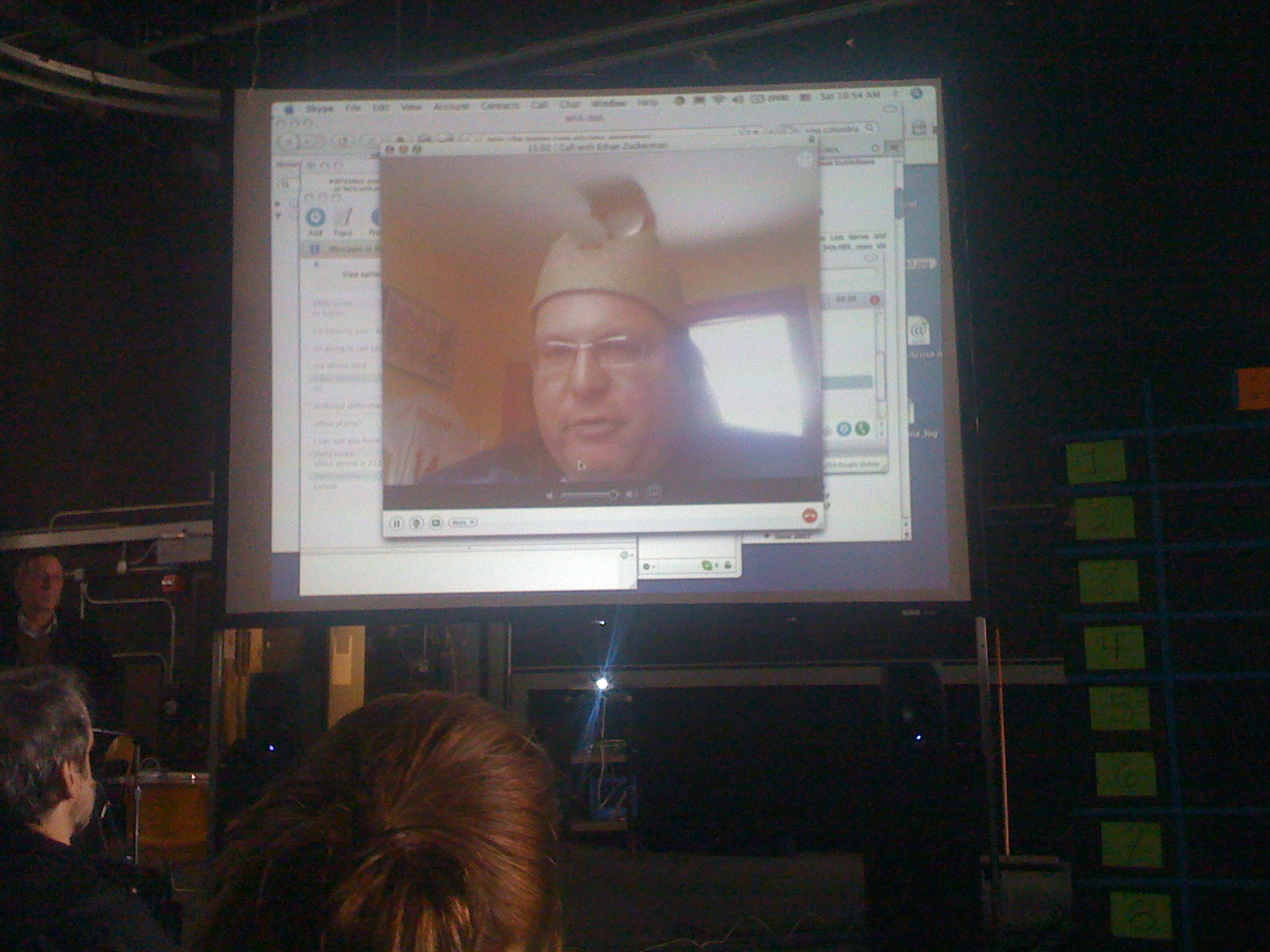
Ethan Zuckerman kicked off m4change with a Skypenote address on social changes generated by mobile technology.

img_0281

Here are the main conclusions I drew from his presentation:

  • Ownership versus access to technology: While not everyone in Tanzania owns a mobile phone, 97% have access to one.
  • Endogenous versus exogenous protests: Protesters in Jordan turned up in front of the US Embassy not because they intentionally sought to join a centralized political movement but because five of their friends were going. Friend-to-Friend (F2F) communication?
  • Impact of ICTs on nondemocratic regimes: Those who doubt that modern ICTs pose a threat to authoritarian rule should explain why repressive regimes often switch SMS networks and restrict Internet access.
  • Communication technology ecosystems: Convergence of ICTs is far more powerful than the increasingly ubiquitous mobile phone. When mobile phones and SMS are paired with radio talk show programs, the combination replicates much of the functionalities that characterize the Internet. Once information is broadcase over radio, it becomes public knowledge.

Mobile Tech in Repressive Contexts

I offered to guide a session on Mobile Tech 4 Social Change in Repressive Regimes. The proposal was to identify challenges and opportunities. I stressed the need to look at both tech and tactics since a one-track approach is not full-proof.

socialdashboard_2

Here are the main points I took away from the session:

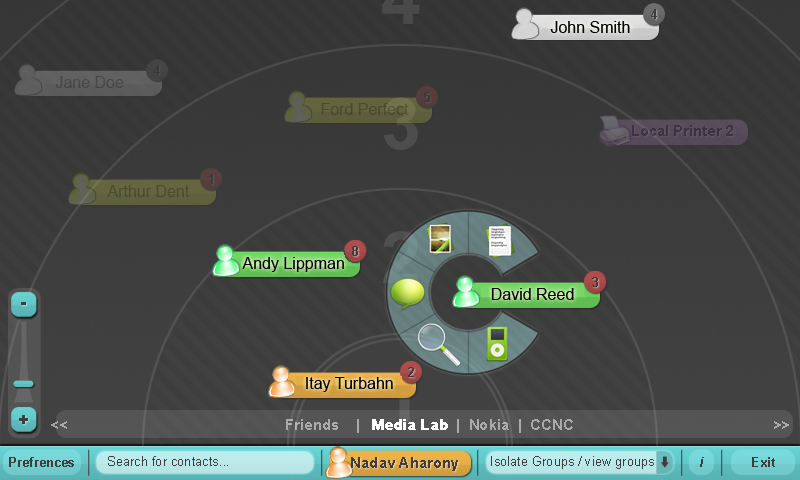
  • Ensuring data security in Peer-to-Peer (P2P) meshed mobile communication (see Terranet for example) is very difficult but a 1-hop approach like Comm.unity (screenshot above) is doable and far more secure. The idea is to leverage knowledge, awareness and learning of the user’s social relationships and integrates this information into the communication protocols and network services.” Furthermore, the platform “runs on mobile phones, PDAs, and regular old laptops and PCs, allowing them to easily communicate with each other and build networks of interactions for their users without the need for any centralized servers, coordination, or administration.”
  • Steganography is the art and science of writing hidden messages in such a way that no-one apart from the sender and intended recipient even realizes there is a hidden message, a form of security through obscurity. This tactic is one that we should apply more often. Steganography can be applied to images, audio recordings and texts. For example, poems mocking the Burmese junta have appeared in the state-run newspaper using the first word of every sentence in an article.
  • Pseudonymity describes a state of disguised identity resulting from the use of a pseudonym. The pseudonym identifies a holder, that is, one or more human beings who possess but do not disclose their true names. Pseudonymity should be more actively used in digital resistance.

Mobile Tech and Communication Security

The second session I participated in was led by Nathanial Freitas. This was an excellent review of the latest tech developments with regards to ensuring that your mobile communications are secure, encrypted, nontraceable, etc. Nathanial used the Android phone as the basis for his presentation. Here are some of the highlights I took away from this informative session:

  • Zfone is a new secure VoIP phone software product which lets you make encrypted phone calls over the Internet. Zfone uses a new protocol called ZRTP, which has a better architecture than the other approaches to secure VoIP.
  • GetPeek is a new mobile tech that offers unlimited email texting for just $20 a month without the need for a contract. GetPeek will be available in India next week.
  • Icognito is an anonymous web browser for the iPhone and iPod.
  • Mobile phones that can immediately encrypt, transmit and delete pictures are necessary.
  • Browser history on mobile phones should not be deleted as this would be calling attention to oneself. Instead, an alternative browser history should be settable.
  • Mobile phones need an actuall off button. Activists always take out the batteries of their phones in order not to have their location traced. Other phones like iPhones do not have a real off button.
  • President Obama’s Blackberry has been modified to require fingerprint authenitication.
  • The competition between authoritarian control and circumvention by activists is like an arms race, a point I make in my own dissertation research. Andrew Lewman from the Tor Project made a very interesting comment in that regard: “It is very important that this arms race be as slow as possible.” According to Andrew, whatever new technology emerges next is unlikley to be a complete game-changer. Instead of investing considerable time and resources into trying to develop the ultimate tool, he suggests that we take small iterative steps that contribute to momentary advantages in this cyber game of cat-and-mouse.

Mobile Tech, Art and Activism

The final self-organized session I attended addressed the intersection between mobile technology and art for political activism. I’m particulary interested in the subservive art within the context of nonviolent civil resistance.

stencil_art

Here are some of the ideas I took away from this session:

  • Stencil art for political activism. “Political stencil art has been significant for centuries as a device for communication and opression. Propoganda was a hallmark of political art in the 20th century in both democratic and communist regimes, at time of war and peace.” See ArtFlux for example.
  • Newmindspace is interactive public art, creative cultural interventions and urban bliss dissemination.

Patrick Philippe Meier

Digital Democracy in Burma

My colleagues Emily Jacobi and Mark Belinsky from Digital Democracy gave an excellent guest lecture yesterday. They presented their findings from their Burma project to undergraduate students in my digital democracy course co-taught with Josh Goldstein. There excellent slides are available on Slideshare here.

Mark and Emily began their presentation with a reference George Orwell who served in Burma as a military officer. It is striking that every Burmese who has read Orwell claims the author wrote not one but three books on Burma: Burmese DaysAnimal Farm and 1984.

Here are just a few insights from the two-hour presentation that I found particularly interesting:

  • Based on 90+ surveys carried out, Mark and Emily found that young Burmese who had access to the Internet were more likely to identify themselves as activists.
  • The Bangladeshi cell phone network extends well into Burma so activists can use phones from Bangladesh to relay information.
  • Monks have access to the Internet and to mobile phones because the Junta provided them the technology as part of alms giving.

Mark and Emily shared some fascinating anecdotes on digital activism in Burma based on their field research. Some are somewhat sensitive and not blog-able but others are less so yet equally eye opening. For example, Mark recounts a visit to a Burmese refugee camp along the Bangladeshi-Burma border:

I had five minutes of idle time and so decided to check my Facebook page using my mobile phone. I was soon approached by one of the refugees who looked on curiously. Before I could explain, the person enquired, “Do you wiki?” I was stunned as he pulled out a much fancier phone and proceeded to show me his favorite Wikipedia pages which were on fancy sports cars.

Patrick Philippe Meier

Digital Resistance and the Orange Revolution

My colleague Joshua Goldstein recently researched the role of digital networked technologies in the Ukranian Orange Revolution (PDF). There are few case studies out there that address both digital activism and civilian resistance, i.e., digital resistance, so what follows is a detailed summary of Josh’s report for the Berkman Center along with some of my own research.

Introduction

Compared to the other three panel presentations, this study takes a narrative case study approach and focuses on a single case study, the role of the Internet and mobile phones during the Orange Revolution.

For Josh, one of the most fascinating questions about the Orange Revolution is how the Internet became such an influential tool when only 4% of the population was online? Even though such a small percentage of the population had Internet access, “the Orange Revolution may have been the first in history to be organized largely online.”

Theory

To understand what contributed to this digital revolution, Josh draws on the Two-Step Flow Theory developed by sociologists Katz and Lazardsfeld (1955), which delineates a ‘two step’ information path. The first is the direct path between mass media and the general public. The second path is among elite opinion makers who strongly influence public opinion.

According to Josh,

This theory helps delineate how a relatively small group of activists and citizen journalists helped create a distinct information environment that challenged the narrative presented by state sanctioned media.

In the Ukraine, both the rise of citizen journalism and  influential opinion makers from the opposition were in large part consequences  of the widespread self-censorship that existed in the country.

‘Self censorship was not enshrined in law, but it was well known that oligarchs owned all of the major television stations. Station managers received temnyky, unsigned directives from the President’s office that urged them to cover the news in a particular way. Managers knew that if they did not please the ‘key viewer,’ the President and his regime, they would be in danger of losing their jobs.

As Josh notes, however, Channel 5 was the notable exception. The small television station had been bought by members of the opposition to promote an independent view on Ukranian politics. Although Channel 5 only available to 30% of the population, the station became well known for it’s alternative view on domestic affairs.

In addition, citizen opposition journalism posed a central challenge to the semi-autocratic regime. However, Josh writes that the Ukranian public already recognized the Internet as a legitimate news source. Online news sites including Pravda, Obozrevatel and ProUA, were well already well known. Moreover, they were a “hybrid between citizen and professional media [since] they were predominantly staffed by professional journalists but often received low pay or were motivated by changing the Ukranian landscape.”

To build on his theoretical framework, Josh also draws on Stephen Bandera’s empirical study on political participation during the Orange Revolution. The results of this study revealed that “Ukranians who use the Internet were more likely to be online political citizens than their American counterparts.”

Lastly, Josh recognizes that technologies alone do not explain the success of the Orange Revolution:

The ability to diffuse tension through humor and satire was crucial to the success of the Orange Revolution. […] Every joke and pun created by this community of activists and directed at [the regime] further drew attention to the vastly different information environments and political futures that the two candidates represented.

Case Studies

Josh draws on two case studies to test out his theoretical framework. The first is Maidan and the second Para.

Maidan was a group of tech-savvy pro-democracy activists who used the Internet as a tool to support their movement. Maidan in Ukranian means public square and Maidan’s website features the slogal “You CAN chnage the world you live in. And you can do it now. In Ukraine.”

The main activity of Maidan was election monitoring and networking with other pro-democracy organizations around Eastern Europe. Maidan hosted around 27 election monitoring trainings, in nearly every Ukranian region, with support from Serbia’s Otpor movement. […] In the year leading up to the election, Maidan trained 500 Ukranians to observe the election. This evidence collected […] was central to proving the existence of massive election fraud.

However, the founder of Maidan argues that “websites cannot produce an activist organization.” As Josh explains, it was crucial for Maidan to frequently host real world meetings as their membership base increased. The human element was particularly important. This explains why Maidan encouraged users to disclose their identity whenever possible.

Maidan was not a completely decentralized organization. The community benefited from centralized leadership that developed the organization’s culture, controlled its assets and provided the strategy to achieve desired goals. The Maidan experience thus demonstrates a hybrid organization.

In sum, the Internet was clearly a vital, multi-faceted tool for Maidan. The Internet facilitated outreach, training, awareness raising, fundraising and marketing. At the same time, centralized, top-down leadership was necessary to accomplish the organization’s goals.

Pora, meaning “It’s Time” in Ukranian, was a well-organized group of  pro-democracy volunteers that “emerged as an information sharing campaign and during the elections morphed into coordinators of mass protest centered around tent cities in towns throughout Ukraine. The grassroots movement took its inspiration from Serbia’s Otpor movements as well as “older civic movements in Hungary and Czechoslovakia.”

The organization described it’s raison d’être as follows:

Under conditions of far-reaching censorship and absence of independent media, the main idea of Pora is the creation of alternative ‘mass media,’ in which volunteers deliver election-related information ‘from hand to hand’ directly to people throughout the Ukraine.

Pora promoted “the active use of modern communication systems in the campaign’s management,” and “mobile phones played an important role for mobile fleet of activists.” According to Pora’s post-election report, “a ssytem of immedate dissemination of information by SMS was put in place and proved important.” In addition, “some groups provided the phones themselves, while others provided SIM cards, and most provided airtime.”

The Internet also played a role in Pora’s campaign by providing rapid reporting in a way that no other medium could. As tent cities across the Ukraine became the sign of the revolution,

The news feed from the regions [became] vitally important. Every 10 to 15 minutes another tent city appeared in some town or other, and the fact was soon reported on the air. News from the region was read by opposition leaders on Maidan to millions of listeners in the streets of Ukraine.

While the government certainly saw the Internet as a threat, the government had not come to consensus regarding the “legal and political frameworks it would use to silence journalists that published openly on this new medium.” Ukrainian law considered the Internet to be a “peer-to-peer communication tool and not a mass media platform,” which explains why “online sites were able to blossom” and why many online journalists unlike mainstream journalists were free from the threat of defamation charges.

In addition to new technologies, the grassroots movement also “successfully leveraged traditional methods of spreading information [such as] print products (leaflets, brochures, stickers, and small souvenirs), public activities and demonstration, visual representations (posters and graffiti), media presentations (clips and interviews), and periodicals.”

Josh argues that these activities make the Orange Revolution one of the earliest examples of what Steven Mann calls “sousveillance,” meaning, “the monitoring of authority figures by grassroots groups, using the technologies and techniques of surveillance.” In short, Pora’s campaign represents the clearest link between the small percentage of Ukranian elite who were online and the general public.

Findings

Josh concludes that the Internet and mobile phones proved to to be effective tools for pro-democracy activists.

First, the Internet allowed for the creation of a space for dissenting opinions of ‘citizen journalists’ in an otherwise self-cencosred media environment.

Second, pro-democracy activists used the convergence of mobile phones and the Internet to coordinate a wide range of activities including election monitoring and large-scale protests.

In sum, Josh observes that “pro-democracy forces used the Internet and mobile phones more effectively than the pro-government forces, such that in this specific time and place these technologies weighed on the side of democracy.” Nevertheless, as Ned Rossiter cogently points out,

Technology certainly does not make possible a direct democracy, where everyone can participate in a decision, nor representative democracy where decision makers are elected; nor is it really a one-person-one-vote referendum style democracy. Instead it is a consultative process known as ‘rough consensus and running code.’

This points to a larger question for further research, which forms the basis for my dissertation:

Are these tools inherently conducive to the expansion of civic engagement and democratization or will authoritarian governments adapt the technology to their own advantage?

My Own Conclusion

One very interesting anecdote not reported in Josh’s report demonstrates the real power of traditional media. Natalia Dmytruk worked for the Ukraine’s state-run television news program as an interpreter of sign language for the hearing-impaired. As the revolution picked up momentum, she decided she couldn’t lie anymore and broke from the script with the following message:

I am addressing everybody who is deaf in the Ukraine. Our president is Victor Yushchenko. Do not trust the results of the central election committee. They are all lies. . . . And I am very ashamed to translate such lies to you. Maybe you will see me again…

According to a Washington Post article at the time, “Dmytruk’s live silent signal helped spread the news, and more people began spilling into the streets to contest the vote.”

Overall, what really strikes me about Josh’s peace is the very real convergence between civil resistance and digital activism, or digital resistance. Citizen journalists and digital activists participated in civil resistance trainings across the country, courtesy of Otpor. The use of humor and puns directed at the regime is a classic civil resistance tactic.

I spoke with Josh just yesterday about his research on the Orange Revolution and he was adamant that one of key reasons that explains the success of the revolution has to do with the fact that “the protesters were very well trained and very good at protesting… very, very good.”

This highlights just how critical training in civil resistance is. Digital activists need to acquire the tactical and strategic know-how developed over decades of civil resistance movements. Otherwise, tactical victories by digital activists may never translate into overall strategic victory for a civil resistance movement.

Patrick Philippe Meier

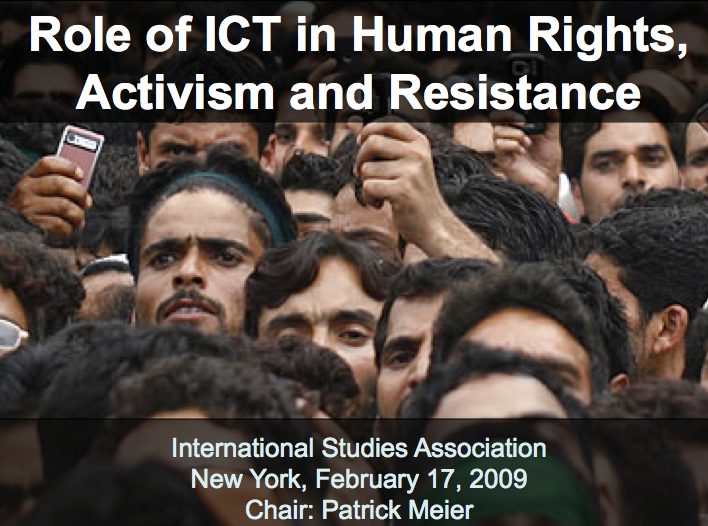
ISA 2009: Panel on ICTs, Human Rights, Activism and Resistance

I just chaired a very productive panel at the International Studies Association (ISA) on the impact of ICTs on human rights, political activism and resistance.

ISApanel

The panel featured the following presentations:

  • Lucía Liste Muñoz and Indra de Soysa onThe Blog vs Big Brother: Information and Communication Technologies and Human Rights, 1980-2005.
  • Fabien Miard on “Call for Power? Mobile Phones as Facilitators of Political Activism.”
  • Patrick Meier on “iRevolutions: The Impact of ICTs on Protest Frequency in Repressive Contexts.” [slideshare]

Presentations

I’ve already blogged about each of the papers individually (see links above) so what follows are points from some of the presentations that I found particularly interesting. I also include the superb feedback that our discussant Professor Dan Drezner from The Fletcher School provided along with a summary of the productive Q&A session we had.

  • Muñoz and de Soysa: Their results show that Internet access leads to increasing respect of human rights by governments. This is true of both democracies and authoritarian regimes.
  • Joshua Goldstein: The role that Safaricom (a private telecommunications company) had in seeking to prevent and/or mitigate the election violence is unprecedented. Not only did the company refuse switch of the SMS network as per the government’s request, the company also sent out broadcast SMS to call on restraint and civic behavior.

Feedback to Panelists

Dan Drezner provided the following feedback:

  • The papers were definitely panel material as they all address important issues related to ICTs that overlap in very interesting ways. So overall, this was great set of papers and presentations, and panelists ought to make sure they read and learn from each others’ papers.
  • Most of the large-N papers blatantly seek to identify a positive correlation between ICT and human rights, political activism, digital resistance, etc. A less biased way to approach the research would be to formulate the question as follows: “How do ICTs benefit the State?”
  • Patrick should expand his set of countries beyond the 22 countries.
  • The dynamic between states and society vis-a-vis repression and circumvention may be an evolutionary one based on learning behavior.
  • The papers should treat ICTs not as independent variables but as an interactive variable with factors such as unemployment. In other words, the question should be: to what extent does ICT interact with other variables that we know ought to trigger protests?
  • The studies should separate anti-foreign protests from anti-government protests.
  • The large-N analyses should include more control variables such as dummy varibales for elections and wars.
  • The studies should also seek to assess the relationship between ICTs and the magnitude of protests and not only the frequency of protests.
  • The papers do not take into account the role of the Diaspora in helping to mobilize, organize and coordinate protests.

Response to Feedback

Here I only respond the feedback relevant to my paper and presentation:

  • On the bias towards finding a statistical relationship and expanding the number of countries in my study, I disagreed with Professor Drezner. I specifically chose the 22 countries in my dataset because the regimes in these countries are actively using ICTs to censor, repress, monitor and block information. So if anything, the cards are stacked against resistance movements when it comes to these countries. Hence my not planning to expand the dataset to include additional countries. Professor Drezner agreed on both points.
  • I completely agree on the evolutionary dynamic, which I described in my dissertation proposal and which explains why I often refer to the dynamic as a cyber game of cat-and-mouse.
  • I’m not entirely sold on treating ICTs as an interactive variable but will explore this nonetheless.
  • Agreed on the suggestion that anti-foreign protests be treated seperately since these protests are often organized by repressive regimes.
  • I fully agree on adding more control variables including elections, wars and population.
  • I concur with the point made about the magnitude of protests but this information is hard to come by. More importantly, however, the dataset I’m using is based on Reuters newswires and the reason I’m using this data is because Reuters is highly unlikely to report on low-level protests but rather on protests that have a national impact. So the dataset serves as a filter for large-scale protests and hence magnitude.
  • Very good point about the diaspora.

Q&A Session

We had an excellent set of questions from the audience which prompted a rich conversation around the following topics:

  • Repressive regimes learning from one another about how to use ICTs for censorship, repression, monitoring, etc. and resistance movement learning from each other.
  • The side to first acquire and apply new technology generally gets a head start, but this prompts the other side, e.g., the State to catch up and regain the upper hand.
  • Who are the users of these technologies? Demographics, gender, age, etc, should be important factors in the study of ICTs, State and society.
  • One member of the audience was a policy maker with the British government and  wanted to know what role Western governments should  play vis-a-vis digital activism.
  • The issue of civil resistance and the intersection with digital activism came up repeatedly in the discussion. Understanding one without the other is increasingly meaningless.

Patrick Philippe Meier

ISA 2009: Digital Technologies in Kenya’s Post Election Crisis

The fourth presentation at the ISA panel that I’m chairing will feature research by Joshua Goldstein and Juliana Rotich on the role of digital networked technologies during Kenya’s post-election violence (PDF). Blog posts on the other three presentations are available here on human rights, here on political activism and here on digital resitance.

Introduction

Josh and Juliana pose the following question: do mobile phones and the Internet promote transparency and good governance or do they promote hate speech and conflict? The authors draw on the 2007-2008 Kenyan presidential elections to assess the impact of digitally networked technologies, specifically mobile phones and the Internet, on the post-election violence.

This study is an important contribution to the scholarly research on the impact of digital technology on democracy since the majority of the existing literature is largely written through the lens of established, Western democracies. The literature thus “excludes the experience of Sub-Saharan Africa, where meaningful access to digital tools is only beginning to emerge, but where the struggle between failed state and functioning democracy are profound.”

Case Study

Josh and Juliana draw on Kenya as a case study to assess the individual impact of mobile phones and the Internet on the post-election violence. The mobile phone is the most widely used digital application in Kenya and the rest of Africa. The low cost and ease of texting explains how quickly “hate SMS” began circulating after Kenya’s election day. Some examples of the messages texted:

Fellow Kenyans, the Kikuyu’s have stolen our children’s future… we must deal with them in a way they understand… violence.

No more innocent Kikuyu blood will be shed. We will slaughter them right here in the capital city. For justice, compile a list of Luo’s you know… we will give you numbers to text this information.

The authors are concerned about the troubling trend of hate SMS in East Africa citing a violent icident in neighboring Uganda that was organized via SMS to protest the government’s sale of a forest to a company. As they note, “mass SMS tools are remarkably useful for organizing this type of explicit, systematic, and publicly organized campaign of mob violence.”

However, the authors also recognize that “since SMS, unlike radio, is a multi-directional tool, there is also hope that voices of moderation can make themselves heard.” They point to the response taken by Michael Joseph, the CEO of Kenya’s largest mobile phone provider Safaricom when he was asked by government officials to consider shutting down the SMS system:

Joseph convinced the government not to shut down the SMS system, and instead to allow SMS providers to send out messages of peace and calm, which Safaricom did to all nine million of its customers.

Josh and Juliana also note that tracking and identifying individuals that promote hate speech is relatively easy for governments and companies to do. “In the aftermath of the violence, contact information for over one thousand seven hundred individuals who allegedly promoted mob violence was forwarded to the Government of Kenya.” While Kenya didn’t have a law to prosecute hate SMS, the Parliament has begun to create such a law.

The Internet in Kenya was also used for predatory and civic speech. For example, “the leading Kenyan online community, Mashahada, became overwhelmed with divisive and hostile messages,” which prompted the moderators to “shut down the site, recognizing that civil discourse was rapidly becoming impossible.”

However, David Kobia, the administrator of Mashahada, decided to launch a new site a few days later explicitly centered on constructive dialogue. The site, “I Have No Tribe,” was successful in promoting a more constructive discourse and demonstrates “that one possible response to destructive speech online is to encourage constructive speech.”

Mobile phones and the Internet were combined by Ushahidi to crowdsource human rights violation during the post-election violence. The authors contend that the Ushahidi platform is “revolutionary for human rights campaigns in the way that Wikipedia is revolutionary for encyclopedias; they are tools that allow cooperation on a massive scale.” I have already blogged extensively about Ushahidi here and here so will not expand on this point other than to emphasize that Ushahidi was not used to promote hate speech.

Josh and Juliana also draw on the role of Kenya’s citizen journalists to highlight another peaceful application of digital technologies. As they note, Kenya has one of the richest blogging traditions in sub-Saharan Africa, which explains why,

Kenyan bloggers became a critical part of the conversation [when] the web traffic from within Kenya shot through the roof. The influence ballooned further when radio broadcasters began to read influential bloggers over the airwaves, helping them reach […] 95% of the Kenyan population.”

When the Government of Kenya declared a ban on live news coverage on December 30, 2007, Kenyan bloggers became indispensable in their role as citizen journalists. […] Blogs challenged the government’s version of events as they unfolded.

[…] Further, Blogs became a critical source of information for Kenyans in Nairobi and the diaspora. Rumors spread via SMS were dispelled via an online dialogue that took place on blogs and in the comments section of blogs.

Conclusion

When we talk about the ‘networked public sphere,’ we are usually referring to a Western public sphere; one that facilitates public discourse, increased transparency and positive cooperation. However, as the case study above demonstrates, the narrative is more involved when we talk about an African or Kenyan ‘networked public sphere.’ Indeed, the authors conclude that digital networked technologies catalyzed both “predatory behavior such as ethnic-based mob violence and civic behavior such as journalism and human rights campaigns.”

Several questions remain to be addressed in further research. Namely, how important is a vibrant blogosphere to promote positive applications of digital technologies in times of crises? Are networked digital technologies like Ushahidi more susceptible to positive uses than predatory uses? And finally, how does the Kenya case compare to others like the Orange Revolution in the Ukraine?

Patrick Philippe Meier

ISA 2009: Digital Technologies in Kenya’s Post Election Crisis

The fourth presentation at the ISA panel that I’m chairing will feature research by Joshua Goldstein and Juliana Rotich on the role of digital networked technologies during Kenya’s post-election violence (PDF). Blog posts on the other three presentations are available here on human rights, here on political activism and here on digital resitance.

Introduction

Josh and Juliana pose the following question: do mobile phones and the Internet promote transparency and good governance or do they promote hate speech and conflict? The authors draw on the 2007-2008 Kenyan presidential elections to assess the impact of digitally networked technologies, specifically mobile phones and the Internet, on the post-election violence.

This study is an important contribution to the scholarly research on the impact of digital technology on democracy since the majority of the existing literature is largely written through the lens of established, Western democracies. The literature thus “excludes the experience of Sub-Saharan Africa, where meaningful access to digital tools is only beginning to emerge, but where the struggle between failed state and functioning democracy are profound.”

Case Study

Josh and Juliana draw on Kenya as a case study to assess the individual impact of mobile phones and the Internet on the post-election violence. The mobile phone is the most widely used digital application in Kenya and the rest of Africa. The low cost and ease of texting explains how quickly “hate SMS” began circulating after Kenya’s election day. Some examples of the messages texted:

Fellow Kenyans, the Kikuyu’s have stolen our children’s future… we must deal with them in a way they understand… violence.

No more innocent Kikuyu blood will be shed. We will slaughter them right here in the capital city. For justice, compile a list of Luo’s you know… we will give you numbers to text this information.

The authors are concerned about the troubling trend of hate SMS in East Africa citing a violent icident in neighboring Uganda that was organized via SMS to protest the government’s sale of a forest to a company. As they note, “mass SMS tools are remarkably useful for organizing this type of explicit, systematic, and publicly organized campaign of mob violence.”

However, the authors also recognize that “since SMS, unlike radio, is a multi-directional tool, there is also hope that voices of moderation can make themselves heard.” They point to the response taken by Michael Joseph, the CEO of Kenya’s largest mobile phone provider Safaricom when he was asked by government officials to consider shutting down the SMS system:

Joseph convinced the government not to shut down the SMS system, and instead to allow SMS providers to send out messages of peace and calm, which Safaricom did to all nine million of its customers.

Josh and Juliana also note that tracking and identifying individuals that promote hate speech is relatively easy for governments and companies to do. “In the aftermath of the violence, contact information for over one thousand seven hundred individuals who allegedly promoted mob violence was forwarded to the Government of Kenya.” While Kenya didn’t have a law to prosecute hate SMS, the Parliament has begun to create such a law.

The Internet in Kenya was also used for predatory and civic speech. For example, “the leading Kenyan online community, Mashahada, became overwhelmed with divisive and hostile messages,” which prompted the moderators to “shut down the site, recognizing that civil discourse was rapidly becoming impossible.”

However, David Kobia, the administrator of Mashahada, decided to launch a new site a few days later explicitly centered on constructive dialogue. The site, “I Have No Tribe,” was successful in promoting a more constructive discourse and demonstrates “that one possible response to destructive speech online is to encourage constructive speech.”

Mobile phones and the Internet were combined by Ushahidi to crowdsource human rights violation during the post-election violence. The authors contend that the Ushahidi platform is “revolutionary for human rights campaigns in the way that Wikipedia is revolutionary for encyclopedias; they are tools that allow cooperation on a massive scale.” I have already blogged extensively about Ushahidi here and here so will not expand on this point other than to emphasize that Ushahidi was not used to promote hate speech.

Josh and Juliana also draw on the role of Kenya’s citizen journalists to highlight another peaceful application of digital technologies. As they note, Kenya has one of the richest blogging traditions in sub-Saharan Africa, which explains why,

Kenyan bloggers became a critical part of the conversation [when] the web traffic from within Kenya shot through the roof. The influence ballooned further when radio broadcasters began to read influential bloggers over the airwaves, helping them reach […] 95% of the Kenyan population.”

When the Government of Kenya declared a ban on live news coverage on December 30, 2007, Kenyan bloggers became indispensable in their role as citizen journalists. […] Blogs challenged the government’s version of events as they unfolded.

[…] Further, Blogs became a critical source of information for Kenyans in Nairobi and the diaspora. Rumors spread via SMS were dispelled via an online dialogue that took place on blogs and in the comments section of blogs.

Conclusion

When we talk about the ‘networked public sphere,’ we are usually referring to a Western public sphere; one that facilitates public discourse, increased transparency and positive cooperation. However, as the case study above demonstrates, the narrative is more involved when we talk about an African or Kenyan ‘networked public sphere.’ Indeed, the authors conclude that digital networked technologies catalyzed both “predatory behavior such as ethnic-based mob violence and civic behavior such as journalism and human rights campaigns.”

Several questions remain to be addressed in further research. Namely, how important is a vibrant blogosphere to promote positive applications of digital technologies in times of crises? Are networked digital technologies like Ushahidi more susceptible to positive uses than predatory uses? And finally, how does the Kenya case compare to others like the Orange Revolution in the Ukraine?

Patrick Philippe Meier

ISA 2009: Mobile Phones and Political Activism

The second presentation at the ISA panel that I’m chairing will feature research by Fabien Miard on mobile phones as facilitators of political activism (see previous post for first presentation). Fabien will be sharing the findings from his recent MA thesis (PDF), which I have read with great interest.

Introduction

Fabien’s research examines whether the number mobile phones affect political activity by drawing on a large-N quantitative study. This is an area in much need of empirical analysis since “little systematic research beyond loose collections of case studies has been done so far.” Furthermore, as I have noted in my own dissertation research, the vast majority of social science research on information and communication technologies (ICTs) is focused on the impact of the Internet exclusively.

Data

The large-N study draws on the proprietary Cross-National Time-Series Data Archive (CNTS) for data on three forms of political activism: anti-government demonstrations, riots and major government crises. This dataset is derived from articles published in the New York Times (NYT). The data on the number of mobile phone subscribers is provided by the International Telecommunication Union (ITU). Control variables include: GDP per capita and population. The data he used spanned 191 countries between 1991-2006 but “a third of these dropped out due to missing values.”

Analysis

Fabien uses negative binomial regression (with one year time lag) to test whether the number of mobile phone subscribers is a statistically significant predictor of political activism.

The results indicate that mobile density has no significant effect on anti-government demonstrations when the control variables are included. The same is true when using riots or major government crises as dependent variables. GDP per capita is small and insignificant except for riots, where it has a significant negative effect. Population has an effect on all three variants of political activism variables.

Conclusion

Fabien therefore concludes that mobile connectivity is neither negatively nor positively associated with political activism. This implies that existing case studies “are overrated and that generalization by means of a global comparative case study is not possible.” He suggests that future quantitative research  take into account the following two recommendations:

  • Compare the impact of mobile phones on democratic versus oppressive regimes;
  • Analyze the combined impact of mobile phones and the Internet in addition to traditional technology variables;

These suggestions are spot on. One large-N quantitative study that I recently co-authored at the Berkman Center takes the first recommendation into account by comparing the impact of Internet and mobile phone users on measures of governance and democracy in both democratic and autocratic regimes (stay tuned for a blog post on this).

In my own dissertation research, I plan to compare the impact of Internet and mobile phone users on protests frequency in highly repressive versus midly repressive regimes. I also take into account Fabien’s second recommendation by adding Internet users and landlines. Furthermore, I include unemployment rate as a control variable which Fabien omits in his analysis.

Patrick Philippe Meier