
Tag Archives: Disaster Response

Developing ICT to Meed Social Needs

I just came across Jim Fruchterman‘s excellent piece on “Developing Information Technology to Meet Social Needs,” which was recently published in Innovations. If Jim’s name sounds familiar, that’s because he’s Benetech‘s CEO.

Jim recognizes that when technology innovation doesn’t generate major financial returns, it is rarely pursued. This is where Benetech comes in. Jim’s objective is to “overcome market failure in socially beneficial applications of information technology.” The Benetech story makes for an interesting and important historical case study on how Jim and colleagues adapated the high-tech company to develop technology for social causes.

What follows are some interesting excerpts from Jim’s piece along with some of my comments.

Our initial idea was spying for human rights, using the same kind of technology as the government intelligence agencies. [In June 2000, however], it was clear that “Spying for Humanity” wasn’t the first place that technology should be used. There were much more basic needs to IT than sophisticated surveillance tools. We needed to build tools that could be used by unsophisticated human rights activists in the field.

In general, I think mainstream tools are still too complicated and cumbersome. The emergence of citizen journalism means that anyone can become a human rights activist. These individuals will use their own everyday-tools to document such abuses, e.g., camera phones, Youtube, blogs, etc.

The tools are already out there, whether we like it or not, and crowdsourcing human rights information may be the way to go. Of course, I realize that the quality of the data may not be up to par with Patrick Ball‘s methods at Benetech, but this could perhaps change with time.

On a related note, I would recommend reading Clay Shirky’s new book “Here Comes Everybody” and Leysia Palen’s piece on “Citizen Communications in Crisis: Anticipating a Future of ICT-Supported Public Participation.”

To this end, “Spying for Humanity” is already happening. The question I ask in my dissertation is whether “humanity” will be able to “out-spy” repressive regimes, or vice-versa.

Think of the human rights sector as a processing industry with a typical pyramidic structure. At the base of the pyramid are the grassroots human rights organizations numbering in the tens of thousands. These groups are on the front lines of human rights violations. […]. [The] narratives [they provide] are the raw material of human rights work; everything else in human rights work is built with these raw materials.

Above the grassroots groups in the pyramid are the provincial or national groups. These larger groups are politically better connected, […]. They also play a role in quality control: membership in a bona fide network confers more credibility to the reports of a grassroots group.

Regional and international groups concentrate the human rights information even more. This information is aggregated and processed into higher value forms. The single incident of human rights abuse is combined with other incidents into a pattern of abuse. These patterns are the basis for international human rights campaigns […].

I find this a really neat way to describe the human rights sector. My concern, coming from the field of conflict early warning/response, is that we always think of the base of the pyramid, ie, the grassroots, as sources for raw material that feed into our work, but we rarely view the base of the pyramid as first-responders. We tend to leave that for “ourselves” at the national, regional and international level. What is most lacking at the grassroots level is tactical training in field craft.

On patterns, see my previous blog on Crisis Mapping Analytics. Satellite imagery provides an important underutilized resource for pattern analysis of mass atrocities. This a gap that the Harvard Humanitarian Initiative (HHI) seeks to address in the near future.

The common product of the human rights community at all levels in the pyramid is information. The human rights sector is an information processing industry. Because of the limited resources available, computers and information technology are not used to anywhere near full potential. The paradox of the human rights community is that it is an information-processing industry that has limited access to information technology.

A very interesting point.

Later on in his piece, Jim describes the criteria that Benetech considers when deciding to pick a project. I include these below as they may be of interest to colleagues also working in this space.

How Benetech picks projects:

  • Return on investment: In our case, the return is to society, not to us. We frequently use benchmarking as a method of assessing returns.
  • Uniqueness: We want to be dramatically different: no interest in being 10% better than some other solution. If it already exists, we should be doing it for a fraction of the existing cost or bringing it to a completely different community.
  • A sustainability case: How can we keep this going without draining resources from Benetech forever?
  • Low technical risk: We assume the technology is out there, but nobody is motivated to bring it to the social application.
  • Deal size: Ideally in the $1 to $4 million range to encourage sustainability.
  • Fit of the technology with our capabilities: Is it in a field that Benetech knows something about?
  • Exit options: We try to devise three exit options before we start a project.
  • Access to resources: Can we access the resources we need to succeed?
  • Potential partnerships: What partners can we leverage? How can we encourage community involvement in this project?
Patrick Philippe Meier

Crisis Tech at Mobile Active ‘08

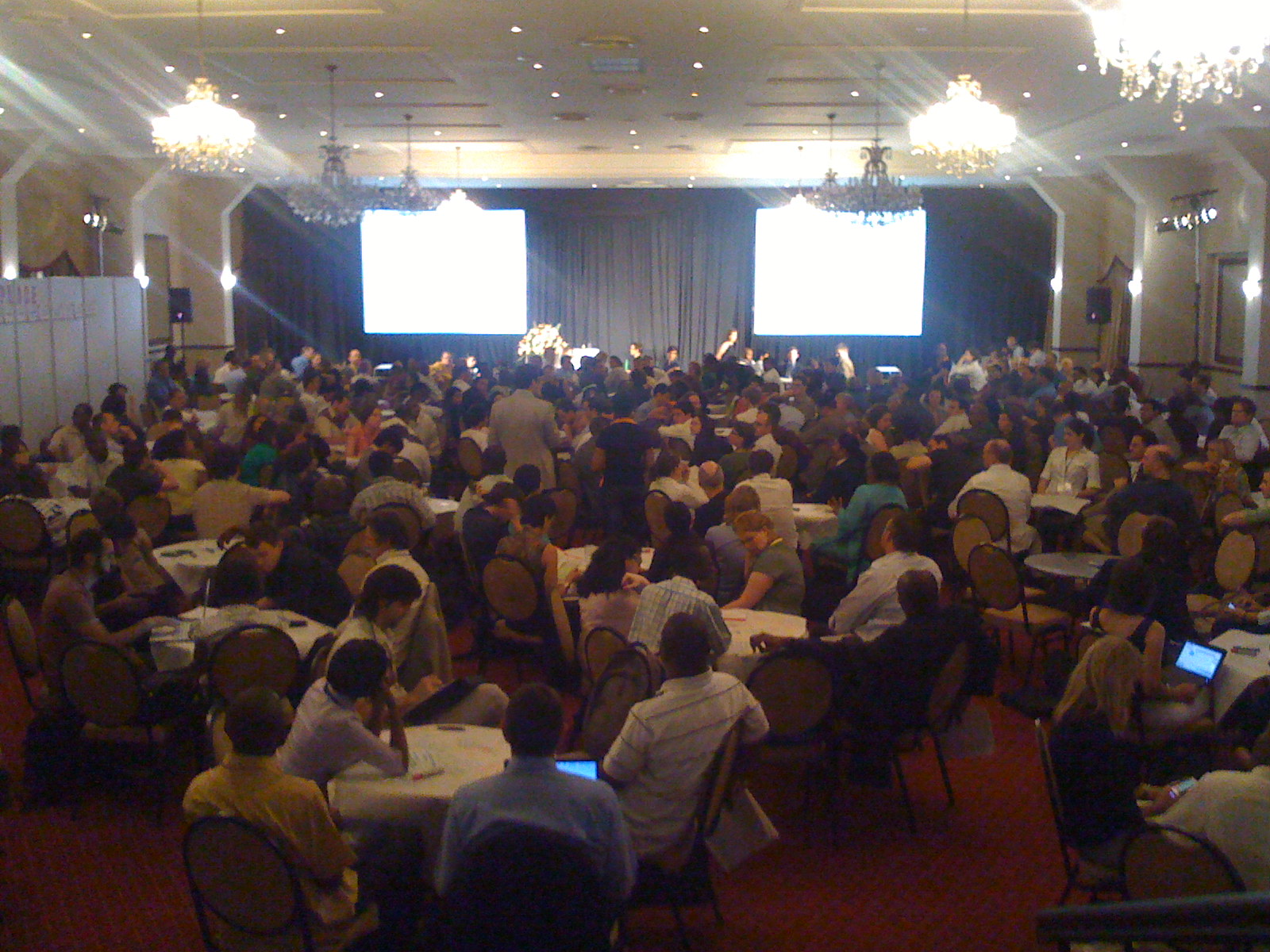
It’s been an eventful three days here in Jo’burg. During Day 2 of the Mobile Active 2008 conference, participants were invited to propose topics for self-organized sessions. I think this was a fabulous idea; some 20+ self-organized sessions took place.

I therefore proposed and moderated one of these sessions, which was entitled “Mobile Communication and Crisis Mapping in Conflict.”

The purpose of this session was to bring together those of us interested in making the most effective use of ICTs in conflict zones and repressive environments. Most effective use of ICTs to what end? For conflict early warning/response, civilian protection, nonviolent action and pro-democracy resistance movements, digital activism and disaster response.

Our friends and colleagues from Ushahidi, Global Voices, Digital Democracy, InSTEDD, UNDP, UNICEF and many more actively participated in the discussion, which lasted over an hour. The main issues addressed included:

  • Connectivity
  • Physical security
  • Data security

On connectivity, the use of satellite phones and VHF radios was broached. The former are cheaper in Burma than regular mobile phones. The importance of making phone credit available during Kenya’s post-election violence was emphasized. One participant suggested that Telecoms make SMS’s free during times of crises, or at least provide subscribers with 10 free SMS’s.

We discussed the problem of congested phone networks during crises and one participant made the observation that Telecoms have little to no incentives for creating redundancy. How do we tackle this? Perhaps, as some suggested, by taking a major initiative such as creating a consortium and launching our own satellites. Others suggested working within existing constraints and identifying creative solutions in the meantime; for example, adding information on early response to “please call me” messages.

Another problem vis-à-vis connectivity is when mobile phone towers go down, or are deliberately shut down by repressive governments. I shared information on a project at MIT that seeks to render mobile phones peer-to-peer technologies, much like file sharing online. This does away with the need for mobile phone towers. As long as trusted individuals are in sufficient proximity, your message (text or voice) can be transmitted through your trusted network of contacts.

I had learned about this project from a colleague earlier that day, and I still think that this initiative is potentially the most revolutionary one I heard about throughout the Mobile Active conference. I’ll be following up with the PhD student working on this project in Boston next week.

On physical security, one participant noted the problem of civilians seeking points of high elevation in order to get phone reception; this regularly places these civilians at risk of nearby snipers. One donor in the room highlighted the constraints they face in funding projects that place individuals in danger. Another participant, who has worked in Iraq and Afghanistan pointed out that being caught with a mobile phone can result in torture and death.

The location of mobile phones can easily be tracked even if the phones are switched off, so I emphasized the importance of removing batteries in order not to be tracked. I also recounted a tactic used by activists in Pakistan back in November 2007, who would send text messages our while driving all around the city, and also using SMS2Blog software to update their blogs in the same way. This surefire way prevented the government from locating the activists. Participants also recommended security guides developed for journalists operating in conflict zones. Tactical Tech’s guides were also highlighted.

On data security, participants highlighted the problem of address books in mobile phones not being encrypted. This poses serious problems when mobile phones are confiscated, since they can then be used to track down collaborators. From a technical point of view, encrypting address books would be perfectly straightforward. One participant who has good contacts with the Android team said he would follow up and recommend an encrypted functionality for address books.

There are also tactical measures that one can take by using false names, as one participant did in Palestine before Israeli soldiers confiscated his phone. SMS encryption was another point raised during the self-organized session. While open source software like CryptoSMS exists, they tend to be difficult to use.

Patrick Philippe Meier

Two Way SMS Gateway on a USB Stick with Drupal

Just got word of this from a good friend of mine, Drew Bennett, a Fletcher School alumnus (F’08). Development Seed has been developing some very neat communications solutions. It’s tempting to write about all their creative projects but I’ll try my best to limit myself to one in particular which draws on new open source tools to make decentralized data collection more effective. From the developers themselves:

The release of the SMS Framework 1.0, along with the road map for a 1.1 version, is making Drupal a more attractive platform for organizations that need powerful, decentralized data collection tools. This recent work shows that using Drupal can give you a serious foundation to integrate sms applications and tools with a website. I want to expand on Will’s recent post about building a two way SMS Gateway on a USB drive and show how Drupal can act as a data hub for collecting data and messaging via sms.

We are interested in this because tools that can integrate with sms like this will be especially helpful for international development agencies with on the ground operations. For example, this functionality could allow an election monitoring organization to use sms to track reports from observers at polling stations or help a public heath organization to monitor when patients take medicine via sms messages sent from personal or public cell phones. It could even assist a disaster response organization to track the status of its team on the ground team through their handsets.

This tool could be particularly interesting for field based organizations operating in conflict zones as well. See also the group’s introductory overview of all their other projects here (PDF), which includes some very interesting dynamic mapping platforms.

Patrick Philippe Meier

Flood Warning, Mobile Phones and Dynamic Mapping in India

I’m in Mumbai for the next 10 days to work on a flood early warning and response project. Here’s a quick overview of the project:

The Monsoon Project
In Mumbai and Ahmedabad, we will see what kind of qualitative data people have reported. The next step is to to expand the data collection exercise to discreet objective data points that may expedite rescue and response in real-time. Can farmers sitting atop roofs in the flooded villages of Orissa use their cell phones to transmit simple, discreet, data points that would help plot a real-time map of events as they unfold? Can such a platform be created? How far are we in terms of technology and collaboration? At HHI, the Crisis Mapping Project is well underway, with small projects at multiple locations in different stages of development.

The Monsoon project is one such: To pilot such an interactive platform we need a predictable, controlled model within which to test such an instrument. In recent years, the monsoons in Mumbai have invariably brought the city to a stand-still. What we want to do now is to see if we can develop simple indicators that the common man can identify (“early warning signs”) to alert their communities to an impending “bad-floods day” in Mumbai. This monsoon Gregg Greenough and Patrick Meier from HHI will be in Mumbai to meet with the faculty at the Geography Dept of Mumbai University to explore ways to collaborate on developing these indicators. Site visits in Mumbai before and after the workshop.

Action points: Request MU/ AIDMI / CEE  to identify local partners in India that should be invited to the workshop. Once the indicators are identified, the goal is to test the technology on a local platform, amongst pre-selected volunteers across the city, during the monsoons of 2009.

My role, as part of the HHI team, is simply to provide a conceptual and technical overview of other crisis early warning projects that make use of mobile technologies. For example, I got the green light from Ory Okolloh to consider a potential partnership with the team in Mumbai should making use of the Ushahidi platform make sense for the Monsoon Project. (Incidentally, congratulations to the Ushahidi team on launching their most recent version of the platform!) In addition to Ushahidi and a number of other related initiatives, I will share the latest maps of Bihar on Google Earth to stimulate a dialogue on whether this type of dynamic mapping is operationally useful (the map I’ve linked to here is not particularly impressive). In conclusion, I will share relevant best practices and lessons “learned” in the field of early warning and response.

It may not be a coincidence that the National Geographic channel was just featuring a documentary on the great Mumbai floods of July 2005 yesterday. Watching these pictures and those of Bihar over the past two weeks, I’m starting to get some sense of the challenge ahead, not least because the topic of disaster management is an area I have more academic than practical experience in; so I’ll be doing a lot of listening and learning. Before leaving for Mumbai, I had the opportunity to touch base with a  friend at the Fletcher School who just returned from working on flood preparedness and response in Bihar.

In any case, I wanted to share some of my own observations. The government’s response to the devastation in the northeast of the country has been particularly slow, with just one military helicopter spotted once or twice in two weeks, according to a BBC report I saw yesterday.

If we are to make good on the UNISDR’s call for a shift towards people-centered early warning, then flood early warning/response systems ought to empower local communities to get out of harm’s way and minimize loss of livelihood. This shift in discourse and operational mandate is an important one in my opinion. Centralized, state-centered, top-down, external responses to crises are apparently increasingly ineffective.

In the case of the devastating floods of 2005, part of the problem was the late warning. The rains had already begun when India’s meteorological department realized that unlike monsoon storms, this storm had clouds as tall as 15 kilometers as opposed to the usual 8 kilometers.  Even if the warning had been disseminated hours or even days earlier, would the most vulnerable populations in Mumbai have had the capacity to get out of harm’s way? I don’t know what the Indian government’s operational plans look like for this type of disaster, but I hope to learn soon.

Another question on my mind is if/how mobile technology might empower vulnerable communities in Mumbai during the Monsoon season? As it happens,  the front page of today’s (Sunday print edition) of The Times of India figured an article on mobile phones: “A Mobile in Every Hand by 2020.” I include some sections below:

Today, one in four Indians has a mobile phone. […] From the villager sitting atop his half-drowned hut calling for help in flood-hit Bihar, to the kabadiwallah who eagerly hands you his number, it’s mobile networking like never before.

“[…] the mobile phone’s ‘greatest impact [will] be on those people with professions that are time, location and information sensitive. […] fishermen wanting a weather update or the location of the best catch; hospitals contacting patients without a permanent address; SMSes on the Sensex.”

“It is true that network coverage and mobile penetration are still limited to certain areas. But, interestingly, as a study by the Center for Knowledge Societies (CKS) showed in Maharashtra, Up and Karnataka, many new mobile users belong to poorer areas with scarce infrastructure, high levels of illiteracy and low PC and internet penetration.”

I remember an interesting conversation I had last year with Suha Ulgen, the coordinator of the UN Geographic Information Working Group Secretariat (UNGIWIG), regarding an earthquake preparedness and response project he had worked on in Turkey. The team involved in the project used mobile technologies and GPS units to map the most vulnerable areas (e.g., buildings, bridges, etc) in various neighborhoods across the city. Together with local volunteers, they documented the neighborhoods in great detail during the day, and would upload all their data directly on to a dynamic mapping platform in the evenings.

This approach appeals to me for several reasons. First, the approach comes close to local crowdsourcing.  Tapping into local knowledge is critical. As mentioned in this article (PDF) I wrote for Monday Developments (April/2007), “From Disaster to Conflict Early Warning: A People-Centered Approach,” the non-local community (a.k.a. international community) has a lot to learn when it comes indigenous early warning and response practices:

In Swaziland, for example, we are taught floods can be predicted from the height of bird nests near rivers, while moth numbers predict drought. Because these indicators are informal, they rarely figure in peer-reviewed journals and remain invisible to the international humanitarian community.

I’m looking forward to learning more about the corresponding local know how in Mumbai. Second, vulnerability mapping is an important component of preparedness training, contingency planning and disaster response. Third, geo-referencing pockets of vulnerability using a dynamic platform provides a host of new possibilities for disaster response including automated and subscription-based SMS alerts, rapid disaster impact assessments and more networked forms of communication in crisis zones. In addition to mapping areas of vulnerability, one could also map potential shelter areas, sources of clean water, etc.

This may or may not make sense within the context of flooding and/or Mumbai, which is why I’ll definitely be doing a lot of listening and learning in the coming days. Any feedback and guidance in the meantime would certainly be of value.

Patrick Philippe Meier

Citizen Communications In Crisis

I recently spoke with Professor Leysia Palen at the University of Colorado, Boulder, about her Crisis Informatics research project and followed up by reading her co-authored paper entitled: “Citizen Communications in Crisis: Anticipating a Future of ICT-Supported Public Participation” published in 2007. The focus of Leysia’s publication overlaps with my previous blog entry on the intersection of citizen journalism (Global Voices) and conflict early warning/response.

Leysia provides a valuable and insightful sociological perspective that is often lacking in our own field.  Indeed, the sociology of disaster includes a public with its own impetus for participation that conventional conflict early warning/response systems rarely consider. Following are some excerpts from her paper that I found pertinent and interesting:

  • ICT in disaster contexts will give further rise to improvised activities and temporary organizations with which formal response organizations need to align.
  • The role held by members of the public in disaster—a role that has always been characterized as one of high involvement by disaster sociologists throughout the nearly century-long history of disaster research—is becoming more visible, active, and in possession of greater reach than ever seen before.
  • Our stance is that the old, linear model for information dissemination of authorities-to-public relations-to-media is outmoded, and will be replaced—at least in practice—by one that is much more complex. Peer communications technologies are a critical piece of these emergent information pathways.
  • Disaster social scientists have long documented the nature of post-disaster public participation as active and largely altruistic. “First responders” are not, in practice, the trained professionals who are deployed to a scene in spite of the common use of that term for them; they are instead people from the local and surrounding communities.
  • People are natural information seekers, and will seek information from multiple sources, relying primarily on their own social networks—friends and family—to validate and interpret information coming from formal sources, and then to calculate their own response measures.
  • The possibilities for public participation are expanding with increased access to the Internet and the wide diffusion of mobile technology—mobile phones, text  and multimedia messaging, and global positioning devices. This technology in the hands of the people further pushes on boundaries between informal and formal rescue and response efforts, and has enabled new media forms that are broadly known as citizen journalism.
  • For example, wikis enable broad participation in the creation and dissemination of information. Some visual wikis use mapping technology for linking textual or photographic information to representations of physical locations, thereby documenting, for example, the extent of damage to a specific neighborhood. Recent disasters show how people, whom we already know will seek information from multiple sources during uncertain conditions, have fueled the proliferation and utility of these sites. In this way, the public is able to take not only a more active part in seeking information, but also in providing information to each other, as well as to formal response efforts.
  • Emerging ICT-supported communications in crisis will result in changing conditions that need to be addressed by the formal response. ICT-supported citizen communications can spawn, often opportunistically, information useful to the formal response effort. Citizen communications can also create new opportunities for the creation of new, temporary organizations that help with the informal response effort. The idea of emergent or ephemeral organizations that arise following disaster is not at all new; in fact, it is one of the hallmarks of disaster sociology, and supports the need for communities to be able to improvise response under uncertain and dynamic conditions. ICT-supported communications, however, add another powerful means by which this kind of organization can occur. No longer do people need the benefit of physical proximity to coordinate and serendipitously discover each other.
  • Implications for Relief Efforts: As the reach of response extends to a broader audience with ICT, how will the formal response effort align with, support and leverage wider community response? Relief work—the provision of food, shelter and basic necessities—already largely arises out of volunteerism through either grassroots efforts or managed through official channels.

Patrick Philippe Meier

Twitter Speed to the Rescue

Twitter is a free social networking and micro-blogging service that allows users to send “updates” (or “tweets”; text-based posts, up to 140 characters long) to the Twitter website, via short message service (e.g. on a mobile phone), instant messaging, or a third-party application such as Twitterrific or Facebook.

Twitter was used by the Los Angeles and San Diego Fire Departments as well the Red Cross: “Cell towers and communication lines were being burnt, [so] SMS and websites were the best ways to get info, and Twitter was perfect in that sense because it published directly to SMS” (1). Particularly telling is the following comment by the LA Fire Department: “We can no longer afford to work at the speed of government. We have responsibilities to the public to move the information as quickly as possible… so that they can make key decisions” (2)

So just how fast is Twitter? Earlier that year, “Twitters beat the US Geological Survey by several minutes” when they were first to report the Mexico City earthquake on April 17th (3). The Twitter alerts, or microblogs, are all documented and time stamped on the Twitter website and also available on TwitterVision.

Is it just a matter of time before Twitter or a similar GeoChat interface gets used for conflict early warning and response?

Patrick Philippe Meier