
I just came across GeoTime, a very neat GIS platform for network analyis in time and space. GeoTime is developed by a company called Oculus and does a great job in presenting an appealing 3D visual interface for the temporal analysis of geo-referenced data. The platform integrates timeline comparisons, chart statistics and network analysis tools to support decision making. GeoTime also includes plug-ins for Excel and ArcGIS.

GeoTime includes a number of important functionalities including:
- Movement trails: to display the history and behavior as paths in space-time;
- Animation: to play back sequences and see how events unfold. Both the direction and speed of the animation can be adjusted.
- Pattern recognition: to automatically identify key behaviors.
- Annotate and Sketch: to add notes directly in the scene and save views as reports.
- Fast Maps: to automatically adjust level of detail.
- Interactive Chain and Network Analysis: to identify related events.

Below is an excerpt of a video demo of GeoTime which is well worth watching to get a sense of how these functionalities come into play:
The demo above uses hurricane data to highlight GeoTime’s integrated functionalities. But the application can be used to analyze a wide range of data such as crime incidents to identify patterns in space and time. A demo for that is avaiable here.
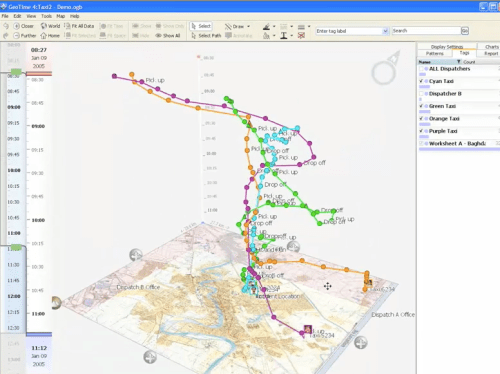
My interest in GeoTime stems from it’s potential application to analyzing conflict datasets. Problem is, the platform will set you back a cool $3,925. They do have a university rate of $1,675 but what’s missing is a rate for humanitarian NGOs or even a limited trial version.
 iRevolutions