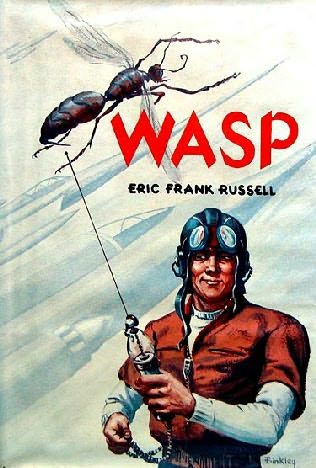
Google’s Vint Cerf recommended Eric Russell’s science fiction novel, Wasp, to a colleague of mine in the field of civil resistance. I’m very glad he did, I just read it and the novel is brilliant. It was published in 1957 and weaves civil resistance theory with creative tactics that remain fully applicable half-a-century later. Plus, it’s an action-packed page-turner. I highly recommend it.
What I want to do here is share some excerpts that elegantly highlight the theory behind civil resistance (my next posts expose creative tactics using stickers and paper-based wars).
The setting is an intergalactic war between Earth and the Sirian Empire. The latter has an advantage in personnel and equipment. Earth needs an edge and this is where James Mowry comes in. He is covertly dropped on the Sirian home planet to destabilize the entire empire. The aim is to divert the Empire’s resources and focus away from the war against Earth by creating a fictitious resistance movement at home. Wasp is the story of the strategies, creative tactics and real-world technologies that Mowry employs to accomplish his mission.
But first he has to be convinced to take on a mission that would have him single-handedly destabilize the entire empire from within. Naturally, he seriously questions the sanity of Agent Wolf, the unpleasant operator assigned to recruit him. Growing impatient with Mowry’s stubbornness, Wolf hands him some press reports.
Mowry glanced at them and perused them slowly.
The first told of a prankster in Roumania. This fellow had done nothing more than stand in the road and gaze fascinatedly at the sky, occasionally crying, ‘Blue flames!’ Curious people had joined him and gaped likewise. The group became a crowd; the crowd became a mob.
Soon the audience blocked the street and overflowed into the side streets. Police tried to break it up, making matters worse. Some fool summoned the fire squads. Hysterics on the fringes swore they could see, or had seen, something weird above the clouds. Reporters and cameramen rushed to scene; rumours raced around. The government sent up the air force for a closer look and panic spread over an area of two hundred square, from which the original cause had judiciously disappeared.
‘Amusing if nothing else,’ Mowry remarked. ‘Read on,’ commanded Wolf.
The second report concerned a daring escape from jail. Two notorious killers had stolen a car; they made six hundred miles before recapture, fourteen hours later. The third report detailed an automobile accident: three killed, one seriously injured, the car a complete wreck. The sole survivor died nine hours later.
Mowry handed back the papers. ‘What’s all this to me?’
Wolf: We’ll take those reports in order as read. They prove something of which we’ve been long aware but which you may not have realized. Now, let’s take the first one. That Roumanian did nothing, positively nothing, except stare at the sky and mumble. Yet he forced a government to start jumping around like fleas on a hot griddle. It shows that in given conditions, actions and reaction can be ridiculously out of proportion. By doing insignificant things in suitable circumstances, one can obtain results monstrously in excel of the effort.
Now consider the two convicts. They didn’t do much, either. They climbed a wall, seized a car, drove like made until they gas ran out, then got caught. But for the better part of fourteen hours, they monopolized the attention of six planes, ten helicopters, one hundred and twenty patrol-cars. They tied up eighteen telephone exchanges, uncountable phone lines and radio link-ups, not to mention police, deputies, posses of volunteers, hunters, trackers, forest rangers and National Guardsmen. The total was twenty-thousand, scattered over three states.
Finally, lets consider this auto smash-up. The survivor was able to tell us the cause before he died. He said the driver lost control at high speed while swiping at a wasp which had flown in through a window and was buzzing around his face. The weight of a wasp is under half an ounce. Compared with a human being, the waps’s size is minute, it’s strength negligible. Its sole armament is a tiny syringe holding a drop of irritant, formic acid. In this instance, the wasp didn’t even use it. Nevertheless, that wasp killed four big men and converted a larger, powerful car into a heap of scarp.
‘I see the point,” Mowry said, “but where do I come in?’
“Right here,” said Wolf. “We want you to become a wasp.”
After several months of training, Mowry is dropped on Pertane, the home planet of the Sirian Empire. He spends the first evening exploring Jaimec, the capital.
He wandered around, memorizing all geographical features that might prove useful to recall later on. But primarily he was seeking to estimate the climate of public opinion with particular reference to minority opinions.
In every war, he knew, no matter how great a government’s power, it’s rule is never absolute. In every war, no matter how righteous the cause, the effort is never total. No campaign has ever been fought with the leadership united in favour of it and with the rank and file one hundred per cent behind them.
There is always the minority that opposes a war for such reasons as reluctance to make necessary sacrifices, fear of personal loss or suffering, or philosophical and ethical objection to warfare as a method of settling disputes. Then there is a lack of confidence in the ability of the leadership; resentment at being called upon to play a subordinate role; pessimistic belief that victory is far from certain and defeat very possible; egoistic satisfaction of refusing to run with the herd; psychological opposition to being yelled at on any and every pretext, and a thousand and one other reasons.
No political or military dictatorship ever has been one hundred per cent successful in identifying and suppressing the malcontents, who bid their time. Mowry could be sure that, by the law of averages, Jaimec must have its share of these.
For a description of the creative tactics used by Mowry, stay tuned for my following post.
Patrick Philippe Meier





 iRevolutions