Tag Archives: repressive regimes

How To Communicate Securely in Repressive Environments

Update: The information below is now out of date, please do not blindly rely on the strategies and technologies listed!

Important: Please check the excellent comments provided by iRevolution readers below for additional tactics/technologies and corrections. The purpose of this blog post was to inform and elicit feedback so thank you very much for improving on what I’ve written!

FYI – I tried keep an up-to-date guide based on the comments below but was too busy to continue. Please see this link (Doc).

I’m preparing to give a presentation at The Fletcher Summer Institute for the Advanced Study of Nonviolent Conflict (FSI 2009). The focus of my presentation will be on digital security, i.e., how to communicate safely and securely in repressive, non-permissive environments. I’d be very grateful for feedback on the information below.

Introduction

Core to effective strategic nonviolent action is the need to remain proactive and on the offensive; the rationale being that both the resistance movement and repressive regime have an equal amount of time allocated when the show-down begins. If the movement becomes idle at any point, this may give the regime the opportunity to regain the upper hand, or vice versa. The same principle is found in Clausewitz’s writings on war.

Nonviolent resistance movements are typically driven by students, i.e., young people, who are increasingly born digital natives. With expanding access to mobile phones, social networking software and online platforms for user-generated content such as blogs, the immediate financial cost of speaking out against repressive regimes is virtually nil. So resistance movements are likely to make even more use of new communication technology and digital media in the future. In fact, they already are.

At the same time, however, the likelihood and consequences of getting caught are high, especially for those political activists without any background or training in digital security. Indeed, recent research by Digital Democracy research suggests that organizational hierarchies are being broken down as youth adopt new technologies. While this empowers them they are also put at risk since they don’t tend to be as consequence-conscious as their adult counterparts.

Empire Strikes Back

It is no myth that repressive regimes are becoming increasingly more savvy in their ability to effectively employ sophisticated filtering, censoring, monitoring technologies (often courtesy of American companies like Cisco) to crack down on resistance movements. In other words, political activists need to realize that their regimes are becoming smarter and more effective, not dumber and hardly clueless.

That said, there are notable—at times surprising—loopholes. During the recent election violence in Iran, for example, facebook.com was blocked but not facebook.com/home.php. In any case, repressive regimes will continue to block more sites impose information blockades because they tend to view new media and digital technologies as a threat.

Perhaps technologies of liberation are a force more powerful?

In order to remain on the offensive against repressive regimes, nonviolent civil resistance movements need to ensure they are up to speed on digital security, if only for defense purposes. Indeed, I am particularly struck by the number of political activists in repressive regimes who aren’t aware of the serious risks they take when they use their mobile phones or the Internet to communicate with other activists.

Adaptive Learning

One way to stay ahead is to make the learning curve less steep for political activists and to continually update them with the latest tested tactics and technologies. To be sure, one way to keep the upper hand in this cyber game of cat-and-mouse is to continue adapting and learning as quickly as possible. We need to ensure that feedback mechanisms are in place.

There are clearly trade-offs between security and convenience or usability, particularly in the context of technologies. As DigiActive notes in the graphic below, the most secure tactics and technologies may not be the most convenient or easy to deploy. Most political activists are not tech-savvy.

This means that digital activists need to design tactics and technologies that are easy to learn and deploy.

The tactics and technologies listed in the next sections fall into all four different quadrants to one extent or another. It is important that political activists at minimum master the easy and convenient digital security tactics and technologies identified in this blog post.

ACmatrix

Recall that both sides are allocated an equal amount of time to plan and execute their operations. Accelerating the learning process is one way for activist networks to remain pro-active and stay ahead of the curve. This is in part is the role that DigiActive seeks to play. Unlike the hierarchical, centralized structures of repressive regimes, networks have more flexibility and feedback loops, which make them more adaptable.

The normative motivation behind my research on digital resistance is based on the recognition by “many scholars and practitioners […] that the techniques associated with strategic nonviolent social movements are greatly enhanced by access to modern information communication technologies, such as mobile telephony, short message service (SMS), email and the World Wide Web, among others” (Walker 2007).

The potential to leverage those techniques is what makes Digital Security so important to integrate in the strategic and tactical repertoire of civil resistance movements.

Digital Security

I define digital security (DS) in the context of digital resistance as the art and science of staying safe when communicating in non-permissive environments. The reason I call it both an art and a science is to emphasize that both tactics and technology play an important role in staying safe when facing repression.

So the DS framework I want to propose is two-pronged: tactics vs. technology, and safety vs. security. I call it the 4-square approach for obvious reasons:

4square

  • DS tactics: these can be “technology free” tactics as well as tactics that apply communication technology.
  • DS technologies: these include both high-tech and low-tech technologies that are designed to improve safe and secure communication in repressive environments.
  • Personal safety: in this context refers to physical, personal safety when communicating in non-permissive environments.
  • Data Security: refers to the security of the data when communicated from one devise to another.

As the graphic above suggests, personal safety and data security are a function of both tactics and technologies. For example, data security is best ensured when combining tactics and technologies.

What follows is a list of tactics and technologies for communicating safely and securely in repressive environments. The list is divided into technology categories and the bullet points are listed in order of relative convenience and easy to more complicated but more secure.

Note that the information below is in no way meant to be exhaustive, so pleasedo send suggestions! (See also the conclusion for a list of reference and suggestions on further reading).

Digital Security Tactics

As mentioned above, DS tactics come as both technology-free tactics and tactics that relate to communication technology. For example, making sure to pay for a sim card in cash and out of sight of security cameras is a technology-free tactic  that increases the chances of staying safe. Removing the batteries from your mobile phone to prevent it from being geo-located is a tactic that relates to the technology and also increases your safety.

DS tactics can also improve data security when communicating information. “Sneakernet” is a technology-free tactic to share information. The term is used to describe tactics whereby the transfer of electronic information such computer files is done by physically carryingremovable media such as hard drives and disk drives. In contrast, using encryption software for mobile phones is a tactic that uses technology. The communication may be intercepted by eavesdroppers but they may be unable to decipher the message itself.

These tactics are listed below along with a number of other important ones. Please keep in mind that tactics are case- and context-specific. They need to be adapted to the local situation.

  • Mobile Phones
    • Purchase your mobile phone far from where you live. Buy lower-end, simple phones that do not allow third-party applications to be installed. Higher-end ones with more functionalities carry more risk. Use cash to purchase your phone and SIM card. Avoid town centers and find small or second-hand shops as these are unlikely to have security cameras. Do not give your real details if asked; many shops do not ask for proof of ID.
    • Use multiple SIM cards and multiple phones and only use pay-as-you go options; they are more expensive but required for anonymity.
    • Remove the batteries from your phone if you do not want to be geo-located and keep the SIM card out of the phone when not in use and store in separate places.Use your phone while in a moving vehicle to reduces probability of geo-location.
    • Never say anything that may incriminate you in any way.
    • Use code.
    • Use Beeping instead of SMS whenever possible. Standard text messages are visible to the network operator, including location, phone and SIM card identifiers. According to this recent paper, the Chinese government has established 2,800 SMS surveillance centers around the country to monitor and censor text messages. The Chinese firm Venus Info Tech Ltd sells real-time content monitoring and filtering for SMS.
    • Use fake names for your address book and memorize the more important numbers. Frequently delete your text messages and call history and replace them with random text messages and calls. The data on your phone is only deleted if it is written over with new data. This means that deleted SMS and contact numbers can sometimes be retrieved (with a free tool like unDeleteSMS. Check your phone’s settings to see whether it can be set to not store sent texts messages and calls.
    • Eavesdropping in mobile phone conversations is technically complicated although entirely possible using commercially available technology. Do not take mobile phones with you to meetings as they can be turned into potential listening/tracking devices. Network operators can remotely activate a phone as a recording device regardless of whether someone is using the phone or whether the phen is even switched on. This functionality is available on US networks.
    • Network operators can also access messages or contact information stored on the SIM card. If surveillance takes place with the co-operation of the operator, little can be done to prevent the spying.
    • Mobile viruses tend to spread easily via Bluetooth so the latter should be turned off when not in use.
    • Using open Bluetooth on phones in group situations, e.g., to share pictures, etc., can be dangerous. At the same time, it is difficult to incriminate any one person and a good way to share information when the cell phone network and Internet are down.
    • Discard phones that have been tracked and burn them; it is not sufficient to simply destroy the SIM card and re-use the phone.
  • Digital Cameras
    • Keep the number of sensitive pictures on your camera to a minimum.
    • Add plenty of random non-threatening pictures (not of individuals) and have these safe pictures locked so when you do a “delete all” these pictures stay on the card.
    • Keep the battery out of the camera when not in use so it can’t be turned on by others.
    • Practice taking pictures without having to look at the view screen.
  • Computers/Laptops
    • Use passphrases for all your sensitive data.
    • Keep your most sensitive files on flash disks and find safe places to hide them.
    • Have a contingency plan to physically destroy or get rid of your computer at short notice.
  • Flash disks
    • Purchase flash disks that don’t look like flash disks.
    • Keep flash disks hidden.
  • Email communication
    • Use code.
    • Use passphrases instead of passwords and change them regularly. Use letters, numbers and other characters to make them “c0mpLeX!”. Do not use personal information and changer your passphrases each month. Do not use the same password for multiple sites.
    • Never use real names for email addresses and use multiple addresses.
    • Discard older email accounts on a regular basis and create new ones.
    • Know the security, safety and privacy policies of providers and monitor any chances (see terms of service tracker).
  • Browsers and websites
    • Turn off java and other potentially malicious add-ons.
    • Learn IP addresses of visited websites so that history shows only numbers and not names.
    • When browsing on a public computer, delete your private data (search history, passwords, etc.) before you leave.
    • When signing up for an account where you will be publishing sensitive media, do not use your personal email address and don’t give personal information.
    • Don’t download any software from pop-ups,  they may be malicious and attack your computer or record your actions online.
    • Do not be logged in to any sensitive site while having another site open.
  • VoIP
    • Just because your talking online doesn’t mean you are not under surveillance.
    • As with a cell or landline, use code do not give salient details about your activities, and do not make incriminating statements.
    • Remember that your online activities can be surveilled using offline techniques.  It doesn’t matter if you are using encrypted VOIP at a cyber cafe if the person next to you is an under-cover police officer.
    • When possible, do not make sensitive VOIP calls in a cyber cafe.  It is simply too easy for someone to overhear you. If you must, use code that doesn’t stand out.
  • Blogs and social networking sites
    • Know the laws in your country pertaining to liability, libel, etc.
    • When signing up for a blog account where you will be publishing sensitive content, do not use you personal email address or information.
    • In your blog posts and profile page, do not post pictures of yourself or your friends, do not use your real name, and do not give personal details that could help identify you (town, school, employer, etc.).
    • Blog platforms like wordpress allow uses to automatically publish a post on a designated date and time. Use this functionality to auto-publish on a different day when you are away from the computer.
    • On social networks, create one account for activism under a false but real-sounding name (so your account won’t be deleted) but don’t tell your friends about it.  The last thing you want is a friend writing on your wall or tagging you in a photo and giving away your identity.
    • Even if you delete your account on a social networking site, your data will remain, so be very careful about taking part in political actions (i.e., joining sensitive groups) online.
    • Never join a sensitive group with your real account.  Use your fake account to join activism groups. (The fake account should not be linked to your fake email).
    • Don’t use paid services.  Your credit card can be linked back to you.
  • File sharing
    • Use a shared Gmail account with a common passphrase and simply save emails instead of sending. Change passphrase monthly.
    • For sharing offline, do not label storage devices (CDs, flash drives) with the true content.  If you burn a CD with an illegal video or piece of software on it, write an album label on it.
    • Don’t leave storage devices in places where they would be easily found if your office or home were searched (i.e., on a table, in a desk drawer).
    • Keep copies of your data on two flash drives and keep them hidden in separate locations.
    • When thinking of safe locations, consider who else has access. Heavily-traveled locations are less safe.
    • Don’t travel with sensitive data on you unless absolutely necessary.  If you need to, make sure to hide it on your person or “camouflage” it (label a data CD as a pop music CD). See Sneakernet.
  • Internet Cafes
    • Assume you are being watched.
    • Assume computers at cyber cafes are tracking key strokes and capturing screenshots.
    • Avoid cyber cafes without an easy exit and have a contingency plan if you need to leave rapidly.

Digital Security Technologies

When combine with the tactics described above, the following technologies can help you stay safe and keep your data relatively more secure.

  • Mobile phones
    • Use CryptoSMS, SMS 007 or Kryptext to text securely (this requires java-based phones).
    • Use Android Guardian as soon as it becomes available.
    • Access mobile versions of websites as they are usually not blocked. In addition, connecting to mobile websites provides for faster connections.
  • Digital cameras
    • Use scrubbing software such as: JPEG stripper to remove the metadata (Exif data) from your pictures before you upload/email.
    • Have a safe Secure Digital Card (SD) that you can swap in. Preferably, use a mini SD card with a mini SD-SD converter. Then place the mini SD into a compatible phone for safekeeping.
  • Computers/Laptops
    • Use a different file type to hide your sensitive files. For example, the .mov file extension will make a large file look like a movie.
    • Mac users can use Little Snitch to track all the data that goes into and out of your computer.
    • From a technical perspective, there’s no such thing as the delete function. Your deleted data is eventually written over with new data. There are two common ways to wipe sensitive data from your hard drive or storage device. You can wipe a single file or you can wipe all of the ‘unallocated’ space on the drive. Eraser is a free and open-source secure deletion tool that is extremely easy to use.
  • Email communication
    • Use https when using Gmail.
    • Use encrypted email platforms such as Hushmail and RiseUp.
  • Browsers and websites
    • Use Firefox and get certain plugins to follow website tracking such as ghostery and adblock, adart to remove ads/trackers.
    • User Tor software or Psiphon to browse privately and securely.
    • I shan’t list access points for secure browsers, Proxy servers and VPNs here. Please email me for a list.
    • Always use https in “Settings/General/Browser Connection.”
  • VoIP
    • Use Skype but not TOM Skype (Chinese version). Note that Skype is not necessarily 100% secure since no one has access to the source code to verify.
    • Off The Record (OTR) is a good encryption plugin. For example, use Pidgin with OTR (you need to add the plug-in yourself).
    • Gizmo offer encryption for voice conversations, and then only if you are calling another VoIP user, as opposed to a mobile or landline telephone. However, because neither application is open-source, independent experts have been unable to test them fully and ensure that they are secure.
    • Adium is a free IM application for Macs with built-in OTR encryption that integrates most other IM applications.
  • Blogs and social networking platforms
    • There are no safe social networks.  The best way to be safe on a social network is fake account and a proxy server.
    • The anonymous blogging platform Invisiblog no longer exists, so the best bet now is WordPress + Proxy (preferably Tor) + anonymity of content.
    • Log out of facebook.com when not using the site.
  • File sharing
    • Use Drop.io to create a private, secure media sharing site.
    • Use BasecampHQ with secure/SSL option to create more specific usernames and passwords for each user or remote site.
  • Internet Cafe
    • Tor can be installed on flash disk and used at Internet cafe and also used from LiveCDs if flash drives are not allowed.
  • Other potential tech

Conclusion

The above material was collected in part from these sources:

As mentioned above, please send suggestions and/or corrections as well as updates. And again, please do check the comments below. Thanks! Patrick Philippe Meier

Steganography 2.0: Digital Resistance against Repressive Regimes

A team of Polish steganographers at the Institute of Telecommunications in Warsaw are doing some neat work that should be of interest to digital activists. Steganography is is the art and science of writing hidden messages in such a way that no one, apart from the sender and intended recipient, suspects the existence of the message, a form of security through obscurity.

Wojciech Mazurczyk, along with Krzysztof Szczypiorski and Milosz Smolarczyk are using the Internet’s transmission control protocol (TCP) to create fake web traffic that can mask the transmission of secret messages.

As the NewScientist explains,

“Web, file transfer, email and peer-to-peer networks all use TCP, which ensures that data packets are received securely by making the sender wait until the receiver returns a “got it” message. If no such acknowledgement arrives (on average 1 in 1000 packets gets lost or corrupted), the sender’s computer sends the packet again. This scheme is known as TCP’s retransmission mechanism – and it can be bent to the steganographer’s whim, says Mazurczyk.”

The team’s project is called Retransmission Steganography, or RSTEG, proposes to use software that deliberately asks the receiver of information to prompt a retransmission from the sender even when the data was successfully received in the first place. As Mazurczyk explains, “the sender then retransmits the packet but with some secret data inserted in it,” which means, “the message is hidden among the teeming network traffic.”

The use of RSTEG as a tactic for digital resistance could be quite effective. While eavesdroppers could monitor the fact that a first sent package is different from a second retransmitted one containing the secret message, this would be somewhat useless since all retransmitted packages differ from original ones anyway. In other words, “Retransmissions in IP networks are a ‘natural phenomenon’, and so intentional retransmissions introduced by RSTEG are not easy to detect if they are kept at a reasonable level.”

Mazurczyk and Szczypiorski are also working on a parallel project that draws on steganographic techniques to creating covert channels for Voice over Internet Protocol (VOIP) streams. This approach, called Lost Audio Packets Steganography, or LACK, “provides hybrid storage-timing covert channel by utilizing delayed audio packets.”

For more information on the technical specifications of the RSTEG and LACK techniques, please see the authors’ papers here and here respectively.

The team plans to demonstrate their approach at a workshop on network steganography in China later this year. Yes, China.

Patrick Philippe Meier

Nation-State Routing: Globalizing Censorship

I just found an interesting piece on Internet censorship at arXiv, my favorite go-to place for scientific papers that are pre-publication. Entitled “Nation-State Routing: Censorship, Wiretapping and BGP,” this empirical study is possibly the first to determine the aggregate effect of national policies on the flow of international traffic.

As government control over the treatment of Internet traffic becomes more common, many people will want to understand how international reachability depends on individual countries and to adopt strategies either for enhancing or weakening the dependence on some countries.

Introduction

States typically impose censorship to prevent domestic users from reaching questionable content. Some censorship techniques, however, “may affect all traffic traversing an [Autonomous System].” For example, Internet Service Providers (ISPs) in China, Britain and Pakistan block Internet traffic at the Internet Protocol (IP) level by “filtering based on IP addresses and URLs in the data packets, or performing internal prefix hijacks, which could affect the international traffic they transit.”

The scope and magnitude of this affect is unclear. What we do know is that one may intentionally or by accident apply censorship policies to international traffic, as demonstrated by the global YouTube outage last year as a result of a domestic Pakistani policy directive.

Methodology

The authors therefore developed a framework to study interdomain routing at the nation-state level. They first adapted the “Betweeness Centrality” metric from statistical physics to measure the importance, or centrality, of each country to Internet reachability. Second, they designed, implemented and validated a Country Path Algorithm (CPA) to infer country-paths from a pair of source and destination IP addresses.

Findings

The table below shows Country Centrality (CC) computed directly from Trace Route (TR) and Border Gate Protocol (BGP). The closer the number is to one, the more impact that country’s domestic Internet censorship policies has on international Internet traffic.

arxivtable1

The second table below lists both Country Centrality (CC) and Strong Country Centrality (SCC). The latter measures how central countries are when alternative routes are considered. When SCC equals one, this suggests a country is completely unavoidable.

arxiv-table2

“Collectively, these results show that the ‘West’ continues to exercise disproportionate influence over international routing, despite the penetration of the Internet to almost every region of the world, and the rapid development of China and India.”

This last table below lists CC and SCC measures for authoritarian countries that are known for significant domestic censorship of Internet content. Aside from China, “these countries have very little influence over global reachability.”

arxiv-table3

Next Steps

The authors of the study point to a number of interesting questions for future research. For example, it would be interesting to know how the centrality result above change over time, i.e., which countries are becoming more central over time, and why?

Another important question is what economically driven strategies single countries (or small coalitions of countries) could adopt to increase their own centrality or to reduce that of other countries?

One final and particularly important question would to find out what fraction of domestic paths are actually routed through another country? This is important because the answer to this question would “provide insight into the influence that foreign nations have over a country’s domestic routing and security, and would shed light on […] whether warrantless tapping on links in one country to another might inadvertently capture some purely domestic traffic.”

Patrick Philippe Meier

iRevolution One Year On…

I started iRevolution exactly one year ago and it’s been great fun! I owe the Fletcher A/V Club sincere thanks for encouraging me to blog. Little did I know that blogging was so stimulating or that I’d be blogging from the Sudan.

Here are some stats from iRevolution Year One:

  • Total number of blog posts = 212
  • Total number of comments = 453
  • Busiest day ever = December 15, 2008

And the Top 10 posts:

  1. Crisis Mapping Kenya’s Election Violence
  2. The Past and Future of Crisis Mapping
  3. Mobile Banking for the Bottom Billion
  4. Impact of ICTs on Repressive Regimes
  5. Towards an Emergency News Agency
  6. Intellipedia for Humanitarian Warning/Response
  7. Crisis Mapping Africa’s Cross-border Conflicts
  8. 3D Crisis Mapping for Disaster Simulation
  9. Digital Resistance: Digital Activism and Civil Resistance
  10. Neogeography and Crisis Mapping Analytics

I do have a second blog that focuses specifically on Conflict Early Warning, which I started at the same time. I have authored a total of 48 blog posts.

That makes 260 posts in 12 months. Now I know where all the time went!

The Top 10 posts:

  1. Crimson Hexagon: Early Warning 2.0
  2. CSIS PCR: Review of Early Warning Systems
  3. Conflict Prevention: Theory, Police and Practice
  4. New OECD Report on Early Warning
  5. Crowdsourcing and Data Validation
  6. Sri Lanka: Citizen-based Early Warning/Response
  7. Online Searches as Early Warning Indicators
  8. Conflict Early Warning: Any Successes?
  9. Ushahidi and Conflict Early Response
  10. Detecting Rumors with Web-based Text Mining System

I look forward to a second year of blogging! Thanks to everyone for reading and commenting, I really appreciate it!

Patrick Philippe Meier

Democratic Effects of the Internet: Latest Findings

Jacob Groshek from Iowa State University just published his large-N quantitative study on the “Democratic Effects of the Internet” in the International Communication Gazette. I’m particularly interested in this study given it’s overlap with my own dissertation research and recent panel at ISA 2009. So thanks to Jacob for publishing and to my colleague Lokman Tsui at the Berkman Center for letting me know about the article as soon as it came out.

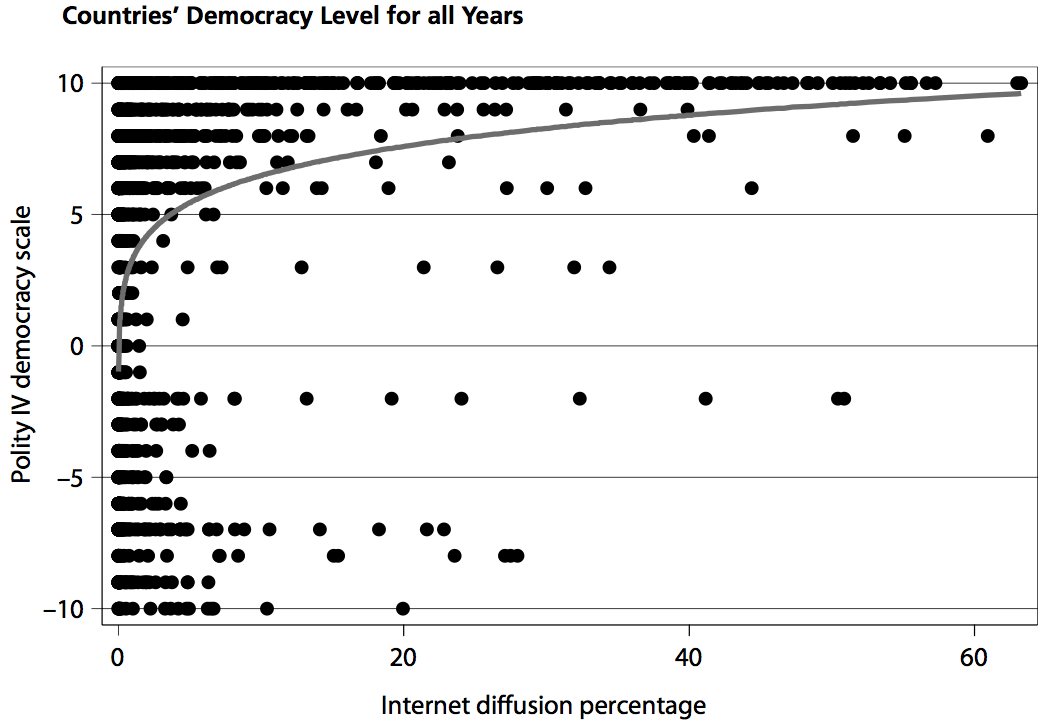
Using macro-level panel data on 152 countries from 1994 to 2003 and multi regression models, Jacob found that “increased Internet diffusion was a meaningful predictor of more democratic regimes.” This democratic effect was greater in countries that were at least partially democratic where the Internet was more prevalent. In addition, the association between Internet diffusion and democracy was statistically significant in “developing countries where the average level of sociopolitical instability was much higher.”

The author thus concludes that policy makers should consider the democratic potential of the Internet but be mindful of unintended consequences in countries under authoritarian rule. In other words, “the democratic potential of the Internet is great, but that actual effects might be limited because Internet diffusion appears conditional upon national-level democracy itself.”

Introduction

While many like Al Gore have professed that information and communication technologies (ICTs) would “spread participatory democracy” and “forge a new Athenian age of democracy,” the lessons of history suggest otherwise. Media system dependence theory maintains that ICTs, “including the Internet, are unlikely to drastically alter asymmetric power and economic relations within and between countries specifically in the short term.”

Others counter that ICTs are “nonetheless vital to democracy and the process of democratization.”For example, both Jefferson and de Tocqueville remarked that a catalyst for American democracy was the free press. While most communication technologies over the last hundred years have failed to fulfill their predicted impact, the Internet is considered special and different. The Internet is “the most interactive and technologically sophisticated medium to date, which enhances user reflexitivity in terms of user participation and generated content and thus has a greater likelihood of affecting change.”

According to media system dependency theory, the framework used in this study, there are two scenarios in which media diffusion may demonstrate micro- and macro-level effects. First, the greater the centralization of specific information-delivery functions, the greater the societal dependency on that media. Second, “as media diffusion and dependency increase over time, the potential for mass media messages to achieve a broad range of cognitive, affective and behavioral effects [is] further increased when there is a high degree of structural instability in the society due to conflict and change.”

Data

The author selected 1994-2003 because “the public launch of the Internet is generally marked around 1994, following the introduction of the Mosaic web browser in 1993 and at the time of writing, 2003 was the latest available year for much of the data.”

  • Socio-political variables included population, urbanism, education, resources, media development, sociopolitical instability, accountability of governors (democracy), gross national income (GNI) and the Human Development Index (HDI), which was included to place countries in developmental categories. While other studies use gross national product (GNP) per capita, Jacob employs GIN per capita, “which is a similar but updated version of GNP that has become the standard for measuring countries’ wealth.”
  • For social instability measures, Jacob used the weighted conflict index found in the Bank’s Cross-Polity Time-Series Database, which represents “an index of domestic stress” used to “approximate domestric stress as a function of sociopolitical instaiblity. “In terms of this study, increased domestic stress was identified as one of the key sociopolitical conditions, namely instability, that might engender a greater democratic effect as a result of the increased diffusion of […] media technologies.” This variable includes codings of assassinations, general strikes, guerrilla warfare, government crises, riots, revolutions, and anti-government desmonstrations.
  • The ICT variables included in the study were Internet diffusion per 100 and a combined figure of televisions and radios divided by popluation figures available from the International Telecommunication Union (ITU). The author did not include newspaper figures because “recent trends in declining newspaper readership suggest newspaper circulation figures may no longer accurately represent mass media development.”
  • The democracy data was drawn from the Polivy IV database, specifically the ‘Polity 2’ democracy score, which is “often recognized for its validity, sophistication and comprehensiveness.” Jacob also notes that factor analyses of the data showed that the Polity 2 scores “load highly (over .90 for all years in this study) with Freedom House (2005) government accountability figures, which have been used previously […].” Note that Jacob used the Polity 2 score with a one-year time lag.
  • The 152 countries were chosen on the basis of their inclusion in many existing databases. The author omitted countries if 15% or more of the data was missing for any category or year. For countries included with missing figures, “mean substitution at the country level was used for each missing case per variable.” It would be helpful if Jacob had noted the number of countries for which mean substitutions was used.

Binary regional and time operators were also added as part of specifying fixed effects regression models.” Like several previous studies, the author did not include government control of the press because an important collinearity problem with democracy measures. “

Method

Jacob used multiple regression models to test his hypothesis that Internet diffusion has democratic effects.  a number of potential causal arguments. He also used fixed effects panel regression to control for time and region-specific effects, omitted variables bias and heteroskedasticity problems. “Specifically, the fixed effects models controlled for unobserved variables that differed across time but did not vary across state.”

Findings

The figure below fits a fractional polynomial (linear-log) regression line to a scatterplot of all countries for all years. Of the most non-democratic countries in 2003 (Belarus, Bahrain, Kuwait, Qatar, Singapore and the United Arab Emirates), only Bahrain showed an increase in the Polity 2 democracy measure. In Belarus, the democracy measure fell dramatically during the 10-year time period despite the fact that the important increase in Internet users by 2003.

While Jacob doesn’t draw on the Open Net Initiative (ONI) research on censorship, the group’s 2008 empirical study “Access Denied” does demonstrate an important global rise in Internet filtering. In other words, repressive regimes are becoming increasingly savvier in their ability to regulate the impact Internet diffusion within their borders.

internetdemocracy1

When taken together, Jacob’s findings suggest that “the democratizing effect of the Internet is severely limited among non-democratic countries.” In addition, Jacob’s results suggest that higher levels of sociopolitical instability in “developing countries proved to be just as important in cultivating a democratic effect as the increased diffusion of Internet.” Another interpretation might be that, “sociopolitical instability may contribute to more apparent levels of Internet effects, even when presented with seemingly inconsequential levels of diffusion” that characterize developing countries.”

This is a surprising finding regardless of the interpretation. At the same time, however, Jacob should have noted that empirical studies in the political science literature have debated the destabilization effects of democratization. See Mansfield and Snyder (2001) for example. In addition, the political transitions literature does note the importance of mass social protests and nonviolent civil resistance in sustainable transitions to democracy. See Stephan and Cherdowith (2008) and my recent findings on the impact of ICTs on the frequency of protests in repressive regimes.

Conclusion

Jacob’s empirical research is an important contribution to the study of ICTs and impact on society, both from a development context—developing versus developed countries—and regime type—democratic versus nondemocratic.

Patrick Philippe Meier

Impact of ICTs on Repressive Regimes: Findings

My dissertation focuses on the impact of digital resistance on nonviolent political transitions. Digital resistance is a term I use to describe the convergence between civilian resistance and digital activism in countries with repressive regimes. I’ve finally completed the quantitative part of my research and would be very grateful to get as much feedback as possible on the findings so I can write up a final draft in the comings weeks and start planning the field research.

Introduction

The question driving my dissertation research is whether digital resistance poses a threat to authoritarian rule? In other words, are the tactics associated with nonviolent civilian resistance movements greatly enhanced by access to modern information communication technologies (ICTs) such as mobile phones and the Web? Or are repressive regimes becoming increasingly savvy in their ability to regulate the impact of the information revolution within their borders?

If I could turn my research into a Hollywood Blockbuster, the title would probably be: “Repression 2.0 versus Revolution 2.0: A Cyber Game of Cat-and-Mouse.”

There are many anecdotes on both sides of the cyber trenches, each asserting tactical victory over the other. But what do all these anecdotes add up to? Can they be quantified to determine what the final score on the scoreboard will read?

Methodology

One way to answer this question is to test whether the diffusion of information communication technology—measured by increasing numbers of Internet and mobile phone users—is a statistically significant predictor of anti-government protests after controlling for other causes of protests. If a positive and statistically significant relationship exists between protest frequency and access to ICT, then one might conclude that the information revolution empowers civil resistance movements at the expense of coercive regimes. If a negative relationship exists, one might deduce that repressive governments have the upper hand.

I used correlation analysis and negative binomial regression analysis on 22 countries between 1990-2007. These countries were selected because their regimes have the technical capacity to repress information. Five regression models were run. The first model included all 22 countries. The second and third model split the countries between high and low levels of protests. The fourth and fifth models split the countries between high and low numbers of mobile phone users.

Findings

This cluster approach was used to minimize the possibility of cancelation effects and to facilitate case study selection for further qualitative research. The cluster of countries with low levels of protests resulted in a statistically significant albeit negative relationship between the number of mobile phone users and protest frequency. This means that an increase in the number of mobile phone users is associated with a decrease in protest frequency.

The cluster of countries with high levels of mobile phones produced a statistically significant and positive relationship between the number of mobile phone users and protest frequency. In other words, an increase in the number of mobile phones is associated with an increase in the number of protests. The other two country clusters, “high protests” and “low mobile phones,” did not produce a statistically significant result for mobile phone use. The number of Internet users was not significant for any of the five models.

The results may suggest that the information revolution empowers civil resistance movements at the expense of repressive regimes in countries with relatively high levels of access to technology. On the other hand, repressive regimes appear to maintain the upper hand in countries with low levels of protest.

Presentation

I’ve written up the findings in this paper (PDF), which I am presenting next week at the International Studies Association (ISA) convention in New York. The paper is part of a panel I organized and will be Chairing on:

“The Changing Role of ICT in Political Activism, Resistance and Human Rights.”

My fellow panelists are presenting the following papers:

  • Fabien Miard on “Mobile Phones as Facilitators of Political Activism.”
  • Joshua Goldstein on “The Role of Digital Networked Technologies in the Ukrainian Orange Revolution.”
  • Lucia Munoz & Indra de Soysa on “The Blog vs Big Brother: Communication Technologies and Human Rights, 1980-2005.”

The chair of my dissertation committee, Professor Daniel Drezner from The Fletcher School, will be the discussant for the panel. Needless to say, I’m really looking forward to this panel. Stay tuned as I’ll be blogging the presentations, discussant feedback and Q&A next Tuesday.

Patrick Philippe Meier

Impact of ICTs on Repressive Regimes: Findings

My dissertation focuses on the impact of digital resistance on nonviolent political transitions. Digital resistance is a term I use to describe the convergence between civilian resistance and digital activism in countries with repressive regimes. I’ve finally completed the quantitative part of my research and would be very grateful to get as much feedback as possible on the findings so I can write up a final draft in the comings weeks and start planning the field research.

Introduction

The question driving my dissertation research is whether digital resistance poses a threat to authoritarian rule? In other words, are the tactics associated with nonviolent civilian resistance movements greatly enhanced by access to modern information communication technologies (ICTs) such as mobile phones and the Web? Or are repressive regimes becoming increasingly savvy in their ability to regulate the impact of the information revolution within their borders?

If I could turn my research into a Hollywood Blockbuster, the title would probably be: “Repression 2.0 versus Revolution 2.0: A Cyber Game of Cat-and-Mouse.”

There are many anecdotes on both sides of the cyber trenches, each asserting tactical victory over the other. But what do all these anecdotes add up to? Can they be quantified to determine what the final score on the scoreboard will read?

Methodology

One way to answer this question is to test whether the diffusion of information communication technology—measured by increasing numbers of Internet and mobile phone users—is a statistically significant predictor of anti-government protests after controlling for other causes of protests. If a positive and statistically significant relationship exists between protest frequency and access to ICT, then one might conclude that the information revolution empowers civil resistance movements at the expense of coercive regimes. If a negative relationship exists, one might deduce that repressive governments have the upper hand.

I used correlation analysis and negative binomial regression analysis on 22 countries between 1990-2007. These countries were selected because their regimes have the technical capacity to repress information. Five regression models were run. The first model included all 22 countries. The second and third model split the countries between high and low levels of protests. The fourth and fifth models split the countries between high and low numbers of mobile phone users.

Findings

This cluster approach was used to minimize the possibility of cancelation effects and to facilitate case study selection for further qualitative research. The cluster of countries with low levels of protests resulted in a statistically significant albeit negative relationship between the number of mobile phone users and protest frequency. This means that an increase in the number of mobile phone users is associated with a decrease in protest frequency.

The cluster of countries with high levels of mobile phones produced a statistically significant and positive relationship between the number of mobile phone users and protest frequency. In other words, an increase in the number of mobile phones is associated with an increase in the number of protests. The other two country clusters, “high protests” and “low mobile phones,” did not produce a statistically significant result for mobile phone use. The number of Internet users was not significant for any of the five models.

The results may suggest that the information revolution empowers civil resistance movements at the expense of repressive regimes in countries with relatively high levels of access to technology. On the other hand, repressive regimes appear to maintain the upper hand in countries with low levels of protest.

Presentation

I’ve written up the findings in this paper (PDF), which I am presenting next week at the International Studies Association (ISA) convention in New York. The paper is part of a panel I organized and will be Chairing on:

“The Changing Role of ICT in Political Activism, Resistance and Human Rights.”

My fellow panelists are presenting the following papers:

  • Fabien Miard on “Mobile Phones as Facilitators of Political Activism.”
  • Joshua Goldstein on “The Role of Digital Networked Technologies in the Ukrainian Orange Revolution.”
  • Lucia Munoz & Indra de Soysa on “The Blog vs Big Brother: Communication Technologies and Human Rights, 1980-2005.”

The chair of my dissertation committee, Professor Daniel Drezner from The Fletcher School, will be the discussant for the panel. Needless to say, I’m really looking forward to this panel. Stay tuned as I’ll be blogging the presentations, discussant feedback and Q&A next Tuesday.

Patrick Philippe Meier

Digital Media & Repressive Regimes: Global Internet Freedom Index

Karin Karlekar from Freedom House gave a really interesting presentation on the development of a Global Internet Freedom Index, or IGIF. She is planning a pilot study of 15 countries that will include analytical reports and numerical ratings.

picture-5

The index’s scoring system will be similar to the Freedom House media freedom index in order to facilitate for comparisons. The IGIF will include both Internet and mobile/phone text messaging. It will focus especially on transmission of news and political relevant communications, while acknowledging that some restrictions on harmful content may be legitimate.

The index is comprised of three general themes, each of which includes a number of (weighted) sub-indicators. The key components of the themes below is access to technology and the free flow of information/content.

  1. Obstacles to access
  2. Limits on content and communication
  3. Violation of individual online rights

One of the sub-indicators, for example, focuses on activism in order to capture local resistance and activism in addition to government restrictions.

I think this is an excellent initiative with the expected added value long term being the ability to identify competing trends between Repression 2.0 and Democracy 2.0. This goes to the heart of my dissertation topic and I hope to draw on the IGIF framework to inform my field research questions.

Patrick Philippe Meier

Digital Media & Repressive Regimes: Media Tactics

The second panel focused on the media tactics of regimes and opponents. Xiao Qiang gave the first presentation which addressed Chinese digital media controls and access to public expresssion. Rebecca MacKinnon presented the findings of her research on China’s censorship 2.0: how companies censor bloggers. The third talk, by Mahmood Enayat, focused on resistance 2.0: power and counter-power in Persian websphere.

img_0922

“In china,” says Xiao, the digital battle “is about controlling information space, both via censorship and propaganda.” The Internet is not just a medium, it’s a social space where netizens organize into communities, share, etc. The Chinese government seeks to control the “main melody” via censorship and disinformation. So Chinese cyberspace is a control space.

How do some Chinese seek to circumvent this control? A number of official Chinese journalists actually lead double-lives; working for the state-controlled media during the day, and blogging or participating in BBS forums at night. Political satire (“eGao”) is also used in response to Chinese media control. There is also an important gap in control between local and central authorities in terms of implementing censorship rules; there is also a timing factor that contributes to the control gap.

img_0929

Rebecca MacKinnon is a leading China expert, having been posted with CNN in Beijing for 9 years and now teaches in Hong King. “There are different kinds of Internet censorship,” says Rebecca, reminding us as well that the Great Firewall of China which filters websites outside China was coind by bloggers. In addition to filtering, Chinese authorities are known to delete websites, shut down domestic sites as well as data centers. Multinational Companies are complicit in Chinese internet censorship.

Rebecca and her team decided to test just how censored China’s different blogging websites really are. Using paragraphs with sensitive political language, they manually tested 15 blog hosting websites to test what content  were being filterred. The team used 108 different types of content and found huge variation in blogging platforms censoring, from one site filtering 56% content to another filtering only 0.9%; of the same content. There is also evidence that the filtering is not always automatic and indeed includes manual intervention.

In one interesting example, Rebbecca mentions a blog post by a former high-level Chinese political adviser. The post, entitled: “Letter to my Son: wishing for multiparty democracy in China.” The blog was highly political but did not use inflammatory language and therefore was not filtered. Out of curiousity, Rebecca copied and pasted articles from the main state-owned media, Xinhua, and found that some of the state’s own articles would get censored!

So why do we see so much variation in Internet filtering within China?

  • Instructions to companies from city or provincial state council inforation office internet section, interpreted diffently;
  • Different methods desvised for implementation;
  • Relationship between company management, investors and regulatory bodies;
  • Manager/editor’s relationship with local state council;

In conclusion, the Great Chinese Firewall is only part of Chinese Internet censorship. Domestic censorship is not centralized. Domestic web censorship is outsourced by government to the private sector. Censorship is inconsistent and it is usually possible to post your content on one platform, for at least a while.

What are the implications of this study? We need larger scale studies of domestic web censorship (including chat rooms, social networking sites, instant-messaging, mobile services, etc.). Unlike automated filtering tests, these tests require manual testing and constant analysis by Chinese speakers with contextual knowledge. We need surveys of web service company employees; also of users and bloggers about their experience.

Implication for activism: circumvention is important but its not the solution to the whole censorship problem. We need to educate bloggers and netizens about strategies to deal with censorship.

img_0932

Mahmood Enayat from the Oxford Internet Institute gave an entertaining presentation on the use of digital media in Iran. (NB: my notes for this section self-deleted, don’t ask). In any case, Mahmood’s presentation was engaging. He discussed the role of underground music one the one hand and the use of YouTube. My apologies to Enayat for this being so short.

Patrick Philippe Meier

Digital Media & Repressive Regimes: Reshaping Public Spheres

Andrew Puddephatt from Global Partners gave the first panel presentation here at the conference on digital media and repressive regimes. He focused on the issue of shaping digital media for human rights. The basic premise of Andrew’s talk is that access to information is a human right. The problem is how we get there.

picture-31

What I took from his talk was that:

  • We should steer away from talking about the media, since there’s no longer such a think. While he didn’t use the following language, I think he would agree: instead of the media, we now have a digital/communication ecosystem, which displays nonlinear dynamics and is by definition more complex;
  • While digital media enthusiasts see digital technologies as a great liberating force, and while these technologies can certainly be disruptive, it’s a two-way street: censorship of content and surveillance are both on the rise;
  • It is meaningless to talk about right to communication if people don’t have access to communication technologies. We have to think about infrastructure;
  • Google shape protocols for search; protocols are commercial secrets, shaped by forces that anything but transparent;
  • We need a digital/communication infrastructure that foster creativity and innovation;
  • All evidence points to the suggestion that the mobile phone will be the key communication tool of our century. The most exciting technology development is being made in this area;
  • New media undermine repressive structures, they are transgressive. However, democratic governments are also worried about the potential impact in the West;
  • Extremists have been empowered thanks to new media;
  • The main challenge is persuading democratic governments that while there are people out there who wish to use new media for ill, the digital media revolution nevertheless has for the first time the potential to create a genuine public sphere.

_____________________________________________

Robert Guerra of Freedom House gave the second talk of the day, which focused on Internet freedom, online activism and emerging threats. Robert argues that we should expect to see threats to internet freedom emerging as a response to the ground gained by digital activists. Just as we may be moving towards Democracy 2.0, we’re about to be introduced (if we haven’t already) to Repression 2.0.

In Egypt freedom of association is only allowed for groups of 5 or less, otherwise larger gatherings are illegal by law. Online activism allows activists to get around this and to do so by the thousand and new media in repressive regimes can promote nonviolent confrontation. So in one regard, online activism presents fewer risks.

_____________________________________________

The framing of Democracy 2.0 versus Repression 2.0 was a useful springboard for my presentation as third speaker of the day. My talk focused on the idea of “digital resistance” which I define as the intersection between digital activism and strategic nonviolent action against repressive regimes. The question I pose is whether digital resistance poses a threat to repressive rule, or vice versa? Why or why not?

There are more and more anecdotes and qualitative case studies available that describe successful instances of digital activism; see those documented on DigiActive, for example. What do all these examples add up to? Can we start measuring the aggregate impact of digital activism on repressive rule? How might we analyze quantitatively the qualitative, anecdotal impact of digital resistance, or lack thereof?  In other words, are we likely to see the fall of Repression 2.0 like we did of Communism? See this previous blog entry for some preliminary thoughts on the question.

Patrick Philippe Meier