
Tag Archives: Response

Google+ for Crowdsourcing Crisis Information, Crisis Mapping and Disaster Response

Facebook is increasingly used to crowdsource crisis information and response, as is Twitter. So is it just a matter of time until we see similar use cases with Google+? Another question I have is whether such uses cases will simply reflect more of the same or whether we’ll see new, unexpected applications and dynamics? Of course, it may be premature to entertain the role that Google+ might play in disaster response just days after it’s private beta launch, but the company seems fully committed to making  this new venture succeed. Entertain-ing how Google+ (G+) might be used as a humanitarian technology thus seems worthwhile.
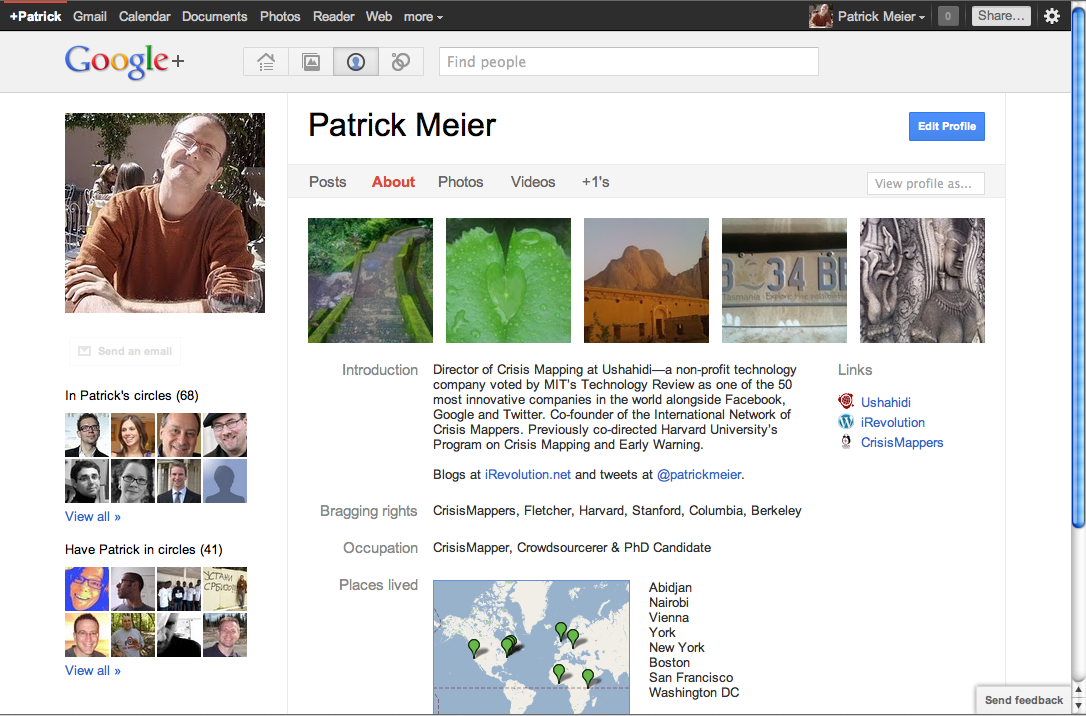
The fact that G+ is open and searchable is probably one of the starkest differences with the walled-garden that is Facebook; that, and their Data Liberation policy. This will make activity on G+ relatively easier to find—Google is the King of Search, after all. This openness will render serendipity and synergies more likely.

The much talked about “Circles” feature is also very appealing for the kind of organic and collaborative crowdsourcing work that we see emerging following a crisis. Think about these “Circles” not only as networks but also as “honeycombs” for “flash” projects—i.e., short-term and temporary—very much along the lines that Skype is used for live collaborative crisis mapping operations.

Google+’s new Hangout feature could also be used instead of Skype chat and video, with the advantage of having multi-person video-conferencing. With a little more work, the Sparks feature could facilitate media monitoring—an important component of live crisis mapping. And then there’s Google+ mobile, which is accessible on most phones with a browser and already includes a “check-in” feature as well as geo-referenced status updates. The native app for the Android is already available and the iPhone app is coming soon.
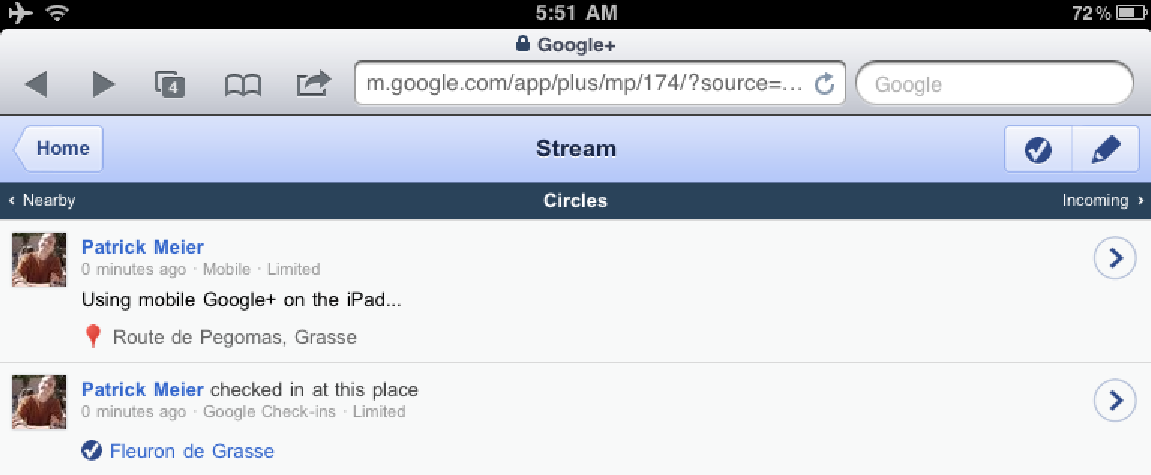
Clicking on my status update above, produces the Google Maps page below. What’s particularly telling about this is how “underwhelming” the use of Google Maps currently is within G+.  There’s no doubt this will change dramatically as G+ evolves. The Google+ team has noted that they already have dozens of new features ready to be rolled out in the coming months. So expect G+ to make full use of Google’s formidable presence on the Geo Web—think MapMaker+ and Earth Engine+. This could be a big plus for live crowdsourced crisis mapping, especially of the multimedia kind.

One stark difference with Facebook’s status updates and check-in’s is that G+ allows you to decide which Circles (or networks of contacts) to share your updates and check-in’s with. This is an important difference that could allow for more efficient information sharing in near real-time. You could set up your Circles as different teams, perhaps even along UN Cluster lines.

As the G+ mobile website reveals, the team will also be integrating SMS, which is definitely key for crisis response. I imagine there will also be a way to connect your Twitter feed with Google+ in the near future. This will make G+ even more compelling as a mobile humanitarian technology platform. In addition, I expect there are also plans to integrate Google News, Google Reader, Google Groups, Google Docs and Google Translate with G+. GMail, YouTube and Picasa are already integrated.

One feature that will be important for humanitarian applications is offline functionality. Google Reader and GMail already have this feature (Google Gears), which I imagine could be added to G+’s Stream and perhaps eventually with Google Maps? In addition, if Google can provide customizable uses of G+, then this could also make the new platform more compelling for humanitarian organizations, e.g., if OCHA could have their own G+ (“iG+”) by customizing and branding their G+ interface; much like the flexibility afforded by the Ning platform. One first step in that direction might be to offer a range of “themes” for G+, just like Google does with GMail.

Finally, the ability to develop third party apps for G+ could be a big win. Think of a G+ store (in contrast to an App Store). I’d love to see a G+ app for Ushahidi and OSM, for example.

If successful, G+ could be the best example of “What Technology Wants” to date. G+ is convergence technology par excellence. It is a hub that connects many of Google’s excellent products and from the looks of it, the G+ team is just getting warmed up with the converging.

I’d love to hear from others who are also brainstorming about possible applications of Google+ in the humanitarian space. Am I off on any of the ideas above? What am I missing? Maybe we could set up a Google+ 4 Disaster Response Circle and get on Hangout to brainstorm together?

The Role of Facebook in Disaster Response

I recently met up with some Facebook colleagues to discuss the role that they and their platform might play in disaster response. So I thought I’d share some thoughts that come up during the conversation seeing as I’ve been thinking about this topic with a number of other colleagues for a while. I’m also very interested to hear any ideas and suggestions that iRevolution readers may have on this.

There’s no doubt that Facebook can—and already does—play an important role in disaster response. In Haiti, a colleague used Facebook to recruit hundreds of Creole speaking volunteers to translate tens of thousands of text messages into English as part of our Ushahidi-Haiti crisis mapping efforts. When an earth-quake struck New Zealand earlier this year, thousands of students organized their response via a Facebook group and also used the platform’s check-in’s feature to alert others in their social network that they were alright.

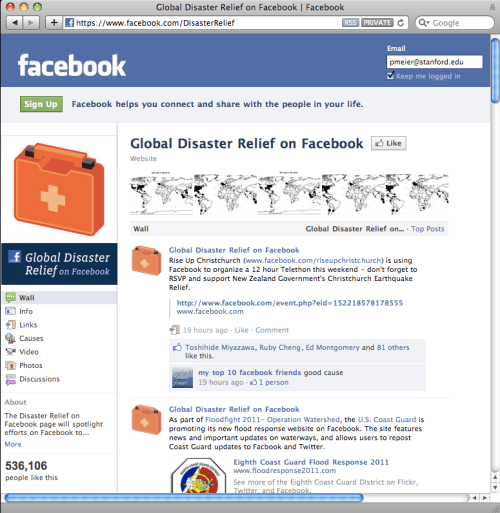
But how else might Facebook be used? The Haiti example demonstrates that the ability to rapidly recruit large numbers of volunteers is really key. So Facebook could create a dedicated landing page when a crisis unfolds, much like Google does. This landing page could then be used to recruit thousands of new volunteers for live crisis mapping operations in support of humanitarian organizations (for example). The landing page could spotlight a number of major projects that new volunteers could join, such as the Standby Volunteer Task Force (SBTF) or perhaps highlight the deployment of an Ushahidi platform for a particular crisis.

The use of Facebook to recruit volunteers presents several advantages, the most important ones being identity and scale. When we recruited hundreds of new volunteers for the Libya Crisis Map in support of the UN’s humanitarian response, we had to vet and verify each and every single one of them twice to ensure they were who they really said they were. This took hours, which wouldn’t be the case using Facebook. If we could set up a way for Facebook users to sign into an Ushahidi platform directly from their Facebook account, this too would save many hours of tedious work—a nice idea that my colleague Jaroslav Valuch suggested. See Facebook Connect, for example.

Facebook also operates at a scale of more than half-a-billion people, which has major “Cognitive Surplus” potential. We could leverage Facebook’s ad services as well—a good point made one Facebook colleague (and also Jon Gosier in an earlier conversation). That way, Facebook users would receive targeted adds on how they could volunteer based on their existing profiles.

So there’s huge potential, but like much else in the ICT-for-you-name-it space, you first have to focus on people, then process and then the technology. In other words, what we need to do first is establish a relationship with Facebook and decide on the messaging and the process by which volunteers on Facebook would join a volunteer network like the Standby Volunteer Task Force and help out on an Ushahidi map, for example.

Absorbing several hundred or thousands of new volunteers is no easy task but as long as we have a simple and efficient micro-tasking system via Facebook, we should be able to absorb this surge. Perhaps our colleagues at Facebook could take the lead on that, i.e, create a a simple interface allowing groups like the Task Force to farm out all kinds of micro-tasks, much like Crowdflower, which already embeds micro-tasks in Facebook. Indeed, we worked with Crowdflower during the floods in Pakistan to create this micro-tasking app for volunteers.

As my colleague Jaroslav also noted, this Mechanical Turk approach would allow these organizations to evaluate the performance of their volunteers on particular tasks. I would add to this some gaming dynamics to provide incentives and rewards for volunteering, as I blogged about here. Having a public score board based on the number of tasks completed by each volunteer would be just one idea. One could add badges, stickers, banners, etc., to your Facebook profile page as you complete tasks. And yes, the next question would be: how do we create the Farmville of disaster response?

On the Ushahidi end, it would also be good to create a Facebook app for Ushahidi so that users could simply map from their own Facebook page rather than open up  another browser to map critical information. As one Facebook colleague also noted, friends could then easily invite others to help map a crisis via Facebook. Indeed, this social effect could be most powerful reason to develop an Ushahidi Facebook app. As you submit a report on a map, this could be shared as a status update, for example, inviting your friends to join the cause. This could help crisis mapping go viral across your own social network—an effect that was particularly important in launching the Ushahidi-Haiti project.

As a side note, there is an Ushahidi plugin for Facebook that allows content posted on a wall to be directly pushed to the Ushahidi backend for mapping. But perhaps our colleagues at Facebook could help us add more features to this existing plugin to make it even more useful, such add integrating Facebook Connect, as noted earlier.

In sum, there are some low hanging fruits and quick wins that a few weeks of collaboration with Facebook could yield. These quick wins could make a really significant impact even if they sound (and are) rather simple. For me, the most exciting of these is the development of a Facebook app for Ushahidi.

Check-In’s with a Purpose: Applications for Disaster Response

This is the second post in my check-in’s-with-a-purpose series. The first post looked at the use of check-in’s to coordinate activist campaigns and street protests. The check-in’s series builds on Ushahidi’s free and open-source check-in service (CI) slated to launch in just a few weeks at SxSW 2011.

So how might organizations and local groups be able to use CI for disaster response? In three ways: (1) preparedness; (2) coordination; and (3) evaluation.

Preparedness

When you walk into a disaster area, say following an earthquake, you don’t want to be swamped with all kinds of information imaginable. You only want information relevant to you and your responsibilities in a given geographic area (demand side versus supply side). CI provides an easy, intuitive interface for this. You check-in when you want additional info about the area you are in.

This is similar to the idea of geo-caching, hence the reference to preparedness. You embed (or pre-populate) a given map with relevant structural and event-data for a given area. By structural data, I mean physical infrastructure such as hospitals, schools, etc. Event-data simply refers to nearby incidents. New data could be regularly embedded into the map (via geo-RSS feeds) to provide the latest event-data available. When you check-in, CI provides you with information and updates relevant to your vicinity and profile. For example, if you’ve added “health” as a tag on your profile, CI could prioritize health-based information when you check-in, including the location of other health-workers and their contact info.

There is another equally important angle to preparedness when it comes to check-in’s. Mapping infrastructure vulnerable to disasters is common practice in disaster risk reduction projects. These can be community-driven and participatory, giving local communities a stake in building their own resilience. In one such project, local communities in neighborhoods around Istanbul mapped infrastructure vulnerable to earthquake damage, e.g., overhanging structures like balconies. They also mapped local shelters, possible escape routes, etc. CI could be used for this type of crowdsourced, participatory mapping. Crowdfeeding would then simply happen by checking-in. The sign “In case of emergency, break glass” would become “In case of emergency, check-in.”

Coordination

What about coordination? Keeping track of who is in a disaster area, and where, is no easy task. A check-in service would go a long way to addressing this coordination challenge. Call it instant mapping. Disaster responders would simply click the check-in app on their smart phones after they land in a disaster area to check-in. Each organization could set up their own check-in service to coordinate their staff with instant maps. Check-in deployments could also be project- or cluster-based.

In addition, an open check-in deployment could be set up for all responders. A separate CI deployment would be especially useful if hundreds of volunteers decide to fly in. They could be tasked more efficiently if they first checked-in. Doing so would provide coordinators with access to individual profiles with listed skill sets and contact info, much like a LinkedIn profile. Disaster responders and volunteers could also check-out once they leave a disaster area.

A check-in service could facilitate a number of other coordination challenges. Finding missing persons after a disaster has always been difficult, for example. One way to let others know you’re ok would be by checking in. Doing so would prompt the CI service to provide you with the latest on the disaster that took place, information on nearby services and who in your own professional or social network is in the vicinity long with their contact info. This could also be a way to coordinate corporate social responsibility projects in the immediate aftermath of a disaster. Large companies with employees wanting to help could simply check-in to their CI service to get information on how to help.

Evaluation

Check-in’s could also be used for evaluation and accountability purposes. Once you’ve accomplished a task, you could quickly check-in with an update, which would leave a digital trace of your accomplishment. Or say you’re on your way to a food distribution site and drive past some newly flooded houses, you could quickly check-in with that information to update everyone else on your network. CI can also be used with badges and points, allowing people to develop a track-record of their work in a disaster area.

Some Challenges

There are of course some challenges in using a CI service for disaster response. Keep it simple. This is perhaps the most important point. One could very easily go all out and add countless features to a CI service. Such is the beauty of open source software. For disaster response, however, the trick will be to keep it simple and not try to turn CI into a solution for everything. If data coverage isn’t possible, then a check-in service should allow for SMS-based check-in’s. This could be done by using SMSsync. Another challenge will be to provide a seamless way to check into multiple CI deployments at the same time and for these to be interoperable. For example, if I’m with WFP, I should be able to check-in on the WFP CI and have my check-in appear simultaneously on the Food Cluster CI, OCHA CI, etc.

If you have ideas about how a check-in service could be used for disaster response, or recommendations on what would make Ushahidi’s CI system more useful, please do add them in the comments section below. My next post in this check-in’s-with-a-purpose series will describe how a CI service combined with gaming can be used to catalyze civic participation and engagement across a range of activities.