Tag Archives: Twitter

New Tech in Emergencies and Conflicts: Role of Information and Social Networks

I had the distinct pleasure of co-authoring this major new United Nations Foundation & Vodafone Foundation Technology Report with my distinguished colleague Diane Coyle. The report looks at innovation in the use of technology along the time line of crisis response, from emergency preparedness and alerts to recovery and rebuilding.

“It profiles organizations whose work is advancing the frontlines of innovation, offers an overview of international efforts to increase sophistication in the use of IT and social networks during emergencies, and provides recommendations for how governments, aid groups, and international organizations can leverage this innovation to improve community resilience.”

Case studies include:

  • Global Impact and Vulnerability Alert System (GIVAS)
  • European Media Monitor (EMM, aka OPTIMA)
  • Emergency Preparedness Information Center (EPIC)
  • Ushahidi Crowdsourcing Crisis Information
  • Télécoms sans Frontières (TSF)
  • Impact of Social Networks in Iran
  • Social Media, Citizen Journalism and Mumbai Terrorist Attacks
  • Global Disaster Alert and Coordination System (GDACS)
  • InSTEDD RIFF
  • UNOSAT
  • AAAS Geospatial Technologies for Human Rights
  • Info Technology for Humanitarian Assistance, Cooperation and Action (ITHACA)
  • Camp Roberts
  • OpenStreetMap and Walking Papers
  • UNDP Threat and Risk Mapping Analysis project (TRMA)
  • Geo-Spatial Info Analysis for Global Security, Stability Program (ISFEREA)
  • FrontlineSMS
  • M-PESA and M-PAISA
  • Souktel

I think this long and diverse list of case studies clearly shows that the field of humanitarian technology is coming into it’s own.  Have a look at the report to learn how all these fit in the ecosystem of humanitarian technologies. And check out the tag #Tech4Dev on Twitter or the UN Foundation’s Facebook page to discuss the report and feel free to add any comments to this blog post below. I’m happy to answer all questions. In the meantime, I salute the UN Foundation for producing a forward looking report on projects that are barely two years old, and some just two months old.

Patrick Philippe Meier

Twitter and Iran: First Get the Data, Then Talk

I just attended a panel at Harvard University on “The Impact of Social Media in the Middle East” which is part of a 3-day conference on the Middle East and North Africa. My colleagues Rob Faris from the Berkman Center and Evgeny Morozov now at Georgetown were both on the panel in addition to Iranian-American activist Lily Mazahery and Kuwaiti blogger Ziad Al-Duaij.

The panelists engaged in rapid-fire debate on the role of Twitter in Iran after their presentations. The typical laundry list of anecdotes were thrown around to win the hearts and minds of the audience.  The summary: Yes, Twitter had a significant impact; No Twitter had no significant impact.

Maybe it’s because I hadn’t eaten all day, but I found this all quite annoying. This is precisely the kind of anecdotal acrobatics that prompted me—two years ago—to pursue a dissertation on The Role of New Media and Technology in Popular Resistance Against Repressive Rule.

If you look close enough, you’ll find that many of the debates in the “field” of digital activism are based on strings of anecdotes. The preponderance of these would have us believe that new media and digital technology spell certain democracy. Yet an increasing number of anecdotes reveal (surprise, surprise) that repressive regimes are making use of new media and technology to forward their own agendas.

So where exactly does this leave us?

In anecdotal heaven or data scarcity hell, depending on your own agenda. I chose to pursue a dissertation in this area because I want to get beyond anecdotal ping pong. Yes, we have more and more anecdotes. And that’s great. But what do all these anecdotes add up to? Are we starting to see a trend emerge? Who is winning this digital—albeit dangerous—game of cat-and-mouse?

I don’t mind being in anecdotal heaven since I realize that hard data is rather hard to come by. But I wish the panelists had been upfront and just said: “Right, given the general lack of quantitative data and rigorous qualitative case study analysis, we have to resort anecdotes, so bear with us as we warm up for our anecdotal ping pong tournament.”

Don’t get me wrong, all the panelists have a wealth of experience and insights to draw on that I simply don’t have. So all I can do is emphasize the need for more data collection and a mixed methods approach to answer the question on everyone’s mind:

Does access to new media and digital technology
change the balance of power

between repressive regimes and resistance movements?

This is what I’m trying to get at with my dissertation. Of course, the answer will be: “It depends”. But at least I’ll be able to draw on data and comparative case study analysis to make an informed judgment on what “it” depends on. How do I plan to get there? See this blog post for the quantitative model and this blog post where I propose an analytical qualitative framework to understand the impact of new media and technology on repressive rule and civil resistance.

But I do not claim that my research design is perfect, which is why I’d be grateful for any feedback iRevolution readers may have.

Patrick Philippe Meier

Twitter vs. Tyrants: Education and Security

My colleague Chris Doten asked me to suggest panelists for this congressional briefing on the role of new media in authoritarian states. I blogged about the opening remarks of each panelist here. But the key issues really came to fore during the Q/A session.

These issues addressed Ushahidi and data validation, security and education. This blog post addresses the issues raised on the latter. The text below includes my comments on some key points by panelists.

Education

Nathan Freitas (NYU)

  • Now, I’m fortunate to be teaching at NYU’s Interactive Tele- communications Program, the course titled:  “Social Activism using Mobile Technology.” This is a one of the first of its time courses and I believe more education opportunities like this should be given to students to understand the alternative opportunities they have coming out of school.
  • [W]e need to have more opportunities to educate students that they can have  a career in using technology to support a variety of causes, and not just focus  on Wall Street or going to work at Google.  So I’m working on that, and I hope some of you will as well.

Me: I couldn’t agree more. This is why my colleague Joshua Goldstein and I co-taught a full-semester undergraduate course on Digital Democracy last semester. All the courseware is open and available here.

Security

Evgeny Morozov (Georgetown)

  • I think that reaching out to Twitter was the most terrible thing that the State  Department could have done at that point, in part because it did confirm the  thesis of David Inoshoradis (ph) that Twitter is being used as a platform for fomenting the next revolution.
  • I think we see, now, looking at the trials happening in Tehran, that the authorities do perceive the information technology as a threat.  Whether it is actually a threat or not doesn’t really matter […]
  • [T]here will always be the human factor involved here, and you would never, no matter how secure your technology is and no matter how many trainings you run, you still run into basic problems, particularly in authoritarian regimes, where torture is much cheaper than hacking.

Me: I completely agree, which is why my Guide on How to Communicate Securely in Repressive Environments addresses both technology tactics and non-technology tactics. Lets also not forget that successful civil resistance movements existed before Twitter.

Chris Spence (NDI)

  • In a lot of ways, the Internet tools that we’re talking about are black boxes to a lot of people.  They don’t know if, okay, I’ve got this image on a phone or got this video on a phone, what am I going to do now?  […] Is it safe for me to transfer it? Is it safe for me to put it up on YouTube?
  • All of those decisions have to be made on a very personal level and I think that’s one part of the discussion that gets a little bit missed, when you think about these people using these tools.

Me: I share Chris’s concern and agree that this discussion is at times overlooked. Groups like DigiActive and Digital Democracy, Tactical Tech specifically focus training individuals on how to use new media and digital technology in secure ways. See also my *Guide on How to Communicate Securely in Repressive Environments.

Nathan Freitas (NYU)

  • I’ve learned an important lesson in working with the Tibetan independence movement and others: It’s that we can’t presume what people are willing – are or are not willing to do for their own freedom and liberty and democracy.

Me: I completely agree.

Chiyu Zhou (GIF)

  • [A]n any-day user has no computer knowledge at all, even.  As long as he knows how to get Internet, then he can use the little tool and double-click it, and then he can penetrate the firewall. So that’s the very, very challenging work.

Me: Fully agreed, again. I’m relying on tech savvy activists like Chiyu to make censorship circumvention tools that are as easy as just surfing the web. The importance of achieving this goal cannot possibly be over-stated.

Patrick Philippe Meier

Twitter vs. Tyrants: Remarks by Global Internet Freedom

My colleague Chris Doten asked me to suggest panelists for this congressional briefing on the role of new media in authoritarian states. Here are the highlights from the Global Internet Freedom (GIF) Consortium’s  opening remarks along with my critiques:

  • The Internet censorship firewalls have become the 21st century Berlin Walls that separate our world. Amid the darkness of the Internet censorship in closed societies, a thread of light still remains.  It is the Internet life lines offered by the anti-censorship systems like that of [GIF], which has been providing millions in closed societies for free access to the Internet for years.
  • It is our firm belief that free flow of information is the most effective and powerful way to peacefully transform a closed society and promote human rights and civil liberties.
  • During the Saffron Revolution in Burma, in late August 2007, we experienced the three-fold increase in average daily traffic from Burma.  Many Burmese use our system to post photos and videos of the crackdown to the outside blogs and Websites.  The Burmese government had to entirely shut down Internet to stop the outflow of information about the oppression.
  • Perhaps, the best example of the role of GIF software was during the Iranian election this past June, when our traffic from Iran increased by nearly 600 percent in one week. On the Saturday of June the 20th, an estimated 1 million Iranians used our system to visit previously censored Web sites such as Facebook, YouTube, Twitter and Google. The Iranian users posted videos, photos and messages about the bloody crackdown.
  • Internet freedom has the potential of transforming the closed societies in a peaceful but powerful way that must not be underestimated. The operation of our system is very efficient. It only needs a few dollars to support a user in closed societies for an entire year. Moreover, for every dollar we spent, China and other censors will need to spend hundreds, perhaps thousands, of dollars to block us. The information warfare over the Internet has now boiled down to the battle of resources. We have technology and the commitment.

Me: This is spot on. I have often described the situation as an “Information Race” with dynamics that hark back to the arms race of the Cold War. So the conclusion that it all boils down to the battle of resources is fascinating—especially since one of Reagan’s strategies was to bankrupt the Soviet Union with the arms race.

What the panelist should have added is that time is money. And the issue of time is central to the field of nonviolent action. Each side, citizens and repressive regimes have equal amounts of hours available to them. But regimes are by definition composed of elites, i.e., a minority, whereas citizens will always form the majority. This suggests that citizens have an inherent advantage if they know how to manage their time and remain on the offensive.

  • With a modest amount of resources, there is capacity to tear down the 21st-century Berlin walls. When Congress passed the Internet Freedom Provision in the fiscal year 2008 appropriation act, it declared that, quote, “ensuring the freedom of Internet communication in dictatorships and autocracies throughout the world is a high and critical national interest priority of the United States,” end quote.
  • And I really like the idea of using citizen observers and giving them the tools and technology to sort of go out there and report things on election day, but –and I know that they’re– the missions do go out there and observe any sort of foul play beforehand, but is there planning to do any activities or any ongoing activities right now to sort of utilize the same sort of strategy before the elections?

Me: This is an important question and one that I and colleagues are right now addressing vis-à-vis several upcoming elections.

Patrick Philippe Meier

Twitter vs. Tyrants: Remarks by NDI

My colleague Chris Doten asked me to suggest panelists for this congressional briefing on the role of new media in authoritarian states. Here are the highlights from Chris Spence’s opening remarks along with my critiques:

  • [T]he introduction of new media and other technologies should not be seen as a  panacea for democratic development nor goal in and of itself. These technologies, paired with effective methodologies, can help organizations make significant contributions toward advancing democratic process in authoritarian states.
  • Activists and civic groups have demonstrated remarkable ability to adapt new technologies and when combined with traditional organizing principles, can create moments of opportunity for democratic gains and enhanced channels for political engagement in authoritarian states.
  • The key is not only to employ effective technologies but to pair the technologies with strategies and approaches that are developed for the political environment in which the technologies are being used. This approach can help activists get out ahead of authoritarian regimes and make relative gains and even game-changing democratic gains when periods are identified where such innovations can rapidly be put to use.

Me: I’ve been advocating for this two-pronged approach, nonviolent action and digital activism, for a while now. Indeed, my dissertation research is founded on the premise that a combined strategy is imperative if activists are to gain the upper hand in authoritarian states. See also this blog post on Digital Resistance: Between Digital Activism and Civil Resistance.

  • While regimes make quickly catch up or clamp down by employing technologies and other techniques to bolster their regimes, gains made during the gap between early adoption and governmental response can have long-term, positive consequences for democratic activists. The strengths of the early uses of new media for activism have been in communication and in sharing information about political developments.

Me: This hypothesis is identical to one that I have advanced in my dissertation research. One needs to accelerate activists’ learning curve and early adoption of new technologies and tactics. Hence the importance of DigiActive’s mission and my Guide on How to Communicate Securely in Repressive Regimes.

  • However, […] the tools have been less effectively utilized for the organizing required that can lead to constructive political outcomes.  In some situations, information has been produced by citizens using innovative new media tools that initiate the process of change, but the process is stalled due to a lack of the organizations or institutions in the country required to capture the interests and channel the process toward purposeful, strategic and peaceful direct action.  Assisting organizations in these countries to build this capacity is an important component in leveraging new media tools toward political reform.

Me: This is precisely why nonviolent tactics and strategies need to inform digital activism. More about this here.

  • One set of institutions that are particularly well-suited to this role but are often overlooked in international circles are political parties. Relatively little attention is paid to the important role that parties play in aggregating citizen interests and channeling them into constructive and peaceful means toward democratic reform.
  • One area of opportunity, with tremendous potential in countries where NDI works, is to provide more new media technology assistance to political parties, especially in autocratic states where the regime often has access to considerable state resources and controls the organs of state communication.
  • [W]e believe our partners have made contributions that have prevented post-election violence or identified and raised important concerns about the electoral process that have led to more democratic and peaceful outcomes.
  • The field of domestic election monitoring has improved significantly in the last several years, partly due to improved methods and strategies and certainly enabled by these new technologies and replicated by the role of international organizations.
  • Citizen reporting is another method by which citizens have been able to communicate various aspects of their Election Day experiences using new media tools, usually text messages and Tweets. The information reported by citizens is typically collected and made accessible to the public on a Web site or online map in raw form. The value of this approach is to increase citizen participation in the election process. But to date, the challenge has been putting the information to good use.

Me: Ushahidi is probably the most well known example of citizen-based election monitoring. Full disclosure: I am Director of Crisis Mapping and Strategic Partnerships at Ushahidi. The value of this approach is more than to increase citizen participation. The approach can also increase pressure for transparency and accountability in a way that has not been possible previously.

In terms of putting the information to good use, the challenge is simply due to the fact that Ushahidi is still new to many activists. As Chris himself noted above, “The strengths of the early uses of new media for activism have been in communication and in sharing information about political developments.” First comes communication and sharing. Second comes strategizing and action.

Another important point that often gets overlooked is that the various groups that have deployed Ushahidi for the election monitoring have usually done so “at the last minute”, i.e., with just weeks prior to election day. This is  starting to change now, with groups taking an advanced-planning approach to deploying Ushahidi. Indeed, I am in touch with several partners who are already planning for elections taking place more than half-a-year from now.

  • Tools are being developed to evaluate the authenticity and filter this incoming information so that organizations can then be prepared to put this powerful crowd-sourcing methodology to work during election periods. However, even as the tools and methods improve, citizen reporting promises to be a useful tool towards some electoral goals but won’t be a substitute for election monitoring in situations where assessing the overall legitimacy of an election is required.

Me: One example of a tool being developed to validate crowdsourced information is Swift River. Again, full disclosure: Swift River is one of my priority projects at Ushahidi. In terms of the promises of citizen reporting, I find Chris’s comment surprising. I have never heard anyone suggest that citizen-based election monitoring is a substitute for election monitoring.

  • The challenges faced by activists in autocratic nations are immense.  And these challenges are not only technical in nature but also legal and political.
  • [W]indows of opportunities for political reform can be created by the use of new media in authoritarian states with a combination of good technology tools, effective strategies and methodologies – put into use  by organizations or institutions that can channel the energy of the public and  the information they produce toward construct and peaceful political activities.

Patrick Philippe Meier

Twitter vs. Tyrants: Summary of Congressional Briefing

My colleague Chris Doten sent me the following email on September 25th:

Hey Patrick-

I’m currently working for the US Helsinki Commission, which as you probably know is a semi-congressional human rights watchdog. They’ve asked me to put a briefing together on the role of new media technology in democratization – very exciting opportunity for me, and I hope to do it justice. I thought you might have thoughts on experts to whom I could talk in the field, or potential panelists we should call.

Thoughts? Hope you’re doing well!

Thanks,
Chris

Needless to say, I couldn’t have been more excited to learn that the topic of my dissertation research and consulting work would be the subject of a Congressional Briefing. I emailed Chris right back for more details. He put it simply:

“If you were in the driver’s seat for such a panel,
where would you go?”

What a treat. I’ve been studying the role of new media and digital technology in authoritarian regimes for a while now, and I’m on the Board of Advisors of DigiActive and Digital Democracy. I’ve also served as New Media Advisor on a major USAID project that seeks to foster peaceful transition to democratic rule in a certain authoritarian state.

So I suggested to Chris that he contact my colleagues Evgeny Morozov (Georgetown), Nathan Freitas (NYU), Rob Farris (Berkman Center), Emily Jacobi and Mark Belinsky (Digital Democracy), and Mary Joyce (DigiActive). While Rob’s schedule didn’t allow him to be a the Congressional Briefing last Thursday, my other colleagues were indeed there. Chris Spence (NDI), Daniel Calingaert (Freedom House) Chiy Zhou (GIF) were also present.

Both DigiActive and Digital Democracy also submitted written remarks for the record here and here. Here is a copy of the full 30 page transcript of the Congressional Briefing. Since reading through 30 pages can be quite time consuming, I have summarized the briefing using annotated excerpts of the most important points made by panelists. You’ll note that while I agree with some of the comments made by the panelists, I clearly disagree with others.

Opening Remarks & My Critique

Q/A Session & My Critique

Patrick Philippe Meier

An Analytical Framework to Understand Twitter’s use in Iran?

The digital activism and resistance witnessed in Iran go to the heart of my dissertation research, which asks whether the information revolution empowers coercive regimes at the expense of resistance movements or vice versa? Iran is one of my case studies for my upcoming field research in addition to Burma, Tunisia and Ukraine.

Introduction

There have been a number of excellent blog posts on the intersection between technology and resistance in Iran, and especially on the use of Twitter. The mainstream press is also awash with references to Twitter’s role. For example, Agence France Presse (AFP) recently cited my research in this piece entitled “Twitter Streams Break Iran News Dam.”

However, what I haven’t seen in the blogosphere and mainstream press is the application of an analytical and theoretical framework to place Twitter’s use in Iran into context.

For example, just how important is/was Twitter’s role vis-a-vis the mobilization and organization of anti-government protests in Iran? We can draw on anecdotes here and there but this process is devoid of any applied social science methodology.

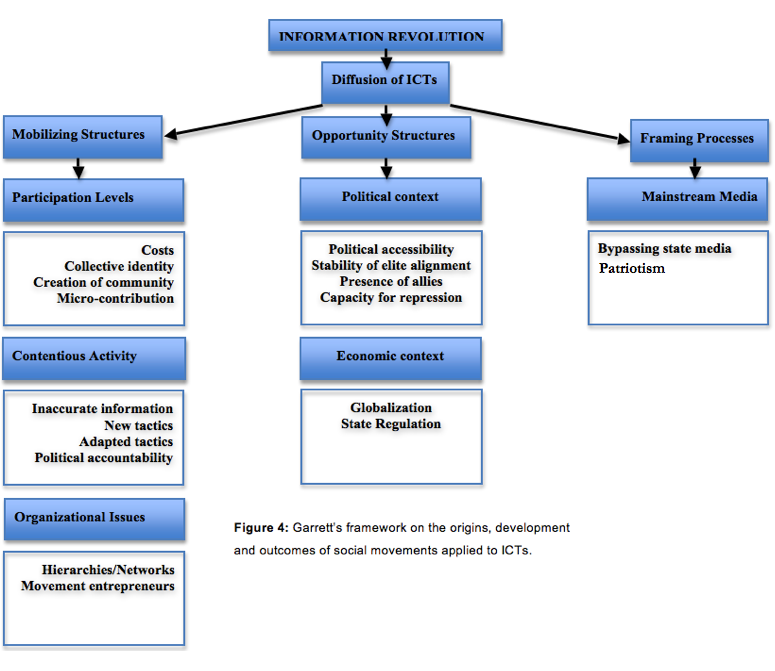
This post seeks to shed light on how, when and why information and communication technologies (ICTs) are used by resistance movements in repressive environments. The framework I draw on (summarized below) is informed by Kelly Garrett’s excellent publication on “Protest in an Information Society: A Review of the Literature on Social Movements and New ICTs” (2006).

Framework

The framework seeks to “explain the emergence, development and outcomes of social movements by addressing three interrelated factors: mobilizing structures, opportunity structures and framing processes”  within the context of ICTs. (The figure below is excerpted from my dissertation, hence the figure 4 reference).

PhDFramework

  • Mobilizing Structures are the mechanisms that facilitate organization and collective action. These include social structures and tactical repertoires.
  • Opportunity Structures are conditions that favor social movement activity. For example, these include factors such as the state’s capacity and propensity for repression.
  • Framing Processes are “strategic attempts to craft, disseminate, and contest the language and narratives used to describe a movement.”

These three factors should be further disaggregated to facilitate analysis. For example, mobilizing structures can be divided into categories susceptible to the impact of ICTs:

  • Participation levels (recruitment);
  • Contentious activity;
  • Organizational issues.

These sub-indicators are still to broad, however. Take, for example, participation levels; what is participation a function of? What underlying mechanisms are facilitated or constrained by the wider availability and use of ICTs? Participation levels may change as a function of three factors:

  • Reduction of participation costs;
  • Promotion of collective identity;
  • Creation of community.

These activities are of course not mutually exclusive but often interdependent. In any case, taking the analysis of ICTs in repressive environments to the tactical level facilitates the social science methodology of process tracing.

Application

We can apply the above framework to test a number of hypotheses regarding Twitter’s use in Iran. Take Mobilizing Structures, for example. The following hypothesis could be formulated.

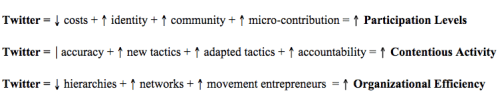
  • Hypothesis 1: The availability of Twitter in Iran increased participation levels, contentious activity and organizational activity.

Using process tracing and the above framework, one could test hypothesis 1 as follows:

hypo1

These causal chains, or “micro theories,” are posited with the “⎥” marker to signify that the causal relationship is contended. The direction of the arrows above reflects the theoretical narratives extracted from the theoretical framework presented above. Note that the above “micro” theories are general and not necessarily reflective of Twitter’s use in Iran.

Iran Case Study

When the arrows are tallied, the results suggest the following general theory: there is a direct and positive relationship between the impact of Twitter and the incidents of protests and riots. The next step is to test these “micro theories” in the context of Iran by actually “weighting” the arrows. And of course, to do so comparatively by testing the use of Twitter relative to the use of mobile phones and the Internet. Furthermore, the results of this hypothesis testing should be compared to those for Opportunity Structures and Framing Processes.

I plan to carry out field research to qualitatively test these hypotheses once the first phase of my dissertation is completed. The first phase is a large-N quantitative study to determine whether increasing access to ICTs in repressive regimes is a statistically significant predictor of anti-government protests.

Patrick Philippe Meier

Empirical Study: Twitter is not a Social Network

Given my long time interest in complexity science, I often browse through arXiv (pronounced “archive”, as if the “X” were the Greek letter Chi, χ) for a little distraction. This archive is the go-to site for electronic preprints of scientific papers in the fields of mathematics, physics, computer science and statistics. If only we could have a similar archive in the social sciences.

In any case, I was pleasantly surprised to find a paper on arXiv entitled “Social Networks that Matter: Twitter Under the Miscroscope.” The authors argue that the linked structures of social networks do not reveal actual interactions among people. “Scarcity of attention and the daily rythms of life and work makes people default to interacting with those few that matter and that reciprocate their attention.” Using Twitter to study social interactions, the authors find that the “driver of usage is a sparse and hidden network of connections underlying the ‘declared’ set of friends and followers.”

The authors compiled a large dataset of Twitter 309,740 users. They obtained the number of followers and followees for each user along with the content and datestamp of all her posts. They also identified the number of directed (@name) posts and definited a user’s friend as a person whom the user has directed at least two posts to. The researchers were thus able to compare the number of friends a user has with the number of followers and followees they declared.

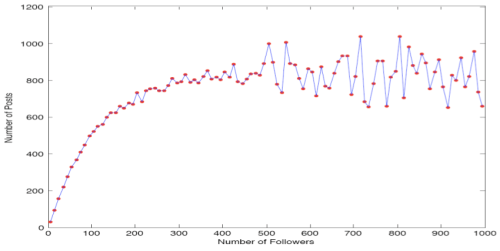
The first figure below depicts the number of posts as a function of the number of followers. The number of posts initially increases as the number of followers increases but it eventually saturates.
arXiv Twitter1

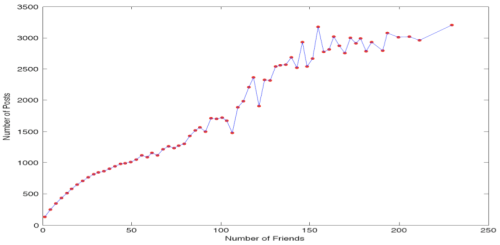
The second figure depicts the number of posts as a function of the number of friends. The number of posts increases as the number of friends increases, reaching the maximum 3,200 without saturating. As the authors note, “this suggests that in order to predict how active a Twitter user is, the number of friends is a more accurate signal than the number of his followers.”
arXiv Twitter2

The histogram below depicts a Twitter user’s number of friends divided by the number of followers. Most users have a very small number of friends compared to the number of followers they declared. “Hence, while the social network created by the declared followers and followees appears to be very dense, in reality the more influential network of friends suggests that the social network is sparse.”

arXiv Twitter2

The next figure below represents the number of friends as a function of the number of followees. As can be noted, the total number of friends saturates while the number of followers keeps growing due to the minimal effort required to add a followee.

arXiv Twitter4

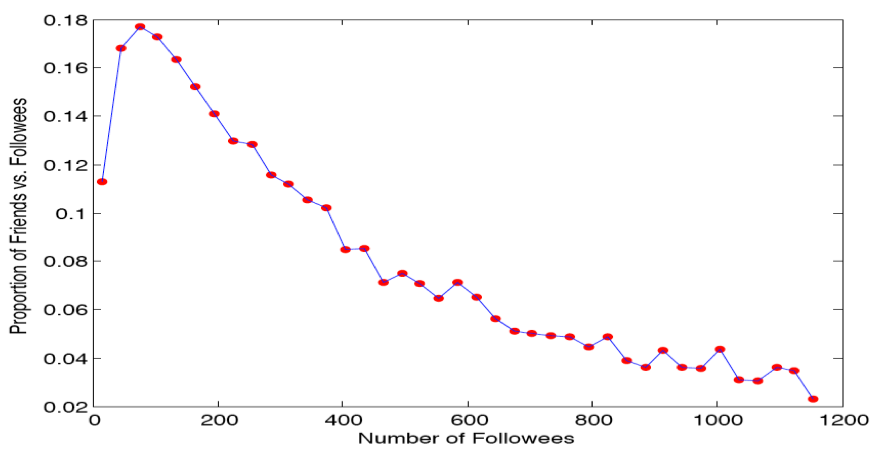
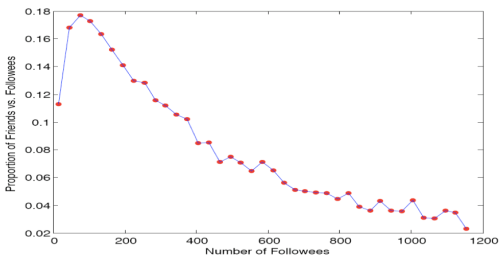
In turn, the figure below depicts the proportion of friends versus followees as a function of followers. The curve initially increases but rapidly approaches zero as the number of followees increases.
arXive Twitter5

The authors thus conclude that Twitter users have a very small number of friends compared to the number of followers and followees they declare.

“This implies the existence of two different networks: a very dense one made up of followers and followees, and a sparser and simpler network of actual friends. The latter proves to be a more influential network in driving Twitter usage since users with many actual friends tend to post more updates than users with few actual friends. On the other hand, users with many followers or followees post updates more infrequently than those with few followers or followees.”

arXive Twitter6

In social network (a) above, all followees are depicted as linked nodes. In network (b), only links to actual friends are depicted. The latter is the hidden network that is more representative of actual interactions between Twitter users.

Most avid Twitter users would most likely find the authors’ conclusions rather obvious. As  Twitter user @timoreilly recently Tweeted, “Facebook is about people you used to know; Twitter is about people you’d like to know better.” I for one view Twitter as more of an information subscription tool that complements my use of emails than an actual network for social interaction.

This is precisely what the Twitter study are getting at:

Many people, including scholars, advertisers and political activists, see online social networks as an opportunity to study the propagation of ideas, the formation of social bonds and viral marketing, among others.

This view should be tempered by our findings that a link between any two people does not necessarily imply an interaction between them. As we showed in the case of Twitter, most of the links declared within Twitter were meaningless from an interaction point of view. Thus the need to find the hidden social network; the one that matters when trying to rely on word of mouth to spread an idea, a belief, or a trend.

This is an important reminder, especially for colleagues of mine at the Berkman Center who are engaged in social network analyses of various political blogospheres. Just because the data is there and “easily” available doesn’t mean that they actually represent the offline social interactions that we are ultimatley interested in studying. Social network data no matter how novel are still proxy data at best.

Patrick Philippe Meier

Gene Sharp, Civil Resistance and Technology

Major civil nonviolent campaigns are twice as likely to lead to sustainable democratic transitions than violent campaigns. This conclusion comes from a large-N statistical study carried out by my colleague Maria Stephan (PhD Fletcher ’06) and Erica Chenoweth. Recently published in International Security, the study notes that civil resistance movements have achieved success 55% of the time while only 28% of violent campaigns have succeeded.

Another colleague, Chris Walker (MALD Fletcher ’07), wrote in his excellent Master’s Thesis that “techniques associated with strategic nonviolent social movements are greatly enhanced by access to modern information communication technologies, such as mobile telephony, short message service (SMS), email and the World Wide Web, among others.”

It stands to reason, then, that increasing access to modern communication technologies may in turn up the 55% success rate of nonviolent campaigns by several percentage points. To this end, the question that particularly interests me (given my dissertation research) is the following: What specific techniques associated with civil resistance can tactical uses of modern communication technologies amplify?

This is the question I recently posed to Dr. Peter Ackerman—another Fletcher Alum (PhD ’76) and the founding Chair of the International Center for Nonviolent Conflict (ICNC)—when I described my dissertation interests. When Peter suggested I look into Gene Sharp’s work on methods of nonviolent action, I replied “that’s exactly what I intend to do.”

In The Politics of Nonviolent Action, Gene identifies 198 methods of nonviolent protest and persuasion. The majority of these can be amplified by modern communication technologies. What  follows is therefore only a subset of 12 tactics linked to applied examples of modern technologies. I very much welcome feedback on this initial list, as I’d like to formulate a more complete taxonomy of digital resistance and match the tactic-technologies with real-world examples from DigiActive’s website.

  • Quickie walkout (lightning strike): Flashmob
  • Hiding, escape, and false identities: Mobile phone, SMS

Do please let me know (in the comments section below) if you can think of other communication technologies, Web 2.0 applications, examples, etc. Thanks!

Patrick Philippe Meier

Snap Mobs of the World Unite – A Better Taxonomy? (Udpated)

Economist3

A writer for The Economist interviewed me earlier in the week for his article entitled “Rioters of the World Unite” sparked by the recent Greek riots. In the article, the author asks whether it is possible to imagine an Anarchist International comparable to the then Communist International, “a trans-national version of the inchoate but impassioned demonstrations that have ravaged Greece this month?”

While I’m not convinced that the word “anarchist” is an appropriate label for the rioters in Athens (more on that later), the author is certainly correct that the kind of “psychological impulse behind the Greek protests […] can now be transmitted almost instantaneously, in ways that would make the Bolsheviks very jealous. These days, images (moving as well as still) spread faster than words; and images, of course, transcend language barriers.”

E-communications are now a familiar feature in pro-democracy protests against dictators. Equally fast-moving, say specialists, is the role of technology in what might be called “undemocratic protests”: violent acts in prosperous, networked societies.

Leaving aside the need to distinguish between protests and riots, I find the notion of “undemocratic protests” rather interesting although I’m not sure whether the qualifier “undemocratic” necessarily adds clarity. What is undemocratic about Hungarian youths in 2006 using “blogs to aggregate visual evidence of police brutality” and “distributing an audio recording of the prime minister admitting government corruption?”

This brings us to the issue of developing an appropriate taxonomy, as I noted in response to some excellent questions in the comments section of my blog post on the “Greek Riots, Facebook, Twitter and SMS.” (Incidentally, I should have included Second Life where a memorial was erected “giving its users a glimpse of real-life material from the riots”).

I think we need a better taxonomy for today’s new media. Individuals who find themselves in the middle of the action and send text messages or camera shots from their phones are not journalists in the conventional sense of the word. Adding “citizen” in front of journalism is perhaps too simplistic.

First of all, in repressive contexts, “citizen journalists” are not really citizens of their country; they tend to be marginalized, oppressed and persecuted. The term “civilian journalism” may be more apt. But we’ve already established that the qualifier “journalism” muddies the waters.

The Greek students rioting in the streets of Athens could not be described as a “smart mob” either. I wouldn’t use the term “dumb mobs” because I don’t find that any more accurate than describing the rioters as anarchists. Indeed, I think The Economist article gets it particularly wrong on that note:

The shooting and ensuing riots in Greece must be understood in the context of the “disenchantment of Greek students, the mistrust in and corruption of the right-wing government,”  as well as the “many acts of police brutality and incompetence through the years. This is why people wouldn’t wait for the coronary report. There were many things wrong even before the shooting and the coronary report” (see previous blog post).

In this context, then, perhaps a term like “snap mobs” might be more useful. Snap implies quick and plays on terms like “snapshot” and “snap judgment” which is a better description of the student-led riots in Greece.

As the article in The Economist suggests, what happened in Athens is bound to happen again in different forms across the world, i.e., rumors spreading and leading to chaos or worse, bloodshed. This may eventually drive the point home that text messages and Tweets should simply not be taken at face value.

I do think that as foreign reporting continues to decline, we will see the rise of  a professional class of citizen journalists and as a consequence, readers will expect the latter to operate at standards akin to that of the mainstream media today. At the same time, I suspect the mainstream media will shift towards a more investigative-journalism mode as consequence of increasing “snap mob” behavior.

Patrick Philippe Meier