
I’m a wanna-be physicist; which is probably why one of my most memorable summers was spent at the Sante Fe Institute’s (SFI) Complex Systems Summer School (CSSS) in 2006.
But this is not a recent fad, my International Baccalaureate (IB) courses in 1996 included advanced physics, advanced calculus and graph theory and advanced computer science. One of my favorite books at the time was Numerical Recipes in C. In fact, my extended essay for the IB was actually a software program that determines the degree of randomness of stellar distributions. This required writing code that could determine what constituted a star in any given picture with variable resolution, i.e., pattern recognition. Oh, the good old days.
My interest in the hard sciences explains why I’m still an avid reader of scientific journals, and why I just came across a special edition of The New Journal of Physics focused on visualization in physics. Some excerpts and pictures:
Early on in this twenty-first century, scientific communities are just starting to explore the potential of digital visualization. Whether visualization is used to represent and communicate complex concepts, or to understand and interpret experimental data, or to visualize solutions to complex dynamical equations, the basic tools of visualization are shared in each of these applications and implementations.
The effectiveness of visualization arises by exploiting the unmatched capability of the human eye and visual cortex to process the large information content of images. In a brief glance, we recognize patterns or identify subtle features even in noisy data, something that is difficult or impossible to achieve with more traditional forms of data analysis.
The advantages of visualization found for simulated data also hold for real world data as well. With the application of computerized acquisition many scientific disciplines are witnessing exponential growth rates of the volume of accumulated raw data [c.f., crowdsourcing conflict data], which often makes it daunting to condense the information into a manageable form, a challenge that can be addressed by modern visualization techniques.

This image shows a simulation of the distortion due to a spaceship inside a warp bubble moving past the Earth and Moon, as seen from space.
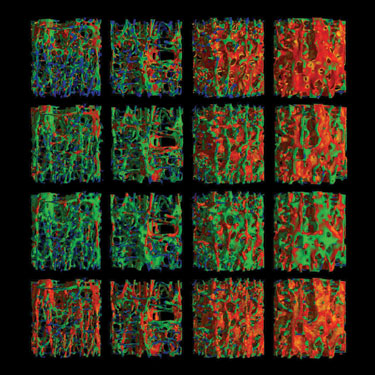
3D images of human bone can help predict fracture risk due to osteoporosis.
As one article in the Special Edition noted, visualization tools can be used to show internal properties of complex networks. As more raw, geo-referenced crisis data is collected, our field of conflict early warning and crisis mapping will need to start making sense of the volumes of new data. This is where the new field of Crisis Mapping Analytics (CMA) begins.
The purpose of CMA is to develop metrics and methods to identify patterns in conflict data over space and time. For more on CMA, see these two blog entries on “Crisis Mapping, Dynamic Visualization and Pattern Recognition” and “Tracking Genocide by Remote Sensing.” My hunch is that we should be talking to our colleagues in the hard sciences for tips on data visualization and patterns analysis.
 iRevolutions