
Monthly Archives: October 2016

What Happens When the Media Sends Drone Teams to Disasters?

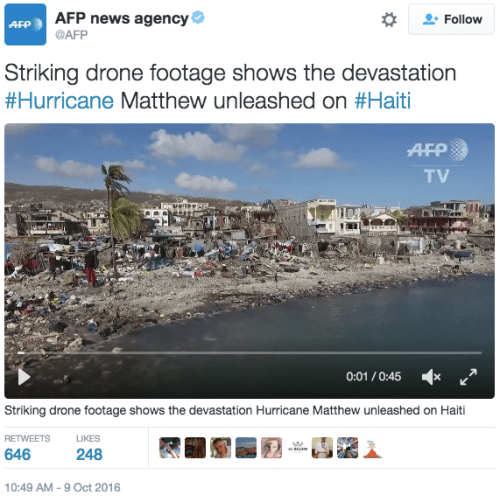
Media companies like AFP, CNN and others are increasingly capturing dramatic aerial footage following major disasters around the world. These companies can be part of the solution when it comes to adding value to humanitarian efforts on the ground. But they can also be a part of the problem.
screenshot-2016-10-26-04-51-44

Media teams are increasingly showing up to disasters with small drones (UAVs) to document the damage. They’re at times the first with drones on the scene and thus able to quickly capture dramatic aerial footage of the devastation below. These media assets lead to more views and thus traffic on news websites, which increases the probability that more readers click on ads. Cue Noam Chomsky’s Manufacturing Consent: The Political Economy of the Mass Media, my favorite book whilst in high school.

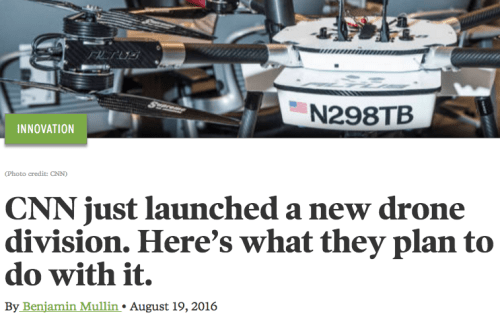
Aerial footage can also increase situational awareness for disaster responders if that footage is geo-located. Labeling individual scenes in video footage with the name of the towns or villages being flown over would go a long way. This is what I asked one journalist to do in the aftermath of the Nepal Earthquake after he sent me dozens of his aerial videos. I also struck up an informal agreement with CNN to gain access to their raw aerial footage in future disasters. On a related note, I was pleased when my CNN contact expressed an interest in following the Humanitarian UAV Code of Conduct.

In an ideal world, there would be a network of professional drone journalists with established news agencies that humanitarian organizations could quickly contact for geo-tagged video footage after major disasters to improve their situational awareness. Perhaps the Professional Society of Drone Journalists (PSDJ) could be part of the solution. In any case, the network would either have its own Code of Conduct or follow the humanitarian one. Perhaps they could post their footage and pictures directly to the Humanitarian UAV Network (UAViators) Crisis Map. Either way, the media has long played an important role in humanitarian disasters, and their increasing use of drones makes them even more valuable partners to increase situational awareness.

The above scenario describes the ideal world. But the media can (and has) been part of the problem as well. “If it bleeds, it leads,” as the saying goes. Increased competition between media companies to be the first to capture dramatic aerial video that goes viral means that they may take shortcuts. They may not want to waste time getting formal approval from a country’s civil aviation authority. In Nepal after the earthquake, one leading company’s drone team was briefly detained by authorities for not getting official permission.
screenshot-2016-10-26-05-07-05

Media companies may not care to engage with local communities. They may be on a tight deadline and thus dispense with getting community buy-in. They may not have the time to reassure traumatized communities about the robots flying overhead. Media companies may overlook or ignore potential data privacy repercussions of publishing their aerial videos online. They may also not venture out to isolated and rural areas, thus biasing the video footage towards easy-to-access locations.

So how do we in the humanitarian space make media drone teams part of the solution rather than part of the problem? How do we make them partners in these efforts? One way forward is to start a conversation with these media teams and their relevant networks. Perhaps we start with a few informal agreements and learn by doing. If anyone is interested in working with me on this and/or has any suggestions on how to make this happen, please do get in touch. Thanks!

Why Robots Are Flying Over Zanzibar and the Source of the Nile

An expedition in 1858 revealed that Lake Victoria was the source of the Nile. We found ourselves on the shores of Africa’s majestic lake this October, a month after a 5.9 magnitude earthquake struck Tanzania’s Kagera Region. Hundreds were injured and dozens killed. This was the biggest tragedy in decades for the peaceful lakeside town of Bukoba. The Ministry of Home Affairs invited WeRobotics to support the recovery and reconstruction efforts by carrying out aerial surveys of the affected areas. 

2016-10-10-08-14-57-hdr

The mission of WeRobotics is to build local capacity for the safe and effective use of appropriate robotics solutions. We do this by co-creating local robotics labs that we call Flying Labs. We use these Labs to transfer the professional skills and relevant robotics solutions to outstanding local partners. Our explicit focus on capacity building explains why we took the opportunity whilst in Kagera to train two Tanzanian colleagues. Khadija and Yussuf joined us from the State University of Zanzibar (SUZA). They were both wonderful to work with and quick learners too. We look forward to working with them and other partners to co-create our Flying Labs in Tanzania. More on this in a future post.

Aerial Surveys of Kagera Region After The Earthquake

We surveyed multiple areas in the region based on the priorities of our local partners as well as reports provided by local villagers. We used the Cumulus One UAV from our technology partner DanOffice to carry out the flights. The Cumulus has a stated 2.5 hour flight time and 50 kilometer radio range. We’re using software from our partner Pix4D to process the 3,000+ very high resolution images captured during our 2 days around Bukoba.

img_6753

Above, Khadija and Yussuf on the left with a local engineer and a local member of the community on the right, respectfully. The video below shows how the Cumulus takes off and lands. The landing is automatic and simply involves the UAV stalling and gently gliding to the ground. 

We engaged directly with local communities before our flights to explain our project and get their permissions to fly. Learn more about our Code of Conduct.

img_6807

Aerial mapping with fixed-wing UAVs can identify large-scale damage over large areas and serve as a good base map for reconstruction. A lot of the damage, however, can be limited to large cracks in walls, which cannot be seen with nadir (vertical) imagery. We thus flew over some areas using a Parrot Bebop2 to capture oblique imagery and to get closer to the damage. We then took dozens of geo-tagged images from ground-level with our phones in order to ground-truth the aerial imagery.

img_6964

We’re still processing the resulting imagery so the results below are simply the low resolution previews of one (out of three) surveys we carried out.

ortho1_bukoba

Both Khadija and Yussuf were very quick learners and a real delight to work with. Below are more pictures documenting our recent work in Kagera. You can follow all our trainings and projects live via our Twitter feed (@werobotics) and our Facebook page. Sincerest thanks to both Linx Global Intelligence and UR Group for making our work in Kagera possible. Linx provided the introduction to the Ministry of Home Affairs while the UR Group provided invaluable support on the logistics and permissions.

img_6827

Yussuf programming the flight plan of the Cumulus

img_6875

Khadija is setting up the Cumulus for a full day of flying around Bukoba area

img_6756

Khadija wants to use aerial robots to map Zanzibar, which is where she’s from

img_6787

Community engagement is absolutely imperative

img_6791

Local community members inspecting the Parrot’s Bebop2

From the shores of Lake Victoria to the coastlines of Zanzibar

Together with the outstanding drone team from the State University of Zanzibar, we mapped Jozani Forest and part of the island’s eastern coastline. This allowed us to further field-test our long-range platform and to continue our local capacity building efforts following our surveys near the Ugandan border. Here’s a picture-based summary of our joint efforts.

2016-10-14-09-09-48

Flying Labs Coordinator Yussuf sets up the Cumulus UAV for flight

2016-10-13-14-44-27-hdr

Turns out selfie sticks are popular in Zanzibar and kids love robots.

2016-10-14-10-01-25

Khairat from Team SUZA is operating the mobile air traffic control tower. Team SUZA uses senseFly eBees for other projects on the island.

2016-10-15-09-03-10

Another successful takeoff, courtesy of Flying Labs Coordinator Yussuf.

2016-10-15-11-11-20

We flew the Cumulus at a speed of 65km/h and at an altitude of 265m.

2016-10-15-13-11-13

The Cumulus flew for 2 hours, making this our longest UAV flight in Zanzibar so far.

2016-10-15-10-38-51-hdr

Khadija from Team SUZA explains to local villagers how and why she maps Zanzibar using flying robots.

2016-10-15-17-26-23

Tide starts rushing back in. It’s important to take the moon into account when mapping coastlines, as the tide can change drastically during a single flight and thus affect the stitching process.

The content above is cross-posted from WeRobotics.