Category Archives: Crowdsourcing

Is Journalism Just Failed Crowdsourcing?

This provocative question materialized during a recent conversation I had with a Professor of Political Science whilst in New York in this week. Major news companies like CNN have started to crowdsource citizen generated news on the basis that “looking at the news from different angles gives us a deeper understanding of what’s going on.” CNN’s iReporter thus invites citizens to help shape the news “in order to paint a more complete picture of the news.”

This would imply that traditional journalism has provided a relatively incomplete picture of global events. So the question is, if crowdsourcing platforms had been available to journalists one hundred years ago, would they view these platforms as an exciting opportunity to get early leads on breaking stories? The common counter argument is: but crowdsourcing “opens the floodgates” of information and we simply can’t follow up on everything. Yes, but whoever said that every lead requires follow up?

Journalists are not always interested in following up on every lead that comes their way. They’ll select a few sources, interview them and then write up the story. What crowdsourcing citizen generated news does, however, is to provide them with many more leads to choose from. Isn’t this an ideal set up for a journalist? Instead of having to chase down leads across town, the leads come directly to them with names, phone numbers and email addresses.

Imagine that the field of journalism had started out using crowdsourcing platforms combined with investigative journalism. If these platforms were then outlawed for whatever reason, would investigative journalists be hindered in their ability to cover the news from different angles? Or would they still be able to paint an equally complete picture of the news?

Granted, one common criticism of citizen journalism is the lack of context they provide especially when using Twitter given the 140 characters restriction. But surely 140 characters are plenty for the purposes of a potential lead. And if a mountain of Tweets started to point to the same lead story, then a professional journalist could take advantage of this information when deciding whether or not to follow up.

Source: CoolThing

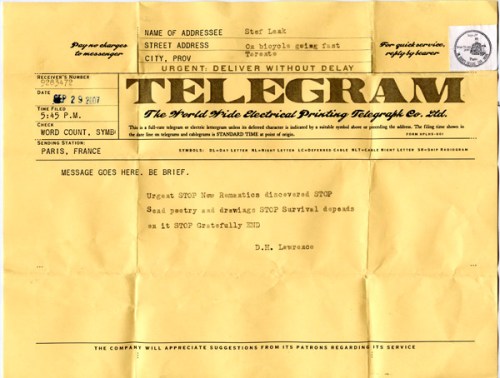
I also find the criticism against Twitter interesting coming from traditional journalists. In the early 1900s, large newspapers started hiring war correspondents “who used the new telegraph and expanding railways to move news faster to their newspapers.” However, the cost of sending telegrams forced reporters to develop a “new concise or ‘tight’ style of writing which became the standard for journalism through the next century.”

Today, the costs of hiring professional journalists means that a newspaper like the Herald (at the time),  is not going to send any modern Henry Stanley to find a certain Dr. Livingstone in Africa. And besides, if the Herald had global crowdsourcing platforms back in the 1870s, they may have instead used Twitter to crowdsource the coordinates of Dr. Livingstone.

This may imply that traditional journalism was primarily shaped by the constraint of technology at the time. In a teleological sense, then, crowdsourcing may simply by the next phase in the future of journalism.

Patrick Philippe Meier

Crisis Information and The End of Crowdsourcing

When Wired journalist Jeff Howe coined the term crowdsourcing back in 2006, he did so in contradistinction to the term outsourcing and defined crowdsourcing as tapping the talent of the crowd. The tag line of his article was: “Remember outsourcing? Sending jobs to India and China is so 2003. The new pool of cheap labor: everyday people using their spare cycles to create content, solve problems, even do corporate R & D.”

If I had a tag line for this blog post it would be: “Remember crowdsourcing? Cheap labor to create content and solve problems using the Internet is so 2006. What’s new and cool today is the tapping of official and unofficial sources using new technologies to create and validate quality content.” I would call this allsourcing.

The word “crowdsourcing” is obviously a compound word that combines “crowd” and “sourcing”. But what exactly does “crowd” mean in this respect? And how has “sourcing” changed since Jeff introduced the term crowdsourcing over three-and-a-half years ago?

Lets tackle the question of “sourcing” first. In his June 2006 article on crowdsourcing, Jeff provides case studies that all relate to a novel application of a website and perhaps the most famous example of crowdsourcing is Wikipedia, another website. But we’ve just recently seen some interesting uses of mobile phones to crowdsource information. See Ushahidi or Nathan Eagle’s talk at ETech09, for example:

So the word “sourcing” here goes beyond the website-based e-business approach that Jeff originally wrote about in 2006. The mobile technology component here is key. A “crowd” is not still. A crowd moves, especially in crisis, which is my area of interest. So the term “allsourcing” not only implies collecting information from all sources but also the use of “all” technologies to collect said information in different media.

As for the word “crowd”, I recently noted in this Ushahidi blog post that we may need some qualifiers—namely bounded and unbounded crowdsourcing. In other words, the term “crowd” can mean a large group of people (unbounded crowdsourcing) or perhaps a specific group (bounded crowdsourcing). Unbounded crowdsourcing implies that the identity of individuals reporting the information is unknown whereas bounded crowdsourcing would describe a known group of individuals supplying information.

The term “allsourcing” represents a combination of bounded and unbounded crowdsourcing coupled with new “sourcing” technologies. An allsourcing approach would combined information supplied by known/official sources and unknown/unofficial sources using the Web, e-mail, SMS, Twitter, Flickr, YouTube etc. I think the future of crowdsourcing is allsourcing because allsourcing combines the strengths of both bounded and unbounded approaches while reducing the constraints inherent to each individual approach.

Let me explain. One main important advantage of unbounded crowdsourcing is the ability to collect information from unofficial sources. I consider this an advantage over bounded crowdsourcing since more information can be collected this way. The challenge of course is how to verify the validity of said information. Verifying information is by no means a new process, but unbounded crowdsourcing has the potential to generate a lot more information than bounded crowdsourcing since the former does not censor unofficial content. This presents a challenge.

At the same time, bounded crowdsourcing has the advantage of yielding reliable information since the reports are produced by known/official sources. However, bounded crowdsourcing is constrained to a relatively small number of individuals doing the reporting. Obviously, these individuals cannot be everywhere at the same time. But if we combined bounded and unbounded crowdsourcing, we would see an increase in (1) overall reporting, and (2) in the ability to validate reports from unknown sources.

The increased ability to validate information is due to the fact that official and unofficial sources can be triangulated when using an allsourcing approach. Given that official sources are considered trusted sources, any reports from unofficial sources that match official reports can be considered more reliable along with their associated sources. And so the combined allsourcing approach in effect enables the identification of new reliable sources even if the identify of these sources remains unknown.

Ushahidi is good example of an allsourcing platform. Organizations can use Ushahidi to capture both official and unofficial sources using all kinds of new sourcing technologies. Allsourcing is definitely something new so there’s still much to learn. I have a hunch that there is huge potential. Jeff Howe titled his famous article in Wired “The Rise of Crowdsourcing.” Will a future edition of Wired include an article on “The Rise of Allsourcing”?

Patrick Philippe Meier

Three Common Misconceptions About Ushahidi

Cross posted on Ushahidi

Here are three interesting misconceptions about Ushahidi and crowdsourcing in general:

  1. Ushahidi takes the lead in deploying the Ushahidi platform
  2. Crowdsourced information is statistically representative
  3. Crowdsourced information cannot be validated

Lets start with the first. We do not take the lead in deploying Ushahidi platforms. In fact, we often learn about new deployments second-hand via Twitter. We are a non-profit tech company and our goal is to continue developing innovative crowdsourcing platforms that cater to the growing needs of our current and prospective partners. We provide technical and strategic support when asked but otherwise you’ll find us in the backseat, which is honestly where we prefer to be. Our comparative advantage is not in deployment. So the credit for Ushahidi deployments really go the numerous organizations that continue to implement the platform in new and innovative ways.

On this note, keep in mind that the first downloadable Ushahidi platform was made available just this May, and the second version just last week. So implementing organizations have been remarkable test pilots, experimenting and learning on the fly without recourse to any particular manual or documented best practices. Most election-related deployments, for example, were even launched before May, when platform stability was still an issue and the code was still being written. So our hats go off to all the organizations that have piloted Ushahidi and continue to do so. They are the true pioneers in this space.

Also keep in mind that these organizations rarely had more than a month or two of lead-time before scheduled elections, like in India. If all of us have learned anything from watching these deployments in 2009, it is this: the challenge is not one of technology but election awareness and voter education. So we’re impressed that several organizations are already customizing the Ushahidi platform for elections that are more than 6-12 months away. These deployments will definitely be a first for Ushahidi and we look forward to learning all we can from implementing organizations.

The second misconception, “crowdsourced information is statistically representative,” often crops up in conversations around election monitoring. The problem is largely one of language. The field of election monitoring is hardly new. Established organizations have been involved in election monitoring for decades and have gained a wealth of knowledge and experience in this area. For these organizations, the term “election monitoring” has specific connotations, such as random sampling and statistical analysis, verification, validation and accredited election monitors.

When partners use Ushahidi for election monitoring, I think they mean something different. What they generally mean is citizen-powered election monitoring aided by crowdsourcing. Does this imply that crowdsourced information is statistically representative of all the events taking place across a given country? Of course not: I’ve never heard anyone suggest that crowdsourcing is equivalent to random sampling.

Citizen-powered election monitoring is about empowering citizens to take ownership over their elections and to have a voice. Indeed, elections do not start and stop at the polling booth. Should we prevent civil society groups from crowdsourcing crisis information on the basis that their reports may not be statistically representative? No. This is not our decision to make and the data is not even meant for us.

Another language-related problem has to due with the term “crowdsourcing”. The word  “crowd” here can literally mean anyone (unbounded crowdsourcing) or a specific group (bounded crowdsourcing) such as designated election monitors. If these official monitors use Ushahidi and they are deliberately positioned across a country for random sampling purposes, then this becomes no different at all to standard and established approaches to election monitoring. Bounded crowdsourcing can be statistically representative.

The third misconception about Ushahidi has to do with the tradeoff between unbounded crowdsourcing and the validation of said crowdsourced information. One of the main advantages of unbounded crowdsourcing is the ability to collect a lot of information from a variety of sources and media—official and nonofficial sources—in near real time. Of course, this means that a lot more of information can be reported at once, which can make the validation of said information a challenging process.

A common reaction to this challenge is to dismiss crowdsourcing altogether because unofficial sources may be unreliable or at worse deliberately misleading. Some organizations thus find it easier to write off all unofficial content because of these concerns. Ushahidi takes a different stance. We recognize that user-generated content is not about to disappear any time soon and that a lot of good can come out of such content, not least because official information can too easily become proprietary and guarded instead of shared.

So we’re not prepared to write off user-generated content because validating information happens to be challenging. Crowdsourcing crisis information is our business and so is (obviously) the validation of crowdsourced information. This is why Ushahidi is fully committed to developing Swift River. Swift is a free and open source platform that validates crowdsourced information in near real-time. Follow the Ushahidi blog for exciting updates!

Crowdsourcing for Peace Mapping

Lynda Gratton at the London Business School gave one of the best Keynote speeches that I’ve heard all year. Her talk was a tour de force on how to catalyze innovation and one of her core recommendations really hit home for me: “If you really want to be at the cutting edge of innovation, then you better make sure that 20% of your team is under the age of 27.” Lynda upholds this principle in all her business ventures.

I find this absolutely brilliant, which explains why I prefer teaching undergraduate seminars and why I always try to keep in touch with former students. Without fail, they continue to be an invaluable source of inspiration and innovative thinking.

A former student of mine, Adam White, recently introduced me to another undergraduate student at Tufts University, Rachel Brown. Rachel is a perfect example of why I value interacting with bright young minds. She wants to return to Kenya next year to identify and connect local peace initiatives in Nairobi in preparation for the 2012 elections.

Rachel was inspired by the story of Solo 7, a Kenyan graffiti artist in Kibera who drew messages of peace throughout the slum as a way to prevent violence from escalating shortly after the elections. “Imagine,” she said, “if we could identify all the Solo 7’s of Nairobi, all the individuals and local communities engaged in promoting peace.”

I understood at once why Adam recommended I meet with Rachel: Ushahidi.

I immediately told Rachel about Ushahidi, a free and open source platform that uses crowdsourcing to map crisis information. I suggested she consider using the platform to crowdsource and map local peace initiatives across Kenya, not just Nairobi. I’ve been so focused on crisis mapping that I’ve completely ignored my previous work in the field of conflict early warning. An integral part of this field is to monitor indicators of conflict and cooperation.

There are always pockets of cooperation no matter how dire a conflict is. Even in Nazi Germany and the Rwandan genocide we find numerous stories of people risking their lives to save others. The fact is that most people, most of the time in most places choose cooperation over conflict. If that weren’t the case, we’d be living in state of total war as described by Clausewitz.

If we only monitor indicators of war and violence, then that’s all we’ll see. Our crisis maps only depict a small part of reality. It is incredibly important that we also map indicators of peace and cooperation. By identifying the positive initiatives that exist before and during a crisis, we automatically identify multiple entry points for intervention and a host of options for conflict prevention. If we only map conflict, then we may well identify where most of the conflict is taking place, but we won’t necessarily know who in the area might be best placed to intervene.

Documenting peace and cooperation also has positive psychological effects. How often do we lament the fact that the only kind of news available in the media is bad news? We turn on CNN or BBC and there’s bad news—sometimes breaking news of bad news. It’s easy to get depressed and to assume that only bad things happen. But violence is actually very rare statistically speaking. The problem is that we don’t systematically document peace, which means that our perceptions are completely skewed.

Take the following anecdote, which occurred to me several years ago when I taught my first undergraduate course on conflict early warning systems. I was trying to describe the important psychological effects of documenting peace and cooperation by using the example of the London underground (subway).

If you’ve been to London, you’ve probably experienced the frequent problems and delays with the underground system. And like most other subway systems, announcements are made to inform passengers of annoying delays and whatnot. But unlike other subway systems I’ve used, the London underground also makes announcements to let passengers know that all lines are currently running on time.

Now lets take this principle and apply it to Rachel’s project proposal combined with Ushahidi. Imagine if she were to promote the crowdsourcing of local peace initiatives all across Kenya. She could work with national and local media to get the word out. Individuals could send text messages to report what kinds of peace activities they are involved in.

This would allow Rachel and others to follow up on select text messages to learn more about each activity. In fact, she could use Ushahidi’s customizable reporting forms to ask individuals texting in information to elaborate on their initiatives. Rachel wants to commit no less than a year to this project, which should give her and colleagues plenty of time to map hundreds of local peace initiatives across Kenya.

Just imagine a map covered with hundreds of doves or peace dots representing local peace initiatives? What a powerful image. The Peace Map would be public, so that anyone with Internet access could learn about the hundreds of different peace initiatives in Kenya. Kenyan peace activists themselves could make use of this map to learn about creative approaches to conflict prevention and conflict management. They could use Ushashidi’s subscription feature to receive automatic updates when a new peace project is reported in their neighborhood, town or province.

When peace activists (and anyone else, for that matter) find peace projects they like on Ushahidi’s Peace Map, they can “befriend” that project, much like the friend feature in Facebook. That way they can receive updates from a particular project via email, SMS or even Twitter. These updates could include information on how to get involved. When two projects (or two individuals) are connected this way, Ushahidi could depict the link on the map with a line connecting the two nodes.

Imagine if this Peace Map were then shown on national television in the lead up to the elections. Not only would there be hundreds of peace dots representing individual peace efforts, but many of these would be linked, depicting a densely connected peace network.

The map could also be printed in Kenya’s national and local newspapers. I think a Peace Map of Kenya would send a powerful message that Kenyans want peace and won’t stand for a repeat of the 2007 post-election violence. When the elections do happen, this Peace Map could be used operationally to quickly respond to any signs of escalating tensions.

Rachel could use the Peace Map to crowdsource reports of any election violence that might take place. Local peace activists could use Ushahidi’s subscription feature to receive alerts of violent events taking place in their immediate vicinity. They would receive these via email and/or SMS in near real-time.

This could allow peace activists to mobilize and quickly respond to escalating signs of violence, especially if preparedness measures and contingency plans already in place. This is what I call fourth generation conflict early warning and early response (4G). See this blog post for more on 4G systems. This is where The Third Side framework for conflict resolution meets the power of new technology platforms like Ushahidi.

It is when I meet inspiring students like Rachel that I wish I were rich so I could just write checks to turn innovative ideas into reality. The next best thing I can do is to work with Rachel and her undergraduate friends to write up a strong proposal. So if you want to get involved or you know a donor, foundation or a philanthropist who might be interested in funding Rachel’s project, please do email me so I can put you directly in touch with her: Patrick@iRevolution.net.

In the meantime, if you’re about to start a project, remember Lynda’s rule of thumb: make sure 20% of your team is under 27. You won’t regret it.

Patrick Philippe Meier

Is Crowdsourcing Really a Myth?

Dan Woods had an interesting piece in Forbes Magazine last month that labels crowdsourcing as a myth. As Dan puts it, the popular press and millions of people are deluded in thinking that “there is a crowd that solves problem better than individuals.”

Dan writes that…

  • The notion of crowds creating solutions appeals to our desire to believe that working together we can do anything, but in terms of innovation it is just ridiculous.
  • There is no crowd in crowdsourcing. There are only virtuosos, usually uniquely talented, highly trained people who have worked for decades in a field. […] From their fervent brains spring new ideas. The crowd has nothing to do with it. The crowd solves nothing, creates nothing.
  • What really happens in crowdsourcing as it is practiced in wide variety of contexts, from Wikipedia to open source to scientific research, is that a problem is broadcast to a large number of people with varying forms of expertise. Then individuals motivated by obsession, competition, money or all three apply their individual talent to creating a solution.
  • What bugs me is that misplaced faith in the crowd is a blow to the image of the heroic inventor. We need to nurture and fund inventors and give them time to explore, play and fail. A false idea of the crowd reduces the motivation for this investment, with the supposition that companies can tap the minds of inventors on the cheap.
  • Whatever term we use, let’s not call it crowdsourcing and pretend that 10,000 average Joes invent better products than Steve Jobs.

Dan certainly makes some valid points. But when Wired journalist Jeff Howe coined the term in 2006, he did so to differentiate the process from “outsourcing”, from whence the term crowdsourcing originates. In his own words, crowdsourcing describes a process when tasks are opened to anyone as a way “to tap the talent of the crowd.”

I looked up the definition of the word talent and sure enough the term can be used to describe both a person and a group. Clearly Dan takes issue with the semantics of the term crowdsourcing since he sees this as misleading and unfair to those who do most of the innovative work.

In context of the Internet, the 1 % rule or the 90-9-1 principle reflects an observation that “more people will lurk in a virtual community than will participate. This term is often used as a euphemism for participation inequality in the context of the Internet.” What is often overlooked, however, is that this 1% figure is one percent of a growing number given the increasing access to the Web around the world. So the 1% figure does constitute a crowd; a self-selected crowd for sure, but a crowd nevertheless.

In terms of innovation, new ideas are not isolated islands of thought. Ideas tend to ricochet off different minds. Innovation doesn’t occur in a vacuum; there is always context.

Why have have innovation labs otherwise? Why cluster in Silicon Valley?

While I certainly respect individual talent and absolutely believe that individuals should get credit for their work, I feel that Dan’s article is bent on establishing ownership and safeguarding proprietary rights, i.e., control. This stands in contrast to the crowdsourcing approach which has individuals contribute without controlling.

Perhaps elitesourcing is the term that the author would prefer? But as James Surowiecki notes in his best seller, “The Wisdom of the Crowds“:

Diversity and independence are important because the best collective decisions are the product of disagreement and contest, not consensus or compromise.

Under the right circumstances, groups are remarkably intelligent, and are often smarter than the smartest people in them. Groups do not need to be dominated by exceptionally intelligent people in order to be smart.

There is also confusion with respect to micro-motives and macro-behavior, or emergent behavior. Swarm intelligence also comes to mind. When we see a flock of birds seemingly “dancing” in the sky as if one entity, this is emergent behavior driven by local synchronization. Does this mean we value the individual birds any less? Of course not. When we say that “it takes a village to raise a child” do we devalue individual parents and family members? Surely not.

We credit the crowd because no one person lives in a vacuum and comes up with innovative ideas that are completely independent from their interaction with the outside world.

Patrick Philippe Meier

Developing Swift River to Validate Crowdsourcing

Swift River is an Ushahidi initiative to crowdsource the process of data validation. We’re developing a Swift River pilot to complement the VoteReport India crowdsourcing platform we officially launched this week. As part of the Swift River team, I’d like to share with iRevolution readers what I hope the Swift River tool will achieve.

We had an excellent series of brainstorming sessions several weeks ago in Orlando and decided we would combine both natural language processing (NLP) and decentralized human filtering to get one step closer at validating crowdsourced data. Let me expand on how I see both components working individually and together.

Automated Parsing

Double-counting has typically been the bane of traditional NLP or automated event-data extraction algorithms. At Virtual Research Associates (VRA), for example, we would parse headlines of Reuters newswires in quasi real-time, which meant that a breaking story would typically be updated throughout the day or week.

But the natural language parser was specifically developed to automate event-data extraction based on the parameters “Who did what, to whom, where and when?” In other words, the parser could not distinguish whether coded events were actually the same or related. This tedious task was left to VRA analysts to carry out.

Digital Straw

The logic behind eliminating double counting (duplicate event-data) is inevitably reversed given the nature of crowdsourcing. To be sure, the more reports are collected about a specific event, the more likely it is that the event in question actually took place as described by the crowd. Ironically, that is precisely why we want to “drink from the fire hose,” the swift river of data gushing through the wires of social media networks.

We simply need a clever digital straw to filter the torrent of data. This is where our Swift River project comes in and why I first addressed the issue of double counting. One of the central tasks I’d like Swift River to do is to parse the incoming reports from VoteReport India and to cluster them into unique event-clusters. This would be one way to filter the cascading data. Moreover, the parser could potentially help filter fabricated reports.

An Example

For example, if 17 individual reports from different sources are submitted over a two-day period about “forged votes,” then the reports in effect self-triangulate or validate each other. Of course, someone (with too much time on their hands) might decide to send 17 false reports about “forged votes.”

Our digital straw won’t filter all the impurities, but automating this first-level filter is surely better than nothing. Automating this process would require that the digital straw automate the extraction of nouns, verbs and place names from each report, i.e., actor, action and location. Date and time would automatically be coded based on when the report was submitted.

Reports that use similar verbs (synonyms) and refer to the same or similar actors at the same location on the same day can then be clustered into appropriate event-clusters. More on that in the section on crowdsourcing the filter below.

More Filters

A second-level filter would compare the content of the reports to determine if they were exact replicas. In other words, if someone were simply copying and pasting the same report, Swift River could flag those identical reports as suspicious. This means someone gaming the system would have to send multiple reports with different wording, thus making it a bit more time consuming to game the system.

A third-level filter or trip-wire could compare the source of the 17 reports. For example, perhaps 10 reports were submitted by email, 5 by SMS and two by Twitter. The greater the diversity of media used to report an event, the more likely that event actually happened. This means that someone wanting to game the system would have to send several emails, text messages and Tweets using different language to describe a particular event.

A fourth-level filter could identify the email addresses, IP addresses and mobile phone numbers in question to determine if they too were different. A crook trying to game the system would now have to send emails from different accounts and IP addresses, different mobile phone numbers, and so on. Anything “looking suspicious” would be flagged for a human to review; more on that soon. The point is to make the gaming of the system as time consuming and frustrating as possible.

Gaming the System

Of course, if someone is absolutely bent on submitting fabricated data that passes all the filters, then they will.  But those individuals probably constitute a minority of offenders. Perhaps the longer and more often they do this, the more likely someone in the crowd will pick up on the con. As for the less die-hard crooks out there, they may try and game the system only to see that their reports do not get mapped. Hopefully they’ll give up.

I do realize I’m giving away some “secrets” to gaming the system, but I hope this will be more a deterrent than an invitation to crack the system. If you do happen to be someone bent on gaming the platform, I wish you’d get in touch with us instead and help us improve the filters. Either way, we’ll learn from you.

No one on the Swift River team claims that 100% of the dirt will be filtered. What we seek to do is develop a digital filter that makes the data that does come through palatable enough for public consumption.

Crowdsourcing the Filter

Remember the unique event-clusters idea from above? These could be visualized in a simple and intuitive manner for human volunteers (the crowd) to filter. Flag icons, perhaps using three different colors—green, orange and red—could indicate how suspicious a specific series of reports might be based on the results of the individual filters described above.

A green flag would indicate that the report has been automatically mapped on VoteReport upon receipt. An orange flag would indicate the need for review by the crowd while a red flag would send an alert for immediate review.

If a member of the crowd does confirm that a series of reports were indeed fabricated, Swift River would note the associated email address(es), IP address(es) and/or mobile phone number(s) and automatically flag future reports from those sources as red. In other words, Swift River would start rating the credibility of users as well.

If we can pull this off, Swift River may actually start to provide “early warning” signals. To be sure, if we fine tune our unique event-cluster approach, a new event-cluster would be created by a report that describes an event which our parser determines has not yet been reported on.

This should set off a (yellow) flag for immediate review by the crowd. This could either be a legitimate new event or a fabricated report that doesn’t fit into pre-existing cluster. Of course, we will get a number of false positives, but that’s precisely why we include the human crowdsourcing element.

Simplicity

Either way, as the Swift River team has already agreed, this process of crowdsourcing the filter needs to be rendered as simple and seamless as possible. This means minimizing the number of clicks and “mouse motions” a user has to make and allowing for short-cut keys to be used, just like in Gmail. In addition, a userfiendly version of the interface should be designed specifically for mobile phones (various platforms and brands).

As always, I’d love to get your feedback.

Patrick Philippe Meier

Ushahidi: From Croudsourcing to Crowdfeeding

Humanitarian organizations at the Internews meetings today made it clear that information during crises is as important as water, food and medicine. There is now a clear consensus on this in the humanitarian community.

This is why I have strongly encouraged Ushahidi developers (as recently as this past weekend) to include a subscription feature that allows crisis-affected communities to subscribe to SMS alerts. In other words, we are not only crowdsourcing crisis information we are also crowdfeeding crisis information.

I set off several flags when I mentioned this during the Internews meeting since crowdsourcing typically raises concerns about data validation or lack thereof. Participants at the meeting began painting scenarios whereby militias in the DRC would submit false reports to Ushahidi in order to scare villagers (who would receive the alert by SMS) and have them flee in their direction where they would ambush them.

Here’s why I think humanitarian organizations may in part be wrong.

First of all, militias do not need Ushahidi to scare or ambush at-risk communities. In fact, using a platform like Ushahidi would be tactically inefficient and would require more coordinating on their part.

Second, local communities are rarely dependent on a single source of information. They have their own trusted social and kinship networks, which they can draw on to validate information. There are local community radios and some of these allow listeners to call in or text in with information and/or questions. Ushahidi doesn’t exist in an information vacuum. We need to understand information communication as an ecosystem.

Third, Ushahidi makes it clear that the information is crowdsourced and hence not automatically validated. Beneficiaries are not dumb; they can perfectly well understand that SMS alerts are simply alerts and not confirmed reports. I must admit that the conversation that ensued at the meeting reminded me of Peter Uvin’s “Aiding Violence” in which he lays bare our “infantilizing” attitude towards “our beneficiaries.”

Fourth, many of the humanitarian organizations participating in today’s meetings work directly with beneficiaries in conflict zones. Shouldn’t they take an interest in the crowdsourced information and take advantage of being in the field to validate said information?

Fifth, all the humanitarian organizations present during today’s meetings embraced the need for two-way, community-generated information and social media. Yet these same organizations fold there arms and revert to a one-way communication mindset when the issue of crowdsourcing comes up. They forget that they too can generate information in response to rumors and thus counter-act misinformation as soon as it spreads. If the US Embassy can do this in Madagascar using Twitter, why can’t humanitarian organizations do the equivalent?

Sixth, Ushahidi-Kenya and Ushahidi-DRC were the first deployments of Ushahidi. The model that Ushahidi has since adopted involves humanitarian organizations like UNICEF in Zimbabwe or Carolina for Kibera in Nairobi, and international media groups like Al-Jazeera in Gaza, to use the free, open-source platform for their own projects. In other words, Ushahidi deployments are localized and the crowdsourcing is limited to trusted members of those organizations, or journalists in the case of Al-Jazeera.

Patrick Philippe Meier

Crowdsourcing Honesty?

I set an all-time personal record this past week: my MacBook was dormant for five consecutive days. I dedicate this triumph to the delightful friends with whom I spent New Year’s. Indeed, I had the pleasure of celebrating with friends from Digital Democracy, The Fletcher School and The Global Justice Center on a Caribbean island for some much needed time off.

Ariely

We all brought some good reading along and I was finally able to enjoy a number of books on my list. One of these, Dan Ariely’s “Predictably Irrational” was recommended to me by Erik Hersman, and I’m really glad he did. MIT Professor Ariely specializes in behavioral economics. His book gently discredits mainstream economics. Far from being rational agents, we are remarkably irrational in our decision-making, and predictably so.

Ariely draws on a number of social experiments to explicate his thesis.

For social scientists, experiments are like microscopes or strobe lights. They help us slow human behavior to a frame-by-frame narration of events, isolate individual forces, and examine those forces carefully and in more detail. They let us test directly and unambiguously what makes us tick.

In a series of fascinating experiments, Ariely seeks to understand what factors influence our decisions to be honest, especially when we can get away with dishonesty. In one experiment, participants complete a very simple math exercise. When done, the first set of participants (control group) are asked to hand in their answers for independent grading but the second set are subsequently given the answers and asked to report their own scores. At no point do the latter hand in their answers; hence the temptation to cheat.

In this experiment, some students are asked to list the names of 10 books they read in high school while others are asked to write down as many of the Ten Commandments as they can recall prior to the math exercise. Ariely’s wanted to know whether this would have any effect on the honesty of those participants reporting their scores? The statistically significant results surprised even him: “The students who had been asked to recall the Ten Commandments had not cheated at all.”

In fact, they averaged the same score as the (control) group that could not cheat. In contrast, participants who were asked to list their 10 high school books and self-report their scores cheated: they claimed grades that were 33% higher than those who could not cheat (control group).

What especially impressed me about the experiment […] was that the students who could remember only one or two commandments were as affected by them as the students who remembered nearly all ten. This indicated that it was not the Commandments themselves that encouraged honestly, but the mere contemplation of a moral benchmark of some kind.

Ariely carried out a follow up experiment in which he asked some of his MIT students to sign an honor code instead of listing the Commandments. The results were identical. What’s more, “the effect of signing a statement about an honor code is particularly amazing when we take into account that MIT doesn’t even have an honor code.”

In short, we are far more likely to be honest when reminded of morality, especially when temptation strikes. Ariely thus concludes that the act of taking an oath can make all the difference.

I’m intrigued by this finding and it’s potential application to crowdsourcing crisis information, e.g., Ushahidi‘s work in the DRC. Could some version of an honor code be introduced in the self-reporting process? Could the Ushahidi team create a control group to determine the impact on data quality? Even if impact were difficult to establish, would introducing an honor code still make sense given Ariely’s findings on basic behavioral psychology?

Patrick Philippe Meier

Links: Revolution 2.0, Mumbai Attacks, Response

  • Revolution 2.0 – Obama’s Web Tools Work for Others Too: If I had blogged about this Newsweek article, I would have been quite critical. First, we all know full well that technology can be used for good or ill. Second, the piece focuses exclusively on the negative effects of the Internet’s potential to empower marginalized groups. Third, as a colleague noted, “The writer thinks of marginalized groups like terrorists.  I think of marginalized groups like 90% of the world’s population.”
  • Mumbai Terrorists used Google Earth: In a first in terror strikes in the country, all the 10 terrorists involved in the Mumbai attack got familiar with the terrain of the city by using the Google Earth service, according to sources in the Maharashtra home ministry.
  • Mobiles and Twitter Play Key Role in Mumbai Reporting: Mobiles are yet again playing a key role in citizen reporting as terror attacks grip the Indian city of Mumbai.  Twitter, the microblogging service that is available in India, was especially instrumental in conveying first hand reports as the chaotic events were unfolding in the city.  Twitter users set up aggregator accounts at Mumbai, Bombay@BreakingNews and with the search tag #Mumbai.
  • Citizen Voices and Mumbai Attacks: When news from the developing world dominates the global news agenda, we get a lot of traffic on Global Voices. As the horrific events unfolded in Mumbai this past week, our authors, editors and tech staff began compiling accounts from blogs, Flickr, YouTube and Twitter feeds. You can get a good overview of the use of social media in reporting the Mumbai crisis on our special coverage page.

Crisis Mappers Meeting

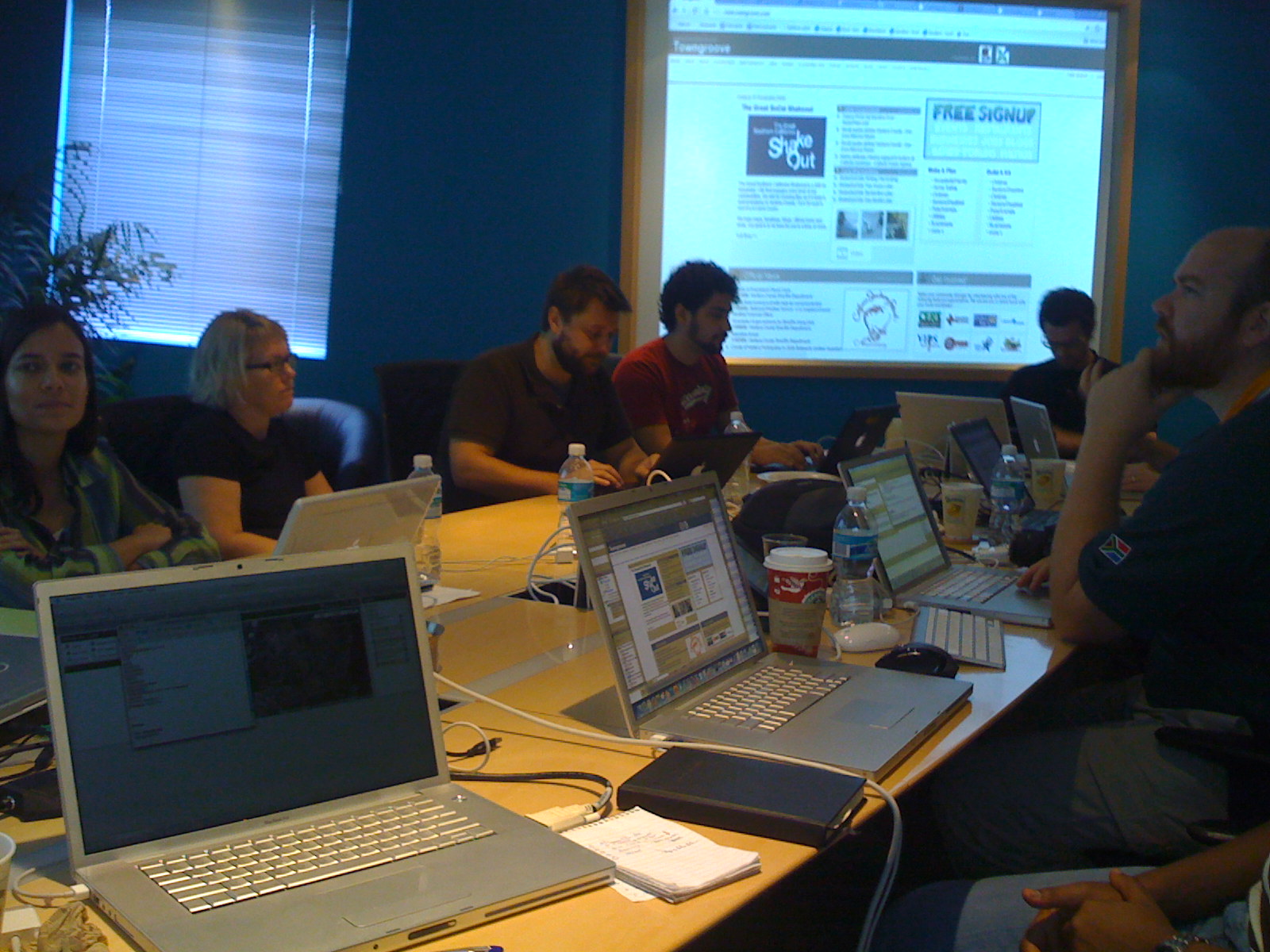
Our first CrisisMappers meeting took place in Orlando, Florida this past weekend. The meeting brought together a small group of tech professionals who are at the very cutting edge of crisis mapping. It truly was a powerhouse. Ushahidi, Development Seed, NiJEL, Emergencity, GeoCommons, InSTEDD, In.itiative and the Harvard Humanitarian Initiative (HHI). This meeting was mostly self-funded and scheduled on a Saturday. The fact that everyone showed up is a clear testament to the commitment we all have to pushing the new field of crisis mapping forward to the next frontier.

img_0001

Andrew Turner gave a typical tour de force presentation on some of the most exciting tech-innovations in mapping. I highly recommend viewing his slide show presentations available on Slideshare here. I gave the second introductory talk and chose to highlight two major themes in the future of crisis mapping: Mobile Crisis Mapping (MCM) and Crisis Mapping Analytics (CMA).

The former focuses on our understanding of dynamic mapping platforms as communication tools. In other words, all our communication tools should be fully integrated within our dynamic mapping platforms. Imagine a Google Map interface from which I can receive geo-referenced text messages and forward those messages by SMS broadcast or email right back to the field, without ever having to navigate away from the map. InSTEDD’s GeoChat is a good example of what I have in mind.

Understanding mapping platforms as communication tools poses two challenges common to communication in crisis zones. The first is connectivity while the second is data security. In terms of connectivity, we urgently need to move towards meshed-networked peer-to-peer communication that obviates the need for cell phone towers. As for encryption, SMS encryption should be the default setting on all our communications. Anything less is simply unsatisfactory.

I’ve written about Crisis Mapping Analytics before, so won’t go into detail here. I just want to point out that as our crisis mapping platforms continue to crowdsource data, we will need to make sense of this information in terms of trends over both space and time. We are still far from having any user friendly  point-and-click statistical tools for identifying such trends.

Since I was the only token humanitarian-wanna-be-geek at the meeting, I closed my introductory talk with the following three reminders: (1) if our crisis mapping tools work in humanitarian crises, they’ll work anywhere; (2) we need to identify methods and metrics to evaluate the impact of our crisis mapping platforms; (3) if you don’t keep your crisis mappers as simple as Fisher Price, they are unlikely to be adopted by the humanitarian community; call it the Fisher Price Theory of Crisis Mapping.

Let me expand on the latter point. What our colleagues in the tech-world need to keep in mind is that the vast majority of our partners in the field have never taken a computer science or software engineering course. Most of my humanitarian colleagues have done a Master’s degree in Humanitarian Affairs, International Development, etc. I guarantee you that 99.9% of these graduate programs do not include any seminar on humanitarian information management systems let alone computer science.

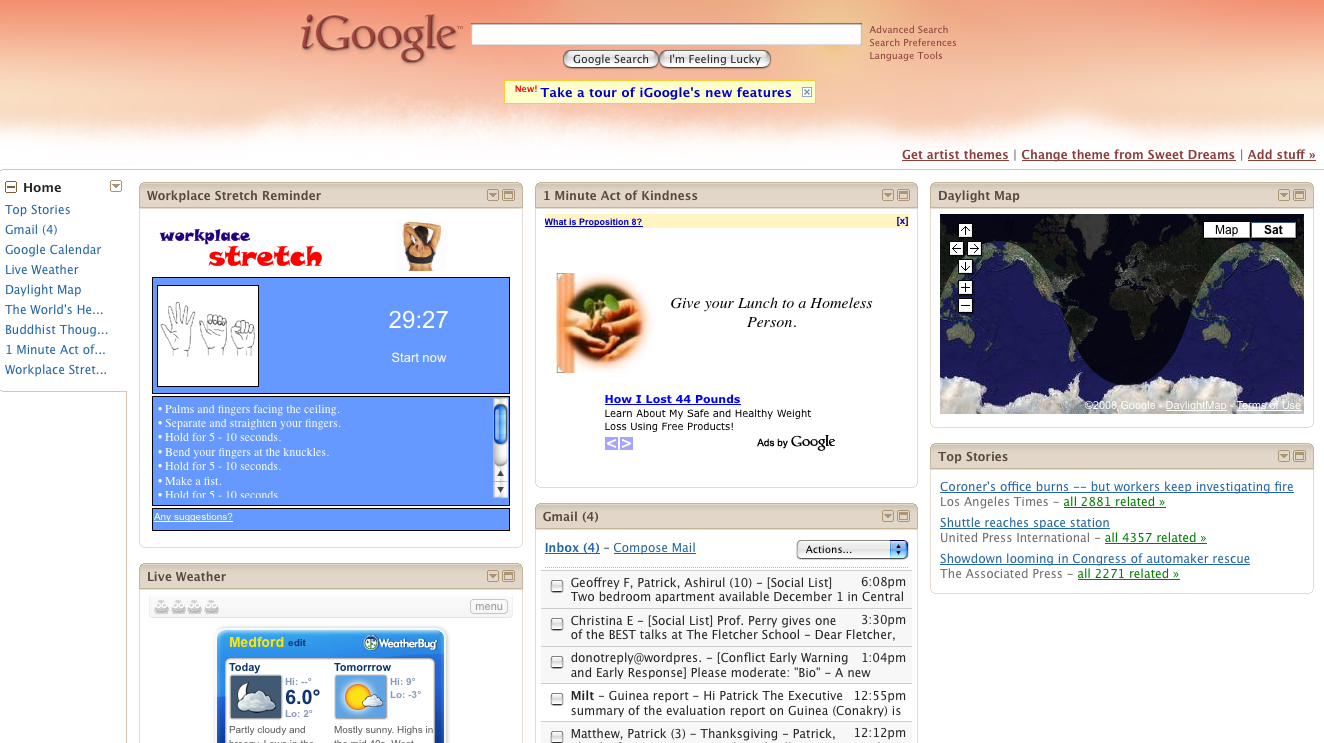
The onus thus falls on the techies to produce the most simple, self-explanatory, intuitive interfaces. What we in the humanitarian field want are interfaces as simple as computer games. We want software packages that are simply plug-and-play. Say an iGoogle approach which allows us humanitarians to import various “widgets” such as 2-way SMS broadcasting, wiki-mapping, etc.

picture-13

The rest of the CrisisMappers meeting was dedicated to a series of thought-provoking presentations on individual crisis mapping projects that each organization is working on. I shan’t attempt a summary here but shall close with the following. I had the good fortune of sitting next to Ushahidi’s David Kobia during the meeting. At one point, he turns to me and motions to his laptop screen: “Look, just got a text message from someone in the DRC.”

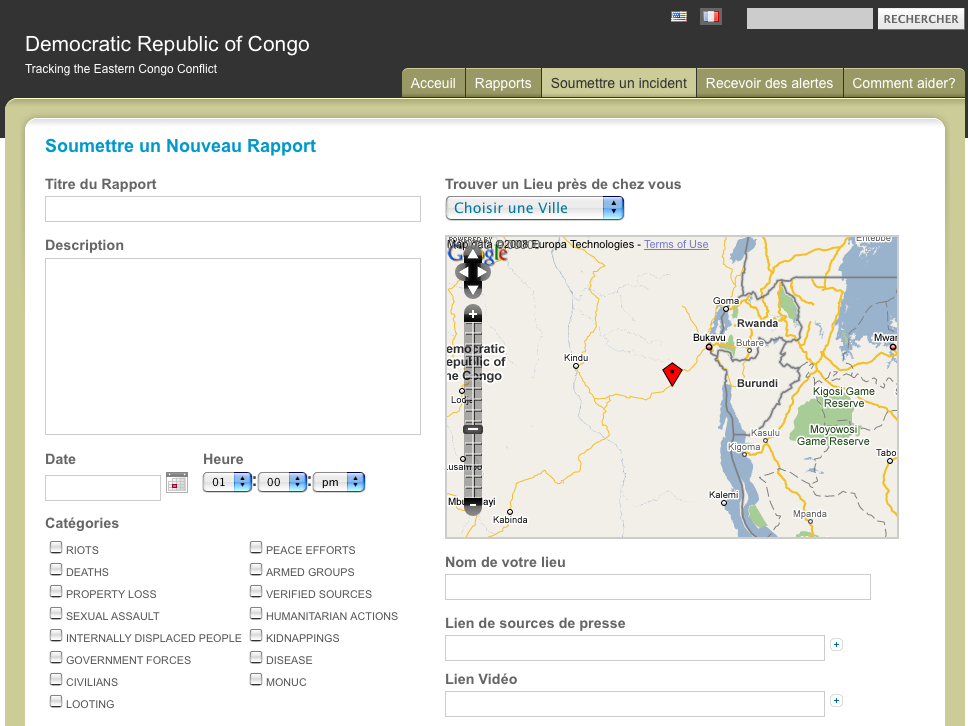
David was pointing to Ushahidi’s admin interface, and indeed, someone on the ground had gotten wind of Ushahidi’s new deployment and had texted the dedicated Ushahidi DRC number. The texter was expressing her/his concern that the DRC site was in English which posed problems for French speakers. The text message itself was in French. The Ushahidi team has been working diligently on a French version of the interface and are nearly finished. David asked me if I might be able to reply (in French) to the person and let them know that the completed interface will be ready next week. I did so, and pointed the texter to the “French Flag” icon on the Ushahidi DRC interface.

picture-32

Here’s what I find particularly neat about this exchange. First, here we were sitting in a conference room in Florida on a Saturday afternoon getting a text message from someone in the DRC interested in reporting events using Ushahidi’s DRC platform. Second, the admin interface that David had up set up was simple and clear to understand. Third, David had included two optional buttons to send one-click replies to the text messages he receives: (1) please send us more information on the event; (2) please send us more information on the location event. Simple yet elegant. After I finished typing my reply to the sender of the text message, I clicked on send and off went my message, right back to the field. All this took place in less than five minutes.

Patrick Philippe Meier