Category Archives: Digital Activism

Technologies and Practice for the Prevention of Mass Atrocity Crimes

I’ve waited years for a conference like this: “Early Warning for Protection: Technologies and Practice for the Prevention of Mass Atrocity Crimes.”

This high-level conference combines my main areas of interest: conflict early warning, crisis mapping, civilian protection and technology. I’ll be giving a keynote presentation on “The Potential of New Technologies in Conflict Early Warning” at this conference next week, and I’m particularly looking forward to the panel that will follow, co-organized with my colleague Phoebe Wynn-Pope.

The conference will explore a number of issues.

  • What is the role of new technologies in conflict early warning and how do they interact with more traditional monitoring systems?
  • How can we harness, coordinate, and utilize the sometimes overwhelming amount of information available?
  • What systems and mechanisms need to be put in place to ensure effective early-warning is given?
  • How does the humanitarian sector work effectively with communities at risk once early-warning has been sounded?
  • How can a change in attitude and behavior at a policy level be brought about in a way that forestalls a descent to violence?

In preparing for the presentation, I started re-reading some papers I had written several years ago including this one from 2008: “Bridging Multiple Divides in Early Warning and Response: Upgrading the Role of Information and Communication Technology” (PDF). I will base my presentation in part on this paper and welcome any feedback readers may have. If you don’t have time to read a 25-page paper, here’s a short summary in bullet point format:

  • The field of conflict early warning has largely been monopolized by academics who are obsessed with forecasting conflict.
  • Operational conflict early warning systems are little more than glorified databases.
  • The conflict early warning community’s track-record in successfully predicting (let alone preventing) armed conflict is beyond dismal.
  • State-centric and external approaches to conflict early warning and rapid response have almost systematically failed.
  • The disaster early warning community have long advocated for a people-centered approach to early warning given the failures of top-down, institutional methods.
  • The disaster early warning community has been an early adopter of new technologies, particularly those engaged in public health.
  • The purpose of a people-centered approach is to empower individuals so they can mitigate the impact of a disaster on their livelihoods and/or to get out of harm’s way.
  • Preparedness and contingency planning are core to a people-centered approach since natural hazards like earthquakes can’t be easily predicted let alone stopped.
  • Given the dismal failure of conflict early warning systems, the conflict prevention community should make conflict preparedness and contingency planning a top priority.
  • Precedents for a people-centered approach to conflict early warning  exists in the fields of strategic nonviolent action and digital activism.
  • More importantly, communities that experienced conflict have developed sophisticated coping strategies to evade and survive.
  • Some of these communities already use technologies to survive.

I will expand on these points with several real-world examples and, more importantly, will combine these with what I have learned over the past two years, specifically in terms of crisis mapping, new technologies and civilian resistance. I’m excited to put all of my thoughts together for this conference, and I especially look forward to feedback from readers and conversing with participants.

 

My Thoughts on Gladwell’s Article in The New Yorker, Part 2

The first part of my response to Gladwell’s article in The New Yorker explained why principles, strategies and tactics of civil resistance are important for the future of digital activism. In this second part, I address Gladwell’s arguments on high vs. low risk activism, weak vs. strong ties and hierarchies vs networks.

According to Stanford sociologist Doug McAdam, the civil rights movement represented “high-risk activism” which requires “strong-ties”. By strong-ties, McAdam refers to the bonds of friendship, family, relationships, etc. These social ties appear to be a necessary condition for recruiting and catalyzing a movement engaged in high-risk activism. “What mattered more was an applicant’s degree of personal connection to the civil-rights movement.” Indeed, you’re more likely to join a rally if your close friends are going. “One study of the Red Brigades, the Italian terrorist group of the nineteen-seventies, found that seventy per cent of recruits had at least one good friend already in the organization.”

In contrast, Gladwell argues that “the platforms of social media are built around weak ties.” The problem with evangelists of social media, according to him, is that they “believe a Facebook friend is the same as a real friend.” In addition, while “social networks are effective at increasing participation,” they only do so by “lessening the level of motivation that participation requires.”

Gladwell then adds the “networks versus hierarchies argument” to further his point. Strategic nonviolent action requires organization, planning and authority structures. Social media, on the other hand, “are not about this kind of hierarchical organization.” This is a “crucial distinction between traditional activism and its online variant,” says Gladwell.

Facebook and the like are tools for building networks, which are the opposite, in structure and character, of hierarchies. Unlike hierarchies, with their rules and procedures, networks aren’t controlled by a single central authority. Decisions are made through consensus, and the ties that bind people to the group are loose. This structure makes networks enormously resilient and adaptable in low-risk situations.

But it is simply a form of organizing which favors the weak-tie connections that give us access to information over the strong-tie connections that help us persevere in the face of danger. It shifts our energies from organizations that promote strategic and disciplined activity and toward those which promote resilience and adaptability. It makes it easier for activists to express themselves, and harder for that expression to have any impact.

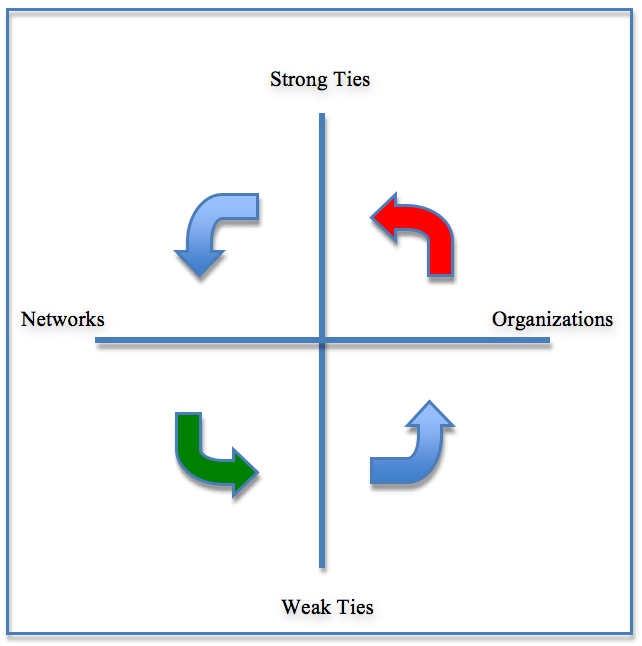
I tried to summarize Gladwell’s arguments in the diagram below and would be interested in feedback. The red arrow represents high-risk activism and the green low-risk. As per his argument, high-risk activism requires both strong ties and high levels of organization.

Gladwell makes a compelling case and one that I largely agree with, but not completely. Would the four colleague students who instigated the first wave of protests in North Carolina during the Winter of 1960 have turned down the opportunity to use email, SMS, Facebook or Twitter? Would their use of social media tools have caused their movement to fail? Would the strong-ties these students shared be diluted as a result of also being friends on Facebook? I personally doubt it, they would still have shown up at Woolworth.

Gladwell is right to distinguish between high-risk and low-risk activism but this is a false dichotomy. Not everyone in society faces the same kinds of risks, nor do they face the same levels of risk all the time. Total war in the Clausewitzian sense only holds true for thought-experiments. Indeed, a recent study study found that, “The average percentage of area covered by civil war […] is approximately 48%, but the average amount of territory with repeated fighting is considerably smaller at 15%.”

So if communities face a range of risks that span from low to high, then one would want to leverage both strong-ties and weak-ties along with appropriate organizational forms, offline tactics and social media tools. This means that both networks and hierarchies are needed; and that neither organizational form need remain static over time since risks are not static. Indeed, an effective social movement needs organizations that promote strategic and disciplined activity and networks that promote resilience and adaptability. Both are absolutely key to the practice of strategic nonviolent action.

There’s no doubt that the civil rights movement represented high-risk activism. Does this mean that the same methods used in the 1960s would work for high-risk activism in a country like Egypt, North Korea or even in Cambodia during the genocide that killed an estimated 1.2 to 1.7 million people?  Can the US media of the 1960s really be compared to North Korean media? As my colleague David Faris noted in a recent email exchange on Gladwell’s article,

The initial sit-ins may have been launched by a small group of people impervious to the danger, but they grew to 70,000 not only because close friends were doing it, but also because people saw acquaintances protesting, and decided that the level of risk required to participate had fallen. This is important because in the U.S. in 1960 the media were willing to report on these events. This is not the case across the authoritarian world, where news relayed by text and Twitter may be the only reliable source of information apart from your immediate circle of friends. By relaying information about the preferences of your weak ties, social media provide individuals with more accurate pictures of the preference-sets of other members of their community.

New social media tools don’t dictate the organizational form of the movement, they simply create more options. So a hierarchical organization can very well use new media platforms to conduct their own highly centralized movement. It’s just like the Ushahidi platform, it is a tool, not a methodology. If a group of protesters don’t put any serious time into planning their campaigns, identifying key strategies and tactics, training, drafting contingency measures, fund raising, etc., then the presence of social media tools will not explain why their protests are ineffective. It would be too easy of an excuse.

Ushahidi is only 10% of the solution

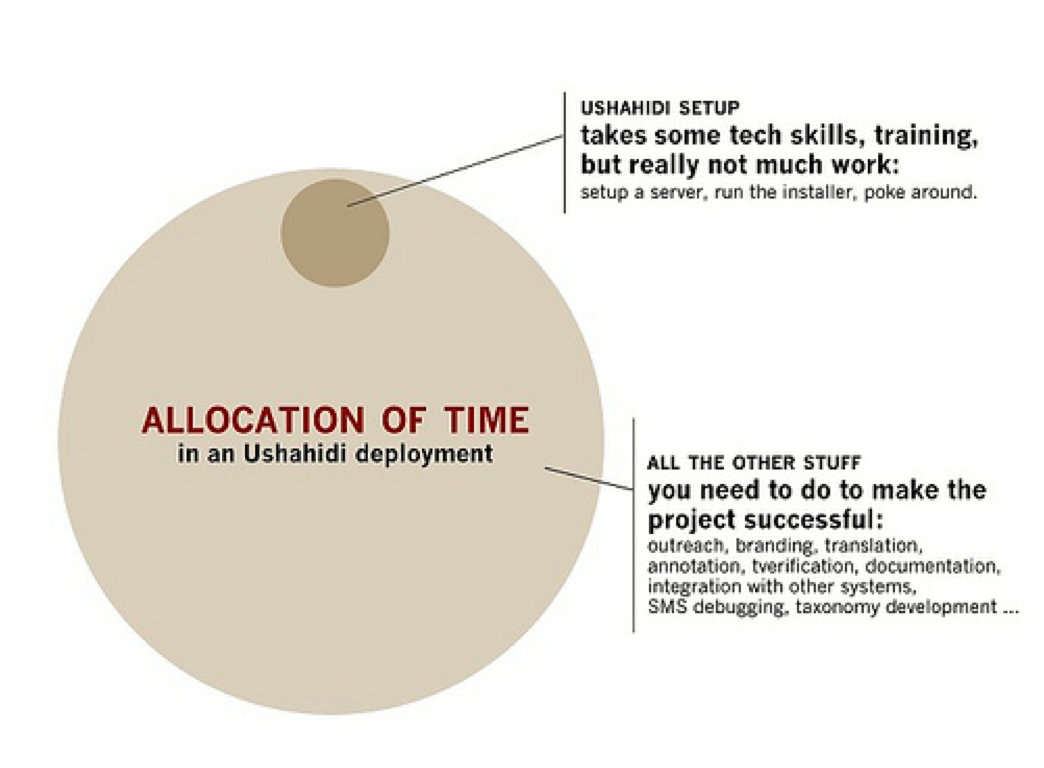
Here’s a graphic designed by my colleague Chris Blow that shows why technology is at most 10% of the solution (the context is Ushahidi but the principle applies more broadly). If a movement doesn’t take on “all the other stuff”, then it doesn’t matter whether members are part of a network, a centralized organization, have weak-ties or strong-ties, or whether they are in a high-risk or low-risk environment. They are unlikely to succeed.

My Thoughts on Gladwell’s Article in The New Yorker

Malcom Gladwell’s article “Small Change: Why the Revolution Will Not be Tweeted,” was forwarded to me by at least half-a-dozen colleagues after it was published just three days ago. I have purposefully not read other people’s responses to this piece so that I could write down my own observations before being swayed by those of others.

So what do I think? Finally, someone else is calling attention to the importance of  civil resistance (strategic nonviolent action) in the context of new digital technologies! This intersection is what I’m most excited about when it comes to the new tools of social media.

Gladwell uses the example of the civil rights movement, which in his own words was an example of “high-risk activism” and “also crucially, strategic activism: a challenge to the establishment mounted with precision and discipline.” Indeed, “the civil-rights movement was more like a military campaign than like a contagion.” Gladwell is spot on, strategic nonviolent action is nonviolent guerrilla warfare. If I’m not trained in civil resistance, then I can still use all the technology I want but the tools won’t necessarily make me more effective or make up for my lack of skills in nonviolent warfare.

But most tend to completely skip over the rich lessons learned from the long history of nonviolent action because they are more excited about the tools. As Gladwell notes, “Where activists were once defined by their causes, they are now defined by their tools.” But these tools were never used in the vast majority of protests in the history of the world. See this piece by the Global Post on “How to Run a Protest without Twitter.”

I specifically blogged about this issue two years ago in a post entitled: “Digital Resistance: Between Digital Activism and Civil Resistance.” Some excerpts:

The future of political activism in repressive environments belongs to those who mix and master both digital activism and civil resistance—digital resistance. Digital activism brings technical expertise to the table while civil resistance offers rich tactical and strategic competence.

At the same time, however, the practice of digital activism is surprisingly devoid of tactical and strategic know-how. In turn, the field of civil resistance lags far behind in its command of new information technologies for strategic nonviolent action.

In this blog post, I called attention to the work of Gene Sharp who is considered by many as one of the most influential scholars in the field of civil resistance. His book, Waging Nonviolent Struggle, is a must-read for anyone interested in strategic nonviolent action. I argue that digital activism needs  much stronger grounding in the tactics and strategies of nonviolent civil resistance. That is why I followed up with a second blog post in 2008 on “Gene Sharp, Civil Resistance and Technology.”

In The Politics of Nonviolent Action, Gene identifies 198 methods of nonviolent protest and persuasion. The majority of these can be amplified by modern communication technologies. What  follows is therefore only a subset of 12 tactics linked to applied examples of modern technologies. I very much welcome feedback on this initial list, as I’d like to formulate a more complete taxonomy of digital resistance and match the tactic-technologies with real-world examples from DigiActive’s website.

So when starting from the principles, strategies and tactics of civil resistance, I do think that the tools of social media can act as multiplier effect in a nonviolent campaign. Gladwell rightly likens the civil rights movement to a military campaign. And communication is central to the effectiveness of nonviolent campaigns. In fact, some of the most successful nonviolent campaigns detailed in numerous case studies turned on the ability to get accurate, timely information. The literature on military history also demonstrates that “success in counter-guerrilla operations almost invariably goes to the force which receives timely information.”

Effective civil resistance requires sound intelligence and strategic estimates. But Gladwell only dwells on the role of new technologies in the context of recruitment. He doesn’t consider the effect of new tools on information sharing and information cascades. And if Gladwell had the time to read more of McAdam’s work, he’d have come across other relevant causal mechanisms described in the literature that are relevant to the discussion.

I plan to follow up with a second post based on Gladwell’s piece to address his points on strong versus weak ties and hierarchies versus networks.

A Survey on Repression vs Liberation: Does Technology Make a Difference?

I’m getting started on the second half of my dissertation research. This will comprise a series of semi-structured interviews with individuals who are knowledgeable about the impact of information and communication technologies in four countries under authoritarian rule. These countries include: Burma, Iran, Ukraine and Zimbabwe.

I’ll be looking to interview at least 10 individuals per country case study. That means a total of 40 interviews between now and December. I also want to interview an additional 10 individuals who are not necessarily experts in one country per se but are particularly well informed about the overall subject matter. These 50 individuals will represent a mix of political activists, digital activists, technologists and academics who are either from the countries in question or experts on these countries.

I’d be most grateful for suggestions on which 50 individuals you might recommend touching base with. I already have a list about of about 30 but would like to compare this with reader suggestions. Please email me at patrick @ irevolution dot net. Obviously, I’m aware of the sensitivities around interviewing those colleagues who may be based in the countries in question. I will of course take appropriate precautions based on guidance from digital security professionals. Interviewees will remain anonymous in my own notes and these notes will be destroyed following my write-up which will be devoid of specific details and personal identifiers. Obviously, anyone I approach (directly or indirectly) can turn down the interview request.

I’d also be very interested in getting feedback on the survey questions I propose to ask. The ultimate question I want to answer is whether access to new ICTs empowers coercive regimes at the expense of resistance movements or vice-versa? The associated set of questions  below are based on a conceptual framework grounded on a comprehensive literature review. While these have already been approved by my dissertation chair, I’m keen to get a crowdsourced opinion. Feel free to add your thoughts on the comments section below or email them to me if you prefer.  Note that I will use more conversational language when posing the questions below. Thank you very much.

Mobilizing Structures
1. Are more individuals participating in social resistance? Why/why not? If so, how and is this changing?
2. Is the resistance becoming more contentious? Why/why not?
3. Are resistance movements better organized? Why/why not?

Opportunity Structures
4.
Do social resistance groups have more or less access to the political system? Why/why not?
5. Is state control of information communication increasing opportunity costs? Why/why not?

Digital Activism
6. How have resistance groups used ICTs to organize and mobilize? If so, how?
7. Have ICTs been critical to the success of social resistance activities? Why/why not?
8. How have state officials used ICTs to control resistance groups?
9. Have ICTs been critical to the success of controlling resistance activities? Why/why not? And if so, how?
10. Would you characterize the competition between coercive states and social movements as a game of cat-and-mouse? Why/why not? If so, who do you think is winning and why?

Standby Crisis Mappers Task Force: Apply Now!

Please click here to apply to the Crisis Mappers Volunteer Task Force.

_______________________________________________________

The disaster response to Haiti was unprecedented in terms of volunteer buy-in and contribution. It was also reactive. The hundreds of volunteers who rallied to the cause were certainly able and committed but one of the main challenges during the first few weeks was the need to train and maintain this informal network. The humanitarian community openly recognizes the important role that volunteer networks can play in crisis response. What they need now are guarantees that a trained and professionalized volunteer force can be on standby and activated within hours. The good news? Many of the volunteers I interacted with during the response to Haiti, Chile and now Pakistan are eager to join a professionalized volunteer standby team.

So what exactly are we waiting for? I posed this question to my colleagues George Chamales and Rob Munro in San Francisco yesterday. Indeed, there’s no reason to wait. We can get started now so we can take this initiative to the upcoming International Conference on Crisis Mapping (ICCM 2010) and get feedback from participants. The challenge, as mentioned in my previous blog post on Disaster Relief 2.0, is to find a way to interface an informal distributed network of volunteers with a highly organized and structured organization like UN OCHA. Three types of reliable networks are needed for this interface: (1) Tech Team; (2) Task Team; and (3) Crowd Force Team.

On the technical side, what colleagues and I have found to be particularly important is to have a group of software developers who are already highly experienced in deploying platforms like Ushahidi, FrontlineSMS, Sahana, etc. This is not about building new tools from scratch. The point here is to rapidly customize existing tools that have already seen action. On the Ushahidi side, there are more and more seasoned Ushahidi developers. These individuals are the ones who made the deployments in Haiti, Chile and Pakistan possible. This network of core technical and reliable volunteers doesn’t need to be large and it already exists.

What this group needs, however, is a support team that can take specific technical tasks given to them for implementation, e.g., fixing an important bug, etc. That way, the core team can focus on rapidly developing customized Ushahidi plugin’s and so on. We need to create a roster of standby software dev’s who are already qualified and ready to support the core team. This group largely exists already, but we need to formalize, professionalize and publicize this information on a dedicated site and turn them into a standby force.

The second type of standby group needed is the Task Team. These are individuals who are not software developers but savvy in media monitoring, geo-referencing, mapping, blogging on updates, etc. These individuals already exist, they played an invaluable role in contributing their time and skills to the responses in Haiti, Chile and Pakistan. Again, it’s just a matter of formalizing, professionalizing and publicizing the information, i.e., to render visible the capacity and assets that already exists, and to have them on standby.

This core task-based team also needs a strong support team for back-up, especially during the first few days of an emergency. This is where the Crowd Force Team comes in. This important team doesn’t need prior-training; only Internet access, browsing experience, an interest in online maps, news, etc. Perhaps most importantly, members of the Crowd Force Team are known for their energy, commitment, team-player attitude and can-do mentality.

We want to formalize this Standby Crisis Mappers Task Force in a professional manner. This means that individuals who want to be part of Tech, Task or Crowd Force Team need to apply. We will first focus on the Ushahidi platform. In the case of the Tech and Task team, interested applicants need to clearly demonstrate that they have the experience necessary to be part of the Standby Task Force. I would actually want to include representatives from the humanitarian community to participate in vetting the candidates who apply. Individuals who want to join the Crowd Force Team will also need to apply so we can keep a roster of the people power available along with their skill set.

There’s no reason we can’t do this. If we learned anything from Haiti, it’s that Community Emergency Response Teams (CERTs) don’t need to be physically present to contribute to disaster response thanks to online social networking tools and open source platforms like Ushahidi, etc. They can be part of the online community. We need CERTs 2.0 and just like traditional response teams, they should be trained and ready.

My experienced colleagues George Chamales and Anahi Ayala will lead the Technical and Task Teams respectively. Anahi will also coordinate the Crowd Force Team. They will help select the applicants, set up the appropriate communication channels and keep a calendar of which members of their teams are available for rapid response on a daily basis. Jaroslav Valuch and I will support George and Anahi in their efforts.

Please click here to apply to the Crisis Mappers Volunteer Task Force. Once we have developed a robust model for interfacing with the humanitarian community using the Ushahidi platform, we hope to work with other colleagues from FrontlineSMS, Sahana, etc., so that their qualified volunteers can be part of this dedicated Task Force.

The Future of Digital Activism and How to Stop It

I’ve been following a “debate” on a technology list serve which represents the absolute worse of the discourse on digital activism. Even writing the word debate in quotes is too generous. It was like watching Bill O’Reilly or Glenn Beck go all out on Fox News.

The arguments were mostly one-sided and mixed with insults to create public ridicule. It was blatantly obvious that those doing the verbal lynching were driven by other motives. They have a history of being aggressive and seeking provocation in public because it gets them attention, which further bloats their egos. They thrive on it. The irony? Neither of them have much of a track record to speak of in the field of digital activism. All they seem to do is talk about tech in the context of insulting others who get engaged operationally and try to make a difference. Constructive criticism is important, but this hardly qualifies. This is a shame as these individuals are otherwise quite sharp.

So how do we prevent a Fox-styled future of Digital Activism? First, ignore these poisonous debates. If people were serious about digital activism, the discourse would take on a very different tone, a professional one. Second, don’t be fooled, most of the conversations on digital activism are mixed with anecdotes, selection bias and hype, often to get media attention. You’ll find that most involved in the “study” of digital activism have no idea about methodology and research design. Third, help make data-driven, mixed-methods research on digital activism  possible by adding data to the Global Digital Activism Data Set (GDADS). The Meta-Activism Project (MAP) recently launched this data project to catalyze more empirical research on digital activism.

Is Ushahidi a Liberation Technology?

Professor Larry Diamond, one of my dissertation advisers, recently published a piece on “Liberation Technology” (PDF) in the Journal of Democracy in which he cites Ushahidi and FrontlineSMS amongst other tools. Is Ushahidi really a liberation technology?

Larry recently set up the Program on Liberation Technology at Stanford University together with colleagues Joshua Cohen and Terry Winograd to catalyze more rigorous, applied research on the role of technology in repressive environments—both in terms of liberation and repression. This explains why I’ll be joining the group as a Visiting Fellow this year. The program focuses on the core questions I’m exploring in my dissertation research and ties in technologies like Ushahidi which I’m directly working on.

What is Liberation Technology? Larry defines this technology as,

“… any form of information and communication technology (ICT) that can expand political, social, and economic freedom. In the contemporary era, it means essentially the modern, interrelated forms of digital ICT—the computer, the Internet, the mobile phone, and countless innovative applications for them, including “new social media” such as Facebook and Twitter.”

As is perfectly well known, however, technology can also be used to repress. This should not be breaking news. Liberation Technology vs Digital Repression. My dissertation describes this competition as an arms-race, a cyber game of cat-and-mouse. But the technology variable is not the most critical piece, as I argue in this recent Newsweek article:

“The technology variable doesn’t matter the most,” says Patrick Meier […] “It is the organizational structure that will matter the most. Rigid structures are unable to adapt as quickly to a rapidly changing environment as a decentralized system. Ultimately, it is a battle of organizational theory.”

As Larry writes,

“Democrats and autocrats now compete to master these technologies. Ultimately, however, not just technology but political organization and strategy and deep-rooted normative, social, and economic forces will determine who ‘wins’ the race.”

That is precisely the hypothesis I am testing in my dissertation research. As the Newsweek article put it,

“The only way to stay ahead in this cyberwar, though, is to play offense, not defense. ‘If it is a cat-and-mouse game,’ says Meier of Ushahidi, ‘by definition, the cat will adopt the mouse’s technology, and vice versa.’ His view is that activists will have to get better at adopting some of the same tactics states use. Just as authoritarian governments try to block Voice of America broadcasts, so protest movements could use newer technology to jam state propaganda on radio or TV.”

Larry rightly notes that,

“In the end, technology is merely a tool, open to both noble and nefarious purposes. Just as radio and TV could be vehicles of information pluralism and rational debate, so they could also be commandeered by totalitarian regimes for fanatical mobilization and total state control. Authoritarian states could commandeer digital ICT to a similar effect. Yet to the extent that innovative citizens can improve and better use these tools, they can bring authoritarianism down—as in several cases they have.”

A bold statement for sure. But as Larry recognizes, it is particularly challenging to disentangle political, social and technology factors. This is why more empirical research is needed in this space which is largely limited to qualitative case-studies. We need to bring mixed-methods research to the study of digital activism in repressive environments. This is why I’m part of the Meta-Activism Project (MAP) and why I’m particularly excited to be collaborating on the development of a Global Digital Activism Dataset (GDADS).

Larry writes that Liberation Technology is also “Accountability Technology” in that “it provides efficient and powerful tools for transparency and monitoring.” This is where he describes the FrontlineSMS and Ushahidi platforms. In some respects, these tools have already served as liberation technologies. The question is, will innovative citizens improve these tools and use them more effectively to be able to bring down dictators? I’d love to know your thoughts.

Patrick Philippe Meier

Wanted: Hyper Local Disruption

Why does the newly opened residential building that I’m moving into in San Francisco have no online social network connecting it’s residents? Some four hundred people live here but they remain completely disconnected, strangers. That really gets to me. We talk about international networks of digital activists spanning the globe from New York to Iran via Zimbabwe and Burma. Yet we remain completed disconnected at the hyper local level.

There’s a good reason why many repressive regimes prohibit large public meetings. These meetings allow people to connect, exchange  information and yes, plot. At The Fletcher School (not a repressive environment), we have a list-serve for the student body called “the social list,” which helps Fletcherites connect, exchange and plot. This an opt-in system and not all students choose to get on the list-serve. The vast majority do, however, and the social list has become an integral component of the “Fletcher experience.”

The list has been the site of many political discussions and disagreements, but also an incredible source of information for a wide variety of (real-time) needs: “I lost my contact lenses, anyone have -0.5 vision ones handy?”, “Looking for internships in Cote d’Ivoire, any recommendations?”, “I’ve launched an Ushahidi map for Haiti and need all the help I can get!” What makes this a versatile network is not simply that members share the “Fletcher identify” but that they are geographically concentrated. It matters that members of this network have the opportunity to see each other on a regular basis.

The Pew Internet & American Life Project recently released a new report on how people use the Internet to stay up to speed on happenings in their neighborhood (H/T Chrissy Martin). “The report showed that face-to-face encounters with neighbors remain the primary method that people talk with each other about community issues.” Proximity matters. More interesting findings as reported in AmericanCity.org:

When it comes to online tools such as email, blogs, text messaging and social networking, only about one fifth of Americans (and 27% of internet users) report such activity. At first glance, this figure may seem underwhelming. But when you consider that practically the same number of Americans (21%) use the telephone to talk about community issues with their neighbors, the numbers don’t seem so bad.

To dispel stereotypes about Internet-addicted shut-ins, the report also points out that frequent Internet use is not correlated with a lack of community engagement (measured simply via if you know your neighbors’ names or not, and how often you talk to them). In fact, daily Internet users are more likely to know their neighbors’ names, and talk with them face to face, than non Internet users.

Just as the New Urbanists have sought to put front porches on homes to get people talking, developers of online tools like social networks can begin to think about how to create virtual opportunities for a “neighborly chat”.

Being connected increases the probability of synergies not to mention serendipity at the local level. Off-line activism is easier if we’re all in the same place. We don’t have to wait until a major issue crops up to organize as digital activists. A simple list-serve can be very useful during quiet times; it increases social cohesion between residents and builds trust. In sum, hyper local connectivity can change the balance of power between people and institutions.

So back to my new building in San Francisco. I did ask the real estate rep whether the building came with an online social network. “No,” was the answer. “You mean none of the residents are connected in any way?” “No” again. For me this is like a smart phone that comes without an address book. You’d think with the new move towards open, connected cities, smart buildings, etc., that new residences would include an online social network component “straight out of the box.” Not so.

This is nuts. For all I know, out of the 400+ residents in my building, 3 could be venture capitalists interested in supporting Ushahidi. Perhaps 14 could become lifelong friends. Maybe another 6 might inspire new ideas that could help human rights monitoring in Burma. Who knows? Nobody. Nobody knows because there’s no online social network to find out.

This means I’ll have to do it myself. I was initially hesitating between a Google Group, a Ning platform and Meetup.com. I’m thinking of starting out with a simple Google Group and potentially transitioning to MeetUp. Any thoughts? As for how I’m going to spread the word, I was thinking of doing the old fashioned flyer-under-the-door trick. I’ll start with my floor and see what happens. Stay tuned for blog updates next month.

Oh, and as for the focus of my first “disruptive” plot, I’m going to find out if we can create an open WiFi movement between immediate neighbors.

Patrick Philippe Meier

Cognitive Surplus Implications for Digital Activism in Repressive Environments

This is the second of two blog posts inspired by Clay Shirky’s new book “Cognitive Surplus: Creativity and Generosity in a Connected Age.” The “cognitive surplus” that Clay refers to is the ” buildup of well over a trillion hours of free time each year on the part of the world’s educated population.” And unlike any other time in human history, “we can now treat free time as a general social asset that can be harnessed for large, communally created projects, rather than a set of individual minutes to be whiled away one person at a time.”

The notion of “cognitive surplus” touches on some of the arguments I’ve made regarding the competition between digital activists and repressive regimes—the time and organizational factor. As noted by this guide on nonviolent struggle, “time is perhaps the most important resource in a struggle.” The question is, which side—or organizational topology—can make best use of this time?

The trillion hours of free time and low cost of discovery afforded by today’s communication technologies means that individuals can find themselves more easily and network around a cause. This gives rise to new actors as noted by Clay:

The competition between the government and the people has thus become an arms race, but one that involves a new class of participants. When teenage girls can help organize events that unnerve national governments, without needing professional organizations or organizers to get the ball rolling, we are in new territory.

I don’t think the same is true of repressive regimes. Give a dictator more free time but will they spend this time finding new creative ways to repress? Or will they instead spend this extra time buying new luxury cars while taking time off on a yacht off the coast of Monaco? Ah, but how about those who work for said dictator? Clay argues that “having to act on behalf of an authority can be one of life’s great demotivators.” Moreover,

Amateurs are sometimes separated from professionals by skill, but always by motivation; the term itself derives from the Latin amare—to love. The essence of amateurism is intrinsic motivation: to be an amateur is to do something for the love of it.

This motivation also affects how amateurs work in groups. Keeping a large group focused can be a full-time job. (It’s middle management’s reason for being, in one phrase). Organizing groups into an effective whole is brutally difficult that, past a certain scale, it requires professional management. Professional managers in turn require salaries, and salaries require income and bookkeeping and all the rest of the trappings of a formal organization, meaning there is a huge step between a bunch of people who really care about that issue and work together to do something about it.

This goes to the heart of my hypothesis for my dissertation research. See my previous blog post: Where I Stand on Digital Activism. In sum, the unprecedented trillion hour cognitive surplus is more likely to empower digital activists at the expense of coercive regimes.

Patrick Philippe Meier

Information Sharing During Crisis Management in Hierarchical vs. Network Teams

The month of May turned out to be ridiculously busy, so much so that I haven’t been able to blog. And when that happens, I know I’m doing too much. So my plan for June is to slow down, prioritize and do more of what I enjoy, e.g., blog.

In the meantime, the Journal of Contingencies and Crisis Management just published an interesting piece on “Information Sharing During Crisis Management in Hierarchical vs. Network Teams.” The topic and findings have implications for digital activism as well as crisis management.

Here’s the abstract:

This study examines the differences between hierarchical and network teams in emergency management. A controlled experimental environment was created in which we could study teams that differed in decision rights, availability of information, information sharing, and task division. Thirty-two teams of either two (network) or three (hierarchy) participants (N=80 in total) received messages about an incident in a tunnel with high-ranking politicians possibly being present. Based on experimentally induced knowledge, teams had to decide as quickly and as accurately as possible what the likely cause of the incident was: an attack by Al Qaeda, by anti-globalists, or an accident. The results showed that network teams were overall faster and more accurate in difficult scenarios than hierarchical teams. Network teams also shared more knowledge in the difficult scenarios, compared with the easier scenarios. The advantage of being able to share information that is inherent in network teams is thus contingent upon the type of situation encountered.

The authors define a hierarchical team as one in which members pass on information to a leader, but not to each other. In a network team, members can freely exchange information with each other. Here’s more on the conclusions derived by the study:

Our goal with the present study was to focus on a relatively simple comparison between a classic hierarchical structure and a network structure. The structures differed in terms of decision rights, availability of information, information sharing, and task division. Although previous research has not found unequivocal support in terms of speed or accuracy for one structure or the other, we expected our network structure to perform better and faster on the decision problems. We also expected the network teams to learn faster and exchange more specialist knowledge than the hierarchical teams.

Our hypotheses are partially supported. Network teams are indeed faster than hierarchical teams. Further analyses showed that network teams were, on average, as fast as the slowest working individual in the hierarchical teams. Analyses also showed that network teams very early on converged on a rapid mode of arriving at a decision, whereas hierarchical teams took more time. The extra time needed by hierarchical teams is therefore due to the time needed by the team leader to arrive at his or her decision.

We did not find an overall effect of team structure on the quality of team decision, contrary to our prediction. Interestingly, we did find that network teams were significantly better than hierarchical teams on the Al Qaeda scenarios (as compared with the anti-globalist scenarios). The Al Qaeda scenarios were the most difficult scenarios. Furthermore, scores on the Post-test showed that there was a larger transfer of knowledge on Al Qaeda from the specialist to the nonspecialist in the network condition as compared with the hierarchical condition. These results indicate that a high level of team member interaction leads to shared specialist knowledge, particularly in difficult scenarios. This in turn leads to more accurate decisions.

This study focused on the information assessment part of crisis management, not on the operative part. However, there may not be that much of a difference in terms of the actual teamwork involved. When team members have to carry out particular tasks, they may frequently also have to share specialist knowledge. Wilson, Salas, Priest, and Andrews (2007) have studied how teamwork breakdowns in the military may contribute to fratricide, the accidental shooting of one’s own troops rather than the enemy. This is obviously a very operative part of the military task. Teamwork breakdowns are subdivided into communication, coordination and cooperation, with information exchange mutual performance monitoring, and mutual trust as representative teamwork behaviours for each category (Wilson et al., 2007).

We believe that it is precisely these behaviours that are fostered by network structures rather than hierarchical structures. Network structures allow teams to exchange information quickly, monitor each other’s performance, and build up mutual trust. This is just as important in the operative part of crisis management work as it is in the information assessment part.

In conclusion, then, network teams are faster than hierarchical teams, while at the same time maintaining the same level of accuracy in relatively simple environments. In relatively complex environments, on the other hand, network teams arrive at correct decisions more frequently than hierarchical teams. This may very likely be due to a better exchange of knowledge in network teams.

Patrick Philippe Meier