Category Archives: Digital Activism

Latest Empirical Findings on Democratic Effects of the Internet

Jacob Groshek from Iowa State University recently published the latest results from his research on the democratic effects of the Internet in the International Journal of Communication. A copy of Groshek’s study is available here (PDF).

Groshek published an earlier study in 2009 which I blogged about here. In this latest set of findings, Groshek concludes that “Internet diffusion was not a specific causal mechanism of national-level democratic growth during the timeframe analyzed,” which was 1994-2003. The author therefore argues that “the diffusion of the Internet should not be considered a democratic panacea, but rather a component of contemporary democratization processes.” Interestingly, these conclusions seem to contradict his findings from 2009.

The purpose of this blog post is to summarize Groshek’s research so I can include it in my dissertation’s literature review. What follows therefore are some excerpts that summarize Groshek’s research design and methodology. I also add my thoughts on the study and the implications of the findings.

Some Background:

“Technological developments, especially communicative ones, have long been positioned — and even romanticized — as powerful instruments of democracy (Dunham, 1938; Lerner, 1958). This tradition goes back at least as far as the printing press and its contribution to democratic movements of past centuries (Schudson, 1999) in relation to conceptions of the public sphere and the fourth estate (Jones, 2000). Over the course of the past century, telegraphs, telephones, radios, and televisions were all introduced as “new” media, and each of these technologies were often ascribed broad potential for enhancing democratic development around the world (Becker, 2001; Navia & Zweifel, 2006; Spinelli, 1996).”

The Methodology:

“Though there are many ways to operationalize democracy and measure the prevalence of media technologies, this study relies principally on macro-level time–series democracy data from an historical sample that includes 72 countries, reaching back as far as 1946 in some cases, but at least from 1954 to 2003. From this sample, a sequence of ARIMA (autoregressive integrated moving average) time–series regressions were modeled for each country for at least 40 years prior to 1994.”

“These models were then used to generate statistically-forecasted democracy values for each country, in each year from 1994 to 2003. A 95% confidence interval with an upper and lower democracy score was then constructed around each of the forecasted values using dynamic mean squared errors. The actual democracy scores of each country for each year from 1994 to 2003 were then compared to the upper and lower values of the confidence interval.”

The Results:

“Based on the statistical findings, three countries that demonstrated democracy levels greater than those statistically predicted  [Croatia, Indonesia and Mexico] were selected for brief contemporary historical analyses to identify whether the Internet acted as a specific causal mechanism that may have contributed to democratization processes. These case study evaluations were basic overviews of historical events, figures, and policies that placed these findings into context to better specify what precise role, if any, the Internet had on the increases in democracy observed in these three countries that were greater than they had been predicted to be, statistically.”

Interestingly, out of the 72 countries studied, the only one with democracy scores significantly below the statistically predicted score was Belarus.

“While the purpose of this study is to more specifically assess the possibility that Internet diffusion might be linked to democratic growth, the case of Belarus provides an important counterbalance to that concept. This is because, starting with 1995, the actual democracy score was less than the predicted democracy score — and it remained below the predicted values through 2003, even though Internet diffusion reached approximately 14% by the end of the time frame investigated. Thus, it is evident that less democratic countries can invest in increasing Internet diffusion and still constrict democratic development.”

What about Croatia, Indonesia and Mexico?

“A circumspect approach to understanding the role Internet diffusion played in Croatia’s democratization is to recognize that, by most accounts, it was an important factor that helped determine the trajectory of political development in this country. It was not, however, the defining feature of this democratic transition, which was set in motion years earlier by a coalescing of events and political figures that also transcended Croatia’s national boundaries (Hampton, 2007).”

“Indonesia had observed actual democracy levels greater than that of the predicted confidence interval from 1999 to 2003. Yet, for nearly all of the timeframe investigated here, Indonesian media development was tightly restricted by the government and subject to severe censorship (Eick, 2007), so it seems unlikely that the diffusion of the Internet would be a critical democratic agent. In addition, the diffusion of the Internet was a paltry 0.44 people per 100 in 1999, when the democracy level spiked through the upper confidence interval of the predicted value.”

“[In the final case, it is] impossible to summarily conclude that Mexico was more democratic precisely due to Internet diffusion than it would have been had the Internet not diffused, at least when considering institutionalized national level democracy. This is because the transnational civil society network pioneered by the Zapatistas was more about élites who had Internet access and how the Zapatistas tapped this group and projected their ideological views through the Internet, even though, in Mexico, the Internet only reached a tiny portion of the general population. Therefore, it was not high levels of Internet diffusion among the Mexican citizens in 1994, but rather influential Internet users that contributed democratic change during that time period.”

In Conclusion:

“The results of the investigations undertaken in this study yield no conclusive evidence that the democratic growth from 1994 to 2003 was due singularly, or even primarily, to the diffusion of the Internet.”

Side note: I personally don’t know anyone or of any empirical study that claims that democratic growth around the world is singularly or even primarily due to the Internet. Do you?

“It is therefore prudent to consider the Internet a potentially potent but underutilized democratic tool, one that is only as useful as the citizens who employ and implement it for political purposes (Schudson, 2003). Thus far, the Internet has not been diffused or activated to an extent that this technology has sustained the third democratic wave (Huntington, 1991). Importantly, virtuosity and democratic agency are not inherent in media technologies, no matter how interactive or participatory. Rather, these exist in individuals, and in the crucial applications and uses they make of communicative technologies (Nord, 2001; Schudson, 1999, 2003).”

“Thus, the general conclusion of this study is that the Internet has not catalyzed transformative, national-level democratic growth, although there is some reason to believe that it may contribute to these changes, as the cases of Mexico and Croatia exhibit. This finding, of course, does not rule out the possibility that there may be national-level democratic effects related to Internet diffusion in the future, nor does it rule out possible effects on personal or other sub-national levels.”

It’s great to see more data-driven research on this topic and be spared (albeit temporarily) anecdote-laden and chronically repetitive popular media reports on technologies being either all-liberating or all-repressive. A possible corollary to Groshek’s  findings is that the use of the Internet by repressive regimes did not lead to a statistically significant decrease in expected democracy scores.  In other words, dictators may love the web, but that romance ain’t having a macro-level impact on the level of repression.

Obviously, multiple factors contribute to democratic processes and transitions. The more interesting questions, in my opinion, are these: what are the underlying drivers of protest movements and how might new technologies accelerate those drivers and/or create new ones? Along these lines, how do tactics and strategies from civil resistance benefit from using new technologies? Does the careful, planned and innovative use of these technologies in social protests provide activists with a competitive edge they didn’t have in the past?

Update: My colleague Mary Joyce makes an excellent point regarding the time span covered by the analysis, i.e., through to 2003. As she rightly notes, major social media platforms used for activism, like YouTube (2005), Facebook (2004) and Twitter (2006), were created after 2003. See her blog post here for more of her analysis on Groshek’s work.

The Political Power of Social Media

Clay Shirky just published a piece in Foreign Affairs on “The Political Power of Social Media.” I’m almost done with writing my literature review of digital activism in repressive states for my dissertation so this is a timely write-up by Clay who also sits on my dissertation committee. The points he makes echo a number of my blog posts and thus provides further support to some of the arguments articulated in my dissertation. I’ll use this space to provide excerpts and commentary on his 5,000+ word piece to include in my literature review.

“Less than two hours after the [Philippine Congress voted not to impeach President Joseph Estrada], thousands of Filipinos […] converged on Epifanio de los Santos Avenue, a major crossroads in Manila. The protest was arranged, in part, by forwarded text messages reading, ‘Go 2 EDSA. Wear blk.’ The crowd quickly swelled, and in the next few days, over a million people arrived, choking traffic in downtown Manila.”

“The public’s ability to coordinate such a massive and rapid response — close to seven million text messages were sent that week — so alarmed the country’s legislators that they reversed course and allowed the evidence to be presented. Estrada’s fate was sealed; by January 20, he was gone. The event marked the first time that social media had helped force out a national leader. Estrada himself blamed ‘the text-messaging generation’ for his downfall.”

“As the communications landscape gets denser, more complex, and more participatory, the networked population is gaining greater access to information, more opportunities to engage in public speech, and an enhanced ability to undertake collective action. In the political arena […] these increased freedoms can help loosely coordinated publics demand change.”

See this blog post on Political Change in the Digital Age: The Prospect of Smart Mobs in Authoritarian States.

“The Philippine strategy has been adopted many times since. In some cases, the protesters ultimately succeeded, as in Spain in 2004, when demonstrations organized by text messaging led to the quick ouster of Spanish Prime Minister José María Aznar, who had inaccurately blamed the Madrid transit bombings on Basque separatists. The Communist Party lost power in Moldova in 2009 when massive protests coordinated in part by text message, Facebook, and Twitter broke out after an obviously fraudulent election.”

“There are, however, many examples of the activists failing, as in Belarus in March 2006, when street protests (arranged in part by e-mail) against President Aleksandr Lukashenko’s alleged vote rigging swelled, then faltered, leaving Lukashenko more determined than ever to control social media. During the June 2009 uprising of the Green Movement in Iran, activists used every possible technological coordinating tool to protest the miscount of votes for Mir Hossein Mousavi but were ultimately brought to heel by a violent crackdown. The Red Shirt uprising in Thailand in 2010 followed a similar but quicker path: protesters savvy with social media occupied downtown Bangkok until the Thai government dispersed the protesters, killing dozens.”

“The use of social media tools — text messaging, e-mail, photo sharing, social networking, and the like — does not have a single preordained outcome. Therefore, attempts to outline their effects on political action are too often reduced to dueling anecdotes.”

Clay picks up on some of my ongoing frustration with the “study” of digital activism. He borrows his dueling analogy from some of my earlier blog post of mine in which I chide the popular media for sensationalizing anecdotes. See for example:

“Empirical work on the subject is also hard to come by, in part because these tools are so new and in part because relevant examples are so rare. The safest characterization of recent quantitative attempts to answer the question, Do digital tools enhance democracy? (such as those by Jacob Groshek and Philip Howard) is that these tools probably do not hurt in the short run and might help in the long run — and that they have the most dramatic effects in states where a public sphere already constrains the actions of the government.”

Reading this made me realize that I need to get my own empirical results out in public in the coming weeks. As part of my dissertation research, I used econometric analysis to test whether an increase in access to mobile phones and the Internet serves as a statistically significant predictor of anti-government protests. So I’ll add this to my to-do list of blog posts and will also share my literature review in full as soon as I’m done with that dissertation chapter.

In the meantime, have a look at the Global Digital Activism Dataset (GDADS) project that both Clay and I are involved in to spur more empirical research in this space.

Although the story of Estrada’s ouster and other similar events have led observers to focus on the power of mass protests to topple governments, the potential of social media lies mainly in their support of civil society and the public sphere — change measured in years and decades rather than weeks or months. [We] should likewise assume that progress will be incremental and, unsurprisingly, slowest in the most authoritarian regimes.

I wrote up a blog post just a few weeks ago on “How to Evaluate Success in Digital Resistance: Look at Guerrilla Warfare,” which makes the same argument. Clay goes on to formulate two perspectives on the role of social media in non-permissive environments, the instrumentalist versus environmental schools of thought.

“The instrumental view is politically appealing, action-oriented, and almost certainly wrong. It overestimates the value of broadcast media while underestimating the value of media that allow citizens to communicate privately among themselves. It overestimates the value of access to information, particularly information hosted in the West, while underestimating the value of tools for local coordination. And it overestimates the importance of computers while underestimating the importance of simpler tools, such as cell phones.”

“According to [the environmental view], positive changes in the life of a country, including pro-democratic regime change, follow, rather than precede, the development of a strong public sphere. This is not to say that popular movements will not successfully use these tools to discipline or even oust their governments, but rather that U.S. attempts to direct such uses are likely to do more harm than good. Considered in this light, Internet freedom is a long game, to be conceived of and supported not as a separate agenda but merely as an important input to the more fundamental political freedoms.”

One aspect that I particularly enjoy about Clay’s writings is his use of past examples from history to bolster his arguments.

“One complaint about the idea of new media as a political force is that most people simply use these tools for commerce, social life, or self-distraction, but this is common to all forms of media. Far more people in the 1500s were reading erotic novels than Martin Luther’s “Ninety-five Theses,” and far more people before the American Revolution were reading Poor Richard’s Almanack than the work of the Committees of Correspondence. But those political works still had an enormous political effect.”

“Just as Luther adopted the newly practical printing press to protest against the Catholic Church, and the American revolutionaries synchronized their beliefs using the postal service that Benjamin Franklin had designed, today’s dissident movements will use any means possible to frame their views and coordinate their actions; it would be impossible to describe the Moldovan Communist Party’s loss of Parliament after the 2009 elections without discussing the use of cell phones and online tools by its opponents to mobilize. Authoritarian governments stifle communication among their citizens because they fear, correctly, that a better-coordinated populace would constrain their ability to act without oversight.”

Turning to the fall of communism, Clay juxtaposes the role of communication technologies with the inevitable structural macro-economic forces that lifted the Iron Curtain.

“Any discussion of political action in repressive regimes must take into account the astonishing fall of communism in 1989 in eastern Europe and the subsequent collapse of the Soviet Union in 1991. Throughout the Cold War, the United States invested in a variety of communications tools, including broadcasting the Voice of America radio station, hosting an American pavilion in Moscow  […], and smuggling Xerox machines behind the Iron Curtain to aid the underground press, or samizdat.”

“Yet despite this emphasis on communications, the end of the Cold War was triggered not by a defiant uprising of Voice of America listeners but by economic change. As the price of oil fell while that of wheat spiked, the Soviet model of selling expensive oil to buy cheap wheat stopped working. As a result, the Kremlin was forced to secure loans from the West, loans that would have been put at risk had the government intervened militarily in the affairs of non-Russian states.”

“In 1989, one could argue, the ability of citizens to communicate, considered against the background of macroeconomic forces, was largely irrelevant. Communications tools during the Cold War did not cause governments to collapse, but they helped the people take power from the state when it was weak. […]. For optimistic observers of public demonstrations, this is weak tea, but both the empirical and the theoretical work suggest that protests, when effective, are the end of a long process, rather than a replacement for it.”

Clay also emphasizes the political importance of conversation over the initial information dissemination effect:

“Opinions are first transmitted by the media, and then get echoed by friends, family members, and colleagues. It is in this second, social step that political opinions are formed. This is the step in which the Internet in general, and social media in particular, can make a difference. As with the printing press, the Internet spreads not just media consumption but media production as well — it allows people to privately and publicly articulate and debate a welter of conflicting views.”

How about the role of social media in organization and coordination?

“Disciplined and coordinated groups, whether businesses or govern-ments, have always had an advantage over undisciplined ones: they have an easier time engaging in collective action because they have an orderly way of directing the action of their members. Social media can compensate for the disadvantages of undisciplined groups by reducing the costs of coordination. The anti-Estrada movement in the Philippines used the ease of sending and forwarding text messages to organize a massive group with no need (and no time) for standard managerial control. As a result, larger, looser groups can now take on some kinds of coordinated action, such as protest movements and public media campaigns, that were previously reserved for formal organizations.”

I’m rather stunned by this argument: “Social media can compensate for the disadvantages of undisciplined groups by reducing the costs of coordination.” Seriously? If a group is unorganized and undisciplined, advocating that it use social media—particularly in a repressive environment—is highly inadvisable. Turning an unorganized and undisciplined mob into a flash mob thanks to social media tools does not make it a smart mob. Clay’s argument directly contradicts the  rich empirical research that exists on civil resistance in authoritarian states.

“For political movements, one of the main forms of coordination is what the military calls ‘shared awareness,’ the ability of each member of a group to not only understand the situation at hand but also understand that everyone else does, too. Social media increase shared awareness by propagating messages through social networks.”

Political Change in the Digital Age: The Prospect of Smart Mobs in Authoritarian States

The latest edition of the SAIS Review of International Affairs is focused on cyber threats and opportunities. My Stanford colleague Rob Munro and I contributed a piece on crowdsourcing SMS for crisis response. Colleagues at Harvard’s Berkman Center wrote this piece on political change in the digital age—specifically with respect to authoritarian and semi-authoritarian regimes. Their research overlaps considerably with my dissertation so what follows is a short summary of their article.

Bruce Etling, Robert Faris and John Palfrey basically argue that policymakers and scholars have been focusing too narrowly on the role of digital technology in providing unfiltered access to the Internet and independent sources of information. They argue that “more attention should be paid to the means of overcoming the difficulties of online organization in the face of authoritarian governments in an increasingly digital geopolitical environment.” The authors thus seek to distinguish between flow of information and social organization facilitated by digital tools.

“While information and organizing are inextricably linked—photographs and videos play an important and growing role in empowering and motivating social activists—it is helpful to consider them separately as the use of technology entails different opportunities and challenges for each.”

They therefore develop a simple analytical framework to describe the interaction between civil society, media and governments in different types of regimes.

They argue that to understand the role of digital tools on democratic processes, “we must better understand the impact of the use of these tools on the composition and role of civil society.” Etling, Faris and Palfrey therefore assess the influence of digital technologies on the formation and activities of civil society groups—and in particular mobs, movements and civil society organizations. See Figure 2 below.

The authors claim that “hierarchical organizations with strong networks—the mainstay of civil society in consolidated democracies—are not a viable option in authoritarian states.” No news there. They write that civil society organizations (CSOs) are therefore easy targets since their “offline activities are already highly regimented and watched by the state.”

The protests in Burma and Iran are characterized by a “grey area between a flash mob and social movement” and efforts at digital organizing in these cases have been largely ineffective, according to the authors. They do have hope for smart mobs, however, given their ability to emerge organically and take governments by surprise: “In a few cases, the ability of a mob to quickly overwhelming unprepared governments has been successful.” They cite the case of Estrada in the Philippines, also the Philippines and Kyrgyzstan. The authors don’t elaborate on any of these anecdotes (see my rant on the use of anecdotes in the study of digital activism here).

As iRevolution readers will know, I’m not an advocate of spontaneous protests in the context of authoritarian states. I have argued time and time again that digital activists need more dedicated training in civil resistance and nonviolent action, which emphasizes planning and preparation. The Berkman authors write that success is “likely determined not by the given technology tool, but by the human skill and facility in using the networks that are being mobilized.” Likely? More like “definitely not determined by the technology.”

The authors also write that successful movements:

“… appear to combine the best of ‘classic’ organizing tactics with the improvisation, or “jazz” that is enabled by new Internet tools; for example, constantly updated mobile mapping tools […]. It is less clear how far online organizing and digital communities will be allowed to push states toward drastic political change and greater democratization, especially in states where offline restrictions to civic and political organization are severe. As scholars, we ought to focus our attention on the people involved and their competencies in using digitally-mediated tools to organize themselves and their fellow citizens, whether as flash mobs or through sustained social movements or organizations, rather than the flow of information as such.”

The Berkman scholars are mistaken in their reference to improvisation and jazz. As anyone interested in music will know, playing jazz—and acquiring the skills for jazz improv—takes years of training and hard work. It is therefore foolhardy to advocate for spontaneous mob action in repressive environments or to romanticize their power. The authors only dedicate one sentence to this concern: “Poorly organized mass actions are highly unpredictable and easily manipulated.”

In closing, I’d like to link this Berkman paper to the ongoing conversations around WikiLeaks. As the authors note, the best illustration of the threat that new information flows pose to authoritarian governments is their reaction to it.

Maptivism: Live Tactical Mapping for Protest Swarming

My colleague Adeel Khamisa from GeoTime kindly shared this news story on how student protesters created a live tactical map to outwit police in London during yesterday’s demonstrations.

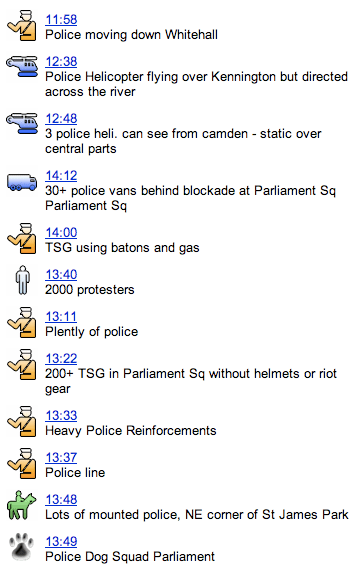
Check out these real time updates:

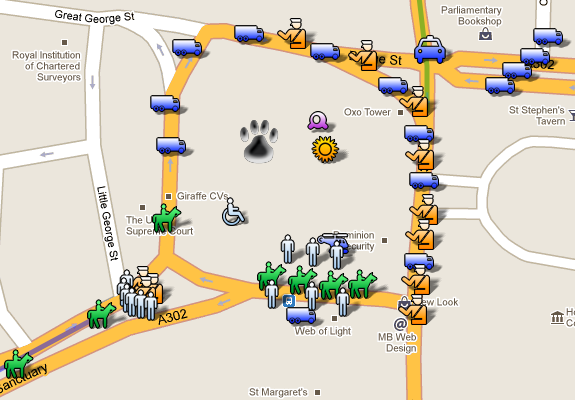
The students also caught the following picture:

The map depicts the tactics employed by the students:

The limits of using Google Maps

As I looked closer at the map, it occurred to me how much this resembles a computer game with moving characters. The strategy employed by the police can be discerned by the pattern below.

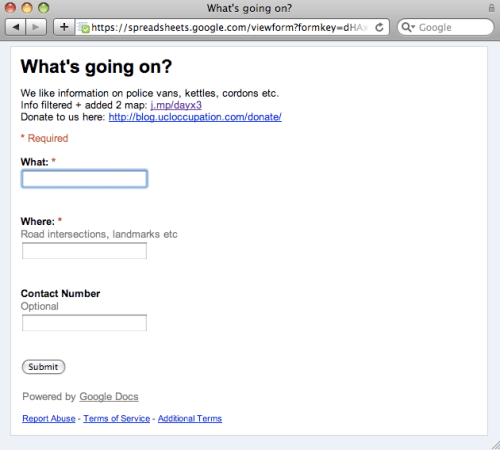
But I doubt that students were able to update their Google map in real-time directly from their mobile phones, let alone via SMS, Twitter, Smartphone App, camera phone or Facebook. Nor can they subscribe to alerts and receive them directly via an automated email or SMS. Indeed, it appears they were using Google Forms to “crowdsource” information and this Twitter account to disseminate important updates.

This is why I got in touch with the group and recommended that they think of using Crowdmap (free and open source):

Or GroundCrew (partially free, not open source):

See the following links for more info on Maptivism:

WikiLeaks of Mass Disruption: Get Ready for the Clone Wars

Anyone who claims that Julian Assange has no plan is (net) deluded. Read this excellent piece by Aaron Bady that details Julian’s political theory. Whether or not you agree with his theory of conspiracy, there is a method to the “madness”. And this “madness” is about to trigger the proliferation of WMD’s, WikiLeaks of Mass Disruption. Get ready for the Clone Wars.

Why? Have a look at what happened to the music industry. As Ori Brafman and Rod Beckstrom wrote in “The Spider and the Starfish,” the biggest players with the best lawyers in the world went up against P2P file-sharing companies like Napster and Grokster. But as the labels were repeatedly winning lawsuits, “the overall problem of music piracy was getting worse and worse. It wasn’t that the labels weren’t vigilant enough. It was actually the exact opposite—the labels were adding fuel to the fire with every new lawsuit. The harder they fought, the stronger the opposition grew.”

When Napster was shut down, more decentralized P2P file-sharing sites began to spring up that became harder to eliminate, e.g., eDonkey, eMule, etc. The same will  happen with Wikileaks. As the group becomes increasingly targeted, they will become more decentralized and will inevitably spawn “copy-cats”. And not just technology copy-cats, but legal-copy cats; as participants at NewsFoo repeatedly noted, WikiLeaks is a legal-hack, distributing servers across liberal democracies. (Meanwhile, by the way, the US government will become more centralized and closed).

Just yesterday I proposed  a “Humanitarian Wikileaks” on Twitter and got numerous enthusiastic replies, DM’s and emails. And check out this site (OpenLeaks) still under construction (updated just 2 weeks ago), owned by CINIPAC Webhosting: Offshore, Secure, Anonymous.”

What’s going to happen next? Read these “8 Principles of Decentralization.” WikiLeaks is just the first generation. Future spin-off’s will become more specialized, sophisticated and will make fewer mistakes. Julian is often criticized for focusing primarily on the US. What people fail to understand is that all he has to do (and has done) is to trigger the Clone Wars to bring this disruption to many other shores.

On a personal note, I’m less worried by WikiLeaks than the actions that “open” democracies are taking to eliminate the initiative.

Updated: As is widely known, the US government and Amazon forced the wikileaks.org domain off the Web:

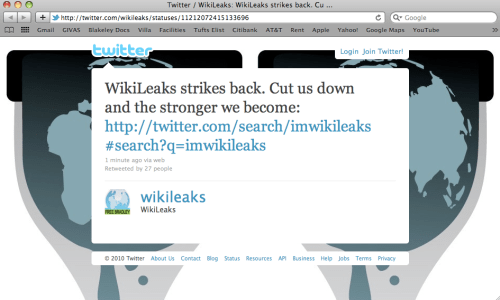
Here is WikiLeaks’ response:

See also: Former WikiLeaks Activists to Launch New Whistleblowing Site from the Spiegel Online and WikiLeaks: Moving Target by Renesys blog.

How to Evaluate Success in Digital Resistance: Look at Guerrilla Warfare

The Iranian protests of 2009 are still framed as a failure. The same goes for the 2007 protests in Burma and other nonviolent movements that have combined digital technologies with civil resistance (digital resistance). Are these efforts really failures or are we simply looking through the wrong lens? What characterizes success in digital activism?

The international community and mainstream media seem to think that success means full-out regime change and overnight transitions to democracy, rule of law and respect for human rights. This state-centric framework is the wrong one to use if the goal is to critically assess the success of resistance movements. We should instead be looking at digital resistance through the lens of guerrilla warfare, or “little war” in Spanish.

Guerrilla warfare is characterized by small, highly mobile groups that employ military tactics to harass a larger enemy, striking and withdrawing almost immediately. Hit-and-run tactics against supply chains and disrupting communication lines is a guerrilla favorite.

Tactically, guerrillas avoid confrontation with larger enemy forces and seek instead to attack smaller, weaker groups to minimize losses and exhaust the opposition. They seek the support of local populations in the process. Their goal is to weaken the enemy and eventually to undermine the state’s ability to prosecute the war; victory by attrition.

Civil resistance movements use guerrilla warfare. Their tactics and strategies are almost identical. The majority of guerrilla actions do not use violence. Given the similarities between civil resistance and guerrilla campaigns, we should look into how the latter are evaluated. If we used today’s media frames to evaluate passed successful resistance movements, they would all be failures.

The history of nonviolent struggle shows that movements which were counted out when major repression first hit – such as Solidarity in Poland in 1981 and nonviolent South African anti-apartheid strikers and boycotters in the mid-1980’s – were, a few years later, on the winning side (1).

This means that an evaluation framework for digital resistance should include a broader time frame and have a more micro-level focus. We should be looking at a group’s ability to organize an underground movement, recruit, spread propaganda, elicit support from the local population, employ a rich mix of tactics to over time to harass, provoke and delegitimize a repressive regime, and a group’s ability to continue existing even after government crack downs.

On this latter point, for example, “a more comprehensive and accurate frame on [Iran and Burma] would have reminded us that such shows of force are used only when a regime feels threatened, that is, when it perceives itself in a position of potential weakness if opposition is permitted to gain any foothold” (2).

Weighing the Scales: The Internet’s Effect on State-Society Relations

The Chair of my dissertation committed, Professor Dan Drezner just published this piece in the Brown Journal of World Affairs that directly relates to my dissertation research. He presented an earlier version of this paper at a conference in 2005 which was instrumental in helping me frame and refine my dissertation question. I do disagree a bit with the paper’s approach, however.

Professor Drezner first reviews the usual evidence on whether the Internet empowers coercive regimes at the expense of resistance movements or vice versa. Not surprisingly, this perusal doesn’t point to a clear winner. Indeed, as is repeatedly stated in the academic discourse, “parsing out how ICT affects the tug-of-war between states and civil society activists is exceedingly difficult.”

Drezner therefore turns to a transaction costs metaphor for insight. He argues that “metaphorically, the problem is akin to the one economists faced when predicting how the communications revolution would affect the optimal size of the firm.” I’m not convinced this is an appropriate metaphor but lets proceed and summarize his reasoning on firm size in any case.

Economists argue that the size of a firm is a function of transaction costs. “If these costs of market exchange exceed those of more hierarchical governance structures—i.e., firms—then hierarchy would be the optimal choice. With the fall in communication costs, economists therefore predicted an associated decline in firm size. “There were lots of predictions about how the communications revolution would lead to an explosion in independent entrepreneurship.”

But Drezner argues that decreasing communication costs (a transaction cost) has not affected aggregate firm size: “Empirically, there has been minimal change.” Unfortunately, he doesn’t cite any literature to back this claim. Regardless, Drezner concludes that firm size has not significantly changed because “the information revolution has lowered the organizational costs of hierarchy as well” and even “increased the optimal size of the firm” in some sectors. “The implications of this [metaphor] for the internet’s effect on states and civil society should be apparent.”

The problem (even if the choice of metaphor were applicable) is that these implications provide minimal insight into the debate on liberation technologies: large organizations or institutions have the opportunity to scale thanks to the Internet; meaning that government monitoring becomes more efficient and sophisticated, making it “easier for the state to anticipate and regulate civic protests.” More specifically, “repressive regimes can monitor opposition websites, read Twitter feeds, and hack e-mails—and crack down on these services when necessary.” Yes, but this is already well known so I’m not sure what the transaction metaphor adds to the discourse.

That said, Drezner does recognize that the Internet could have a “pivotal effect” on state-society relations with respect to “authoritarian and semi-authoritarian states that wish to exploit the economic possibilities of the information society.” Unfortunately, he doesn’t really expand on this point beyond the repeating the “Dictator’s Dilemma” argument. But he does address the potential relevance of “information cascades” for the study of digital activism in non-permissive environments.

“An informational cascade takes place when individuals acting in an environment of uncertainty strongly condition their choices on     what others have done previously. More formally, an information cascade is a situation in which every actor, based on the observations of others, makes the same choice independent of his/her private information signal. Less formally, an information cascade demonstrates the power of peer pressure—many individuals will choose actions based on what they observe others doing.”

So if others are not protesting, you are unlikely to stick your neck out and start a protest yourself, particularly against a repressive state. But Drezner argues that information cascades can be reversed as a result of a shock to the system such as an election or natural disaster. These events can “trigger spontaneous acts of protest or a reverse in the cascade,” especially since “a little bit of public information can reverse a long-standing informational cascade that contributed to citizen quiescence.” In sum,  “even if people may have previously chosen one action, seemingly little information can induce the same people to choose the exact opposite action in response to a slight increase in information.”

This line of argument seems to cast aside what has been learned about civil disobedience. Drezner suggests that reverse information cascades can catalyze spontaneous protests. Perhaps, but are these “improvised” protests actually effective in achieving their stated aims? The empirical evidence from the literature on civil resistance suggests otherwise: extensive planning and strategizing is more likely to result in success then unplanned spontaneous protests. If I find out that it’s cooler in the frying pan than the fire, will I automatically jump into said pan? A little bit of additional information without prior planning on how to leverage that information into action can be dangerous and counterproductive.

For example:

“The spread of information technology increases the fragility of information cascades that sustain the appearance of authoritarian control. This effect creates windows of opportunity for civil society groups.”

Yes, but this means little if these groups are not adequately prepared to deliberately exploit weaknesses in authoritarian control and cash in on this window of opportunity.

“At moments when a critical mass of citizens recognizes their mutual dissatisfaction with their government, the ability of the state to repress can evaporate.”

Yes, but this rarely happens completely spontaneously. Undermining the pillars of power of a repressive state takes deliberate and calculated work with an appropriate mix of tactics and strategies to delegitimize the regime. There is a reason why civil resistance is often referred to as (nonviolent) guerrilla warfare. The latter is not random or haphazard. Guerilla campaigns are carefully thought through and successful actions are meticulously planned.

Drezner argues that, “Extremists, criminals, terrorists, and hyper-nationalists have embraced the information society just as eagerly as classical liberals.” Yes, this is already well known but the author doesn’t make the connection to training and planning on the part of extremists. As Thomas Homer-Dixon notes in his book The Upside of Down: “Extremists are often organized in coherent and well-coordinated groups that have clear goals, distinct identities, and strong internal bonds that have grown around a shared radical ideology. As a result, they can mobilize resources and power effectively.” Successful terrorists do not spontaneously terrorize! Furthermore, they create information cascades as much as they react to them.

In conclusion, Drezner criticizes the State Department’s Civil Society 2.0 Initiative. State presumes that technologies will primarily help the “good guys” and  “assumes that the biggest impediment to the flowering of digital liberalism comes from the heavy hand of the state.” (He doesn’t say what the biggest impediment is, however). Drezner ends his piece with the following: “It is certainly possible that the initiative fails because of the coercive apparatus of a repressive government. It is equally likely, however, that the initiative succeeds—in empowering illiberal forces across the globe.” This is already well known. I’m not sure that one needs a transaction metaphor or to refer to the dictator’s dilemma, information cascades, spontaneous protests and extremist groups to reach this conclusion.

Stop Crowdsourcing? Remember, Remember the Fifth of November…

… because a man can fail. He can be caught. He can be killed and forgotten.
But four hundred years later an idea can still change the world. I’ve witnessed firsthand the power of ideas. I’ve seen people kill in the name of them; and die defending them. But you cannot kiss an idea, cannot touch it or hold it.
Ideas do not bleed, it cannot feel pain, and it does not love.
V for Vendetta, 2006

The power of crowdsourcing crisis information has little to do with the people behind Ushahidi. If individuals, communities, organizations want to crowdsource and access  information, they’ll find a way regardless of the challenges or the number of blog posts that try to stop them. Cynics warned that the  printing press and telephone would lead society to ruin. They failed to stem an idea more powerful than them. They’ll fail again. Information wants to be free, and people want the freedom to source and access this information. Increasingly, these people include grassroots activists, seasoned humanitarian professionals, students, established media groups, local organizations, volunteer networks and amateur professionals. Cynics will realize that their voices have long been drowned out by the voices of the many drawn by the power of an idea.

The Digital Disruption: Connectivity and the Diffusion of Power

Google’s Eric Schmidt and Jared Cohen published this piece in the November/December 2010 issue of Foreign Affairs. It was a notable step up from the “Cyberspace and Democracy” article in the same issue. In any case, Eric and Jared address the same core questions I am writing my dissertation on so here’s my take on what they had to say.

I far prefer the term “connection technologies” over “liberation technologies”. I also appreciate the authors’ emphasis on the diffusion of power via mini-rebellions as opposed to full-out regime change and overnight transitions to democracy. Any serious student or practitioner of strategic nonviolent action knows full well that power is not monolithic but defuse—even in the most autocratic regimes. Repression is driven by obedience. As Gene Sharp noted in “The Politics of Nonviolent Action”:

By themselves, rulers cannot collect taxes, enforce repressive laws and regulations, keep trains running on time, prepare national budgets, direct traffic, manage ports, print money, repair roads, keep markets supplied with food, make steel, build rockets, train the police and army, issue postage stamps or even milk a cow. People provide these services to the ruler through a variety of organizations and institutions. If people would stop providing these skills, the ruler could not rule.

This is why power is necessarily diffuse in every single society. Rulers operate thanks to just a few key pillars of support including: the police, military, civil service, educational system, organized religion, media, business and financial communities, etc. These pillars are only there because of obedience—and individuals comprising these pillars always have the power to withdraw their support. In strategic nonviolent action, obedience is regarded as the heart of political power. Indeed, if people do not obey, the decision-makers cannot implement their decisions, simple as that.

Manifestations of disobedience are most powerful when public, which is where mini-rebellions come in. These can slowly but surely erode the pillars of support temporarily propping repressive regimes. Eric and Jared write that, “taken one by one, these effects may be seen as impractical or insignificant, but together they constitute a meaningful change in the democratic process.” Ah, but there’s the rub. How does one string a series of mini-rebellions into more than just a series of mini-rebellions? Otherwise, digital activists run the risk of winning the battles but losing the war.

Here is why lessons learned and best practices from the long history of nonviolent civil resistance and guerrilla warfare are crucial. This was the crux of my response to Malcom Gladwell’s article in The New Yorker. Civil resistance takes careful planning, grand strategy to tactics and specific methods. Successful civil resistance movements are not organized spontaneously! Concerted and meticulous planning is key.

There are two principles of strategic planning:

Strategic sequencing of tactics: “The strategic selection and sequencing of a variety of nonviolent tactics is essential. Tactics should be directly linked to intermediate goals which in turn flow from the movement’s or campaign’s grand strategy. There are over 198 documented types of nonviolent tactics, and each successful movement invents new ones” (1).

Tactical capacity building: “Successful movements build up their capacity to recruit and train activists, gather material resources, and maintain a communications network and independent outlets for information, such as encrypted emails, short-text messaging, an underground press, and alternative web sites. This also involves detailed campaign and tactical planning, and efficient time management. Time is perhaps the most important resource in a struggle” (2).

This is why I disagree with Eric and Jared when they write that “in many of these cases, the only thing holding the opposition back is the lack of organizational and communications tools, which connection technologies threaten to provide cheaply and widely.” The tools themselves won’t make up for any lack of organizational or communication skills, planning, strategy, and so on.

Towards the end of their article, the authors note that, “these kinds of cat-and-mouse games will no doubt continue…” referring to the dynamic between repressive regimes and resistance movements. The point is hardly whether or not this dynamic will continue. The more serious question has to do with what drives this dynamic, what factors influence whether or not the cat has the upper hand?

If you’re interested in learning more about civil resistance and strategic disruption, I highly recommend reading these short books:


Democracy in Cyberspace: What Information Technology Can and Cannot Do

Stunning. How can an article like this still be published in 2010 let alone in a peer-reviewed journal? Is the study of digital activism so shallow and superficial? Have we really learned nothing? This article could have been published years ago and even then one wonders what the added value would have been.

I wrote a blog post last year called “Breaking News: Repressive Regimes use Technology to Repress” to poke fun at those who sensationalize stories about digital repression. They make these anecdotes seem surprising and stupefying: “Who would have thought?!” is the general tone. The equivalent in a car magazine would be: “Wow! Cars can be used for Drive By Shootings and Picnics in the Park.” And speaking of anecdotes, articles like this one in Foreign Affairs is why I wrote that data hell and anecdotal heaven series on digital activism a while back. But still the discourse changes little.

Check out these groundbreaking “insights” from the Foreign Affairs article:

  • “… cyberspace is a complex space, and technological advances are not substitute for human wisdom.” Go figure
  • “… the tools of modern communications satisfy as wide a range of ambitions and appetites as their 20th century ancestors did, and many of these ambitions and appetites do not have anything to do with democracy.” Are you sure?
  • “Techno-optimists appear to ignore the fact that these tools [of modern communication] are value neutral; there is nothing inherently pro-democratic about them.’ Never thought of that
  • “[These technologies] are a megaphone, and have a multiplier effect, but they serve both those who want to speed up the cross-border flow of information and those who want to divert or manipulate it.” No way, who would have thought?
  • “If technology has helped citizens pressure authoritarian governments in several countries, it is not because the technology created a demand for that change. That demand must come from public anger at authoritarian rule.” That’s ridiculous
  • “Citizens are not the only ones active in cyberspace. The state is online, too, promoting it’s own ideas and limiting what the average user can see and do. Innovations in communications technology provide people with new sources of information and new opportunities to share ideas, but they also empower governments to manipulate the conversation and to monitor what people are saying.” Since when do governments have access to the Internet?
  • “China, Iran, Myanmar, North Korea, Saudi Arabia, and other authoritarian states cannot halt the proliferation of weapons of modern communications, but they can try to monitor and manipulate them for their own purposes.” But why would they do that?

There is little depth or analytical rigor to this piece. The contribution to the literature is close to nil. Lets hope this will be the last of its kind. The study of digital activism has got to move beyond sweeping generalizations and vague truisms. We know that governments use technology to repress, enough with broken-record-publications.

What we need is more granular, data-driven analysis and mixed methods research, which is why the Global Digital Activism Dataset (GDADS) project is long overdue. Ethan Zuckerman and Clay Shirky are both advisers to this initiative because they recognize that without more empirically grounded research, articles like this one in Foreign Affairs will continue to be published.