Category Archives: Humanitarian Technologies

Job: Satellite Imagery & Conflict Specialist

The European Union’s Information Support for Effective and Rapid External Action (ISFEREA) is looking for a conflict specialist post-doc researcher. I haven’t posted job openings before but this one from my colleagues at the Joint Research Center (JRC) is especially relevant to iRevolution’s focus.

Background: ISFEREA develops techniques for automatic image processing of digital images acquired via satellite platforms as well as methodologies to explore the links between conflict risk and the exploitation (and degradation) of natural resources such as minerals. In particular, very high resolution (VHR) sensors with meter and sub-meter spatial resolution are being tested for multi-spectral and multi-temporal analysis.

Applications fields are related to human security, conflict resource monitoring, post-disaster damage assessment, and analysis of human settlements, including temporary settlements and refugee camps

The candidate will conduct research on conflict risk modelling and links between natural resources and conflicts. She/he would contribute to:

  1. Collecting, organizing and analyzing all available data sources on conflicts, political tensions/crises, and some types of natural resources;
  2. Developing modelling scenarios and applying them to study the relationships between natural resources and armed conflicts as well as political instability.

The position presumes the will and the interest of the candidate to publish the results of his/her work in peer reviewed publications.

Requirements: University degree in political or social sciences; PhD degree in similar discipline or 5 years of relevant work experience, especially in conflict studies; good knowledge of at least one of the following three regions: African Great Lakes, Horn of Africa and Central Asia; good oral and written communication skills in English; team player and collaborative, proactive in research, capacity to learn and adaptability to stress.

Duration: 36 months

Applications Due: before 11 Jan, 2009 – 23:59:59 CET

Please follow this link for further information.

Patrick Philippe Meier

Humanitarian Assistance Training Simulator

Howard Rheingold, who is on my “shadow dissertation committee”, recently flagged this very neat training simulator called Virtual Peace for students interested in humanitarian response. The platform brings together digital learning technologies and serious gaming for humanitarian aid education.

VP6

Students and educators enter an immersive, multi-sensory game-based environment that simulates real disaster relief and conflict resolution conditions in order to learn first-hand the necessary tools for sensitive and timely crisis response. […] The simulation developed by these partners takes as its model the real-life events following a major natural disaster: Hurricane Mitch, which devastated much of Central America in 1998.

VP2

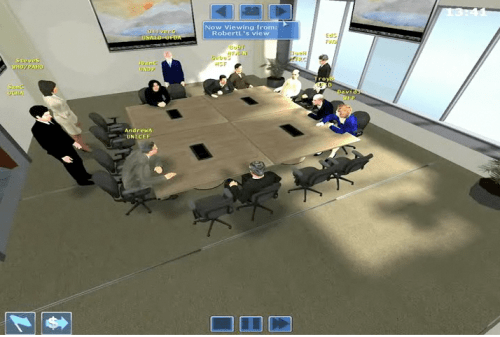
When playing the game, students who represent governments, the United Nations (UN) and nongovernmental organizations, meet in the Virtual Peace simulation. As part of the simulation, students are responsible for providing and coordinating aid to the two countries hardest hit by Hurricane Mitch: Honduras and Nicaragua. Students carry out background research on the scenario in order to represent one of 16 different humanitarian organizations such as Medecins Sans Frontieres (MSF), the Office of Foreign of Affairs of Nicaragua, USAID and the World Health Organization (WHO).

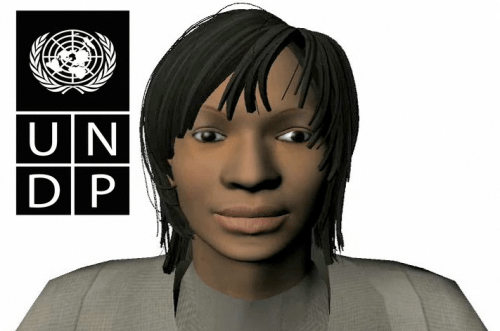
By playing the game together, the students are responsible for navigating the challenges and pathways to effective response. Each student assumes her or his role as an avatar designed to look like actual persons in the international aid community. They converse via voice and text channels in the game space which is designed to look like the real venues where these representatives might convene. Students present their views to the group at large and then (within the virtual space) break out into smaller groups for planning and negotiation.

VP3

In addition to allowing students to use real life diplomatic and conflict resolution skills, students and teachers can bookmark specific instances in the game that can be referred back to for learning purposes when debriefing the simulation. This allows them to assess whether certain goals were met, if students properly represented the values and views of their government or organization and how they can work more effectively in the future.

VP5

By extending to educators the multi-sensory nature of the digital media, Virtual Peace becomes much more than just an extension of a role-playing exercise. Ultimately, it is a cutting edge interdisciplinary platform for creative learning, uniting the technologies of the future and the experiences of the past. For more on virtual training for humanitarian response, see my blog post on 3D Crisis Mapping for Disaster Simulation Training.

I like the fact that Virtual Peace has “transformed video game technology previously used for army training simulations into an innovative tool for international humanitarian aid education.” In addition, I like the combination of the serious game with the social networking platform, Ning. This would be a neat addition to the Humanitarian Studies Initiative (HSI) seminar co-taught by the Harvard Humanitarian Initiative (HHI).

Indeed, I wish Virtual Peace had been around in 2006 when I taught an undergraduate course on “Disaster and Conflict Early Warning Systems” because Duke University actually offers a seminar on “Policy Anlaysis for Development” that uses Virtual Peace as a pedagogical tool.

The pictures and accompanying text above were taken from this Virtual Peace video demo:

Patrick Philippe Meier

Covering the DRC – opportunities for Ushahidi

This blog entry was inspired by Ory’s recent blog post on “Covering the DRC – challenges for Ushahidi.” The thoughts that follow were originally intended for the comments section of Ushahidi’s blog but they surreptitiously morphed into a more in depth reflection. First, however, many thanks to Ory for taking the time to share the team’s experience in the DRC over the past few weeks.

Much of what Ory writes resonates with my own experience in conflict early warning/response. While several factors contribute to the challenge of Ushahidi’s deployment, I think one in particular regrettably remains a constant in my own experience: the link to early response, or rather the lack thereof. The main point I want to make is this: if Ushahidi addresses the warning-response gap, then Ushahidi-DRC is likely to get far more traction on the ground than it currently is.

To explain, if Ushahidi is going to provide a platform that enables the crowdsourcing of crisis information, then it must also facilitate the crowdsourcing of response. Why? For otherwise the tool is of little added value to the individuals who constitute said crowd, ie, the Bottom of the Pyramid (BoP) in conflict zones. If individuals at the BoP don’t personally benefit from Ushahidi, then they should not be spending time/resources on communicating alerts. As one of my dissertation committee members, Peter Walker wrote in 1991 vis-a-vis famine early warning/response systems in Africa:

It must be clearly understood that the informants are the most important part of the information system. It is their information […] upon which the rest of the system is based […]. The informant must be made to feel, quite rightly, that he or she is an important part of the system, not just a minion at the base, for ever giving and never receiving.

In 1988 (that’s write ’88), Kumar Rupesinghe published a piece on disaster early warning systems in which he writes that civil society has

… a vital role to play in the development of a global, decentralized early warning system. They now need the capacity to build information systems and to provide the basis for rapid information exchange. In general [civil society] will have to confront the monopolization of information with a demand for the democratic access to information technology.

Information on local concerns must be available to the local structures in society. The right to be informed and the right to information have to find entry into international discussions.

Ushahidi’s crowdsourcing approach has the potential to reverse the monopolization of information and thereby create a demand for access to conflict information. Indeed, Ushahidi is starting to influence the international discourse on early warning (forthcoming reports by the EC and OECD). However, it is the mobile crowdsourcing of response that will create value and thereby demand by the BoP for Ushahidi.

Put it this way, Twitter would be far less useful if it were limited to one (and only one) global website on which all tweets were displayed. What makes Twitter valuable is the ability to select specific feeds, and to have those feeds pushed to us effortlessly, using Twhirl or similar programs, and displayed (in less than 141 characters) on our computer screens in real time. At the moment, Ushahidi does the equivalent of the former, but not the latter.

Yet the latter is precisely where the added value to the individual lies. An NGO may be perfectly content with Ushahidi’s current set up, but NGOs do not constitute the BoP; they are not the “fundamental unit” of crowdsourcing—individuals are. (Just imagine if Wikipedia entries could only be written/edited by NGOs).

This mismatch in fundamental units is particularly prevalent in the conflict early warning/response field. NGOs do not have the same incentive structures as individuals. If individuals in at-risk communities were to receive customized alerts on incidents in/near their own town (if they themselves send alerts to Ushahidi), then that response presents a far more direct and immediate return on investment. Receiving geo-specific alerts in quasi real-time improves situational awareness and enables an individual to take a more informed decision about how to respond to the alerts. That is added value. The BoP would have an incentive, empowerment, to crowdsource crisis information.

Here’s a scenario: if an individual texts in an alert for the first time, Ushahidi should: (1) contact that person as soon as possible to thank them for their alert and, (2) ask them what SMS alerts they would like to receive and for what town(s). I guarantee you this person will spread the word through their own social network and encourage others to send in alerts so that they too may receive alerts. (Incidentally, Erik, this is the strategy I would recommend in places like Jos, Nigeria).

In summary, while the Ushahidi team faces a multitude of other challenges in the DRC deployment, I believe that addressing the early response dimension will render the other challenges more manageable. While the vast majority of conflict early warning systems are wired vertically (designed by outsiders for outsiders), the genius of Ushahidi is the paradigm shift to horizontally wired, local early warning/response, aka crowdsourcing.

In a way, it’s very simple: If Ushahidi can create value for the BoP, the client base will necessarily expand (substantially). To this end, Ushahidi should not be pitched as an early warning system, but rather as an early response service. This is one of the reasons why I am trying hard to encourage the operationalization of mobile crisis mapping.

Satellite Imagery, Mobile Phones and Radios

Earth Observation System Launches in Africa: the SERVIR system integrates satellite resources into a web-based Earth information system, putting previously inaccessible information into action locally.

“A satellite birds-eye view can provide an overall picture of a natural disaster and its consequences,” said Dr. Tesfaye Korme, director of remote sensing and geographic information systems at RCMRD. “The new SERVIR-Africa platform comes just in time to provide us with the satellite data to develop maps of last week’s flooding in western Kenya and eastern Uganda, and estimate the number of displaced people.  We will provide this information to the authorities responsible for disaster response.”

For early warning in advance of events, SERVIR-Africa is developing tools to predict floods in high-risk areas and vector-borne diseases such as Rift Valley Fever. It will also provide visualization capability to map the location of climate change projections so people can see, for example, the potential impact climate change may have on the land resources where they live.  In addition, SERVIR-Africa’s information technology team will use the Internet to serve up satellite and ground-based earth observations, map data, and geospatial analyzes that target issues such as urbanization, biodiversity threats, and management of natural resources.  Mobile phones and radio, too, will be explored as a means to deliver useful information to people.
I’m particularly pleased to read that mobile phones and radios will be explored (and hopefully used) to deliver information at the community level.

InSTEDD’s Mesh4X Explained

I’ve had the pleasure of crossing paths with InSTEDD’s Robert Kirkpatrick on several occasions this year and always come away from our conversations having learned something new. Robert has recently been presenting InSTEDD’s new Mesh4X project. I confessed to him that I wasn’t entirely sure I fully grasped all the technical language he used to describe Mesh4X (which may serve as one answer to Paul Curion’s recent questions on The Innovation Fallacy).

Shortly after our recent CrisisMappers Meeting in Orlando, Robert kindly took the time to rework his description of Mesh4X for non techies. What follows is this description in Robert’s own words: “Having now heard the message a second time, I’m trying to clarify my description of Mesh4x for a lay audience. This version is more of a ‘product brochure’ in style, but I hope you find it useful in filling in any gaps.”

_____________________________________________

InSTEDD Mesh4X

Problem:  cross-organizational data sharing shouldn’t be this hard.

A major obstacle to effective humanitarian action today is that while advances in information technology have made it possible for individual organizations to collect, organize, and analyze data as never before, sharing of data between organizations remains problematic.  Organizations choose to adopt different information systems and software applications for many good reasons, yet a consequence of this is that data ends up fragmented across multiple organizations’ servers, PCs, and networks and remains “trapped” in different databases and formats.

This fragmentation incurs a high opportunity cost, as each organization working on a problem ends up having to act based on a fraction of what is actually known collectively. When data is shared today, it typically involves staff manually exporting from a database,  emailing spreadsheets files, and them importing them manually on the receiving end – a cumbersome and error-prone process further complicated by situations where Internet access is slow, unreliable, or completely unavailable.

Solution: Mesh4X – critical data when you need it, where you need it.

  • Imagine if that spreadsheet on your desktop, filled with health surveys, supply requests, or project status reports, were seamlessly linked to databases, programs, map software, websites and PDAs of others you want to share with, so that whenever you add or update data, the changes end up  being reflected everyone else as well, and all of their changes would also show up in your spreadsheet automatically.
  • Imagine being able to see all of this collective information on a map – a map that updates itself whenever anyone makes a change  to shared data.
  • Now imagine being able to exchange data with others even when no Internet access is available.

InSTEDD Mesh4X is a technology designed to create seamless cross-organizational information sharing between different databases, desktop applications, websites, and devices. It allows you to create or join a shared “data mesh” that links together disparate software and servers and synchronizes data between them automatically. You choose the data you wish to share, others do the same, and now everyone’s data ends up everywhere it needs to be.

  • Using Mesh4X, changes to data in any one location in the mesh are automatically synchronized to every other location.
  • If you’re offline at the time, all of your data will synchronize the next time you connect to the network.
  • For cases where no Internet access is available at all, there is no longer any need for the slow transport of files physically between locations.  Mesh4X gives you the option to synchronize all data via a series of SMS text messages – just plug a compatible phone into your laptop, and Mesh4X does the rest.
Using Mesh4X, you’ll have access to more information, and sooner, when making critical decisions.  When you need to collaborate with multiple organizations toward a shared goal, everyone will have a more complete and up-to-date understanding of needs, resources, and who is doing what where.

_____________________________________________

Thanks again to Robert for pulling this version together. I’m now more assured that I did grasp the in’s and out’s of Mesh4X. My next question to Robert and the InSTEDD team is whether Mesh4X is at point where it’s “plug and play”? That is, as easy to download and set up as, say, a blog on wordpress? Will the setup process be facilitated by a Microsoft-like-wizard for easy guidance and implementation?

InSTEDD’s Mesh4X Explained

I’ve had the pleasure of crossing paths with InSTEDD’s Robert Kirkpatrick on several occasions this year and always come away from our conversations having learned something new. Robert has recently been presenting InSTEDD’s new Mesh4X project. I confessed to him that I wasn’t entirely sure I fully grasped all the technical language he used to describe Mesh4X (which may serve as one answer to Paul Curion’s recent questions on The Innovation Fallacy).

Shortly after our recent CrisisMappers Meeting in Orlando, Robert kindly took the time to rework his description of Mesh4X for non techies. What follows is this description in Robert’s own words: “Having now heard the message a second time, I’m trying to clarify my description of Mesh4x for a lay audience. This version is more of a ‘product brochure’ in style, but I hope you find it useful in filling in any gaps.”

_____________________________________________

InSTEDD Mesh4X

Problem:  cross-organizational data sharing shouldn’t be this hard.

A major obstacle to effective humanitarian action today is that while advances in information technology have made it possible for individual organizations to collect, organize, and analyze data as never before, sharing of data between organizations remains problematic.  Organizations choose to adopt different information systems and software applications for many good reasons, yet a consequence of this is that data ends up fragmented across multiple organizations’ servers, PCs, and networks and remains “trapped” in different databases and formats.

This fragmentation incurs a high opportunity cost, as each organization working on a problem ends up having to act based on a fraction of what is actually known collectively. When data is shared today, it typically involves staff manually exporting from a database,  emailing spreadsheets files, and them importing them manually on the receiving end – a cumbersome and error-prone process further complicated by situations where Internet access is slow, unreliable, or completely unavailable.

Solution: Mesh4X – critical data when you need it, where you need it.

  • Imagine if that spreadsheet on your desktop, filled with health surveys, supply requests, or project status reports, were seamlessly linked to databases, programs, map software, websites and PDAs of others you want to share with, so that whenever you add or update data, the changes end up  being reflected everyone else as well, and all of their changes would also show up in your spreadsheet automatically.
  • Imagine being able to see all of this collective information on a map – a map that updates itself whenever anyone makes a change  to shared data.
  • Now imagine being able to exchange data with others even when no Internet access is available.

InSTEDD Mesh4X is a technology designed to create seamless cross-organizational information sharing between different databases, desktop applications, websites, and devices. It allows you to create or join a shared “data mesh” that links together disparate software and servers and synchronizes data between them automatically. You choose the data you wish to share, others do the same, and now everyone’s data ends up everywhere it needs to be.

  • Using Mesh4X, changes to data in any one location in the mesh are automatically synchronized to every other location.
  • If you’re offline at the time, all of your data will synchronize the next time you connect to the network.
  • For cases where no Internet access is available at all, there is no longer any need for the slow transport of files physically between locations.  Mesh4X gives you the option to synchronize all data via a series of SMS text messages – just plug a compatible phone into your laptop, and Mesh4X does the rest.
Using Mesh4X, you’ll have access to more information, and sooner, when making critical decisions.  When you need to collaborate with multiple organizations toward a shared goal, everyone will have a more complete and up-to-date understanding of needs, resources, and who is doing what where.

_____________________________________________

Thanks again to Robert for pulling this version together. I’m now more assured that I did grasp the in’s and out’s of Mesh4X. My next question to Robert and the InSTEDD team is whether Mesh4X is at point where it’s “plug and play”? That is, as easy to download and set up as, say, a blog on wordpress? Will the setup process be facilitated by a Microsoft-like-wizard for easy guidance and implementation?

Links: Satellite Maps, Scientific Data, Digital Tracing

  • Satellites Predict Cholera: Science Daily just ran a piece on a new technique using satellites to predict and map cholera outbreaks.
  • Visualizing Scientific Data: The annual American Geophysical Union meeting in San Francisco will include a session on Visualizing Scientific Data Using KML and Virtual Globes.
  • Digital Images Contain Maker’s Mark: If you thought your digital photos could not be traced back to you, think again. Digital cameras leave a telltale fingerprint buried in the pixels of every image they capture.

Policy Briefing: Information in Humanitarian Responses

The BBC World Service Trust just released an excellent Policy Brief (PDF) on “The Unmet Need for Information in Humanitarian Responses.” The majority of the report’s observations and conclusions are in line with the findings identified during Harvard Humanitarian Initiative’s (HHI) 18-month applied research project on Conflict Early Warning and Crisis Mapping.

I include below excerpts that resonated particularly strongly.

  • People need information as much as water, food, medicine or shelter. Information can save lives, livelihoods and resources. Information bestows power.
  • Effective information and communication exchange with affected populations are among the least understood and most complex challenges facing the humanitarian sector in the 21st century.
  • Disaster victims need information about their options in order to take any meaningful choices about their future. Poor information follow is undoubtedly the biggest source of dissatisfaction, anger and frustration among affected people.
  • Information—and just as important communication—is essential for people to start claiming a sense of power and purpose over their own destiny.

In this context, recall the purpose of people-centered early warning as defined by the UN International Strategy for Disaster Reduction (UNISDR) during the Third International Conference on Early Warning (EWC III) in 2006:

To empower individuals and communities threatened by hazards to act in sufficient time and in an appropriate manner so as to reduce the possibility of personal injury, loss of life, damage to property and the environment, and loss of livelihoods.

picture-6

Other important observations worth noting from the Policy Brief:

  • Sometimes information is the only help that can be made available, especially when isolated populations are cut off and beyond the reach of aid.
  • There are still misplaced assumptions and confusion about how and what to think about information and communication—and where organizationally to locate it. Humanitarian actors systematically fail to see the difference between public relations and communications with affected populations, and thus funds neither the expertise nor infrastructure necessary.
  • The information needs of people affected by disasters remain largely unmet because the people, systems and resources that are required to meet them simply don’t exist in a meaningful way.
  • The humanitarian system is not equipped with either the capacity or the resources to begin tackling the challenge of providing information to those affected by crises.
  • A prior understanding of how populations in disaster prone areas source information is vital in determining the best channels for information flow: for example, local media, local religious networks and local civil society groups.
  • Studies have shown that affected populations go to great lengths to reinstate their media infrastructure and access to information at the earliest opportunity following a disaster. Relief efforts should recognize these community-driven priorities and response accordingly.

My one criticism of the report has to do with the comments in parentheses in this paragraph:

Rebuilding the local media infrastructure for sustained operations must be prioritized as aid efforts continue. This may be as simple as providing a generator to a radio station that has lost its electricity supply, using UN communications structures such as the World Food Program towers to relay local radio stations (though in politically complex environments this needs careful thought)…

The BBC’s Policy Brief focuses on the unmet need for information in humanitarian responses but leaves out of the equation “politically complex environments.” This is problematic. As the UNISDR remarked in it’s 2006 Global Survey of Early Warning Systems (PDF), “the occurrence of “natural” disasters amid complex political crises is increasingly widespread: over 140 natural disasters have occurred alongside complex political crises in the past five years alone.”

Operating in politically volatile, repressive environments and conflict zones presents a host of additional issues that the majority of policy briefs and reports tend to ignore. HHI’s research has sought to outline these important challenges and to highlight potential solutions both in terms of technology and tactics.

picture-7

The importance technology design has been all but ignored in our field. We may continue to use every day communication tools and adopt them for our purposes, but these will inevitably come with constraints. Mobile phones were not designed for operation in hostile environments. This means, for example, that mobile phones don’t come preinstalled with encrypted SMS options. Nor are mobile phones designed to operate in a peer-to-peer (mesh) configuration, which would render mobile phones less susceptible to repressive regimes switching off entire mobile phone networks.

What are today’s most vexing problems in the field of humanitarian early warning and response? This is a question often posed by my colleague Ted Okada to remind us that we often avoid the most important challenges in the humanitarian field. It’s one thing to respond in a post-disaster environment with easy access to refugee populations and donor funding. It’s quite another to be operating in a conflict zone, with restrictions on mobility, with no clear picture of the effected population and with donors reluctant to fund experimental communication projects.

It is high time we focus our attention and resources on tackling the most vexing issues in our field since the solutions we develop there will have universal application elsewhere. In contrast, identifying solutions to the less vexing problems will be of little benefit to large humanitarian community operating in political complex environments. As my colleague Erik Hersman is fond of saying, “If it works in Africa, it’ll work anywhere.” I’ve been making a similar argument over the past year: “If it works in conflict zones, it’ll work anywhere.”

Patrick Philippe Meier

Developing ICT to Meed Social Needs

I just came across Jim Fruchterman‘s excellent piece on “Developing Information Technology to Meet Social Needs,” which was recently published in Innovations. If Jim’s name sounds familiar, that’s because he’s Benetech‘s CEO.

Jim recognizes that when technology innovation doesn’t generate major financial returns, it is rarely pursued. This is where Benetech comes in. Jim’s objective is to “overcome market failure in socially beneficial applications of information technology.” The Benetech story makes for an interesting and important historical case study on how Jim and colleagues adapated the high-tech company to develop technology for social causes.

What follows are some interesting excerpts from Jim’s piece along with some of my comments.

Our initial idea was spying for human rights, using the same kind of technology as the government intelligence agencies. [In June 2000, however], it was clear that “Spying for Humanity” wasn’t the first place that technology should be used. There were much more basic needs to IT than sophisticated surveillance tools. We needed to build tools that could be used by unsophisticated human rights activists in the field.

In general, I think mainstream tools are still too complicated and cumbersome. The emergence of citizen journalism means that anyone can become a human rights activist. These individuals will use their own everyday-tools to document such abuses, e.g., camera phones, Youtube, blogs, etc.

The tools are already out there, whether we like it or not, and crowdsourcing human rights information may be the way to go. Of course, I realize that the quality of the data may not be up to par with Patrick Ball‘s methods at Benetech, but this could perhaps change with time.

On a related note, I would recommend reading Clay Shirky’s new book “Here Comes Everybody” and Leysia Palen’s piece on “Citizen Communications in Crisis: Anticipating a Future of ICT-Supported Public Participation.”

To this end, “Spying for Humanity” is already happening. The question I ask in my dissertation is whether “humanity” will be able to “out-spy” repressive regimes, or vice-versa.

Think of the human rights sector as a processing industry with a typical pyramidic structure. At the base of the pyramid are the grassroots human rights organizations numbering in the tens of thousands. These groups are on the front lines of human rights violations. […]. [The] narratives [they provide] are the raw material of human rights work; everything else in human rights work is built with these raw materials.

Above the grassroots groups in the pyramid are the provincial or national groups. These larger groups are politically better connected, […]. They also play a role in quality control: membership in a bona fide network confers more credibility to the reports of a grassroots group.

Regional and international groups concentrate the human rights information even more. This information is aggregated and processed into higher value forms. The single incident of human rights abuse is combined with other incidents into a pattern of abuse. These patterns are the basis for international human rights campaigns […].

I find this a really neat way to describe the human rights sector. My concern, coming from the field of conflict early warning/response, is that we always think of the base of the pyramid, ie, the grassroots, as sources for raw material that feed into our work, but we rarely view the base of the pyramid as first-responders. We tend to leave that for “ourselves” at the national, regional and international level. What is most lacking at the grassroots level is tactical training in field craft.

On patterns, see my previous blog on Crisis Mapping Analytics. Satellite imagery provides an important underutilized resource for pattern analysis of mass atrocities. This a gap that the Harvard Humanitarian Initiative (HHI) seeks to address in the near future.

The common product of the human rights community at all levels in the pyramid is information. The human rights sector is an information processing industry. Because of the limited resources available, computers and information technology are not used to anywhere near full potential. The paradox of the human rights community is that it is an information-processing industry that has limited access to information technology.

A very interesting point.

Later on in his piece, Jim describes the criteria that Benetech considers when deciding to pick a project. I include these below as they may be of interest to colleagues also working in this space.

How Benetech picks projects:

  • Return on investment: In our case, the return is to society, not to us. We frequently use benchmarking as a method of assessing returns.
  • Uniqueness: We want to be dramatically different: no interest in being 10% better than some other solution. If it already exists, we should be doing it for a fraction of the existing cost or bringing it to a completely different community.
  • A sustainability case: How can we keep this going without draining resources from Benetech forever?
  • Low technical risk: We assume the technology is out there, but nobody is motivated to bring it to the social application.
  • Deal size: Ideally in the $1 to $4 million range to encourage sustainability.
  • Fit of the technology with our capabilities: Is it in a field that Benetech knows something about?
  • Exit options: We try to devise three exit options before we start a project.
  • Access to resources: Can we access the resources we need to succeed?
  • Potential partnerships: What partners can we leverage? How can we encourage community involvement in this project?

Patrick Philippe Meier

e-CORCE to render Google Earth Obsolete?

I was watching TV Afrique during my stay in Jo’burg for MobileActive ’08 and caught an interesting piece of news that could have far-reaching implications for crisis mapping: a new project called “e-Continuous Observing System Relayed by Cellular processing Environment” or e-CORCE.

The driving question behind this bold initiative led by le Centre Francais d’Etudes Spatiales (CNES) is: “can we provide a massive and automated representation of the whole Earth with 1-m resolution and on a daily basis?”

The project would make use of 13 satellites and 50 relay stations for image processing. CNES hopes to have the e-CORCE operational by 2014.

Patrick Philippe Meier