Wag the Dog, or How Falsifying Crowdsourced Data Can Be a Pain

I had the pleasure of finally meeting Robert Scoble in person at Where 2.0 last week. We had a great chat about validating crowdsourced information, which he caught on camera below. In the conversation, I used Wag the Dog as an analogy for Ushahidi‘s work on Swift River. I’d like to expand on this since open platforms are obviously susceptible to “information vandalism”, ie, having false data deliberately entered.

The typical concern goes something like this: what if a repressive regime (or non-state group) feeds false information to an Ushahidi deployment? As I’ve noted on iRevolution before (here, here and here), Swift River collects information from sources across various media such as SMS, Twitter, Facebook Groups, Blogs, Online News, Flickr and YouTube. In other words, Swift River pulls in visual and text based information.

So where does Wag the Dog come in? Have a look at this scene from the movie if you haven’t watched it yet:

If an authoritarian state wanted to pretend that rioters had violently attacked military police and submit false information to this effect in an Ushahidi deployment, for example, then what would that effort entail? Really gaming the system would probably require the following recipe:

  1. Dozens of  pictures of different quality from different types of phones of fake rioters taken from different angles at different times.
  2. Dozens of text messages from different phone using similar language to describe the fake riots.
  3. Several dozens of Tweets to this same effect. Not just retweets.
  4. Several fake blog posts and Facebook groups.
  5. Several YouTube videos of fake footage.
  6. Hacking national and international media to plant fake reports in the mainstream media.
  7. Hundreds of (paid?) actors of different ages and genders to play the rioters, military police, shopkeepers, onlookers, etc.
  8. Dozens of “witnesses” who can take pictures, create video footage, etc.
  9. A cordoned off area in the city where said actors can stage the scene. Incidentally, choreographing a fight scene using hundreds actors definitely needs time and requires rehearsals. A script would help.
  10. Props including flags, banners, guns, etc.
  11. Ketchup, lots of ketchup.
  12. Consistent weather. Say a repressive state decides to preemptively create this false information just in case it might become useful later in the year. If it was raining during the acting, it better be raining when the state wants to use that false data.

Any others you can think of? I’d love to expand the recipe. In any case, I think the above explains why I like using the analogy of Wag the Dog. If a repressive state wanted to fabricate an information ecosystem to game an Ushahidi install, they’d have to move to Hollywood. Is Swift River a silver bullet? No, but the platform will make it more of pain for states to game Ushahidi.

Patrick Philippe Meier

Rethinking the UN’s Global Pulse

Update: This project is now called UN Global Pulse.

I’m in Bellagio on Lake Como this week for a Blue Sky Thinkers Workshop on the UN’s new Global Pulse Initiative. When I first blogged about GIVAS as it was called back in July 2009, the Pulse Team in the UN Secretary General’s Office actually commented on my blog post. The fact that the UNSG’s Office was taking the time to read blogs and comment on them was the first sign that something about this project was very different from my previous experience with the UN.

We’re under Chatham House Rules here so I’ll just stick to my own thoughts on what I think Global Pulse should be. First, I don’t think Global Pulse should be for the UN or nation states. The global alert system should directly empower vulnerable communities to prevent or mitigate the impact of crises on their own livelihoods. In other words, Global Pulse should be a self-help system for vulnerable communities. The development and maintenance of this system should be the responsibility of the UN and governments.

So here’s an idea (still under development): why not use the QuestionBox technology and approach to create “call in” centers for information on tactics for resilience.

Question Box helps people find answers to everyday questions like health, agriculture, business, education and entertainment. It provides easy access to information in hard-to-reach areas and breaks through technology, language and literacy barriers. We do this through:

  • Live telephone hotlines connected to live operators
  • SMS (Text Messaging)
  • Mobile and solar technologies that operate off the grid
  • Open Question – a simple software to start your own Question Box project

The group behind Question Box also help several organizations start their own Question Box-inspired services. So lets turn Global Pulse into a Global Resilience Information Service for vulnerable communities. There are four key reasons I find this approach compelling. First, this approach provides a demand-driven direct service to vulnerable communities as opposed to just “watching” them. Databases of resilience tactics can be (continually) developed by either local communities themselves or government sponsored projects. This information can then be shared across towns and regions. Think of this as a “Resilience Wiki”.

The second reason I want to continue exploring this system is because the queries made using a Resilience Question Box approach are in and of themselves important indicators. Think of Google’s Flu trends project. The team “found a close relationship between the number of people who search for flu-related topics and the number of people who actually have flu symptoms.” In other words, the queries made to Resilience Question Box could serve as proxy indicators for local vulnerability. This data would then be analyzed for trends and policy making at the UN.

The third reason this approach appeals to me is because it serves the interest of vulnerability communities first and foremost. The rhetoric behind global alert systems is that they are for vulnerable communities but the reality is that these communities rarely know that such systems actually exist. The first indicator of success for Global Pulse will therefore be whether vulnerable communities are aware of Pulse. A second indicator will be whether they actually use the system.

The fourth and final reason I’m keen about a Question Box approach is because of the focus on information for vulnerable communities. In my opinion, most crises are ultimately crises in information, which is another reason why information is power. Imagine if Global Pulse could work with Member States to set up hundreds of thousands of Resilience Boxes. Think of the One Laptop per Child (OLPC). Global Pulse could provide a Resilience Box per Vulnerable Community, enabling the latter to make more informed decisions to increase their own resilience in near real-time.

Now how does one fund all this? I got a possible answer over lunch while talking to one of the participants (whose identity I can’t reveal because of Chatham House Rules). How about a Kiva for Resilience Boxes? Instead of donating money to one (or more) specific project, you could donate money for 50 QuestionBox answers to a specific community in Bangladesh. I personally find that very compelling, i.e., knowing that my money provided 50 answers for vulnerable communities. In return for my donation, perhaps I could also get a copy of the 50 questions/answers and learn something new in the process.

Patrick Philippe Meier

From Grassroots Mapping to One Satellite Per Child

There were some amazing presentations at Where 2.0, but for me personally, Jeffrey Warren’s talk on Community-based Grassroots Mapping with Balloons and Kites in Lima was the most exciting. Jeffrey and his colleagues were inspired by two MIT undergraduate students who “launched a digital camera into near-space to take photographs of the earth from high up above.”

Jeff and colleague traveled to Lima in January 2010 to work with children and adults from several communities to bring a truly participatory (and fun!) approach to mapping.

Seeking to invert the traditional power structure of cartography, the grassroots mappers used helium balloons and kites to loft their own “community satellites” made with inexpensive digital cameras. The resulting images, which are owned by the residents, are georeferenced and stitched into maps which are 100x higher resolution that those offered by Google, at extremely low cost.

In some cases these maps may be used to support residents’ claims to land title. By creating open-source tools to include everyday people in exploring and defining their own geography, we hopes to enable a diverse set of alternative agendas and practices, and to emphasize the fundamentally narrative and subjective aspects of mapping over its use as a medium of control.

Once several pictures have been taken, they can be “stitched together” to form a map like the one below. The stitching can be done by hand or using this neat tool.

All it takes is $100 for the equipment below. In fact, you could even use $1.30 trash bags instead to reduce the cost. I highly recommend looking through this fun illustrated guide.

I also like how the communities used tracing paper to annotate the maps they produced from the balloons. This is something I had wanted to do for this community mapping project in the Sudan.

I absolutely love this project. It’s easy, cheap, participatory, empowering and fun. Jeff and company are democratizing aerial mapping. I’d love to see this approach take off all over the world and would like to find some use cases in the humanitarian context, e.g., in post-disaster reconstruction and development. Imagine if local communities in Haiti could use balloon mapping to hold the development community accountable for the way their own country is being rebuilt. This approach can democratize urban planning in post-disaster environments.

Do check out the Grassroots Mapping website. You can also sign up for the group’s mailing list. If you’re in the Boston area, you may want to join Jeffrey and friends for some balloon mapping excercises. I definitely will! In the meantime, check out Jeff’s Ignite Talk from the 2009 CrisisMappers Conference.

Patrick Philippe Meier

Why Universities are Key for the Future of Crisis Mapping

In January 2010, I launched the Ushahidi Crisis Map for Haiti. In February, I launched the Ushahidi Crisis Map of Chile. Neither initiative would have been possible without the incredible student volunteer network that formed at The Fletcher School/Tufts University, the Graduate Institute in Geneva and Columbia University’s School of International and Public Affairs (SIPA). We also had a few volunteers from the London School of Economics (LSE).

At one point, I had set up a Skype IM chat group titled “Global Situation Rooms” which included the core reps from Fletcher, Geneva and SIPA. The highlight for me was when we all got on the chat group to debrief. I moderated the session and would literally write “Geneva, you have the floor”, “New York, you have the floor”, “London, you have the floor”, etc. Talk about the first open source, global neogeography disaster response operation.

Given that The Fletcher School/Tufts group have paved the way forward in absolutely amazing ways, I  suggested back in February that we formalize this set up and launch a network of global situation rooms. I think the Fletcher team could play a leading role in this bold initiative and become the convener or Secretariat of this global network. If a disaster strikes Madagascar, for example, the Fletcher team could convene reps from other University Situation Rooms (USRs) and coordinate the near real-time crisis mapping support.

I ran with this idea and pitched it to the Clinton Global Initiative University (CGI-U), which will take place in mid-April. I’ve called the project “Universities for Ushahidi” and made this my commitment as a student participant at CGI-U. I’ve thought about this initiative further over the past two months and would like to focus  specifically on universities in the developing world and not restrict operations to emergency response, or to Ushahidi.

So here’s my dream: have the awesome team at Fletcher pave the way in training 12 universities around the world, 4 in Africa, 4 in Asia and 4 in South America. Have each of these new Situation Rooms be capable of launching near real-time crisis mapping support projects within hours after a crisis strikes in their countries/regions. In between crises, the new Situation Rooms could run other projects using Ushahidi. As I noted above, however, I would want this to include training and applications combined with other tools including OpenStreetMap, FrontlineSMS, etc.

I’m really excited by the potential. Universities have a clear comparative advantage. What other organization or institution has the ability to mobilize hundreds of student volunteers for weeks on end? I do see this as a form of activism. Students should be paving the way, revolutionizing the way we think and do things. I’m proud to be a Fletcher School student and can think of no better way to contribute to our moto: “Preparing Leaders with a Global Perspective.”

Fletcher students are exactly the type of students who will go on to work for the UN and other humanitarian/development/human rights organizations. They are the first generation of Crisis Mappers and their leadership, professionalism and camaraderie will change what is possible in this space. That is why universities are key to the future of crisis mapping.

Patrick Philippe Meier

The Rise of CrisisMapping and the CrisisMappers Group

My colleague Jennifer Leaning and I co-founded the Program on Crisis Mapping and Early (CM&EW) at the Harvard Humanitarian Initiative (HHI) back in June 2007. At the time, the term “Crisis Mapping” was virtually unheard of. In January 2008, Ushahidi demonstrated how crisis mapping could be combined with crowdsourcing and SMS.

In October 2009, my colleague Jen Ziemke and I launched the International Network of CrisisMappers with a dedicated Crisis Mappers Google Group, which currently has over 700 subscribers. Jen and I also co-organized the  first International Conference on Crisis Mapping (ICCM 2009) last year and are now preparing for ICCM 2010, which will focus on Haiti and Beyond. Over 30 online videos on Crisis Mapping have also been produced and we recently launched a dedicated monthly WebCast series on CrisisMapping as well.

On January 21, 2010, I attended a speech by Secretary of State Hillary Clinton in which she noted the pivotal role of interactive maps and SMS in the disaster response to Haiti. In her own words:

“The technology community has set up interactive maps to help us identify needs and target resources. And on Monday, a seven-year-old girl and two women were pulled from the rubble of a collapsed supermarket by an American search-and-rescue team after they sent a text message calling for help. Now, these examples are manifestations of a much broader phenomenon. The spread of information networks is forming a new nervous system for our planet.”

The CrisisMappers community played an instrumental role in the disaster response to Haiti. The interactive maps that Clinton refers to  include OpenStreetMap, Sahana, Telescience and Ushahidi. I like this idea of a new nervous system and hope the CrisisMappers community can continue growing this nervous system to ensure more rapid responses to crises. The term “crisis mapping” is at least beginning to make the rounds.

A Google search of “crisis mapping” in October 2009 returned 36,500 hits. Today, 5 months later, the search returns “123,000” hits.  During this time, Crisis Mapping initiatives have been written about and featured on CNN, ABC News, MSNBC, BBC, Reuters, UK Guardian, Al-Jazeera, NPR, the New York Times, the Washington Post, the Boston Globe, Huffington Post, Newsweek, the Globe and Mail, Wired, NewScientist, PC World, DiscoveryNews, Forbes Magazine and the TED Blog.

Several members of the CrisisMappers Group are currently preparing to present their projects at this year’s Where 2.0 Conference:

  • Haiti: Crisis Mapping the Earthquake –> link
  • Crowdsourcing the Impossible: Ushahidi-Haiti –> link
  • Community-Based Grassroots Mapping –> link
  • Mobilizing Ushahidi-Haiti  –> link
  • Crisis Mapping –> link
  • MapKibera –> link

I very much look forward to ICCM 2010 as I’m very curious to discuss what the next generation of crisis mapping technologies and applications will bring.

Patrick Philippe Meier

Using Massive Multiplayer Games to Playsource Crisis Information

This blog sequel follows this one on Netsourcing, Crowdsourcing and Turksourcing. This new round of thinking is inspired by a recent dinner conversation (that made it to the New York Times!) with Riley Crane, Omar Wasow, Anand Giridharadas, and Jen Brea. If the ideas below seem a little off the wall, the bottle of Kirsch I brought over for the Swiss fondue is to blame. Some parts of this post were were also inspired by The Polymath Project and conversations with Kuang Chen, Abraham Flaxman and Rob Munro during the Symposium on Artificial Intelligence for Development (AI-D) at Stanford University.

I wonder how many indoor cycling bikes exist in the world, or at least in the US. The number may in part be a function of the number of gyms. In any event, to borrow the language of Douglas Adams, the number must be “vastly, hugely, mind-bogglingly big,” especially the total number of hours spent on these bikes everyday in California alone. I’ve often wondered how much energy these machines generate when used; enough to recharge my iPhone? Hundreds of iPhones?  Why do I ask?

I’ve been thinking about the number of hours that gamers spend playing computer games in the US. Hundreds of thousands hours? I’m not quite sure what the correct order of magnitude is, but I do know the number is increasing. So how does the cycling analogy come in? Simple: how can we harness the millions of hours spent playing computer games every year to turksource crisis information? Could real world information be subtly fed into these games when necessary to process Human Intelligence Tasks (HITs) that would help tag and/or geolocate crisis information? Can we think of mobile games akin to FourSquare that could generate collective action around HITs?

In other words, what is the game equivalent of reCAPTCHA for turksourcing crisis information? Remember the computer game “Where in the World is Carmen Sandiego?” Could a cross between that type of learning game, a treasure hunt and “The DaVinci Code” get gamers hooked? I’m probably thinking way too old school here. Perhaps taking the most popular games today and subtly embed some HITs is the way to go. As mentioned in my previous blog post, one of the most time consuming and human resource intensive tasks that volunteers carried out during the first weeks of Ushahidi-Haiti was the manual, near real-time geo-location of unfolding events.

So how about adding a fun gaming user interface to OpenStreetMap? Like any good game, a user would be able to specify a difficulty level. Making a mobile UI would also come in handy when tourists are abroad and want to help geolocate. You’ve heard of eco-tourism, welcome to geo-tourism. Maybe Lonely Planet or Rough Guides could partner on such a project. Or, as happened in Haiti, geo-coding was also crowdsourced thanks to the pro-active Haitian volunteers of Mission 4636 who were far quicker at tagging than student volunteers. But what happens if the only volunteers around are not country experts or familiar with satellite imagery? Is there a way to use a Mechanical Turk Service approach to greatly simplify this geocoding process?

Maybe the day will come when kids whose parents tell them to get off their computer game to do their homework will turn around and say: “But Mom, I’m learning about the geography of Mozambique, which is what my quiz is on tomorrow, and I’m playsourcing crisis information to save lives at the same time!”

Patrick Philippe Meier

From Netsourcing to Crowdsourcing to Turksourcing Crisis Information

The near real-time crisis mapping of the disasters in Haiti and Chile using Ushahidi required a substantial number of student volunteers. These volunteers were not the proverbial crowd but rather members of pre-existing, highly-connected social networks: universities. How do we move from netsourcing to crowdsourcing and on to turksourcing?

Student volunteers from Fletcher/Tufts, SIPA/Columbia and the Graduate Institute in Geneva all represent established social networks and not an anonymous crowd. They contributed over ten thousand free hours over the past 3 months to monitor hundreds of sources on the web and map actionable information on an ongoing basis. The Core Team at Fletcher spent dozens of hours training volunteers on media monitoring and mapping.

Netsourcing presents some important advantages. Pre-existing social ties can help mobilize a trusted volunteer network. I  just sent one email to the Fletcher list-serve and because the Fletcher student body is a tight community, this eventually let do hundreds of volunteers being trained and contributing to the crisis mapping of Haiti.

The first call for volunteers

At the same time, however, netsourcing is bounded crowdsourcing. In other words, netsourcing is scale-constrained. Imagine if Wikipedia contributions had been limited to professors only—that too would be bounded crowdsourcing. So how do we move from netsourcing to crowdsourcing crisis information? How do we move from having 300 volunteers connected via existing social networks to 300,000 or even 3,000,000 anonymous volunteers?

This was one of the many questions that my colleague Riley Crane, a friend of his and I discussed for almost 4 hours over dinner. (Riley recently rose to fame when he and his team at MIT that won DARPA’s Red Balloon competition). The answer, we think, is to develop a Mechanical Turk Service plug-in for Ushahidi. I’m calling this turksourcing. The two most time-consuming tasks that volunteers labored on was media monitoring and geo-location. Both processes can be disaggregated into human intelligence tasks (HITs) combined with some automation, like Swift River. And none of this would require prior training.

This is a conversation I very much look forward to continuing with Riley and one that I also plan to bring up at Nathan Eagle‘s Symposium on Artificial Intelligence for Development (AI-D) at Stanford next Monday. There is another related conversation that I’m excited to continue—namely the use of distributed, mobile gaming as an incentive catalytic for collective action, an area that Riley has spent a lot of time thinking about.

In terms of Ushahidi, If turksourcing crisis information can be combined with gaming, users could compete for altruism points, e.g., for how many HITs they contributed to a disaster response. This could be a proxy for how “good” a person is; a kind of public social ranking score for those who opt in. I imagine having individuals include their score and ranking on their blog (much like the number of Twitter followers they have). Who knows, a high altruism score could even get you more dates on Match.com.

Patrick Philippe Meier

Sentiment Analysis of Haiti Text Messages (Updated)

The field of sentiment analysis is one that I’ve long been interested in. See my previous post on the use of sentiment analysis for early warning here. So when we began receiving thousands of text messages from Haiti, I decided to ask my colleagues at the EC’s Joint Research Center (JRC) whether they could run some of their sentiment analysis software on the incoming SMS’s.

The 4636 SMS initiative in Haiti was a collaboration between many organizations and was coordinated by Josh Nesbit of FrontlineSMS. The system allowed individuals in Haiti to text in their location and urgent needs. These would then be shared with some of the humanitarian actors on the ground and also mapped on the Ushahidi-Haiti platform, which was used by first responders such as the Marine Corps.

Here’s how the JRC in partnership with the University of Alicante carried out their analysis on the incoming SMS’s:

As many individual words are ambiguous (e.g. the word ‘help’ probably predominantly indicates a negative situation, but it may also be positive, as in “help has finally arrived”), they looked at the most frequent word groups, or word n-grams (sizes 2 to 5 words). Out of these, they identified about 100 n-grams that they felt are (high) negative or (high) positive. These were added to the sentiment analysis tool.

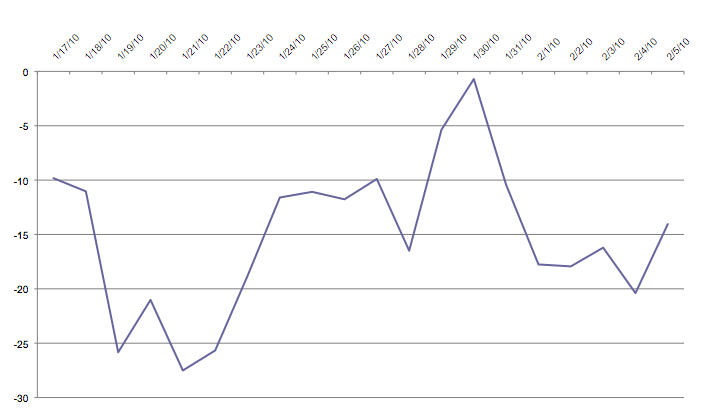
The graph below depicts the changing sentiment reflected in the SMS data between January 17th and February 5th.

Sentiment Analysis of Haiti SMS’s

There is, of course, no way to tell whether the incoming text messages reflect the general feeling of the population. It is also important to emphasize that the number of individuals sending in SMS’s increased during this time period. Still, it would be interesting to go through the sentiment analysis data and identify what may have contributed to the peaks and troughs of the above graph.

Incidentally, the lowest point on this graph is associated with the date of January 21. The data reveals that a major aftershock took place that day. There are subsequent reports of trauma, food/water shortages, casualties, need for medication, etc., which drive the sentiment analysis scores down.

Update 1: My colleague Ralf Steinberger and the Ushahidi-Haiti group is looking into the reasons behind the spike around January 30th. Ralf notes the following:

I checked the news a bit, using the calendar function in EMM NewsExplorer (http://emm.newsexplorer.eu/). I checked both the English and the French news for the day. One certainly positive news item accessible to Haitians on that day was that Haiti leaders pointed to progress. Another (French) positive news item is that the WFP (PAM) put in place a structured food aid system aiming at feeding up to 2 million people via women only. People were given food coupons (25kg of rice per family), starting Saturday 30.1.

Ralf also found that many of the original SMS’s received on that day had not been translated into English. So we’re looking into why that might have been. Hopefully we can get them translated retro-actively for the purposes of this analysis.

Update 2: Josef Steinberger from JRC has produced a revised sentiment analysis graph through to mid March.

This kind of sentiment analysis can be done in real-time. In future deployments where SMS becomes the principle source to communicate with disaster affected populations, using this kind of approach may  eventually provide an overall score for how the humanitarian community is doing.

Patrick Philippe Meier

Towards an SMS Code of Conduct for Disaster Response

Picture this: it’s October 7, 2011, and a major hazard hits a highly vulnerable population resulting in a devastating disaster. The entire humanitarian response community mobilizes within 48 hours. Days later, the cell phone network is back up and dozens of SMS systems are activated by large and small organizations. Two or three of these systems use short codes thanks to rapid collaboration with the country’s national telecommunication companies. The other SMS systems all use long codes.

That picture concerns me, a lot. The technology community’s response to Haiti has demonstrated that using SMS to communicate with disaster affected communities can save lives, hundreds of lives. Humanitarian organizations and NGOs have all taken note and nothing will prevent them from setting up their own SMS systems in the near future. This wouldn’t worry me if coordination wasn’t already a major challenge in this space.

Let me elaborate on the above picture.

Picture further that one organization decides to send out regular SMS broadcasts to the disaster affected communities to improve their situational awareness and prevent panic. This is an important service during the first few days of a disaster. But imagine that this organization does not provide a way for users receiving this information to unsubscribe or to specify exactly what type of information they would like and for which locations. Next suppose that three NGOs set up long codes to do the same. Now imagine that two major organizations independently set up an alerts SMS system, asking individuals to text in their location and most urgent needs.

This is an information disaster in the making for communities in crisis.

So what are we going to do to prevent the above picture from turning into reality? The group Communicating with Disaster Affected Communities (CDAC) is probably best placed to support a coordinating role in this space. But before we even get to this, our own community should start drafting an “SMS Code of Conduct for Disaster Response” for ourselves. I can think of no better way to start the process by using distributed cognition (aka crowdsourcing). This blog post on lessons learned and best practices may be informative as well.

Here are a few ideas to begin with:

  • Set up a complaints mechanism
  • Do not duplicate existing national SMS systems
  • Set up a single clearing house for all outgoing SMS broadcasts
  • Ensure that SMS messages are demand driven in terms of content
  • Enable receivers of Disaster SMS’s to unsubscribe and to specify alert type and location

There are likely dozens more points we could add. So please feel free to do so in the comments section below. I will then create a more structured Google Doc out of your replies and send this out for further peer reviewing.

Patrick Philippe Meier

Haiti and the Tyranny of Technology

How quickly we forget what has come before us. Is it because our technologies are so new or different that recommendations in the disaster literature don’t apply to us? The technology community repeatedly emphasized the unprecedented nature of the response in Haiti, particularly with respect to communication with disaster effected populations. Was is it really a complete departure? To a large extent yes, but were there really no guidelines available?

The challenges that materialized in the response to Haiti included:

  • Raising of expectations
  • Lack of formal complaints mechanism
  • Absence of downward accountability
  • Coordination and clarity of messaging

Guidelines to address these challenges do exist. I’ll draw on two documents that are both 4 years old. The first is my colleague Imogen Wall’s study “The Right to Know: The Challenge of Public Information and Accountability in Aceh and Sri Lanka”. The second is the Final Report of the Global Symposium+5.

Here are some of the main points to take home from Imogen’s 60-page study:

  • Many organizations are still paying for mistakes made in communicating with communities in the early days of the tsunami recovery effort, resulting in what many call the ‘broken promises’ phenomenon. The inherent problems of managing expectations were exacerbated by a widespread use of translators and jargon and the extreme levels of trauma experienced by beneficiaries.
  • Confusion about policies, an inability to report misuse of aid, ignorance about where to turn for assistance, cynicism and anger stemming from broken promises about aid, and mismanaged expectations were all noted in the 2004 Tsunami. But while cases of actual broken promises undoubtedly occurred, the majority of perceived broken promises actually seem to have resulted from communications problems.
  • Managing communications with communities is key to successful community-driven development. Knowledge is power: without information, communities cannot participate, make choices, or ask questions. Good communication is also about trust and partnership, and is thus at the heart of successful community partnerships.
  • Putting communities at the center of disaster response requires that adequate provision be made for community access to information about projects, channels through which they can ask questions, and mechanisms by which they can register dissatisfaction or complaints. Such efforts both supply information and create space for dialogue between communities and aid agencies, a two way information flow tht is beneficial to both parties. No accountability and transparency system is complete without a strong complaints mechanism. Complaints mechanisms have an important role in conflict mitigation at a community level and in the prevention of violence.
  • Donors must require downward accountability and communications strategies in projects they fund and by exploring ways in which they can receive feedback on projects from beneficiaries.
  • Until information is properly shared with beneficiaries, they will never be equal partners. And until they are provided with a voice and the ability to judge a project’s viability, organizations will never be able to claim that they enabled survivors to rebuild and move on to a as bright a future as possible.
  • Primarily, beneficiaries want practical information that explains what aid is available, what assistance they can expect, how to apply for it, when aid will arrive, why what they have received might differ from their neighbor, and what to do if they are not satisfied. They are not interested in materials that simply promote a particular organization. Secondly, they are very interested in hearing how the aid effort is going, how money is being spent, what problems are being experienced elsewhere, and what solutions are being found.
  • Low-tech solutions are almost invariably better. A simple bulletin board can  do more to enhance transparency and accountability towards beneficiaries than any website. All IDP locations should be required to have a bulletin board, and aid organizations should be required to display basic project information and contact details.
  • Broadly speaking, the aim of public relations (PR) is to promote an organization; the aim of public information (PI) is to channel information to the relevant audiences. But most communications expertise within international aid organizations is geared toward public relations.
  • Aid organizations have a tendency to regard communication with beneficiaries as an optional extra rather than seeing information as a vital commodity and a humanitarian right, the key to empowerment, better relationships with beneficiaries and a more effective recovery effort. There has also been a failure to understand that information deprivation causes stress and exacerbates trauma.
  • Organizations should consider, where appropriate, incorporating some form of community-bsaed monitoring and evaluation systems into their projects.
  • Written community contracts between organizations and beneficiaries should be adopted wherever possible.
  • There will always be questions regarding how much information can or should be shared with beneficiaries. Communities should be the driver of how much information will be shared.
  • Always leave a contact name, number and address, ideally of the liaison person responsible for the community.
  • With text messaging, a simple, short message can be sent to a list of phone numbers simultaneously. And while it is easy to compile a list of phone numbers of key people in beneficiary communities, collating and managing wider lists of numbers and making them available to aid organizations could be undertaken by a body such as OCHA’s Humanitarian Information Centers.
  • SMS is a powerful medium that can be harnessed for otherwise very difficult tasks, such as providing information quickly that is available only at the last minute, such as times for aid deliveries or changes in a medical clinic’s arrival time in a certain area. The list of recipients can be easily tailored to include only those in a certain geographical area, enabling messages to be very precisely targetted.

The Final Report of the 2006 Symposium+5 event that I participated includes a review of lessons learned, best practices and recommendations on the topic of communicating with disaster affected communities. Here are the main points:

  • Programs designed to enhance two-way information-sharing and communication with affected populations are not mainstreamed into all phases of the humanitarian continuum or the UN cluster system. More needs to be done to financially support the establishment of these projects in the preparedness and early response phase.
  • Provide easily understandable information to affected communities to encourage and empower people to take action to build and strengthen their resilience. The information should be developed with affected populations, incorporate relevant traditional and indigenous knowledge and cultural heritage and be tailored to different target audiences through both media and non-media communication channels, taking into account cultural and social factors.
  • Provide funding and support to local media and journalistic organizations that have a role in providing information to affected populations in all phases, from preparedness, during response, and into recovery and reconstruction.

Yes, we have new integrated platforms that allow for 2-way communication with disaster affected populations in near real time. But do these new tools render the above lessons learned and recommendations obsolete? If not, then why did the technology community not draw on them to guide their work in Haiti?

Patrick Philippe Meier