Ushahidi & The Unprecedented Role of SMS in Disaster Response

What if we could communicate with disaster affected communities in real-time just days after a major disaster like the quake in Haiti? That is exactly what happened thanks to a partnership between the Emergency Information Service (EIS), InSTEDD, Ushahidi, Haitian Telcos and the US State Department. Just 4 days after the earthquake, Haitians could text their location and urgent needs to “4636” for free.

I will focus primarily on the way that Ushahidi used 4636. Since the majority of incoming text messages were in Creole, we needed a translation service. My colleague Brian Herbert from Ushahidi and Robert Munro of Energy for Opportunity thus built a dedicated interface for crowdsourcing this step and reached out to dozens of Haitian communities groups to aid in the translation, categorization and geo-location of every message, quickly mobilizing 100s of motivated and dedicated volunteers. So not only was Ushahidi crowdsourcing crisis information in near real-time but also crowdsourcing translation in near real-time.

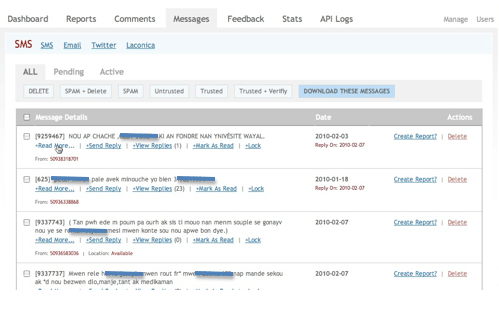
Text messages are translated into English just minutes after they leave a mobile phone in Haiti. The translated messages then appear directly on the Ushahidi platform. The screenshots below (click on graphics to enlarge) illustrates how the process works. The original SMS in Creole (or French) is displayed in the header. In order to view the translation, one simply clicks on “Read More”.

Ushahidi Back End

Incoming Text Messages

If further information is required, then one can reply to the sender of the text message directly from the Ushahidi platform. This is an important feature for several reasons. First, this allows for two-way communication with disaster affected communities. Second, an important number of messages we received were not actionable because of insufficient location information. The reply feature allowed us to get more precise information.

The screenshots below show how the “Send Reply” feature works. We weren’t sure if Universite Wayal was the same as Royal University. So we replied and asked for more location information. Note the preset replies in both English and Creole. The presets include thanks & requests for more location information, for example. Of course, one is not limited to these presets. Any text can be typed in and sent back to the sender of the original SMS. This feature has been part of the Ushahidi for almost two years now. We send off the request for more information and receive the following reply within minutes.

Preset Replies

When we receive an urgent and actionable SMS like this one, we can immediately create a report. By actionable, we mean there is sufficient location information and the description of the need is specific enough to respond to, just like the example above.
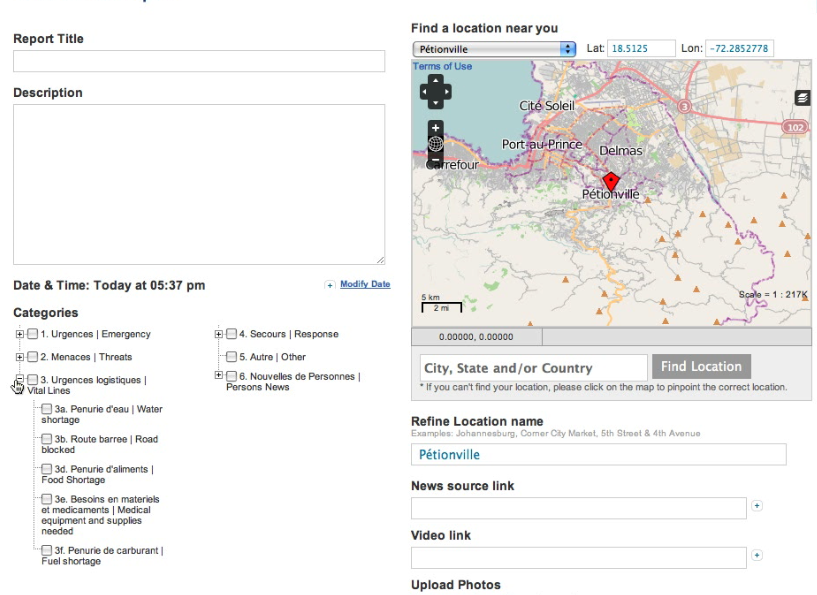
Creating a Report

First, the GPS coordinates for the location is identified. This can be done directly from the Ushahidi platform by entering the street address or town name. Sometimes a bit of detective work is needed to pinpoint the exact coordinates. Next, a title and description for the report is included–the latter usually comprising the text of the SMS. This is what we mean by structured information. The report is then tagged based on the category framework. Pictures can be uploaded with the report, and links to videos can also be included. Finally the report is saved and then approved for publication.

This is how the Ushahidi-Haiti @ Tufts team mapped 1,500+ text messages on the Ushahidi platform. We are now working with Samasource and Crowdflower to have the translation work serve as a source of income for Haitians inside Haiti. But how does all this connect to response?

Ushahidi’s “Get Alerts” feature is one of my favorite because it allows responders themselves to customize the specific type of actionable information that is important to them; i.e., demand driven situational awareness in near real-time. Not only can responders elect to receive automated alerts via email, but they can also do so via SMS. Responders can also specify their geographic area of interest.

Subscribe to Alerts

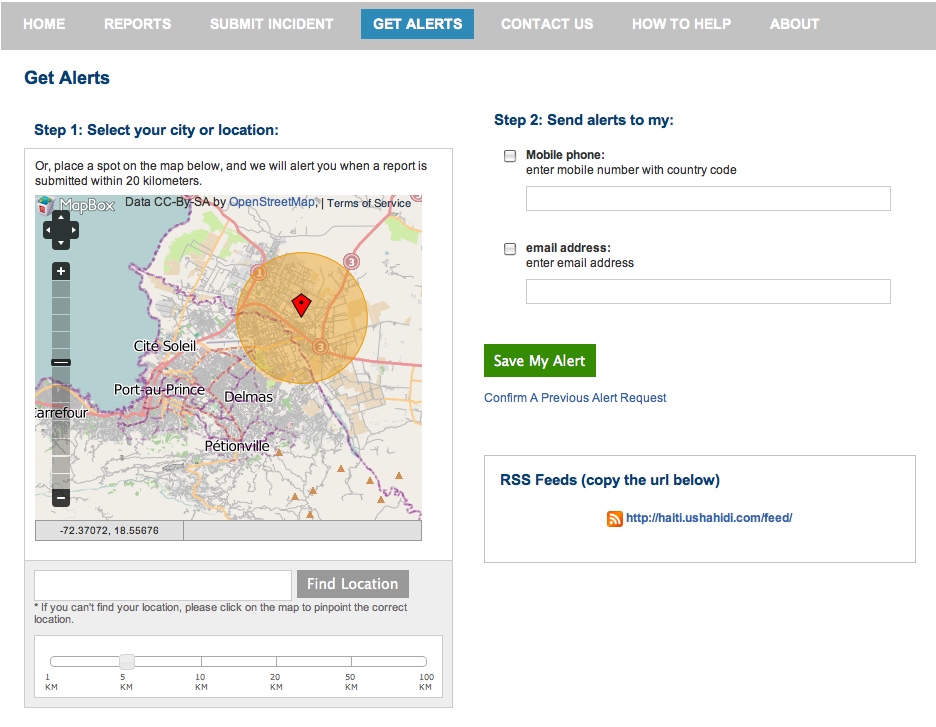
For example, if a relief worker from the Red Cross has a field office in neighborhood of Delmas, they can subscribe to Ushahidi to receive information on all reports originating from their immediate vicinity by specifying a radius, as shown below.
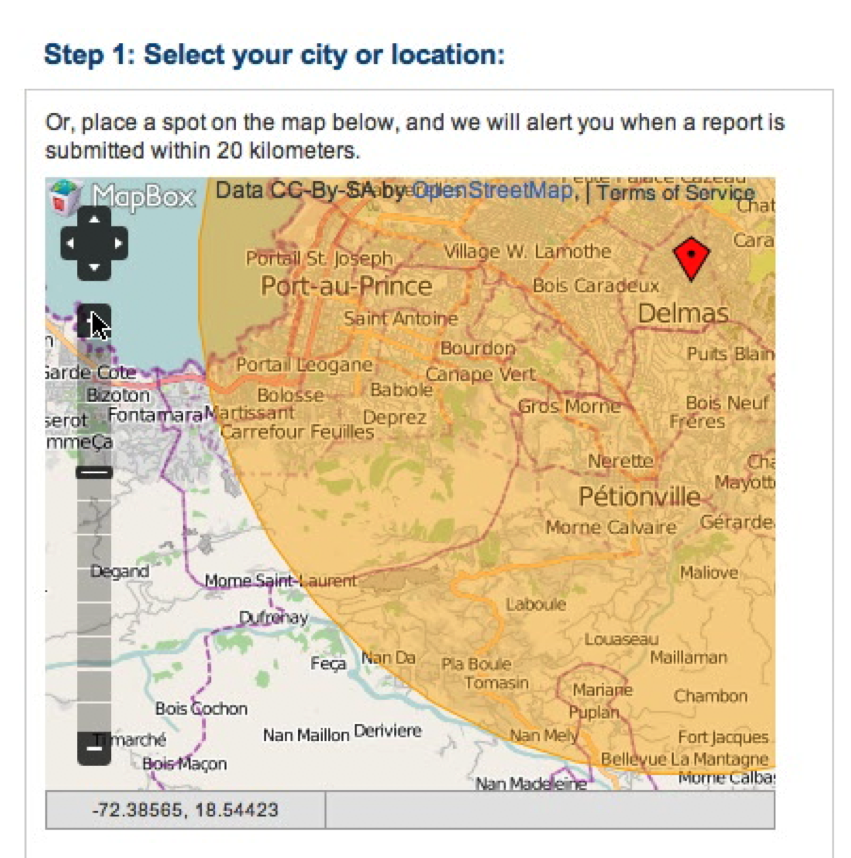
Selecting Area of Interest

The above Alerts feature is now being upgraded to the one depicted below, which was designed by my colleague Caleb Bell from Ushahidi. Not only are responders able to specify their geographic area of interest, but they can also select the type of alert (e.g., collapsed building, food shortage, looting, etc.) they want to receive. They can even add key words of interest to them, such as “water”, “violence” or “UN”. The goal is to provide responders with an unprecedented degree of customization to ensure they receive exactly the kind of alerts that they can respond to.

Highly Customized Alerts

On a more “macro” level, I recently reached out to colleagues at the EC’s Joint Research Center (JRC) to leverage their automated sentiment (“mood”) analysis platform. Sentiment Analysis is a branch of natural language processing (NLP) that seeks to quantify positive vs negative perceptions; akin to “tone” analysis. I suggested that we use their platform on the incoming text messages from Haiti to get a general sense of changing mood on an hourly basis. I’ll blog about the results shortly. In the meantime, here’s a previous blog post on the use of Sentiment Analysis for early warning.
Patrick Philippe Meier

Location Based Mobile Alerts for Disaster Response in Haiti

Using demand-side and supply-side economics as an analogy for the use of communication and information technology (ICT) in disaster response may yield some interesting insights. Demand-side economics (a.k.a. Keynesian economics) argues that government policies should seek to “increase aggregate demand, thus increasing economic activity and reducing unemployment.” Supply-side economics, in contrast, argues that “overall economic well-being is maximized by lowering the barriers to producing goods and services.”

I’d like to take this analogy and apply it to the subject of text messaging in Haiti. The 4636 SMS system was set up in Haiti by the Emergency Information Service or EIS (video) with InSTEDD (video), Ushahidi (video) and the US State Department. The system allows for both demand-side and supply-side disaster response. Anyone in the country can text 4636 with their location and needs, i.e., demand-side. The system is also being used to supply some mobile phone users with important information updates, i.e., supply-side.

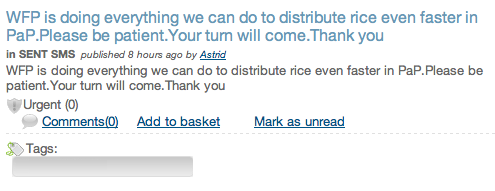
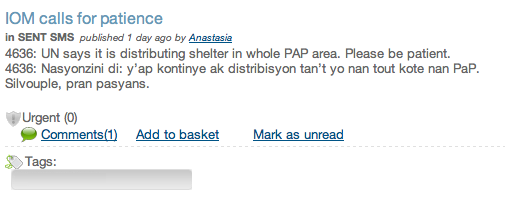
Both communication features are revolutionizing disaster response. Lets take the supply-side approach first. EIS together with WFP, UNICEF, IOM, the Red Cross and others are using the system to send out SMS to all ~7,500 mobile phones (the number is increasing daily) with important information updates. Here are screen shots of the latest messages sent out from the EIS system:

The supply-side approach is possible thanks to the much lower (technical and financial) barriers to disseminating this information in near real-time. Providing some beneficiaries with this information can serve to reassure them that aid is on the way and to inform them where they can access various services thus maximizing overall economic well-being.

Ushahidi takes both a demand-side and supply-side approach by using the 4636 SMS system. 4636 is used to solicit text messages from individuals in urgent need. These SMS’s are then geo-tagged in near real-time on Ushahidi’s interactive map of Haiti. In addition, Ushahidi provides a feature for users to receive alerts about specific geographic locations. As the screen shot below depicts, users can specify the location and geographical radius they want to receive information on via automated email and/or SMS alerts; i.e., supply-side.

The Ushahidi Tech Team is currently working to allow users to subscribe to specific alert categories/indicators based on the categories/indicators already being used to map the disaster and humanitarian response in Haiti. See the Ushahidi Haiti Map for the list. This will enable subscribers to receive even more targeted location based mobile alerts,  thus further improving their situational awareness, which will enable them to take more informed decisions about their disaster response activities.

Both the demand- and supply-side approaches are important. They comprise an unprecedented ability to provide location-based mobile alerts for disaster response; something not dissimilar to location based mobile advertising, i.e., targeted communication based on personal preferences and location. The next step, therefore, is to make all supply-side text messages location based when necessary. For example, the following SMS broadcast would only go to mobile phone subscribers in Port-au-Prince:

It is important that both demand- and supply-side mobile alerts be location based when needed. Otherwise, we fall prey to Seeing Like a State.

“If we imagine a state that has no reliable means of enumerating and locating its population, gauging its wealth, and mapping its land, resources, and settlements, we are imagining a state whose interventions in that society are necessarily crude.”

In “Seeing Like a State: How Certain Schemes to Improve the Human Condition Have Failed,” James Scott uses the following elegant analogy to emphasize the importance of locality.

“When a large freighter or passenger liner approaches a major port, the captain typically turns the control of his vessel over to a local pilot, who brings it into the harbor and to its berth. The same procedure is followed when the ship leaves its berth until it is safely out into the sea-lanes. This sensible procedure, designed to avoid accidents, reflects the fact that navigation on the open sea (a more “abstract” space) is the more general skill. While piloting a ship through traffic in a particular port is a highly contextual skill. We might call the art of piloting a “local and situated knowledge.”

An early lesson learned in the SMS deployment in Haiti is that more communication between the demand- and supply-side organizations need to happen. We are sharing the 4636 number,  so we are dependent on each other and need to ensure that changes to the system be up for open discussion. This lack of joint outreach has been the single most important challenge in my opinion. The captains are just not talking to the local pilots.

Patrick Philippe Meier

Using Mechanical Turk to Crowdsource Humanitarian Response

I’m increasingly intrigued by the idea of applying Mechanical Turk services to humanitarian response. Mechanical Turk was first developed by Amazon to crowdsource and pay for simple tasks.

An excellent example of a Mechanical Turk service in the field of ICT for Development (ICT4D) is txteagle, a platform that enables mobile phone subscribers in developing countries to earn money and accumulate savings by completing simple SMS-based micro-tasks for large corporate clients. txteagle has been used to translate pieces of text by splitting them into individual words and sending these out by SMS. Subscribers can then reply with the translation and earn some money in the process. This automatic compensation system uses statistical machinery to automatically evaluate the value of submitted work.

In Haiti, Samasource and Crowdflower have partnered with Ushahidi and FrontlineSMS to set up a Mechanical Turk service called “Mission 4636“. The system that Ushahidi and partners originally set up uses the generosity of Haitian volunteers in the US to translate urgent SMS’s from the disaster affected population in near real-time. Mission 4636 will relocate the translation work to Haiti and become an automatic compensation system for Haitian’s in-country.

At Ushahidi, we aggregate and  categorize urgent, actionable information from multiple sources including SMS and geo-tag this information on the Ushahidi’s interactive mapping platform. In the case of Haiti, this work is carried out by volunteers in Boston, Geneva, London and Portland coordinated by the Ushahidi-Haiti Situation Room at Tufts University. Volunteer retention is often a challenge, however. I wonder whether we an automated compensation system could be used to sustain future crisis mapping efforts.

Another challenge of crowdsourcing crisis information is tracking response. We know for a fact that a number of key responders are following our near real-time mapping efforts but knowing which reports they respond to is less than automatic. We have been able to document a number of success stories and continue to receive positive feedback from responders themselves but this information is hard to come by.

In a way, by crisis mapping actionable information in near real-time and in the public domain, we are in effect trying to crowdsource response. This, by nature, is a distributed and decentralized process, hence difficult to track. The tracking challenge is further magnified when the actors in question are relief and aid organizations responding to a large disaster. As anyone who has worked in disaster response knows, communicating who is doing what, where and when is not easy. Responders don’t have the bandwidth to document which reports they’ve responded to on Ushahidi.

This is problematic for several reasons including coordination. Organizations don’t necessarily know who is responding to what and whether this response is efficient. I wonder whether a Mechanical Turk system could be set up to crowdsource discrete response tasks based on individual organizations’ mandates. Sounds a little far out and may not be feasible, but the idea nevertheless intrigues me.

The automatic compensation system could be a public way to compensate response. Incoming SMS’s could be clustered along the UN Cluster system. The Shelter Cluster, for example, would have a dedicated website to which all shelter-related SMS’s would be pushed to. Organizations working in this space would each have access to this password protected website and tag the alerts they can and want to respond to.

In order to “cash in” following a response, a picture (or text based evidence) has to be submitted as proof, by the organization in question e.g., of new shelters being built. The number of completed responses could also be made public and individuals compelled to help, could send donations via SMS to each organization to reward and further fund the responses.

The task of evaluating the evidence of responses can also be crowdsource à la Mechanical Turk and serve as a source of revenue for beneficiaries.

For example, local Haitian subscribers to the system would receive an SMS notifying them that new shelters have been set up near Jacmel. Only subscribers in the Jacmel area would receive the SMS. They would then have a look for themselves to see whether the new shelters were in fact there and text back accordingly. Dozens of individuals could send in SMS’s to describe their observations which would further help triangulate the veracity of the evaluation à la Swift River. Note that the Diaspora could also get involved in this. And like txteagle, statistical machinery could also  be used to automatically evaluate the response and dispense the micro-compensations.

I have no doubt there are a number of other important kinks to be ironed out but I wanted to throw this out there now to get some preliminary feedback. This may ultimately not be feasible or worthwhile. But I do think that a partnership between Ushahidi and Crowdflower makes sense, not only in Haiti but for future deployments as well.

See also:

  • Digital Humanitarian Response: Moving from Crowdsourcing to Microtasking [Link]

How To Royally Mess Up Disaster Response in Haiti

I have to find an outlet other than this one to vent my frustrations at this time, which is why I deleted the 5 paragraphs that followed about 3 times. Not to worry, I saved them in a Word document. Good, now that I’ve got the venting part over with, lets play a crowdsourcing game.

I’d love to get your thoughts on the Top 10 ways to mess up disaster response in Haiti using information and communication technology. Suggestions can be completely made up, they can be jokes, serious commentary, witty remarks, predictions, actual observations, and so on, you get the idea. Feel free to post your comments below (anonymously if you wish), but no insults or accusations please, or else I’ll have to delete them.

I’ll keep this game open for 7 days and will post the best results on a new blog post. The person with the best comment will get a free invitation to the:

2nd International Conference on Crisis Mapping (ICCM 2010):
Haiti and Beyond

Patrick Philippe Meier

The Role of Live Skype Chats in the Disaster Response to Haiti

Live Skype chats played an invaluable role in the disaster response to Haiti but this has gone largely unnoticed by both mainstream and citizen media. I have a Word document with over 2,000 pages worth of Skype chat messages exchanged  in various groups during the first 2.5 weeks after the earthquake. I have no doubt that this data will become a source of major interest for scholars seeking to evaluate the disaster response in Haiti.

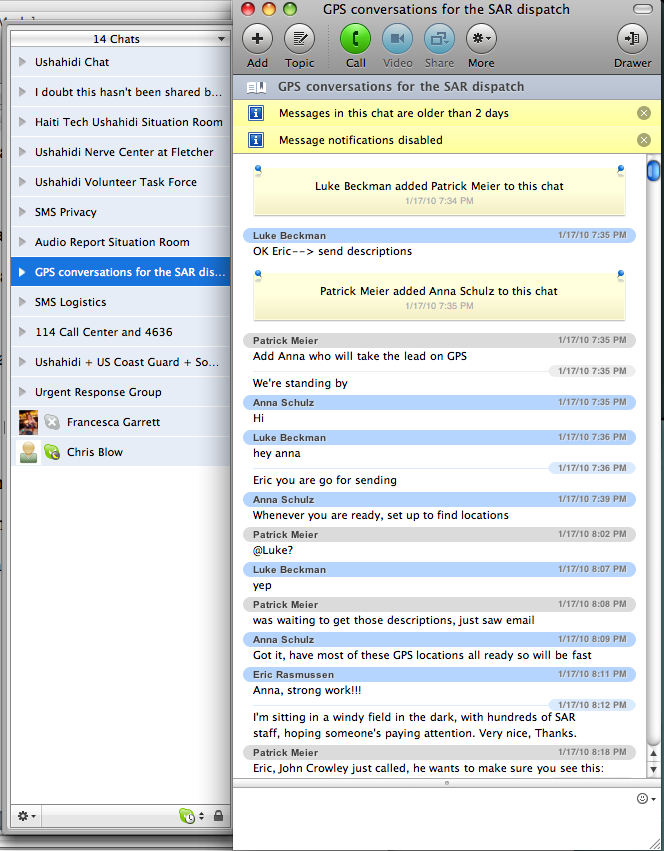
The Skype chats reveal a minute-by-minute account of the actions and decisions that organizations like Ushahidi, FrontlineSMS, InSTEDD, Sahana, Google, Thomson-Reuters and others took following the earthquake. Search and Rescue (SAR) teams in Port-au-Prince also participated in these Skype chats:

For the full story behind the above exchange between Anna, Eric and myself, please see my previous blog post. In addition to SAR staff, the US State Department,  a White House liaison contact, SOUTHCOM, DAI, UN/OCHA, WFP, the US Coast Guard, a Telecom company, and so on were all on live Skype chats at one point or another. It’s actually hard to keep track of everyone who has used the various Skype chats since the earthquake.

The most active and critical Skype Chat Groups were/are:

  • Haiti Tech Ushahidi Situation Room (72 users)
  • GPS Conversations for the SAR Dispatch (21 users)
  • SMS Logistics (37)
  • Ushahidi + US Coast Guard + SOUTHCOM (11 users)
  • Urgent Response Group (13 users)
  • Ushahidi Volunteer Task Force (168)

I would really like to see a discourse analysis and social network analysis of this data. Not to mention different visualizations of the data. In fact, I’d love to partner with anyone who has the time and expertise in these areas to do this. For now, lets take the first Skype chat group above, which was the most critical group during the first week, and just focus on the growth of this group in terms of users during the first week. And then lets create some Wordl visualizations based on data in this chat group.

I started the Haiti Tech Ushahidi Situation Room a couple hours after David Kobia and I launched the Ushahidi-Haiti platform. The second person I called (on my cell) after David was Chris Blow from Meedan. Chris got started on the icons for the platform right away. In the meantime, we used color-coded dots to represent the different categories/indicators.

I checked in with Chris on Skype a couple hours later. Below is the progression of users added to the Skype chat during the first week in case anyone wants to start on some simple social network analysis:

[1/12/10 9:09:55 PM] Patrick Meier: hey Chris, you there?

[1/12/10 10:00:27 PM] Patrick Meier added Brian Herbert to this chat

[1/12/10 10:02:30 PM] Patrick Meier added David Kobia to this chat

[1/12/10 10:10:39 PM] Patrick Meier added Jeffrey Villaveces to this chat

[1/12/10 10:47:41 PM] Jeffrey Villaveces added Luishernando to this chat

[1/12/10 11:42:01 PM] Jeffrey Villaveces added Gabriel Dicelis to this chat

[1/12/10 11:48:49 PM] Brian Herbert added Ory Okolloh to this chat

[1/13/10 2:00:03 AM] Patrick Meier added Kennedy Kasina to this chat

[1/13/10 2:00:11 AM] Patrick Meier: just added Ken to this chat

[1/13/10 2:00:43 AM] Ory Okolloh added Henry Addo to this chat

[1/13/10 2:02:54 AM] Brian Herbert added Henry Addo to this chat

[1/13/10 3:30:13 AM] Patrick Meier added Kaushal Jhalla to this chat

[1/13/10 8:46:07 AM] Patrick Meier added Claire U to this chat

[1/13/10 10:06:59 AM] Brian Herbert added Pablo Destefanis to this chat

[1/13/10 10:09:41 AM] Brian Herbert added Oscar Salazar to this chat

[1/13/10 10:22:02 AM] Patrick Meier added Emily Jacobi to this chat

[1/13/10 10:47:32 AM] Oscar Salazar added Nicolas et Alice BIais- Bonhomme to this chat

[1/13/10 10:51:59 AM] Patrick Meier added Rob Baker to this chat

[1/13/10 11:22:54 AM] Emily Jacobi added Mark Belinsky to this chat

[1/13/10 12:05:59 PM] Patrick Meier added Josh Marcus to this chat

[1/13/10 12:08:10 PM] Patrick Meier added Shoreh Elhami to this chat

[1/13/10 12:11:54 PM] Jeffrey Villaveces added Luke Beckman to this chat

[1/13/10 12:18:52 PM] Luke Beckman added Eduardo Jezierski, Eric Rasmussen to this chat

[1/13/10 12:38:09 PM] Brian Herbert added Erik Hersman to this chat

[1/13/10 1:29:05 PM] Luke Beckman added Brian Steckler to this chat

[1/13/10 1:41:03 PM] Erik Hersman added Caleb Bell to this chat

[1/13/10 2:32:19 PM] Erik Hersman added Jason Mule to this chat

[1/13/10 2:40:31 PM] Luke Beckman added Josh Nesbit to this chat

[1/13/10 5:32:31 PM] Claire U added Fabienne to this chat

[1/13/10 6:13:48 PM] Eduardo Jezierski added Mark Prutsalis to this chat

[1/13/10 7:28:34 PM] David Kobia added Andrew Turner to this chat

[1/13/10 10:59:49 PM] Josh Marcus added Tim Schwartz to this chat

[1/14/10 12:25:58 AM] Tim Schwartz added Ryan Brown to this chat

[1/14/10 4:00:41 AM] Erik Hersman added Meryn Stol to this chat

[1/14/10 4:25:46 AM] Erik Hersman added Victor Miclovich to this chat

[1/14/10 4:29:46 AM] Kennedy Kasina added Charles Kithika to this chat

[1/14/10 5:02:55 AM] Erik Hersman added Brian Joel Conley to this chat

[1/14/10 5:14:35 AM] Kennedy Kasina added lisudza to this chat

[1/14/10 5:21:03 AM] Erik Hersman added aliveinbaghdad to this chat

[1/14/10 1:26:56 PM] Erik Hersman added Dale Zak to this chat

[1/14/10 1:43:43 PM] Dale Zak added benrigby to this chat

[1/14/10 1:51:00 PM] benrigby added Boris Korsunsky to this chat

[1/14/10 2:00:21 PM] Brian Herbert added Abdallah Chamas to this chat

[1/14/10 3:09:37 PM] Josh Nesbit added Paul Goodman to this chat

[1/14/10 3:24:11 PM] Brian Herbert added Satchit Balsari to this chat

[1/14/10 3:37:02 PM] Satchit Balsari added ritwikdey to this chat

[1/14/10 3:50:38 PM] Satchit Balsari added Selvam Velmurugan to this chat

[1/14/10 4:12:47 PM] Josh Marcus added Sharda Sekaran to this chat

[1/14/10 5:53:19 PM] Ory Okolloh added Jonathan Greenblatt to this chat

[1/14/10 7:30:37 PM] Tim Schwartz added wendell_iii to this chat

[1/14/10 10:02:25 PM] Tim Schwartz added Christopher Csikszentmihalyi to this chat

[1/14/10 11:43:09 PM] Josh Nesbit added Robert Munro to this chat

[1/15/10 4:59:07 AM] Brian Steckler added Ryan Burke to this chat

[1/15/10 5:03:45 AM] Kennedy Kasina added joanwmaina to this chat

[1/15/10 5:39:11 AM] David Kobia added Cooper Quintin to this chat

[1/15/10 10:38:10 AM] mark.prutsalis added Chamindra de Silva to chat

[1/15/10 11:24:43 AM] Sharda Sekaran added Amir Reavis-Bey to this chat

[1/15/10 11:27:07 AM] Josh Nesbit added David Wade to this chat

[1/15/10 3:30:51 PM] Paul Goodman added Tapan Parikh to this chat

[1/15/10 7:02:37 PM] Mark Belinsky added Philip Ashlock to this chat

[1/15/10 8:02:39 PM] Brian Steckler added Michael D. McDonald to chat

[1/15/10 10:15:38 PM] mark.prutsalis added David Bitner to this chat

[1/16/10 12:26:11 PM] mark.prutsalis added lifeeth to this chat

[1/16/10 9:23:24 PM] Rob Baker added Rachel Weidinger to this chat

[1/17/10 11:36:20 AM] Josh Nesbit added Lisa Lamanna to this chat

[1/18/10 3:54:06 PM] Luke Beckman added doshi.sd to this chat

[1/18/10 4:18:09 PM] Tim Schwartz added Christina Xu to this chat

[1/19/10 12:10:19 PM] Jeffrey Villaveces added Amaury to this chat

[1/19/10 6:05:19 PM] Ryan Burke added Randy Maule to this chat

[1/19/10 10:24:21 PM] Tapan Parikh added david.notkin to this chat

Here’s the Wordl rendition of the above text:

Below is the Wordl visualization of all the data in the Haiti Chat group, i.e., not only users being added but also the full content of all the chats between 9pm on January 12th through 9pm on January 30th.  This constitutes over 300 pages of content in a Word document. Of course, dates and individual names still come up most frequently.

The Wordl visualization below draws on the first week of data but with all names, dates and times removed. This enables us to focus exclusively on the content or dialogue exchanged between users.

I like the fact that the word “thanks” stands out fairly prominently. Stay tuned for more Wordl visualizations on the other Skype chat groups. In the meantime, if you want to get started on some more statistical discourse analysis or social network analysis, please feel free to get in touch. Thanks!

Patrick Philippe Meier

From Clinton to Ushahidi-Haiti to Digital Repression and Back

I’m grateful to the State Department for having invited me to attend Secretary Hillary Clinton’s recent speech in DC on Net Freedom. Little did I know before the event that Secretary Clinton was about to tie my main professional and scholarly interests in one speech. As my Fletcher colleague put it:

Before starting her important speech on Net Freedom (which is directly related to the topic of my dissertation), Clinton spoke about the disaster in Haiti. She specifically referred to the critical role that communication networks played in the immediate aftermath of the quake and also noted that,

“The technology community has set up interactive maps to help us identify needs and target resources. And on Monday, a seven-year-old girl and two women were pulled from the rubble of a collapsed supermarket by an American search-and-rescue team after they sent a text message calling for help.”

She was clearly referring to the interactive maps launched by Ushahidi, Open Street Map (OSM) and Sahana as well as the free “4636” SMS number that Ushahidi and partners set up with the support of the State Department. Haitians can send a text to 4636 to report their location and urgent needs. These SMS’s are translated into English and mapped in near real-time on Ushahidi-Haiti.

Secretary Clinton then transitioned to the topic of Net Freedom with the following comment,

“There are more ways to spread more ideas to more people than at any moment in history. And even in authoritarian countries, information networks are helping people discover new facts and making governments more accountable.”

Towards the middle of her speech, Clinton emphasized the Obama Administration’s interest in placing new media and digital technologies “in the hands of people who will use them to advance democracy and human rights […].” The next steps articulated by Clinton:

“That’s why today I’m announcing that over the next year, we will work with partners in industry, academia, and nongovernmental organizations to establish a standing effort that will harness the power of connection technologies and apply them to our diplomatic goals. By relying on mobile phones, mapping applications, and other new tools, we can empower citizens and leverage our traditional diplomacy. We can address deficiencies in the current market for innovation.”

I was particularly pleased to hear more reference to mobile phones and mapping applications. In closing, Clinton wrapped up with the following comment:

“So let me close by asking you to remember the little girl who was pulled from the rubble on Monday in Port-au-Prince. She’s alive, she was reunited with her family, she will have the chance to grow up because these networks took a voice that was buried and spread it to the world. No nation, no group, no individual should stay buried in the rubble of oppression. We cannot stand by while people are separated from the human family by walls of censorship. And we cannot be silent about these issues simply because we cannot hear the cries.”

This is when my Fletcher colleague sent out that Tweet:

It would certainly appear that the answer to Brian’s question is “Yes!”

My dissertation focuses on the role of new media and digital technology in popular resistance against authoritarian rule. And I happen to be the Director of Crisis Mapping at Ushahidi, which is why I launched the Ushahidi-Haiti platform two hours after the earthquake. The more I work on crisis mapping, the more I experience firsthand the applications for digital activism. And the more I work on digital activism in non-permissive environments, the more I realize how important some of the tactics are for crisis mapping.

In sum, every day that passes provides more and more evidence that this is the space I currently belong in; the intersection between communication technology, interactive mapping, digital activism and nonviolent civil resistance.

Patrick Philippe Meier

Haiti and the Power of Crowdsourcing

It’s been two weeks since I called David Kobia to launch Ushahidi’s crisis mapping platform in Haiti. I could probably write 100 blog posts on the high’s and low’s of the past 14 days. Perhaps there will more time be next month to recount the first two weeks of the disaster response. For now, I wanted to share an astounding example of crowdsourcing that took place 10 days ago.

Boston, January 17, 8pm

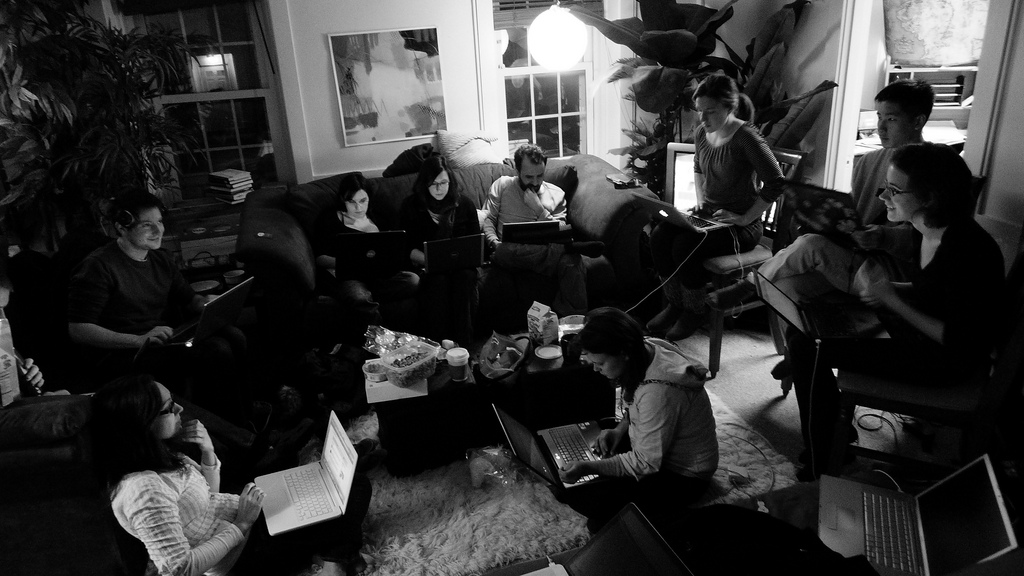
Picture a snowy Boston evening and the following “Situation Room” a.k.a. my living room at Blakeley Hall, part of The Fletcher School.

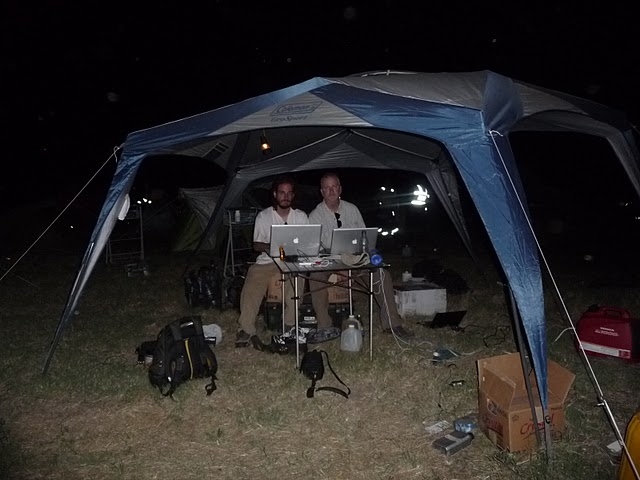
My fellow PhD colleague Anna Schulz, who has rapidly become an expert in satellite imagery analysis and geolocation, receives an urgent request via Skype from InSTEDD‘s Eric Rasmussen pictured below with Nico di Tada. That tent is pitched right next to the runway of Port-au-Prince’s international airport, some 1,600 miles south of Boston.

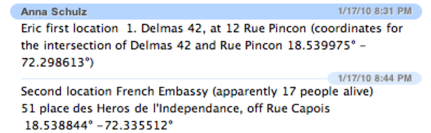
The urgent request? GPS coordinates for 7 key locations across Port-au-Prince where many Haitians were known to be trapped under rubble. They needed to communicate this information to the Search and Rescue (SAR) teams before 0600. Anna immediately got to work.

Boston, January 17, 8.30pm

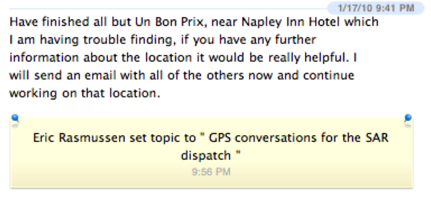
An hour later, Anna had found the GPS coordinates for all but one of the locations for the rescue operations.

Boston, January 17, 9.41pm

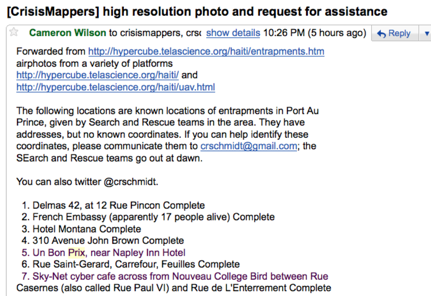
Boston, January 17, 10.26pm

Some time later, the same urgent request originally sent by Eric and Nico appears on the CrisisMappers Google Group:

Boston, January 17, ~11.00pm

At Anna’s request, I send out the following Tweet on Ushahidi.

Boston, January 18, ~1.00am

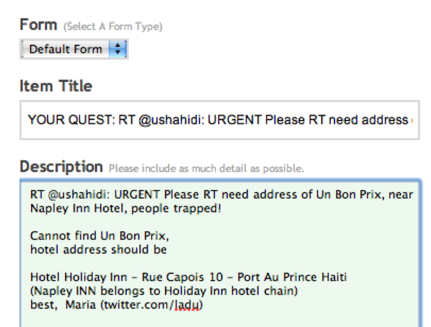
The following report is submitted to the Ushahidi-Haiti platform by someone from the Twittersphere:

Boston, January 18, 1.20am

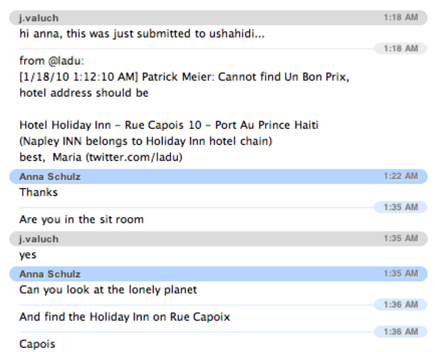
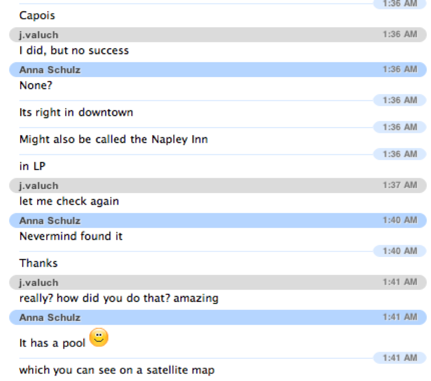
My colleague Jaroslav in The Fletcher Situation room Skypes back to Anna:

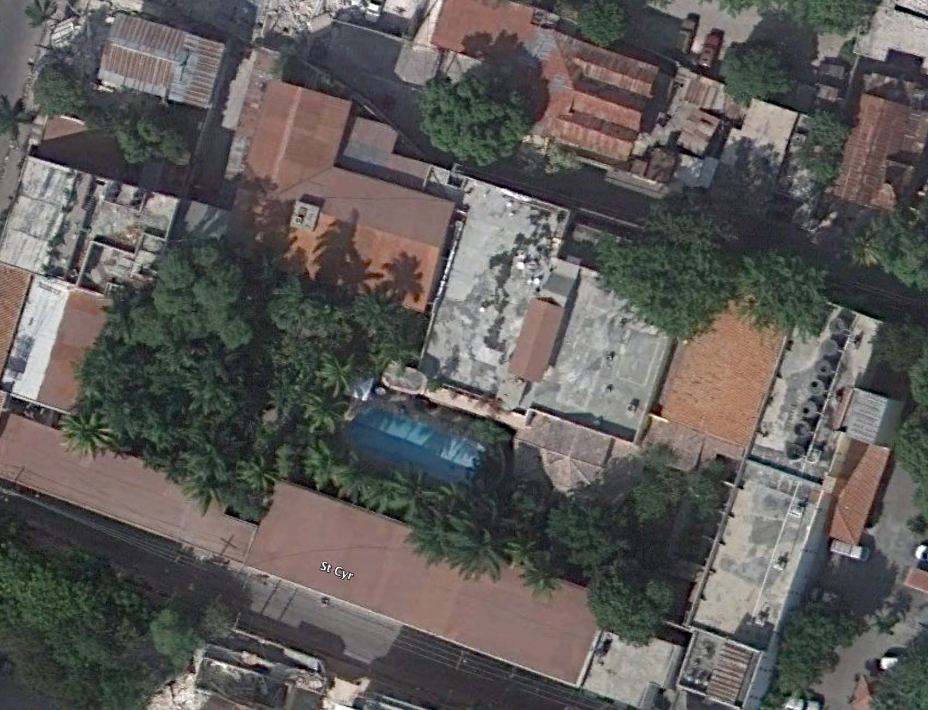
Courtesy of high-resolution satellite imagery on Google Earth:

Boston, January 18, ~2.00am

It’s getting late but the ALL CAPS in this Tweet to Ushahidi catches my eye:

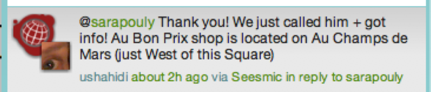
My colleague Jaroslav and I decide to try the number. Low and behold, we get Marc on the phone after just one ring. With a mixture of English and French, we find out that he was indeed a former employee of Au Bon Prix which happens to be a book store just off “Au Champs de Mars” near the Palace. We immediately Skype this information back to Eric and Nico at Port-au-Prince airport.

Boston, January 18, ~2.15am

Boston, January 18, ~4.30am

It’s still snowing in Boston. Time to get a few hours of sleep. We hand over operations to the Ushahidi Team in Africa.

Patrick Philippe Meier

Cyberconflict and Global Politics: New Media, War, Digital Activism

Athina Karatzogianni has just edited another informative book, this one on “Cyberconflict and Global Politics.” I blog-reviewed her previous book on “The Politics of Cyberconflict” here after meeting Athina at Politics 2.0 back in 2008. This blog posts consists of book notes for my dissertation research.

Athina authors the first chapter on “New Media and the Reconfiguration of Power in Global Politics.” Some relevant excerpts:

  • The information revolution is altering the nature of conflict by strengthening network forms of organization over hierarchical forms.
  • Dissidents against governments are able to use a variety of Internet-based techniques […] to spread alternative frames for events and a possible alternative online democratic sphere. An example of dissidents’ use of the Internet is spamming e-magazines to an unprecedented number of people within China, a method which provides recipients with ‘plausible deniability.’

The second chapter authored by Hall Gardner addresses “War and the Media Paradox.”

  • While the prospects of instant communication had been hailed as a means to prevent conflict and to help negotiate an end to disputes and wars […] one of the major paradoxes is that a number of media inventions are actually helping to cause, if not perpetuate, social and political conflict in general.
  • In China […] just prior to the Tiananmen Square repression in June 1989, it had been the transistor radio that provided alternative views to those of the government.

The third chapter on “The Internet as a weapon of war” is primarily focused on news and as such is not directly relevant to my research. Chapter 4 on “Transparency and Accountability in the Age of Cyberpolitics” by Maori Touri has an interesting reference to Kant:

  • The impact of transparency and publicity on human behavior is hardly new with Kant being amongst the first to argue that the principlesof human action could be ethical only if they were public.

The fifth chapter by Michael Dartnell addresses “Web Activism as an Element of Global Security.”

  • While the World Wide Web and information technologies (IT) that emerged over the past decade have a transformative impact on global security, neither they nor the expectations that they arouse are unique to our time. In “The Radio as an Apparatus of Communication”, Bertolt Brecht argued that

The radio would be the finest possible communication apparatus in public life […] if it knew how to receive as well as transmit, how to let the listener speak as well as hear, how to bring him into a relationship instead of isolating him.

  • As James Katz and Ronald Rice suggest, ‘although the Internet has not led to any political revolutions, it has supported and encouraged them (as have—and do—the phone and fax)’ (Katz and Rice 2002:352).
  • Web activism is a form of electronic direct action in which previous one-way media are superseded by global communications devices. […]. As Miekle notes, ‘Internet activism is largely about raising awareness of the issues concerned, and this means more coverage than the purely online’ (Miekle 2002:26).
  • The telegraph […] was an innovation that facilitated European imperialism and helped consolidate global dominance.
  • Instead of a tool for revolutionary transformation, Web activism is a powerful new method for political organizations of all stripes in precise circumstances that favor their messages.
  • The evaluation [of the impact of IT on IR] needs to be conducted in a variety of ways since the impacts are in fact a diverse body of content.

Chapter 6 on “The Laws of the Playground” is not relevant to my research nor is chapter 7 on “Information Warfare Operations within the Concept of Individual Self-Defense”. Chapters 8 and 9 are interesting but not directly informative for my dissertation: “The Internet and Militant Jihadism”, and “How Small are Small Numbers in Cyberspace?” Chapter 10 focuses on a case study of Sri Lanka while Chapter 11 draws on the case study of Women in Black.

Chapter 12 by Graham Meikle is on “Electronic Civil Disobedience and Symbolic Power.”

  • Electronic Civil Disobedience [ECD] is a key example of the Internet’s capacity to enable users to exercise what Castells terms ‘counter-power’—’the capacity by social actors to challenge and eventually change the power relations institutionalized in society’ (2007:248).
  • However, the discourse of ECD is contested, and where its proponents seek to align it with the civil disobedience tradition of Thoreau, Gandhi and Martin Luther King, it is frequently implicated in other discourses: in the concept of ‘hactivism’; in the concept of ‘netwar’; and in debates about terrorism.
  • [In 1994, the Critical Art Ensemble] aligned the concept of electronic civil disobedience with the widely-understood principles of traditional civil disobedience […]. There were continuities […] such as the use of trespass and blockades as central tactics. However, there were also discontinuities, such as the de-emphasizing of mass participation in favor of decentralized, cell-based organization [and] that electronic civil disobedience should be surreptitious, in the hacker tradition.
  • Where practitioners of civil disobedience have been transparent about their opposition [… the Critical Art Ensemble] argued for a clandestine approach, proposing electronic disobedience as ‘an underground activity that should be kept out of the public/popular sphere (as in the hacker tradition) and the eye of the media’ (CAE 2001: 14).
  • [There is a dilemma for activists] in that while the news media are drawn to novelty and disruption, their coverage is also more likely to focus on that very novelty and disruption than on the underlying issues or causes involved, which may in fact work against the activist cause (Scalmer 2002:41).
  • [One challenge for activists] is not just to formulate new strategies and tactics appropriate to a shifting mediascape, but to recognize the ongoing need to create a careful vocabulary for discussing those tactics and strategies.
  • ‘The information revolution is favoring and strengthening network forms of organization, often giving them an advantage of hierarchical forms. The rise of networks means that power is migrating to nonstate actors, because they are able to organize into sprawling multiorganizational networks […] more readily than can traditional, hierarchical, state actors. This means that conflicts may increasingly be waged by ‘networks’, perhaps more than by ‘hierarchies’. It also means that whoever masters the network form stands to gain the advantage’ (Arquilla and Ronfeld 2001a: 1).

The final two chapters focus on a case study of the European Social Forum and capitalism respectively.

Patrick Philippe Meier

Twitter in Iran: Where I disagree with Will Heaven vs Josh Shahryar

Will Heaven of the Daily Telegraph and EA‘s Josh Shahryar have been engaged in a battle of words on the role of Twitter in Iran. I think the battle has now drawn to a close. Given the popularity of my previous post on “Where I disagree with Morozov and Shirky on Digital Activism,” I thought I’d continue the series, which also helps me keep track of my notes for my dissertation.

————

It all started on December 29th when Will published this article in the Daily Telegraph:

Iran and Twitter: the fatal folly of the online revolutionaries

Which he followed up with this blog post, still on the Daily Telegraph:

Iran’s brutal regime won’t be toppled by Twitter and the niceties of social media

This provoked the following response from Josh (the page may be down):

Twitter Revolution 101: Get Your Facts Right

Will in turn replied to Josh’s post with one of his own:

My response to Twitterati: stop putting Iranian lives at risk

Finally, unless I’ve missed another exchange, Josh posted this closing response yesterday:

Iran & Twitter: Last Words on The Hell of Heaven

————

I copied and pasted this lengthy exchange in a Word document (available here) and did a word count. The debate generated over 7,500 words. That’s about 12 pages, single-space of font-size 10 text. I’ve re-read this document several times and I’m not quite sure what the debate ultimately amounts to. They both make very good points but neither is willing to concede that.

In my opinion, the contentious exchange stems from the use of the word “revolution” and the subsequent arms-race of anecdotes that all too often causes more confusion than clarity. When Will uses the term, “there has been no revolution in Iran,” he implies a political revolution whereas Josh—on several occasions—clearly states that he’s talking about a revolution in information dissemination: “That Revolution is about awareness, not provoking a political revolt or helping it directly.”

In any case, here are my individual comments on their exchange.

My Response to Will

Will: It’s deluded to think that “hashtags”, “Tweets” and “Twibbons” have threatened the regime for a second.

Really? Then why would the regime or sympathetic elements within Iran try to shut it down?

Will: Here’s the other thing “social media experts” will forget to tell you: dictatorships across the world now use their own tools to hunt down online protesters.

I would like to challenge Will to find one “social media expert” who forgets that digital repression is real. Please see my previous blog post on this.

Will: And it is foolish to think that their use [Tor, Freebase] guarantees safety: if the Revolutionary Guard were to find someone using the software, the consequences would be dire.

Both Will and Josh are fixated on technology at the expense of tactics. I think they’d find this guide on how to communicate securely in repressive environments of interest. There needs to be more cross-fertilization between civil resistance strategies and digital activism tactics. See this post for more.

And before either fault me for making the above guide public, all the information in said-guide is already public and available online. Repressive regimes may very well be aware of most of the tactics and technologies used, but just like chess, this doesn’t mean one side can defeat the other at every game.

Will: When you consider the danger posed to Iranians by online participation – compared with what online participation has achieved – the overall result is hardly tangible, and certainly not worth the risks which have been undertaken.

True, perhaps, but a little too passive a statement for my tastes. Those risks are not static, they can be reduced; hence the guide. And hence the need for more education and training in digital activism around the world. See Tactical Tech‘s excellent work in this area, for example.

One other point that Will overlooks (understandably since he doesn’t live in the US) is the stunning shift in perception that took place in the minds of Americans when viewing Iran’s post-election protests. Prior to the elections, the word Iran would generally evoke the following: “Nuclear weapons”, “Kill the Great Satan”, etc. But after young Iranians took to the streets and the protests were documented on Twitter, Facebook and Flickr, many Americans finally realized that “the other” was perhaps not that different. The shift in mindset was huge.

My Response to Josh

I largely agree with Josh’s take on the role of Twitter in Iran although I see why it’s easy for Will to carefully select one or two arguments and push back. In any case, I do take issue with this comment:

Josh: The fact that Iranians are dying is not the fault of Westerners. It is not even a fault. It is a sacrifice that Iranians must make to gain their freedom.

The Responsibility to Protect (R2P) suggests that state sovereignty is contingent on a state protecting it’s citizens. A regime that kills some 400 citizens in response to street protests should hardly have the right to remain sovereign. There should be a Chapter 7 UN mandate with 20,000 observers in Iran to prevent any more violence. Realistically though, I don’t know what the solution to this crisis is, but I do feel that we’re all responsible for the bloodshed.

I definitely disagree with Josh’s implication that revolutions require death and destruction. “Be smart, don’t be dead” is what I tell political activists. There are very good reasons why nonviolent action is called “A Force More Powerful.” Digital activists really need to get up to speed on nonviolent civil resistance tactics and strategies just as the latter need to get up to speed on how to communicate more securely in repressive environments.

Patrick Philippe Meier

Breaking News: Repressive States Use Technologies to Repress!

I kid you not: repressive regimes actually have the nerve to use technologies to repress! Who would’ve guessed?! Nobody could possibly have seen this one coming. I mean, this shocking development is completely unprecedented in the history of state repression. Goodness, how did these repressive regimes even come up with the idea?!

Yes, that was sarcasm. But I never cease to be amazed by the incredible hullabaloo generated by the media every time a new anecdote pops up on a repressive regime caught red handed with digital technology. Just stunning. It’s as if world history started yesterday.

I hate to state what should be obvious but repressive states also used technology to repress in 2009, and in 2008, 2007, 2006, 2005, 2004, 2003, 2002, 2001 … You get the point. Hint: tech-based repression doesn’t start in 1984 either, try a little earlier. As Brafman and Beckstrom point out,

All phone calls were routed through Moscow [during the time of the Soviet Union]. Why? The Kremlin wanted to keep tabs on what you were talking about–whether plotting to overthrow the government or locating spare parts for your tractor. The Soviets weren’t the first, or the last, to keep central control of communication lines. Even the Roman empire, though spread around the world, maintained a highly centralized transportation system, giving rise to the expression ‘All roads lead to Rome’ (52).

Why the media continues to treat digital repression as a surprise is beyond me. Repressive states have used technologies for hundreds of years. So someone please tell me why repressive regimes wouldn’t use new technologies as well? Because they’re new? No, that’s probably not it. Wait, because they’re cheap? Or effective? Darn, I don’t know, what’s the answer? Is this a trick question?

As Evgeny Morozov notes,

There is, of course, nothing surprising about it: why wouldn’t governments be doing this? After all, there are many smart techies working for the governments as well – and sometimes they even believe in and like what they are doing.

But you still come across the typical comment “I told you so!” on Twitter, blogs, etc., “I told you that repressive states would use technology to repress!” And so the anecdotes keep flying and the “oooh’s” and “aaah’s” keep coming. The media freaks out, everyone gets excited. And the next day is exactly the same since the media thrives on repetitive soundbites, especially very catchy (preferably one-word) soundbites, which explains why I increasingly feel like I’m stuck in digital groundhog day.

If I had more time, I’d write a blog post entitled “10 Easy Steps to Writing the Best Anecdote on Digital Repression Ever” along the lines of Evgeny’s fun post on “10 Easy Steps to Writing the Scariest Cyberwarfare Article Ever.” But my post would be a lot shorter:

1) Find an anecdote in the mainstream media;
2) Formulate a blockbuster title ending with an exclamation mark;
3) Preface your post with a note that no one but you anticipated this to happen;
4) Quote at least one full paragraph on the anecdote from another source;
5) For extra credit, create your own new one-word soundbite;
6) Conclude with a few snarky lines about how this clearly refutes all the dumb hype on digital technologies.

Some applaud the media’s focus on digital repression. They are grateful to the media for countering the Utopian hype. Fair enough, but this refrain is quickly becoming an excuse to spew out more anecdotes instead of contributing solid analysis. Moreover, the media is largely responsible for promoting the techno-Utopian hype to begin with. This inevitably triggers an arms race of anecdotes, which only leads to mutually assured confusion. But don’t panic, we’ve always got our catchy one-word soundbites to clear things up!

So here’s a practical thought: why doesn’t someone aggregate and code all these anecdotes to analyze them and look for trends? I realize that’s a little harder than writing up daily blog posts on the latest anecdotes so why not do this together? Lets set up an open spreadsheet to keep track of digital repression event-data. Then, when we have 6 months or more of event-data for a particular country, lets analyze this data so we can actually say something more informative about the dynamics of digital repression.

Come to think of it, Global Voices Advocacy, Herdict and the OpenNet Initiative are already doing a lot of this information collection, and very well. Still, it would be great if they could turn this information into event-data and expand beyond the Internet to include mobile phones and other digital technologies. Something along these lines, perhaps.

This won’t answer all our questions, but it would give us the underlying event-data to study digital repression at the tactical level over time. (Would asking daily data updates be too much?).

The next step would be to do the same for “digital liberation”, i.e., capturing event-data on how/when/where civil society groups evade digital repression. Analyzing both datasets would allow us to get a grasp on the cat-and-mouse dynamics that may characterize the race between digital activists and repressive states. I think the analysis would show that states are more often than not reactive. But who knows. Such is life in data hell.

Patrick Philippe Meier