Satellite Imagery, Mobile Phones and Radios

Earth Observation System Launches in Africa: the SERVIR system integrates satellite resources into a web-based Earth information system, putting previously inaccessible information into action locally.

“A satellite birds-eye view can provide an overall picture of a natural disaster and its consequences,” said Dr. Tesfaye Korme, director of remote sensing and geographic information systems at RCMRD. “The new SERVIR-Africa platform comes just in time to provide us with the satellite data to develop maps of last week’s flooding in western Kenya and eastern Uganda, and estimate the number of displaced people.  We will provide this information to the authorities responsible for disaster response.”

For early warning in advance of events, SERVIR-Africa is developing tools to predict floods in high-risk areas and vector-borne diseases such as Rift Valley Fever. It will also provide visualization capability to map the location of climate change projections so people can see, for example, the potential impact climate change may have on the land resources where they live.  In addition, SERVIR-Africa’s information technology team will use the Internet to serve up satellite and ground-based earth observations, map data, and geospatial analyzes that target issues such as urbanization, biodiversity threats, and management of natural resources.  Mobile phones and radio, too, will be explored as a means to deliver useful information to people.
I’m particularly pleased to read that mobile phones and radios will be explored (and hopefully used) to deliver information at the community level.

Links: Facebook, Palentir, People Power, MapMaker

  • People Power: Revolutions Colored Green: Think of popular protests, of the kind that make clever use of technology to mobilize support, flummox the authorities and disseminate facts and images. Campaigns have recently been applying the latest “people power” techniques to environmental activism. In time, eco-protest may lead to political change, but the focus is narrower.
  • 16th Century Map Maker’s Intriguing Knowledge: How was it that a German priest writing in Latin and living in a French city far from the coast became the first person to tell the world that a vast ocean lay to the west of the American continents?

InSTEDD’s Mesh4X Explained

I’ve had the pleasure of crossing paths with InSTEDD’s Robert Kirkpatrick on several occasions this year and always come away from our conversations having learned something new. Robert has recently been presenting InSTEDD’s new Mesh4X project. I confessed to him that I wasn’t entirely sure I fully grasped all the technical language he used to describe Mesh4X (which may serve as one answer to Paul Curion’s recent questions on The Innovation Fallacy).

Shortly after our recent CrisisMappers Meeting in Orlando, Robert kindly took the time to rework his description of Mesh4X for non techies. What follows is this description in Robert’s own words: “Having now heard the message a second time, I’m trying to clarify my description of Mesh4x for a lay audience. This version is more of a ‘product brochure’ in style, but I hope you find it useful in filling in any gaps.”

_____________________________________________

InSTEDD Mesh4X

Problem:  cross-organizational data sharing shouldn’t be this hard.

A major obstacle to effective humanitarian action today is that while advances in information technology have made it possible for individual organizations to collect, organize, and analyze data as never before, sharing of data between organizations remains problematic.  Organizations choose to adopt different information systems and software applications for many good reasons, yet a consequence of this is that data ends up fragmented across multiple organizations’ servers, PCs, and networks and remains “trapped” in different databases and formats.

This fragmentation incurs a high opportunity cost, as each organization working on a problem ends up having to act based on a fraction of what is actually known collectively. When data is shared today, it typically involves staff manually exporting from a database,  emailing spreadsheets files, and them importing them manually on the receiving end – a cumbersome and error-prone process further complicated by situations where Internet access is slow, unreliable, or completely unavailable.

Solution: Mesh4X – critical data when you need it, where you need it.

  • Imagine if that spreadsheet on your desktop, filled with health surveys, supply requests, or project status reports, were seamlessly linked to databases, programs, map software, websites and PDAs of others you want to share with, so that whenever you add or update data, the changes end up  being reflected everyone else as well, and all of their changes would also show up in your spreadsheet automatically.
  • Imagine being able to see all of this collective information on a map – a map that updates itself whenever anyone makes a change  to shared data.
  • Now imagine being able to exchange data with others even when no Internet access is available.

InSTEDD Mesh4X is a technology designed to create seamless cross-organizational information sharing between different databases, desktop applications, websites, and devices. It allows you to create or join a shared “data mesh” that links together disparate software and servers and synchronizes data between them automatically. You choose the data you wish to share, others do the same, and now everyone’s data ends up everywhere it needs to be.

  • Using Mesh4X, changes to data in any one location in the mesh are automatically synchronized to every other location.
  • If you’re offline at the time, all of your data will synchronize the next time you connect to the network.
  • For cases where no Internet access is available at all, there is no longer any need for the slow transport of files physically between locations.  Mesh4X gives you the option to synchronize all data via a series of SMS text messages – just plug a compatible phone into your laptop, and Mesh4X does the rest.
Using Mesh4X, you’ll have access to more information, and sooner, when making critical decisions.  When you need to collaborate with multiple organizations toward a shared goal, everyone will have a more complete and up-to-date understanding of needs, resources, and who is doing what where.

_____________________________________________

Thanks again to Robert for pulling this version together. I’m now more assured that I did grasp the in’s and out’s of Mesh4X. My next question to Robert and the InSTEDD team is whether Mesh4X is at point where it’s “plug and play”? That is, as easy to download and set up as, say, a blog on wordpress? Will the setup process be facilitated by a Microsoft-like-wizard for easy guidance and implementation?

InSTEDD’s Mesh4X Explained

I’ve had the pleasure of crossing paths with InSTEDD’s Robert Kirkpatrick on several occasions this year and always come away from our conversations having learned something new. Robert has recently been presenting InSTEDD’s new Mesh4X project. I confessed to him that I wasn’t entirely sure I fully grasped all the technical language he used to describe Mesh4X (which may serve as one answer to Paul Curion’s recent questions on The Innovation Fallacy).

Shortly after our recent CrisisMappers Meeting in Orlando, Robert kindly took the time to rework his description of Mesh4X for non techies. What follows is this description in Robert’s own words: “Having now heard the message a second time, I’m trying to clarify my description of Mesh4x for a lay audience. This version is more of a ‘product brochure’ in style, but I hope you find it useful in filling in any gaps.”

_____________________________________________

InSTEDD Mesh4X

Problem:  cross-organizational data sharing shouldn’t be this hard.

A major obstacle to effective humanitarian action today is that while advances in information technology have made it possible for individual organizations to collect, organize, and analyze data as never before, sharing of data between organizations remains problematic.  Organizations choose to adopt different information systems and software applications for many good reasons, yet a consequence of this is that data ends up fragmented across multiple organizations’ servers, PCs, and networks and remains “trapped” in different databases and formats.

This fragmentation incurs a high opportunity cost, as each organization working on a problem ends up having to act based on a fraction of what is actually known collectively. When data is shared today, it typically involves staff manually exporting from a database,  emailing spreadsheets files, and them importing them manually on the receiving end – a cumbersome and error-prone process further complicated by situations where Internet access is slow, unreliable, or completely unavailable.

Solution: Mesh4X – critical data when you need it, where you need it.

  • Imagine if that spreadsheet on your desktop, filled with health surveys, supply requests, or project status reports, were seamlessly linked to databases, programs, map software, websites and PDAs of others you want to share with, so that whenever you add or update data, the changes end up  being reflected everyone else as well, and all of their changes would also show up in your spreadsheet automatically.
  • Imagine being able to see all of this collective information on a map – a map that updates itself whenever anyone makes a change  to shared data.
  • Now imagine being able to exchange data with others even when no Internet access is available.

InSTEDD Mesh4X is a technology designed to create seamless cross-organizational information sharing between different databases, desktop applications, websites, and devices. It allows you to create or join a shared “data mesh” that links together disparate software and servers and synchronizes data between them automatically. You choose the data you wish to share, others do the same, and now everyone’s data ends up everywhere it needs to be.

  • Using Mesh4X, changes to data in any one location in the mesh are automatically synchronized to every other location.
  • If you’re offline at the time, all of your data will synchronize the next time you connect to the network.
  • For cases where no Internet access is available at all, there is no longer any need for the slow transport of files physically between locations.  Mesh4X gives you the option to synchronize all data via a series of SMS text messages – just plug a compatible phone into your laptop, and Mesh4X does the rest.
Using Mesh4X, you’ll have access to more information, and sooner, when making critical decisions.  When you need to collaborate with multiple organizations toward a shared goal, everyone will have a more complete and up-to-date understanding of needs, resources, and who is doing what where.

_____________________________________________

Thanks again to Robert for pulling this version together. I’m now more assured that I did grasp the in’s and out’s of Mesh4X. My next question to Robert and the InSTEDD team is whether Mesh4X is at point where it’s “plug and play”? That is, as easy to download and set up as, say, a blog on wordpress? Will the setup process be facilitated by a Microsoft-like-wizard for easy guidance and implementation?

Links: Satellite Maps, Scientific Data, Digital Tracing

  • Satellites Predict Cholera: Science Daily just ran a piece on a new technique using satellites to predict and map cholera outbreaks.
  • Visualizing Scientific Data: The annual American Geophysical Union meeting in San Francisco will include a session on Visualizing Scientific Data Using KML and Virtual Globes.
  • Digital Images Contain Maker’s Mark: If you thought your digital photos could not be traced back to you, think again. Digital cameras leave a telltale fingerprint buried in the pixels of every image they capture.

Crisis Mappers Meeting

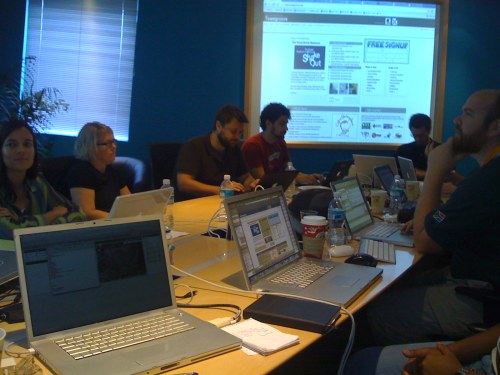
Our first CrisisMappers meeting took place in Orlando, Florida this past weekend. The meeting brought together a small group of tech professionals who are at the very cutting edge of crisis mapping. It truly was a powerhouse. Ushahidi, Development Seed, NiJEL, Emergencity, GeoCommons, InSTEDD, In.itiative and the Harvard Humanitarian Initiative (HHI). This meeting was mostly self-funded and scheduled on a Saturday. The fact that everyone showed up is a clear testament to the commitment we all have to pushing the new field of crisis mapping forward to the next frontier.
img_0001

Andrew Turner gave a typical tour de force presentation on some of the most exciting tech-innovations in mapping. I highly recommend viewing his slide show presentations available on Slideshare here. I gave the second introductory talk and chose to highlight two major themes in the future of crisis mapping: Mobile Crisis Mapping (MCM) and Crisis Mapping Analytics (CMA).

The former focuses on our understanding of dynamic mapping platforms as communication tools. In other words, all our communication tools should be fully integrated within our dynamic mapping platforms. Imagine a Google Map interface from which I can receive geo-referenced text messages and forward those messages by SMS broadcast or email right back to the field, without ever having to navigate away from the map. InSTEDD’s GeoChat is a good example of what I have in mind.

Understanding mapping platforms as communication tools poses two challenges common to communication in crisis zones. The first is connectivity while the second is data security. In terms of connectivity, we urgently need to move towards meshed-networked peer-to-peer communication that obviates the need for cell phone towers. As for encryption, SMS encryption should be the default setting on all our communications. Anything less is simply unsatisfactory.

I’ve written about Crisis Mapping Analytics before, so won’t go into detail here. I just want to point out that as our crisis mapping platforms continue to crowdsource data, we will need to make sense of this information in terms of trends over both space and time. We are still far from having any user friendly  point-and-click statistical tools for identifying such trends.

Since I was the only token humanitarian-wanna-be-geek at the meeting, I closed my introductory talk with the following three reminders: (1) if our crisis mapping tools work in humanitarian crises, they’ll work anywhere; (2) we need to identify methods and metrics to evaluate the impact of our crisis mapping platforms; (3) if you don’t keep your crisis mappers as simple as Fisher Price, they are unlikely to be adopted by the humanitarian community; call it the Fisher Price Theory of Crisis Mapping.

Let me expand on the latter point. What our colleagues in the tech-world need to keep in mind is that the vast majority of our partners in the field have never taken a computer science or software engineering course. Most of my humanitarian colleagues have done a Master’s degree in Humanitarian Affairs, International Development, etc. I guarantee you that 99.9% of these graduate programs do not include any seminar on humanitarian information management systems let alone computer science.

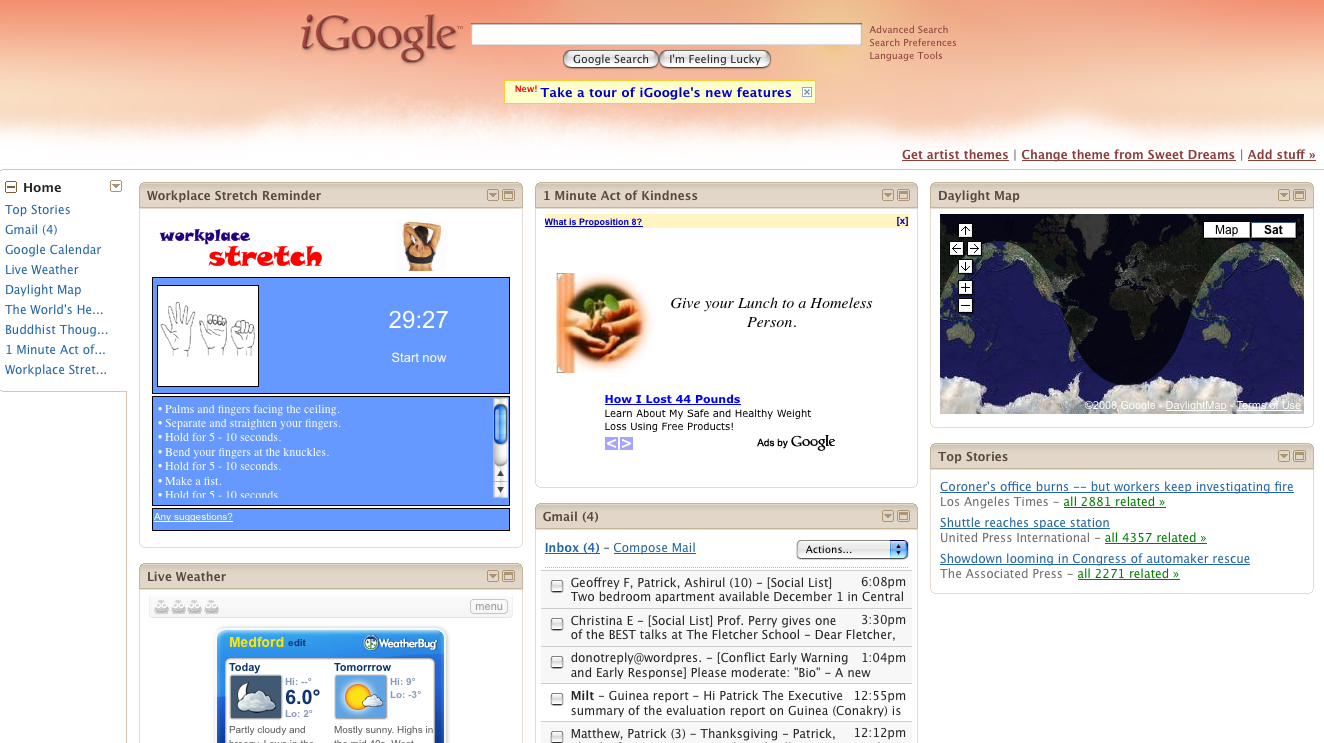
The onus thus falls on the techies to produce the most simple, self-explanatory, intuitive interfaces. What we in the humanitarian field want are interfaces as simple as computer games. We want software packages that are simply plug-and-play. Say an iGoogle approach which allows us humanitarians to import various “widgets” such as 2-way SMS broadcasting, wiki-mapping, etc.

picture-13

The rest of the CrisisMappers meeting was dedicated to a series of thought-provoking presentations on individual crisis mapping projects that each organization is working on. I shan’t attempt a summary here but shall close with the following. I had the good fortune of sitting next to Ushahidi’s David Kobia during the meeting. At one point, he turns to me and motions to his laptop screen: “Look, just got a text message from someone in the DRC.”

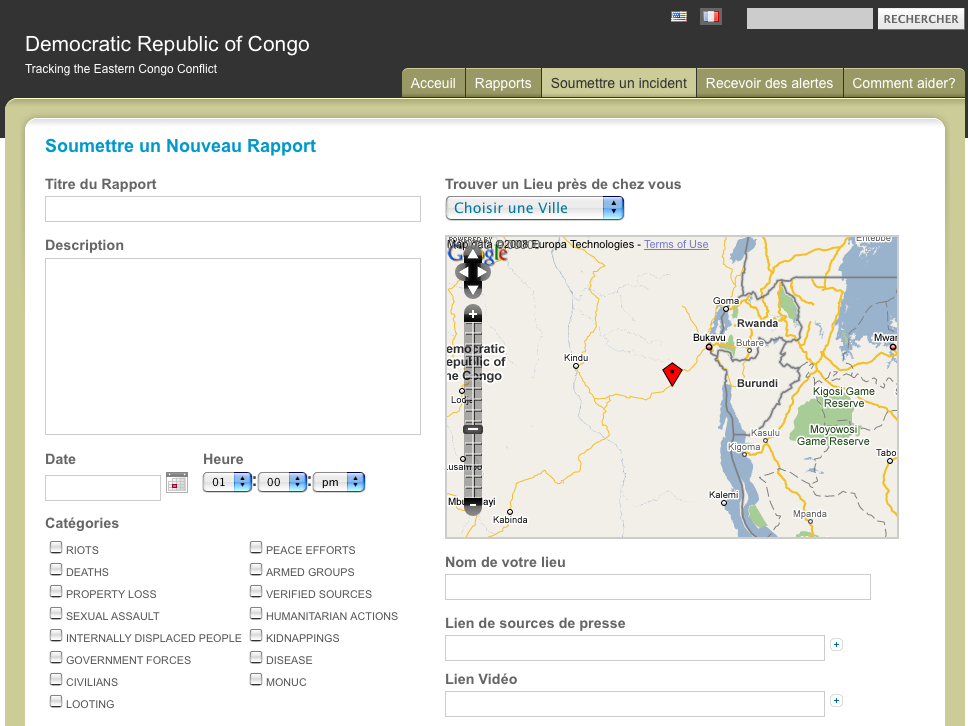
David was pointing to Ushahidi’s admin interface, and indeed, someone on the ground had gotten wind of Ushahidi’s new deployment and had texted the dedicated Ushahidi DRC number. The texter was expressing her/his concern that the DRC site was in English which posed problems for French speakers. The text message itself was in French. The Ushahidi team has been working diligently on a French version of the interface and are nearly finished. David asked me if I might be able to reply (in French) to the person and let them know that the completed interface will be ready next week. I did so, and pointed the texter to the “French Flag” icon on the Ushahidi DRC interface.

picture-32

Here’s what I find particularly neat about this exchange. First, here we were sitting in a conference room in Florida on a Saturday afternoon getting a text message from someone in the DRC interested in reporting events using Ushahidi’s DRC platform. Second, the admin interface that David had up set up was simple and clear to understand. Third, David had included two optional buttons to send one-click replies to the text messages he receives: (1) please send us more information on the event; (2) please send us more information on the location event. Simple yet elegant. After I finished typing my reply to the sender of the text message, I clicked on send and off went my message, right back to the field. All this took place in less than five minutes.

Patrick Philippe Meier

Global Incident Map

A colleague of mine recently flagged this automated, quasi real-time crisis map: Global Incident Map. The map displays the latest 25 terror-related incidents using customized icons. These include markers for suspicious devices, bus hijackings, airport incidents, etc. Clicking on the icon provides a link to local news report(s) concerning the event. The service is subscription based so I wasn’t able to tinker around as much as I would have liked.

picture-22

Compare this with other automated crisis maps such as the Global Disaster Alert and Coordination System (GDACS), Havaria and HealthMap.

Patrick Philippe Meier

CrisisWire Goes Live

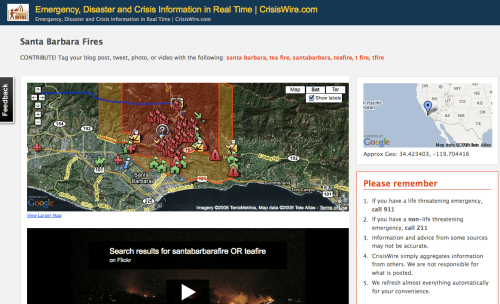
CrisisWire is a “self-aggregating website that pulls information on any disaster around the US and displays it on one page.” The project seeks to get information into the hands of the people that need it most.

picture-12

From Nate Ritter:

During a disaster people spend valuable time searching the internet and waiting for the media to report on their city, their neighborhood, their street.  While main stream media serves a vital role during disasters, it is impossible to update the population on everything that is happening during a crisis.  There usually isn’t enough time or resources.  CrisisWire not only uses the traditional media outlets’ valuable information but will also utilize citizen journalist and google maps to track the disaster. YouTube.com (videos), Flickr.com (photos) and a whole host of other types of published media will also soon be integrated.

Future iterations of CrisisWire will include text messages to reach disaster-affected communities who have lost their electricity, Internet access, or who have been displaced from their home. The developers of CrisisWire hope that the platform will “change the way people respond and learn about disasters.” The team  just set up a page on the fires in Santa Barabara, which will be a good “on-site” test for CrisisWire. At the moment, only one contributor appears to be populating the dynamic map.

As always, my interest in such platforms (including Ushahidi, Humanitarian SensorWeb, etc)., is their:

  1. Viability in conflict zones and places with minimal communications infrastructure;
  2. Link to local, decentralized early response;
  3. Actual impact on the ground.

Patrick Philippe Meier

Digital Media & Repressive Regimes: Global Internet Freedom Index

Karin Karlekar from Freedom House gave a really interesting presentation on the development of a Global Internet Freedom Index, or IGIF. She is planning a pilot study of 15 countries that will include analytical reports and numerical ratings.

picture-5

The index’s scoring system will be similar to the Freedom House media freedom index in order to facilitate for comparisons. The IGIF will include both Internet and mobile/phone text messaging. It will focus especially on transmission of news and political relevant communications, while acknowledging that some restrictions on harmful content may be legitimate.

The index is comprised of three general themes, each of which includes a number of (weighted) sub-indicators. The key components of the themes below is access to technology and the free flow of information/content.

  1. Obstacles to access
  2. Limits on content and communication
  3. Violation of individual online rights

One of the sub-indicators, for example, focuses on activism in order to capture local resistance and activism in addition to government restrictions.

I think this is an excellent initiative with the expected added value long term being the ability to identify competing trends between Repression 2.0 and Democracy 2.0. This goes to the heart of my dissertation topic and I hope to draw on the IGIF framework to inform my field research questions.

Patrick Philippe Meier

Digital Media & Repressive Regimes: Media Tactics

The second panel focused on the media tactics of regimes and opponents. Xiao Qiang gave the first presentation which addressed Chinese digital media controls and access to public expresssion. Rebecca MacKinnon presented the findings of her research on China’s censorship 2.0: how companies censor bloggers. The third talk, by Mahmood Enayat, focused on resistance 2.0: power and counter-power in Persian websphere.

img_0922

“In china,” says Xiao, the digital battle “is about controlling information space, both via censorship and propaganda.” The Internet is not just a medium, it’s a social space where netizens organize into communities, share, etc. The Chinese government seeks to control the “main melody” via censorship and disinformation. So Chinese cyberspace is a control space.

How do some Chinese seek to circumvent this control? A number of official Chinese journalists actually lead double-lives; working for the state-controlled media during the day, and blogging or participating in BBS forums at night. Political satire (“eGao”) is also used in response to Chinese media control. There is also an important gap in control between local and central authorities in terms of implementing censorship rules; there is also a timing factor that contributes to the control gap.

img_0929

Rebecca MacKinnon is a leading China expert, having been posted with CNN in Beijing for 9 years and now teaches in Hong King. “There are different kinds of Internet censorship,” says Rebecca, reminding us as well that the Great Firewall of China which filters websites outside China was coind by bloggers. In addition to filtering, Chinese authorities are known to delete websites, shut down domestic sites as well as data centers. Multinational Companies are complicit in Chinese internet censorship.

Rebecca and her team decided to test just how censored China’s different blogging websites really are. Using paragraphs with sensitive political language, they manually tested 15 blog hosting websites to test what content  were being filterred. The team used 108 different types of content and found huge variation in blogging platforms censoring, from one site filtering 56% content to another filtering only 0.9%; of the same content. There is also evidence that the filtering is not always automatic and indeed includes manual intervention.

In one interesting example, Rebbecca mentions a blog post by a former high-level Chinese political adviser. The post, entitled: “Letter to my Son: wishing for multiparty democracy in China.” The blog was highly political but did not use inflammatory language and therefore was not filtered. Out of curiousity, Rebecca copied and pasted articles from the main state-owned media, Xinhua, and found that some of the state’s own articles would get censored!

So why do we see so much variation in Internet filtering within China?

  • Instructions to companies from city or provincial state council inforation office internet section, interpreted diffently;
  • Different methods desvised for implementation;
  • Relationship between company management, investors and regulatory bodies;
  • Manager/editor’s relationship with local state council;

In conclusion, the Great Chinese Firewall is only part of Chinese Internet censorship. Domestic censorship is not centralized. Domestic web censorship is outsourced by government to the private sector. Censorship is inconsistent and it is usually possible to post your content on one platform, for at least a while.

What are the implications of this study? We need larger scale studies of domestic web censorship (including chat rooms, social networking sites, instant-messaging, mobile services, etc.). Unlike automated filtering tests, these tests require manual testing and constant analysis by Chinese speakers with contextual knowledge. We need surveys of web service company employees; also of users and bloggers about their experience.

Implication for activism: circumvention is important but its not the solution to the whole censorship problem. We need to educate bloggers and netizens about strategies to deal with censorship.

img_0932

Mahmood Enayat from the Oxford Internet Institute gave an entertaining presentation on the use of digital media in Iran. (NB: my notes for this section self-deleted, don’t ask). In any case, Mahmood’s presentation was engaging. He discussed the role of underground music one the one hand and the use of YouTube. My apologies to Enayat for this being so short.

Patrick Philippe Meier