Digital Media & Repressive Regimes: Reshaping Public Spheres

Andrew Puddephatt from Global Partners gave the first panel presentation here at the conference on digital media and repressive regimes. He focused on the issue of shaping digital media for human rights. The basic premise of Andrew’s talk is that access to information is a human right. The problem is how we get there.

picture-31

What I took from his talk was that:

  • We should steer away from talking about the media, since there’s no longer such a think. While he didn’t use the following language, I think he would agree: instead of the media, we now have a digital/communication ecosystem, which displays nonlinear dynamics and is by definition more complex;
  • While digital media enthusiasts see digital technologies as a great liberating force, and while these technologies can certainly be disruptive, it’s a two-way street: censorship of content and surveillance are both on the rise;
  • It is meaningless to talk about right to communication if people don’t have access to communication technologies. We have to think about infrastructure;
  • Google shape protocols for search; protocols are commercial secrets, shaped by forces that anything but transparent;
  • We need a digital/communication infrastructure that foster creativity and innovation;
  • All evidence points to the suggestion that the mobile phone will be the key communication tool of our century. The most exciting technology development is being made in this area;
  • New media undermine repressive structures, they are transgressive. However, democratic governments are also worried about the potential impact in the West;
  • Extremists have been empowered thanks to new media;
  • The main challenge is persuading democratic governments that while there are people out there who wish to use new media for ill, the digital media revolution nevertheless has for the first time the potential to create a genuine public sphere.

_____________________________________________

Robert Guerra of Freedom House gave the second talk of the day, which focused on Internet freedom, online activism and emerging threats. Robert argues that we should expect to see threats to internet freedom emerging as a response to the ground gained by digital activists. Just as we may be moving towards Democracy 2.0, we’re about to be introduced (if we haven’t already) to Repression 2.0.

In Egypt freedom of association is only allowed for groups of 5 or less, otherwise larger gatherings are illegal by law. Online activism allows activists to get around this and to do so by the thousand and new media in repressive regimes can promote nonviolent confrontation. So in one regard, online activism presents fewer risks.

_____________________________________________

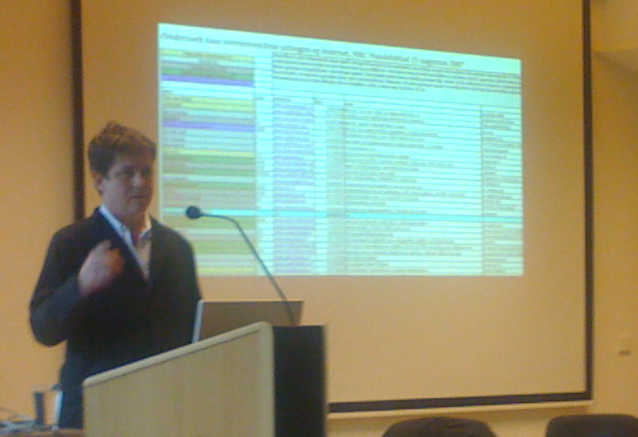
The framing of Democracy 2.0 versus Repression 2.0 was a useful springboard for my presentation as third speaker of the day. My talk focused on the idea of “digital resistance” which I define as the intersection between digital activism and strategic nonviolent action against repressive regimes. The question I pose is whether digital resistance poses a threat to repressive rule, or vice versa? Why or why not?

There are more and more anecdotes and qualitative case studies available that describe successful instances of digital activism; see those documented on DigiActive, for example. What do all these examples add up to? Can we start measuring the aggregate impact of digital activism on repressive rule? How might we analyze quantitatively the qualitative, anecdotal impact of digital resistance, or lack thereof?  In other words, are we likely to see the fall of Repression 2.0 like we did of Communism? See this previous blog entry for some preliminary thoughts on the question.


Patrick Philippe Meier

Iran: Mullahs Impose Restrictions on SMS

Mobile phone users in Iran who wish to use the SMS feature on their mobile phones will now be required to apply for security clearance by the Ministry of of Intelligence and Security.

Sending SMS deemed contrary to national security will be punishable by law. Any change of address by the subscriber of the service must be reported promptly to the relevant authorities. It is the security agents who decide which SMS are in breach of national security .

In October, A number of senior officials of the Iranian regime’s Ministry of Culture and Islamic Guidance (MCIG), the main body for imposing censorship, have expressed its deep concern over the use of SMS messaging by the Iranian Resistance’s network inside Iran (source).

Some 20 million text messages are sent every day in Iran according to some sources. Will the new regulation have a significant impact on that number? If so, will the regime care at all about the loss of revenue?

Patrick Philippe Meier

Digital Media in Repressive Regimes – Intro

I’m now in Copenhagen to participate in what is bound to be a fascinating conference on the role and use of digital media in repressive regimes. On the way to the venue, I was greeted by a dozen familiar faces in the conference hotel, all of them from Global Voices 2008.

Ole Brun from the Institute for Society and Globalization at Roskilde University gave the opening talk to place the two-day conference into context. Ole pointed out that the social sciences have been rather sluggish in the study of new digital media in repressive contexts.

img_0913

We have sought to study the impact of information communication technologies on democracy. Perhaps this question is too ambitious. Can we instead start understanding what impact new media has on political structures, transparence and accountability, new ties between disparate groups.

Patrick Philippe Meier

Links: Obama, Picture Passwords, Mini-UAVs

  • Obama, Internet and Elections: Obama’s victories in the Democratic primaries and the presidential election would not have been possible without Internet-empowered fundraising and social networking.
  • Mini-UAVs used to Collect Health Samples: The National Health Laboratory Services of South Africa is using mini-UAV’s to collect HIV/AIDS and TB samples from remote health posts in the region. Could this be applied to conflict early warning and early response?

Social Web: Carrotmob, Anonymous and Second Life

The final panel I attended at the social web and networked political protests conference included interesting case studies on Carrotmob, Anonymous and Second Life.

Professor Caja Thimm gave a fascinating presentation on avatars in politics. Caja is particularly interested in studying Second Life (SL) as a new political platform:

Various politicans have their personal look alike avatars, from the French presidential candidate Le Pen to the presidentials hopeful Barack Obama. Various states (States of Hungary, Sweden ) run their virtual embassies to attract cyber visitors. SL is not only a place for political marketing or political campaining, it is also starting to function as a plattform for political activism. Avatars engage in demonstrations, in protestmarches, human chaines and smart mobs. Causes are many: for human rights in Burma, against the right wing French Le Pen, against nuclear energy, against the G8 summit and more. Recently, rising problems of a virtual society have become an issue. Sexual assualts, child pornography or vandalism call for political actions by the SL Residents on various levels.

Caja’s research focuses on how avatars and their human counterparts try to organize and (perhaps) democratize their newly created world. I find this a truly fascinating research topic and can’t wait to read Caja’s upcoming book on the subject. We happened to take the same train back to Frankfurt after the conference and it was interesting to hear some of the reactions she has had vis-a-vis this research topic. Only younger scholars seem to “get it”, others just miss the point entirely.

picture-21

This raises another issue, or rather concern, that struck me while at the two-day conference. Here we are, the vast majority of us scholars, talking about the social web as experts, and yet only a tiny fraction of us at the conference actually have a blog. Of the sixty-or-so participants, three are on Twitter. Fewer still have avatars or a YouTube account. It is incredibly important that we actually use these social web tools if we want to study them. My understanding of blogs, their power, their network-effect and their negative side has completely and utterly changed after I started to blog. The same goes with Twitter. Which is why I went on Second Life this morning and created my first avatar.

__________________________________________________

Mundo Yang presented his very interesting research on Anonymous. Mundo’s paper, entitled “Bringing ‘A for Anonymous’ and Public Sphere Together” is available here (PDF).

On Carrotmob:

It’s often said that you vote with your dollars, and what you buy sends signals to companies. But what if, rather then as individuals supporting businesses we like, or boycotting them en masse, we as a crowd were harnessed to financially reward companies that make the most change, as compared to other companies competing for the honor? What if we dropped the stick, and put out a carrot, that carrot being that you will have a “Carrot Mob” descend on your store and make a point of buying from you on a specified date, and perhaps even ongoing? That, I imagine, would be quite the motivation for a business to extend itself to make the effort to change or improve how they do business, generating immediate financial returns, positive press, and longer term goodwill from consumers (source).

Patrick Philippe Meier

Social Web: Twitter, Facebook and Digital Activism

The application of new communication tools for digital activism was specifically addressed at the conference on the social web and networked political protests. Andreas Jungherr focused on Twitter while Christina Newmayer and Celine Roff shared their findings on the use of Facebook for digital activism. I hope the presenters will agree to post a summary of their research on DigiActive.

Andreas, whose paper on the use of of Twitter for political activism is available here (PDF), drew on four case studies:

  1. Assassination of Benazir Bhutto: the news of this event traveled with amazing speed through the community of Twitter users, even overtaking the speed by which the blogosphere was reacting. This incident shows the potential for political activists to distribute highly volatile information through Twitter.
  2. 2008 SXSW conference in Austin: the journalist Sarah Lacy interviewed Facebook Founder Mark Zuckerberg in a keynote presentation. A large group of Twitter users in the audience started  sharing  negative reactions to Sarah’s interview style in real time on their respective Twitter-Feeds. Their criticism was first raised and amplified on their Twitter-Feeds before they expressed their criticism at the keynote presentation itself. This incident shows the potential for political activists to use Twitter as a powerful backchannel to social events.
  3. San Diego wildfires in October 2007: volunteers and journalists started to use Twitter to distribute live updates on the position of fires and orchestrated collective action. This incident shows that political activists can use Twitter to efficiently coordinate social action and protests. I blogged about the use of Twitter in San Diego here.
  4. Arrest and release of James Karl Buck in April 2008: the American journalism student was arrested by the Egyptian police while covering a protest event. Via SMS he posted the word “Arrested” on his Twitter-Feed. Friends and colleagues of his monitored his Twitter-Feed and could secure his release in a matter of hours. This incident shows that political activists can use Twitter to monitor each other’s situation and in doing so increase their security.

Christina and Celine used the case of Facebook and anti-FARC protests in Colombia. Their findings suggest that Facebook enhances the link from local to global. They suggest that the virtual world is not really virtual but rather an extension of the real world. They cite the fact that 87% of the countries in which the protests took place have a high a human development index (HDI).

Patrick Philippe Meier

Social Web: Digital Methods for the Study of Protest Content

Richard Rogers gave what I thought was the most interesting talk of the conference on the social web and networked political protests thus far. Richard is particularly interested in “web epistemology” and asks whether the transfer (or application) of social scientific methods to the online environment dilutes the value of the ensuing findings? Owing to the problem of exhaustiveness, findings may become “indicators” as opposed to “grounded theory.”

picture-11

So what methods exist for the study of online protest content? How do we study links, websites, search engines and social networking sites.

  • Links can be studied using hypertext theory; small worlds; paths; and social networks. When we browse online we collect digital information from link to link thereby authoring a story, we leave a digital trace, a narrative that can be studied.
  • Websites can be studied by assessing usability; eye tracking heat maps; site optimization. Increasingly, browsing has led to searching. For example, Google once used to have a directory on it’s home page. No longer.
  • Search Engines can be studied as dark web matter since no search engine is able to connect to the entire world wide web. Users are looking at fewer and fewer results displayed by search engines. In fact, studies suggest we very rarely look beyond the first 20 results of an online search. One can also capture and study results generated by search engines. Such research shows both the stability and volatility of the web.
  • Social networking sites can be studied by focusing on characteristics of profiles, which have become what one might call “post-demographics”. Richard used the ElFriendo.com website to display the profile characteristics of “friends” of Obama and McCain. These characteristics tend to cluster, with Obama friends sharing the same favorite movies and TV shows, for example; and McCain friends sharing interests that have little overlap with those of Obama friends.

In conclusion, Richard asks whether virtual worlds are really that virtual as they increasingly import and reflect characteristics from the offline world? Should we continue using the term virtual world? I’m really eager to read up on Richard’s excellent research.

Patrick Philippe Meier

Social Web: Ideological Orientation and Online Strategies

More from the conference on the social web and networked political protests.

Ralf Lindner gave an interesting presentation on “Models of Democracy and Internet-based Communication: How Ideological Orientations Shape Online-Strategies of Parties and Interest Groups.” Ralf builds on previous qualitative empirical analysis of internet-based  communication strategies of eight Canadian intermediary organizations. His research demonstrates that online-communication patterns in terms of campaign styles largely correlate with the political actors’ basic ideological orientations, operationalised by the fundamental democratic visions championed by these organisations.

In other words, ideological orientations are an important factor in the processes of adopting communication technologies for the purposes of political communication. While Ralf’s case study focuses on Canada, I think  the recent US presidential elections demonstrated the same tendencies.

Patrick Philippe Meier

Social Web: An Empirical Analysis of Networked Political Protests

I kicked off the first panel presentation of the conference on the social web and networked political protests by introducing the preliminary quantitative findings of my dissertation research. The question I ask in the first part of my dissertation is whether the rapid diffusion of information communication technology has had any statistically significant impact on anti-government protests in countries under repressive rule? Or do authoritarian regimes maintain the upper hand? My  research was funded by Harvard University’s Berkman Center’s and my presentation is available on Slideshare.

picture-2

While there are many qualitative case studies out there and numerous anecdotes, the question that motivates my interest in this research is whether all these instances of digital activism actually add up to anything.  For example, DigiActive systematically documents instances of digital activism around the world, sharing best practices and lessons learned. But few studies (if any) seek to quantify the impact of the information revolution on state-society relations in repressive contexts.

Berkman Center fellow Victoria Stodden and I recently carried out a large-N quantitative study on the impact of ICT diffusion on World Bank measures of democracy and governance. While we drew on data from 180 countries, we also took a subset of these countries, namely autocracies, and tested whether an increase in Interent access and mobile phones had any impact on one indicator in particularly, political stability. We found that both variables, Internet and mobile phones, were statistically significant, and negative, with the mobile phones coefficent being larger the Internet coefficient. This would suggest that mobile phones have more of a disruptive impact on repressive regimes.

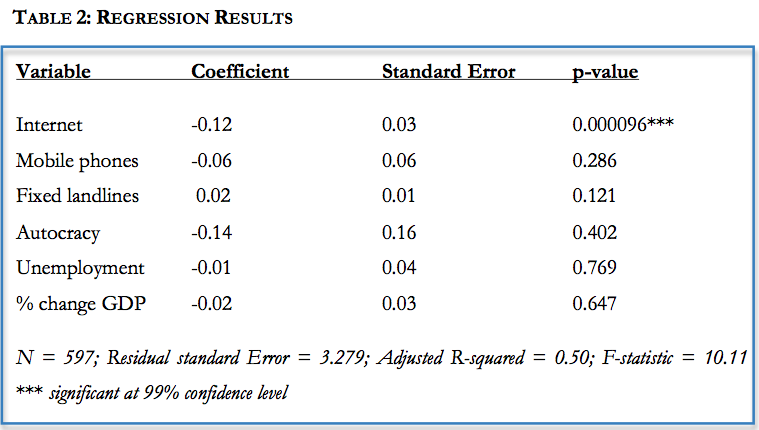
One question that naturally follows is what form that immediate instability takes? Does the rapid diffusion of communication tools facilitate the organization, mobilization and coordination of anti-government protests, which then contributes to political instability? I decided to find out whether new communication technologies do lead to more frequent protests. Please see the Slideshare presentation for specifics on the regression analysis (thanks to Dr. Stodden and Dr. Woodard for their assistance on the quantitative analysis). As my research is still ongoing and my findings preliminary, I hesitate to make any definite conclusions. With this caveate in mind, here are the tentative results.

picture-3

Somewhat surprisingly, the results suggest that an increase in the number of Internet users in countries under repressive rule leads to a decrease in the number of protests. Perhaps even more surprising is the fact that mobile phones turned out to have no statistically significant impact on the frequency of protests. The reason I find these findings surprising is that Internet access in repressive environments is extremely limited compared to mobile phones.

picture-4

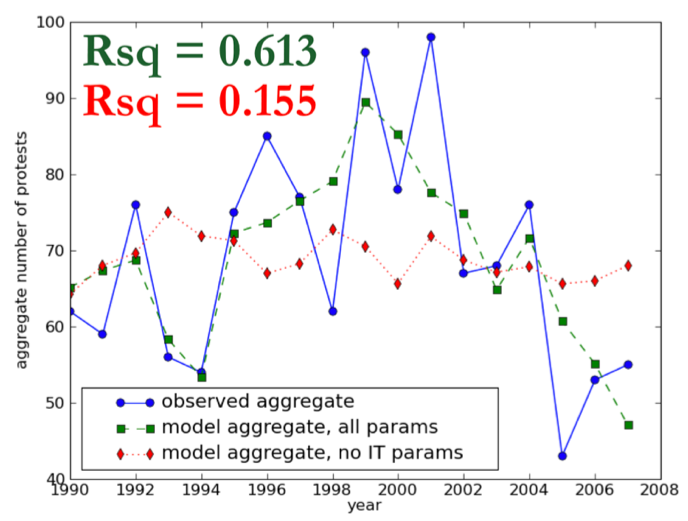
The above results are equally surprising. The blue curve is a time series of observed political protests. The green curve is my complete model which includes ICT independent variables as well as my political and economic control variables. The red curve represents the model without the ICT variables. The large difference between the two adjusted R squared figures is rather striking, not to mention that an R squared of 0.613 seems rather high.

In sum, I’m rather skeptical about these results and specifically asked my fellow participants for their feedback. One colleague rightly mentioned that frequency of protests does not provide information on the magnitude of protests—an issue I noted in my dissertation proposal. The same colleague recommended that I include literacy rates as a control variable while Professor Dieter Rucht expressed his concern about the quality of the protest dataset I am drawing on.

The dataset was developed using automated natural language parsing of Reuters news wires. Although Professor Rucht mistakenly assumed that I am using the KEDS dataset, his remarks on the nature of media reporting still hold. There is a considerable amount of literature out there on media bias, which I have reviewed for my dissertation research, and which Professor Rucht echoed. In particular, he is concerned that as Reuters opens new offices in a particular country, this might lead to “over reporting” of protest events compared to other countries. Interestingly enough, however, the frequency of protests in the 22 countries I analyzed goes down with time.

In any case, these kinds of concerns are precisely why my dissertation takes a nested analysis approach, or a mixed method approach. The first part of my research seeks to carry out a large-N quantitative study while the second part entails field based research to carry out qualitative comparative case studies on the impact of ICTs in repressive environments. Whether qualitative findings support my quantitative ones remains to be seen. In the meantime, I plan on running additional regressions and models to double-check my findings.

Patrick Philippe Meier

Social Web: Towards Networked Political Protests – Keynote

I’m in Frankfurt, Germany for two days to participate in a conference on networked political protests hosted by the University of Siegen (agenda in PDF). The conference is taking place in the new Artur-Woll-Haus, one of Germany’s most energy efficient buildings which also draws on a unique architectural style from the 1920s that shies away from straightlines. In fact, Artur-Woll-Haus from the inside looks distinctly like three sea-farring ships turned upside down.

Really neat!

img_0009

Professor Dieter Rucht gave the Keynote address on “Protest Mobilization in the Age of Social Web” which was an excellent, sceptical overview of the current state of the debate between proponents of Web 2.0 and skeptics. Professor Rucht is Germany’s leading scholar on the topic and his current research seeks to assess the web’s relevance with respect to progressive social movements, particularly in terms of increasing political education, empowering citizens and furthering the process of democratization.

He criticized our field’s tendency to focus only on “stunning success stories” which create high (and arguably at times) unfounded expectations. These success stories are the exception, not the rule. Professor Ruch reminds us that the Internet serves progressive groups as well as their opponents, with the latter becoming increasingly sophisticated in their technical abilities.

picture-1

While I largely agreed with most of what Professor Rucht had to say, some of his comments did surprise me. For example, he argued that the Internet hardly serves to mobilize new constituents. I find that hard to believe. Even more surprising was his comment on the Obama campaign, which he argued was not a social movement. Professor Rucht maintains that the campaign strategy was centrally controlled and orchestrated by a small group of individuals who simply happened to be awash with vast sums of money. What Professor Rucht fails to recognize, however, is that the only way the Obama campaign was able to tap into so much money was precisely because it created an effective social movement!

Another comment that through me off has to do with his take on mass mobilization in the past compared to present day. “Mass mobilization was also effecient before the era of the Internet. To be sure, the Internet is not a necessary condition for mass protests, it is simply a facilitator.” I basically agree with the second part of his statement but take issue with the first, particularly because Professor Rucht does not even define what he means by efficient. Does he mean efficient in terms of cost and time? Efficient relative to the tools of the time? Making sweeping statements is fine to provoke discussion, but at least we should take care to cleary define our terms!

In any case, I do agree with the general gist of Professor Rucht’s keynote address and while I don’t share the extent of his skepticism, I find it healthy. It is true that the Internet cannot replace physical protests in the streets. What is less evident to me, however, is whether Professor Rucht is correct in claiming that the rise of the social web and networked political protests is not changing the existing constellation of political power between large and small groups.

Patrick Philippe Meier