Mobile Banking for the Bottom Billion: An iRevolution?

CGAP

I chose iRevolution as the title of this blog because of my interest in the revolutionary potential of technology vis-a-vis the empowerment of the individual. I see the information revolution as having a multiplier effect on individual power, enabling the individual to make more informed and calculated decisions.

While the topic of my blog entries have ranged from conflict early warning and crisis mapping issues to civil resistance and digital activism, the subject of mobile banking is one that I am particularly interested in terms of iRevolutions in the making.

This explains why I just participated in a half-day roundtable on mobile banking for the poor, which was organized by the Consultative Group to Assist the Poor (CGAP) and hosted at the World Bank (WB) headquarters in Washington DC. This blog entry comprises a summary of the introductory remarks. (A detailed summary of the 3-panels that followed are available below).

The poor are bound to be affected by today’s synchronized global recession. Two processes in particular are at work: 1) decline in demand; and 2) contracting remittance flows, down -12% to -14% in some developing countries. However, micro finance banks are immune to economic downturns. To this end, mobile banking, also referred to as branchless banking, may provide one way to increase the financial resilience of the bottom billion.

Of the 140 million poor people employed who receive social payments (aka G2P), less then 1/4th receive their payments via bank accounts. There are multiple benefits of moving away from a cash-based system to a debit system. Argentina recently introduced a debit system which saw fraud decrease 12 fold. One limitation of Argentina’s approach, however, is that only the government can issue load cards.

The three panels that comprised the roundtable moderated by CGAP included:

  1. Driving Mass Market Customer Adoption
  2. Building a Viable Agent Network
  3. Creating and Taking Advantage of Regulatory Regimes

Please click on the above links for detailed summaries of the three panels.

Patrick Philippe Meier

International News Coverage in a New Media World

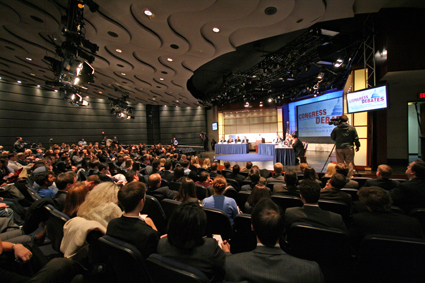
I just had the pleasure of participating in a fascinating panel discussion on the decline of the foreign correspondent and the rise of citizen journalist. The event was hosted by the Institute for Public Diplomacy and Global Communications at George Washington University (GWU) and supported by the Broadcasting Board of Governors (BBG).

Jeffrey Hirschberg from BBG gave the opening remarks and GWU Professor Steve Roberts moderated the panel, which included Loren Jenkins, Senior Foreign Editor at NPR, Professor Sherry Ricchiardi, Senior Writer at the American Journalism Review (AJR) and Professor at Indian University’s School of Journalism, Bob Dietz with the Committee to Protect Journalists (CPJ), and myself.

Where to begin? I was definitely the only one on the panel without a formal background in journalism, possibly the only blogger, probably the only one with a YouTube account and most likely the only panelist on Twitter. Inevitably, then, I brought a slightly different perspective, but more importantly, I had the opportunity to learn a lot from my fellow panelists and to understand their perspective on the decline of foreign reporting. It was a truly rich conversation.

Professional journalists engaged in international news are increasingly concerned about the possibility of misinformation and manipulation that may originate from citizen journalists, e.g., through blogs, Twitter, etc. In my opinion, one of the defining roles of the mainstream media is to distinguish between fact and fiction, which means that they play an even more important role in the digital age. The question of journalist standards was also raised, or the lack thereof. within citizen journalism In my opinion, as international news reporting declines and citizen journalists continue to fill the void, the public will expect and come to demand that the latter meet some of the same standards practiced by mainstream media.

Having had the opportunity to interact with numerous bloggers with Global Voices and beyond, I emphasized the fact that reputation for many bloggers is everything. Her or his readership is a function of the person’s reputation and hence credibility and accountability. Over time, as Lauren mentioned, we come to “get to know” and trust a blogger even if we never meet in person. Journalists investigate stories by interviewing sources, there is no reason to discount citizen journalists as valuable sources.

The challenge of validating sources and information is not a new one. There is a trade off between volume of information and the ability to verify that information. This trade off, or continuum, becomes even more acute in rapidly changing situations like the recent carnage in Mumbai.

What we need to keep in mind, however, is that we each have different demands or needs for validity. If you found yourself in downtown Mumbai during the terrorist attacks, you would rather know about rumors spread via Twitter than not. Why? Because at least you’d be able to take precautionary measures should the rumor prove to be true.

Watching the unfolding tragedy from thousands of miles away in the comfort of our own homes, we have less need for expediency, we just want to know what really happened, the facts. However, our demand for facts and rigorous validation should not overshadow the fact that rumors and unverified reports from unknown sources can save lives.

Steve asked Bob whether his work on the protection of journalists should be expanded to citizen journalists. In his response, Bob preempted an important point I had planned to make; namely that the line between citizen journalism and digital activism is becoming increasingly blurred. In the past, documenting human rights abuses and broadcasting this documentation was rarely done by one individual. Today, thanks to YouTube, documenting events is the same as broadcasting events, which is alot about what advocacy is.

This is why it is increasingly important for citizen journalists in repressive environments to interact with digital activists and individuals engaged in strategic nonviolence. As a a fellow blogger of mine recently remarked about her experience covering the post-election violence in Kenya, there is a distinction between being able to speak out and being heard. In most contexts, the former is far easier than the latter. However, if you start being heard, and a government or regime starts to pay attention to what you are blogging, you become a target. It’s a catch 22. Bloggers need to learn from digital activists and strategic nonviolence movements about how to stay safe and how to make maximum use technology to get their message out.

I drew on several examples to highlight the important contribution that citizen journalists are making around the world, from Global Voices to Witness.org. I also highlighted HHI‘s recent work on crisis mapping Kenya to compare mainstream media reports with citizen journalism reports and crowdsourcing reports (via Ushahidi). In the context of Mumbai, I pointed to the incredible speed with which a Wikipedia page was created and maintained fully up to date, with some 900 edits taking place within the first 21 hours of the event. No mainstream media outfit could possibly mimic this crowdsourcing approach without reaching out to citizen journalists.

On Global Voices, I highlighted the important role they are playing in translating (and analyzing) a lot of local news (and other blogs) into English. With the decline in foreign reporting, mainstream media’s role in translating news will also decline. The amount of volume produced by Global Voices during the Mumbai attacks was trully stunning.

I brought up Witness.org because much of the conversation between panelists focused on print media, and how easy it was to mislead readers. Doctoring pictures, let alone footage, is not as easy. The case of Reuters and the doctored photograph of Israeli rockets firing on Lebanon is an exception and far from the rule. It is a very isolated incident when one considers the massive number of pictures printed every day in the mainstream press. Furthermore, I argued thanks to built-in cameras in mobile phones, dozens of different individuals can each take pictures of an event, which serves as a verification mechanism. We don’t need fewer citizen witnesses armed with cameras, we need more.

Two final points, or rather open ended questions for further discussion. First, if we are moving towards a more hyper-local approach to media reports, and if this happens across the globe, then why the concern? Isn’t someone’s local media another’s foreign media? Second, having counted Noam Chomsky’s Manufacturing Consent: The Political Economy of the Mass Media as one of my all time favorite books, how is the media changing now that the political economy is completely changing?

Patrick Philippe Meier

Covering the DRC – opportunities for Ushahidi

This blog entry was inspired by Ory’s recent blog post on “Covering the DRC – challenges for Ushahidi.” The thoughts that follow were originally intended for the comments section of Ushahidi’s blog but they surreptitiously morphed into a more in depth reflection. First, however, many thanks to Ory for taking the time to share the team’s experience in the DRC over the past few weeks.

Much of what Ory writes resonates with my own experience in conflict early warning/response. While several factors contribute to the challenge of Ushahidi’s deployment, I think one in particular regrettably remains a constant in my own experience: the link to early response, or rather the lack thereof. The main point I want to make is this: if Ushahidi addresses the warning-response gap, then Ushahidi-DRC is likely to get far more traction on the ground than it currently is.

To explain, if Ushahidi is going to provide a platform that enables the crowdsourcing of crisis information, then it must also facilitate the crowdsourcing of response. Why? For otherwise the tool is of little added value to the individuals who constitute said crowd, ie, the Bottom of the Pyramid (BoP) in conflict zones. If individuals at the BoP don’t personally benefit from Ushahidi, then they should not be spending time/resources on communicating alerts. As one of my dissertation committee members, Peter Walker wrote in 1991 vis-a-vis famine early warning/response systems in Africa:

It must be clearly understood that the informants are the most important part of the information system. It is their information […] upon which the rest of the system is based […]. The informant must be made to feel, quite rightly, that he or she is an important part of the system, not just a minion at the base, for ever giving and never receiving.

In 1988 (that’s write ’88), Kumar Rupesinghe published a piece on disaster early warning systems in which he writes that civil society has

… a vital role to play in the development of a global, decentralized early warning system. They now need the capacity to build information systems and to provide the basis for rapid information exchange. In general [civil society] will have to confront the monopolization of information with a demand for the democratic access to information technology.

Information on local concerns must be available to the local structures in society. The right to be informed and the right to information have to find entry into international discussions.

Ushahidi’s crowdsourcing approach has the potential to reverse the monopolization of information and thereby create a demand for access to conflict information. Indeed, Ushahidi is starting to influence the international discourse on early warning (forthcoming reports by the EC and OECD). However, it is the mobile crowdsourcing of response that will create value and thereby demand by the BoP for Ushahidi.

Put it this way, Twitter would be far less useful if it were limited to one (and only one) global website on which all tweets were displayed. What makes Twitter valuable is the ability to select specific feeds, and to have those feeds pushed to us effortlessly, using Twhirl or similar programs, and displayed (in less than 141 characters) on our computer screens in real time. At the moment, Ushahidi does the equivalent of the former, but not the latter.

Yet the latter is precisely where the added value to the individual lies. An NGO may be perfectly content with Ushahidi’s current set up, but NGOs do not constitute the BoP; they are not the “fundamental unit” of crowdsourcing—individuals are. (Just imagine if Wikipedia entries could only be written/edited by NGOs).

This mismatch in fundamental units is particularly prevalent in the conflict early warning/response field. NGOs do not have the same incentive structures as individuals. If individuals in at-risk communities were to receive customized alerts on incidents in/near their own town (if they themselves send alerts to Ushahidi), then that response presents a far more direct and immediate return on investment. Receiving geo-specific alerts in quasi real-time improves situational awareness and enables an individual to take a more informed decision about how to respond to the alerts. That is added value. The BoP would have an incentive, empowerment, to crowdsource crisis information.

Here’s a scenario: if an individual texts in an alert for the first time, Ushahidi should: (1) contact that person as soon as possible to thank them for their alert and, (2) ask them what SMS alerts they would like to receive and for what town(s). I guarantee you this person will spread the word through their own social network and encourage others to send in alerts so that they too may receive alerts. (Incidentally, Erik, this is the strategy I would recommend in places like Jos, Nigeria).

In summary, while the Ushahidi team faces a multitude of other challenges in the DRC deployment, I believe that addressing the early response dimension will render the other challenges more manageable. While the vast majority of conflict early warning systems are wired vertically (designed by outsiders for outsiders), the genius of Ushahidi is the paradigm shift to horizontally wired, local early warning/response, aka crowdsourcing.

In a way, it’s very simple: If Ushahidi can create value for the BoP, the client base will necessarily expand (substantially). To this end, Ushahidi should not be pitched as an early warning system, but rather as an early response service. This is one of the reasons why I am trying hard to encourage the operationalization of mobile crisis mapping.

How to Visualize the Immense – Physics

I’m a wanna-be physicist; which is probably why one of my most memorable summers was spent at the Sante Fe Institute’s (SFI) Complex Systems Summer School (CSSS) in 2006.

But this is not a recent fad, my International Baccalaureate (IB) courses in 1996 included advanced physics, advanced calculus and graph theory and advanced computer science. One of my favorite books at the time was Numerical Recipes in C. In fact, my extended essay for the IB was actually a software program that determines the degree of randomness of stellar distributions. This required writing code that could determine what constituted a star in any given picture with variable resolution, i.e., pattern recognition. Oh, the good old days.

My interest in the hard sciences explains why I’m still an avid reader of scientific journals, and why I just came across a special edition of The New Journal of Physics focused on visualization in physics. Some excerpts and pictures:

Early on in this twenty-first century, scientific communities are just starting to explore the potential of digital visualization. Whether visualization is used to represent and communicate complex concepts, or to understand and interpret experimental data, or to visualize solutions to complex dynamical equations, the basic tools of visualization are shared in each of these applications and implementations.

The effectiveness of visualization arises by exploiting the unmatched capability of the human eye and visual cortex to process the large information content of images. In a brief glance, we recognize patterns or identify subtle features even in noisy data, something that is difficult or impossible to achieve with more traditional forms of data analysis.

The advantages of visualization found for simulated data also hold for real world data as well. With the application of computerized acquisition many scientific disciplines are witnessing exponential growth rates of the volume of accumulated raw data [c.f., crowdsourcing conflict data], which often makes it daunting to condense the information into a manageable form, a challenge that can be addressed by modern visualization techniques.

spacetime

This image shows a simulation of the distortion due to a spaceship inside a warp bubble moving past the Earth and Moon, as seen from space.

portfolio1

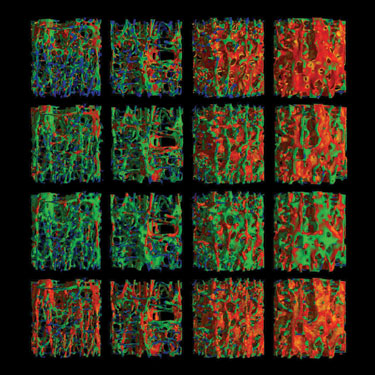
3D images of human bone can help predict fracture risk due to osteoporosis.

As one article in the Special Edition noted, visualization tools can be used to show internal properties of complex networks. As more raw, geo-referenced crisis data is collected, our field of conflict early warning and crisis mapping will need to start making sense of the volumes of new data. This is where the new field of Crisis Mapping Analytics (CMA) begins.

The purpose of CMA is to develop metrics and methods to identify patterns in conflict data over space and time. For more on CMA, see these two blog entries on “Crisis Mapping, Dynamic Visualization and Pattern Recognition” and “Tracking Genocide by Remote Sensing.” My hunch is that we should be talking to our colleagues in the hard sciences for tips on data visualization and patterns analysis.

Patrick Philippe Meier

Links: Revolution 2.0, Mumbai Attacks, Response

  • Revolution 2.0 – Obama’s Web Tools Work for Others Too: If I had blogged about this Newsweek article, I would have been quite critical. First, we all know full well that technology can be used for good or ill. Second, the piece focuses exclusively on the negative effects of the Internet’s potential to empower marginalized groups. Third, as a colleague noted, “The writer thinks of marginalized groups like terrorists.  I think of marginalized groups like 90% of the world’s population.”
  • Mumbai Terrorists used Google Earth: In a first in terror strikes in the country, all the 10 terrorists involved in the Mumbai attack got familiar with the terrain of the city by using the Google Earth service, according to sources in the Maharashtra home ministry.
  • Mobiles and Twitter Play Key Role in Mumbai Reporting: Mobiles are yet again playing a key role in citizen reporting as terror attacks grip the Indian city of Mumbai.  Twitter, the microblogging service that is available in India, was especially instrumental in conveying first hand reports as the chaotic events were unfolding in the city.  Twitter users set up aggregator accounts at Mumbai, Bombay@BreakingNews and with the search tag #Mumbai.
  • Citizen Voices and Mumbai Attacks: When news from the developing world dominates the global news agenda, we get a lot of traffic on Global Voices. As the horrific events unfolded in Mumbai this past week, our authors, editors and tech staff began compiling accounts from blogs, Flickr, YouTube and Twitter feeds. You can get a good overview of the use of social media in reporting the Mumbai crisis on our special coverage page.

Event: International News Coverage in a New Media World

I’ve been invited by the Broadcasting Board of Governors (BBG) and George Washington University’s (GWU) Institute for Public Diplomacy and Global Communications to give a panel presentation on “International News Coverage in a New Media World: The Decline of the Foreign Correspondent and the Rise of the Citizen Journalist.”

gwu

The event will take place on December 10th to commemorate the 60th anniversary of the United Nations Universal Declaration of Human Rights.

Experts will examine the dramatic shift of traditional media away from foreign reporting, the growth of web-based citizen journalists, and their effects on coverage of international news and human rights issues.

I was originally planning to focus the bulk of my presentation on the role of new media in covering Kenya’s post-election violence but given the (still) current carnage in Mumbai and the unprecedented response of citizen journalists in covering the attacks, I’d like to present a comparative analysis of both events. To this end, I welcome any links/tips/suggestions you might have on what you consider to be the most striking (less obvious) issues worth highlighting.

Patrick Philippe Meier

Web 2.0 Tracks Attacks on Mumbai (Updated)

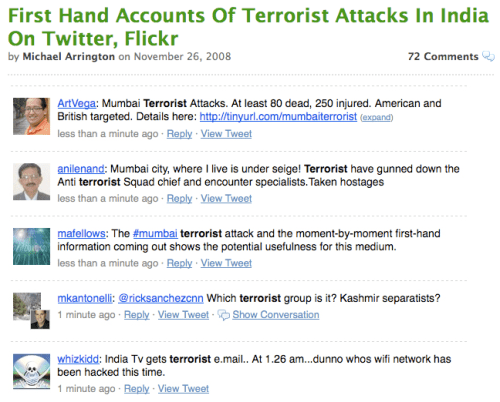
Twitter, Flickr, Wikipedia, YouTube – a few of the Web 2.0 & mobile applications tracking the Mumbai attacks in quasi real time along with the aftermath. Twitter was apparently faster than CNN in reporting the initial events, according to TechCrunch:

picture-61

From TechMacro: “the local authority advised TV channels to stop broadcasting sensitive information which may help terrorists tracking army’s movements. It is much less likely that the terrorists are now using Twitter to find way to escape.”

For live, crowdsourcing updates, see the following links on Twitter, Flickr, Wikipedia. The Wikipedia entry already includes a picture (probably taken with mobile phone) of one of the terrorists.

Wired also writes that “local bloggers at Metblogs Mumbai have new updates every couple of minutes. So do the folks at GroundReport. Dozens of videos have been uploaded to YouTube. But the most remarkable citizen journalism may be coming from “Vinu,” who is posting a stream of harrowing post-attack pictures to Flickr.”

Patrick Philippe Meier

Crisis Maps of Mumbai (Updated)

Here are initial crisis maps of Mumbai, please let me know if you know of others.

CrisisWire:

picture-51

GeoCommons:

picture-33

Al Jazeera Google Map:

picture-24

My Fox Chicago:

picture-14

Patrick Philippe Meier

Crisis Mapping Africa’s Crossborder Conflicts

My colleague Dennis King just sent me update on the Humanitarian Information Unit’s (HIU) project, “Africa: Conflicts Without Borders 2007-2008.”

Instead of the usual depiction of conflicts as countrywide and defined by national boundaries, this map displays distinct conflict-affected areas in Africa as sub-national and transnational pockets of insecurity, violence, and armed aggression.  Areas of conflict were drawn around locations of reported conflict incidents in 2007 and 2008, as well as concentrations of internally displaced persons and cross-border rebel bases and refugee camps in neighboring countries.

This depiction of areas of conflict more accurately displays where conflict has been occurring in Africa and the sub-national and transnational nature of these conflicts.  In a follow-on project, this new visualization will be used to analyze the relationship between conflict and geo-spatial factors that are also not related to national boundaries, such as topography, natural resources, demographic distributions, and climatic hazards.

A PDF of the map below is available here.

HIU

The map categorizes conflict-affected areas into three types of conflict:

Armed Conflict, Inter-communal Strife, and Political Violence.  In many cases, armed conflicts and political violence are based on inter-communal strife.  The locations of violent food riots, pirate attacks (as of October 2008) and targeted attacks associated with terrorism during 2007-2008 have also been plotted on this map.  Disputed border conflicts are also identified on this map.

HIU zoom

As I have suggested in earlier blogs, I continue to be surprised that crisis maps are still shared as PDFs or JPGs. The above data should be made available in KML with a simple interface that enables users to query the data they are visualizing. At the very minimum, we should be able to visualize the data over time. I find static data less and less compelling in the context of crisis mapping.

For a Google Earth Layer of the above map, please see my follow up blog post.

Patrick Philippe Meier

Crisis Mapping Africa’s Crossborder Conflicts

My colleague Dennis King just sent me update on the Humanitarian Information Unit’s (HIU) project, “Africa: Conflicts Without Borders 2007-2008.”

Instead of the usual depiction of conflicts as countrywide and defined by national boundaries, this map displays distinct conflict-affected areas in Africa as sub-national and transnational pockets of insecurity, violence, and armed aggression.  Areas of conflict were drawn around locations of reported conflict incidents in 2007 and 2008, as well as concentrations of internally displaced persons and cross-border rebel bases and refugee camps in neighboring countries.

This depiction of areas of conflict more accurately displays where conflict has been occurring in Africa and the sub-national and transnational nature of these conflicts.  In a follow-on project, this new visualization will be used to analyze the relationship between conflict and geo-spatial factors that are also not related to national boundaries, such as topography, natural resources, demographic distributions, and climatic hazards.

A PDF of the map below is available here.

HIU

The map categorizes conflict-affected areas into three types of conflict:

Armed Conflict, Inter-communal Strife, and Political Violence.  In many cases, armed conflicts and political violence are based on inter-communal strife.  The locations of violent food riots, pirate attacks (as of October 2008) and targeted attacks associated with terrorism during 2007-2008 have also been plotted on this map.  Disputed border conflicts are also identified on this map.

HIU zoom

As I have suggested in earlier blogs, I continue to be surprised that crisis maps are still shared as PDFs or JPGs. The above data should be made available in KML with a simple interface that enables users to query the data they are visualizing. At the very minimum, we should be able to visualize the data over time. I find static data less and less compelling in the context of crisis mapping.

For a Google Earth Layer of the above map, please see my follow up blog post.

Patrick Philippe Meier