Tag Archives: Map

Crisis Mapping Sudan: Protest Map of Khartoum

Unlike the many maps of the #Jan25 protests in neighboring Egypt there is but this one map for the #Jan30 protests taking place in the Sudan and Khartoum in particular. The map was requested by Sudanese colleagues in Khartoum who in their own words wanted a public map for the world to see what is happening in their own country.
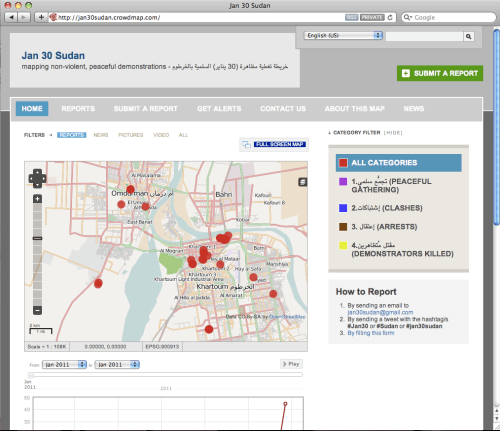
Some 70 individual reports have been mapped thus far. These capture a range of incidents including the following:

  • Police use gas bombs against medical students [View Report]
  • Peaceful gatherings and demonstrations [View1 View2]
  • Sudanese security harassing foreign journalists [View1 View2]
  • Picture of police beating protesters on Palace Street [View]
  • Videos of protest in Khartoum [View]

While all eyes of the media are on Egypt, few are sharing the developments in the Sudan. This makes the Sudan map even more important. As Philip Howard has found in his comprehensive new study on “The Digital Origins of Dictatorship and Democracy: Information Technology and Political Islam,” the presence of a comparatively active online civil society appears to be one of the key ingredients for democratic transition. Compared to the online civil society in Egypt, the one in the Sudan is far smaller. But activists in Khartoum have reached out to digital activists outside the country for support. And this joint effort has  resulted in more than just a map.

Sudanese contacts have been sharing relevant information via email  and Skype throughout the day, some of which is mapped, and some which is included in the News section of the map. In addition, digital activists have provided training on Twitter and have set up a Flickr account for the Sudanese activists (at their request). See this DigiActive guide on how to use Twitter for activism, also available in Arabic (PDF).

The group has also been trying hard to set up a local FrontlineSMS number for activists to text their reports directly to the map. The first phone they tried didn’t work, so they’re looking to use a GSM modem in the coming days. (Update: an international number has been set up). Once a number is set up, the activists want to share it widely, including the 16,000+ members of the Jan30 Facebook group. Local activists hope this will help them overcome some of the coordination challenges that cropped up today when there was confusion over where and when the demonstrations were meant to take place. This resulted in smaller dispersed protests instead of mass action. You can read more on first hand accounts of this in the News section which includes an email written by Sudanese activist about what they saw today.

Despite the constraints in organization, activists still took to the streets but did face higher risks by being in smaller more dispersed groups. I’m hoping they’ll be able to regroup and plan their future protests in such a way that there is less confusion. The activists do have a full copy of the mass action strategy guide used by Egyptian protesters this week. This may serve them well if they can circulate it widely in the country.

Maptivism: Live Tactical Mapping for Protest Swarming

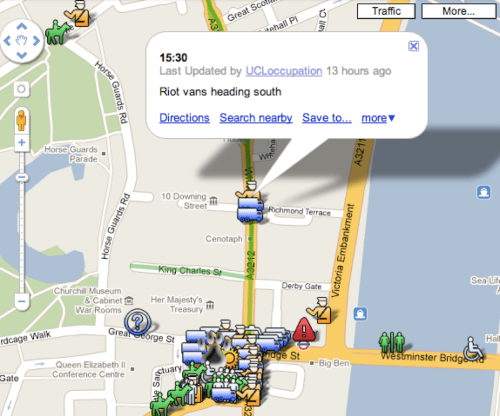
My colleague Adeel Khamisa from GeoTime kindly shared this news story on how student protesters created a live tactical map to outwit police in London during yesterday’s demonstrations.

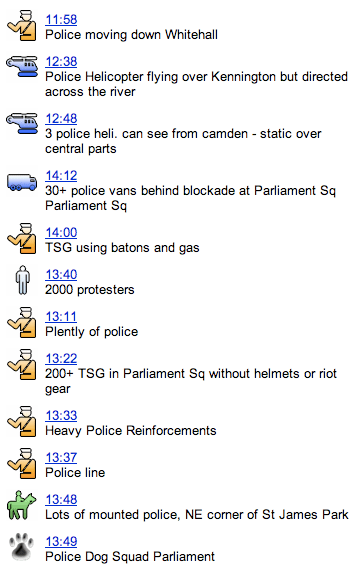
Check out these real time updates:

The students also caught the following picture:

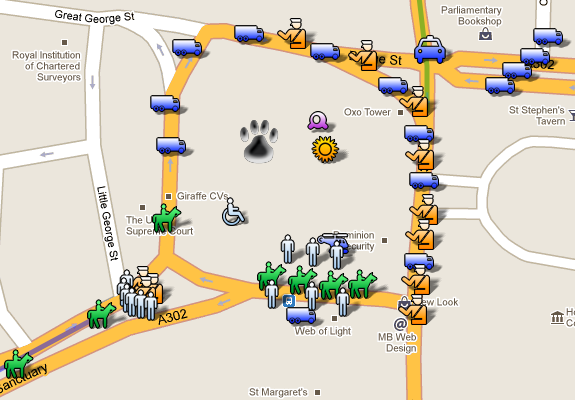
The map depicts the tactics employed by the students:

The limits of using Google Maps

As I looked closer at the map, it occurred to me how much this resembles a computer game with moving characters. The strategy employed by the police can be discerned by the pattern below.

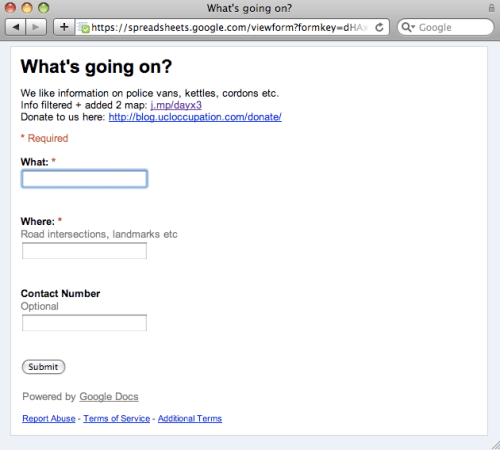
But I doubt that students were able to update their Google map in real-time directly from their mobile phones, let alone via SMS, Twitter, Smartphone App, camera phone or Facebook. Nor can they subscribe to alerts and receive them directly via an automated email or SMS. Indeed, it appears they were using Google Forms to “crowdsource” information and this Twitter account to disseminate important updates.

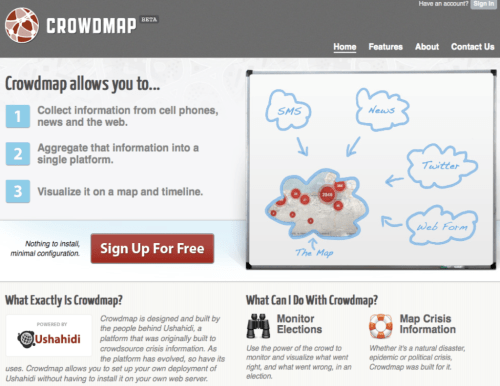
This is why I got in touch with the group and recommended that they think of using Crowdmap (free and open source):

Or GroundCrew (partially free, not open source):

See the following links for more info on Maptivism:

How to Lie with Maps

I just finished reading Mark Monmonier‘s enjoyable book on “How to Lie with Maps” and thought I’d share some tidbits. Mark is the distinguished Professor of Geography at the Maxwell School of Syracuse University in New York.

In writing this book, Mark wanted to “make readers aware that maps, like speeches and paintings, are authored collections of information and also are also subject to distortions arising from ignorance, greed, ideological blindness, or malice.” Note that this second edition was published in 1996.

mapslie

Terminology

Mark uses some terms that made me chuckle at times. Take “cartographic priesthood,” for example, or “cartographic license.” Other terms of note include “cartopropaganda,” “cartographic disinformation and censorship,” and “cartographic security.”

Quotes

  • “The map is the perfect symbol of the state.”
  • “Maps can even make nuclear war appear survivable.”
  • “A legend might make a bad map useful, but it can’t make it efficient.”
  • “Maps are like milk: their information is perishable, and it is wise to check the date.”
  • “People trust maps, and intriguing maps attract the eye as well as connote authority.”
  • “Circles bring to the map a geometric purity easily mistaken for accuracy and authority.”
  • “Like guns and crosses, maps can be good or bad, depending on who’s holding them, who they’re aimed at, how they’re used, and why.”
  • “No other group has exploited the map as an intellectual weapon so blatantly, so intensely, so persistently, and with such variety [as the Nazis].”
  • “That maps drawn up by diplomats and generals became a political reality lends an unintended irony to the aphorism that the pen is mightier than the sword.”

Excerpts

“Even tiny maps on postage stamps can broadcast political propaganda. Useful both on domestic mail to keep aspirations alive and on international mail to suggest national unity and determination, postage stamps afford a small but numerous means for asserting territorial claims.”

“In 1668, Louis XIV of France commissioned three-dimensional scale models of eastern border towns, so that his generals in Paris and Versailles could plan realistic maneuvers. […] As late as World War II, the French government guarded them as military secrets with the highest security classification.” See picture.

louisxiv

“Government maps have for centuries been ideological statements rather than fully objective scientific representations of geographic reality. […] Governments practice two kinds of cartographic censorship—a censorship of secrecy to serve military defense and a censorship of  silence to enforce social and political values” (citing historian Brian Harley).

“Few maps symbols are as forceful and suggestive as the arrow. A bold, solid line might make the map viewer infer a well-defined, generally accepted border separating nations with homogeneous populations, but an arrow or a set of arrows can dramatize an attack across the border, exaggerate a concentration of troops, and perhaps even justify a ‘pre-emptive strike’.”

“Faulty map reading almost led to an international incident in 1988, when the Manila press reported the Malaysian annexation of the Turtle Islands.” The faulty map was “later traced to the erroneous reading of an American navigation chart by a Philippines naval officer who mistook a line representing the recommended deepwater route for ships passing the Turtle Islands for the boundary of Malaysia’s newly declared exclusive economic zone.”

Conclusion

“As display systems become more flexible, and more like video games, users must be wary that maps, however realistic, are merely representations, vulnerable to bias in both what they show and what they ignore.”

“Skepticism is especially warranted when a dynamic map supporting a simulation model pretends to describe the future.”

“Although electronic cartography may make complex simulations easier to understand, no one should trust blindly a map that acts like a crystal ball.”

Patrick Philippe Meier