Tag Archives: SMS

New Publications on Haiti, Crowdsourcing and Crisis Mapping

Two new publications that may be of interest to iRevolution readers:

MIT’s Journal, Innovations: Technology, Governance, Globalization just released a special edition focused on Haiti which includes lead articles by President Bill Clinton and Digicel’s CEO Denis O’Brien. My colleague Ida Norheim-Hagtun and I were invited to contribute the following piece: Crowdsourcing for Crisis Mapping in Haiti. The edition also includes articles by Mark Summer from Inveneo and my colleague Josh Nesbit from Medic:Mobile.

The SAIS Review of International Affairs recently published a special edition on the cyber challenge threats and opportunities in a networked world, which includes an opening article on Internet Freedom by Alec Ross. My colleague Robert Munro and I were invited to submit write the following piece: The Unprecedented Role of SMS in Disaster Response, which focuses specifically on Haiti. Colleagues from Havard University’s Berkman Center also had a piece on Political Change in the Digital Age, which I reviewed here.

Please feel free to get in touch if you’d like copies of the articles on Haiti. In the meantime, here is a must-read for everyone working in Haiti: “Foreign Friends, Leave January 12th to Haitians.”

The Political Power of Social Media

Clay Shirky just published a piece in Foreign Affairs on “The Political Power of Social Media.” I’m almost done with writing my literature review of digital activism in repressive states for my dissertation so this is a timely write-up by Clay who also sits on my dissertation committee. The points he makes echo a number of my blog posts and thus provides further support to some of the arguments articulated in my dissertation. I’ll use this space to provide excerpts and commentary on his 5,000+ word piece to include in my literature review.

“Less than two hours after the [Philippine Congress voted not to impeach President Joseph Estrada], thousands of Filipinos […] converged on Epifanio de los Santos Avenue, a major crossroads in Manila. The protest was arranged, in part, by forwarded text messages reading, ‘Go 2 EDSA. Wear blk.’ The crowd quickly swelled, and in the next few days, over a million people arrived, choking traffic in downtown Manila.”

“The public’s ability to coordinate such a massive and rapid response — close to seven million text messages were sent that week — so alarmed the country’s legislators that they reversed course and allowed the evidence to be presented. Estrada’s fate was sealed; by January 20, he was gone. The event marked the first time that social media had helped force out a national leader. Estrada himself blamed ‘the text-messaging generation’ for his downfall.”

“As the communications landscape gets denser, more complex, and more participatory, the networked population is gaining greater access to information, more opportunities to engage in public speech, and an enhanced ability to undertake collective action. In the political arena […] these increased freedoms can help loosely coordinated publics demand change.”

See this blog post on Political Change in the Digital Age: The Prospect of Smart Mobs in Authoritarian States.

“The Philippine strategy has been adopted many times since. In some cases, the protesters ultimately succeeded, as in Spain in 2004, when demonstrations organized by text messaging led to the quick ouster of Spanish Prime Minister José María Aznar, who had inaccurately blamed the Madrid transit bombings on Basque separatists. The Communist Party lost power in Moldova in 2009 when massive protests coordinated in part by text message, Facebook, and Twitter broke out after an obviously fraudulent election.”

“There are, however, many examples of the activists failing, as in Belarus in March 2006, when street protests (arranged in part by e-mail) against President Aleksandr Lukashenko’s alleged vote rigging swelled, then faltered, leaving Lukashenko more determined than ever to control social media. During the June 2009 uprising of the Green Movement in Iran, activists used every possible technological coordinating tool to protest the miscount of votes for Mir Hossein Mousavi but were ultimately brought to heel by a violent crackdown. The Red Shirt uprising in Thailand in 2010 followed a similar but quicker path: protesters savvy with social media occupied downtown Bangkok until the Thai government dispersed the protesters, killing dozens.”

“The use of social media tools — text messaging, e-mail, photo sharing, social networking, and the like — does not have a single preordained outcome. Therefore, attempts to outline their effects on political action are too often reduced to dueling anecdotes.”

Clay picks up on some of my ongoing frustration with the “study” of digital activism. He borrows his dueling analogy from some of my earlier blog post of mine in which I chide the popular media for sensationalizing anecdotes. See for example:

“Empirical work on the subject is also hard to come by, in part because these tools are so new and in part because relevant examples are so rare. The safest characterization of recent quantitative attempts to answer the question, Do digital tools enhance democracy? (such as those by Jacob Groshek and Philip Howard) is that these tools probably do not hurt in the short run and might help in the long run — and that they have the most dramatic effects in states where a public sphere already constrains the actions of the government.”

Reading this made me realize that I need to get my own empirical results out in public in the coming weeks. As part of my dissertation research, I used econometric analysis to test whether an increase in access to mobile phones and the Internet serves as a statistically significant predictor of anti-government protests. So I’ll add this to my to-do list of blog posts and will also share my literature review in full as soon as I’m done with that dissertation chapter.

In the meantime, have a look at the Global Digital Activism Dataset (GDADS) project that both Clay and I are involved in to spur more empirical research in this space.

Although the story of Estrada’s ouster and other similar events have led observers to focus on the power of mass protests to topple governments, the potential of social media lies mainly in their support of civil society and the public sphere — change measured in years and decades rather than weeks or months. [We] should likewise assume that progress will be incremental and, unsurprisingly, slowest in the most authoritarian regimes.

I wrote up a blog post just a few weeks ago on “How to Evaluate Success in Digital Resistance: Look at Guerrilla Warfare,” which makes the same argument. Clay goes on to formulate two perspectives on the role of social media in non-permissive environments, the instrumentalist versus environmental schools of thought.

“The instrumental view is politically appealing, action-oriented, and almost certainly wrong. It overestimates the value of broadcast media while underestimating the value of media that allow citizens to communicate privately among themselves. It overestimates the value of access to information, particularly information hosted in the West, while underestimating the value of tools for local coordination. And it overestimates the importance of computers while underestimating the importance of simpler tools, such as cell phones.”

“According to [the environmental view], positive changes in the life of a country, including pro-democratic regime change, follow, rather than precede, the development of a strong public sphere. This is not to say that popular movements will not successfully use these tools to discipline or even oust their governments, but rather that U.S. attempts to direct such uses are likely to do more harm than good. Considered in this light, Internet freedom is a long game, to be conceived of and supported not as a separate agenda but merely as an important input to the more fundamental political freedoms.”

One aspect that I particularly enjoy about Clay’s writings is his use of past examples from history to bolster his arguments.

“One complaint about the idea of new media as a political force is that most people simply use these tools for commerce, social life, or self-distraction, but this is common to all forms of media. Far more people in the 1500s were reading erotic novels than Martin Luther’s “Ninety-five Theses,” and far more people before the American Revolution were reading Poor Richard’s Almanack than the work of the Committees of Correspondence. But those political works still had an enormous political effect.”

“Just as Luther adopted the newly practical printing press to protest against the Catholic Church, and the American revolutionaries synchronized their beliefs using the postal service that Benjamin Franklin had designed, today’s dissident movements will use any means possible to frame their views and coordinate their actions; it would be impossible to describe the Moldovan Communist Party’s loss of Parliament after the 2009 elections without discussing the use of cell phones and online tools by its opponents to mobilize. Authoritarian governments stifle communication among their citizens because they fear, correctly, that a better-coordinated populace would constrain their ability to act without oversight.”

Turning to the fall of communism, Clay juxtaposes the role of communication technologies with the inevitable structural macro-economic forces that lifted the Iron Curtain.

“Any discussion of political action in repressive regimes must take into account the astonishing fall of communism in 1989 in eastern Europe and the subsequent collapse of the Soviet Union in 1991. Throughout the Cold War, the United States invested in a variety of communications tools, including broadcasting the Voice of America radio station, hosting an American pavilion in Moscow  […], and smuggling Xerox machines behind the Iron Curtain to aid the underground press, or samizdat.”

“Yet despite this emphasis on communications, the end of the Cold War was triggered not by a defiant uprising of Voice of America listeners but by economic change. As the price of oil fell while that of wheat spiked, the Soviet model of selling expensive oil to buy cheap wheat stopped working. As a result, the Kremlin was forced to secure loans from the West, loans that would have been put at risk had the government intervened militarily in the affairs of non-Russian states.”

“In 1989, one could argue, the ability of citizens to communicate, considered against the background of macroeconomic forces, was largely irrelevant. Communications tools during the Cold War did not cause governments to collapse, but they helped the people take power from the state when it was weak. […]. For optimistic observers of public demonstrations, this is weak tea, but both the empirical and the theoretical work suggest that protests, when effective, are the end of a long process, rather than a replacement for it.”

Clay also emphasizes the political importance of conversation over the initial information dissemination effect:

“Opinions are first transmitted by the media, and then get echoed by friends, family members, and colleagues. It is in this second, social step that political opinions are formed. This is the step in which the Internet in general, and social media in particular, can make a difference. As with the printing press, the Internet spreads not just media consumption but media production as well — it allows people to privately and publicly articulate and debate a welter of conflicting views.”

How about the role of social media in organization and coordination?

“Disciplined and coordinated groups, whether businesses or govern-ments, have always had an advantage over undisciplined ones: they have an easier time engaging in collective action because they have an orderly way of directing the action of their members. Social media can compensate for the disadvantages of undisciplined groups by reducing the costs of coordination. The anti-Estrada movement in the Philippines used the ease of sending and forwarding text messages to organize a massive group with no need (and no time) for standard managerial control. As a result, larger, looser groups can now take on some kinds of coordinated action, such as protest movements and public media campaigns, that were previously reserved for formal organizations.”

I’m rather stunned by this argument: “Social media can compensate for the disadvantages of undisciplined groups by reducing the costs of coordination.” Seriously? If a group is unorganized and undisciplined, advocating that it use social media—particularly in a repressive environment—is highly inadvisable. Turning an unorganized and undisciplined mob into a flash mob thanks to social media tools does not make it a smart mob. Clay’s argument directly contradicts the  rich empirical research that exists on civil resistance in authoritarian states.

“For political movements, one of the main forms of coordination is what the military calls ‘shared awareness,’ the ability of each member of a group to not only understand the situation at hand but also understand that everyone else does, too. Social media increase shared awareness by propagating messages through social networks.”

Crisis Response and SMS Systems Management for NGOs and Governments

Guest blog post: Bart Stidham is an enterprise architect committed to bringing positive change to the world via better information systems architecture. He has served as CTO of four companies including one of the largest communications companies in the world, been a senior executive at Accenture, and served as CIO of the largest NGO funded by USAID. He is an independent consultant and can be found in Washington, DC when he is not traveling.

This blog post builds off of and supports Patrick Meier’s previous post on developing an SMS Code of Conduct for Humanitarian Response. Patrick raises many important issues in his post and it is clear that with the success of Ushahidi-Haiti it is likely we will see a vast increase in the use of similar SMS based information management systems in the future. While the deployment of such systems and all communications systems is likely to be orderly and well structured in normal circumstances, it is likely that during crises such order may break down and these systems may negatively impact one another. For this reason I applaud Patrick’s effort to raise this issue but my hope is that the “normal order” imposed by governments and societies will help prevent the potential disruption of communications systems from occurring in disasters, emergencies, and crises.

I believe Patrick’s concerns are best discussed in the larger issue of frequency spectrum management. This is a huge issue and one that needs substantial education within the entire response space. It is a growing problem across each and every communications system not just in crises but also globally as we humans desire to communicate more in more ways and with more devices. There are limits to the amount of information that can be “pushed” through any communications system and those limits increasingly have to do with the laws of physics, not just the design of the systems.

The electromagnetic frequency spectrum (EF) is the basis of all wireless communication. We started our use of it the late 1800s with the first use of radio. Long ago we exhausted the entire spectrum and are now trying to find ways to reuse parts of it more efficiently. However it is critical that we protect this “public commons” on which so many of our communications systems depend.

Every communications system needs a “physical channel” and this varies widely but they all share some common characteristics. One is the problem of “collisions” which are bad because that means that the information is not delivered successfully. As humans using the physical channel of sound and speech we encounter this in our normal conversations whenever we meet in groups. A simple example of a collision is when two or more people are talking loudly over each other with the result being that no one understands what either is saying.

There are multiple ways to deal with collisions and every communications system must manage collisions or the system collapses. One way is to have a token and you are only allowed to talk if you hold the token. This method of managing communications was used brilliantly by various Native American tribes when discussing heated issues such as war – if you are not in possession of the peace pipe (the token) you are not allowed to speak. This forces everyone to listen to what you are saying and to politely take turns speaking. It is passed back and forth and everyone gets a turn. There are several types of network architecture that use this exact method for avoiding collisions.

Another method is collision avoidance by assigning each speaker a window of time to speak in. This is roughly the approach used by GSM for instance. Yet another method is collision detection where you allow for a certain statistical overlap and all parties know that the last “conversation” collided with another and the information was lost. The system then corrects the problem. This is not as efficient but is easy to do and cheap to implement. This is what Ethernet uses.

Finally as systems are deployed and interact with each other in a certain physical space they need to divide up the space. This can be done by frequency or cables or physical area or by time or all of the above.

In our discussion SMS are best likened to frequencies (although this is not an exact analogy). The advantage of them is that no two NGOs can ever end up with the same long code as this is handled by the carriers and their agreements. Internationally no two carriers can ever issue the same phone number or long code globally. If all NGOs stuck with long codes or full phone numbers we could avoid the problem Patrick is rightly concerned with.

NGOs and other organizations can problematically and mistakenly issue the same short code within a geographic area and we should all be concerned about this exactly as Patrick is. This problem can happen because short codes are for humans – not for the system itself. If the carriers are using different underlying cell phone technologies they can both issue the same short code and neither will interfere technically with the other one. Unfortunately it could have disastrous consequences for the socialization of the short codes to the local or larger population if they cross either technical or geographic lines. This is a problem largely unique to SMS and the plethora of technologies,carriers, bands (or frequencies) that can be deployed in a large physical area and the fact that short codes are for human convenience.

Right now there are 14 frequency bands just within the GSM voice system (thankfully quad band phones support all the widely used ones) and another 14 for data (furthermore the data “bands” actually cover a huge range of frequencies). This is why it is possible to have within one region, country or city with two “overlapping” short codes on two or more different carriers – the codes will each work only on the carrier that operates on that actual GSM frequency band. The system doesn’t care but it can be confusing to us humans.

Another thing Patrick has raised as a concern is actually “subject matter frequency” overlap (or collisions) and the confusion that can result to us simpleminded humans.

It makes no difference how many SMS codes are used as long as they are long codes OR if private and on short codes. The only time there is a problem is when two groups set up short codes that become public (meaning they are advertised in some way to the general public) as “the right number for X” where X is the same subject matter area.

In order to speed response many countries do NOT follow the US 911 system which uses a single short number for all emergencies. For instance Austria uses no less than 9 “short code” voice numbers each for a separate emergency type. That’s great if you live there and have them all memorized and know that for extreme sports there is a number just for “alpine rescue” to get your friend off some ledge that he crashed into in his para-glider. It speeds vital response and gets the right team dispatched in the least time. It does however require a massive amount of public education.

In the US the government decided to have a “one number fits all” system. This was in response to the fact that previously we had thousands of local numbers for each fire and police department, hospital and ambulance service. Without a local phone book it wasn’t possible to know who to call in an emergency. We designed the 911 system as a way to solve this problem and looped all three major responders into the one system. This was then deployed on a county by county basis across the US. There is no national 911 system. The system scales by dividing itself into small geographic sections.

SMS systems tend to be larger in size because SMS carriers are geographically larger that the old local phone POP (point of presence) that became the basis of the US 911 system. Another major concern for SMS design is the total carrying capacity of the carrier SMS system itself. SMS is NOT designed to be use for “one to many” messages. That was never part of the design and the system can be knocked out if the overall limits of the system are exceeded. At that point the SMS systems themselves collapse under the load and start failing and can cause a cascade failure of the entire carrier network in a region – this means that SMS can knock out voice. It does appear that such a failure occurred in Haiti to one of the local carriers that implemented an SMS emergency broadcast system in conjunction with an NGO so this is a real problem.

Getting back to Patrick’s identified concern – we should be worried when multiple SMS “subject channels” are socialized via the mass media and it confuses the public. In Haiti that didn’t happen because there was only one due largely to the work and efforts of the 4636 Haiti.Ushahidi community.

I believe in the future that is also unlikely to happen because I hope the mass media outlets will simply refuse to say “use any of the following SMS codes for health and these for x and y and z.” I think they won’t do this haphazardly. Doing so (meaning confusing the public) could endanger their (mass media) operating license from the host country.

Furthermore countries and cities are typically aware of this whole discussion and carefully control the distribution of short codes (but this does vary widely from region to region). The country that issues the carrier the license to operate the infrastructure is the ultimate authority for this and reserves the right to yank someone off the air or kick them out of the country for failure to follow the rules. Frequency spectrum must be managed for the greater public good or the classic “crisis of the commons” will result. This is the concern Patrick has brought to light.
One can not and should not assume that the rules, laws and policies we (individuals) are used to operating under in our home country apply elsewhere. The term “sovereign nation” means exactly that – they set their own laws concerning how things operate – including technology and communications systems. For instance WiFi is NOT WiFi everywhere and a WiFI router sold in Japan is illegal to operate in the US.

Some well meaning but largely uneducated NGOs deployed systems in Haiti that badly broke rules, laws, policies, etc and the Government of Haiti (and the US Government on behalf of the Haitian Government) was very polite to them. They stepped all over local businesses and disrupted them. Had this happened in the US the FCC would have issued huge fines to them – fines that likely would drive them out of business – and for good reason. They are exploiting the “public commons” for their own advantage. Whether they meant to or not is irrelevant just as ignorance of the law is no excuse.

In the past most responders to such emergencies were large NGOs with trained communications teams that knew they must coordinate their use of various communications platforms with each other or everyone would suffer. In this past this was easy and obvious because NGOs, governments and businesses made extensive use of UHF and VHF radios for communications. Because these systems were voice based it was obvious when you had a problem and when someone was on your assigned frequency. Furthermore you frequently had the opportunity to yell at them over that same communications system.

In the era of digital communications systems we no longer have the ability to yell at anyone and in fact both the designed legal and official user and the illegal user may be unaware that they are colliding and causing both systems to fail. This is a huge problem because it means that both parties have no way to know even know they are interfering with each other much less how or where to resolve the problem.

In conclusion, I applaud Patrick’s efforts as he has raised an important issue that all NGOs that respond to emergencies (both in the US and abroad) must to be aware of. Education is critical. Please tell your organization that they must contact and coordinate with the official frequency manager, typically the local government’s communications agency or ministry, prior to deploying any communications equipment. Failing to do so is typically illegal and can have grave consequences in emergencies, crises and disasters.

Sentiment Analysis of Haiti Text Messages (Updated)

The field of sentiment analysis is one that I’ve long been interested in. See my previous post on the use of sentiment analysis for early warning here. So when we began receiving thousands of text messages from Haiti, I decided to ask my colleagues at the EC’s Joint Research Center (JRC) whether they could run some of their sentiment analysis software on the incoming SMS’s.

The 4636 SMS initiative in Haiti was a collaboration between many organizations and was coordinated by Josh Nesbit of FrontlineSMS. The system allowed individuals in Haiti to text in their location and urgent needs. These would then be shared with some of the humanitarian actors on the ground and also mapped on the Ushahidi-Haiti platform, which was used by first responders such as the Marine Corps.

Here’s how the JRC in partnership with the University of Alicante carried out their analysis on the incoming SMS’s:

As many individual words are ambiguous (e.g. the word ‘help’ probably predominantly indicates a negative situation, but it may also be positive, as in “help has finally arrived”), they looked at the most frequent word groups, or word n-grams (sizes 2 to 5 words). Out of these, they identified about 100 n-grams that they felt are (high) negative or (high) positive. These were added to the sentiment analysis tool.

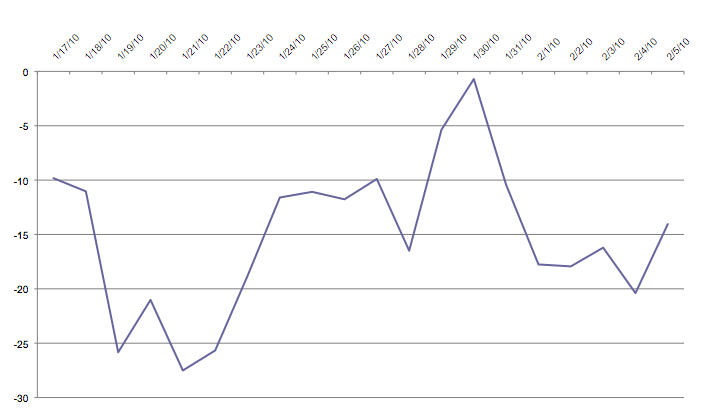
The graph below depicts the changing sentiment reflected in the SMS data between January 17th and February 5th.

Sentiment Analysis of Haiti SMS’s

There is, of course, no way to tell whether the incoming text messages reflect the general feeling of the population. It is also important to emphasize that the number of individuals sending in SMS’s increased during this time period. Still, it would be interesting to go through the sentiment analysis data and identify what may have contributed to the peaks and troughs of the above graph.

Incidentally, the lowest point on this graph is associated with the date of January 21. The data reveals that a major aftershock took place that day. There are subsequent reports of trauma, food/water shortages, casualties, need for medication, etc., which drive the sentiment analysis scores down.

Update 1: My colleague Ralf Steinberger and the Ushahidi-Haiti group is looking into the reasons behind the spike around January 30th. Ralf notes the following:

I checked the news a bit, using the calendar function in EMM NewsExplorer (http://emm.newsexplorer.eu/). I checked both the English and the French news for the day. One certainly positive news item accessible to Haitians on that day was that Haiti leaders pointed to progress. Another (French) positive news item is that the WFP (PAM) put in place a structured food aid system aiming at feeding up to 2 million people via women only. People were given food coupons (25kg of rice per family), starting Saturday 30.1.

Ralf also found that many of the original SMS’s received on that day had not been translated into English. So we’re looking into why that might have been. Hopefully we can get them translated retro-actively for the purposes of this analysis.

Update 2: Josef Steinberger from JRC has produced a revised sentiment analysis graph through to mid March.

This kind of sentiment analysis can be done in real-time. In future deployments where SMS becomes the principle source to communicate with disaster affected populations, using this kind of approach may  eventually provide an overall score for how the humanitarian community is doing.

Patrick Philippe Meier

Towards an SMS Code of Conduct for Disaster Response

Picture this: it’s October 7, 2011, and a major hazard hits a highly vulnerable population resulting in a devastating disaster. The entire humanitarian response community mobilizes within 48 hours. Days later, the cell phone network is back up and dozens of SMS systems are activated by large and small organizations. Two or three of these systems use short codes thanks to rapid collaboration with the country’s national telecommunication companies. The other SMS systems all use long codes.

That picture concerns me, a lot. The technology community’s response to Haiti has demonstrated that using SMS to communicate with disaster affected communities can save lives, hundreds of lives. Humanitarian organizations and NGOs have all taken note and nothing will prevent them from setting up their own SMS systems in the near future. This wouldn’t worry me if coordination wasn’t already a major challenge in this space.

Let me elaborate on the above picture.

Picture further that one organization decides to send out regular SMS broadcasts to the disaster affected communities to improve their situational awareness and prevent panic. This is an important service during the first few days of a disaster. But imagine that this organization does not provide a way for users receiving this information to unsubscribe or to specify exactly what type of information they would like and for which locations. Next suppose that three NGOs set up long codes to do the same. Now imagine that two major organizations independently set up an alerts SMS system, asking individuals to text in their location and most urgent needs.

This is an information disaster in the making for communities in crisis.

So what are we going to do to prevent the above picture from turning into reality? The group Communicating with Disaster Affected Communities (CDAC) is probably best placed to support a coordinating role in this space. But before we even get to this, our own community should start drafting an “SMS Code of Conduct for Disaster Response” for ourselves. I can think of no better way to start the process by using distributed cognition (aka crowdsourcing). This blog post on lessons learned and best practices may be informative as well.

Here are a few ideas to begin with:

  • Set up a complaints mechanism
  • Do not duplicate existing national SMS systems
  • Set up a single clearing house for all outgoing SMS broadcasts
  • Ensure that SMS messages are demand driven in terms of content
  • Enable receivers of Disaster SMS’s to unsubscribe and to specify alert type and location

There are likely dozens more points we could add. So please feel free to do so in the comments section below. I will then create a more structured Google Doc out of your replies and send this out for further peer reviewing.

Patrick Philippe Meier

Haiti and the Tyranny of Technology

How quickly we forget what has come before us. Is it because our technologies are so new or different that recommendations in the disaster literature don’t apply to us? The technology community repeatedly emphasized the unprecedented nature of the response in Haiti, particularly with respect to communication with disaster effected populations. Was is it really a complete departure? To a large extent yes, but were there really no guidelines available?

The challenges that materialized in the response to Haiti included:

  • Raising of expectations
  • Lack of formal complaints mechanism
  • Absence of downward accountability
  • Coordination and clarity of messaging

Guidelines to address these challenges do exist. I’ll draw on two documents that are both 4 years old. The first is my colleague Imogen Wall’s study “The Right to Know: The Challenge of Public Information and Accountability in Aceh and Sri Lanka”. The second is the Final Report of the Global Symposium+5.

Here are some of the main points to take home from Imogen’s 60-page study:

  • Many organizations are still paying for mistakes made in communicating with communities in the early days of the tsunami recovery effort, resulting in what many call the ‘broken promises’ phenomenon. The inherent problems of managing expectations were exacerbated by a widespread use of translators and jargon and the extreme levels of trauma experienced by beneficiaries.
  • Confusion about policies, an inability to report misuse of aid, ignorance about where to turn for assistance, cynicism and anger stemming from broken promises about aid, and mismanaged expectations were all noted in the 2004 Tsunami. But while cases of actual broken promises undoubtedly occurred, the majority of perceived broken promises actually seem to have resulted from communications problems.
  • Managing communications with communities is key to successful community-driven development. Knowledge is power: without information, communities cannot participate, make choices, or ask questions. Good communication is also about trust and partnership, and is thus at the heart of successful community partnerships.
  • Putting communities at the center of disaster response requires that adequate provision be made for community access to information about projects, channels through which they can ask questions, and mechanisms by which they can register dissatisfaction or complaints. Such efforts both supply information and create space for dialogue between communities and aid agencies, a two way information flow tht is beneficial to both parties. No accountability and transparency system is complete without a strong complaints mechanism. Complaints mechanisms have an important role in conflict mitigation at a community level and in the prevention of violence.
  • Donors must require downward accountability and communications strategies in projects they fund and by exploring ways in which they can receive feedback on projects from beneficiaries.
  • Until information is properly shared with beneficiaries, they will never be equal partners. And until they are provided with a voice and the ability to judge a project’s viability, organizations will never be able to claim that they enabled survivors to rebuild and move on to a as bright a future as possible.
  • Primarily, beneficiaries want practical information that explains what aid is available, what assistance they can expect, how to apply for it, when aid will arrive, why what they have received might differ from their neighbor, and what to do if they are not satisfied. They are not interested in materials that simply promote a particular organization. Secondly, they are very interested in hearing how the aid effort is going, how money is being spent, what problems are being experienced elsewhere, and what solutions are being found.
  • Low-tech solutions are almost invariably better. A simple bulletin board can  do more to enhance transparency and accountability towards beneficiaries than any website. All IDP locations should be required to have a bulletin board, and aid organizations should be required to display basic project information and contact details.
  • Broadly speaking, the aim of public relations (PR) is to promote an organization; the aim of public information (PI) is to channel information to the relevant audiences. But most communications expertise within international aid organizations is geared toward public relations.
  • Aid organizations have a tendency to regard communication with beneficiaries as an optional extra rather than seeing information as a vital commodity and a humanitarian right, the key to empowerment, better relationships with beneficiaries and a more effective recovery effort. There has also been a failure to understand that information deprivation causes stress and exacerbates trauma.
  • Organizations should consider, where appropriate, incorporating some form of community-bsaed monitoring and evaluation systems into their projects.
  • Written community contracts between organizations and beneficiaries should be adopted wherever possible.
  • There will always be questions regarding how much information can or should be shared with beneficiaries. Communities should be the driver of how much information will be shared.
  • Always leave a contact name, number and address, ideally of the liaison person responsible for the community.
  • With text messaging, a simple, short message can be sent to a list of phone numbers simultaneously. And while it is easy to compile a list of phone numbers of key people in beneficiary communities, collating and managing wider lists of numbers and making them available to aid organizations could be undertaken by a body such as OCHA’s Humanitarian Information Centers.
  • SMS is a powerful medium that can be harnessed for otherwise very difficult tasks, such as providing information quickly that is available only at the last minute, such as times for aid deliveries or changes in a medical clinic’s arrival time in a certain area. The list of recipients can be easily tailored to include only those in a certain geographical area, enabling messages to be very precisely targetted.

The Final Report of the 2006 Symposium+5 event that I participated includes a review of lessons learned, best practices and recommendations on the topic of communicating with disaster affected communities. Here are the main points:

  • Programs designed to enhance two-way information-sharing and communication with affected populations are not mainstreamed into all phases of the humanitarian continuum or the UN cluster system. More needs to be done to financially support the establishment of these projects in the preparedness and early response phase.
  • Provide easily understandable information to affected communities to encourage and empower people to take action to build and strengthen their resilience. The information should be developed with affected populations, incorporate relevant traditional and indigenous knowledge and cultural heritage and be tailored to different target audiences through both media and non-media communication channels, taking into account cultural and social factors.
  • Provide funding and support to local media and journalistic organizations that have a role in providing information to affected populations in all phases, from preparedness, during response, and into recovery and reconstruction.

Yes, we have new integrated platforms that allow for 2-way communication with disaster affected populations in near real time. But do these new tools render the above lessons learned and recommendations obsolete? If not, then why did the technology community not draw on them to guide their work in Haiti?

Patrick Philippe Meier

Ushahidi & The Unprecedented Role of SMS in Disaster Response

What if we could communicate with disaster affected communities in real-time just days after a major disaster like the quake in Haiti? That is exactly what happened thanks to a partnership between the Emergency Information Service (EIS), InSTEDD, Ushahidi, Haitian Telcos and the US State Department. Just 4 days after the earthquake, Haitians could text their location and urgent needs to “4636” for free.

I will focus primarily on the way that Ushahidi used 4636. Since the majority of incoming text messages were in Creole, we needed a translation service. My colleague Brian Herbert from Ushahidi and Robert Munro of Energy for Opportunity thus built a dedicated interface for crowdsourcing this step and reached out to dozens of Haitian communities groups to aid in the translation, categorization and geo-location of every message, quickly mobilizing 100s of motivated and dedicated volunteers. So not only was Ushahidi crowdsourcing crisis information in near real-time but also crowdsourcing translation in near real-time.

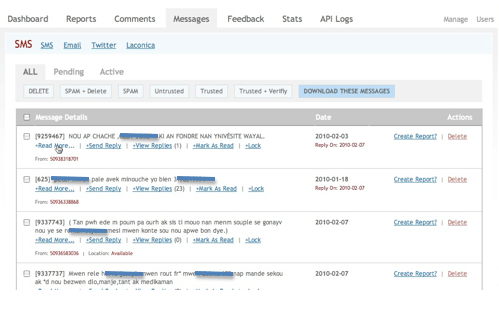
Text messages are translated into English just minutes after they leave a mobile phone in Haiti. The translated messages then appear directly on the Ushahidi platform. The screenshots below (click on graphics to enlarge) illustrates how the process works. The original SMS in Creole (or French) is displayed in the header. In order to view the translation, one simply clicks on “Read More”.

Ushahidi Back End

Incoming Text Messages

If further information is required, then one can reply to the sender of the text message directly from the Ushahidi platform. This is an important feature for several reasons. First, this allows for two-way communication with disaster affected communities. Second, an important number of messages we received were not actionable because of insufficient location information. The reply feature allowed us to get more precise information.

The screenshots below show how the “Send Reply” feature works. We weren’t sure if Universite Wayal was the same as Royal University. So we replied and asked for more location information. Note the preset replies in both English and Creole. The presets include thanks & requests for more location information, for example. Of course, one is not limited to these presets. Any text can be typed in and sent back to the sender of the original SMS. This feature has been part of the Ushahidi for almost two years now. We send off the request for more information and receive the following reply within minutes.

Preset Replies

When we receive an urgent and actionable SMS like this one, we can immediately create a report. By actionable, we mean there is sufficient location information and the description of the need is specific enough to respond to, just like the example above.

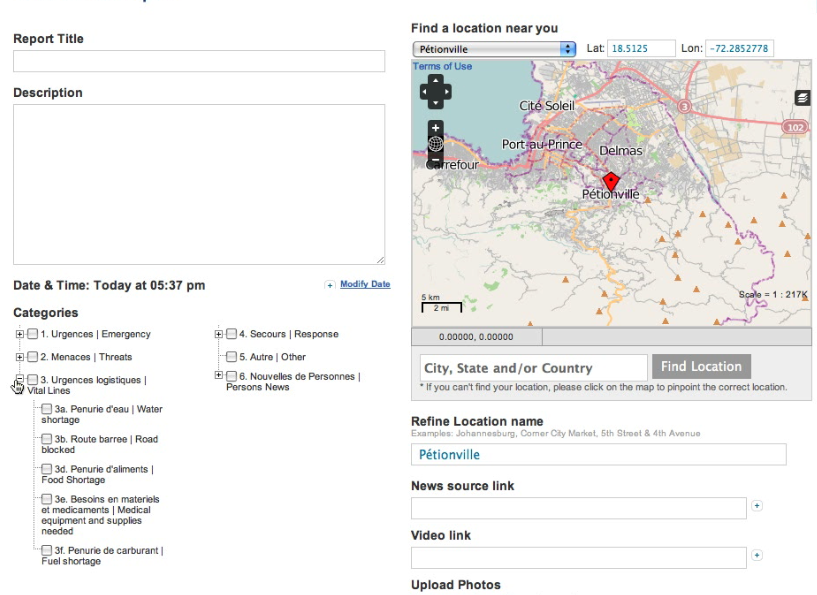
Creating a Report

First, the GPS coordinates for the location is identified. This can be done directly from the Ushahidi platform by entering the street address or town name. Sometimes a bit of detective work is needed to pinpoint the exact coordinates. Next, a title and description for the report is included–the latter usually comprising the text of the SMS. This is what we mean by structured information. The report is then tagged based on the category framework. Pictures can be uploaded with the report, and links to videos can also be included. Finally the report is saved and then approved for publication.

This is how the Ushahidi-Haiti @ Tufts team mapped 1,500+ text messages on the Ushahidi platform. We are now working with Samasource and Crowdflower to have the translation work serve as a source of income for Haitians inside Haiti. But how does all this connect to response?

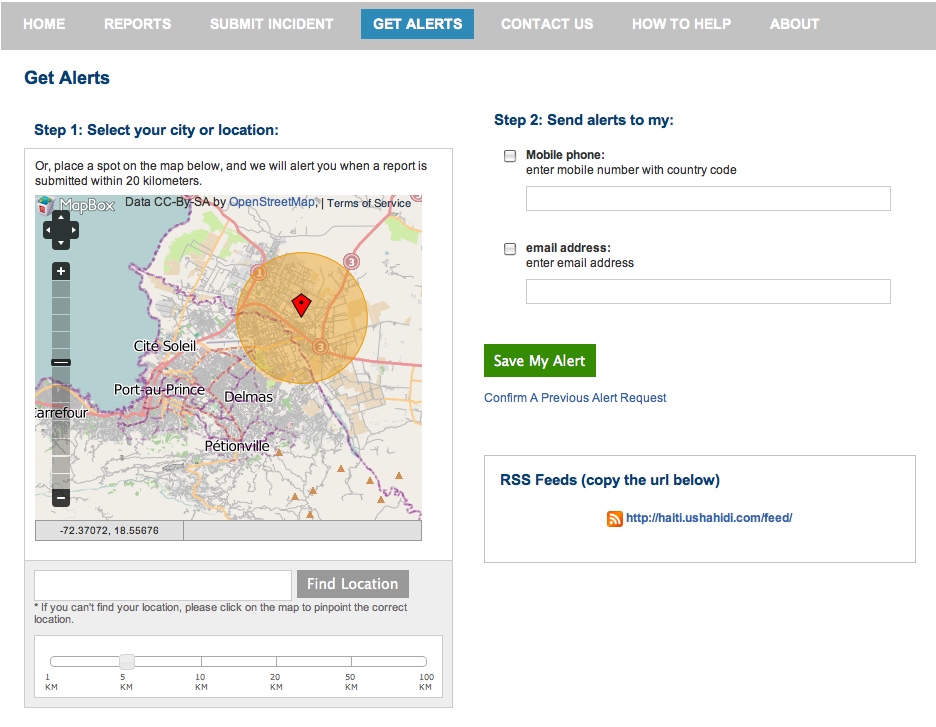
Ushahidi’s “Get Alerts” feature is one of my favorite because it allows responders themselves to customize the specific type of actionable information that is important to them; i.e., demand driven situational awareness in near real-time. Not only can responders elect to receive automated alerts via email, but they can also do so via SMS. Responders can also specify their geographic area of interest.

Subscribe to Alerts

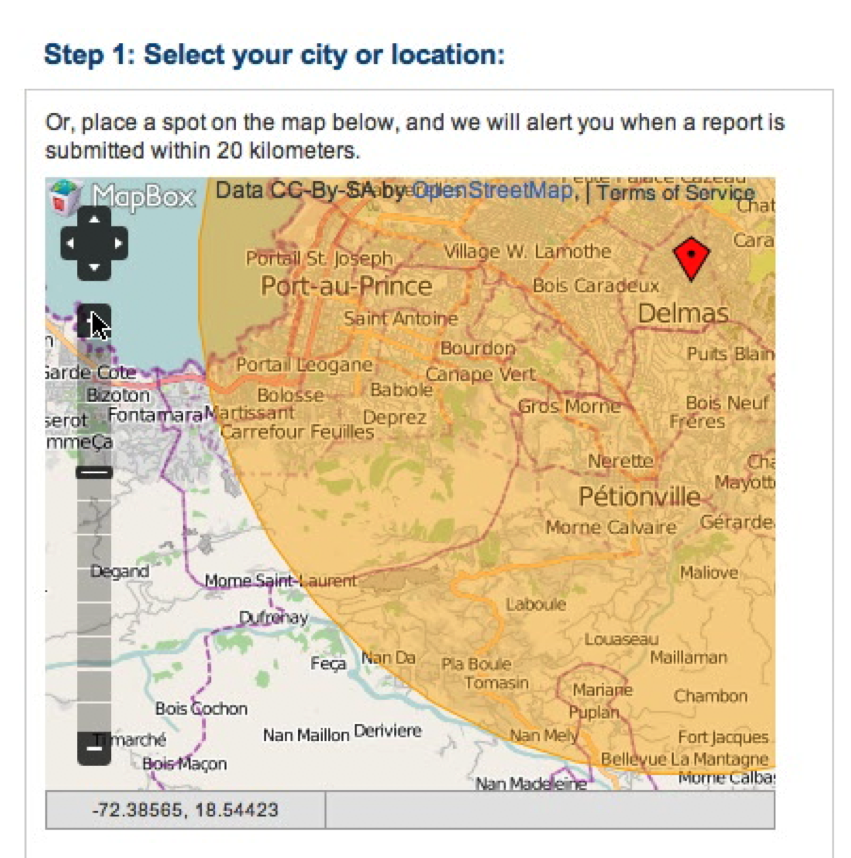
For example, if a relief worker from the Red Cross has a field office in neighborhood of Delmas, they can subscribe to Ushahidi to receive information on all reports originating from their immediate vicinity by specifying a radius, as shown below.

Selecting Area of Interest

The above Alerts feature is now being upgraded to the one depicted below, which was designed by my colleague Caleb Bell from Ushahidi. Not only are responders able to specify their geographic area of interest, but they can also select the type of alert (e.g., collapsed building, food shortage, looting, etc.) they want to receive. They can even add key words of interest to them, such as “water”, “violence” or “UN”. The goal is to provide responders with an unprecedented degree of customization to ensure they receive exactly the kind of alerts that they can respond to.

Highly Customized Alerts

On a more “macro” level, I recently reached out to colleagues at the EC’s Joint Research Center (JRC) to leverage their automated sentiment (“mood”) analysis platform. Sentiment Analysis is a branch of natural language processing (NLP) that seeks to quantify positive vs negative perceptions; akin to “tone” analysis. I suggested that we use their platform on the incoming text messages from Haiti to get a general sense of changing mood on an hourly basis. I’ll blog about the results shortly. In the meantime, here’s a previous blog post on the use of Sentiment Analysis for early warning.

Patrick Philippe Meier

Location Based Mobile Alerts for Disaster Response in Haiti

Using demand-side and supply-side economics as an analogy for the use of communication and information technology (ICT) in disaster response may yield some interesting insights. Demand-side economics (a.k.a. Keynesian economics) argues that government policies should seek to “increase aggregate demand, thus increasing economic activity and reducing unemployment.” Supply-side economics, in contrast, argues that “overall economic well-being is maximized by lowering the barriers to producing goods and services.”

I’d like to take this analogy and apply it to the subject of text messaging in Haiti. The 4636 SMS system was set up in Haiti by the Emergency Information Service or EIS (video) with InSTEDD (video), Ushahidi (video) and the US State Department. The system allows for both demand-side and supply-side disaster response. Anyone in the country can text 4636 with their location and needs, i.e., demand-side. The system is also being used to supply some mobile phone users with important information updates, i.e., supply-side.

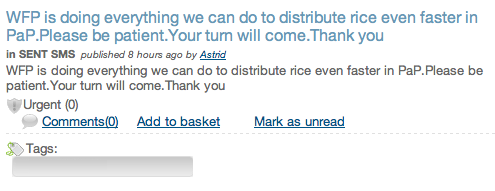
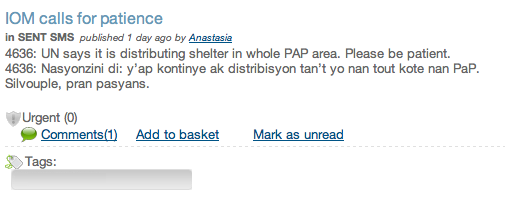
Both communication features are revolutionizing disaster response. Lets take the supply-side approach first. EIS together with WFP, UNICEF, IOM, the Red Cross and others are using the system to send out SMS to all ~7,500 mobile phones (the number is increasing daily) with important information updates. Here are screen shots of the latest messages sent out from the EIS system:

The supply-side approach is possible thanks to the much lower (technical and financial) barriers to disseminating this information in near real-time. Providing some beneficiaries with this information can serve to reassure them that aid is on the way and to inform them where they can access various services thus maximizing overall economic well-being.

Ushahidi takes both a demand-side and supply-side approach by using the 4636 SMS system. 4636 is used to solicit text messages from individuals in urgent need. These SMS’s are then geo-tagged in near real-time on Ushahidi’s interactive map of Haiti. In addition, Ushahidi provides a feature for users to receive alerts about specific geographic locations. As the screen shot below depicts, users can specify the location and geographical radius they want to receive information on via automated email and/or SMS alerts; i.e., supply-side.

The Ushahidi Tech Team is currently working to allow users to subscribe to specific alert categories/indicators based on the categories/indicators already being used to map the disaster and humanitarian response in Haiti. See the Ushahidi Haiti Map for the list. This will enable subscribers to receive even more targeted location based mobile alerts,  thus further improving their situational awareness, which will enable them to take more informed decisions about their disaster response activities.

Both the demand- and supply-side approaches are important. They comprise an unprecedented ability to provide location-based mobile alerts for disaster response; something not dissimilar to location based mobile advertising, i.e., targeted communication based on personal preferences and location. The next step, therefore, is to make all supply-side text messages location based when necessary. For example, the following SMS broadcast would only go to mobile phone subscribers in Port-au-Prince:

It is important that both demand- and supply-side mobile alerts be location based when needed. Otherwise, we fall prey to Seeing Like a State.

“If we imagine a state that has no reliable means of enumerating and locating its population, gauging its wealth, and mapping its land, resources, and settlements, we are imagining a state whose interventions in that society are necessarily crude.”

In “Seeing Like a State: How Certain Schemes to Improve the Human Condition Have Failed,” James Scott uses the following elegant analogy to emphasize the importance of locality.

“When a large freighter or passenger liner approaches a major port, the captain typically turns the control of his vessel over to a local pilot, who brings it into the harbor and to its berth. The same procedure is followed when the ship leaves its berth until it is safely out into the sea-lanes. This sensible procedure, designed to avoid accidents, reflects the fact that navigation on the open sea (a more “abstract” space) is the more general skill. While piloting a ship through traffic in a particular port is a highly contextual skill. We might call the art of piloting a “local and situated knowledge.”

An early lesson learned in the SMS deployment in Haiti is that more communication between the demand- and supply-side organizations need to happen. We are sharing the 4636 number,  so we are dependent on each other and need to ensure that changes to the system be up for open discussion. This lack of joint outreach has been the single most important challenge in my opinion. The captains are just not talking to the local pilots.

Patrick Philippe Meier

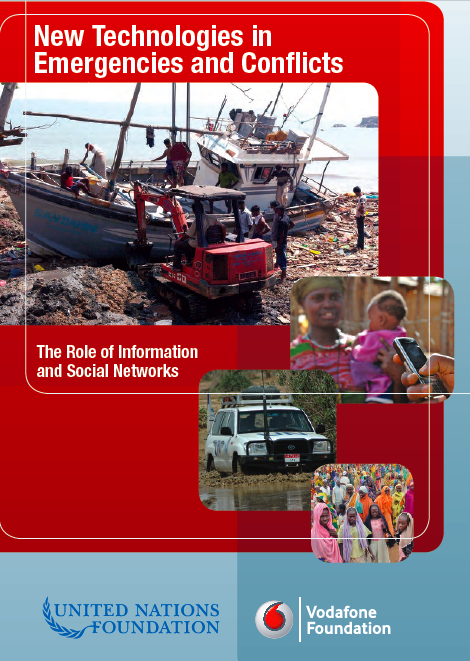
New Tech in Emergencies and Conflicts: Role of Information and Social Networks

I had the distinct pleasure of co-authoring this major new United Nations Foundation & Vodafone Foundation Technology Report with my distinguished colleague Diane Coyle. The report looks at innovation in the use of technology along the time line of crisis response, from emergency preparedness and alerts to recovery and rebuilding.

“It profiles organizations whose work is advancing the frontlines of innovation, offers an overview of international efforts to increase sophistication in the use of IT and social networks during emergencies, and provides recommendations for how governments, aid groups, and international organizations can leverage this innovation to improve community resilience.”

Case studies include:

  • Global Impact and Vulnerability Alert System (GIVAS)
  • European Media Monitor (EMM, aka OPTIMA)
  • Emergency Preparedness Information Center (EPIC)
  • Ushahidi Crowdsourcing Crisis Information
  • Télécoms sans Frontières (TSF)
  • Impact of Social Networks in Iran
  • Social Media, Citizen Journalism and Mumbai Terrorist Attacks
  • Global Disaster Alert and Coordination System (GDACS)
  • InSTEDD RIFF
  • UNOSAT
  • AAAS Geospatial Technologies for Human Rights
  • Info Technology for Humanitarian Assistance, Cooperation and Action (ITHACA)
  • Camp Roberts
  • OpenStreetMap and Walking Papers
  • UNDP Threat and Risk Mapping Analysis project (TRMA)
  • Geo-Spatial Info Analysis for Global Security, Stability Program (ISFEREA)
  • FrontlineSMS
  • M-PESA and M-PAISA
  • Souktel

I think this long and diverse list of case studies clearly shows that the field of humanitarian technology is coming into it’s own.  Have a look at the report to learn how all these fit in the ecosystem of humanitarian technologies. And check out the tag #Tech4Dev on Twitter or the UN Foundation’s Facebook page to discuss the report and feel free to add any comments to this blog post below. I’m happy to answer all questions. In the meantime, I salute the UN Foundation for producing a forward looking report on projects that are barely two years old, and some just two months old.

Patrick Philippe Meier

Crowdsourcing for Peace Mapping

Lynda Gratton at the London Business School gave one of the best Keynote speeches that I’ve heard all year. Her talk was a tour de force on how to catalyze innovation and one of her core recommendations really hit home for me: “If you really want to be at the cutting edge of innovation, then you better make sure that 20% of your team is under the age of 27.” Lynda upholds this principle in all her business ventures.

I find this absolutely brilliant, which explains why I prefer teaching undergraduate seminars and why I always try to keep in touch with former students. Without fail, they continue to be an invaluable source of inspiration and innovative thinking.

A former student of mine, Adam White, recently introduced me to another undergraduate student at Tufts University, Rachel Brown. Rachel is a perfect example of why I value interacting with bright young minds. She wants to return to Kenya next year to identify and connect local peace initiatives in Nairobi in preparation for the 2012 elections.

Rachel was inspired by the story of Solo 7, a Kenyan graffiti artist in Kibera who drew messages of peace throughout the slum as a way to prevent violence from escalating shortly after the elections. “Imagine,” she said, “if we could identify all the Solo 7’s of Nairobi, all the individuals and local communities engaged in promoting peace.”

I understood at once why Adam recommended I meet with Rachel: Ushahidi.

I immediately told Rachel about Ushahidi, a free and open source platform that uses crowdsourcing to map crisis information. I suggested she consider using the platform to crowdsource and map local peace initiatives across Kenya, not just Nairobi. I’ve been so focused on crisis mapping that I’ve completely ignored my previous work in the field of conflict early warning. An integral part of this field is to monitor indicators of conflict and cooperation.

There are always pockets of cooperation no matter how dire a conflict is. Even in Nazi Germany and the Rwandan genocide we find numerous stories of people risking their lives to save others. The fact is that most people, most of the time in most places choose cooperation over conflict. If that weren’t the case, we’d be living in state of total war as described by Clausewitz.

If we only monitor indicators of war and violence, then that’s all we’ll see. Our crisis maps only depict a small part of reality. It is incredibly important that we also map indicators of peace and cooperation. By identifying the positive initiatives that exist before and during a crisis, we automatically identify multiple entry points for intervention and a host of options for conflict prevention. If we only map conflict, then we may well identify where most of the conflict is taking place, but we won’t necessarily know who in the area might be best placed to intervene.

Documenting peace and cooperation also has positive psychological effects. How often do we lament the fact that the only kind of news available in the media is bad news? We turn on CNN or BBC and there’s bad news—sometimes breaking news of bad news. It’s easy to get depressed and to assume that only bad things happen. But violence is actually very rare statistically speaking. The problem is that we don’t systematically document peace, which means that our perceptions are completely skewed.

Take the following anecdote, which occurred to me several years ago when I taught my first undergraduate course on conflict early warning systems. I was trying to describe the important psychological effects of documenting peace and cooperation by using the example of the London underground (subway).

If you’ve been to London, you’ve probably experienced the frequent problems and delays with the underground system. And like most other subway systems, announcements are made to inform passengers of annoying delays and whatnot. But unlike other subway systems I’ve used, the London underground also makes announcements to let passengers know that all lines are currently running on time.

Now lets take this principle and apply it to Rachel’s project proposal combined with Ushahidi. Imagine if she were to promote the crowdsourcing of local peace initiatives all across Kenya. She could work with national and local media to get the word out. Individuals could send text messages to report what kinds of peace activities they are involved in.

This would allow Rachel and others to follow up on select text messages to learn more about each activity. In fact, she could use Ushahidi’s customizable reporting forms to ask individuals texting in information to elaborate on their initiatives. Rachel wants to commit no less than a year to this project, which should give her and colleagues plenty of time to map hundreds of local peace initiatives across Kenya.

Just imagine a map covered with hundreds of doves or peace dots representing local peace initiatives? What a powerful image. The Peace Map would be public, so that anyone with Internet access could learn about the hundreds of different peace initiatives in Kenya. Kenyan peace activists themselves could make use of this map to learn about creative approaches to conflict prevention and conflict management. They could use Ushashidi’s subscription feature to receive automatic updates when a new peace project is reported in their neighborhood, town or province.

When peace activists (and anyone else, for that matter) find peace projects they like on Ushahidi’s Peace Map, they can “befriend” that project, much like the friend feature in Facebook. That way they can receive updates from a particular project via email, SMS or even Twitter. These updates could include information on how to get involved. When two projects (or two individuals) are connected this way, Ushahidi could depict the link on the map with a line connecting the two nodes.

Imagine if this Peace Map were then shown on national television in the lead up to the elections. Not only would there be hundreds of peace dots representing individual peace efforts, but many of these would be linked, depicting a densely connected peace network.

The map could also be printed in Kenya’s national and local newspapers. I think a Peace Map of Kenya would send a powerful message that Kenyans want peace and won’t stand for a repeat of the 2007 post-election violence. When the elections do happen, this Peace Map could be used operationally to quickly respond to any signs of escalating tensions.

Rachel could use the Peace Map to crowdsource reports of any election violence that might take place. Local peace activists could use Ushahidi’s subscription feature to receive alerts of violent events taking place in their immediate vicinity. They would receive these via email and/or SMS in near real-time.

This could allow peace activists to mobilize and quickly respond to escalating signs of violence, especially if preparedness measures and contingency plans already in place. This is what I call fourth generation conflict early warning and early response (4G). See this blog post for more on 4G systems. This is where The Third Side framework for conflict resolution meets the power of new technology platforms like Ushahidi.

It is when I meet inspiring students like Rachel that I wish I were rich so I could just write checks to turn innovative ideas into reality. The next best thing I can do is to work with Rachel and her undergraduate friends to write up a strong proposal. So if you want to get involved or you know a donor, foundation or a philanthropist who might be interested in funding Rachel’s project, please do email me so I can put you directly in touch with her: Patrick@iRevolution.net.

In the meantime, if you’re about to start a project, remember Lynda’s rule of thumb: make sure 20% of your team is under 27. You won’t regret it.

Patrick Philippe Meier