Tag Archives: SMS

Evolving a Global System of Info Webs

I’ve already blogged about what an ecosystem approach to conflict early warning and response entails. But I have done so with a country focus rather than thinking globally. This blog post applies a global perspective to the ecosystem approach given the proliferation of new platforms with global scalability.

Perhaps the most apt analogy here is one of food webs where the food happens to be information. Organisms in a food web are grouped into primary producers, primary consumers and secondary consumers. Primary producers such as grass harvest an energy source such as sunlight that they turn into biomass. Herbivores are primary consumers of this biomass while carnivores are secondary consumers of herbivores. There is thus a clear relationship known as a food chain.

This is an excellent video visualizing food web dynamics produced by researchers affiliated with the Santa Fe Institute (SFI):

Our information web (or Info Web) is also composed of multiple producers and consumers of information each interlinked by communication technology in increasingly connected ways. Indeed, primary producers, primary consumers and secondary consumers also crawl and dynamically populate the Info Web. But the shock of the information revolution is altering the food chains in our ecosystem. Primary consumers of information can now be primary producers, for example.

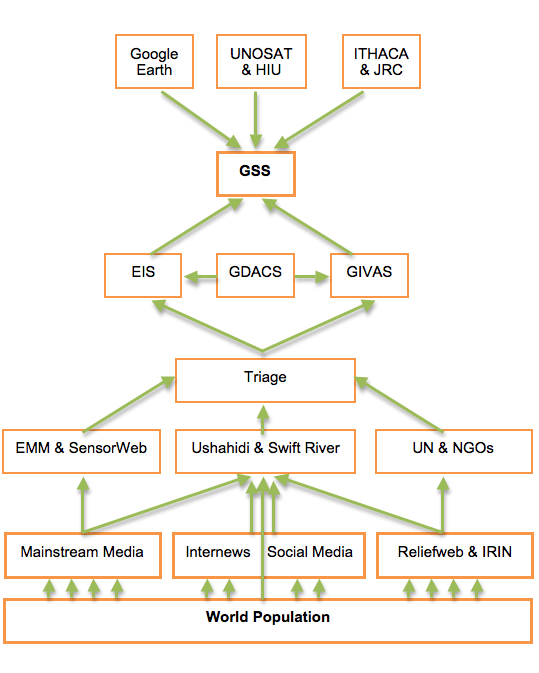
At the smallest unit of analysis, individuals are the most primary producers of information. The mainstream media, social media, natural language parsing tools, crowdsourcing platforms, etc, arguably comprise the primary consumers of that information. Secondary consumers are larger organisms such as the global Emergency Information Service (EIS) and the Global Impact and Vulnerability Alert System (GIVAS).

These newly forming platforms are at different stages of evolution. EIS and GIVAS are relatively embryonic while the Global Disaster Alert and Coordination Systems (GDACS) and Google Earth are far more evolved. A relatively new organism in the Info Web is the UAV as exemplified by ITHACA. The BrightEarth Humanitarian Sensor Web (SensorWeb) is further along the information chain while Ushahidi’s Crisis Mapping platform and the Swift River driver are more mature but have not yet deployed as a global instance.

InSTEDD’s GeoChat, Riff and Mesh4X solutions have already iterated through a number of generations. So have ReliefWeb and the Humanitarian Information Unit (HIU). There are of course additional organisms in this ecosystem, but the above list should suffice to demonstrate my point.

What if we connected these various organisms to catalyze a super organism? A Global System of Systems (GSS)? Would the whole—a global system of systems for crisis mapping and early warning—be greater than the sum of its parts? Before we can answer this question in any reasonable way, we need to know the characteristics of each organism in the ecosystem. These organisms represent the threads that may be woven into the GSS, a global web of crisis mapping and early warning systems.

Global System of Systems

Emergency Information Service (EIS) is slated to be a unified communications solution linking citizens, journalists, governments and non-governmental organizations in a seamless flow of timely, accurate and credible information—even when local communication infrastructures are rendered inoperable. This feature will be made possible by utilizing SMS as the communications backbone of the system.

In the event of a crisis, the EIS team would sift, collate, make sense of and verify the myriad of streams of information generated by a large humanitarian intervention. The team would gather information from governments, local media, the military, UN agencies and local NGOs to develop reporting that will be tailored to the specific needs of the affected population and translated into local languages. EIS would work closely with local media to disseminate messages of critical, life saving information.

Global Impact and Vulnerability Alert System (GIVAS) is being designed to closely monitor vulnerabilities and accelerate communication between the time a global crisis hits and when information reaches decision makers through official channels. The system is mandated to provide the international community with early, real-time evidence of how a global crisis is affecting the lives of the poorest and to provide decision-makers with real time information to ensure that decisions take the needs of the most vulnerable into account.

BrightEarth Humanitarian Sensor Web (SensorWeb) is specifically designed for UN field-based agencies to improve real time situational awareness. The dynamic mapping platform enables humanitarians to easily and quickly map infrastructure relevant for humanitarian response such as airstrips, bridges, refugee camps, IDP camps, etc. The SensorWeb is also used to map events of interest such as cholera outbreaks. The platform leverages mobile technology as well as social networking features to encourage collaborative analytics.

Ushahidi integrates web, mobile and dynamic mapping technology to crowdsource crisis information. The platform uses FrontlineSMS and can be deployed quickly as a crisis unfolds. Users can visualize events of interest on a dynamic map that also includes an animation feature to visualize the reported data over time and space.

Swift River is under development but designed to validate crowdsourced information in real time by combining machine learning for predictive tagging with human crowdsourcing for filtering purposes. The purpsose of the platform is to create veracity scores to denote the probability of an event being true when reported across several media such as Twitter, Online news, SMS, Flickr, etc.

GeoChat and Mesh4X could serve as the nodes connecting the above platforms in dynamic ways. Riff could be made interoperable with Swift River.

Can such a global Info Web be catalyzed? The question hinges on several factors the most important of which are probably awareness and impact. The more these individual organisms know about each other, the better picture they will have of the potential synergies between their efforts and then find incentives to collaborate. This is one of the main reasons I am co-organizing the first International Conference on Crisis Mapping (ICCM 2009) next week.

Patrick Philippe Meier

Connectedness Unnecessary for Successful Mobilization

The latest issue of the American Journal of Political Science (AJPS) includes an insightful study entitled “Don’t Forget to Vote: Text Message Reminders as a Mobilization Tool.”

Co-authored by Allison Dale and Aaron Strauss, the study (PDF) suggests that connectedness is not a necessary condition for a successful mobilization campaign. “For certain voters, a noticeable reminder is sufficient to drive them to the polls.” What’s particularly interesting is that “impersonal text messages are as effective as other, more personal,  forms of voter mobilization.”

Abstract. Current explanations of effective voter mobilization strategies maintain that turnout increases only when a potential voter is persuaded to participate through increased social connectedness. The connectedness explanation does not take into account, however, that registered voters, by registering, have already signaled their interest in voting.

The theory presented in this article predicts that impersonal, noticeable messages can succeed in increasing the likelihood that a registered voter will turn out by reminding the recipient that Election Day is approaching. Text messaging is examined as an example of an impersonal, noticeable communication to potential voters.

A nationwide field experiment (n = 8,053) in the 2006 election finds that text message reminders produce a statistically significant 3.0 percentage point increase in the likelihood of voting. While increasing social connectedness has been shown to positively affect voter turnout, the results of this study, in combination with empirical evidence from prior studies, suggest that connectedness is not a necessary condition for a successful mobilization campaign. For certain voters, a noticeable reminder is sufficient to drive them to the polls.

One question that remains is whether this finding would hold true in countries under authoritarian rule.

Patrick Philippe Meier

New Media, Accuracy and Balance of Power in Crises

I just read Nik Gowing’s book entitled “Skyful of Lies and Black Swans: The New Tyranny of Shifting Information Power in Crises.” The term “Black Swan” refers to sudden onset crises and the title of an excellent book on the topic by Nassim Taleb. “Skyful of Lies,” were the words used by the Burmese junta to dismiss the deluge of digital evidence of the mass pro-democracy protests  that took place in 2007.

yournewmedia001_3

Nik packs in some very interesting content in this study, a lot of which is directly relevant to my dissertation research and consulting work. He describes the rise of new media as “having an asymmetric, negative impact on the traditional structures of power.”

Indeed, British Foreign Secretary David Miliband labeled this “shifting of power from state to citizen as the new ‘civilian surge.'” To be sure, “that ‘civilian surge’ of growing digital empowerment is forcing an enhanced level of accountability that […] is a ‘real change to democracy’.” As for authoritarian regimes, “the impact of new media technologies has been shown to be as potentially ‘subversive’ as for highly developed democratic states.”

However, Nik recognizes that “the implications for power and policy-makers is not well developed or appreciated.” He adds that “the implications of this new level of empowerment are profound but still, in many ways, unquantifiable.” Hence the purpose and focus of my dissertation.

Time Lines out of Sync

Nik notes that the time lines of media action and institutional reaction are increasingly out of sync. “The information pipelines facilitated by the new media can provide information and revelations within minutes. But the apparatus of government, the military or the corporate world remain conditioned to take hours.”

Take for example, the tube and train bombings in London, 2005. During the first three hours following the incidents, the official government line was that an accidental power surge had caused the catastrophe. Meanwhile, some 1,300 blog posts were written within just 80 minutes of the terrorist attack which pointed to explosive devices as the cause. “The content of the real-time reporting of 20,000 emails, 3,000 text messages, 1,000 digital images and 20 video clips was both dramatic and largely correct.”

New Media and Accuracy

I find the point about accuracy particularly interesting. According to Nik, the repeated warnings that new media and user-generated content (UGC) cannot be trusted “does not seem to apply in a major crisis.”

“Far from it. The accumulated evidence is that the asymmetric torrent of overwhelming ‘amateur’ inputs from the new generators of content produces largely accurate, if personalized, information in real time. It may be imperfect and incomplete as the crisis time line unfolds.

There is also the risk of exaggeration or downright misleading ‘reporting’. But the impact is profound. Internal BBC research discovered that audiences are understanding if errors or exaggerations creep in by way of such information doer material, as long as they are sourced and later corrected.

In addition, the concept of trust can ‘flex’ in a crisis. Trust does not diminish as long as the ongoing levels of doubt or lack of certainty are always made clear. It is about ‘doing your best in [a] world where speed and information are the keys’. But the research concluded that the BBC needed to do more work to analyze the implications of the UGC phenomenon for accuracy, speed, personalization, dialogue and trust. That challenge is the same for all traditional media organizations.

Low Tech Power

Nik describes the onslaught of new media as the low tech empowerment of the media space. During the Burma protests of 2007, “the ad hoc community of risk-taking information doers became empowered. Those undisputed and widely corroborated images swiftly challenged the authority and claims of the regime.”

burmaprotests1

During the aftermath of Cyclone Nargis, both foreign journalists and aid agencies were forbidden from entering the country. But one producer and camera operator from a major news organization “managed to enter the country on tourist visas. Before being arrested and deported they evaded security checks and military intelligence to record vivid video that confirmed the terrible impact and human cost of the cyclone. Hiding in ditches they beamed it out of the country on a new tiny, portable Bgan satellite uplink carried in a hiker’s backpack.”

The Question

This is definitely an example of the “asymmetric, negative impact on the traditional structures of power,” that Nik refers to in his introduction. Question is, how much of a threat does this asymmetry pose to repressive regimes? That is one of the fundamental questions I pose in my dissertation research.

Patrick Philippe Meier

Video Introduction to Crisis Mapping

I’ve given many presentations on crisis mapping over the past two years but these were never filmed. So I decided to create this video presentation with narration in order to share my findings more widely and hopefully get a lot of feedback in the process. The presentation is not meant to be exhaustive although the video does run to about 30 minutes.

The topics covered in this presentation include:

  • Crisis Map Sourcing – information collection;
  • Mobile Crisis Mapping – mobile technology;
  • Crisis Mapping Visualization – data visualization;
  • Crisis Mapping Analysis – spatial analysis.

The presentation references several blog posts of mine in addition to several operational projects to illustrate the main concepts behind crisis mapping. The individual blog posts featured in the presentation are listed below:

This research is the product of a 2-year grant provided by Humanity United  (HU) to the Harvard Humanitarian Initiative’s (HHI) Program on Crisis Mapping and Early Warning, where I am a doctoral fellow.

I look forward to any questions/suggestions you may have on the video primer!

Patrick Philippe Meier

Folksomaps: Gold Standard for Community Mapping

There were a number of mapping-related papers, posters and demo’s at ICTD2009. One paper in particular caught my intention given the topic’s direct relevance to my ongoing consulting work with the UN’s Threat and Risk Mapping Analysis (TRMA) project in the Sudan and the upcoming ecosystem project in Liberia with Ushahidi and Humanity United.

Introduction

Entitled “Folksomaps – Towards Community Intelligent Maps for Developing Regions,” the paper outlines a community-driven approach for creating maps by drawing on “Web 2.0 principles” and “Semantic Web technologies” but without having to rely entirely on a web-based interface. Indeed, Folksomaps “makes use of web and voice applications to provide access to its services.”

I particularly value the authors’ aim to “provide map-based services that represent user’s intuitive way of finding locations and directions in developing regions.” This is an approach that definitely resonates with me. Indeed, it is our responsibility to adapt and customize our community-based mapping tools to meet the needs, habits and symbology of the end user; not the other way around.

I highly recommend this paper (or summary below) to anyone doing work in the crisis mapping field. In fact, I consider it required reading. The paper is co-authored by Arun Kumar, Dipanjan Chakraborty, Himanshu Chauhan, Sheetal Agarwal and Nitendra Rajput of IBM India Research Lab in New Delhi.

Background

Vast rural areas of developing countries do not have detailed maps or mapping tools. Rural populations are generally semi-literate, low-income and non-tech savvy. They are hardly like to have access to neogeography platforms like Google Earth. Moreover, the lack of electricity access and Internet connection also complicates the situation.

We also know that cities, towns and villages in developing countries “typically do not have well structured naming of streets, roads and houses,” which means “key landmarks become very important in specifying locations and directions.”

Drawing on these insights, the authors seek to tap the collective efforts of local communities to populate, maintain and access content for their own benefit—an approach I have described as crowdfeeding.

Surveys of Tech and Non-Tech Users

The study is centered on end-user needs, which is rather refreshing. The authors carried out a series of surveys to be better understand the profiles of end-users, e.g., tech and non-tech users.

The first survey sought to identify answers to the following questions:

  • How do people find out points of interest?
  • How do much people rely on maps versus people on the streets?
  • How do people provide local information to other people?
  • Whether people are interested in consuming and feeding information for a community-driven map system?

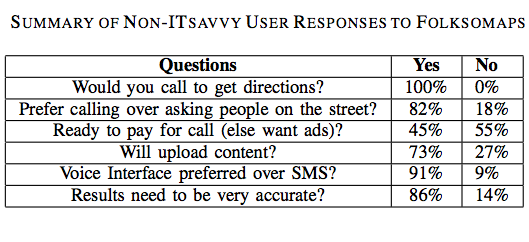
The results are listed in the table below:
folksotb1

Non-tech savvy users did not use maps to find information about locations and only 36% of these users required precise information. In addition, 75% of non-tech respondents preferred the choice of a phone-based interface, which really drives home the need for what I have coined “Mobile Crisis Mapping” or MCM.

Tech-users also rely primarily on others (as opposed to maps) for location related information. The authors associate this result with the lack of signboards in countries like India. “Many a times, the maps do not contain fine-grained information in the first place.”

Most tech-users responded that a phone-based location and direction finding system in addition to a web-based interface. Almost 80% expressed interest in “contributing to the service by uploading content either over the phone or though a web-based portal.”

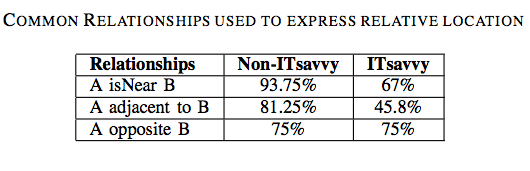
The second survey sought to identify how tech and non-tech users express directions and local information. For example:

  • How do you give directions to people on the road or to friends?
  • How do you describe proximity of a landmark to another one?
  • How do you describe distance? Kilometers or using time-to-travel?

The results are listed in the table below:
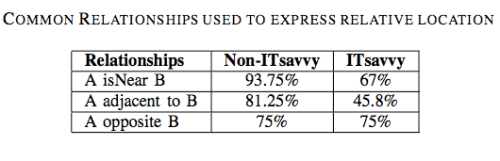
folksotb2

The majority of non-tech savvy participants said they make use of landmarks when giving directions. “They use names of big roads […] and use ‘near to’, ‘adjacent to’, ‘opposite to’ relations with respect to visible and popular landmarks […].” Almost 40% of responders said they use time only to describe the distance between any two locations.

Tech-savvy participants almost always use both time and kilometers as a measure to represent distance. Only 10% or so of participants used kilometers only to represent distance.

The Technology

The following characteristics highlight the design choices that differentiate Folksomaps from established notions of map systems:

  • Relies on user generated content rather than data populated by professionals;
  • Strives for spatial integrity in the logical sense and does not consider spatial integrity in the physical sense as essential (which is a defining feature of social maps);
  • Does not consider visual representation as essential, which is important considering the fact that a large segment of users in developing countries do not have access to Internet (hence my own emphasis on mobile crisis mapping);
  • Is non-static and intelligent in the sense that it infers new information from what is entered by the users.
  • User input is not verified by the system and it is possible that pieces of incorrect information in the knowledgebase may be present at different points of time. Folksomaps adopts the Wiki model and allows all users to add, edit and remove content freely while keeping maps up-to-date.

Conceptual Design

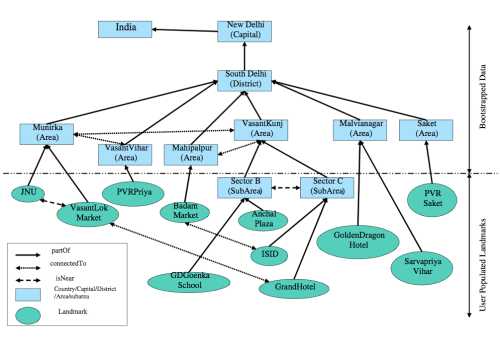
Folksomaps uses “landmark” as the basic unit in the mapping knowledgebase model while “location” represents more coarse-grained geographical areas such as a village, city or country. The model then seeks to capture a few key logical characteristics of locations such as direction, distance, proximity and reachability and layer.

The latter constitutes the granularity of the geographic area that a location represents. “The notion of direction and distance from a location is interpreted with respect to the layer that the location represents. In other words, direction and distance could be viewed as binary operator over locations of the same level. For instance, ‘is towards left of ’ would be appropriate if the location pair being considered is <Libya, Egypt>,” but not if the pair is <Nairobi, India>.

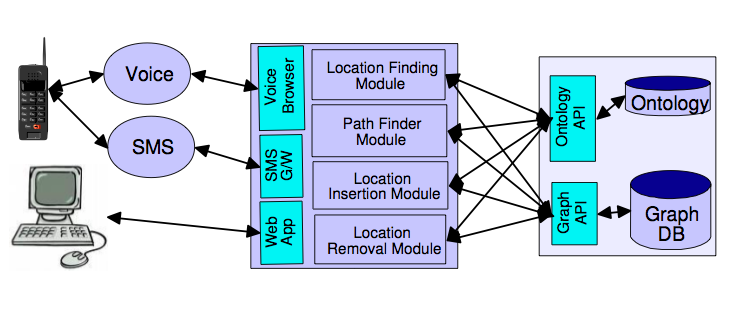
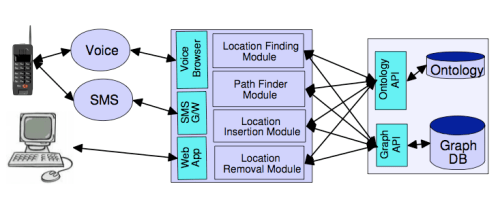
The knowledgebase makes use of two modules, the Web Ontology Language (OWL) and a graph database, to represent and store the above concepts. The Semantic Web language OWL is used to model the categorical characteristics of a landmark (e.g., direction, proximity, etc), and thence infer new relationships not explicitly specified by users of the system. In other words, OWL provides an ontology of locations.

The graph database is used represent distance (numerical relationships) between landmarks. “The locations are represented by nodes and the edges between two nodes of the graph are labeled with the distance between the corresponding locations.” Given the insights gained from user surveys, precise distances and directions are not integral components of community-based maps.

The two modules are used to generate answers to queries submitted by users.

User Interaction

The authors rightly recognize that the user interface design is critical to the success of community-based mapping projects. To be sure, users of may be illiterate, or semi-illiterate and not very tech-savvy. Furthermore, users will tend to query the map system when they need it most, e.g., “when they are stuck on the road looking for directions […] and would be pressed for time.” This very much holds true for crisis mapping as well.

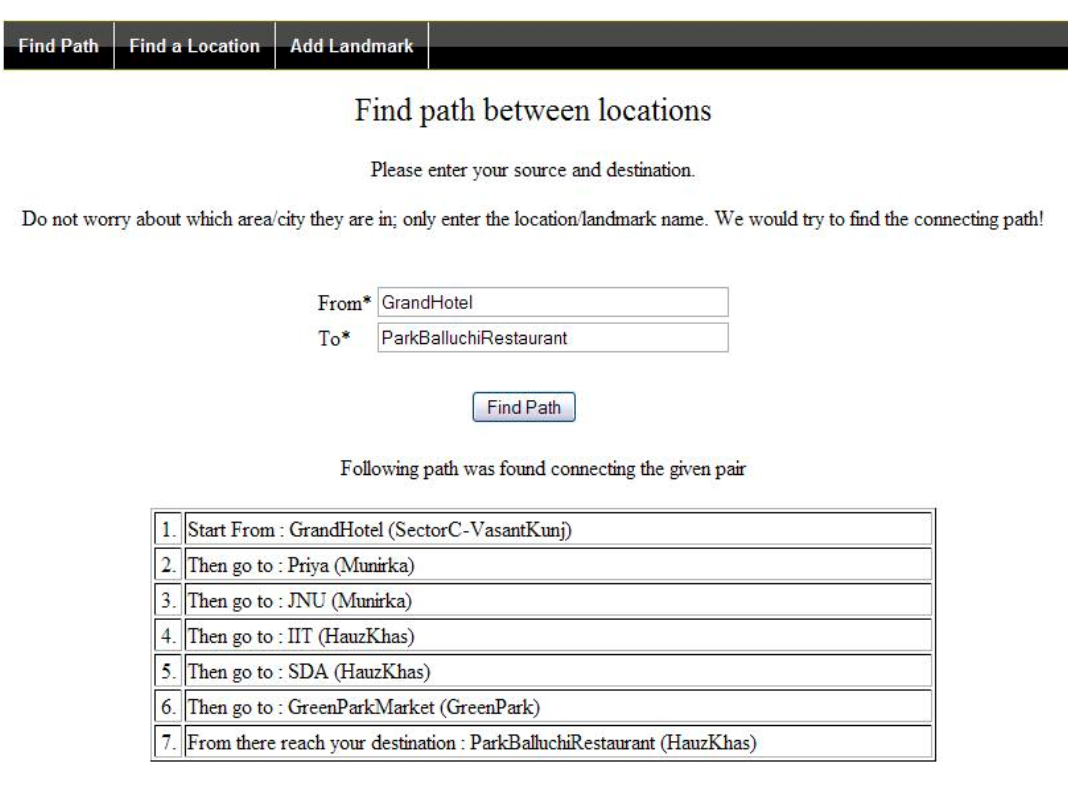
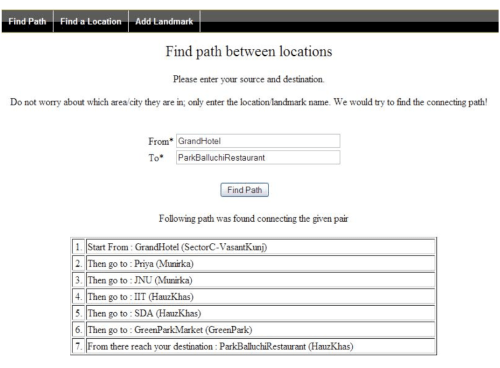
Users can perform three main tasks with the system: “find place”, “trace path” and “add info.” In addition, some or all users may be granted the right to edit or remove entries from the knowledgebase. The Folksomaps system can also be bootstrapped from existing databases to populate instances of location types. “Two such sources of data in the absence of a full-fledged Geographical Information System (GIS) come from the Telecom Industry and the Postal Department.”
folksofig3

How the users interface with the system to carry out these tasks will depend on how tech-savvy or literate they are and what type of access they have to information and communication technologies.

Folksomaps thus provides three types of interface: web-based, voice-based and SMS-based. Each interface allows the user to query and update the database. The web-based interface was developed using Java Server Pages (JSP) while the voice-based interface uses JSPs and VoiceXML.
folksofig41

I am particularly interested in the voice-based interface. The authors point to previous studies that suggest a voice-based interaction works well with users who are illiterate or semi-illiterate and who cannot afford to have high-end devices but can use ordinary low-end phones.
folksofig1

I will share this with the Ushahidi development team with the hopes that they will consider adding a voice-based interface for the platform later this year. To be sure, could be very interesting to integrate Freedom Fone’s work in this area.

Insights from User Studies

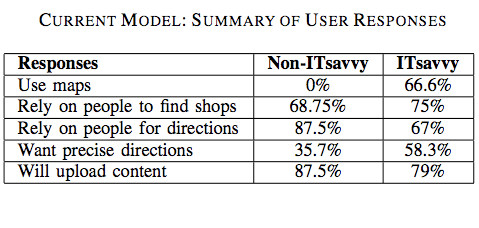
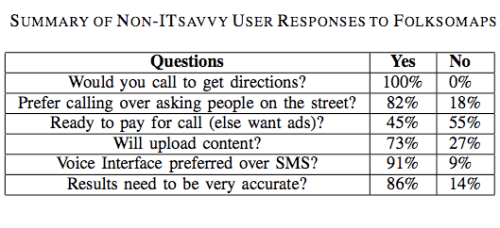
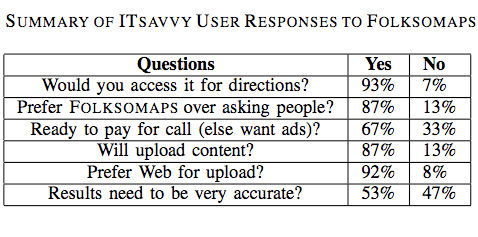
The authors conducted user studies to verify the benefit and acceptability of Folksomaps. Tech-savvy used the web-based interface while non-tech savvy participants used the voice-based interface. The results are shown in the two tables below.
folksotb3

Several important insights surfaced from the results of the user studies. For example, an important insight gained from the non-tech user feedback was “the sense of security that they would get with such a system. […] Even though asking for travel directions from strangers on the street is an option, it exposes the enquirer to criminal elements […].”

Another insight gain was the fact that many non-tech savvy participants were willing to pay for the call even a small premium over normal charges as they saw value to having this information available to them at all times.” That said, the majority of participants “preferred the advertisement model where an advertisement played in the beginning of the call pays for the entire call.”

Interestingly, almost all participants preferred the voice-based interface over SMS even though the former led to a number of speech recognition errors. The reason being that “many people are either not comfortable using SMS or not comfortable using a mobile phone itself.”

There were also interesting insights on the issue of accuracy from the perspective of non-tech savvy participants. Most participants asked for full accuracy and only a handful were tolerant of minor mistakes. “In fact, one of the main reasons for preferring a voice call over asking people for directions was to avoid wrong directions.”

This need for high accuracy is driven by the fact that most people use public transportation, walk or use a bicycle to reach their destination, which means the cost of incorrect information is large compared to someone who owns a car.

This is an important insight since the authors had first assumed that tolerance for incorrect information was higher. They also learned that meta information is as important to non-tech savvy users as the landmarks themselves. For instance, low-income participants were more interested in knowing the modes of available transportation, timetables and bus route numbers than the road route from a source to a destination.
folkstb4

In terms of insights from tech-savvy participants, they did not ask for fine-grained directions all the time. “They were fight with getting high level directions involving major landmarks.” In addition, the need for accuracy was not as strong as for the non-tech savvy respondents and they preferred the content from the queries sent to them via SMS so they could store it for future access, “pointing out that it is easy to forget the directions if you just hear it.”

Some tech-savvy participants also suggested that the directions provided by Folksomaps should “take into consideration the amount of knowledge the subject already has about the area, i.e., it should be personalized based upon user profile. Other participants mentioned that “frequent changes in road plans due to constructions should be captured by such a system—thus making it more usable than just getting directions.”

Conclusion

In sum, the user interface of Folksomaps needs to be “rich and adaptive to the information needs of the user […].” To be sure, given user preference towards “voice-based interface over SMS, designing an efficient user-friendly voice-based user interface […].” In addition, “dynamic and real-time information augmented with traditional services like finding directions and locations would certainly add value to Folksomaps.” Furthermore, the authors recognize that Folksomaps can “certainly benefit from user interface designs,” and “multi-model front ends.”

Finally, the user surveys suggest “the community is very receptive towards the concept of a community-driven map,” so it is important that the TRMA project in the Sudan and the ecosystem Liberia project build on the insights and lessons learned provided in this study.

Patrick Philippe Meier

Evaluating Accuracy of Data Collection on Mobile Phones

The importance of data validation is unquestioned but few empirical studies seek to assess the possible errors incurred during mobile data collection. Authors Somani Patnaik, Emma Brunskill and William Thies thus carried out what is possibly the first quantitative evaluation  (PDF) of data entry accuracy on mobile phones in resource-constrained environments. They just presented their findings at ICTD 2009.

Mobile devices have become an increasingly important tool for information collection. Hence, for example, my interest in pushing forward the idea of Mobile Crisis Mapping (MCM). While studies on data accuracy exist for personal digital assistants (PDAs), there are very few that focus on mobile phones. This new study thus evaluates three user interfaces for information collection: 1) Electronic forms; 2) SMS and 3) voice.

The results of the study indicate the following associated error rates:

  • Electronic forms = 4.2%
  • SMS = 4.5%
  • Voice = 0.45%

For compartive purposes and context, note that error rates using PDAs have generally been less than 2%. These figures represent the fraction of questions that were answered incorrectly. However, since “each patient interaction consisted of eleven questions, the probability of error somewhere in a patient report is much higher. For both electronic forms and SMS, 10 out of 26 reports (38%) contained an error; for voice, only 1 out of 20 reports (5%) contained an error (which was due to operator transcription).

I do hope that the results of this study prompt many others to carry out similar investigations.  I think we need a lot more studies like this one but with a larger survey sample (N) and across multiple sectors (this study drew on just 13 healthworkers).

The UN Threat and Risk Mapping Analysis (TRMA) project I’m working on in the Sudan right now will be doing a study on data collection accuracy using mobile phones when they roll out their program later this month. The idea is to introduce mobile phones in a number of localities and not in neighboring ones. The team will then compare the data quality of both samples.

I look forward to sharing the results.

Patrick Philippe Meier

ISA 2009: Panel on ICTs, Human Rights, Activism and Resistance

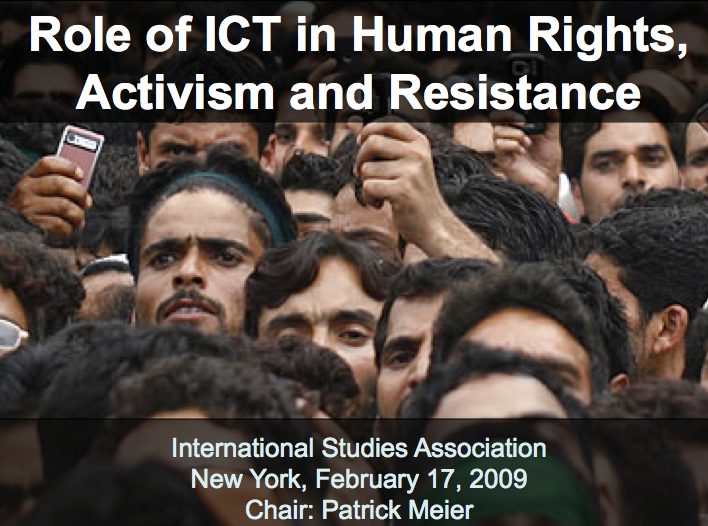
I just chaired a very productive panel at the International Studies Association (ISA) on the impact of ICTs on human rights, political activism and resistance.

ISApanel

The panel featured the following presentations:

  • Lucía Liste Muñoz and Indra de Soysa onThe Blog vs Big Brother: Information and Communication Technologies and Human Rights, 1980-2005.
  • Fabien Miard on “Call for Power? Mobile Phones as Facilitators of Political Activism.”
  • Patrick Meier on “iRevolutions: The Impact of ICTs on Protest Frequency in Repressive Contexts.” [slideshare]

Presentations

I’ve already blogged about each of the papers individually (see links above) so what follows are points from some of the presentations that I found particularly interesting. I also include the superb feedback that our discussant Professor Dan Drezner from The Fletcher School provided along with a summary of the productive Q&A session we had.

  • Muñoz and de Soysa: Their results show that Internet access leads to increasing respect of human rights by governments. This is true of both democracies and authoritarian regimes.
  • Joshua Goldstein: The role that Safaricom (a private telecommunications company) had in seeking to prevent and/or mitigate the election violence is unprecedented. Not only did the company refuse switch of the SMS network as per the government’s request, the company also sent out broadcast SMS to call on restraint and civic behavior.

Feedback to Panelists

Dan Drezner provided the following feedback:

  • The papers were definitely panel material as they all address important issues related to ICTs that overlap in very interesting ways. So overall, this was great set of papers and presentations, and panelists ought to make sure they read and learn from each others’ papers.
  • Most of the large-N papers blatantly seek to identify a positive correlation between ICT and human rights, political activism, digital resistance, etc. A less biased way to approach the research would be to formulate the question as follows: “How do ICTs benefit the State?”
  • Patrick should expand his set of countries beyond the 22 countries.
  • The dynamic between states and society vis-a-vis repression and circumvention may be an evolutionary one based on learning behavior.
  • The papers should treat ICTs not as independent variables but as an interactive variable with factors such as unemployment. In other words, the question should be: to what extent does ICT interact with other variables that we know ought to trigger protests?
  • The studies should separate anti-foreign protests from anti-government protests.
  • The large-N analyses should include more control variables such as dummy varibales for elections and wars.
  • The studies should also seek to assess the relationship between ICTs and the magnitude of protests and not only the frequency of protests.
  • The papers do not take into account the role of the Diaspora in helping to mobilize, organize and coordinate protests.

Response to Feedback

Here I only respond the feedback relevant to my paper and presentation:

  • On the bias towards finding a statistical relationship and expanding the number of countries in my study, I disagreed with Professor Drezner. I specifically chose the 22 countries in my dataset because the regimes in these countries are actively using ICTs to censor, repress, monitor and block information. So if anything, the cards are stacked against resistance movements when it comes to these countries. Hence my not planning to expand the dataset to include additional countries. Professor Drezner agreed on both points.
  • I completely agree on the evolutionary dynamic, which I described in my dissertation proposal and which explains why I often refer to the dynamic as a cyber game of cat-and-mouse.
  • I’m not entirely sold on treating ICTs as an interactive variable but will explore this nonetheless.
  • Agreed on the suggestion that anti-foreign protests be treated seperately since these protests are often organized by repressive regimes.
  • I fully agree on adding more control variables including elections, wars and population.
  • I concur with the point made about the magnitude of protests but this information is hard to come by. More importantly, however, the dataset I’m using is based on Reuters newswires and the reason I’m using this data is because Reuters is highly unlikely to report on low-level protests but rather on protests that have a national impact. So the dataset serves as a filter for large-scale protests and hence magnitude.
  • Very good point about the diaspora.

Q&A Session

We had an excellent set of questions from the audience which prompted a rich conversation around the following topics:

  • Repressive regimes learning from one another about how to use ICTs for censorship, repression, monitoring, etc. and resistance movement learning from each other.
  • The side to first acquire and apply new technology generally gets a head start, but this prompts the other side, e.g., the State to catch up and regain the upper hand.
  • Who are the users of these technologies? Demographics, gender, age, etc, should be important factors in the study of ICTs, State and society.
  • One member of the audience was a policy maker with the British government and  wanted to know what role Western governments should  play vis-a-vis digital activism.
  • The issue of civil resistance and the intersection with digital activism came up repeatedly in the discussion. Understanding one without the other is increasingly meaningless.

Patrick Philippe Meier

ISA 2009: Digital Technologies in Kenya’s Post Election Crisis

The fourth presentation at the ISA panel that I’m chairing will feature research by Joshua Goldstein and Juliana Rotich on the role of digital networked technologies during Kenya’s post-election violence (PDF). Blog posts on the other three presentations are available here on human rights, here on political activism and here on digital resitance.

Introduction

Josh and Juliana pose the following question: do mobile phones and the Internet promote transparency and good governance or do they promote hate speech and conflict? The authors draw on the 2007-2008 Kenyan presidential elections to assess the impact of digitally networked technologies, specifically mobile phones and the Internet, on the post-election violence.

This study is an important contribution to the scholarly research on the impact of digital technology on democracy since the majority of the existing literature is largely written through the lens of established, Western democracies. The literature thus “excludes the experience of Sub-Saharan Africa, where meaningful access to digital tools is only beginning to emerge, but where the struggle between failed state and functioning democracy are profound.”

Case Study

Josh and Juliana draw on Kenya as a case study to assess the individual impact of mobile phones and the Internet on the post-election violence. The mobile phone is the most widely used digital application in Kenya and the rest of Africa. The low cost and ease of texting explains how quickly “hate SMS” began circulating after Kenya’s election day. Some examples of the messages texted:

Fellow Kenyans, the Kikuyu’s have stolen our children’s future… we must deal with them in a way they understand… violence.

No more innocent Kikuyu blood will be shed. We will slaughter them right here in the capital city. For justice, compile a list of Luo’s you know… we will give you numbers to text this information.

The authors are concerned about the troubling trend of hate SMS in East Africa citing a violent icident in neighboring Uganda that was organized via SMS to protest the government’s sale of a forest to a company. As they note, “mass SMS tools are remarkably useful for organizing this type of explicit, systematic, and publicly organized campaign of mob violence.”

However, the authors also recognize that “since SMS, unlike radio, is a multi-directional tool, there is also hope that voices of moderation can make themselves heard.” They point to the response taken by Michael Joseph, the CEO of Kenya’s largest mobile phone provider Safaricom when he was asked by government officials to consider shutting down the SMS system:

Joseph convinced the government not to shut down the SMS system, and instead to allow SMS providers to send out messages of peace and calm, which Safaricom did to all nine million of its customers.

Josh and Juliana also note that tracking and identifying individuals that promote hate speech is relatively easy for governments and companies to do. “In the aftermath of the violence, contact information for over one thousand seven hundred individuals who allegedly promoted mob violence was forwarded to the Government of Kenya.” While Kenya didn’t have a law to prosecute hate SMS, the Parliament has begun to create such a law.

The Internet in Kenya was also used for predatory and civic speech. For example, “the leading Kenyan online community, Mashahada, became overwhelmed with divisive and hostile messages,” which prompted the moderators to “shut down the site, recognizing that civil discourse was rapidly becoming impossible.”

However, David Kobia, the administrator of Mashahada, decided to launch a new site a few days later explicitly centered on constructive dialogue. The site, “I Have No Tribe,” was successful in promoting a more constructive discourse and demonstrates “that one possible response to destructive speech online is to encourage constructive speech.”

Mobile phones and the Internet were combined by Ushahidi to crowdsource human rights violation during the post-election violence. The authors contend that the Ushahidi platform is “revolutionary for human rights campaigns in the way that Wikipedia is revolutionary for encyclopedias; they are tools that allow cooperation on a massive scale.” I have already blogged extensively about Ushahidi here and here so will not expand on this point other than to emphasize that Ushahidi was not used to promote hate speech.

Josh and Juliana also draw on the role of Kenya’s citizen journalists to highlight another peaceful application of digital technologies. As they note, Kenya has one of the richest blogging traditions in sub-Saharan Africa, which explains why,

Kenyan bloggers became a critical part of the conversation [when] the web traffic from within Kenya shot through the roof. The influence ballooned further when radio broadcasters began to read influential bloggers over the airwaves, helping them reach […] 95% of the Kenyan population.”

When the Government of Kenya declared a ban on live news coverage on December 30, 2007, Kenyan bloggers became indispensable in their role as citizen journalists. […] Blogs challenged the government’s version of events as they unfolded.

[…] Further, Blogs became a critical source of information for Kenyans in Nairobi and the diaspora. Rumors spread via SMS were dispelled via an online dialogue that took place on blogs and in the comments section of blogs.

Conclusion

When we talk about the ‘networked public sphere,’ we are usually referring to a Western public sphere; one that facilitates public discourse, increased transparency and positive cooperation. However, as the case study above demonstrates, the narrative is more involved when we talk about an African or Kenyan ‘networked public sphere.’ Indeed, the authors conclude that digital networked technologies catalyzed both “predatory behavior such as ethnic-based mob violence and civic behavior such as journalism and human rights campaigns.”

Several questions remain to be addressed in further research. Namely, how important is a vibrant blogosphere to promote positive applications of digital technologies in times of crises? Are networked digital technologies like Ushahidi more susceptible to positive uses than predatory uses? And finally, how does the Kenya case compare to others like the Orange Revolution in the Ukraine?

Patrick Philippe Meier

ISA 2009: Digital Technologies in Kenya’s Post Election Crisis

The fourth presentation at the ISA panel that I’m chairing will feature research by Joshua Goldstein and Juliana Rotich on the role of digital networked technologies during Kenya’s post-election violence (PDF). Blog posts on the other three presentations are available here on human rights, here on political activism and here on digital resitance.

Introduction

Josh and Juliana pose the following question: do mobile phones and the Internet promote transparency and good governance or do they promote hate speech and conflict? The authors draw on the 2007-2008 Kenyan presidential elections to assess the impact of digitally networked technologies, specifically mobile phones and the Internet, on the post-election violence.

This study is an important contribution to the scholarly research on the impact of digital technology on democracy since the majority of the existing literature is largely written through the lens of established, Western democracies. The literature thus “excludes the experience of Sub-Saharan Africa, where meaningful access to digital tools is only beginning to emerge, but where the struggle between failed state and functioning democracy are profound.”

Case Study

Josh and Juliana draw on Kenya as a case study to assess the individual impact of mobile phones and the Internet on the post-election violence. The mobile phone is the most widely used digital application in Kenya and the rest of Africa. The low cost and ease of texting explains how quickly “hate SMS” began circulating after Kenya’s election day. Some examples of the messages texted:

Fellow Kenyans, the Kikuyu’s have stolen our children’s future… we must deal with them in a way they understand… violence.

No more innocent Kikuyu blood will be shed. We will slaughter them right here in the capital city. For justice, compile a list of Luo’s you know… we will give you numbers to text this information.

The authors are concerned about the troubling trend of hate SMS in East Africa citing a violent icident in neighboring Uganda that was organized via SMS to protest the government’s sale of a forest to a company. As they note, “mass SMS tools are remarkably useful for organizing this type of explicit, systematic, and publicly organized campaign of mob violence.”

However, the authors also recognize that “since SMS, unlike radio, is a multi-directional tool, there is also hope that voices of moderation can make themselves heard.” They point to the response taken by Michael Joseph, the CEO of Kenya’s largest mobile phone provider Safaricom when he was asked by government officials to consider shutting down the SMS system:

Joseph convinced the government not to shut down the SMS system, and instead to allow SMS providers to send out messages of peace and calm, which Safaricom did to all nine million of its customers.

Josh and Juliana also note that tracking and identifying individuals that promote hate speech is relatively easy for governments and companies to do. “In the aftermath of the violence, contact information for over one thousand seven hundred individuals who allegedly promoted mob violence was forwarded to the Government of Kenya.” While Kenya didn’t have a law to prosecute hate SMS, the Parliament has begun to create such a law.

The Internet in Kenya was also used for predatory and civic speech. For example, “the leading Kenyan online community, Mashahada, became overwhelmed with divisive and hostile messages,” which prompted the moderators to “shut down the site, recognizing that civil discourse was rapidly becoming impossible.”

However, David Kobia, the administrator of Mashahada, decided to launch a new site a few days later explicitly centered on constructive dialogue. The site, “I Have No Tribe,” was successful in promoting a more constructive discourse and demonstrates “that one possible response to destructive speech online is to encourage constructive speech.”

Mobile phones and the Internet were combined by Ushahidi to crowdsource human rights violation during the post-election violence. The authors contend that the Ushahidi platform is “revolutionary for human rights campaigns in the way that Wikipedia is revolutionary for encyclopedias; they are tools that allow cooperation on a massive scale.” I have already blogged extensively about Ushahidi here and here so will not expand on this point other than to emphasize that Ushahidi was not used to promote hate speech.

Josh and Juliana also draw on the role of Kenya’s citizen journalists to highlight another peaceful application of digital technologies. As they note, Kenya has one of the richest blogging traditions in sub-Saharan Africa, which explains why,

Kenyan bloggers became a critical part of the conversation [when] the web traffic from within Kenya shot through the roof. The influence ballooned further when radio broadcasters began to read influential bloggers over the airwaves, helping them reach […] 95% of the Kenyan population.”

When the Government of Kenya declared a ban on live news coverage on December 30, 2007, Kenyan bloggers became indispensable in their role as citizen journalists. […] Blogs challenged the government’s version of events as they unfolded.

[…] Further, Blogs became a critical source of information for Kenyans in Nairobi and the diaspora. Rumors spread via SMS were dispelled via an online dialogue that took place on blogs and in the comments section of blogs.

Conclusion

When we talk about the ‘networked public sphere,’ we are usually referring to a Western public sphere; one that facilitates public discourse, increased transparency and positive cooperation. However, as the case study above demonstrates, the narrative is more involved when we talk about an African or Kenyan ‘networked public sphere.’ Indeed, the authors conclude that digital networked technologies catalyzed both “predatory behavior such as ethnic-based mob violence and civic behavior such as journalism and human rights campaigns.”

Several questions remain to be addressed in further research. Namely, how important is a vibrant blogosphere to promote positive applications of digital technologies in times of crises? Are networked digital technologies like Ushahidi more susceptible to positive uses than predatory uses? And finally, how does the Kenya case compare to others like the Orange Revolution in the Ukraine?

Patrick Philippe Meier

Web4Dev: Innovation Track Day 2

The second day of the Innovation Track at Web4Dev focused on monitoring and evaluation. Robert Kirkpatrick from InSTEDD, Erik Hersman from Ushahidi and Christopher Strebel from UNESCO each gave a presentation.

Robert introduced InSTEDD’s Mesh4X and GeoChat which I’ve already blogged about here so won’t expand on. But Robert also introduced a new project I was not aware of called Evolve. This tool helps to synthesize data into actionable information, to collaborate around diverse data streams to detect, analyze, triage and track critical events as they unfold.

Erik introduced Ushahidi and described our increasing capacity to crowdsource eyewitness crisis data. However, the challenge is increasingly how to consume and make sense of the incoming data stream. There were thousands of Tweets per minute during the Mumbai attacks. Ushahidi is working on Swift River to explore ways to use crowdsourcing as a filter for data validation.

Christopher Strebel introduced GigaPan, a robotic camera that captures gigapixel images. The tool was developed for the Mars Rover program to take very high resolution images of Mars. UNESCO is introducing the technology for education purposes. I’m not sure I’m entirely convinced about this project; not just because the camera costs $300-$400 but because I don’t see what such a sophisticated  tool adds over regular cameras in terms of education and participation.

In any case, while I found all three presentations interesting, none of them actually addressed the second topic of today’s workshop, namely evaluation. I spent most of December and January working with a team of monitoring and evaluation (M&E) experts to develop a framework for a multi-year project in Liberia. I can conclude from this experience that those of us who don’t have expertise in M&E have a huge amount to learn. Developing serious M&E frameworks is a rigorous process.

Patrick Philippe Meier