
Tag Archives: Twitter

Greek Riots, Facebook, Twitter and SMS (Updated)

I am particularly interested in riots since part of my doctoral research focuses on the strategic and tactical uses of digital technology to organize, mobilize and coordinate protest events in repressive contexts. On this note, Alternet just published this piece by Andrew Lam on the “Greek Riots and the News Media in the Age of Twitter,” which echoes some of the issues raised during the panel discussion I participated in last week in  DC on the decline of foreign reporting and rise of citizen journalism.

The Greek riots are a classic case of iRevolutions in the making, i.e., individuals and networks (hyper) empowered by linking technologies like Facebook, Twitter and SMS. What follows first are my thoughts on the two main points that the Andrew highlights in his piece. The second part of this post sheds light on the dynamics of riots by drawing on complexity science and Clay Shirky’s work.
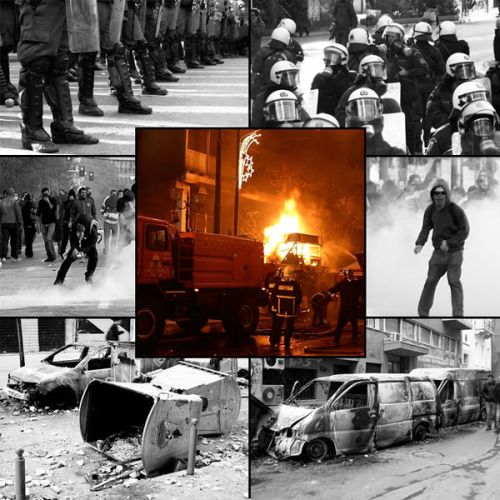
greekriotmontage

Initial Conditions: The riots were sparked after a 15-year old student “died from a gunshot wound in his heart, inflicted by a policeman following an altercation between a police patrol and a small group of youths in Athens” (1). Thousands of young people took to the streets after quickly spreading the news via Facebook, Twitter and SMS.

But as Andrew points out, no one bothered to verify or investigate the police officer’s claim that he was innocent: “When the coroner’s report came out several days later, it said the bullet was dented, meaning it ricocheted before hitting the teenager, but the information changed nothing. Athens had been burning for several nights, and the people, whose rage fueled the flames, couldn’t care less for facts.”

These valid points aside, my first question is what took the coroner so long? Extracting a bullet (pardon the morbidity) is not exactly brain surgery.  If said coroner had a mobile phone, s/he could have taken a picture of the dented bullet and shared it as widely as possible hoping that it would go viral. I have no idea how effective that would have been, but it’s a thought. The second question I have is whether any investigative journalists were pressing the coroner to get on with it?

Future Conditions: Andrew notes that “professional front line reporters may very well be on the way to being redundant in a world where, according to Reuters Director of News Media Development, Chris Cramer, ‘Every key event going forward will be covered by members of the public, and not by traditional journalists.’” (I just checked the Wikipedia page on the riots and it was edited close to 200 times within 48 hours of the shooting).

However, as I mentioned during last week’s panel, the mainstream media has an increasingly more important social service to play in the Twitter Age: distinguishing fact from fiction. Andrew is thus spot on when he writes that “the role of the mature news organization […] is to filter real news from pseudo news, rather than treating all content as equal.”

Complexity Science: Power laws are a defining signature of complex systems. The Richter scale, which relates earthquake frequencies to magnitude, is probably the most well known power law. As we all know, there are many small tremors every day but only a few major earthquakes every century. As it happens, protests such as strikes also follow a power law distribution. See for example this piece by Michael Bigs in the American Journal of Sociology. Here’s the abstract:

Historians have persistently likened strike waves to wildfires, avalanches, and epidemics. These phenomena are characterized by a power-law distribution of event sizes. This kind of analysis is applied to outbreaks of class conflict in Chicago from 1881 to 1886. Events are defined as individual strikes or miniature strike waves; size is measured by the number of establishments or workers involved. In each case, events follow a power law spanning two or three orders of magnitude. A similar pattern is found for strikes in Paris from 1890 to 1899. The “forest fire” model serves to illustrate the kind of process that can generate this distribution.

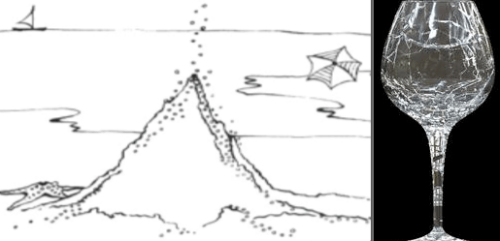
One classic way to illustrate this is by using the analogy of grains of sand falling on a sand pile. Eventually, small and large avalanches begin to occur at different frequencies that follow a power law.
sandpile1

The study of complex systems is often called the study of history. The sand pile becomes increasingly unstable over time as grains of sand cause “fingers of instability” to run through the structure, like fissures running across a wine glass or cracks in the earth as an earthquake unloads the built up tension. If you want to understand the vulnerability of the sand pile of a “Richter 9” earthquake, dissecting the falling grains will give you little insight. In other words, the answer lies in the past, in the evolution of the sand pile.

I make this point to reinforce the fact that the recent shooting and riots in Greece should be understood in context. The incident was  but one of several that befell Mount Olympus. As Katrin Verclas and others have commented (below) in response to this blog post, “the disenchantment of Greek students, the mistrust in and corruption of the right-wing government,”  as well as the “many acts of police brutality and incompetence through the years,” provides the historical context behind the shooting. “This is why people wouldn’t wait for the coronary report. There were many things wrong even before the shooting and the coronary report.”

Networks Analysis: One way to think about the impact of the information revolution on the ability of groups to mobilize and organize is to use the analogy of disease contagion, which also follows a power law distribution. As Clay Shirky writes, “The classic model for the spread of disease looks at three variables—likelihood of infection, likelihood of contact between any two people, and overall size of population. If any of those variables increases, the overall spread of disease increases as well.”

As a consequence of the information revolution, the likelihood of an individual receiving and broadcasting information is increasing significantly while the likelihood of any two people communicating is increasing exponentially; and world population is also growing at a furious pace. Since each of these three variables are increasing, the overall risk of protests increases as well.

The reason I raise this issue of power laws and epidemics of information is to address the issue of rumors. As Andrew Lam writes, “the streamlining of news [via Twitter and SMS] makes the story skeletal and thin, bordering on becoming rumor and hearsay.” Countering false rumors  in a highly connected network may require a systems approach since command-and-control is unlikely to work (short of switching the network off).

This is where the work by Malcom Gladwell, Mark Buchanan and and the Santa Fe Institute’s (SFI) research might shed some light on the viral cure for false rumors in the Twitter Age.
See also my follow up post on the Greek riots.

Patrick Philippe Meier

International News Coverage in a New Media World

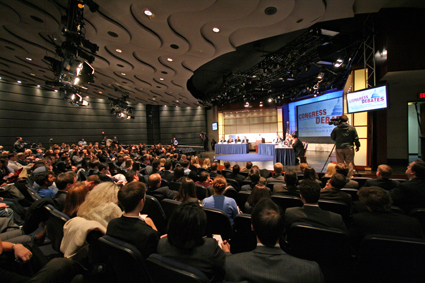
I just had the pleasure of participating in a fascinating panel discussion on the decline of the foreign correspondent and the rise of citizen journalist. The event was hosted by the Institute for Public Diplomacy and Global Communications at George Washington University (GWU) and supported by the Broadcasting Board of Governors (BBG).

Jeffrey Hirschberg from BBG gave the opening remarks and GWU Professor Steve Roberts moderated the panel, which included Loren Jenkins, Senior Foreign Editor at NPR, Professor Sherry Ricchiardi, Senior Writer at the American Journalism Review (AJR) and Professor at Indian University’s School of Journalism, Bob Dietz with the Committee to Protect Journalists (CPJ), and myself.

Where to begin? I was definitely the only one on the panel without a formal background in journalism, possibly the only blogger, probably the only one with a YouTube account and most likely the only panelist on Twitter. Inevitably, then, I brought a slightly different perspective, but more importantly, I had the opportunity to learn a lot from my fellow panelists and to understand their perspective on the decline of foreign reporting. It was a truly rich conversation.

Professional journalists engaged in international news are increasingly concerned about the possibility of misinformation and manipulation that may originate from citizen journalists, e.g., through blogs, Twitter, etc. In my opinion, one of the defining roles of the mainstream media is to distinguish between fact and fiction, which means that they play an even more important role in the digital age. The question of journalist standards was also raised, or the lack thereof. within citizen journalism In my opinion, as international news reporting declines and citizen journalists continue to fill the void, the public will expect and come to demand that the latter meet some of the same standards practiced by mainstream media.

Having had the opportunity to interact with numerous bloggers with Global Voices and beyond, I emphasized the fact that reputation for many bloggers is everything. Her or his readership is a function of the person’s reputation and hence credibility and accountability. Over time, as Lauren mentioned, we come to “get to know” and trust a blogger even if we never meet in person. Journalists investigate stories by interviewing sources, there is no reason to discount citizen journalists as valuable sources.

The challenge of validating sources and information is not a new one. There is a trade off between volume of information and the ability to verify that information. This trade off, or continuum, becomes even more acute in rapidly changing situations like the recent carnage in Mumbai.

What we need to keep in mind, however, is that we each have different demands or needs for validity. If you found yourself in downtown Mumbai during the terrorist attacks, you would rather know about rumors spread via Twitter than not. Why? Because at least you’d be able to take precautionary measures should the rumor prove to be true.

Watching the unfolding tragedy from thousands of miles away in the comfort of our own homes, we have less need for expediency, we just want to know what really happened, the facts. However, our demand for facts and rigorous validation should not overshadow the fact that rumors and unverified reports from unknown sources can save lives.

Steve asked Bob whether his work on the protection of journalists should be expanded to citizen journalists. In his response, Bob preempted an important point I had planned to make; namely that the line between citizen journalism and digital activism is becoming increasingly blurred. In the past, documenting human rights abuses and broadcasting this documentation was rarely done by one individual. Today, thanks to YouTube, documenting events is the same as broadcasting events, which is alot about what advocacy is.

This is why it is increasingly important for citizen journalists in repressive environments to interact with digital activists and individuals engaged in strategic nonviolence. As a a fellow blogger of mine recently remarked about her experience covering the post-election violence in Kenya, there is a distinction between being able to speak out and being heard. In most contexts, the former is far easier than the latter. However, if you start being heard, and a government or regime starts to pay attention to what you are blogging, you become a target. It’s a catch 22. Bloggers need to learn from digital activists and strategic nonviolence movements about how to stay safe and how to make maximum use technology to get their message out.

I drew on several examples to highlight the important contribution that citizen journalists are making around the world, from Global Voices to Witness.org. I also highlighted HHI‘s recent work on crisis mapping Kenya to compare mainstream media reports with citizen journalism reports and crowdsourcing reports (via Ushahidi). In the context of Mumbai, I pointed to the incredible speed with which a Wikipedia page was created and maintained fully up to date, with some 900 edits taking place within the first 21 hours of the event. No mainstream media outfit could possibly mimic this crowdsourcing approach without reaching out to citizen journalists.

On Global Voices, I highlighted the important role they are playing in translating (and analyzing) a lot of local news (and other blogs) into English. With the decline in foreign reporting, mainstream media’s role in translating news will also decline. The amount of volume produced by Global Voices during the Mumbai attacks was trully stunning.

I brought up Witness.org because much of the conversation between panelists focused on print media, and how easy it was to mislead readers. Doctoring pictures, let alone footage, is not as easy. The case of Reuters and the doctored photograph of Israeli rockets firing on Lebanon is an exception and far from the rule. It is a very isolated incident when one considers the massive number of pictures printed every day in the mainstream press. Furthermore, I argued thanks to built-in cameras in mobile phones, dozens of different individuals can each take pictures of an event, which serves as a verification mechanism. We don’t need fewer citizen witnesses armed with cameras, we need more.

Two final points, or rather open ended questions for further discussion. First, if we are moving towards a more hyper-local approach to media reports, and if this happens across the globe, then why the concern? Isn’t someone’s local media another’s foreign media? Second, having counted Noam Chomsky’s Manufacturing Consent: The Political Economy of the Mass Media as one of my all time favorite books, how is the media changing now that the political economy is completely changing?

Patrick Philippe Meier

Links: Revolution 2.0, Mumbai Attacks, Response

  • Revolution 2.0 – Obama’s Web Tools Work for Others Too: If I had blogged about this Newsweek article, I would have been quite critical. First, we all know full well that technology can be used for good or ill. Second, the piece focuses exclusively on the negative effects of the Internet’s potential to empower marginalized groups. Third, as a colleague noted, “The writer thinks of marginalized groups like terrorists.  I think of marginalized groups like 90% of the world’s population.”
  • Mumbai Terrorists used Google Earth: In a first in terror strikes in the country, all the 10 terrorists involved in the Mumbai attack got familiar with the terrain of the city by using the Google Earth service, according to sources in the Maharashtra home ministry.
  • Mobiles and Twitter Play Key Role in Mumbai Reporting: Mobiles are yet again playing a key role in citizen reporting as terror attacks grip the Indian city of Mumbai.  Twitter, the microblogging service that is available in India, was especially instrumental in conveying first hand reports as the chaotic events were unfolding in the city.  Twitter users set up aggregator accounts at Mumbai, Bombay@BreakingNews and with the search tag #Mumbai.
  • Citizen Voices and Mumbai Attacks: When news from the developing world dominates the global news agenda, we get a lot of traffic on Global Voices. As the horrific events unfolded in Mumbai this past week, our authors, editors and tech staff began compiling accounts from blogs, Flickr, YouTube and Twitter feeds. You can get a good overview of the use of social media in reporting the Mumbai crisis on our special coverage page.

Event: International News Coverage in a New Media World

I’ve been invited by the Broadcasting Board of Governors (BBG) and George Washington University’s (GWU) Institute for Public Diplomacy and Global Communications to give a panel presentation on “International News Coverage in a New Media World: The Decline of the Foreign Correspondent and the Rise of the Citizen Journalist.”

gwu

The event will take place on December 10th to commemorate the 60th anniversary of the United Nations Universal Declaration of Human Rights.

Experts will examine the dramatic shift of traditional media away from foreign reporting, the growth of web-based citizen journalists, and their effects on coverage of international news and human rights issues.

I was originally planning to focus the bulk of my presentation on the role of new media in covering Kenya’s post-election violence but given the (still) current carnage in Mumbai and the unprecedented response of citizen journalists in covering the attacks, I’d like to present a comparative analysis of both events. To this end, I welcome any links/tips/suggestions you might have on what you consider to be the most striking (less obvious) issues worth highlighting.

Patrick Philippe Meier

Web 2.0 Tracks Attacks on Mumbai (Updated)

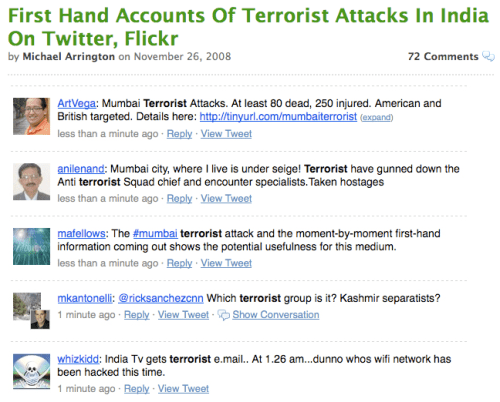
Twitter, Flickr, Wikipedia, YouTube – a few of the Web 2.0 & mobile applications tracking the Mumbai attacks in quasi real time along with the aftermath. Twitter was apparently faster than CNN in reporting the initial events, according to TechCrunch:

picture-61

From TechMacro: “the local authority advised TV channels to stop broadcasting sensitive information which may help terrorists tracking army’s movements. It is much less likely that the terrorists are now using Twitter to find way to escape.”

For live, crowdsourcing updates, see the following links on Twitter, Flickr, Wikipedia. The Wikipedia entry already includes a picture (probably taken with mobile phone) of one of the terrorists.

Wired also writes that “local bloggers at Metblogs Mumbai have new updates every couple of minutes. So do the folks at GroundReport. Dozens of videos have been uploaded to YouTube. But the most remarkable citizen journalism may be coming from “Vinu,” who is posting a stream of harrowing post-attack pictures to Flickr.”

Patrick Philippe Meier

Twitter: Sending Out Voice-to-Text SOS

One of the constraints of using SMS to evade state censorship in developing countries under repressive rule is literacy—or lack thereof. TwitterFone is a new service that converts voice to text and then posts it to Twitter. While Jott and Spinvox already enable voice to text conversion for Twitter and Facebook, TwitterFone is said to be far simpler to use.

According to TechCrunch,

The service launched moments ago into private beta. To use it you need to verify your phone number and Twitter account, and TwitterFone will then give you a local phone number to call to leave messages (they support the U.S., UK and Ireland now, adding more). Then, any message you send will be transcribed, and posted to Twitter along with a link to the recording. If the message is longer than 140 characters, just the first part is transcribed, but the entire recording is still available. There is a time limit of 15 seconds on the recording. The service is partially automated via voice recognition software, and flagged words go to a human for translation.

Patrick Philippe Meier

Twitter Speed to the Rescue

Twitter is a free social networking and micro-blogging service that allows users to send “updates” (or “tweets”; text-based posts, up to 140 characters long) to the Twitter website, via short message service (e.g. on a mobile phone), instant messaging, or a third-party application such as Twitterrific or Facebook.

Twitter was used by the Los Angeles and San Diego Fire Departments as well the Red Cross: “Cell towers and communication lines were being burnt, [so] SMS and websites were the best ways to get info, and Twitter was perfect in that sense because it published directly to SMS” (1). Particularly telling is the following comment by the LA Fire Department: “We can no longer afford to work at the speed of government. We have responsibilities to the public to move the information as quickly as possible… so that they can make key decisions” (2)

So just how fast is Twitter? Earlier that year, “Twitters beat the US Geological Survey by several minutes” when they were first to report the Mexico City earthquake on April 17th (3). The Twitter alerts, or microblogs, are all documented and time stamped on the Twitter website and also available on TwitterVision.

Is it just a matter of time before Twitter or a similar GeoChat interface gets used for conflict early warning and response?

Patrick Philippe Meier