Category Archives: Crisis Mapping

Top 10 Posts of 2010

Here are the Top 10 iRevolution Posts of 2010!

1. The Future of News: Mobilizing the Masses to Write First Draft of History

2. How to Run a Successful Crowdsourcing Project

3. The Starfish and the Spider: 8 Principles of Decentralization

4. Haiti and the Power of Crowdsourcing

5. The Digital Disruption: Connectivity and the Diffusion of Power

6. The Unprecedented Role of SMS in Disaster Response

7. How Crowdsourced Data Can Predict Crisis Impact

8. My Thoughts on Gladwell’s Piece in The New Yorker

9. WikiLeaks of Mass Disruption: Get Ready for the Clone Wars

10. Maptivism: Live Tactical Mapping for Protest Swarming

Happy Holidays!

Maptivism: Live Tactical Mapping for Protest Swarming

My colleague Adeel Khamisa from GeoTime kindly shared this news story on how student protesters created a live tactical map to outwit police in London during yesterday’s demonstrations.

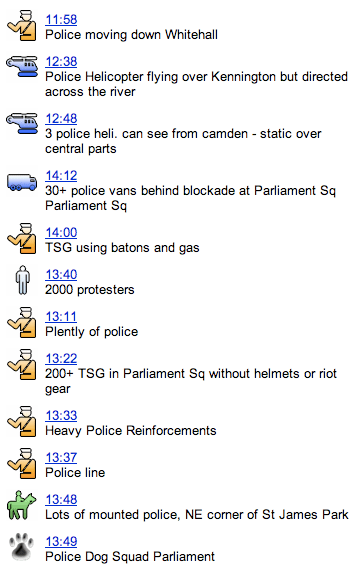
Check out these real time updates:

The students also caught the following picture:

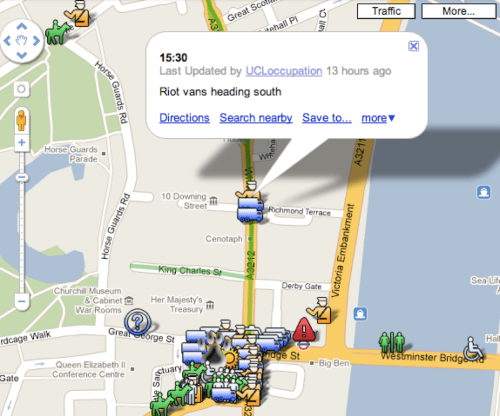
The map depicts the tactics employed by the students:

The limits of using Google Maps

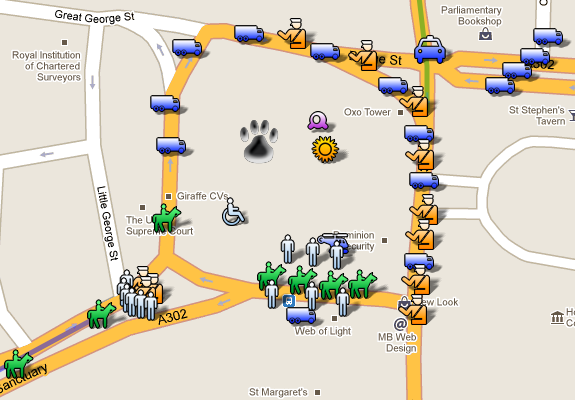
As I looked closer at the map, it occurred to me how much this resembles a computer game with moving characters. The strategy employed by the police can be discerned by the pattern below.

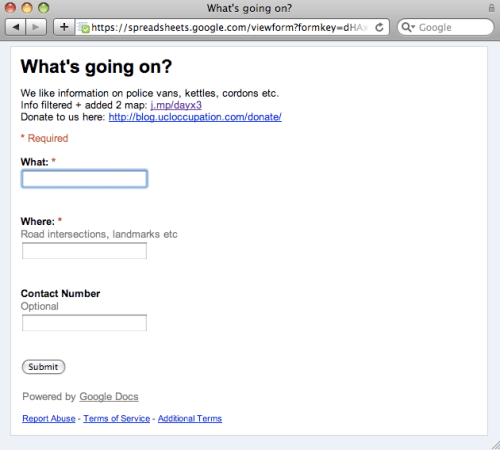
But I doubt that students were able to update their Google map in real-time directly from their mobile phones, let alone via SMS, Twitter, Smartphone App, camera phone or Facebook. Nor can they subscribe to alerts and receive them directly via an automated email or SMS. Indeed, it appears they were using Google Forms to “crowdsource” information and this Twitter account to disseminate important updates.

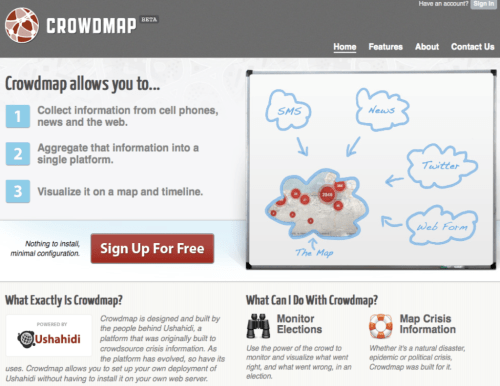
This is why I got in touch with the group and recommended that they think of using Crowdmap (free and open source):

Or GroundCrew (partially free, not open source):

See the following links for more info on Maptivism:

Technologies and Practice for the Prevention of Mass Atrocity Crimes

I’ve waited years for a conference like this: “Early Warning for Protection: Technologies and Practice for the Prevention of Mass Atrocity Crimes.”

This high-level conference combines my main areas of interest: conflict early warning, crisis mapping, civilian protection and technology. I’ll be giving a keynote presentation on “The Potential of New Technologies in Conflict Early Warning” at this conference next week, and I’m particularly looking forward to the panel that will follow, co-organized with my colleague Phoebe Wynn-Pope.

The conference will explore a number of issues.

  • What is the role of new technologies in conflict early warning and how do they interact with more traditional monitoring systems?
  • How can we harness, coordinate, and utilize the sometimes overwhelming amount of information available?
  • What systems and mechanisms need to be put in place to ensure effective early-warning is given?
  • How does the humanitarian sector work effectively with communities at risk once early-warning has been sounded?
  • How can a change in attitude and behavior at a policy level be brought about in a way that forestalls a descent to violence?

In preparing for the presentation, I started re-reading some papers I had written several years ago including this one from 2008: “Bridging Multiple Divides in Early Warning and Response: Upgrading the Role of Information and Communication Technology” (PDF). I will base my presentation in part on this paper and welcome any feedback readers may have. If you don’t have time to read a 25-page paper, here’s a short summary in bullet point format:

  • The field of conflict early warning has largely been monopolized by academics who are obsessed with forecasting conflict.
  • Operational conflict early warning systems are little more than glorified databases.
  • The conflict early warning community’s track-record in successfully predicting (let alone preventing) armed conflict is beyond dismal.
  • State-centric and external approaches to conflict early warning and rapid response have almost systematically failed.
  • The disaster early warning community have long advocated for a people-centered approach to early warning given the failures of top-down, institutional methods.
  • The disaster early warning community has been an early adopter of new technologies, particularly those engaged in public health.
  • The purpose of a people-centered approach is to empower individuals so they can mitigate the impact of a disaster on their livelihoods and/or to get out of harm’s way.
  • Preparedness and contingency planning are core to a people-centered approach since natural hazards like earthquakes can’t be easily predicted let alone stopped.
  • Given the dismal failure of conflict early warning systems, the conflict prevention community should make conflict preparedness and contingency planning a top priority.
  • Precedents for a people-centered approach to conflict early warning  exists in the fields of strategic nonviolent action and digital activism.
  • More importantly, communities that experienced conflict have developed sophisticated coping strategies to evade and survive.
  • Some of these communities already use technologies to survive.

I will expand on these points with several real-world examples and, more importantly, will combine these with what I have learned over the past two years, specifically in terms of crisis mapping, new technologies and civilian resistance. I’m excited to put all of my thoughts together for this conference, and I especially look forward to feedback from readers and conversing with participants.


Crowdsourcing the Angry Skies: The SKYWARN Volunteer Network

SKYWARN is a volunteer network of 290,000 trained storm spotters who provide localized weather reports to the US National Weather Service (NWS).  The concept was developed in the late 1960s and comprises a network volunteers who report “wind gusts, hail size and cloud formations that could signal a developing tornado” where they live.

According to Weather.gov, “the information provided by SKYWARN spotters, coupled with Doppler radar technology, improved satellite and other data, has enabled NWS to issue more timely and accurate warnings for tornadoes, severe thunderstorms and flash floods.”

This illustrates how crowdsourcing can be combined with “techsourcing” to provide better results.

Who Are SKYWARN volunteers?

Volunteers include police and fire personnel, dispatchers, EMS workers, public utility workers and other concerned private citizens. Individuals affiliated with hospitals, schools, churches, nursing homes or who have a responsibility for protecting others are also encouraged to become a spotter. NWS encourages anyone with an interest in public service and access to communication to join the SKYWARN program. (1)

Why Join SKYWARN?

There can be no finer reward than to know that their efforts have given communities the precious gift of time–seconds and minutes that can help save lives. (2)

How Are Volunteers Trained?

NWS has 122 local Weather Forecast Offices, each with a Warning Coordination Meteorologist, who is responsible for administering the SKYWARN program in their local area. Training is conducted at these local offices and covers:

  • Basics of thunderstorm development
  • Fundamentals of storm structure
  • Identifying potential severe weather features
  • Information to report
  • How to report information
  • Basic severe weather safety

Classes are free and typically two hours long. To find out when a SKYWARN class will be conducted in local your area, contact your local Warning Coordination Meteorologist. (3)

What else?

In some areas where Emergency Management programs do not provide storm weather reports, people have organized SKYWARN groups that work independent of a parent government agency and feed valuable information to NWS. While this provides the radar meteorologist with much needed input, the circuit is not complete if the information does not reach those who can activate sirens or local broadcast systems.  To this end, SKYWARN also distributes information from the National Weather Service. (4)

So What?

There has been much talk about the potential role of “Volunteer Technical Communities” in the context of disaster response. VTCs, as they are now called, came to the fore in the wake of the Haiti earthquake when their crisis mapping efforts helped the US Marine Corps and US Coast Guard save lives. VTC is the new buzzword, but technology-able volunteer communities have been around for decades. SKYWARN has been active for almost half-a-century.

As my colleagues and I continue to operationalize the Standby Volunteer Task Force (see this blog post and recent article on CNN), it behooves us to learn as much as possible from others who have set up volunteer networks in the past and in other sectors. The SKYWARN example shows how volunteer networks can interface with formal organizations in an effective manner.

The Spotter Network is a newer and less formal volunteer community that is not sanctioned or affiliated with the NWS or any other government agency. Nevertheless, “several National Weather Service employees and other officials have taken an interest in the capabilities [that this network] brings to them to integrate ground truth provided by spotters into their operational responsibilities. All at zero cost to them.”

The National Weather Service has responded positively to increasing public participation by launching the eSpotter, a system “developed to enhance and increase timely & accurate online spotter reporting and communications between spotters and their local weather forecast offices. The use of the system is currently available for trained spotters and emergency managers.”

Conclusion & Recommendations

  • Volunteer groups and government organizations can work together.
  • Volunteers networks include professionals as well as amateurs.
  • Training is an integral component of volunteer technical networks.
  • Government participation is key to leveraging volunteer groups.
  • Government can provide the infrastructure for collaboration.
  • Government reps should sit on the board of volunteer networks.
  • Generating unique data sets will get government attention. Fancy technology, bravado and media coverage won’t.

Analyzing Call Dynamics to Assess the Impact of Earthquakes

Earthquakes can cripple communication infrastructure and influence the number of voice calls relayed through cell phone towers. Data from cell phone traffic can thus be used as a proxy to infer the epicenter of an earthquake and possibly the needs of the disaster affected population. In this blog post, I summarize the findings from a recent study carried out by Microsoft Research and the Santa Fe Institute (SFI).

The study assesses the impact of the 5.9 magnitude earthquake near Lac Kivu in February 2008 on Rwandan call data to explore the possibility of inferring the epicenter and potential needs of affected communities. Cellular networks continually generate “Call Data Records (CDR) for billing and maintenance purposes” which can be used can be used to make inferences following a disaster. Since the geographic spread of cell phones and towers is not randomly distributed, the authors used methods to capture propagating uncertainties about their inferences from the data. This is important to prioritize the collection of new data.

The study is based on the following 3 assumptions:

1. Cell tower traffic deviates statistically from the normal patterns and trends in case of an unusual event.
2. Areas that suffer larger disruptions experience deviations in call volume that persist for a longer period of time.
3. Disruptions are overall inversely proportional to the distance from the center(s) of a catastrophe.

Based on these assumptions, the authors develop algorithms to detect earthquakes, predict their epicenter and infer opportunities for assistance. The results? Using call data to detect when in February 2008 the earthquake took place yields a highly accurate result. The same is true for predicting the epicenter. This means that call activity and cell phone towers can be used as a large-scale seismic system.

As for inferring hardest hit areas, the authors find that their “predicted model is far superior to the baseline and provides predictions that are significantly better for k = 3, 4 and 5″ where k represents the number of days post-earthquake. In sum, “the results highlight the promise of performing predictive analysis with existing telecommunications infrastructure.” The study is available on the Artificial Intelligence for Development (AI-D) website.

In the future, combining call traffic data with crowdsourced SMS data (see this study on Haiti text messages) could perhaps provide even more detailed information on near real-time impact and needs following a disaster. I’d be very interested to see this kind of study done on call/SMS data before, during and after a contested election or major armed conflict. Could patterns in call/SMS data in one country provide distinct early warning signatures for elections and conflict in other crises?

How Crowdsourced Data Can Predict Crisis Impact: Findings from Empirical Study on Haiti

One of the inherent concerns about crowdsourced crisis information is that the data is not statistically representative and hence “useless” for any serious kind of statistical analysis. But my colleague Christina Corbane and her team at the European Commission’s Joint Research Center (JRC) have come up with some interesting findings that prove otherwise. They used the reports mapped on the Ushahidi-Haiti platform to show that this crowdsourced  data can help predict the spatial distribution of structural damage in Port-au-Prince. The results were presented at this year’s Crisis Mapping Conference (ICCM 2010).

The data on structural damage was obtained using very high resolution aerial imagery. Some 600 experts from 23 different countries joined the World Bank-UNOSAT-JRC team to assess the damage based on this imagery. This massive effort took two months to complete. In contrast, the crowdsourced reports on Ushahidi-Haiti were mapped in near-real time and could “hence  represent an invaluable early indicator on the distribution and on the intensity of building damage.”

Corbane and her co-authors “focused on the area of Port-au-Prince (approximately 9 by 9 km) where a total of 1,645 messages have been reported and 161,281 individual buildings have been identified, each classified into one of the 5 different damage grades.” Since the focus of the study is the relationship between crowdsourced reports and the intensity of structural damage, only grades 4 and 5 (structures beyond repair) were taken into account. The result is a bivariate point pattern consisting of two variables: 1,645 crowdsourced reports and 33,800 damaged buildings (grades 4 and 5 combined).

The above graphic simply serves as an illustrative example of the possible relationships between simulated distributions of SMS and damaged buildings. The two figures below represent the actual spatial distribution of crowdsourced reports and damaged buildings according to the data. The figures show that both crowdsourced data and damage patterns are clustered even though the latter is more pronounced. This suggests that some kind of correlation exists between the two distributions.

Corbane and colleagues therefore used spatial point pattern process statistics to better understand and characterize the spatial structures of crowdsourced reports and building damage patterns. They used the Ripley’s K-function which is often considered “the most suitable and functional characteristic for analyzing point processes.” The results clearly demonstrate the existence of statistically significant correlation between the spatial patterns of crowdsourced data and building damages at “distances ranging between 1 and 3 to 4 km.”

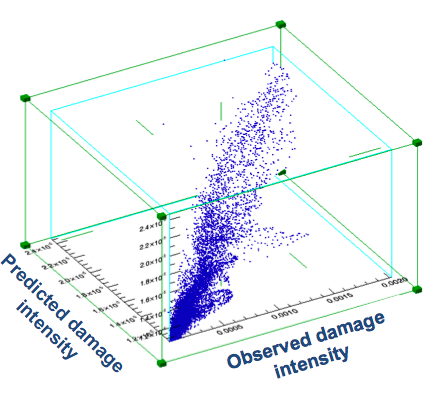
The co-authors then used the marked Gibbs point process model to “derive the conditional intensity of building damage based on the pairwise interactions between SMS [crowdsourced reports] and building damages.” The resulting model was then used to compute the predicted damage intensity values, which is depicted below with the observed damage intensity.

The figures clearly show that the similarity between the patterns exhibited by the predictive model and the actual damage pattern is particularly strong. This visual inspection is confirmed by the computed correlation between the observed and predicted damage patterns shown below.

In sum, the results of this empirical study demonstrates the existence of a spatial dependence between crowdsourced data and damaged buildings. The results of the analysis also show how statistical interactions between the patterns of crowdsourced data and building damage can be used for modeling the intensity of structural damage to buildings.

These findings are rather stunning. Data collected using unbounded crowdsourcing (non-representative sampling) largely in the form of SMS from the disaster affected population in Port-au-Prince can predict, with surprisingly high accuracy and statistical significance, the location and extent of structural damage post-earthquake.

The World Bank-UNOSAT-JRC damage assessment took 600 experts 66 days to complete. The cost probably figured in the hundreds of millions of dollars. In contrast, Mission 4636 and Ushahidi-Haiti were both ad-hoc, volunteer-based projects and virtually all the crowdsourced reports used in the study were collected within 14 days of the earthquake (most within 10 days).

But what does this say about the quality/reliability of crowdsourced data? The authors don’t make this connection but I find the implications particularly interesting since the actual content of the 1,645 crowdsourced reports were not factored into the analysis, simply the GPS coordinates, i.e., the meta-data.

New Dataset Represents Breakthrough for Crisis Mapping Analysis

The Peace Research Institute in Oslo (PRIO) has just released the latest version of the Armed Conflict Location and Event Dataset (ACLED), which I blogged about last year here. The new peer-reviewed paper on this latest release is available here and you can watch ACLED’s presentation at the 2009 International Conference on Crisis Mapping (ICCM 2009) right here. The unit of analysis for ACLED is “an individual event that occurred at a given location.”

This new version has geo-referenced data for 50 unstable countries from 1997 through to 2010. The real breakthrough here is not just the scope of geographical coverage but more importantly how incredibly up to date the data is. I’m excited about this because it is rare that academic datasets can actually inform policy or operational response in a timely way. Academic datasets are generally outdated.

PRIO’s updated dataset codes the “actions of rebels, governments, and militias within unstable states, specifying the exact location and date of battle events, transfers of military control, headquarter establishment, civilian violence, and rioting.” As the authors note, the dataset’s “disaggregation of civil war and transnational violent events allow for research on local level factors and the dynamics of civil and communal conflict.”

Indeed, “micro-level datasets allow researchers to rigorously test sub-national hypotheses and to generate new causal arguments that cannot be studied with country-year or static conflict-zone data.” The authors identify four distinctive advantages of disaggregating local conflict event-data:

  1. Data can be aggregated to any desired level for analysis;
  2. The types of conflict events (e.g. battles or civilian violence) can be analyzed separately or in tandem;
  3. The actors within a conflict can be grouped or analyzed separately;
  4. The dynamics of national or regional war clusters can be addressed together.

The academic paper that discusses this new release of ACLED doesn’t go into much geospatial analysis but the dataset will no doubt catalyze many  analytical studies in the near future. One preliminary finding, however, shows that using country-level data can lead to biased results when studying conflict dynamics. “The average percentage of area covered by civil war from the data sample is approximately 48%, but the average amount of territory with repeated fighting is considerably smaller at 15%. Further, most conflicts initially start out as very local phenomena.”

The Best Part of ICCM 2010, Not.

I facilitated a self-organized session on launching a Standby Crisis Mappers Task Force  at the Annual Meeting of Crisis Mappers. I blogged about this idea before the International Conference on Crisis Mapping (ICCM 2010). Talk about a mistake and a missed opportunity.

I had clearly mentioned in my blog post and in my opening remarks that I was going to experiment with a model to set up a more formal volunteer network using the Ushahidi platform because that’s the tool I know best and because the bulk of this network already exists; because that’s what I can guarantee and take responsibility for getting  done—and not just talk about endlessly saying  wouldn’t it be nice if… At no point did I suggest that the other technology groups could not do the same. On the contrary, I invited them to step up to the plate and do the same, to take responsibility; take ownership.

The reaction from our humanitarian colleagues was largely positive with some important constructive advice. Not so with one of the technology groups present. The response from this group was that we couldn’t be the first to focus on preparedness more actively because of perception issues, i.e., that the Standby Force would be synonymous with Ushahidi and thence favored by UN colleagues who would adopt the platform instead of the other technology platforms.

My response? I immediately apologized for my faux-pas and promptly proposed not to call this initiative the Crisis Mappers Task Force. I vouched to be more explicit that the standby volunteer group I’m personally working to set up with a few colleagues would first and foremost be a network trained on the Ushahidi platform and surrounding ecosystem, e.g., OpenStreetMap, Google Earth, etc.  because that’s what we’re good at. And as one of my colleagues who has trained more volunteer Crisis Mappers than anyone else said, “When I’m training volunteers it is never only on the Ushahidi platform, we have to use several other important platforms to make all this work.”

After this comment, I once again invited this other tech group (and everyone else present) to strengthen our initiative by setting up a joint standby network in collaboration with ours. I clearly said we would happily share our lessons learned on the volunteer model we are testing. No one has a monopoly on preparedness!

But that wasn’t good enough for this tech group. They also said we couldn’t go ahead and recruit, formalize and train a volunteer network on the Ushahidi platform because they would miss out on consulting opportunities and funding. Note: at no point did I ever suggest that this volunteer network would request funding or that we have a monopoly over the volunteer network we are recruiting. Again, the point was/is to use Ushahidi to experiment and test a standby model for volunteer engagement. Indeed, any other tech group is more than welcome to train the volunteers we’re recruiting on their own platforms.  Indeed, if someone else had proposed a Standby Volunteer Network dedicated to crisis mapping before me, I would have joined theirs immediately and offered to train their network tomorrow.

But did this technology group step up to the plate and offer to train the volunteers we’re recruiting? No. Were they pro-active and did they take the opportunity to join and strengthen the initiative? No. Did they make any commitment whatsoever? No, they just did not want us to move forward and implement a core principle of disaster response: preparedness. I have little patience with this kind of positioning and jockeying. Needless to say, I don’t think our humanitarian colleagues were particularly impressed either.

So where does this leave us? Where we started: my colleagues are pressing forward to formalize a standby volunteer network around the Ushahidi platform, which again does not prevent other groups from doing the same and/or joining the initiative. This network of Ushahidi users largely exists already, we’re simply formalizing it so we can be better prepared. We absolutely want the volunteers we recruit to be conversant with the rich ecosystem of different humanitarian technologies that are of interest to them.

I don’t know how much more clear of a signal I can possibly send: please join us and help us strengthen this network.

If this particular tech group I’m referring to doesn’t step up to the plate and instead chooses to criticize others who take initiative, then they ought to know that the real perception issue here is this: humanitarian colleagues  and others  who were present at the session will perceive this particular tech group as being insincere about disaster preparedness.

The UN’s Global Survey of Early Warning Systems commissioned by the former UN Secretary General and carried about by the UN International Strategy for Disaster Reduction (UNISDR) defines the purpose of people-centered early warning systems as follows:

To empower individuals and communities threatened by hazards to act in sufficient time and in an appropriate manner so as to reduce the possibility of personal injury, loss of life, damage to property and the environment, and loss of livelihoods.

I was at the Third International Conference on Early Warning (EWC3) in 2006 where this report was first presented publicly. The key to effective people-centered early warning systems is preparedness. We want to empower an online community to use a wide mix of Crisis Mapping tools to act in sufficient time and in an appropriate manner (with guidance from the humanitarian community) to reduce the possibility of personal injury, loss of life, damage to property and the environment and loss of livelihoods for those threatened by hazards.

If I could train volunteers on 5 different platforms, I would. But I can’t because I’m not an expert on the other platforms and I already have a full time job (and then some). That’s why I took the initiative to organize the pre-conference Crisis Mapping Training Session at ICCM 2010. If we had had more space, time and timely funding, I would have organized an all day training on a dozen platforms and would happily do so on a regular basis. So I’m trying to play my role in this but I will absolutely not take responsibility for others who don’t step up and act  but instead complain because my colleagues and I are choosing to act.

No one has a monopoly on preparedness.

My Introductory Remarks at ICCM 2010

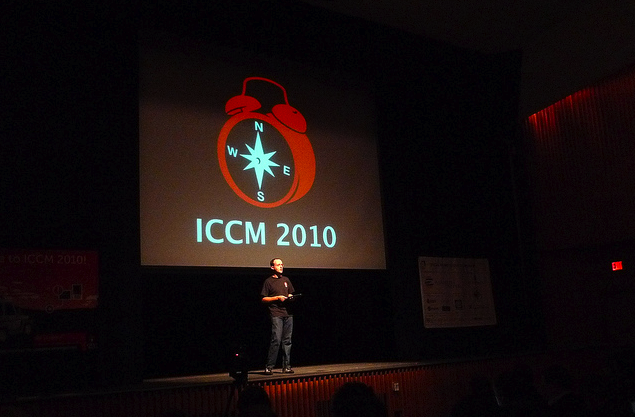
Below is the “speech” I gave to open the 2010 International Conference on Crisis Mapping (ICCM 2010) in Boston on October 1, 2010.

____________________________________

Welcome the 2010 International Conference on Crisis Mapping! This is truly a remarkable turnout, thank you for making the time to join us today. We had expected some 200 participants to show up, but we got double. If you’re new to the Crisis Mappers Network, welcome to the team! It’s really great to have you and we very much look forward to your contributions. If you were with us for last year’s conference, it’s wonderful to have you back after what has certainly been a defining year for Crisis Mapping.

Indeed, the Crisis Mappers Network has grown substantially since we last met. We now have close to 1,000 members in over 30 countries. There are more than 100 organizations represented in this auditorium today. The Crisis Mappers website itself has been accessed from no fewer than 104 countries. The purpose of this international network is to catalyze communication, collaboration and partnerships between members. Our mission is to advance the study and practice of Crisis Mapping worldwide. We do this by organizing the annual International Conference on Crisis Mapping, which brings together high level policymakers, seasoned humanitarian and human rights practitioners, the technology community including both private sector and nonprofit groups, and the academic, research community.

We also pursue our mission by providing our members with an active social networking platform, CrisisMappers.net, where they can blog, engage in discussion forums, watch a unique set of video presentations on crisis mapping projects and contribute to regular webinars. In addition, the Crisis Mappers Network provides an active list-serve for members to communicate and collaborate, especially during crises.

Indeed, this list-serve, the Crisis Mappers Google Group, played a pivotal role in the hours, days and weeks following the earthquake in Haiti. Members of the Network exchanged thousands of emails on this list-serve, sharing critical information ranging from satellite imagery and GIS data to contact lists for key organizations and personnel, important logistics data, locations of IDP camps, and so on. I highly recommend reading this study conducted by my colleague Jen Ziemke which provides hundreds upon hundreds of detailed examples on exactly how members of this network collaborated in the response.

The disaster response to Haiti was indeed unprecedented in a number of ways. One was the number of technology platforms deployed (many from scratch) in the wake of the disaster. Another distinctive element was the volunteer network that sprung into action on a range of projects in collaboration with members of the Crisis Mappers Network. In fact, hundreds of students from this University, The Fletcher School plus undergraduate students, were actively involved in the response. And many of them are here with us in this auditorium today.

In addition, we know that some 2,000 volunteers in about 40 countries were also engaged in the Crisis Mapping efforts, many of them from the Haitian Diaspora. None of these volunteers were ever physically in Haiti but they were still an important part of the operational response thanks to the open collaborative networks they created and the free, open source mapping technologies they used.

The unprecedented nature of this response represents an important opportunity.  At the same time, because many aspects of the response to Haiti were unprecedented, this also means they were necessarily reactive, ad hoc and unprepared. Yet the response nevertheless demonstrated a clear potential. It is now up to the members of this network to grab the opportunity that exists and turn this potential into actuality. The political will is there on all sides to collaborate and learn from each other. The technology community is becoming a more important actor in both the humanitarian and human rights space. The volunteer networks are not new per se but the collaboration between dedicated volunteers and the technology community has certainly created a number of new opportunities for disaster response and beyond.

So the question now is, how do we take these informal, distributed and ad hoc networks and allow them to interface effectively and in a timely way with structured humanitarian organizations? Some colleagues and I believe that one way to do so is by setting up a Standby Crisis Mappers Task Force composed of skilled and experienced volunteers and humanitarian professionals who have been engaged in previous Crisis Mapping operations. We hope that other professional volunteer communities like some friends at CrisisCommons who are interested in mapping will help us to strengthen this initiative.

Now, it is important to remember that Haiti was and remains an outlier. We were indeed very lucky in that information security and government oversight played a limited role. It truly was an open effort. Contrast this to the challenges of crisis mapping in places like Pakistan, Afghanistan, Burma, Liberia or the Sudan. It is these challenges that we must also address at this International Conference on Crisis Mapping. So as we plan for the future, we can and should be inspired by Haiti but we must be careful not to use the response to Haiti as the only model for crisis mapping. Indeed, the title of this year’s conference is Haiti and Beyond.

And this is why senior representatives of many important humanitarian organizations are here today because they want to engage the new opportunities that do exist and they understand the challenges that necessarily come with exploring new territory. Key members of the technology community are also here because they too want to engage and learn how to become more effective and reliable partners in the humanitarian space. Seasoned humanitarian and human rights practitioners are also in the auditorium, and many of them participated in yesterday’s Crisis Mapping Training Session because they recognize the value of expanding their own skill set to leverage the new technologies that are coming online.

Some of the key volunteers from the responses to Haiti, Chile and Pakistan are also here because they are committed to formalizing and professionalizing their role in this more multipolar system. And guess what? A number of these volunteers were already planning to pursue a career in the humanitarian space before Haiti. And others, who weren’t planning to beforehand, are now inspired to pursue a career path in this sector. So these volunteer networks are looking to the humanitarian community for mentorship and guidance.

Finally, the research community and media are both here today as well because they are looking for ways to bring this innovation and inspiration back into the classroom and to a broader audience.

So I think you’ll agree with me when I say that we have many of the right people here in the room today to catalyze the new collaboration and partnerships that will enable all of us to be more adaptive and effective actors in the humanitarian space. Indeed, the opportunity is well within our grasp.

And this opportunity would clearly not be possible were it not for every single one of you choosing to be present here in this auditorium right now. So thank you once again for your time and for joining us. You are the conference. And this opportunity would certainly not be possible without the tremendous sponsorship support that the Crisis Mappers Network has received for this annual Conference on Crisis Mapping. Let me then take this opportunity to thank our following friends: Humanity United, the Knight Foundation, the Open Society Institute, the US Institute of Peace, ESRI, Google, the Hitachi Center at the Fletcher School, Ushahidi, the World Bank, the Human Security Institute at the Fletcher School, the Institute for Global Leadership at Tufts University, the GIS Center at Tufts University and last but not least, GeoTime. So if you see any of our friends during the breaks today, please do take a moment to thank them in person.

Like last year, the co-organizing institutions for the Crisis Mapping Conference are the Harvard Humanitarian Initiative (HHI) and John Carrol University. Many, many thanks indeed to both. I would also like to thank Jen Ziemke, my fellow co-organizer for the conference. This conference series would not exist had Jen not actually suggested the idea 3 years ago. So Jen, thank you very much for a brilliant idea! Finally, I want to express my huge gratitude to all our phenomenal volunteers who have once again gone above and beyond to save the day. You all know who you are, thank you very very much.

And now on with the show! We have a very interesting series of presentations lined up for you this morning and afternoon. We’ll kick off shortly with the first session of Ignite Talks. These talks are 5 minutes a piece with 20 powerpoint slides that automatically forward every 15 seconds. And there’s no stopping! This should definitely be very entertaining or a complete mess. The first session will focus primarily on Haiti and then shift to broader issues. The second session of Ignite Talks, which are scheduled for this afternoon, will look at the opportunities and challenges of crisis mapping beyond Haiti.

In between these Ignite sessions, we will have plenty of breaks for you to network with each other and engage the speakers in person.

We will also have some special remarks from UN Assistant Secretary General Dr. Choi who is the first Chief Information Technology Officer for the United Nations Secretariat. Our Keynote speaker this year is Mr. Kurt Jean-Charles, the CEO of Solutions, a Haitian software company that was directly involved in the disaster response following the earthquake. My colleague Jen Ziemke will introduce both of our distinguished guests more formally before their presentations.

Finally, we have an exciting display of projects and technologies for you at this year’s Technology and Analysis Fair which will kick off this afternoon following the second session of Ignite Talks. This will be a great opportunity for us to learn more about new crisis mapping technologies and projects.

If you plan to Tweet and/or blog about the presentations today, please do and please use the hashtag “ICCM10” And feel free to use the CrisisMappers.net website to publish or cross post your blog posts, to chat live about the presentations, and so on.

Thanks very much for listening.

Standby Crisis Mappers Task Force: Apply Now!

Please click here to apply to the Crisis Mappers Volunteer Task Force.

_______________________________________________________

The disaster response to Haiti was unprecedented in terms of volunteer buy-in and contribution. It was also reactive. The hundreds of volunteers who rallied to the cause were certainly able and committed but one of the main challenges during the first few weeks was the need to train and maintain this informal network. The humanitarian community openly recognizes the important role that volunteer networks can play in crisis response. What they need now are guarantees that a trained and professionalized volunteer force can be on standby and activated within hours. The good news? Many of the volunteers I interacted with during the response to Haiti, Chile and now Pakistan are eager to join a professionalized volunteer standby team.

So what exactly are we waiting for? I posed this question to my colleagues George Chamales and Rob Munro in San Francisco yesterday. Indeed, there’s no reason to wait. We can get started now so we can take this initiative to the upcoming International Conference on Crisis Mapping (ICCM 2010) and get feedback from participants. The challenge, as mentioned in my previous blog post on Disaster Relief 2.0, is to find a way to interface an informal distributed network of volunteers with a highly organized and structured organization like UN OCHA. Three types of reliable networks are needed for this interface: (1) Tech Team; (2) Task Team; and (3) Crowd Force Team.

On the technical side, what colleagues and I have found to be particularly important is to have a group of software developers who are already highly experienced in deploying platforms like Ushahidi, FrontlineSMS, Sahana, etc. This is not about building new tools from scratch. The point here is to rapidly customize existing tools that have already seen action. On the Ushahidi side, there are more and more seasoned Ushahidi developers. These individuals are the ones who made the deployments in Haiti, Chile and Pakistan possible. This network of core technical and reliable volunteers doesn’t need to be large and it already exists.

What this group needs, however, is a support team that can take specific technical tasks given to them for implementation, e.g., fixing an important bug, etc. That way, the core team can focus on rapidly developing customized Ushahidi plugin’s and so on. We need to create a roster of standby software dev’s who are already qualified and ready to support the core team. This group largely exists already, but we need to formalize, professionalize and publicize this information on a dedicated site and turn them into a standby force.

The second type of standby group needed is the Task Team. These are individuals who are not software developers but savvy in media monitoring, geo-referencing, mapping, blogging on updates, etc. These individuals already exist, they played an invaluable role in contributing their time and skills to the responses in Haiti, Chile and Pakistan. Again, it’s just a matter of formalizing, professionalizing and publicizing the information, i.e., to render visible the capacity and assets that already exists, and to have them on standby.

This core task-based team also needs a strong support team for back-up, especially during the first few days of an emergency. This is where the Crowd Force Team comes in. This important team doesn’t need prior-training; only Internet access, browsing experience, an interest in online maps, news, etc. Perhaps most importantly, members of the Crowd Force Team are known for their energy, commitment, team-player attitude and can-do mentality.

We want to formalize this Standby Crisis Mappers Task Force in a professional manner. This means that individuals who want to be part of Tech, Task or Crowd Force Team need to apply. We will first focus on the Ushahidi platform. In the case of the Tech and Task team, interested applicants need to clearly demonstrate that they have the experience necessary to be part of the Standby Task Force. I would actually want to include representatives from the humanitarian community to participate in vetting the candidates who apply. Individuals who want to join the Crowd Force Team will also need to apply so we can keep a roster of the people power available along with their skill set.

There’s no reason we can’t do this. If we learned anything from Haiti, it’s that Community Emergency Response Teams (CERTs) don’t need to be physically present to contribute to disaster response thanks to online social networking tools and open source platforms like Ushahidi, etc. They can be part of the online community. We need CERTs 2.0 and just like traditional response teams, they should be trained and ready.

My experienced colleagues George Chamales and Anahi Ayala will lead the Technical and Task Teams respectively. Anahi will also coordinate the Crowd Force Team. They will help select the applicants, set up the appropriate communication channels and keep a calendar of which members of their teams are available for rapid response on a daily basis. Jaroslav Valuch and I will support George and Anahi in their efforts.

Please click here to apply to the Crisis Mappers Volunteer Task Force. Once we have developed a robust model for interfacing with the humanitarian community using the Ushahidi platform, we hope to work with other colleagues from FrontlineSMS, Sahana, etc., so that their qualified volunteers can be part of this dedicated Task Force.