Category Archives: Early Warning

Will Using ‘Live’ Satellite Imagery to Prevent War in the Sudan Actually Work?

Update: Heglig Crisis 2012, Border Clashes 2012, Invasion of Abyei 2012

The Satellite Sentinel Project has hired private satellites to monitor troop movements around the oil-rich region of Abyei during the upcoming Sudanese referendum and prevent war. The images and analysis will be made public on the Project’s website. George Clooney, who catalyzed this joint initiative between Google, UNOSAT, the Enough Project, Trellon and my colleagues at the Harvard Humanitarian Initiative (HHI), calls this the anti-genocide paparazzi:

“We want them to enjoy the level of celebrity attention that I usually get. If you know your actions are going to be covered, you tend to behave much differently than when you operate in a vacuum.”

The group hopes that they can deter war crimes by observing troop buildups and troop movements in advance. If successful, the project would accomplish an idea first proposed more than half-a-century ago  by US President Dwight Eisenhower during a US-Soviet Summit in Paris at the height of the Cold War. Eisenhower announced his plan to “submit to the United Nations a proposal for the creation of a United Nations aerial surveillance to detect preparations for attack.” Interestingly, Eisenhower had crafted this idea five years earlier as part of his Open Skies Proposal, which actually became a treaty in 2002:

“The Treaty establishes a regime of unarmed aerial observation flights over the entire territory of its participants. The Treaty is designed to enhance mutual understanding and confidence by giving all participants, regardless of size, a direct role in gathering information about military forces and activities of concern to them. Open Skies is one of the most wide-ranging international efforts to date to promote openness and transparency of military forces and activities.”

If you want to find out more about Eisenhower’s efforts, please see my blog post on the subject here.

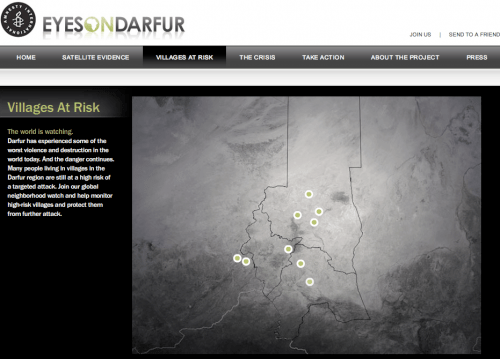
So there is some precedence for what Clooney is trying to pull off. But how is the Sentinel project likely to fare as a non-state effort? Looking at other non-state actors who have already operationalized Eisenhower’s ideas may provide some insights. Take Amnesty International’s “Eyes on Darfur” initiative, which “leverages the power of high- resolution satellite imagery to provide unim- peachable evidence of the atrocities being committed in Darfur–enabling action by private citizens, policy makers and international courts.”

According to Amnesty, the project “broke new ground in protecting human rights by allowing people around the world to literally ‘watch over’ and protect twelve intact, but highly vulnerable, villages using commercially available satellite imagery.” The imagery also enabled Amnesty to capture the movement of Janjaweed forces. Amnesty claims that their project has had a deterrence effect. Apparently, the villages monitored by the project have not been attacked while neighboring ones have. That said, at least two of the monitored villages were removed from the site after reported attacks.

Still Amnesty argues that there have been notable changes in decisions made by the Bashir government since “Eyes on Darfur” went live. They also note that the government of Chad cited their as one of the reasons they accepted UN peacekeepers along their border.

In my blog post on Eisenhower’s UN surveillance speech I asked whether the UN would ever be allowed to monitor and detect preparations for attack using satellite imagery. I now have my answer given that UNOSAT is involved in the Sentinel Project which plans to “deter the resumption of war between North and South Sudan” by providing an “early warning system to deter mass atrocities by focusing world attention and generating rapid responses on human rights and human security concerns” (Sentinel). But will these efforts really create an effective deterrence-based “Global Panopticon”?

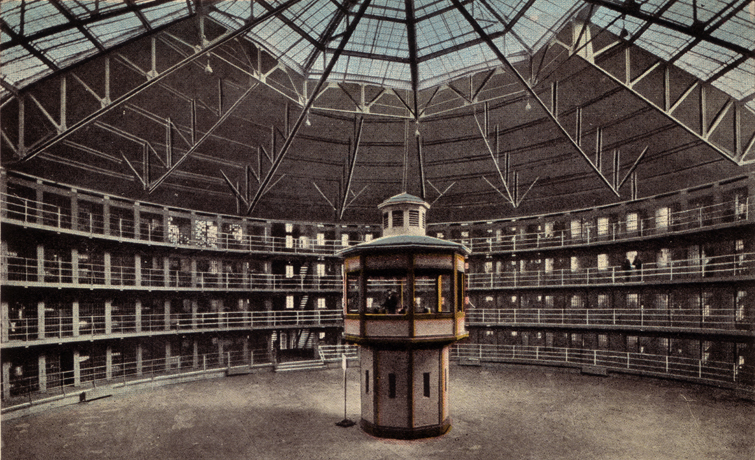
French philosopher Michel Foucault has famously written on the role of surveillance as an instrument of power. “He cites the example of Jeremy Bentham’s ‘Panopticon,’ an architectural model for a prison enabling a single guard, located in a central tower, to watch all of the inmates in their cells.  The ‘major effect of the Panopticon,’ writes Foucault, is ‘to induce in the inmate a state of conscious and permanent visibility that assures the automatic functioning of power.'”

According to Foucault, the Panopticon renders power both “visible and unverifiable”: Visible: the inmate will constantly have before his eyes the tall outline of the central tower from which he is being spied upon. Unverifiable: the inmate must never know whether he is being looked at at any one moment; but he must be sure that he may always be so. But potential perpetrators of the violence in the Sudan do not actually see the  outline of the satellites flying overhead. They are not being directly harassed by high-powered “cameras” stuck into their faces by the anti-genocide paparazzi. So the power is not directly visible in the traditional sense. But who exactly is the inmate in or connected to Abyei in the first place?

There are multiple groups in the area with different agendas that don’t necessarily tie back to the Sudanese government in Khartoum. The Arab Misseriya tribe has thus far remained north during this dry season to avert confrontation with the Ngok Dinka in the Southern part of Abyei. These nomadic tribes typically carry Kalashnikovs to guard their cattle. So distinguishing these nomads from armed groups prepared to raid and burn down villages is a challenge especially when dealing with satellite imagery. Using UAV’s may be more useful and cheaper. (Note that monitoring the location and movement of cattle could be insightful because cattle issues are political in the area).

If armed groups who intend to burn down villages are the intended inmates, do they even know or care about the Satellite Sentinel Project? The ICC has already struggled to connect the chain of command back to the Sudanese government. Besides, the expected turn-around time to develop the satellite imagery is between eight to twenty-four hours. Getting armed men on a truck and raiding a village or two doesn’t take more than a few hours. So the crimes may already have been committed by the time the pictures come in. And if more heavy military machinery like tanks are rolled in, well, one doesn’t need satellite imagery to detect those.

As scholars of the panopticon have noted, the successful use of surveillance has to be coupled with the threat of punishment for deviant acts. So putting aside the issue of who the intended inmates are, the question for the Sentinel Project is whether threats of punishment are perceived by inmates as sufficiently real enough for the deterrence to work. In international relations theory, “deterrence is a strategy by which governments threaten an immense retaliation if attacked, such that aggressors are deterred if they do not wish to suffer great damage as a result of an aggressive action.”

This means that official state actors need to step up and publicly pledge to carry out the necessary punishment if the satellite imagery collected by Sentinel provides evidence of wrong-doing. The ICC should make it crystal clear to all inmates (whoever they are) that evidence from the satellite imagery will be used for prosecution (and that they should care). There also need to be armed guards in  “the tower” who are proximate enough to be deployed and have the political will to use force if necessary. Or will the anti-genocide paparazzi’s many eyes be sufficient to keep the peace? It’s worth remembering that the Hollywood paparazzi haven’t exactly turned movie stars into alter boys or girls. But then again, they’d probably get away with a whole lot more without the paparazzi.

US spy satellites have no doubt monitored conflict-prone areas in the past but this  hasn’t necessarily deterred major crimes against humanity as far as I know. Of course, the imagery collected has remained classified, which means the general public hasn’t been able to lobby their governments and the international community to act based on this information and shared awareness.

The Sentinel Project’s open source approach changes this calculus. It may not deter the actual perpetrators, but the shared awareness created thanks to the open data will make it more difficult for those who can prevent the violence to look the other way. So the Satellite Sentinel Project may be more about keeping our own governments accountable to the Responsibility to Protect (R2P) than deterring actors in the Sudan from committing further crimes.

How will we know if Clooney succeeds? I’m not quite sure. But I do know that the Sentinel Project is a step in the right direction. More evidence is always more compelling than less evidence. And more public evidence is even better. I have no doubt therefore that Eisenhower would back this Open Skies project.

p.s. It is worth noting that the satellite imagery of Sri Lankan forces attacking civilians in 2009 were dismissed as fake by the Colombo government even though the imagery analysis was produced by UNOSAT.

Technologies and Practice for the Prevention of Mass Atrocity Crimes

I’ve waited years for a conference like this: “Early Warning for Protection: Technologies and Practice for the Prevention of Mass Atrocity Crimes.”

This high-level conference combines my main areas of interest: conflict early warning, crisis mapping, civilian protection and technology. I’ll be giving a keynote presentation on “The Potential of New Technologies in Conflict Early Warning” at this conference next week, and I’m particularly looking forward to the panel that will follow, co-organized with my colleague Phoebe Wynn-Pope.

The conference will explore a number of issues.

  • What is the role of new technologies in conflict early warning and how do they interact with more traditional monitoring systems?
  • How can we harness, coordinate, and utilize the sometimes overwhelming amount of information available?
  • What systems and mechanisms need to be put in place to ensure effective early-warning is given?
  • How does the humanitarian sector work effectively with communities at risk once early-warning has been sounded?
  • How can a change in attitude and behavior at a policy level be brought about in a way that forestalls a descent to violence?

In preparing for the presentation, I started re-reading some papers I had written several years ago including this one from 2008: “Bridging Multiple Divides in Early Warning and Response: Upgrading the Role of Information and Communication Technology” (PDF). I will base my presentation in part on this paper and welcome any feedback readers may have. If you don’t have time to read a 25-page paper, here’s a short summary in bullet point format:

  • The field of conflict early warning has largely been monopolized by academics who are obsessed with forecasting conflict.
  • Operational conflict early warning systems are little more than glorified databases.
  • The conflict early warning community’s track-record in successfully predicting (let alone preventing) armed conflict is beyond dismal.
  • State-centric and external approaches to conflict early warning and rapid response have almost systematically failed.
  • The disaster early warning community have long advocated for a people-centered approach to early warning given the failures of top-down, institutional methods.
  • The disaster early warning community has been an early adopter of new technologies, particularly those engaged in public health.
  • The purpose of a people-centered approach is to empower individuals so they can mitigate the impact of a disaster on their livelihoods and/or to get out of harm’s way.
  • Preparedness and contingency planning are core to a people-centered approach since natural hazards like earthquakes can’t be easily predicted let alone stopped.
  • Given the dismal failure of conflict early warning systems, the conflict prevention community should make conflict preparedness and contingency planning a top priority.
  • Precedents for a people-centered approach to conflict early warning  exists in the fields of strategic nonviolent action and digital activism.
  • More importantly, communities that experienced conflict have developed sophisticated coping strategies to evade and survive.
  • Some of these communities already use technologies to survive.

I will expand on these points with several real-world examples and, more importantly, will combine these with what I have learned over the past two years, specifically in terms of crisis mapping, new technologies and civilian resistance. I’m excited to put all of my thoughts together for this conference, and I especially look forward to feedback from readers and conversing with participants.


Swarming Crisis Response

[Cross-posted from my Conflict Early Warning Blog]

John Arquilla had a very interesting Op-Ed in the New York Times this weekend on “The Coming Swarm.” I’ve been interested in John’s work for years given his application of complexity science to the study of terrorism and would have assigned this Op-Ed as required reading for the graduate course I co-taught on “Complexity Science and International Relations.”

John writes about the recent simultaneous suicide attacks in Kabul last week and argues that a new ‘Mumbai model’ of swarming, smaller-scale terrorist violence is emerging:

The basic concept is that hitting several targets at once, even with just a few fighters at each site, can cause fits for elite counterterrorist forces that are often manpower-heavy, far away and organized to deal with only one crisis at a time.

[…] This pattern suggests that Americans should brace for a coming swarm. Right now, most of our cities would be as hard-pressed as Mumbai was to deal with several simultaneous attacks. Our elite federal and military counterterrorist units would most likely find their responses slowed, to varying degrees, by distance and the need to clarify jurisdiction.

Current strategy for counterterrorism contemplates having to respond using “overwhelming force” to as many as three simultaneous terrorist attacks. This would imply mobilizing as many as 3,000 ground troops to each site.

If that’s an accurate picture, it doesn’t bode well. We would most likely have far too few such elite units for dealing with a large number of small terrorist teams carrying out simultaneous attacks across a region or even a single city.

“So how are swarms to be countered?” John asks. In his opinion,

The simplest way is to create many more units able to respond to simultaneous, small-scale attacks and spread them around the country. This means jettisoning the idea of overwhelming force in favor of small units that are not “elite” but rather “good enough” to tangle with terrorist teams. In dealing with swarms, economizing on force is essential.

For the defense of American cities against terrorist swarms, the key would be to use local police officers as the first line of defense instead of relying on the military. The first step would be to create lots of small counterterrorism posts throughout urban areas instead of keeping police officers in large, centralized precinct houses. This is consistent with existing notions of community-based policing […]

At the federal level, we should stop thinking in terms of moving thousands of troops across the country and instead distribute small response units far more widely.

I think John’s recommendations are very important and directly applicable to the field of operational crisis early warning and rapid response, particularly on the response side.  This means taking more of a people-centered or community-based approach to early response and shifting away from the top-down mentality of “The Responsibility to Protect” to one of “The Responsibility to Empower” from the bottom-up.

The Crowd is Always There: A Marketplace for Crowdsourcing Crisis Response

This blog post is based on the recent presentation I gave at the Emergency Social Data Summit organized by the Red Cross this week. The title of my talk was “Collaborative Crisis Mapping” and the slides are available here.

What I want to expand on is the notion of a “marketplace for crowdsourcing” that I introduced at the Summit. The idea stems from my experience in the field of conflict early warning, the Ushahidi-Haiti deployment and my observations of the Ushahidi-DC and Ushahidi-Russia initiatives.

The crowd is always there. Paid Search & Rescue (SAR) teams and salaried emergency responders aren’t. Nor can they be on the corners of every street, whether that’s in Port-au-Prince, Haiti, Washington DC or Sukkur, Pakistan. But the real first responders, the disaster affected communities, are always there. Moreover, not all communities are equally affected by a crisis. The challenge is to link those who are most affected with those who are less affected (at least until external help arrives).

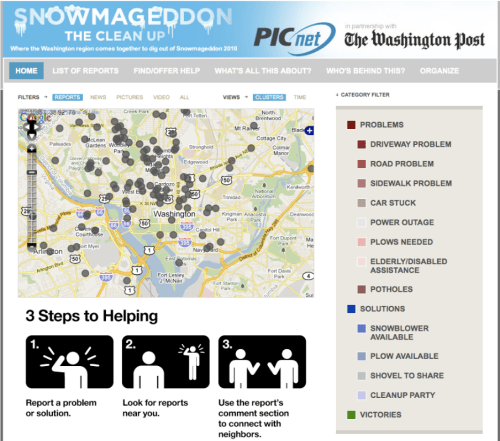
This is precisely what PIC Net and the Washington Post did when they  partnered to deploy this Ushahidi platform in response to the massive snow storm that paralyzed Washington DC earlier this year. They provided a way for affected residents to map their needs and for those less affected to map the resources they could share to help others. You don’t need to be a professional disaster response professional to help your neighbor dig out their car.

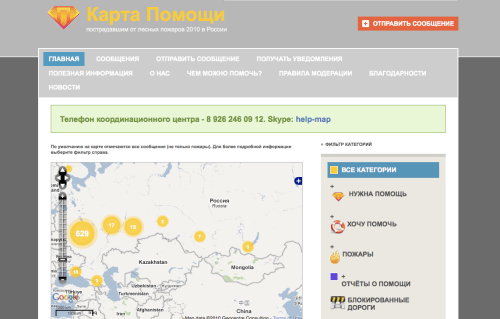
More recently, friends at Global Voices launched the most ambitious crowdsourcing initiative in Russia in response to the massive forest fires. But they didn’t use this Ushahidi platform to map the fires. Instead, they customized the public map so that those who needed help could find those who wanted to help. In effect, they created an online market place to crowdsource crisis response. You don’t need professional certification in disaster response to drive someone’s grandparents to the next town over.

There’s a lot that disaster affected populations can (and already do) to help each other out in times of crisis. What may help is to combine the crowdsourcing of crisis information with what I call crowdfeeding in order to create an efficient market place for crowdsourcing response. By crowdfeeding, I mean taking crowdsourced information and feeding it right back to the crowd. Surely they need that information as much if not more than external, paid responders who won’t get to the scene for hours or days.

We talk about top-down and bottom-up approaches. Crowdfeeding is a “bottom-bottom” approach; horizontal, meshed communication for local rapid response. Information of the crowd, by the crowd and for the crowd. For the marketplace to work at the technical level, users should easily be able to map their needs or map the resources they have to help others. They should be able to do this via webform, SMS, Twitter, smart phone apps, phone call, etc.

But users shouldn’t have to keep looking back at the map to check whether anyone has posted offers to help in their area, or vice versa. They should get an automated email and/or text message when a potential match is found. The matching should be done by a simple algorithm, a Match.com for crowdsourcing crisis response. (Just like online dating, users should take appropriate precautions when contacting their match). On a practical level, this marketplace will work best if it draws many traders. That’s why the data should be easily shared across platforms.

During the Summit, the Red Cross presented findings from this study which revealed that 75% of people now expect an almost-immediate response after posting a call for help on a social media platform during a disaster. The Red Cross and other humanitarian organizations are particularly troubled by this figure. They shouldn’t be. As the Head of FEMA noted at the summit, it is high time that crisis response organizations start viewing the public as part of the team. One way to make them part of the team is to create an open marketplace for crowdsourcing crisis response.

Crisis Response and SMS Systems Management for NGOs and Governments

Guest blog post: Bart Stidham is an enterprise architect committed to bringing positive change to the world via better information systems architecture. He has served as CTO of four companies including one of the largest communications companies in the world, been a senior executive at Accenture, and served as CIO of the largest NGO funded by USAID. He is an independent consultant and can be found in Washington, DC when he is not traveling.

This blog post builds off of and supports Patrick Meier’s previous post on developing an SMS Code of Conduct for Humanitarian Response. Patrick raises many important issues in his post and it is clear that with the success of Ushahidi-Haiti it is likely we will see a vast increase in the use of similar SMS based information management systems in the future. While the deployment of such systems and all communications systems is likely to be orderly and well structured in normal circumstances, it is likely that during crises such order may break down and these systems may negatively impact one another. For this reason I applaud Patrick’s effort to raise this issue but my hope is that the “normal order” imposed by governments and societies will help prevent the potential disruption of communications systems from occurring in disasters, emergencies, and crises.

I believe Patrick’s concerns are best discussed in the larger issue of frequency spectrum management. This is a huge issue and one that needs substantial education within the entire response space. It is a growing problem across each and every communications system not just in crises but also globally as we humans desire to communicate more in more ways and with more devices. There are limits to the amount of information that can be “pushed” through any communications system and those limits increasingly have to do with the laws of physics, not just the design of the systems.

The electromagnetic frequency spectrum (EF) is the basis of all wireless communication. We started our use of it the late 1800s with the first use of radio. Long ago we exhausted the entire spectrum and are now trying to find ways to reuse parts of it more efficiently. However it is critical that we protect this “public commons” on which so many of our communications systems depend.

Every communications system needs a “physical channel” and this varies widely but they all share some common characteristics. One is the problem of “collisions” which are bad because that means that the information is not delivered successfully. As humans using the physical channel of sound and speech we encounter this in our normal conversations whenever we meet in groups. A simple example of a collision is when two or more people are talking loudly over each other with the result being that no one understands what either is saying.

There are multiple ways to deal with collisions and every communications system must manage collisions or the system collapses. One way is to have a token and you are only allowed to talk if you hold the token. This method of managing communications was used brilliantly by various Native American tribes when discussing heated issues such as war – if you are not in possession of the peace pipe (the token) you are not allowed to speak. This forces everyone to listen to what you are saying and to politely take turns speaking. It is passed back and forth and everyone gets a turn. There are several types of network architecture that use this exact method for avoiding collisions.

Another method is collision avoidance by assigning each speaker a window of time to speak in. This is roughly the approach used by GSM for instance. Yet another method is collision detection where you allow for a certain statistical overlap and all parties know that the last “conversation” collided with another and the information was lost. The system then corrects the problem. This is not as efficient but is easy to do and cheap to implement. This is what Ethernet uses.

Finally as systems are deployed and interact with each other in a certain physical space they need to divide up the space. This can be done by frequency or cables or physical area or by time or all of the above.

In our discussion SMS are best likened to frequencies (although this is not an exact analogy). The advantage of them is that no two NGOs can ever end up with the same long code as this is handled by the carriers and their agreements. Internationally no two carriers can ever issue the same phone number or long code globally. If all NGOs stuck with long codes or full phone numbers we could avoid the problem Patrick is rightly concerned with.

NGOs and other organizations can problematically and mistakenly issue the same short code within a geographic area and we should all be concerned about this exactly as Patrick is. This problem can happen because short codes are for humans – not for the system itself. If the carriers are using different underlying cell phone technologies they can both issue the same short code and neither will interfere technically with the other one. Unfortunately it could have disastrous consequences for the socialization of the short codes to the local or larger population if they cross either technical or geographic lines. This is a problem largely unique to SMS and the plethora of technologies,carriers, bands (or frequencies) that can be deployed in a large physical area and the fact that short codes are for human convenience.

Right now there are 14 frequency bands just within the GSM voice system (thankfully quad band phones support all the widely used ones) and another 14 for data (furthermore the data “bands” actually cover a huge range of frequencies). This is why it is possible to have within one region, country or city with two “overlapping” short codes on two or more different carriers – the codes will each work only on the carrier that operates on that actual GSM frequency band. The system doesn’t care but it can be confusing to us humans.

Another thing Patrick has raised as a concern is actually “subject matter frequency” overlap (or collisions) and the confusion that can result to us simpleminded humans.

It makes no difference how many SMS codes are used as long as they are long codes OR if private and on short codes. The only time there is a problem is when two groups set up short codes that become public (meaning they are advertised in some way to the general public) as “the right number for X” where X is the same subject matter area.

In order to speed response many countries do NOT follow the US 911 system which uses a single short number for all emergencies. For instance Austria uses no less than 9 “short code” voice numbers each for a separate emergency type. That’s great if you live there and have them all memorized and know that for extreme sports there is a number just for “alpine rescue” to get your friend off some ledge that he crashed into in his para-glider. It speeds vital response and gets the right team dispatched in the least time. It does however require a massive amount of public education.

In the US the government decided to have a “one number fits all” system. This was in response to the fact that previously we had thousands of local numbers for each fire and police department, hospital and ambulance service. Without a local phone book it wasn’t possible to know who to call in an emergency. We designed the 911 system as a way to solve this problem and looped all three major responders into the one system. This was then deployed on a county by county basis across the US. There is no national 911 system. The system scales by dividing itself into small geographic sections.

SMS systems tend to be larger in size because SMS carriers are geographically larger that the old local phone POP (point of presence) that became the basis of the US 911 system. Another major concern for SMS design is the total carrying capacity of the carrier SMS system itself. SMS is NOT designed to be use for “one to many” messages. That was never part of the design and the system can be knocked out if the overall limits of the system are exceeded. At that point the SMS systems themselves collapse under the load and start failing and can cause a cascade failure of the entire carrier network in a region – this means that SMS can knock out voice. It does appear that such a failure occurred in Haiti to one of the local carriers that implemented an SMS emergency broadcast system in conjunction with an NGO so this is a real problem.

Getting back to Patrick’s identified concern – we should be worried when multiple SMS “subject channels” are socialized via the mass media and it confuses the public. In Haiti that didn’t happen because there was only one due largely to the work and efforts of the 4636 Haiti.Ushahidi community.

I believe in the future that is also unlikely to happen because I hope the mass media outlets will simply refuse to say “use any of the following SMS codes for health and these for x and y and z.” I think they won’t do this haphazardly. Doing so (meaning confusing the public) could endanger their (mass media) operating license from the host country.

Furthermore countries and cities are typically aware of this whole discussion and carefully control the distribution of short codes (but this does vary widely from region to region). The country that issues the carrier the license to operate the infrastructure is the ultimate authority for this and reserves the right to yank someone off the air or kick them out of the country for failure to follow the rules. Frequency spectrum must be managed for the greater public good or the classic “crisis of the commons” will result. This is the concern Patrick has brought to light.
One can not and should not assume that the rules, laws and policies we (individuals) are used to operating under in our home country apply elsewhere. The term “sovereign nation” means exactly that – they set their own laws concerning how things operate – including technology and communications systems. For instance WiFi is NOT WiFi everywhere and a WiFI router sold in Japan is illegal to operate in the US.

Some well meaning but largely uneducated NGOs deployed systems in Haiti that badly broke rules, laws, policies, etc and the Government of Haiti (and the US Government on behalf of the Haitian Government) was very polite to them. They stepped all over local businesses and disrupted them. Had this happened in the US the FCC would have issued huge fines to them – fines that likely would drive them out of business – and for good reason. They are exploiting the “public commons” for their own advantage. Whether they meant to or not is irrelevant just as ignorance of the law is no excuse.

In the past most responders to such emergencies were large NGOs with trained communications teams that knew they must coordinate their use of various communications platforms with each other or everyone would suffer. In this past this was easy and obvious because NGOs, governments and businesses made extensive use of UHF and VHF radios for communications. Because these systems were voice based it was obvious when you had a problem and when someone was on your assigned frequency. Furthermore you frequently had the opportunity to yell at them over that same communications system.

In the era of digital communications systems we no longer have the ability to yell at anyone and in fact both the designed legal and official user and the illegal user may be unaware that they are colliding and causing both systems to fail. This is a huge problem because it means that both parties have no way to know even know they are interfering with each other much less how or where to resolve the problem.

In conclusion, I applaud Patrick’s efforts as he has raised an important issue that all NGOs that respond to emergencies (both in the US and abroad) must to be aware of. Education is critical. Please tell your organization that they must contact and coordinate with the official frequency manager, typically the local government’s communications agency or ministry, prior to deploying any communications equipment. Failing to do so is typically illegal and can have grave consequences in emergencies, crises and disasters.

Failing Gracefully in Complex Systems: A Note on Resilience

Macbeth’s castle, Act 1, Scene VII. Macbeth and Lady Macbeth are plotting Duncan’s death.

Macbeth: If we should fail?

Lady Macbeth: Then we fail! But screw your courage to the sticking place, And we’ll not fail.

Complex dynamic systems tend to veer towards critical change. This is explained by the process of Self-Organized Criticality (SEO). Over time, non-equilibrium systems with extended degrees of freedom and a high level of nonlinearity become increasingly vulnerable to collapse. As the Santa Fe Institute (SFI) notes,

“The archetype of a self-organized critical system is a sand pile. Sand is slowly dropped onto a surface, forming a pile. As the pile grows, avalanches occur which carry sand from the top to the bottom of the pile.”

Scholars like Thomas Homer-Dixon argue that we are becoming increasingly prone to domino effects or cascading changes across systems, thus increasing the likelihood of total synchronous failure. “A long view of human history reveals not regular change but spasmodic, catastrophic disruptions followed by long periods of reinvention and development.”

That doesn’t mean we’re necessarily done for, however. As Homer-Dixon notes, we can “build resilience into all systems critical to our well-being. A resilience system can absorb large disturbances without changing its fundamental nature.”

“Resilience is an emergent property of a system–it’s not a result of any one of the system’s parts but of the synergy between all of its parts.  So as a rough and ready rule, boosting the ability of each part to take care of itself in a crisis boosts overall resilience.”

This is where Homer-Dixon’s notion of “failing gracefully” comes in: “somehow we have to find the middle ground between dangerous rigidity and catastrophic collapse.”

“In our organizations, social and political systems, and individual lives, we need to create the possibility for what computer programmers and disaster planners call ‘graceful’ failure. When a system fails gracefully, damage is limited, and options for recovery are preserved. Also, the part of the system that has been damaged recovers by drawing resources and information from undamaged parts.”

“Breakdown is probably something that human social systems must go through to adapt successfully to changing conditions over the long term. But if we want to have any control over our direction in breakdown’s aftermath, we must keep breakdown constrained. Reducing as much as we can the force of underlying tectonic stresses helps, as does making our societies more resilient. We have to do other things too, and advance planning for breakdown is undoubtedly the most important.”

Planning for breakdown is not defeatist or passive. Quite on the contrary, it is wise and pro-active. Our hubris all too often clouds our better judgment and rarely do we—as the humanitarian/development community—seriously ask ourselves what we would do “if we should fail.” The answer: “then we fail” is an option. But are we, like Macbeth, prepared to live with the consequences?

Patrick Philippe Meier

Rethinking the UN’s Global Pulse

Update: This project is now called UN Global Pulse.

I’m in Bellagio on Lake Como this week for a Blue Sky Thinkers Workshop on the UN’s new Global Pulse Initiative. When I first blogged about GIVAS as it was called back in July 2009, the Pulse Team in the UN Secretary General’s Office actually commented on my blog post. The fact that the UNSG’s Office was taking the time to read blogs and comment on them was the first sign that something about this project was very different from my previous experience with the UN.

We’re under Chatham House Rules here so I’ll just stick to my own thoughts on what I think Global Pulse should be. First, I don’t think Global Pulse should be for the UN or nation states. The global alert system should directly empower vulnerable communities to prevent or mitigate the impact of crises on their own livelihoods. In other words, Global Pulse should be a self-help system for vulnerable communities. The development and maintenance of this system should be the responsibility of the UN and governments.

So here’s an idea (still under development): why not use the QuestionBox technology and approach to create “call in” centers for information on tactics for resilience.

Question Box helps people find answers to everyday questions like health, agriculture, business, education and entertainment. It provides easy access to information in hard-to-reach areas and breaks through technology, language and literacy barriers. We do this through:

  • Live telephone hotlines connected to live operators
  • SMS (Text Messaging)
  • Mobile and solar technologies that operate off the grid
  • Open Question – a simple software to start your own Question Box project

The group behind Question Box also help several organizations start their own Question Box-inspired services. So lets turn Global Pulse into a Global Resilience Information Service for vulnerable communities. There are four key reasons I find this approach compelling. First, this approach provides a demand-driven direct service to vulnerable communities as opposed to just “watching” them. Databases of resilience tactics can be (continually) developed by either local communities themselves or government sponsored projects. This information can then be shared across towns and regions. Think of this as a “Resilience Wiki”.

The second reason I want to continue exploring this system is because the queries made using a Resilience Question Box approach are in and of themselves important indicators. Think of Google’s Flu trends project. The team “found a close relationship between the number of people who search for flu-related topics and the number of people who actually have flu symptoms.” In other words, the queries made to Resilience Question Box could serve as proxy indicators for local vulnerability. This data would then be analyzed for trends and policy making at the UN.

The third reason this approach appeals to me is because it serves the interest of vulnerability communities first and foremost. The rhetoric behind global alert systems is that they are for vulnerable communities but the reality is that these communities rarely know that such systems actually exist. The first indicator of success for Global Pulse will therefore be whether vulnerable communities are aware of Pulse. A second indicator will be whether they actually use the system.

The fourth and final reason I’m keen about a Question Box approach is because of the focus on information for vulnerable communities. In my opinion, most crises are ultimately crises in information, which is another reason why information is power. Imagine if Global Pulse could work with Member States to set up hundreds of thousands of Resilience Boxes. Think of the One Laptop per Child (OLPC). Global Pulse could provide a Resilience Box per Vulnerable Community, enabling the latter to make more informed decisions to increase their own resilience in near real-time.

Now how does one fund all this? I got a possible answer over lunch while talking to one of the participants (whose identity I can’t reveal because of Chatham House Rules). How about a Kiva for Resilience Boxes? Instead of donating money to one (or more) specific project, you could donate money for 50 QuestionBox answers to a specific community in Bangladesh. I personally find that very compelling, i.e., knowing that my money provided 50 answers for vulnerable communities. In return for my donation, perhaps I could also get a copy of the 50 questions/answers and learn something new in the process.

Patrick Philippe Meier

Sentiment Analysis of Haiti Text Messages (Updated)

The field of sentiment analysis is one that I’ve long been interested in. See my previous post on the use of sentiment analysis for early warning here. So when we began receiving thousands of text messages from Haiti, I decided to ask my colleagues at the EC’s Joint Research Center (JRC) whether they could run some of their sentiment analysis software on the incoming SMS’s.

The 4636 SMS initiative in Haiti was a collaboration between many organizations and was coordinated by Josh Nesbit of FrontlineSMS. The system allowed individuals in Haiti to text in their location and urgent needs. These would then be shared with some of the humanitarian actors on the ground and also mapped on the Ushahidi-Haiti platform, which was used by first responders such as the Marine Corps.

Here’s how the JRC in partnership with the University of Alicante carried out their analysis on the incoming SMS’s:

As many individual words are ambiguous (e.g. the word ‘help’ probably predominantly indicates a negative situation, but it may also be positive, as in “help has finally arrived”), they looked at the most frequent word groups, or word n-grams (sizes 2 to 5 words). Out of these, they identified about 100 n-grams that they felt are (high) negative or (high) positive. These were added to the sentiment analysis tool.

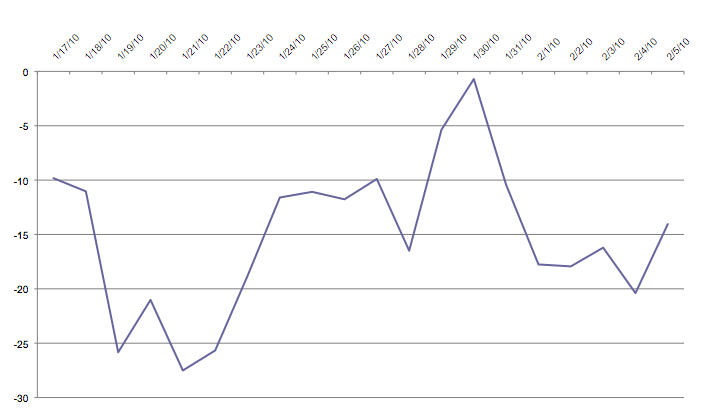
The graph below depicts the changing sentiment reflected in the SMS data between January 17th and February 5th.

Sentiment Analysis of Haiti SMS’s

There is, of course, no way to tell whether the incoming text messages reflect the general feeling of the population. It is also important to emphasize that the number of individuals sending in SMS’s increased during this time period. Still, it would be interesting to go through the sentiment analysis data and identify what may have contributed to the peaks and troughs of the above graph.

Incidentally, the lowest point on this graph is associated with the date of January 21. The data reveals that a major aftershock took place that day. There are subsequent reports of trauma, food/water shortages, casualties, need for medication, etc., which drive the sentiment analysis scores down.

Update 1: My colleague Ralf Steinberger and the Ushahidi-Haiti group is looking into the reasons behind the spike around January 30th. Ralf notes the following:

I checked the news a bit, using the calendar function in EMM NewsExplorer (http://emm.newsexplorer.eu/). I checked both the English and the French news for the day. One certainly positive news item accessible to Haitians on that day was that Haiti leaders pointed to progress. Another (French) positive news item is that the WFP (PAM) put in place a structured food aid system aiming at feeding up to 2 million people via women only. People were given food coupons (25kg of rice per family), starting Saturday 30.1.

Ralf also found that many of the original SMS’s received on that day had not been translated into English. So we’re looking into why that might have been. Hopefully we can get them translated retro-actively for the purposes of this analysis.

Update 2: Josef Steinberger from JRC has produced a revised sentiment analysis graph through to mid March.

This kind of sentiment analysis can be done in real-time. In future deployments where SMS becomes the principle source to communicate with disaster affected populations, using this kind of approach may  eventually provide an overall score for how the humanitarian community is doing.

Patrick Philippe Meier

Ushahidi & The Unprecedented Role of SMS in Disaster Response

What if we could communicate with disaster affected communities in real-time just days after a major disaster like the quake in Haiti? That is exactly what happened thanks to a partnership between the Emergency Information Service (EIS), InSTEDD, Ushahidi, Haitian Telcos and the US State Department. Just 4 days after the earthquake, Haitians could text their location and urgent needs to “4636” for free.

I will focus primarily on the way that Ushahidi used 4636. Since the majority of incoming text messages were in Creole, we needed a translation service. My colleague Brian Herbert from Ushahidi and Robert Munro of Energy for Opportunity thus built a dedicated interface for crowdsourcing this step and reached out to dozens of Haitian communities groups to aid in the translation, categorization and geo-location of every message, quickly mobilizing 100s of motivated and dedicated volunteers. So not only was Ushahidi crowdsourcing crisis information in near real-time but also crowdsourcing translation in near real-time.

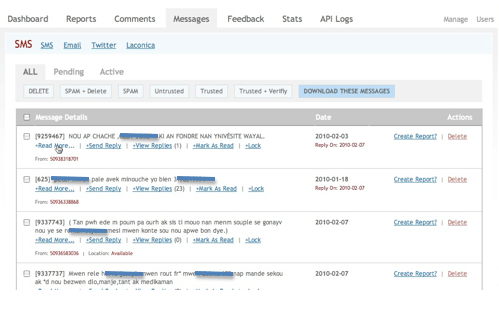
Text messages are translated into English just minutes after they leave a mobile phone in Haiti. The translated messages then appear directly on the Ushahidi platform. The screenshots below (click on graphics to enlarge) illustrates how the process works. The original SMS in Creole (or French) is displayed in the header. In order to view the translation, one simply clicks on “Read More”.

Ushahidi Back End

Incoming Text Messages

If further information is required, then one can reply to the sender of the text message directly from the Ushahidi platform. This is an important feature for several reasons. First, this allows for two-way communication with disaster affected communities. Second, an important number of messages we received were not actionable because of insufficient location information. The reply feature allowed us to get more precise information.

The screenshots below show how the “Send Reply” feature works. We weren’t sure if Universite Wayal was the same as Royal University. So we replied and asked for more location information. Note the preset replies in both English and Creole. The presets include thanks & requests for more location information, for example. Of course, one is not limited to these presets. Any text can be typed in and sent back to the sender of the original SMS. This feature has been part of the Ushahidi for almost two years now. We send off the request for more information and receive the following reply within minutes.

Preset Replies

When we receive an urgent and actionable SMS like this one, we can immediately create a report. By actionable, we mean there is sufficient location information and the description of the need is specific enough to respond to, just like the example above.

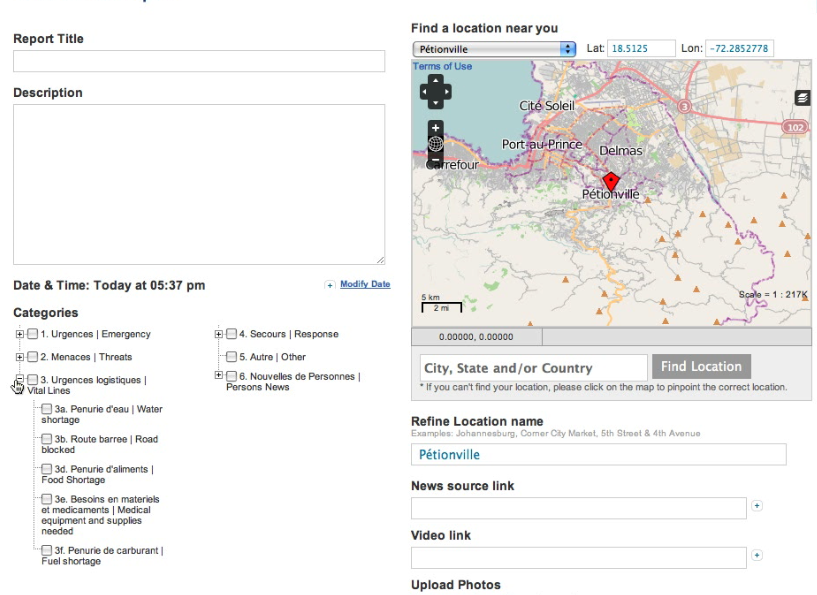
Creating a Report

First, the GPS coordinates for the location is identified. This can be done directly from the Ushahidi platform by entering the street address or town name. Sometimes a bit of detective work is needed to pinpoint the exact coordinates. Next, a title and description for the report is included–the latter usually comprising the text of the SMS. This is what we mean by structured information. The report is then tagged based on the category framework. Pictures can be uploaded with the report, and links to videos can also be included. Finally the report is saved and then approved for publication.

This is how the Ushahidi-Haiti @ Tufts team mapped 1,500+ text messages on the Ushahidi platform. We are now working with Samasource and Crowdflower to have the translation work serve as a source of income for Haitians inside Haiti. But how does all this connect to response?

Ushahidi’s “Get Alerts” feature is one of my favorite because it allows responders themselves to customize the specific type of actionable information that is important to them; i.e., demand driven situational awareness in near real-time. Not only can responders elect to receive automated alerts via email, but they can also do so via SMS. Responders can also specify their geographic area of interest.

Subscribe to Alerts

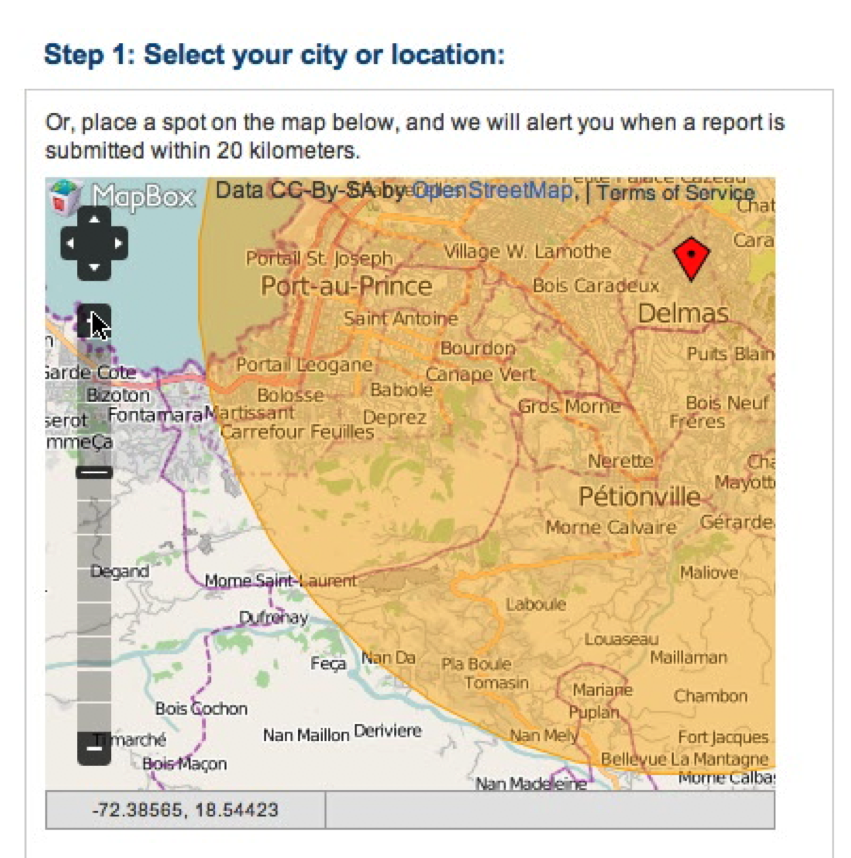
For example, if a relief worker from the Red Cross has a field office in neighborhood of Delmas, they can subscribe to Ushahidi to receive information on all reports originating from their immediate vicinity by specifying a radius, as shown below.

Selecting Area of Interest

The above Alerts feature is now being upgraded to the one depicted below, which was designed by my colleague Caleb Bell from Ushahidi. Not only are responders able to specify their geographic area of interest, but they can also select the type of alert (e.g., collapsed building, food shortage, looting, etc.) they want to receive. They can even add key words of interest to them, such as “water”, “violence” or “UN”. The goal is to provide responders with an unprecedented degree of customization to ensure they receive exactly the kind of alerts that they can respond to.

Highly Customized Alerts

On a more “macro” level, I recently reached out to colleagues at the EC’s Joint Research Center (JRC) to leverage their automated sentiment (“mood”) analysis platform. Sentiment Analysis is a branch of natural language processing (NLP) that seeks to quantify positive vs negative perceptions; akin to “tone” analysis. I suggested that we use their platform on the incoming text messages from Haiti to get a general sense of changing mood on an hourly basis. I’ll blog about the results shortly. In the meantime, here’s a previous blog post on the use of Sentiment Analysis for early warning.

Patrick Philippe Meier

Diane Coyle Responds to Criticisms of UN/Vodafore Report

Guest Blogger: Diane Coyle, lead author of UN/Vodafone Report

The tone of some comments about our report has surprised and disappointed me. It should go without saying that a report-as opposed to a catalog-could never include all the technologies and applications available in this exciting field now.

We selected examples that illustrated relevant aspects of the use of communications and information in the context of an emergency or conflict. The selection methodology was that they should be good illustrations of innovative uses, covering a reasonable spread of technologies, users and countries. In addition, we played to our own strengths in terms of the technologies and approaches we know well, meaning that we understood thoroughly the contribution they can make.

What’s more, this is not an academic report, which some of the criticisms ignored. It is meant to be accessible to a general audience, especially practitioners and policy makers. Why on earth would we include a literature review?

Some comments simply seemed to have missed the point, and no doubt I could have spelled some things out more clearly. For example, the point made in the document about Cyclone Nargis is precisely that even in contexts which hold no promise for humanitarian agencies to introduce new information-rich technologies, very simple low-tech information can still help build community resilience.

Having said that, I am really grateful for comments which pointed out a few factual errors and infelicities, and I hope we can correct them soon. I’m confident that the report makes an important contribution in highlighting the potential for the latest technologies in this field, and the obstacles to realization of that potential.