Guest Blogger: Diane Coyle, lead author of UN/Vodafone Report
The tone of some comments about our report has surprised and disappointed me. It should go without saying that a report-as opposed to a catalog-could never include all the technologies and applications available in this exciting field now.
We selected examples that illustrated relevant aspects of the use of communications and information in the context of an emergency or conflict. The selection methodology was that they should be good illustrations of innovative uses, covering a reasonable spread of technologies, users and countries. In addition, we played to our own strengths in terms of the technologies and approaches we know well, meaning that we understood thoroughly the contribution they can make.
What’s more, this is not an academic report, which some of the criticisms ignored. It is meant to be accessible to a general audience, especially practitioners and policy makers. Why on earth would we include a literature review?
Some comments simply seemed to have missed the point, and no doubt I could have spelled some things out more clearly. For example, the point made in the document about Cyclone Nargis is precisely that even in contexts which hold no promise for humanitarian agencies to introduce new information-rich technologies, very simple low-tech information can still help build community resilience.
Having said that, I am really grateful for comments which pointed out a few factual errors and infelicities, and I hope we can correct them soon. I’m confident that the report makes an important contribution in highlighting the potential for the latest technologies in this field, and the obstacles to realization of that potential.
Update: I’m in conversation with the UN/Vodafone Foundation about adding a paragraph on case selection, a case study on Sahana and correcting the error on UNOSAT.
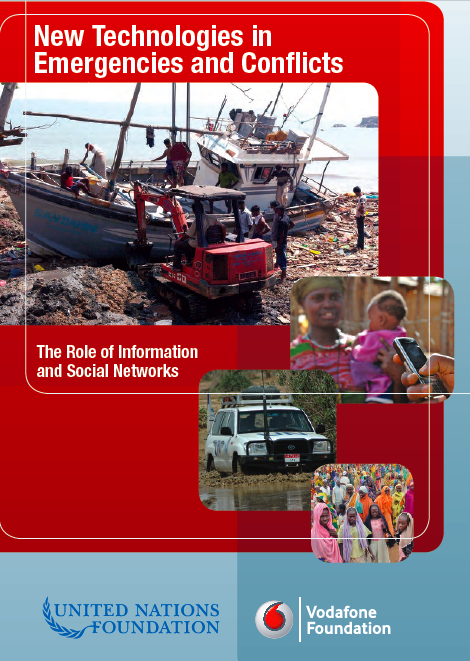
The UN/Vodafone Foundation recently published a new Report on New Technologies in Emergencies and Conflicts. This blog post responds to feedback on this report. Please note that I do so as second-author. My respected colleague Diane Coyle is the report’s lead author and editor so she may have other thoughts on the feedback. Naturally, I will only address the feedback that relates to my input.
Intended audience: The report was written for a general (non-technical/expert) audience as a way to showcase technology applications in the humanitarian space.
Case selection: The case studies were selected in consultation with the UN/Vodafone Foundation throughout the research period. These consultations included the authors of the report (Diane and myself) and three members of the UN/Vodafone Foundation who served as editors. Some of the case studies were requested by the Foundation. For the other case studies, we strove to highlight some of the most recent initiatives in consultation with the UN/Vodafone Foundation. Of the 19 case studies selected, 13 didn’t exist some 2 years ago. The others comprise major global initiatives, fit well together as examples for a general audience, or were requested case studies. Clearly, the limited space did not allow us include everyone’s favorite project.
Length of report: We originally had some 80-or-so draft pages between us and had to reduce the content to about 60 pages. This meant having to decide what to keep and what to put aside. Some of the rewrite was also done to make the report less technical and more widely understandable. This helped to save on space.
UNOSAT and Sri Lanka: The reference does not intend to endorse or discount the interpretation of the imagery by the international community. The reference is based on in-person consultations with several well-placed experts. That said, I would agree that some rephrasing is in order this paragraph needs to be reworked.
On a personal note, I have found the tone of some criticisms rather disappointing and old school. There are several ways to give feedback: one is constructive, another is destructive. The former provides incentives to improve and continue an open collaborative conversation as a community. The latter defeats the incentive for growth and leads to a more self-centered community.
Some of the criticisms of this report have been destructive. Why is it that some of us can’t get our points across with more composure? Does bitterness make us feel more important? I expected a lot more from some of my (older, wiser) colleagues. But I haven’t always been good on providing constructive feedback either, so thanks to my “new fan club” I’ve got another New Year’s resolution for 2010: I will do my best to give constructive, supportive feedback.
So that’s what they’ve been up to. Google is developing a new computational platform for global-scale analysis of satellite imagery to monitor deforestation. But this is just “the first of many Earth Engine applications that will help scientists, policymakers, and the general public to better monitor and understand the Earth’s ecosystems.”
How about the Earth’s social systems? Humanitarian crises? Armed conflicts? This has been one of the main drivers of the Program on Crisis Mapping and Early Warning (CM&EW) which I co-direct at the Harvard Humanitarian Initiative (HHI) with Dr. Jennifer Leaning. Indeed, we had a meeting with the Google Earth team earlier this year to discuss the development of a computational platform to analyze satellite imagery of humanitarian crises for the purposes of early detection and early response.
In particular, we were interested in determining whether certain spatial patterns could be identified and if so whether we could develop a taxonomy of different spatial patterns of humanitarian crises; something like a library of “crisis finger prints.” As we noted to Google in writing following the conversations,
It is our view that the work of interpretation will be powerfully enhanced by the development of valid patterns relating to issues of importance in specific sets of circumstances that can be reproducibly recognized in satellite imagery. To be sure, the geo-spatial analysis of humanitarian crisis can serve as an important control mechanism for Google’s efforts in extending the functionality of Google Earth and Google’s analytical expertise.
This is something that a consortium of organizations including HHI can get engaged in. Population movement and settlement, shelter options and conditions, environmental threats, access to food and water, are discernible from various elements and resolution levels of satellite imagery. But much more could be apprehended from these images were patterns assembled and then tested against other information sources and empirical field assessments. For an excellent presentation on this, see my colleague Jennifer Leaning’s excellent Keynote address at ICCM 2009:
The military uses of satellite imagery are far more developed than the humanitarian capacities because the interpretive link between what can be seen in the image and what is actually happening on the ground has been made, in great iterative detail, over a period of many years, encompassing a wide span of geographies and technological deployments. We need to develop a process to explore and validate what can be understood from satellite imagery about key humanitarian concerns by augmenting standard satellite analytics with time-specific and informed assessments of what was concurrently taking place in the location being photographed.
The potential for such applications has just begun to surface in humanitarian circles. The Darfur Google initiative has demonstrated the force of vivid images of destruction tethered to actual locations of villages across the span of Darfur. Little further detail is available from the actual images, however, and much of the associated information depicted by clicking on the image is static derived from other sources, somewhat laboriously acquired. The full power of what might be gleaned simply from the satellite image remains to be explored.
Because systematic and empirical analysis of what a series of satellite images might reveal about humanitarian issues has not yet been undertaken, any effort to draw inferences from current images does not lead far. The recent coverage of the war in Sri Lanka included satellite photos of the same contested terrain in the northeast, for two time frames, a month apart. The attempt to determine what had transpired in that interim, relating to population movement, shelter de-construction and reconstruction, and land bombardment, was a matter of conjecture.
Bridging this gap from image to insight will not only be a matter of technological enhancement of satellite imaging. It will require interrogating the satellite images through the filter of questions and concerns that are relevant to humanitarian action and then infusing other kinds of information, gathered through a range of methods, to create visual metrics for understanding what the images project.
There is a lot of exciting work to be done in this space and I do hope that Google will seek to partner with humanitarian organizations and applied research institutes to develop an Earth Engine for Humanitarian Crises. While the technological and analytical breakthroughs are path breaking, let us remember that they can be even more breathtaking by applying them to save lives in humanitarian crises.
I had the distinct pleasure of co-authoring this major new United Nations Foundation & Vodafone Foundation Technology Report with my distinguished colleague Diane Coyle. The report looks at innovation in the use of technology along the time line of crisis response, from emergency preparedness and alerts to recovery and rebuilding.
“It profiles organizations whose work is advancing the frontlines of innovation, offers an overview of international efforts to increase sophistication in the use of IT and social networks during emergencies, and provides recommendations for how governments, aid groups, and international organizations can leverage this innovation to improve community resilience.”
Case studies include:
Global Impact and Vulnerability Alert System (GIVAS)
European Media Monitor (EMM, aka OPTIMA)
Emergency Preparedness Information Center (EPIC)
Ushahidi Crowdsourcing Crisis Information
Télécoms sans Frontières (TSF)
Impact of Social Networks in Iran
Social Media, Citizen Journalism and Mumbai Terrorist Attacks
Global Disaster Alert and Coordination System (GDACS)
InSTEDD RIFF
UNOSAT
AAAS Geospatial Technologies for Human Rights
Info Technology for Humanitarian Assistance, Cooperation and Action (ITHACA)
Camp Roberts
OpenStreetMap and Walking Papers
UNDP Threat and Risk Mapping Analysis project (TRMA)
Geo-Spatial Info Analysis for Global Security, Stability Program (ISFEREA)
FrontlineSMS
M-PESA and M-PAISA
Souktel
I think this long and diverse list of case studies clearly shows that the field of humanitarian technology is coming into it’s own. Have a look at the report to learn how all these fit in the ecosystem of humanitarian technologies. And check out the tag #Tech4Dev on Twitter or the UN Foundation’s Facebook page to discuss the report and feel free to add any comments to this blog post below. I’m happy to answer all questions. In the meantime, I salute the UN Foundation for producing a forward looking report on projects that are barely two years old, and some just two months old.
The Harvard Humanitarian Initiative (HHI) just published a working paper I co-authored with my colleague Dr. Jennifer Leaning. Jennifer and I co-founded the Program on Crisis Mapping and Early Warning (CM&EW) back in 2007 with the generous support of Humanity United (HU).
During this two-year period, HU commissioned a series of internal working papers to inform their thinking in the field of crisis mapping. The report just published by HHI is one of the first internal papers we produced for HU. I am particularly indebted to my HHI colleague Enzo Bollettino for pushing this initiative working paper series at HHI.
This inaugural working paper presents a conceptual framework that distinguishes between the “big world” and “small world” to assess the use of ICTs for communication in conflict zones. The study does so by delineating the multiple information pathways relevant for conflict early warning, crisis mapping and humanitarian response.
The second and third working paper in the series will address information collection and visual analysis respectively. Each working paper will highlight existing projects or case studies; draw on informative anecdotes; and/or relay the most recent thinking on future applications of ICTs.
This working paper series is not meant to be exhaustive since humanitarian tech as a field of study and practice is still in formative phases. The analysis that follows is simply one step forward in trying to understand where the field is headed. We very much welcome feedback and input from fellow colleagues in the community. Feel free to use the comments section below to share your thoughts.
The working paper is available on the website of HHI’s Crisis Mapping Program.
I’ve already blogged about what an ecosystem approach to conflict early warning and response entails. But I have done so with a country focus rather than thinking globally. This blog post applies a global perspective to the ecosystem approach given the proliferation of new platforms with global scalability.
Perhaps the most apt analogy here is one of food webs where the food happens to be information. Organisms in a food web are grouped into primary producers, primary consumers and secondary consumers. Primary producers such as grass harvest an energy source such as sunlight that they turn into biomass. Herbivores are primary consumers of this biomass while carnivores are secondary consumers of herbivores. There is thus a clear relationship known as a food chain.
This is an excellent video visualizing food web dynamics produced by researchers affiliated with the Santa Fe Institute (SFI):
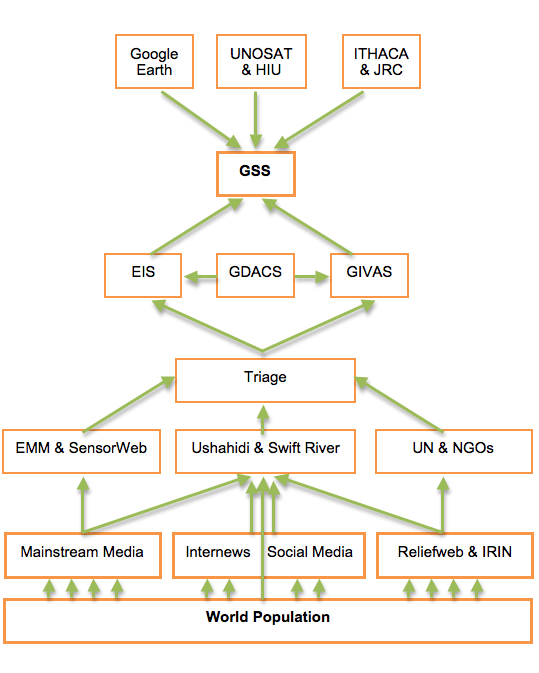
Our information web (or Info Web) is also composed of multiple producers and consumers of information each interlinked by communication technology in increasingly connected ways. Indeed, primary producers, primary consumers and secondary consumers also crawl and dynamically populate the Info Web. But the shock of the information revolution is altering the food chains in our ecosystem. Primary consumers of information can now be primary producers, for example.
At the smallest unit of analysis, individuals are the most primary producers of information. The mainstream media, social media, natural language parsing tools, crowdsourcing platforms, etc, arguably comprise the primary consumers of that information. Secondary consumers are larger organisms such as the global Emergency Information Service (EIS) and the Global Impact and Vulnerability Alert System (GIVAS).
These newly forming platforms are at different stages of evolution. EIS and GIVAS are relatively embryonic while the Global Disaster Alert and Coordination Systems (GDACS) and Google Earth are far more evolved. A relatively new organism in the Info Web is the UAV as exemplified by ITHACA. The BrightEarth Humanitarian Sensor Web (SensorWeb) is further along the information chain while Ushahidi’s Crisis Mapping platform and the Swift River driver are more mature but have not yet deployed as a global instance.
InSTEDD’s GeoChat, Riff and Mesh4X solutions have already iterated through a number of generations. So have ReliefWeb and the Humanitarian Information Unit (HIU). There are of course additional organisms in this ecosystem, but the above list should suffice to demonstrate my point.
What if we connected these various organisms to catalyze a super organism? A Global System of Systems (GSS)? Would the whole—a global system of systems for crisis mapping and early warning—be greater than the sum of its parts? Before we can answer this question in any reasonable way, we need to know the characteristics of each organism in the ecosystem. These organisms represent the threads that may be woven into the GSS, a global web of crisis mapping and early warning systems.
Emergency Information Service (EIS) is slated to be a unified communications solution linking citizens, journalists, governments and non-governmental organizations in a seamless flow of timely, accurate and credible information—even when local communication infrastructures are rendered inoperable. This feature will be made possible by utilizing SMS as the communications backbone of the system.
In the event of a crisis, the EIS team would sift, collate, make sense of and verify the myriad of streams of information generated by a large humanitarian intervention. The team would gather information from governments, local media, the military, UN agencies and local NGOs to develop reporting that will be tailored to the specific needs of the affected population and translated into local languages. EIS would work closely with local media to disseminate messages of critical, life saving information.
Global Impact and Vulnerability Alert System (GIVAS) is being designed to closely monitor vulnerabilities and accelerate communication between the time a global crisis hits and when information reaches decision makers through official channels. The system is mandated to provide the international community with early, real-time evidence of how a global crisis is affecting the lives of the poorest and to provide decision-makers with real time information to ensure that decisions take the needs of the most vulnerable into account.
BrightEarth Humanitarian Sensor Web (SensorWeb) is specifically designed for UN field-based agencies to improve real time situational awareness. The dynamic mapping platform enables humanitarians to easily and quickly map infrastructure relevant for humanitarian response such as airstrips, bridges, refugee camps, IDP camps, etc. The SensorWeb is also used to map events of interest such as cholera outbreaks. The platform leverages mobile technology as well as social networking features to encourage collaborative analytics.
Ushahidi integrates web, mobile and dynamic mapping technology to crowdsource crisis information. The platform uses FrontlineSMS and can be deployed quickly as a crisis unfolds. Users can visualize events of interest on a dynamic map that also includes an animation feature to visualize the reported data over time and space.
Swift River is under development but designed to validate crowdsourced information in real time by combining machine learning for predictive tagging with human crowdsourcing for filtering purposes. The purpsose of the platform is to create veracity scores to denote the probability of an event being true when reported across several media such as Twitter, Online news, SMS, Flickr, etc.
GeoChat and Mesh4X could serve as the nodes connecting the above platforms in dynamic ways. Riff could be made interoperable with Swift River.
Can such a global Info Web be catalyzed? The question hinges on several factors the most important of which are probably awareness and impact. The more these individual organisms know about each other, the better picture they will have of the potential synergies between their efforts and then find incentives to collaborate. This is one of the main reasons I am co-organizing the first International Conference on Crisis Mapping (ICCM 2009) next week.
“I am planning in the near future to submit to the United Nations a proposal for the creation of a United Nations aerial surveillance to detect preparations for attack. This plan I had intended to place before this conference. This surveillance system would operate in the territories of all nations prepared to accept such inspection. For its part, the United States is prepared not only to accept United Nations aerial surveillance but to do everything in its power to contribute to the rapid organization and successful operation of such international surveillance.”
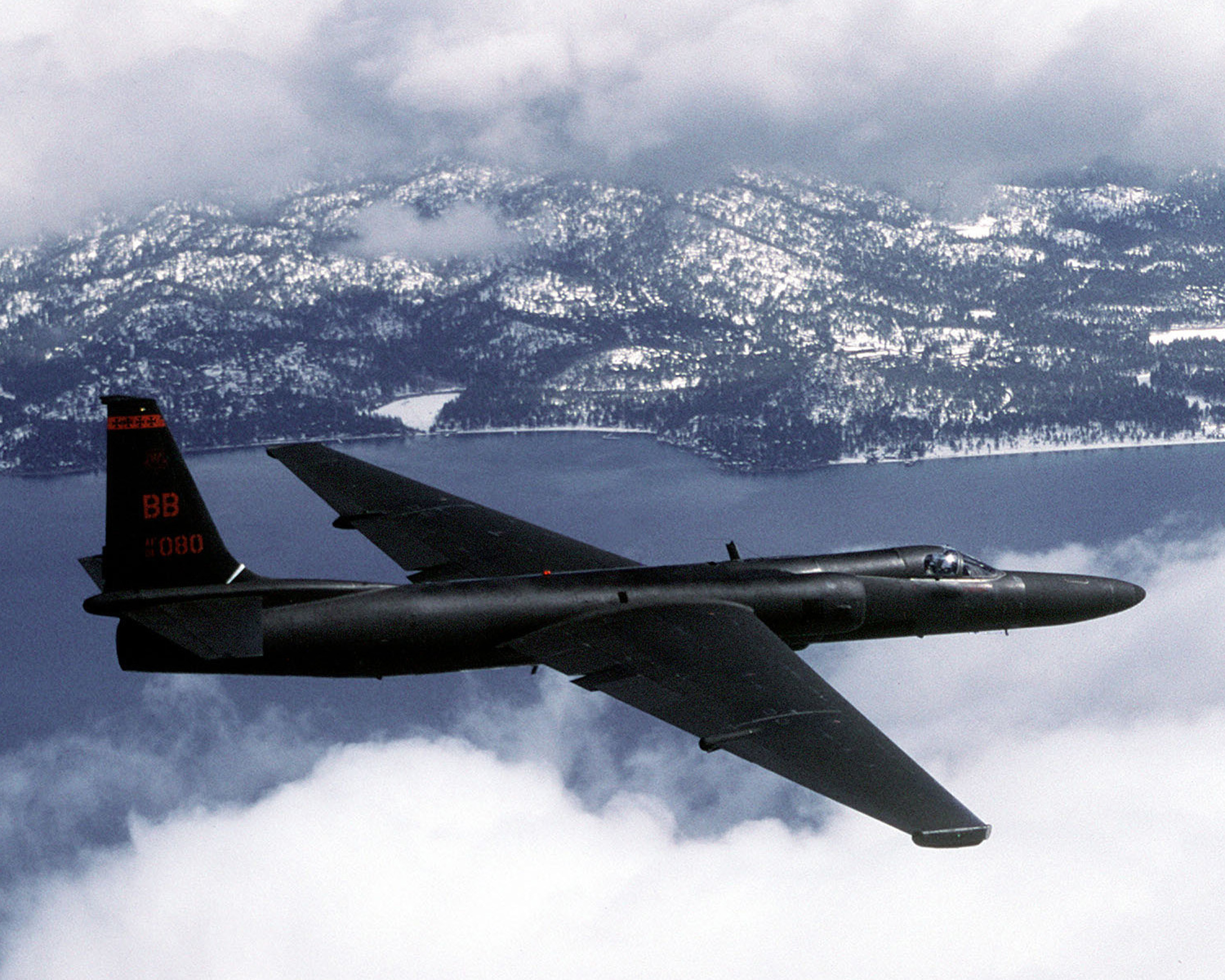
The conference in question was the US-Soviet Summit meeting held in Paris on May 16th, 1960, and the words above were Dwight Eisenhower’s. Just weeks earlier, the Soviets had shot down an American U-2 CIA spy plane and captured it’s pilot Gary Powers. The Soviet leader Nikita Khrushchev lost no time in lashing out against the US President during the Summit, holding him directly responsible for the collapse of the talks, which many on both sides had hoped would usher in a period of “peaceful coexistence” between the superpowers.
Khrushchev called the espionage sanctioned by Eisenhower a provocative and aggressive act against the Soviet Union.
“We regret that this Meeting has been torpedoed by the reactionary element in the United States as the outcome of provocative flights by American military planes over the Soviet Union. […] Let the shame and blame for it fall on those who have proclaimed a brigand policy in relation to the Soviet Union…” (1).
Eisenhower, who is said to have been furious at Khrushchev’s public attacks, replied forthwith:
“I have come to Paris to seek agreements with the Soviet Union which would eliminate the necessity for all forms of espionage, including overflights. I see no reason to use this incident to disrupt the conference.”
“Should it prove impossible, because of the Soviet attitude, to come to grips here in Paris with this problem and the other vital issues threatening world peace, I am planning in the near future to submit to the United Nations a proposal for the creation of a United Nations aerial surveillance to detect preparations for attack. This plan I had intended to place before this conference. This surveillance system would operate in the territories of all nations prepared to accept such inspection. For its part, the United States is prepared not only to accept United Nations aerial surveillance but to do everything in its power to contribute to the rapid organization and successful operation of such international surveillance” (2).
I find this all absolutely fascinating, and mentioned the exchange to colleagues at UNOSAT just a few weeks ago at CERN in Geneva. The UN’s Operational Satellite Program was actually created 40 years after Eisenhower’s threats to set up UN aerial surveillance unit. It was equally fascinating to learn about UNOSAT’s analysis of satellite imagery during Sri Lanka’s military attacks in April. The analysis clearly showed that the military shelled areas where civilians were sheltering in a no-fire zone.
As per UNOSAT’s mandate, this analysis was done regardless of whether the Sri Lankan government was prepared to accept such inspection, and rightly so.
Military attacks are not random, they are organized. This by definition means that preparations for military attacks reveal patterns. Heavy equipment, military trucks, jeeps, etc., all need to be mobilized in a coordinated manner. I recently spoke with one of the world’s leading experts on automated change detection of satellite imagery and he confirmed that algorithms could now be developed to detect specific types of traffic patterns, for example.
Will the UN ever be allowed to monitor and detect preparations for attack? After all, the first Article of the Charter commits the UN to “maintain international peace and security, and to that end: to take effective collective measures for the prevention and removal of threats to the peace […].” Can a US President today commit the UN to a full fledged international aerial surveillance program? There clearly is a strong precedent and it is important we not forget this important piece of history.
The Treaty establishes a regime of unarmed aerial observation flights over the entire territory of its participants. The Treaty is designed to enhance mutual understanding and confidence by giving all participants, regardless of size, a direct role in gathering information about military forces and activities of concern to them. Open Skies is one of the most wide-ranging international efforts to date to promote openness and transparency of military forces and activities.
UN Secretary-General Ban Ki-Moon is calling for better real-time data on the impact of the financial crisis on the poor. To this end, he is committing the UN to the development of a Global Impact and Vulnerability Alert System (or GIVAS) in the coming months. While I commend the initiative’s focus on innovative data collection, I’m concerned that this is yet another “early warning system” that will fail to bridge alert and operational response.
The platform is being developed in collaboration with the World Bank and will use real time data to assess the vulnerability of particular countries or populations. “This will provide the evidence needed to determine specific and appropriate responses,” according to UNDP. UN-Habitat opines that the GVA will be a “vital tool to know what is happening and to hold ourselves accountable to those who most need our help.”
According to sources, the objective for the GIVAS is to “ensure that in times of global crisis, the fate of the poorest and most vulnerable populations is not marginalized in the international community’s response. By closely monitoring emerging and dramatically worsening vulnerabilities on the ground, the Alert would fill the information gap that currently exists between the point when a global crisis hits vulnerable populations and when information reaches decision makers through official statistical channels.”
GIVAS will draw on both high frequency and low frequency indicators:
“The lower frequency contextual indicators would allow the Alert system to add layers of analysis to the real time “evidence” generated by the high frequency indicators. Contextual indicators would provide information, for example, on a country’s capacity to respond to a crisis (resilience) or its exposure to a crisis (transmission channels). Contextual indicators could be relatively easily drawn from existing data bases. Given their lesser crisis sensitivity, they are generally collected less frequently without losing significantly in relevance.”
“The high frequency indicators would allow the system to pick up significant and immediately felt changes in vulnerability at sentinel sites in specific countries. This data would constitute the heart of the Alert system, and would provide the real-time evidence – both qualitative and quantitative – of the effects of external shocks on the most vulnerable populations. Data would be collected by participating partners and would be uploaded into the Alert’s technical platform.”
“The pulse indicators would have to be highly crisis sensitive (i.e. provide early signals that there is a significant impact), should be available in high periodicity and should be able to be collected with relative ease and at a reasonable cost. Data would be collected using a variety of methodologies, including mobile communication tools (i.e. text messaging), quick impact assessment surveys, satellite imagery and sophisticated media tracking systems.”
The GIVAS is also expected to use natural language processing (NLP) to extract data from the web. In addition, GIVAS will also emphasize the importance of data presentation and possibly draw on Gapminder’s Trendalyzer software.
There’s a lot more to say on GIVAS and I will definitely blog more about this new initiative as more information becomes public. My main question at this point is simple: How will GIVAS seek to bridge the alert-response gap? Oh, and a related question: has the GIVAS team reviewed past successes and failures of early warning/response systems?
The 2005 World Disasters Report stated that “information is a vital form of aid in itself [since] disaster affected people need information as much as water, food, medicine or shelter. Information can save lives, livelihoods and resources.”
As we know only too well, information is often one of the first casualties in crises: crippled communications and shattered transportation links present significant obstacles. Communication with beneficiaries is rarely high on the priority lists of many relief responders.
The Thomson Reuters Foundation is therefore proposing to tackle this problem with the creation of an Emergency Information Service (EIS). The concept is simple:
Deploy highly mobile reporting teams to disaster zones to disseminate fast, reliable information to affected populations. The EIS will untangle the often chaotic information flows from governments, international agencies and domestic aid players, producing trustworthy material in local languages for distribution by domestic media, cell phone networks and other methods appropriate to circumstances.
Thompson Reuters wants to send out teams of specialist reporters to cover unfolding disaster zones and channel vital information directly to affected communities. The teams would also interface with governments, the military, the United Nations, international NGOs and local charities.
I can see how this would address some of the current shortcomings, but I’m not convinced about sending in teams of reporters. For one, how will EIS deal with governments that refuse entry into their disaster effected regions? We need a less “egocentric” approach, one that seeks “the proper balance between the need for external assistance and the capacity of local people to deal with the situation” (Cardona 2004).
EIS’s reporting strategy appears to replicate the top-down, external approach to humanitarian response instead of empowering local at-risk communities directly so they can conduct their own reporting and communicating. For example, why not include a strategy to improve and expand citizen journalism in crisis zones?
In any case, I think EIS’s disseminating strategy includes some good ideas. For example:
Remote information terminals: These are low-cost computer terminals to be distributed en masse to affected villages, local NGOs, media outlets etc. Terminals will be wind-up or solar-powered laptops capable of being connected to mobile or satellite phones. With minimal training, local people can set up the terminals and use them to gain critical information about relief efforts or trace relatives.
Mobile phone distributions: In many crisis situations, SMS messaging is possible even when other communications are destroyed or overloaded. The distribution of thousands of low-cost handsets to community leaders, NGO volunteers and members of the local media could create a “bush telegraph” effect and allow two-way interaction with beneficiaries.
Recorded information bulletins: Mobile phone users will be able to dial in to regularly updated, local-language bulletins giving the latest information on health, shelter, government response and so on.
Zero-tech solutions: Megaphones, posters, leaflet drops, bulletin boards, community newsletters.
In order for this to catch, ENS should be set up to provide services during times of non-disasters as well.
In terms of next steps:
“The Thomson Reuters Foundation will soon launch a new website – www.trust.org – to serve as a gateway for all its activities. The Emergency News Agency and AlertNet will be core components of the new site. Trust.org will provide a single point of access for aid professionals, journalists, pro bono service providers, donors and members of the public. Telecommunications allowing, it could also serve as a powerful resource centre for communities affected by disasters.”
For more information on the Emergency News Service, please see this thinkpaper (PDF).
This blog entry was inspired by Ory’s recent blog post on “Covering the DRC – challenges for Ushahidi.” The thoughts that follow were originally intended for the comments section of Ushahidi’s blog but they surreptitiously morphed into a more in depth reflection. First, however, many thanks to Ory for taking the time to share the team’s experience in the DRC over the past few weeks.
Much of what Ory writes resonates with my own experience in conflict early warning/response. While several factors contribute to the challenge of Ushahidi’s deployment, I think one in particular regrettably remains a constant in my own experience: the link to early response, or rather the lack thereof. The main point I want to make is this: if Ushahidi addresses the warning-response gap, then Ushahidi-DRC is likely to get far more traction on the ground than it currently is.
To explain, if Ushahidi is going to provide a platform that enables the crowdsourcing of crisis information, then it must also facilitate the crowdsourcing of response. Why? For otherwise the tool is of little added value to the individuals who constitute said crowd, ie, the Bottom of the Pyramid (BoP) in conflict zones. If individuals at the BoP don’t personally benefit from Ushahidi, then they should not be spending time/resources on communicating alerts. As one of my dissertation committee members, Peter Walker wrote in 1991 vis-a-vis famine early warning/response systems in Africa:
It must be clearly understood that the informants are the most important part of the information system. It is their information […] upon which the rest of the system is based […]. The informant must be made to feel, quite rightly, that he or she is an important part of the system,not just a minion at the base, for ever giving and never receiving.
In 1988 (that’s write ’88), Kumar Rupesinghe published a piece on disaster early warning systems in which he writes that civil society has
… a vital role to play in the development of a global, decentralized early warning system. They now need the capacity to build information systems and to provide the basis for rapid information exchange. In general [civil society] will have to confront the monopolization of information with a demand for the democratic access to information technology.
Information on local concerns must be available to the local structures in society. The right to be informed and the right to information have to find entry into international discussions.
Ushahidi’s crowdsourcing approach has the potential to reverse the monopolization of information and thereby create a demand for access to conflict information. Indeed, Ushahidi is starting to influence the international discourse on early warning (forthcoming reports by the EC and OECD). However, it is the mobile crowdsourcing of response that will create value and thereby demand by the BoP for Ushahidi.
Put it this way, Twitter would be far less useful if it were limited to one (and only one) global website on which all tweets were displayed. What makes Twitter valuable is the ability to select specific feeds, and to have those feeds pushed to us effortlessly, using Twhirl or similar programs, and displayed (in less than 141 characters) on our computer screens in real time. At the moment, Ushahidi does the equivalent of the former, but not the latter.
Yet the latter is precisely where the added value to the individual lies. An NGO may be perfectly content with Ushahidi’s current set up, but NGOs do not constitute the BoP; they are not the “fundamental unit” of crowdsourcing—individuals are. (Just imagine if Wikipedia entries could only be written/edited by NGOs).
This mismatch in fundamental units is particularly prevalent in the conflict early warning/response field. NGOs do not have the same incentive structures as individuals. If individuals in at-risk communities were to receive customized alerts on incidents in/near their own town (if they themselves send alerts to Ushahidi), then that response presents a far more direct and immediate return on investment. Receiving geo-specific alerts in quasi real-time improves situational awareness and enables an individual to take a more informed decision about how to respond to the alerts. That is added value. The BoP would have an incentive, empowerment, to crowdsource crisis information.
Here’s a scenario: if an individual texts in an alert for the first time, Ushahidi should: (1) contact that person as soon as possible to thank them for their alert and, (2) ask them what SMS alerts they would like to receive and for what town(s). I guarantee you this person will spread the word through their own social network and encourage others to send in alerts so that they too may receive alerts. (Incidentally, Erik, this is the strategy I would recommend in places like Jos, Nigeria).
In summary, while the Ushahidi team faces a multitude of other challenges in the DRC deployment, I believe that addressing the early response dimension will render the other challenges more manageable. While the vast majority of conflict early warning systems are wired vertically (designed by outsiders for outsiders), the genius of Ushahidi is the paradigm shift to horizontally wired, local early warning/response, aka crowdsourcing.
In a way, it’s very simple: If Ushahidi can create value for the BoP, the client base will necessarily expand (substantially). To this end, Ushahidi should not be pitched as an early warning system, but rather as an early response service. This is one of the reasons why I am trying hard to encourage the operationalization of mobile crisis mapping.
I thrive when working across disciplines, building diverse cross-cutting coalitions to create, translate and apply innovative strategies driven by shared values. This has enabled the 20+ organizations I’ve worked with, and those I’ve led, to accelerate meaningful and inclusive social impact.
Which is why I've been called a social entrepreneur and a translational leader by successful innovators. President Clinton once called me a digital pioneer, while recent colleagues describe me as kind, dedicated, values-driven, authentic, creative, ethical, and impactful.



 iRevolutions
.jpg)