Category Archives: Humanitarian Technologies

New Publications on Haiti, Crowdsourcing and Crisis Mapping

Two new publications that may be of interest to iRevolution readers:

MIT’s Journal, Innovations: Technology, Governance, Globalization just released a special edition focused on Haiti which includes lead articles by President Bill Clinton and Digicel’s CEO Denis O’Brien. My colleague Ida Norheim-Hagtun and I were invited to contribute the following piece: Crowdsourcing for Crisis Mapping in Haiti. The edition also includes articles by Mark Summer from Inveneo and my colleague Josh Nesbit from Medic:Mobile.

The SAIS Review of International Affairs recently published a special edition on the cyber challenge threats and opportunities in a networked world, which includes an opening article on Internet Freedom by Alec Ross. My colleague Robert Munro and I were invited to submit write the following piece: The Unprecedented Role of SMS in Disaster Response, which focuses specifically on Haiti. Colleagues from Havard University’s Berkman Center also had a piece on Political Change in the Digital Age, which I reviewed here.

Please feel free to get in touch if you’d like copies of the articles on Haiti. In the meantime, here is a must-read for everyone working in Haiti: “Foreign Friends, Leave January 12th to Haitians.”

Will Using ‘Live’ Satellite Imagery to Prevent War in the Sudan Actually Work?

Update: Heglig Crisis 2012, Border Clashes 2012, Invasion of Abyei 2012

The Satellite Sentinel Project has hired private satellites to monitor troop movements around the oil-rich region of Abyei during the upcoming Sudanese referendum and prevent war. The images and analysis will be made public on the Project’s website. George Clooney, who catalyzed this joint initiative between Google, UNOSAT, the Enough Project, Trellon and my colleagues at the Harvard Humanitarian Initiative (HHI), calls this the anti-genocide paparazzi:

“We want them to enjoy the level of celebrity attention that I usually get. If you know your actions are going to be covered, you tend to behave much differently than when you operate in a vacuum.”

The group hopes that they can deter war crimes by observing troop buildups and troop movements in advance. If successful, the project would accomplish an idea first proposed more than half-a-century ago  by US President Dwight Eisenhower during a US-Soviet Summit in Paris at the height of the Cold War. Eisenhower announced his plan to “submit to the United Nations a proposal for the creation of a United Nations aerial surveillance to detect preparations for attack.” Interestingly, Eisenhower had crafted this idea five years earlier as part of his Open Skies Proposal, which actually became a treaty in 2002:

“The Treaty establishes a regime of unarmed aerial observation flights over the entire territory of its participants. The Treaty is designed to enhance mutual understanding and confidence by giving all participants, regardless of size, a direct role in gathering information about military forces and activities of concern to them. Open Skies is one of the most wide-ranging international efforts to date to promote openness and transparency of military forces and activities.”

If you want to find out more about Eisenhower’s efforts, please see my blog post on the subject here.

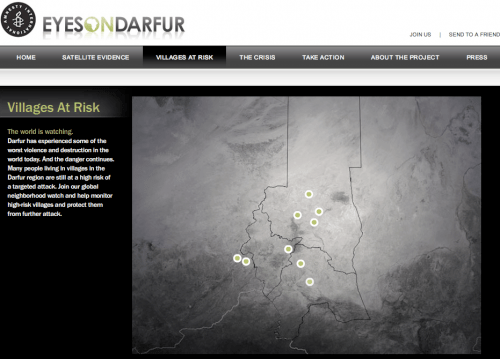
So there is some precedence for what Clooney is trying to pull off. But how is the Sentinel project likely to fare as a non-state effort? Looking at other non-state actors who have already operationalized Eisenhower’s ideas may provide some insights. Take Amnesty International’s “Eyes on Darfur” initiative, which “leverages the power of high- resolution satellite imagery to provide unim- peachable evidence of the atrocities being committed in Darfur–enabling action by private citizens, policy makers and international courts.”

According to Amnesty, the project “broke new ground in protecting human rights by allowing people around the world to literally ‘watch over’ and protect twelve intact, but highly vulnerable, villages using commercially available satellite imagery.” The imagery also enabled Amnesty to capture the movement of Janjaweed forces. Amnesty claims that their project has had a deterrence effect. Apparently, the villages monitored by the project have not been attacked while neighboring ones have. That said, at least two of the monitored villages were removed from the site after reported attacks.

Still Amnesty argues that there have been notable changes in decisions made by the Bashir government since “Eyes on Darfur” went live. They also note that the government of Chad cited their as one of the reasons they accepted UN peacekeepers along their border.

In my blog post on Eisenhower’s UN surveillance speech I asked whether the UN would ever be allowed to monitor and detect preparations for attack using satellite imagery. I now have my answer given that UNOSAT is involved in the Sentinel Project which plans to “deter the resumption of war between North and South Sudan” by providing an “early warning system to deter mass atrocities by focusing world attention and generating rapid responses on human rights and human security concerns” (Sentinel). But will these efforts really create an effective deterrence-based “Global Panopticon”?

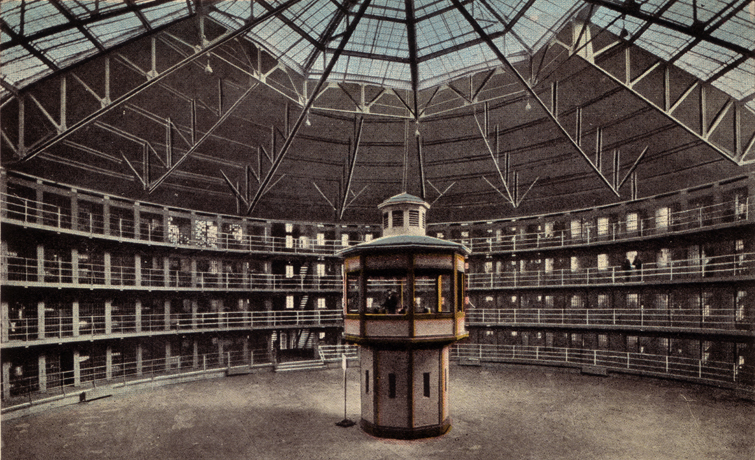
French philosopher Michel Foucault has famously written on the role of surveillance as an instrument of power. “He cites the example of Jeremy Bentham’s ‘Panopticon,’ an architectural model for a prison enabling a single guard, located in a central tower, to watch all of the inmates in their cells.  The ‘major effect of the Panopticon,’ writes Foucault, is ‘to induce in the inmate a state of conscious and permanent visibility that assures the automatic functioning of power.'”

According to Foucault, the Panopticon renders power both “visible and unverifiable”: Visible: the inmate will constantly have before his eyes the tall outline of the central tower from which he is being spied upon. Unverifiable: the inmate must never know whether he is being looked at at any one moment; but he must be sure that he may always be so. But potential perpetrators of the violence in the Sudan do not actually see the  outline of the satellites flying overhead. They are not being directly harassed by high-powered “cameras” stuck into their faces by the anti-genocide paparazzi. So the power is not directly visible in the traditional sense. But who exactly is the inmate in or connected to Abyei in the first place?

There are multiple groups in the area with different agendas that don’t necessarily tie back to the Sudanese government in Khartoum. The Arab Misseriya tribe has thus far remained north during this dry season to avert confrontation with the Ngok Dinka in the Southern part of Abyei. These nomadic tribes typically carry Kalashnikovs to guard their cattle. So distinguishing these nomads from armed groups prepared to raid and burn down villages is a challenge especially when dealing with satellite imagery. Using UAV’s may be more useful and cheaper. (Note that monitoring the location and movement of cattle could be insightful because cattle issues are political in the area).

If armed groups who intend to burn down villages are the intended inmates, do they even know or care about the Satellite Sentinel Project? The ICC has already struggled to connect the chain of command back to the Sudanese government. Besides, the expected turn-around time to develop the satellite imagery is between eight to twenty-four hours. Getting armed men on a truck and raiding a village or two doesn’t take more than a few hours. So the crimes may already have been committed by the time the pictures come in. And if more heavy military machinery like tanks are rolled in, well, one doesn’t need satellite imagery to detect those.

As scholars of the panopticon have noted, the successful use of surveillance has to be coupled with the threat of punishment for deviant acts. So putting aside the issue of who the intended inmates are, the question for the Sentinel Project is whether threats of punishment are perceived by inmates as sufficiently real enough for the deterrence to work. In international relations theory, “deterrence is a strategy by which governments threaten an immense retaliation if attacked, such that aggressors are deterred if they do not wish to suffer great damage as a result of an aggressive action.”

This means that official state actors need to step up and publicly pledge to carry out the necessary punishment if the satellite imagery collected by Sentinel provides evidence of wrong-doing. The ICC should make it crystal clear to all inmates (whoever they are) that evidence from the satellite imagery will be used for prosecution (and that they should care). There also need to be armed guards in  “the tower” who are proximate enough to be deployed and have the political will to use force if necessary. Or will the anti-genocide paparazzi’s many eyes be sufficient to keep the peace? It’s worth remembering that the Hollywood paparazzi haven’t exactly turned movie stars into alter boys or girls. But then again, they’d probably get away with a whole lot more without the paparazzi.

US spy satellites have no doubt monitored conflict-prone areas in the past but this  hasn’t necessarily deterred major crimes against humanity as far as I know. Of course, the imagery collected has remained classified, which means the general public hasn’t been able to lobby their governments and the international community to act based on this information and shared awareness.

The Sentinel Project’s open source approach changes this calculus. It may not deter the actual perpetrators, but the shared awareness created thanks to the open data will make it more difficult for those who can prevent the violence to look the other way. So the Satellite Sentinel Project may be more about keeping our own governments accountable to the Responsibility to Protect (R2P) than deterring actors in the Sudan from committing further crimes.

How will we know if Clooney succeeds? I’m not quite sure. But I do know that the Sentinel Project is a step in the right direction. More evidence is always more compelling than less evidence. And more public evidence is even better. I have no doubt therefore that Eisenhower would back this Open Skies project.

p.s. It is worth noting that the satellite imagery of Sri Lankan forces attacking civilians in 2009 were dismissed as fake by the Colombo government even though the imagery analysis was produced by UNOSAT.

Technologies and Practice for the Prevention of Mass Atrocity Crimes

I’ve waited years for a conference like this: “Early Warning for Protection: Technologies and Practice for the Prevention of Mass Atrocity Crimes.”

This high-level conference combines my main areas of interest: conflict early warning, crisis mapping, civilian protection and technology. I’ll be giving a keynote presentation on “The Potential of New Technologies in Conflict Early Warning” at this conference next week, and I’m particularly looking forward to the panel that will follow, co-organized with my colleague Phoebe Wynn-Pope.

The conference will explore a number of issues.

  • What is the role of new technologies in conflict early warning and how do they interact with more traditional monitoring systems?
  • How can we harness, coordinate, and utilize the sometimes overwhelming amount of information available?
  • What systems and mechanisms need to be put in place to ensure effective early-warning is given?
  • How does the humanitarian sector work effectively with communities at risk once early-warning has been sounded?
  • How can a change in attitude and behavior at a policy level be brought about in a way that forestalls a descent to violence?

In preparing for the presentation, I started re-reading some papers I had written several years ago including this one from 2008: “Bridging Multiple Divides in Early Warning and Response: Upgrading the Role of Information and Communication Technology” (PDF). I will base my presentation in part on this paper and welcome any feedback readers may have. If you don’t have time to read a 25-page paper, here’s a short summary in bullet point format:

  • The field of conflict early warning has largely been monopolized by academics who are obsessed with forecasting conflict.
  • Operational conflict early warning systems are little more than glorified databases.
  • The conflict early warning community’s track-record in successfully predicting (let alone preventing) armed conflict is beyond dismal.
  • State-centric and external approaches to conflict early warning and rapid response have almost systematically failed.
  • The disaster early warning community have long advocated for a people-centered approach to early warning given the failures of top-down, institutional methods.
  • The disaster early warning community has been an early adopter of new technologies, particularly those engaged in public health.
  • The purpose of a people-centered approach is to empower individuals so they can mitigate the impact of a disaster on their livelihoods and/or to get out of harm’s way.
  • Preparedness and contingency planning are core to a people-centered approach since natural hazards like earthquakes can’t be easily predicted let alone stopped.
  • Given the dismal failure of conflict early warning systems, the conflict prevention community should make conflict preparedness and contingency planning a top priority.
  • Precedents for a people-centered approach to conflict early warning  exists in the fields of strategic nonviolent action and digital activism.
  • More importantly, communities that experienced conflict have developed sophisticated coping strategies to evade and survive.
  • Some of these communities already use technologies to survive.

I will expand on these points with several real-world examples and, more importantly, will combine these with what I have learned over the past two years, specifically in terms of crisis mapping, new technologies and civilian resistance. I’m excited to put all of my thoughts together for this conference, and I especially look forward to feedback from readers and conversing with participants.


Analyzing Call Dynamics to Assess the Impact of Earthquakes

Earthquakes can cripple communication infrastructure and influence the number of voice calls relayed through cell phone towers. Data from cell phone traffic can thus be used as a proxy to infer the epicenter of an earthquake and possibly the needs of the disaster affected population. In this blog post, I summarize the findings from a recent study carried out by Microsoft Research and the Santa Fe Institute (SFI).

The study assesses the impact of the 5.9 magnitude earthquake near Lac Kivu in February 2008 on Rwandan call data to explore the possibility of inferring the epicenter and potential needs of affected communities. Cellular networks continually generate “Call Data Records (CDR) for billing and maintenance purposes” which can be used can be used to make inferences following a disaster. Since the geographic spread of cell phones and towers is not randomly distributed, the authors used methods to capture propagating uncertainties about their inferences from the data. This is important to prioritize the collection of new data.

The study is based on the following 3 assumptions:

1. Cell tower traffic deviates statistically from the normal patterns and trends in case of an unusual event.
2. Areas that suffer larger disruptions experience deviations in call volume that persist for a longer period of time.
3. Disruptions are overall inversely proportional to the distance from the center(s) of a catastrophe.

Based on these assumptions, the authors develop algorithms to detect earthquakes, predict their epicenter and infer opportunities for assistance. The results? Using call data to detect when in February 2008 the earthquake took place yields a highly accurate result. The same is true for predicting the epicenter. This means that call activity and cell phone towers can be used as a large-scale seismic system.

As for inferring hardest hit areas, the authors find that their “predicted model is far superior to the baseline and provides predictions that are significantly better for k = 3, 4 and 5″ where k represents the number of days post-earthquake. In sum, “the results highlight the promise of performing predictive analysis with existing telecommunications infrastructure.” The study is available on the Artificial Intelligence for Development (AI-D) website.

In the future, combining call traffic data with crowdsourced SMS data (see this study on Haiti text messages) could perhaps provide even more detailed information on near real-time impact and needs following a disaster. I’d be very interested to see this kind of study done on call/SMS data before, during and after a contested election or major armed conflict. Could patterns in call/SMS data in one country provide distinct early warning signatures for elections and conflict in other crises?

Crowdsourcing the Analysis of Satellite Imagery for Disaster Response

I recently got a call from a humanitarian colleague in the field who asked whether it would be possible to crowdsource the basic analysis of satellite imagery.  They wanted to know because their team was sitting on a pile of satellite imagery but did not have the time or  staff to go through the high-resolution pictures. They wanted to use the imagery to identify where IDPs were located in order to know where to send aid via helicopters.

My colleague’s question reminded me of the search for Steve Fossett, a famous adventurer who went missing in September 2007 after taking off from a small airport in Nevada in a small single-engine airplane. The area where Steve went missing is particularly rugged terrain. The search and rescue aircraft were not able to find any sign of wreckage. However, high-resolution satellite imagery from GeoEye enabled Amazon to produce a Help Find Steve Fossett website, allowing volunteers to search small sections of the available imagery.

“This is an approach to more rapidly search a large area of imagery using many eyeballs of people around the world. A similar technique was used to search for Jim Gray, a Microsoft scientist who went missing on his sailboat off the coast of California.”

Micro-tasking the analysis of satellite imagery has already been done.  So why not in the context of disaster response? One could add this feature to a platform like Crowdflower, which is already being used as a plugin to micro-task the processing of text messages from disaster affected areas. Instead of text, volunteers would see a small subsection of satellite imagery. They’d be asked whether they could see any evidence of individuals in the imagery and if so how many approximately they can make out. A simple 5-minute guide on how to identify people and approximate population size using satellite imagery could be put on YouTube for volunteers to watch before getting started.

Like any type of micro-tasking approach (a.k.a. mechanical turk service), one could triangulate answers to maintain some level of quality control. For example, only when 10 volunteers each tag an image as having individuals in it would the picture be processed as such. The same would apply to the population ranged estimated in a given image. This wouldn’t necessarily produce perfect results, but it would take the bulk of the load off the shoulders of humanitarian on the ground. It would act as a first filter.

Of course the obvious question that arises is security and privacy. There are several ways this could be addressed. First, images would be stripped of any GPS coordinates. Second, images would be sliced up in small bits to prevent easy recognition of the territory. Third, a volunteer would not be given contiguous slices so they couldn’t piece together more information from the satellite imagery. These measures won’t provide 100% security and privacy. The only way to achieve that would be to use bounded crowdsourcing, i.e., only have trusted individuals analyze the imagery.

The Best Part of ICCM 2010, Not.

I facilitated a self-organized session on launching a Standby Crisis Mappers Task Force  at the Annual Meeting of Crisis Mappers. I blogged about this idea before the International Conference on Crisis Mapping (ICCM 2010). Talk about a mistake and a missed opportunity.

I had clearly mentioned in my blog post and in my opening remarks that I was going to experiment with a model to set up a more formal volunteer network using the Ushahidi platform because that’s the tool I know best and because the bulk of this network already exists; because that’s what I can guarantee and take responsibility for getting  done—and not just talk about endlessly saying  wouldn’t it be nice if… At no point did I suggest that the other technology groups could not do the same. On the contrary, I invited them to step up to the plate and do the same, to take responsibility; take ownership.

The reaction from our humanitarian colleagues was largely positive with some important constructive advice. Not so with one of the technology groups present. The response from this group was that we couldn’t be the first to focus on preparedness more actively because of perception issues, i.e., that the Standby Force would be synonymous with Ushahidi and thence favored by UN colleagues who would adopt the platform instead of the other technology platforms.

My response? I immediately apologized for my faux-pas and promptly proposed not to call this initiative the Crisis Mappers Task Force. I vouched to be more explicit that the standby volunteer group I’m personally working to set up with a few colleagues would first and foremost be a network trained on the Ushahidi platform and surrounding ecosystem, e.g., OpenStreetMap, Google Earth, etc.  because that’s what we’re good at. And as one of my colleagues who has trained more volunteer Crisis Mappers than anyone else said, “When I’m training volunteers it is never only on the Ushahidi platform, we have to use several other important platforms to make all this work.”

After this comment, I once again invited this other tech group (and everyone else present) to strengthen our initiative by setting up a joint standby network in collaboration with ours. I clearly said we would happily share our lessons learned on the volunteer model we are testing. No one has a monopoly on preparedness!

But that wasn’t good enough for this tech group. They also said we couldn’t go ahead and recruit, formalize and train a volunteer network on the Ushahidi platform because they would miss out on consulting opportunities and funding. Note: at no point did I ever suggest that this volunteer network would request funding or that we have a monopoly over the volunteer network we are recruiting. Again, the point was/is to use Ushahidi to experiment and test a standby model for volunteer engagement. Indeed, any other tech group is more than welcome to train the volunteers we’re recruiting on their own platforms.  Indeed, if someone else had proposed a Standby Volunteer Network dedicated to crisis mapping before me, I would have joined theirs immediately and offered to train their network tomorrow.

But did this technology group step up to the plate and offer to train the volunteers we’re recruiting? No. Were they pro-active and did they take the opportunity to join and strengthen the initiative? No. Did they make any commitment whatsoever? No, they just did not want us to move forward and implement a core principle of disaster response: preparedness. I have little patience with this kind of positioning and jockeying. Needless to say, I don’t think our humanitarian colleagues were particularly impressed either.

So where does this leave us? Where we started: my colleagues are pressing forward to formalize a standby volunteer network around the Ushahidi platform, which again does not prevent other groups from doing the same and/or joining the initiative. This network of Ushahidi users largely exists already, we’re simply formalizing it so we can be better prepared. We absolutely want the volunteers we recruit to be conversant with the rich ecosystem of different humanitarian technologies that are of interest to them.

I don’t know how much more clear of a signal I can possibly send: please join us and help us strengthen this network.

If this particular tech group I’m referring to doesn’t step up to the plate and instead chooses to criticize others who take initiative, then they ought to know that the real perception issue here is this: humanitarian colleagues  and others  who were present at the session will perceive this particular tech group as being insincere about disaster preparedness.

The UN’s Global Survey of Early Warning Systems commissioned by the former UN Secretary General and carried about by the UN International Strategy for Disaster Reduction (UNISDR) defines the purpose of people-centered early warning systems as follows:

To empower individuals and communities threatened by hazards to act in sufficient time and in an appropriate manner so as to reduce the possibility of personal injury, loss of life, damage to property and the environment, and loss of livelihoods.

I was at the Third International Conference on Early Warning (EWC3) in 2006 where this report was first presented publicly. The key to effective people-centered early warning systems is preparedness. We want to empower an online community to use a wide mix of Crisis Mapping tools to act in sufficient time and in an appropriate manner (with guidance from the humanitarian community) to reduce the possibility of personal injury, loss of life, damage to property and the environment and loss of livelihoods for those threatened by hazards.

If I could train volunteers on 5 different platforms, I would. But I can’t because I’m not an expert on the other platforms and I already have a full time job (and then some). That’s why I took the initiative to organize the pre-conference Crisis Mapping Training Session at ICCM 2010. If we had had more space, time and timely funding, I would have organized an all day training on a dozen platforms and would happily do so on a regular basis. So I’m trying to play my role in this but I will absolutely not take responsibility for others who don’t step up and act  but instead complain because my colleagues and I are choosing to act.

No one has a monopoly on preparedness.

My Introductory Remarks at ICCM 2010

Below is the “speech” I gave to open the 2010 International Conference on Crisis Mapping (ICCM 2010) in Boston on October 1, 2010.

____________________________________

Welcome the 2010 International Conference on Crisis Mapping! This is truly a remarkable turnout, thank you for making the time to join us today. We had expected some 200 participants to show up, but we got double. If you’re new to the Crisis Mappers Network, welcome to the team! It’s really great to have you and we very much look forward to your contributions. If you were with us for last year’s conference, it’s wonderful to have you back after what has certainly been a defining year for Crisis Mapping.

Indeed, the Crisis Mappers Network has grown substantially since we last met. We now have close to 1,000 members in over 30 countries. There are more than 100 organizations represented in this auditorium today. The Crisis Mappers website itself has been accessed from no fewer than 104 countries. The purpose of this international network is to catalyze communication, collaboration and partnerships between members. Our mission is to advance the study and practice of Crisis Mapping worldwide. We do this by organizing the annual International Conference on Crisis Mapping, which brings together high level policymakers, seasoned humanitarian and human rights practitioners, the technology community including both private sector and nonprofit groups, and the academic, research community.

We also pursue our mission by providing our members with an active social networking platform, CrisisMappers.net, where they can blog, engage in discussion forums, watch a unique set of video presentations on crisis mapping projects and contribute to regular webinars. In addition, the Crisis Mappers Network provides an active list-serve for members to communicate and collaborate, especially during crises.

Indeed, this list-serve, the Crisis Mappers Google Group, played a pivotal role in the hours, days and weeks following the earthquake in Haiti. Members of the Network exchanged thousands of emails on this list-serve, sharing critical information ranging from satellite imagery and GIS data to contact lists for key organizations and personnel, important logistics data, locations of IDP camps, and so on. I highly recommend reading this study conducted by my colleague Jen Ziemke which provides hundreds upon hundreds of detailed examples on exactly how members of this network collaborated in the response.

The disaster response to Haiti was indeed unprecedented in a number of ways. One was the number of technology platforms deployed (many from scratch) in the wake of the disaster. Another distinctive element was the volunteer network that sprung into action on a range of projects in collaboration with members of the Crisis Mappers Network. In fact, hundreds of students from this University, The Fletcher School plus undergraduate students, were actively involved in the response. And many of them are here with us in this auditorium today.

In addition, we know that some 2,000 volunteers in about 40 countries were also engaged in the Crisis Mapping efforts, many of them from the Haitian Diaspora. None of these volunteers were ever physically in Haiti but they were still an important part of the operational response thanks to the open collaborative networks they created and the free, open source mapping technologies they used.

The unprecedented nature of this response represents an important opportunity.  At the same time, because many aspects of the response to Haiti were unprecedented, this also means they were necessarily reactive, ad hoc and unprepared. Yet the response nevertheless demonstrated a clear potential. It is now up to the members of this network to grab the opportunity that exists and turn this potential into actuality. The political will is there on all sides to collaborate and learn from each other. The technology community is becoming a more important actor in both the humanitarian and human rights space. The volunteer networks are not new per se but the collaboration between dedicated volunteers and the technology community has certainly created a number of new opportunities for disaster response and beyond.

So the question now is, how do we take these informal, distributed and ad hoc networks and allow them to interface effectively and in a timely way with structured humanitarian organizations? Some colleagues and I believe that one way to do so is by setting up a Standby Crisis Mappers Task Force composed of skilled and experienced volunteers and humanitarian professionals who have been engaged in previous Crisis Mapping operations. We hope that other professional volunteer communities like some friends at CrisisCommons who are interested in mapping will help us to strengthen this initiative.

Now, it is important to remember that Haiti was and remains an outlier. We were indeed very lucky in that information security and government oversight played a limited role. It truly was an open effort. Contrast this to the challenges of crisis mapping in places like Pakistan, Afghanistan, Burma, Liberia or the Sudan. It is these challenges that we must also address at this International Conference on Crisis Mapping. So as we plan for the future, we can and should be inspired by Haiti but we must be careful not to use the response to Haiti as the only model for crisis mapping. Indeed, the title of this year’s conference is Haiti and Beyond.

And this is why senior representatives of many important humanitarian organizations are here today because they want to engage the new opportunities that do exist and they understand the challenges that necessarily come with exploring new territory. Key members of the technology community are also here because they too want to engage and learn how to become more effective and reliable partners in the humanitarian space. Seasoned humanitarian and human rights practitioners are also in the auditorium, and many of them participated in yesterday’s Crisis Mapping Training Session because they recognize the value of expanding their own skill set to leverage the new technologies that are coming online.

Some of the key volunteers from the responses to Haiti, Chile and Pakistan are also here because they are committed to formalizing and professionalizing their role in this more multipolar system. And guess what? A number of these volunteers were already planning to pursue a career in the humanitarian space before Haiti. And others, who weren’t planning to beforehand, are now inspired to pursue a career path in this sector. So these volunteer networks are looking to the humanitarian community for mentorship and guidance.

Finally, the research community and media are both here today as well because they are looking for ways to bring this innovation and inspiration back into the classroom and to a broader audience.

So I think you’ll agree with me when I say that we have many of the right people here in the room today to catalyze the new collaboration and partnerships that will enable all of us to be more adaptive and effective actors in the humanitarian space. Indeed, the opportunity is well within our grasp.

And this opportunity would clearly not be possible were it not for every single one of you choosing to be present here in this auditorium right now. So thank you once again for your time and for joining us. You are the conference. And this opportunity would certainly not be possible without the tremendous sponsorship support that the Crisis Mappers Network has received for this annual Conference on Crisis Mapping. Let me then take this opportunity to thank our following friends: Humanity United, the Knight Foundation, the Open Society Institute, the US Institute of Peace, ESRI, Google, the Hitachi Center at the Fletcher School, Ushahidi, the World Bank, the Human Security Institute at the Fletcher School, the Institute for Global Leadership at Tufts University, the GIS Center at Tufts University and last but not least, GeoTime. So if you see any of our friends during the breaks today, please do take a moment to thank them in person.

Like last year, the co-organizing institutions for the Crisis Mapping Conference are the Harvard Humanitarian Initiative (HHI) and John Carrol University. Many, many thanks indeed to both. I would also like to thank Jen Ziemke, my fellow co-organizer for the conference. This conference series would not exist had Jen not actually suggested the idea 3 years ago. So Jen, thank you very much for a brilliant idea! Finally, I want to express my huge gratitude to all our phenomenal volunteers who have once again gone above and beyond to save the day. You all know who you are, thank you very very much.

And now on with the show! We have a very interesting series of presentations lined up for you this morning and afternoon. We’ll kick off shortly with the first session of Ignite Talks. These talks are 5 minutes a piece with 20 powerpoint slides that automatically forward every 15 seconds. And there’s no stopping! This should definitely be very entertaining or a complete mess. The first session will focus primarily on Haiti and then shift to broader issues. The second session of Ignite Talks, which are scheduled for this afternoon, will look at the opportunities and challenges of crisis mapping beyond Haiti.

In between these Ignite sessions, we will have plenty of breaks for you to network with each other and engage the speakers in person.

We will also have some special remarks from UN Assistant Secretary General Dr. Choi who is the first Chief Information Technology Officer for the United Nations Secretariat. Our Keynote speaker this year is Mr. Kurt Jean-Charles, the CEO of Solutions, a Haitian software company that was directly involved in the disaster response following the earthquake. My colleague Jen Ziemke will introduce both of our distinguished guests more formally before their presentations.

Finally, we have an exciting display of projects and technologies for you at this year’s Technology and Analysis Fair which will kick off this afternoon following the second session of Ignite Talks. This will be a great opportunity for us to learn more about new crisis mapping technologies and projects.

If you plan to Tweet and/or blog about the presentations today, please do and please use the hashtag “ICCM10” And feel free to use the CrisisMappers.net website to publish or cross post your blog posts, to chat live about the presentations, and so on.

Thanks very much for listening.

Calling 911: What Humanitarians Can Learn from 50 Years of Crowdsourcing

Before emergency telephone numbers existed, one would simply pick up the receiver and say “get me the police” when the operator answered. In fact, operators became the first point of contact for emergency dispatch. They would keep lists of specific numbers in their local towns (local fire department, local doctor, etc) to provide a very personalized emergency service and fast track response.


London was the first city to deploy an emergency number system. The number 999 was launched on June 30, 1937. When called, “a buzzer sounded and a red light flashed in the exchange to attract an operator’s attention” (1). The first number to be used in North America was the 911 system deployed in Winnipeg, Canada in 1959. The first US system, also using the 911 number, was launched in Alabama and Alaska in 1968. It wasn’t until the 1980s, however, that 911 was adopted as the standard number across most of the country.

Today, about 240 million 911 calls are made in the US each year, 30%-50% of which are placed using wireless services, and this number is increasing steadily.

When discussing the use of crowdsourcing to collect crisis information in humanitarian disasters, one of the overriding concerns is: “But what if the information is false? How can we trust that the information reported is true?” We forget that national emergency telephone systems have faced the same challenge for half-a-century. Indeed, 911 is a 50 year-old crowdsourcing system! So our colleagues in law enforcement may have learned a few things during this time, which could inform our work in the humanitarian field.

Incidentally, this may be a silly question but why in the world did governments set up  emergency phone numbers if the information collected using this crowdsourced approach is not immediately verifiable? Have the police gone nuts? What were/are they thinking? Were police crowdsourcing reports before telephone lines sprung up across the country? Maybe one had to run, bike or drive to the police station. Or if you were lucky, perhaps you’d have a police officer strolling the streets at just the right time.

So why not keep that good old analog system then? Well, lets face it, do we really want to leg it to the station every time something’s strange in the neighborhood?  No, we want to be able to call…

Can we assume that we’ll always be mobile during an emergency? Do we want to leave it up to chance that a fire truck might be patrolling the streets when the house next door house goes up in flames? Probably not.

In fact, the world’s oldest emergency (crowdsourcing!) call service—the UK’s 999—was introduced over 70 years ago after a London fire on November 10, 1935 killed 5 women. A neighbor had tried to phone the fire brigade but was held up in a queue by the telephone exchange. Neighbor Norman was so outraged that he wrote a letter to the editor of The Times:

A public outcry resulted (which could have been crowdsourced and mapped on an Ushahidi platform as a complaints mechanism):

This prompted a government inquiry. And thus was born the largest crowdsourcing system of the day. Rather ironic that it was ultimately user generated content that created today’s national emergency phone services. Wouldn’t it be great to get a UN inquiry along those same lines that established a crowdsourcing system for humanitarian crises? Sounds crazy, I know, but hey, 999 probably sounded a little nuts back in 1937 as well. And yet, they decided to test the idea in London, then extended trials in Glasgow and within 10 years the entire country was covered. I don’t see why a similar iterative approach couldn’t work in disaster response.

But what challenges does an emergency phone system face? The misuse and abuse of 911 can be divided into 2 categories: unintentional and intentional calls (2). The former includes phantom calls, misdials and hang-up calls. Lets focus on the latter issue, which be divided into the following categories: Non-emergency Calls, Prank Calls, Exaggerated Calls and Lonely Complainant Calls.

  • Non-emergency Calls: reports suggest that non-emergency calls account for a large percentage of 911 calls. For example, callers will phone in to report their car radio getting stolen, or ask for the results of a football game, the time of day, etc. 911 operators even get callers who ask them to transfer their calls to another number since calling 911 is free.
  • Prank Calls: most agencies apparently do not keep figures on total number of prank calls but these generally come from children and teenagers. Diversionary calls represent a sub-category of prank calls. Callers will dial 911 to send the police to a location where not emergency has occurred, sometimes to divert attention away from criminal activity committed by the caller. “There are only a few ways to determine if a call is diversionary: if the caller admits it; if someone informs on the caller; or if the dispatcher or police compare the caller’s location with that of the alleged emergency, to determine if the caller could plausibly claim an emergency at the called in location” (4).
  • Exaggerated Emergency Calls: callers will sometime intentionally exaggerate the seriousness of an emergency expecting that the police will respond faster. It is reportedly unclear how extensive this problem is.
  • Lonely Complainant Calls: other callers will repeatedly report an emergency over a series of month or years but the police never find evidence of there being one. These calls are often made by the elderly and those with mental health problems.

As these news articles here & here show, false reports to 911 can claim lives. Does this mean that law enforcement is considering pulling the plug on the 911 system? Of course not. So how does law enforcement deal with all this? Lets stick to prank and diversionary calls since this comes closest to the most pressing concerns we face in the humanitarian context. (Note the other issues listed above are typically addressed by educating the public).

Law enforcement’s response to prank calls involves targeting violators and applying graduated sanctions, such as fines or jail time. In Ohio, a public service announcement made clear to users that “we know where you are” when you call 911. Prank calls reportedly dropped as a result (5). Police can also take action by targeting specific phones that are used for prank calls. In another example, a hotel in Vegas routed all 911 calls to hotel security for triage after a large number of false 911 reports were made to the fire department.

Could we do something similar within a humanitarian operation? There’s already precedent to prosecute hate-based SMS, as happened in Kenya. We could work with telcos in question to send out a mass SMS broadcast to all subscribers letting them know they can be prosecuted for deliberately reporting false information.

That’s not a silver bullet, of course, but it seems to help national emergency phone systems. We could also draw on natural language processing (NLP) technologies like Swift River to create veracity ratings for crowdsourced reports. Of course, when confronted with a major disaster, everyone may be calling 911 at the same time, thus overwhelming capacity to respond.

In terms of this operational response, one partial answer may be revitalizing Community Emergency Response Teams (CERTs). Another partial answer may be the idea of crowdfeeding, or crowdsourcing response as I blogged about here based on a recent presentation I gave at Red Cross Conference in DC. During that same conference, the Red Cross revealed the results of a study on the role of social media in emergencies, which showed that more than 70% of those surveyed expect a response within an hour after posting a request on an social media platform. Now, there are too few disaster response professionals to assign to every street to meet those expectations (not to mention the cost implications). So they can’t always be there, but the crowd, by definition, is always there.

In the case of national phone emergency systems, there are usually laws that require the police to respond (not that they always do). This may be difficult to work out in the context of humanitarian response. So let me share an anecdote from the Ushahidi-Haiti Project. One of our overriding concerns after launching the 4636 short code with colleagues was raising expectations among those texting that someone would respond to these SMS’s. Three points:

1) Colleagues and I spent hours on Haitian Diaspora radio and television answering questions from listeners and viewers about the purpose of 4636. We made it very clear that the service was simply an information service and that we couldn’t guarantee any kind of response. We also explained that some responders like the US Coast Guard and Marine Corps were prioritizing life and death situations and therefore were not responding to every text message. This helped callers understand the purpose and limits of the service.

2) As a result of these concerns regarding expectations, my colleague Jaroslav Valuch and I recommended that PakReport.org adjust their public messaging campaign by asking people to report their observations instead of their needs. One could also invite people to text in their complaints, thus crowdsourcing perceptions (real or otherwise) of frustration and discontent which could provide humanitarians with important situational awareness. But this too may raise expectations of response. So sticking with simple reports based on observations is sometimes more prudent.

3) As studies from Aceh (the 2004 tsunami) and Pakistan (the 2005 earthquake) showed, it is important to communicate with disaster affected communities, even if the message is that help is not yet on the way. See Imogen Hall’s research and the CDAC consortium, for example.

I’m using the 911 emergency system as an analogy and don’t pretend that the model can be automatically applied to the humanitarian context. But these phone-based emergency crowdsourcing systems have been around for half-a-century and it would be naive to discount any of the lessons learned and best practices that this wealth of experience has produced across such a large scale.

Disaster Relief 2.0: Towards a Multipolar System?

My colleague Adele Waugaman from the UN Foundation & Vodafone Foundation Technology Partnerships has kindly invited some colleagues and I to participate on the following panel at the Mashable Social Good Summit:

Disaster relief 2.0: collaborative technologies & the future of aid
In humanitarian crises, information-sharing and coordination among relief agencies is essential. But what about communications between aid groups and individuals? From Haiti to Pakistan, collaborative technologies are enabling survivors and concerned citizens alike to become important sources of information. Join innovation experts to discuss how new citizen-centered technologies are shaping the future of disaster relief.

I expect that the panel will set the stage and tone for the upcoming 2010 International Conference on Crisis Mapping (ICCM 2010) in Boston in two weeks time. What follows then is a quick recap of where we are in the field of disaster 2.0 and where we might be headed. The recap is based on conversations with colleagues at OCHA and the Crisis Mappers Network, particularly with Oliver Hall and Nigel Snoad.

What Happened

I think it’s fair to say that the disaster response to Haiti was a departure from the past in more ways than one. The Crisis Mappers Network while relatively new played an impressive role in catalyzing rapid collaboration and open information sharing as detailed in this empirical study. In addition, the response to Haiti saw widespread and global volunteer involvement from the Haitian Diaspora and university students: more than 2,000 volunteers based in some 40 countries used their cognitive surplus to try and help those affected by the earthquake thousands of miles away. Ushahidi-Haiti and Mission4636 are both examples of volunteer based projects.

Craig Fugate is the head of FEMA

My friend and colleague Chris Blow described the change best in his phenomenal presentation on Crisis Mapping and Interaction Design. The following slides depict what we are all experiencing–the shift to a multipolar system:

In sum, the rise in informal volunteer networks is shifting the disaster response system towards a more multipolar one, not only in terms of actors but also in terms of the new technologies they employ.

Where To From Here

What does this mean for the future of disaster relief? I think this remains to be seen. The new “world order” brings new possibilities and new consequences. The shift will require both formal and informal actors to adapt and interface in different ways. If the analogy to international relations (unipolar vs multipolar world orders) is apt, then this suggests that new “institutions” are perhaps needed to manage the new constellation of actors.

The launch of the Crisis Mappers Network is a direct response to this transition. The network comprises some 900 members from both state and non-state, formal and informal actors including all the major humanitarian organizations and technology groups in the world. The newly established group Communications with Disaster Affected Communities (CDAC) is an important member. The purpose of the Crisis Mappers Network is to catalyze information sharing, collaboration, partnerships and joint learning in this rapidly changing space—hence the Crisis Mapping Conference series, Annual Meeting of the Crisis Mappers Group, Crisis Mapping Trainings, monthly webinars, blog posts, online discussions and the dedicated Crisis Mappers Google Group.

I believe the Crisis Mappers Group provides an ideal forum to help shape the new conversations, policies and applied research necessary to improve disaster relief 2.0. We need to consider new coordination and cooperation frameworks that connect formal actors with informal networks. As a community, we also need to catalyze joint learning so that informal actors deploying new technologies can learn from more experienced actors who have established best practices in disaster response.

Our Questions

The world of disaster relief 2.0 also brings new possibilities to render humanitarian response more effective and accountable. How can formal actors and informal networks collaborate to foster and implement innovations in humanitarian technology? How do we evaluate this collaboration and the impact of individual crisis mapping initiatives? Information sharing and interoperability are two additional challenges that need to be tackled by the Crisis Mapping Community. This inevitably means that some basic data standards need to be defined—or have existing ones communicated in an accessible manner to volunteer and informal networks.

Some of the most pressing questions in this new “world order” have to do with replicability and sustainability—not to mention leadership—of new crisis mapping initiatives. The challenge of future replicability (and hence reliability) is an issue that colleagues at OCHA communicated to me just weeks after Haiti; rightly so since Ushahidi-Haiti and Mission4636 were both self-organized volunteer driven efforts. I do believe there is room to professionalize some volunteer groups, hence the launch of Universities for Ushahidi (U4U) next month. It is also worth noting that Ushahidi-Chile deployed even more rapidly than Ushahidi-Haiti, even though the former was also purely volunteer driven. The same is true of the Ushahidi-Pakistan deployment called PakReport.

Sustainability in my opinion is less of a challenge if these volunteer groups are well organized and linked to local communities. In the case of Ushahidi-Haiti, for example, the project was successfully transitioned to Solutions.ht, a local software company in Port-au-Prince. But the question of leadership—or governance—is one that has not been sufficiently addressed. An accessible code of conduct is needed to guide informal actors who wish to volunteer their time in aid of disaster response projects. Not all volunteers will add value. Some may actually be disruptive if not destructive. How should state-actors and informal networks manage such situations? This code of conduct should also focus on establishing standards for local ownership, data privacy and data security.

In Sum…

The level of information sharing, collaboration and volunteer involvement in the disaster response to Haiti was unprecedented. This also means it was completely reactive, which is why the disaster relief 2.0 panel and Crisis Mapping Conference are important. They give us the opportunity to begin aligning expectations and catalyze new, responsible partnerships between established actors and informal networks so they can be more deliberate and less reactive in future responses.

In sum, while the transition to a multipolar system may initially bring some disruption, we can all choose to collaborate, iterate and learn quickly to become a more adaptive, transparent and effective community.

Swarming Crisis Response

[Cross-posted from my Conflict Early Warning Blog]

John Arquilla had a very interesting Op-Ed in the New York Times this weekend on “The Coming Swarm.” I’ve been interested in John’s work for years given his application of complexity science to the study of terrorism and would have assigned this Op-Ed as required reading for the graduate course I co-taught on “Complexity Science and International Relations.”

John writes about the recent simultaneous suicide attacks in Kabul last week and argues that a new ‘Mumbai model’ of swarming, smaller-scale terrorist violence is emerging:

The basic concept is that hitting several targets at once, even with just a few fighters at each site, can cause fits for elite counterterrorist forces that are often manpower-heavy, far away and organized to deal with only one crisis at a time.

[…] This pattern suggests that Americans should brace for a coming swarm. Right now, most of our cities would be as hard-pressed as Mumbai was to deal with several simultaneous attacks. Our elite federal and military counterterrorist units would most likely find their responses slowed, to varying degrees, by distance and the need to clarify jurisdiction.

Current strategy for counterterrorism contemplates having to respond using “overwhelming force” to as many as three simultaneous terrorist attacks. This would imply mobilizing as many as 3,000 ground troops to each site.

If that’s an accurate picture, it doesn’t bode well. We would most likely have far too few such elite units for dealing with a large number of small terrorist teams carrying out simultaneous attacks across a region or even a single city.

“So how are swarms to be countered?” John asks. In his opinion,

The simplest way is to create many more units able to respond to simultaneous, small-scale attacks and spread them around the country. This means jettisoning the idea of overwhelming force in favor of small units that are not “elite” but rather “good enough” to tangle with terrorist teams. In dealing with swarms, economizing on force is essential.

For the defense of American cities against terrorist swarms, the key would be to use local police officers as the first line of defense instead of relying on the military. The first step would be to create lots of small counterterrorism posts throughout urban areas instead of keeping police officers in large, centralized precinct houses. This is consistent with existing notions of community-based policing […]

At the federal level, we should stop thinking in terms of moving thousands of troops across the country and instead distribute small response units far more widely.

I think John’s recommendations are very important and directly applicable to the field of operational crisis early warning and rapid response, particularly on the response side.  This means taking more of a people-centered or community-based approach to early response and shifting away from the top-down mentality of “The Responsibility to Protect” to one of “The Responsibility to Empower” from the bottom-up.