Category Archives: Humanitarian Technologies

Here Come the Crowd-Sorcerers: “No We Can’t, No We Won’t” says Muggle Master

Sigh indeed. Yawn, even.

The purpose of this series is not to make it about Paul and Patrick. That’s boring as heck. The idea behind the series was not simply to provoke and use humorous analogies but to dispel confusion about crowdsourcing and thereby provide a more informed understanding of this methodology. I fear this is getting completely lost.

Recall that it was a humanitarian colleague who came up with the label “Crowd Sorcerer”. It made me laugh so I figured we’d have a little fun by using the label Muggle in return. But that’s all it is, good fun. And of course many humanitarians see eye to eye with the Crowd Sorcerer approach, so apologies to those who felt they were wrongly placed in the Muggle category. We’ll use the Sorting Hat next time.

Henry and Erik from Ushahidi

This is not about a division between Crowd Sorcerers and Muggles. As a colleague recently noted, “the line lies somewhere else, between effective implementation of new tools and methodologies versus traditional ways of collecting crisis information.” There are plenty of humanitarians who see value in trying out new approaches. Of course, there are some who simply say “No We Can’t, No We Won’t.”

There’s no point going back and forth with Paul on every one of his issues because many of these have actually little to do with crowdsourcing and more to do with him being provoked. In this post, I’m going to stick to the debate about the in’s and out’s of crowdsourcing in humanitarian response.

On Verification

Muggle Master: And of course the way in which Patrick interprets those words bears little relation to what those words actually said, which is this: “Unless there are field personnel providing “ground truth” data, consumers will never have reliable information upon which to build decision support products.”

I disagree. Again, the traditional mindset here is that unless you have field personnel (your own people) in charge, then there is no way to get accurate information. This implies that the disaster affected populations are all liars, which is clearly untrue.

Verification is of course important—no one said the contrary. Why would Ushahidi be dedicating time and resources to the Swift platform if the group didn’t think that verification was important.

The reality here is that verification is not always possible regardless of which methodology is employed. So it boils down to this: is having information that is not immediately verified better than having no information at all? If your answer is yes or “it depends”, then you’re probably a Crowd Sorcerer. If your answer is, “lets try to test some innovative ways to make rapid verification possible,” then again, you likely are a Crowd Sorcerer/ette.

Incidentally, no one I know has advocated for the use of crowdsourced data at the expense of any other information. Crowd Sorcerers and (many humanitarians) are simply suggesting that it be considered one of multiple feeds. Also, as I’ve argued before, a combined approach of bounded and unbounded crowdsourcing is the way to go.

On Impact Evaluation

The Fletcher Team has commissioned an independent evaluation of the Ushahidi deployment in Haiti to go beyond the informal testimonies of success provided by first responders. This is a four-week evaluation lead by Dr. Nancy Mock, a seasoned humanitarian and M&E expert with over 30 years of experience in the humanitarian and development field.

Nathan Morrow will be working directly with Nancy. Nathan is a geographer who has worked extensively on humanitarian and development information systems. He is a member of the European Evaluation Society and like Nancy a member of the American Evaluation Association. Nathan and Nancy will be aided by a public health student who has several years of experience in community development in Haiti and is a fluent Haitian Creole speaker.

The evaluation team has already gone through much of the data and been in touch with many of the first responders as well as other partners. Their job is to do as rigorous an evaluation  as possible and do this fully transparently. Nancy plans to present her findings publicly at the 2010 Crisis Mappers Conference where we’ve dedicated a roundtable to reviewing these findings, as well as other reviews.

As for background, the ToR (available here) was drafted by graduate students specializing in M&E and reviewed closely by Professor Cheyanne Church, who teaches advanced graduate courses on M&E. She is considered a leading expert on the subject. The ToR was then shared on a number of listserves including the ReliefWeb, CrisisMappers Group and Pelican (a listserve for professional evaluators).

Nancy and Nathan are both experienced in the method known as utilization-focused evaluation (UFE), an approach chosen by The Fletcher Team to ensure that the evaluation is useful to all primary users as well as the humanitarian field. The UFE approach means that the ToR is a living document and being adapted as necessary by the evaluators to ensure that the information gathered is useful and actionable, not just interesting.

We don’t have anything to hide here, Muggles. This was a complete first in terms of live crisis mapping and mobile crowdsourcing. Unlike the humanitarian community, we weren’t prepared at all, nor trained, nor had prior experience with live crisis mapping and mobile crowdsourcing, nor with the use of crowdsourcing for near real-time translation, nor with managing hundreds of unpaid volunteers, nor did the vast majority of them have any background in disaster response, nor were most able to focus on this full time because of their under/graduate coursework and mid-term exams, nor did they have direct links or contacts with first responders prior to the deployment, nor did the many responders know they existed and/or who they were. In sum, they had all the odds stacked against them.

If the evaluation shows that the deployment and the Fletcher Team’s efforts didn’t save lives or are unlikely to have saved any lives, rescued people, had no impact, etc., none of us will dispute this. Will we give up? Of course not, Crowd Sorcerers don’t give up. We’ll learn and do better next time.

One of the main reasons for having this evaluation is not only to assess the impact of the deployment but to create a concrete list of lessons learned so that what didn’t work then is more likely to work in the future. The point here is to assess the impact just as much as it is to assess the potential added value of the approach for future deployments.

How can anyone innovate in a space riddled with a “No We Can’t, No We Won’t” mindset? Trial and error is not allowed, iterative learning and adaptation is as illegal as the dark arts. Some Muggles really need to read this post “On Technology and Learning, or Why the Wright Brothers Did Not Create the 747.” If die-Hard Muggles had had their way, they would have forced the brothers to close up shop after just their first attempt because it “failed.”

Incidentally, the majority of development, humanitarian, aid, etc., projects are never evaluated in any rigorous or meaningful way (if at all, even). But that’s ok because these are double (Muggle) standards.

On Communicating with Local Communities

Concerns over security need not always be used as an excuse for not communicating with local communities. We need to find a way not to exclude potentially important informants. A little innovation and creative thinking wouldn’t hurt. Humanitarians working with Crowd Sorcerers could use SMS to crowdsource reports, triangulate as best as possible using manual means combined with Swift River, cross-reference with official information feeds and investigate reports that appear the most clustered and critical.

That way, if you see a significant number of text messages reporting the lack of water in an area of Port-au-Prince then at least this gives you an indication that something more serious may be happening in that location and you can cross-reference your other sources to check whether the issue has already been picked up. Again, it’s this clustering affect that can provide important insights on a given situation.

This would provide a mechanism to allow Haitians to report problems (or complaints for that matter) via SMS, phone, etc. Imogen Wall and other experienced humanitarians have long called for this to change. Hence the newly founded group Communicating with Disaster Affected Communities (CDAC).

Confusion to the End

Me: Despite what some Muggles may think, crowdsourcing is not actually magic. It’s just a methodology like any other, with advantages and disadvantages.

Muggle Master: That’s exactly what “Muggles” think.

Haha, well if that’s exactly what Muggles think, then this is yet more evidence of confusion in the land of Muggles. Crowdsourcing is just a methodology to collect information. There’s nothing new about non-probability sampling. Understanding the  advantages and disadvantages of this methodology doesn’t require an advanced degree in statistical physics.

Muggle Master: Crowdsourcing should not form part of our disaster response plans because there are no guarantees that a crowd is going to show up. Crowdsourcing is no different from any other form of volunteer effort, and the reason why we have professional aid workers now is because, while volunteers are important, you can’t afford to make them the backbone of the operation. The technology is there and the support is welcome, but this is not the future of aid work.

This just reinforces what I’ve already observed, many in the humanitarian space are still confused about crowdsourcing. The crowd is always there. Haitians were always there. And crowdsourcing is not about volunteering. Again, crowdsourcing is just a methodology to collect information. When the UN does it’s rapid needs assessment does the crowd all of a sudden vanish into thin air? Of course not.

As for volunteers, the folks at Fletcher and SIPA are joining forces to work together on deploying live crisis mapping projects in the future. They’re setting up their own protocols, operating procedures, etc. based on what they’ve learned over the past 6 months in order to replicate the “surge mapping capacity” they demonstrated in response to Haiti and Chile. (Swift River will make the need for a large number of volunteers unnecessary).

And pray tell who in the world has ever said that volunteers should be the backbone of a humanitarian operation? Please, do tell. That would be a nice magic trick.

Muggle Master: “The technology is there and the support is welcome, but this is not the future of aid work.”

The support is welcome? Great! But who said that crowdsourcing was the future of aid work? It’s just a methodology. How can one sole methodology be the future of aid work?

I’ll close with this observation. The email thread that started this Crowd-Sorcerer series ended with a second email written by the same group that wrote the first. That second email was far more constructive and conducive to building bridges. I’m excited by the prospects expressed in this second email and really appreciate the positive tone and interest they expressed in working together. I definitely look forward to working with them and learning more from them as we proceed forward in this space and collaboration.

Patrick Philippe Meier

Crowdsourcing Disaster Preparedness: Time for Some Disruption

We’re well into hurricane season here in Haiti but good luck finding a map on hurricane shelters and evacuation routes. One UN agency was supposed to update a 2007 map but then dropped the ball. Another agency thought they’d take on the task but now there are legal concerns since only the government has the right to decide on official emergency routes and shelters. The result? A highly vulnerable population remains largely unprepared for what many expect will be a busy hurricane season.

Creating country wide maps of hurricane shelters and evacuation routes is obviously no easy task. Or is it? If we adopt the typical top down mentality, then yes, we’re talking about just a handful of people being charged with a huge project that will take them weeks to carry out. With this approach, the maps will completed well after the end of hurricane season. Great.

What if we distributed the task and crowdsourced the maps? We could use the 2007 map of hurricane shelters as a starting point and send out targeted text messages to hundreds of mobile phone users near each of these shelters asking them to report on the condition of each shelter and the access routes. We could triangulate the responses for validation purposes. This could be done tomorrow by using a free short code just like we did during the disaster response operations earlier this year. Since the lottery is big in Haiti, this could serve as an incentive: “timely and accurate replies will qualify you for a raffle.” DigiCel has already conducted SMS raffles in the past, so there is a precedent.

The SMS replies could then be analyzed over the weekend and the results shared with local radio stations early next week. The latter could then broadcast this information on a daily basis. In the meantime, government and UN officials could conduct site visits to improve the shelters and evacuation routes.

An on-line competition could also be launched to have volunteers use Google Earth and other web-based resources to identify areas of land that are elevated in case of flooding. These volunteers could also trace viable roads/paths that lead to and from these areas and mark places that may be vulnerable to landslides and other hazards.

What about the fact that only the government has the legal right to do this? Big deal. The system is not working so it’s time to disrupt it. Would you rather have a crowdsourced disaster preparedness plan now or a government certified plan after the hurricane season? I’m tempted to ask this during tomorrow’s BarCamp Haiti which I am co-organizing with the Haitian tech company Solutions and the Ushahidi Haiti Project.

Patrick Philippe Meier

On Technology and Learning, Or Why the Wright Brothers Did Not Create the 747

I am continuously amazed by critics who outlaw learning curves, especially when it comes to new and innovative projects. These critics expect instantaneous perfection from the outset even when new technologies are involved. So when a new project doesn’t meet their satisfaction (based on their own, often arbitrary measurement of success), they publicly castigate the groups behind the projects for their “failures”.

What would the world look like if these critics were in charge? There would be little to no innovation, progress or breakthrough’s. Isaac Newton would never have spoken the words “If I have seen so far it is because I have stood on the shoulders of giants.” There would be no giants, no perspective, and no accumulation of knowledge.

Take the Wright brothers, Orville and Wilbur, who invented and built the world’s first successful airplane by developing controls that made fixed-wing powered flight possible. They too had their critics. Some of them in “the European aviation community had converted the press to an anti-Wright brothers stance. European newspapers, especially in France, were openly derisive, calling them bluffers.” The Wright brothers certainly failed on numerous occasions. But they kept tinkering and experimenting. It was their failures that eventually made them successful. As the Chinese proverb goes, “Failure is not falling down but refusing to get up.”

The Wright brothers did not create the 747 because they had to start from scratch. They first had to figure out the basic principles of flight. Today’s critics of new technology-for-social impact projects are basically blaming NGOs in the developing world for not creating 747s.

Finally, it is problematic that many critics of technology-for-social impact projects have little to no scholarly or professional background in monitoring and evaluation (M&E). These critics think that because they are technology or development experts they know how to evaluate projects—one of the most common mistakes made by self-styled evaluators as noted at the start of The Fletcher School’s introductory course on M&E.

The field of M&E is a science, not an amateur sport. M&E is an independent, specialized field of expertise in it’s own right, one that requires months (if not several semesters) of dedicated study and training.

Patrick Philippe Meier

Think You Know What Ushahidi Is? Think Again

Ushahidi is the name of both the organization (Ushahidi Inc) and the platform. This understandably leads to some confusion. So let me elaborate on both.

Ushahidi the platform is a piece of software, not a methodology. The Ushahidi platform allows users to map information of interest to them. I like to think of it as democratizing map making in the style of neogeography. How users choose to collect the information they map is where methodology comes in. Users themselves select which methodology they want to use, such as representative sampling, crowdsourcing, etc. In other words, Ushahidi is not exclusively a platform for crowdsourcing. Nor is Ushahidi restricted to mapping crisis information. A wide range of events can be mapped using the platform. Non-events can also be mapped, such as football stadiums, etc.

The platform versus methodology distinction is significant. Why? Because new users often don’t realize that they themselves need to think through which methodology they should use to collect information. Furthermore, once they’ve chosen the methodology, they need to set up the appropriate tools to collect information using that methodology, and then collect.

For example, if a user wants to collect election data using representative sampling, they will need to ensure that they select a sample of polling stations that are likely to be representative of the overall population in terms of voting behavior. They will then need to decide whether they want to use SMS, email, phone calls, etc., to relay that information. Next, they’ll want to hire trusted monitors and train them on what and how to report. But none of this has anything to do with Ushahidi the platform.

Here’s an analogy: Microsoft Word won’t tell me what methodology to use if I want to write a paper on the future of technology. That is up to me, the author, to decide. If I don’t have any training in research methods and design, then I need to get up to speed independently. MS Word won’t provide me with insights on research methods. MS Word is just the platform. Coming back to Ushahidi, if an organization does not have adequate expertise, staff, capacity, time and resources to deploy Ushahidi, that is not the fault of the platform.

In many ways, the use of Ushahidi will only be as good as the organization or persons using the tool.

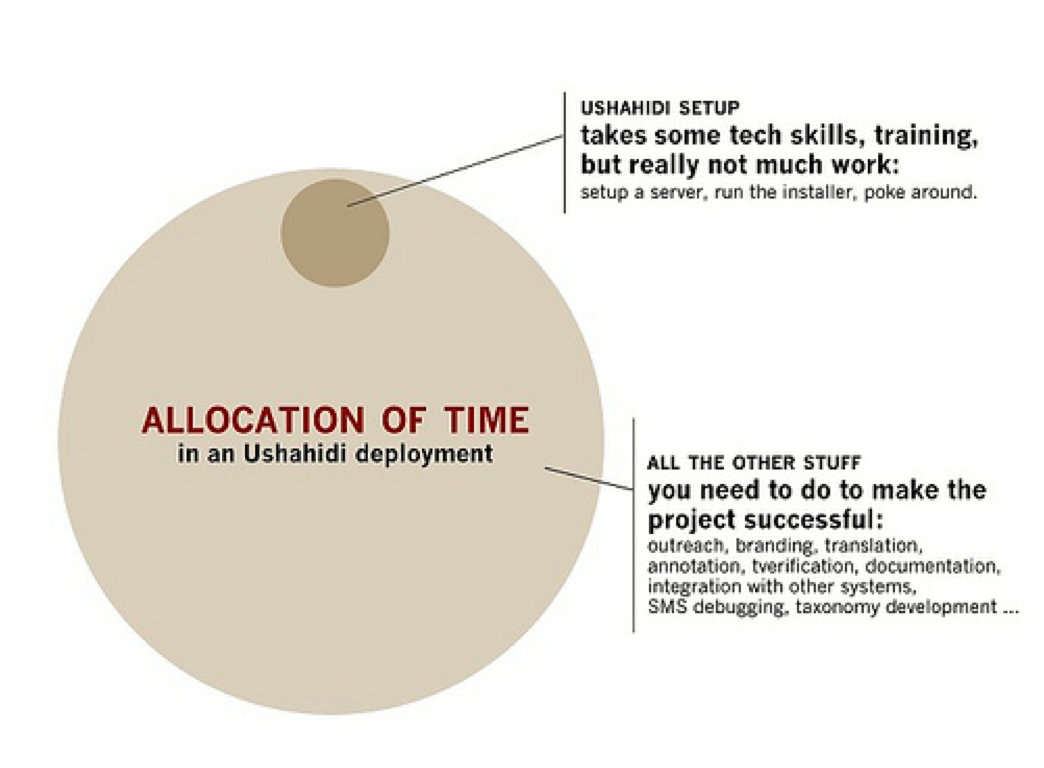
Ushahidi is only 10% of the solution (graphic by Chris Blow)

As my colleague Ory aptly cautioned: “Don’t get too jazzed up about Ushahidi. It is only 10% of the solution.” The other 90% is up to the organization using the platform. If they don’t have their act together, the Ushahidi platform won’t change that. If they do and successfully deploy the Ushahidi platform, then at least 90% of the credit goes to them.

Ushahidi the organization is a non-profit tech company. The group is not a humanitarian organization. We do not take the lead in deployments. In the case of Haiti, I launched the Ushahidi platform at The Fletcher School (where I am a PhD student) and where graduate students (not Ushahidi employees) created a “live” map of the disaster for several weeks. The Ushahidi tech team provided invaluable technical support around the clock during those weeks. It was thus a partnership led by The Fletcher Team.

We do not have a comparative advantage in deploying platforms and our core mission is to continue developing the Ushahidi platform. On occasion, we partner on select projects but do not take the lead on these projects. Why do we partner at all? Because we are required to diversify our business model as part of the grant we received from the Omidyar Network. And I think that’s a good idea.

Patrick Philippe Meier

Information Sharing During Crisis Management in Hierarchical vs. Network Teams

The month of May turned out to be ridiculously busy, so much so that I haven’t been able to blog. And when that happens, I know I’m doing too much. So my plan for June is to slow down, prioritize and do more of what I enjoy, e.g., blog.

In the meantime, the Journal of Contingencies and Crisis Management just published an interesting piece on “Information Sharing During Crisis Management in Hierarchical vs. Network Teams.” The topic and findings have implications for digital activism as well as crisis management.

Here’s the abstract:

This study examines the differences between hierarchical and network teams in emergency management. A controlled experimental environment was created in which we could study teams that differed in decision rights, availability of information, information sharing, and task division. Thirty-two teams of either two (network) or three (hierarchy) participants (N=80 in total) received messages about an incident in a tunnel with high-ranking politicians possibly being present. Based on experimentally induced knowledge, teams had to decide as quickly and as accurately as possible what the likely cause of the incident was: an attack by Al Qaeda, by anti-globalists, or an accident. The results showed that network teams were overall faster and more accurate in difficult scenarios than hierarchical teams. Network teams also shared more knowledge in the difficult scenarios, compared with the easier scenarios. The advantage of being able to share information that is inherent in network teams is thus contingent upon the type of situation encountered.

The authors define a hierarchical team as one in which members pass on information to a leader, but not to each other. In a network team, members can freely exchange information with each other. Here’s more on the conclusions derived by the study:

Our goal with the present study was to focus on a relatively simple comparison between a classic hierarchical structure and a network structure. The structures differed in terms of decision rights, availability of information, information sharing, and task division. Although previous research has not found unequivocal support in terms of speed or accuracy for one structure or the other, we expected our network structure to perform better and faster on the decision problems. We also expected the network teams to learn faster and exchange more specialist knowledge than the hierarchical teams.

Our hypotheses are partially supported. Network teams are indeed faster than hierarchical teams. Further analyses showed that network teams were, on average, as fast as the slowest working individual in the hierarchical teams. Analyses also showed that network teams very early on converged on a rapid mode of arriving at a decision, whereas hierarchical teams took more time. The extra time needed by hierarchical teams is therefore due to the time needed by the team leader to arrive at his or her decision.

We did not find an overall effect of team structure on the quality of team decision, contrary to our prediction. Interestingly, we did find that network teams were significantly better than hierarchical teams on the Al Qaeda scenarios (as compared with the anti-globalist scenarios). The Al Qaeda scenarios were the most difficult scenarios. Furthermore, scores on the Post-test showed that there was a larger transfer of knowledge on Al Qaeda from the specialist to the nonspecialist in the network condition as compared with the hierarchical condition. These results indicate that a high level of team member interaction leads to shared specialist knowledge, particularly in difficult scenarios. This in turn leads to more accurate decisions.

This study focused on the information assessment part of crisis management, not on the operative part. However, there may not be that much of a difference in terms of the actual teamwork involved. When team members have to carry out particular tasks, they may frequently also have to share specialist knowledge. Wilson, Salas, Priest, and Andrews (2007) have studied how teamwork breakdowns in the military may contribute to fratricide, the accidental shooting of one’s own troops rather than the enemy. This is obviously a very operative part of the military task. Teamwork breakdowns are subdivided into communication, coordination and cooperation, with information exchange mutual performance monitoring, and mutual trust as representative teamwork behaviours for each category (Wilson et al., 2007).

We believe that it is precisely these behaviours that are fostered by network structures rather than hierarchical structures. Network structures allow teams to exchange information quickly, monitor each other’s performance, and build up mutual trust. This is just as important in the operative part of crisis management work as it is in the information assessment part.

In conclusion, then, network teams are faster than hierarchical teams, while at the same time maintaining the same level of accuracy in relatively simple environments. In relatively complex environments, on the other hand, network teams arrive at correct decisions more frequently than hierarchical teams. This may very likely be due to a better exchange of knowledge in network teams.

Patrick Philippe Meier

Crisis Response and SMS Systems Management for NGOs and Governments

Guest blog post: Bart Stidham is an enterprise architect committed to bringing positive change to the world via better information systems architecture. He has served as CTO of four companies including one of the largest communications companies in the world, been a senior executive at Accenture, and served as CIO of the largest NGO funded by USAID. He is an independent consultant and can be found in Washington, DC when he is not traveling.

This blog post builds off of and supports Patrick Meier’s previous post on developing an SMS Code of Conduct for Humanitarian Response. Patrick raises many important issues in his post and it is clear that with the success of Ushahidi-Haiti it is likely we will see a vast increase in the use of similar SMS based information management systems in the future. While the deployment of such systems and all communications systems is likely to be orderly and well structured in normal circumstances, it is likely that during crises such order may break down and these systems may negatively impact one another. For this reason I applaud Patrick’s effort to raise this issue but my hope is that the “normal order” imposed by governments and societies will help prevent the potential disruption of communications systems from occurring in disasters, emergencies, and crises.

I believe Patrick’s concerns are best discussed in the larger issue of frequency spectrum management. This is a huge issue and one that needs substantial education within the entire response space. It is a growing problem across each and every communications system not just in crises but also globally as we humans desire to communicate more in more ways and with more devices. There are limits to the amount of information that can be “pushed” through any communications system and those limits increasingly have to do with the laws of physics, not just the design of the systems.

The electromagnetic frequency spectrum (EF) is the basis of all wireless communication. We started our use of it the late 1800s with the first use of radio. Long ago we exhausted the entire spectrum and are now trying to find ways to reuse parts of it more efficiently. However it is critical that we protect this “public commons” on which so many of our communications systems depend.

Every communications system needs a “physical channel” and this varies widely but they all share some common characteristics. One is the problem of “collisions” which are bad because that means that the information is not delivered successfully. As humans using the physical channel of sound and speech we encounter this in our normal conversations whenever we meet in groups. A simple example of a collision is when two or more people are talking loudly over each other with the result being that no one understands what either is saying.

There are multiple ways to deal with collisions and every communications system must manage collisions or the system collapses. One way is to have a token and you are only allowed to talk if you hold the token. This method of managing communications was used brilliantly by various Native American tribes when discussing heated issues such as war – if you are not in possession of the peace pipe (the token) you are not allowed to speak. This forces everyone to listen to what you are saying and to politely take turns speaking. It is passed back and forth and everyone gets a turn. There are several types of network architecture that use this exact method for avoiding collisions.

Another method is collision avoidance by assigning each speaker a window of time to speak in. This is roughly the approach used by GSM for instance. Yet another method is collision detection where you allow for a certain statistical overlap and all parties know that the last “conversation” collided with another and the information was lost. The system then corrects the problem. This is not as efficient but is easy to do and cheap to implement. This is what Ethernet uses.

Finally as systems are deployed and interact with each other in a certain physical space they need to divide up the space. This can be done by frequency or cables or physical area or by time or all of the above.

In our discussion SMS are best likened to frequencies (although this is not an exact analogy). The advantage of them is that no two NGOs can ever end up with the same long code as this is handled by the carriers and their agreements. Internationally no two carriers can ever issue the same phone number or long code globally. If all NGOs stuck with long codes or full phone numbers we could avoid the problem Patrick is rightly concerned with.

NGOs and other organizations can problematically and mistakenly issue the same short code within a geographic area and we should all be concerned about this exactly as Patrick is. This problem can happen because short codes are for humans – not for the system itself. If the carriers are using different underlying cell phone technologies they can both issue the same short code and neither will interfere technically with the other one. Unfortunately it could have disastrous consequences for the socialization of the short codes to the local or larger population if they cross either technical or geographic lines. This is a problem largely unique to SMS and the plethora of technologies,carriers, bands (or frequencies) that can be deployed in a large physical area and the fact that short codes are for human convenience.

Right now there are 14 frequency bands just within the GSM voice system (thankfully quad band phones support all the widely used ones) and another 14 for data (furthermore the data “bands” actually cover a huge range of frequencies). This is why it is possible to have within one region, country or city with two “overlapping” short codes on two or more different carriers – the codes will each work only on the carrier that operates on that actual GSM frequency band. The system doesn’t care but it can be confusing to us humans.

Another thing Patrick has raised as a concern is actually “subject matter frequency” overlap (or collisions) and the confusion that can result to us simpleminded humans.

It makes no difference how many SMS codes are used as long as they are long codes OR if private and on short codes. The only time there is a problem is when two groups set up short codes that become public (meaning they are advertised in some way to the general public) as “the right number for X” where X is the same subject matter area.

In order to speed response many countries do NOT follow the US 911 system which uses a single short number for all emergencies. For instance Austria uses no less than 9 “short code” voice numbers each for a separate emergency type. That’s great if you live there and have them all memorized and know that for extreme sports there is a number just for “alpine rescue” to get your friend off some ledge that he crashed into in his para-glider. It speeds vital response and gets the right team dispatched in the least time. It does however require a massive amount of public education.

In the US the government decided to have a “one number fits all” system. This was in response to the fact that previously we had thousands of local numbers for each fire and police department, hospital and ambulance service. Without a local phone book it wasn’t possible to know who to call in an emergency. We designed the 911 system as a way to solve this problem and looped all three major responders into the one system. This was then deployed on a county by county basis across the US. There is no national 911 system. The system scales by dividing itself into small geographic sections.

SMS systems tend to be larger in size because SMS carriers are geographically larger that the old local phone POP (point of presence) that became the basis of the US 911 system. Another major concern for SMS design is the total carrying capacity of the carrier SMS system itself. SMS is NOT designed to be use for “one to many” messages. That was never part of the design and the system can be knocked out if the overall limits of the system are exceeded. At that point the SMS systems themselves collapse under the load and start failing and can cause a cascade failure of the entire carrier network in a region – this means that SMS can knock out voice. It does appear that such a failure occurred in Haiti to one of the local carriers that implemented an SMS emergency broadcast system in conjunction with an NGO so this is a real problem.

Getting back to Patrick’s identified concern – we should be worried when multiple SMS “subject channels” are socialized via the mass media and it confuses the public. In Haiti that didn’t happen because there was only one due largely to the work and efforts of the 4636 Haiti.Ushahidi community.

I believe in the future that is also unlikely to happen because I hope the mass media outlets will simply refuse to say “use any of the following SMS codes for health and these for x and y and z.” I think they won’t do this haphazardly. Doing so (meaning confusing the public) could endanger their (mass media) operating license from the host country.

Furthermore countries and cities are typically aware of this whole discussion and carefully control the distribution of short codes (but this does vary widely from region to region). The country that issues the carrier the license to operate the infrastructure is the ultimate authority for this and reserves the right to yank someone off the air or kick them out of the country for failure to follow the rules. Frequency spectrum must be managed for the greater public good or the classic “crisis of the commons” will result. This is the concern Patrick has brought to light.
One can not and should not assume that the rules, laws and policies we (individuals) are used to operating under in our home country apply elsewhere. The term “sovereign nation” means exactly that – they set their own laws concerning how things operate – including technology and communications systems. For instance WiFi is NOT WiFi everywhere and a WiFI router sold in Japan is illegal to operate in the US.

Some well meaning but largely uneducated NGOs deployed systems in Haiti that badly broke rules, laws, policies, etc and the Government of Haiti (and the US Government on behalf of the Haitian Government) was very polite to them. They stepped all over local businesses and disrupted them. Had this happened in the US the FCC would have issued huge fines to them – fines that likely would drive them out of business – and for good reason. They are exploiting the “public commons” for their own advantage. Whether they meant to or not is irrelevant just as ignorance of the law is no excuse.

In the past most responders to such emergencies were large NGOs with trained communications teams that knew they must coordinate their use of various communications platforms with each other or everyone would suffer. In this past this was easy and obvious because NGOs, governments and businesses made extensive use of UHF and VHF radios for communications. Because these systems were voice based it was obvious when you had a problem and when someone was on your assigned frequency. Furthermore you frequently had the opportunity to yell at them over that same communications system.

In the era of digital communications systems we no longer have the ability to yell at anyone and in fact both the designed legal and official user and the illegal user may be unaware that they are colliding and causing both systems to fail. This is a huge problem because it means that both parties have no way to know even know they are interfering with each other much less how or where to resolve the problem.

In conclusion, I applaud Patrick’s efforts as he has raised an important issue that all NGOs that respond to emergencies (both in the US and abroad) must to be aware of. Education is critical. Please tell your organization that they must contact and coordinate with the official frequency manager, typically the local government’s communications agency or ministry, prior to deploying any communications equipment. Failing to do so is typically illegal and can have grave consequences in emergencies, crises and disasters.

Rethinking the UN’s Global Pulse

Update: This project is now called UN Global Pulse.

I’m in Bellagio on Lake Como this week for a Blue Sky Thinkers Workshop on the UN’s new Global Pulse Initiative. When I first blogged about GIVAS as it was called back in July 2009, the Pulse Team in the UN Secretary General’s Office actually commented on my blog post. The fact that the UNSG’s Office was taking the time to read blogs and comment on them was the first sign that something about this project was very different from my previous experience with the UN.

We’re under Chatham House Rules here so I’ll just stick to my own thoughts on what I think Global Pulse should be. First, I don’t think Global Pulse should be for the UN or nation states. The global alert system should directly empower vulnerable communities to prevent or mitigate the impact of crises on their own livelihoods. In other words, Global Pulse should be a self-help system for vulnerable communities. The development and maintenance of this system should be the responsibility of the UN and governments.

So here’s an idea (still under development): why not use the QuestionBox technology and approach to create “call in” centers for information on tactics for resilience.

Question Box helps people find answers to everyday questions like health, agriculture, business, education and entertainment. It provides easy access to information in hard-to-reach areas and breaks through technology, language and literacy barriers. We do this through:

  • Live telephone hotlines connected to live operators
  • SMS (Text Messaging)
  • Mobile and solar technologies that operate off the grid
  • Open Question – a simple software to start your own Question Box project

The group behind Question Box also help several organizations start their own Question Box-inspired services. So lets turn Global Pulse into a Global Resilience Information Service for vulnerable communities. There are four key reasons I find this approach compelling. First, this approach provides a demand-driven direct service to vulnerable communities as opposed to just “watching” them. Databases of resilience tactics can be (continually) developed by either local communities themselves or government sponsored projects. This information can then be shared across towns and regions. Think of this as a “Resilience Wiki”.

The second reason I want to continue exploring this system is because the queries made using a Resilience Question Box approach are in and of themselves important indicators. Think of Google’s Flu trends project. The team “found a close relationship between the number of people who search for flu-related topics and the number of people who actually have flu symptoms.” In other words, the queries made to Resilience Question Box could serve as proxy indicators for local vulnerability. This data would then be analyzed for trends and policy making at the UN.

The third reason this approach appeals to me is because it serves the interest of vulnerability communities first and foremost. The rhetoric behind global alert systems is that they are for vulnerable communities but the reality is that these communities rarely know that such systems actually exist. The first indicator of success for Global Pulse will therefore be whether vulnerable communities are aware of Pulse. A second indicator will be whether they actually use the system.

The fourth and final reason I’m keen about a Question Box approach is because of the focus on information for vulnerable communities. In my opinion, most crises are ultimately crises in information, which is another reason why information is power. Imagine if Global Pulse could work with Member States to set up hundreds of thousands of Resilience Boxes. Think of the One Laptop per Child (OLPC). Global Pulse could provide a Resilience Box per Vulnerable Community, enabling the latter to make more informed decisions to increase their own resilience in near real-time.

Now how does one fund all this? I got a possible answer over lunch while talking to one of the participants (whose identity I can’t reveal because of Chatham House Rules). How about a Kiva for Resilience Boxes? Instead of donating money to one (or more) specific project, you could donate money for 50 QuestionBox answers to a specific community in Bangladesh. I personally find that very compelling, i.e., knowing that my money provided 50 answers for vulnerable communities. In return for my donation, perhaps I could also get a copy of the 50 questions/answers and learn something new in the process.

Patrick Philippe Meier

From Grassroots Mapping to One Satellite Per Child

There were some amazing presentations at Where 2.0, but for me personally, Jeffrey Warren’s talk on Community-based Grassroots Mapping with Balloons and Kites in Lima was the most exciting. Jeffrey and his colleagues were inspired by two MIT undergraduate students who “launched a digital camera into near-space to take photographs of the earth from high up above.”

Jeff and colleague traveled to Lima in January 2010 to work with children and adults from several communities to bring a truly participatory (and fun!) approach to mapping.

Seeking to invert the traditional power structure of cartography, the grassroots mappers used helium balloons and kites to loft their own “community satellites” made with inexpensive digital cameras. The resulting images, which are owned by the residents, are georeferenced and stitched into maps which are 100x higher resolution that those offered by Google, at extremely low cost.

In some cases these maps may be used to support residents’ claims to land title. By creating open-source tools to include everyday people in exploring and defining their own geography, we hopes to enable a diverse set of alternative agendas and practices, and to emphasize the fundamentally narrative and subjective aspects of mapping over its use as a medium of control.

Once several pictures have been taken, they can be “stitched together” to form a map like the one below. The stitching can be done by hand or using this neat tool.

All it takes is $100 for the equipment below. In fact, you could even use $1.30 trash bags instead to reduce the cost. I highly recommend looking through this fun illustrated guide.

I also like how the communities used tracing paper to annotate the maps they produced from the balloons. This is something I had wanted to do for this community mapping project in the Sudan.

I absolutely love this project. It’s easy, cheap, participatory, empowering and fun. Jeff and company are democratizing aerial mapping. I’d love to see this approach take off all over the world and would like to find some use cases in the humanitarian context, e.g., in post-disaster reconstruction and development. Imagine if local communities in Haiti could use balloon mapping to hold the development community accountable for the way their own country is being rebuilt. This approach can democratize urban planning in post-disaster environments.

Do check out the Grassroots Mapping website. You can also sign up for the group’s mailing list. If you’re in the Boston area, you may want to join Jeffrey and friends for some balloon mapping excercises. I definitely will! In the meantime, check out Jeff’s Ignite Talk from the 2009 CrisisMappers Conference.

Patrick Philippe Meier

Why Universities are Key for the Future of Crisis Mapping

In January 2010, I launched the Ushahidi Crisis Map for Haiti. In February, I launched the Ushahidi Crisis Map of Chile. Neither initiative would have been possible without the incredible student volunteer network that formed at The Fletcher School/Tufts University, the Graduate Institute in Geneva and Columbia University’s School of International and Public Affairs (SIPA). We also had a few volunteers from the London School of Economics (LSE).

At one point, I had set up a Skype IM chat group titled “Global Situation Rooms” which included the core reps from Fletcher, Geneva and SIPA. The highlight for me was when we all got on the chat group to debrief. I moderated the session and would literally write “Geneva, you have the floor”, “New York, you have the floor”, “London, you have the floor”, etc. Talk about the first open source, global neogeography disaster response operation.

Given that The Fletcher School/Tufts group have paved the way forward in absolutely amazing ways, I  suggested back in February that we formalize this set up and launch a network of global situation rooms. I think the Fletcher team could play a leading role in this bold initiative and become the convener or Secretariat of this global network. If a disaster strikes Madagascar, for example, the Fletcher team could convene reps from other University Situation Rooms (USRs) and coordinate the near real-time crisis mapping support.

I ran with this idea and pitched it to the Clinton Global Initiative University (CGI-U), which will take place in mid-April. I’ve called the project “Universities for Ushahidi” and made this my commitment as a student participant at CGI-U. I’ve thought about this initiative further over the past two months and would like to focus  specifically on universities in the developing world and not restrict operations to emergency response, or to Ushahidi.

So here’s my dream: have the awesome team at Fletcher pave the way in training 12 universities around the world, 4 in Africa, 4 in Asia and 4 in South America. Have each of these new Situation Rooms be capable of launching near real-time crisis mapping support projects within hours after a crisis strikes in their countries/regions. In between crises, the new Situation Rooms could run other projects using Ushahidi. As I noted above, however, I would want this to include training and applications combined with other tools including OpenStreetMap, FrontlineSMS, etc.

I’m really excited by the potential. Universities have a clear comparative advantage. What other organization or institution has the ability to mobilize hundreds of student volunteers for weeks on end? I do see this as a form of activism. Students should be paving the way, revolutionizing the way we think and do things. I’m proud to be a Fletcher School student and can think of no better way to contribute to our moto: “Preparing Leaders with a Global Perspective.”

Fletcher students are exactly the type of students who will go on to work for the UN and other humanitarian/development/human rights organizations. They are the first generation of Crisis Mappers and their leadership, professionalism and camaraderie will change what is possible in this space. That is why universities are key to the future of crisis mapping.

Patrick Philippe Meier

The Rise of CrisisMapping and the CrisisMappers Group

My colleague Jennifer Leaning and I co-founded the Program on Crisis Mapping and Early (CM&EW) at the Harvard Humanitarian Initiative (HHI) back in June 2007. At the time, the term “Crisis Mapping” was virtually unheard of. In January 2008, Ushahidi demonstrated how crisis mapping could be combined with crowdsourcing and SMS.

In October 2009, my colleague Jen Ziemke and I launched the International Network of CrisisMappers with a dedicated Crisis Mappers Google Group, which currently has over 700 subscribers. Jen and I also co-organized the  first International Conference on Crisis Mapping (ICCM 2009) last year and are now preparing for ICCM 2010, which will focus on Haiti and Beyond. Over 30 online videos on Crisis Mapping have also been produced and we recently launched a dedicated monthly WebCast series on CrisisMapping as well.

On January 21, 2010, I attended a speech by Secretary of State Hillary Clinton in which she noted the pivotal role of interactive maps and SMS in the disaster response to Haiti. In her own words:

“The technology community has set up interactive maps to help us identify needs and target resources. And on Monday, a seven-year-old girl and two women were pulled from the rubble of a collapsed supermarket by an American search-and-rescue team after they sent a text message calling for help. Now, these examples are manifestations of a much broader phenomenon. The spread of information networks is forming a new nervous system for our planet.”

The CrisisMappers community played an instrumental role in the disaster response to Haiti. The interactive maps that Clinton refers to  include OpenStreetMap, Sahana, Telescience and Ushahidi. I like this idea of a new nervous system and hope the CrisisMappers community can continue growing this nervous system to ensure more rapid responses to crises. The term “crisis mapping” is at least beginning to make the rounds.

A Google search of “crisis mapping” in October 2009 returned 36,500 hits. Today, 5 months later, the search returns “123,000” hits.  During this time, Crisis Mapping initiatives have been written about and featured on CNN, ABC News, MSNBC, BBC, Reuters, UK Guardian, Al-Jazeera, NPR, the New York Times, the Washington Post, the Boston Globe, Huffington Post, Newsweek, the Globe and Mail, Wired, NewScientist, PC World, DiscoveryNews, Forbes Magazine and the TED Blog.

Several members of the CrisisMappers Group are currently preparing to present their projects at this year’s Where 2.0 Conference:

  • Haiti: Crisis Mapping the Earthquake –> link
  • Crowdsourcing the Impossible: Ushahidi-Haiti –> link
  • Community-Based Grassroots Mapping –> link
  • Mobilizing Ushahidi-Haiti  –> link
  • Crisis Mapping –> link
  • MapKibera –> link

I very much look forward to ICCM 2010 as I’m very curious to discuss what the next generation of crisis mapping technologies and applications will bring.

Patrick Philippe Meier