Category Archives: Social Media

Internews, Ushahidi and Communication in Crises

I had the pleasure of participating in two Internews sponsored meetings in New York today. Fellow participants included OCHA, Oxfram, Red Cross, Save the Children, World Vision, BBC World Service Trust, Thomson Reuters Foundation, Humanitarian Media Foundation, International Media Support and several others.

img_0409

The first meeting was a three-hour brainstorming session on “Improving Humanitarian Information for Affected Communities” organized in preparation for the second meeting on “The Unmet Need for Communication in Humanitarian Response,” which was held at the UN General Assembly.

img_0411

The meetings presented an ideal opportunity for participants to share information on current initiatives that focus on communications with crisis-affected populations. Ushahidi naturally came to mind so I introduced the concept of crowdsourcing crisis information. I should have expected the immediate push back on the issue of data validation.

Crowdsourcing and Data Validation

While I have already blogged about overcoming some of the challenges of data validation in the context of crowdsourcing here, there is clearly more to add since the demand for “fully accurate information” a.k.a. “facts and only facts” was echoed during the second meeting in the General Assembly. I’m hoping this blog post will help move the discourse beyond the black and white concepts that characterize current discussions on data accuracy.

Having worked in the field of conflict early warning and rapid response for the past seven years, I fully understand the critical importance of accurate information. Indeed, a substantial component of my consulting work on CEWARN in the Horn of Africa specifically focused on the data validation process.

To be sure, no one in the humanitarian and human rights community is asking for inaccurate information. We all subscribe to the notion of “Do No Harm.”

Does Time Matter?

What was completely missing from today’s meetings, however, was a reference to time. Nobody noted the importance of timely information during crises, which is rather ironic since both meetings focused on sudden onset emergencies. I suspect that our demand (and partial Western obsession) for fully accurate information has clouded some of our thinking on this issue.

This is particularly ironic given that evidence-based policy-making and data-driven analysis are still the exception rather than the rule in the humanitarian community. Field-based organizations frequently make decisions on coordination, humanitarian relief and logistics without complete and fully accurate, real-time information, especially right after a crisis strikes.

So why is this same community holding crowdsourcing to a higher standard?

Time versus Accuracy

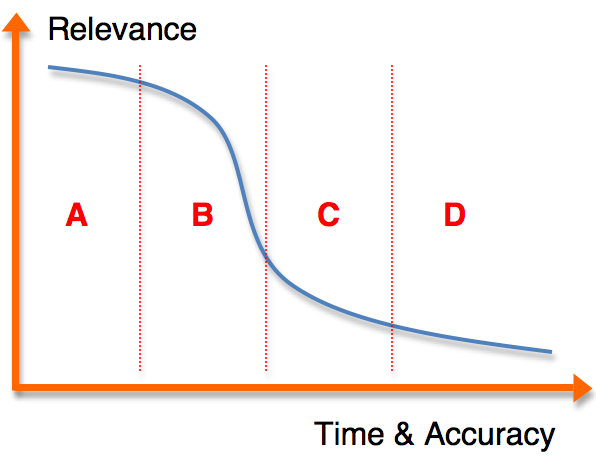
Timely information when a crisis strikes is a critical element for many of us in the humanitarian and human rights communities. Surely then we must recognize the tradeoff between accuracy and timeliness of information. Crisis information is perishable!

The more we demand fully accurate information, the longer the data validation process typically takes and thus the more likely the information will be become useless. Our public health colleagues who work in emergency medicine know this only too well.

The figure below represents the perishable nature of crisis information. Data validation makes sense during time-periods A and B. Continuing to carry out data validation beyond time B may be beneficial to us, but hardly to crisis affected communities. We may very well have the luxury of time. Not so for at-risk communities.
relevance_time

This point often gets overlooked when anxieties around inaccurate information surface. Of course we need to insure that information we produce or relay is as accurate as possible. Of course we want to prevent dangerous rumors from spreading. To this end, the Thomson Reuters Foundation clearly spelled out that their new Emergency Information Service (EIS) would only focus on disseminating facts and only facts. (See my previous post on EIS here).

Yes, we can focus all our efforts on disseminating facts, but are those facts communicated after time-period B above really useful to crisis-affected communities? (Incidentally, since EIS will be based on verifiable facts, their approach may well be liked to Wikipedia’s rules for corrective editing. In any event, I wonder how EIS might define the term “fact”).

Why Ushahidi?

Ushahidi was created within days of the Kenyan elections in 2007 because both the government and national media were seriously under-reporting widespread human rights violations. I was in Nairobi visiting my parents at the time and it was also frustrating to see the majority of international and national NGOs on the ground suffering from “data hugging disorder,” i.e., they had no interest whatsoever to share information with each other or the public for that matter.

This left the Ushahidi team with few options, which is why they decided to develop a transparent platform that would allow Kenyans to report directly, thereby circumventing the government, media and NGOs, who were working against transparency.

Note that the Ushahidi team is only comprised of tech-experts. Here’s a question: why didn’t the human rights or humanitarian community set up a platform like Ushahidi? Why were a few tech-savvy Kenyans without a humanitarian background able to set up and deploy the platform within a week and not the humanitarian community? Where were we? Shouldn’t we be the ones pushing for better information collection and sharing?

In a recent study for the Harvard Humanitarian Initiative (HHI), I mapped and time-stamped reports on the post-election violence reported by the mainstream media, citizen journalists and Ushahidi. I then created a Google Earth layer of this data and animated the reports over time and space. I recommend reading the conclusions.

Accuracy is a Luxury

Having worked in humanitarian settings, we all know that accuracy is more often luxury than reality, particularly right after a crisis strikes. Accuracy is not black and white, yes or no. Rather, we need to start thinking in terms of likelihood, i.e., how likely is this piece of information to be accurate? All of us already do this everyday albeit subjectively. Why not think of ways to complement or triangulate our personal subjectivities to determine the accuracy of information?

At CEWARN, we included “Source of Information” for each incident report. A field reporter could select from several choices: (1) direct observation; (2) media, and (3) rumor. This gave us a three-point weighted-scale that could be used in subsequent analysis.

At Ushahidi, we are working on Swift River, a platform that applies human crowdsourcing and machine analysis (natural language parsing) to filter crisis information produced in real time, i.e., during time-periods A and B above. Colleagues at WikiMapAid are developing similar solutions for data on disease outbreaks. See my recent post on WikiMapAid and data validation here.

Conclusion

In sum, there are various ways to rate the likelihood that a reported event is true. But again, we are not looking to develop a platform that insures 100% reliability. If full accuracy were the gold standard of humanitarian response (or military action for that matter), the entire enterprise would come to a grinding halt. The intelligence community has also recognized this as I have blogged about here.

The purpose of today’s meetings was for us to think more concretely about communication in crises from the perspective of at-risk communities. Yet, as soon as I mentioned crowdsourcing the discussion became about our own demand for fully accurate information with no concerns raised about the importance of timely information for crisis-affected communities.

Ironic, isn’t it?
Patrick Philippe Meier

Snap Mobs of the World Unite – A Better Taxonomy? (Udpated)

Economist3

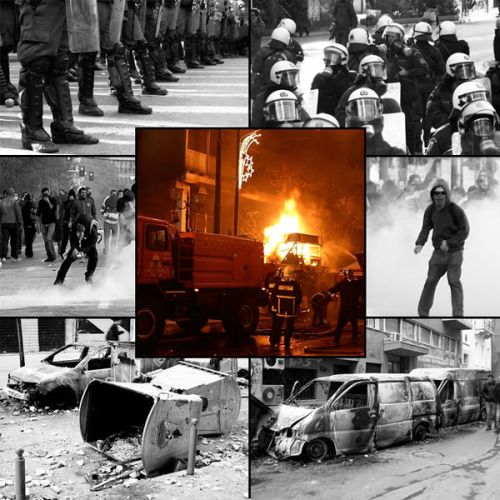
A writer for The Economist interviewed me earlier in the week for his article entitled “Rioters of the World Unite” sparked by the recent Greek riots. In the article, the author asks whether it is possible to imagine an Anarchist International comparable to the then Communist International, “a trans-national version of the inchoate but impassioned demonstrations that have ravaged Greece this month?”

While I’m not convinced that the word “anarchist” is an appropriate label for the rioters in Athens (more on that later), the author is certainly correct that the kind of “psychological impulse behind the Greek protests […] can now be transmitted almost instantaneously, in ways that would make the Bolsheviks very jealous. These days, images (moving as well as still) spread faster than words; and images, of course, transcend language barriers.”

E-communications are now a familiar feature in pro-democracy protests against dictators. Equally fast-moving, say specialists, is the role of technology in what might be called “undemocratic protests”: violent acts in prosperous, networked societies.

Leaving aside the need to distinguish between protests and riots, I find the notion of “undemocratic protests” rather interesting although I’m not sure whether the qualifier “undemocratic” necessarily adds clarity. What is undemocratic about Hungarian youths in 2006 using “blogs to aggregate visual evidence of police brutality” and “distributing an audio recording of the prime minister admitting government corruption?”

This brings us to the issue of developing an appropriate taxonomy, as I noted in response to some excellent questions in the comments section of my blog post on the “Greek Riots, Facebook, Twitter and SMS.” (Incidentally, I should have included Second Life where a memorial was erected “giving its users a glimpse of real-life material from the riots”).

I think we need a better taxonomy for today’s new media. Individuals who find themselves in the middle of the action and send text messages or camera shots from their phones are not journalists in the conventional sense of the word. Adding “citizen” in front of journalism is perhaps too simplistic.

First of all, in repressive contexts, “citizen journalists” are not really citizens of their country; they tend to be marginalized, oppressed and persecuted. The term “civilian journalism” may be more apt. But we’ve already established that the qualifier “journalism” muddies the waters.

The Greek students rioting in the streets of Athens could not be described as a “smart mob” either. I wouldn’t use the term “dumb mobs” because I don’t find that any more accurate than describing the rioters as anarchists. Indeed, I think The Economist article gets it particularly wrong on that note:

The shooting and ensuing riots in Greece must be understood in the context of the “disenchantment of Greek students, the mistrust in and corruption of the right-wing government,”  as well as the “many acts of police brutality and incompetence through the years. This is why people wouldn’t wait for the coronary report. There were many things wrong even before the shooting and the coronary report” (see previous blog post).

In this context, then, perhaps a term like “snap mobs” might be more useful. Snap implies quick and plays on terms like “snapshot” and “snap judgment” which is a better description of the student-led riots in Greece.

As the article in The Economist suggests, what happened in Athens is bound to happen again in different forms across the world, i.e., rumors spreading and leading to chaos or worse, bloodshed. This may eventually drive the point home that text messages and Tweets should simply not be taken at face value.

I do think that as foreign reporting continues to decline, we will see the rise of  a professional class of citizen journalists and as a consequence, readers will expect the latter to operate at standards akin to that of the mainstream media today. At the same time, I suspect the mainstream media will shift towards a more investigative-journalism mode as consequence of increasing “snap mob” behavior.

Patrick Philippe Meier

Greek Riots, Facebook, Twitter and SMS (Updated)

I am particularly interested in riots since part of my doctoral research focuses on the strategic and tactical uses of digital technology to organize, mobilize and coordinate protest events in repressive contexts. On this note, Alternet just published this piece by Andrew Lam on the “Greek Riots and the News Media in the Age of Twitter,” which echoes some of the issues raised during the panel discussion I participated in last week in  DC on the decline of foreign reporting and rise of citizen journalism.

The Greek riots are a classic case of iRevolutions in the making, i.e., individuals and networks (hyper) empowered by linking technologies like Facebook, Twitter and SMS. What follows first are my thoughts on the two main points that the Andrew highlights in his piece. The second part of this post sheds light on the dynamics of riots by drawing on complexity science and Clay Shirky’s work.

greekriotmontage

Initial Conditions: The riots were sparked after a 15-year old student “died from a gunshot wound in his heart, inflicted by a policeman following an altercation between a police patrol and a small group of youths in Athens” (1). Thousands of young people took to the streets after quickly spreading the news via Facebook, Twitter and SMS.

But as Andrew points out, no one bothered to verify or investigate the police officer’s claim that he was innocent: “When the coroner’s report came out several days later, it said the bullet was dented, meaning it ricocheted before hitting the teenager, but the information changed nothing. Athens had been burning for several nights, and the people, whose rage fueled the flames, couldn’t care less for facts.”

These valid points aside, my first question is what took the coroner so long? Extracting a bullet (pardon the morbidity) is not exactly brain surgery.  If said coroner had a mobile phone, s/he could have taken a picture of the dented bullet and shared it as widely as possible hoping that it would go viral. I have no idea how effective that would have been, but it’s a thought. The second question I have is whether any investigative journalists were pressing the coroner to get on with it?

Future Conditions: Andrew notes that “professional front line reporters may very well be on the way to being redundant in a world where, according to Reuters Director of News Media Development, Chris Cramer, ‘Every key event going forward will be covered by members of the public, and not by traditional journalists.’” (I just checked the Wikipedia page on the riots and it was edited close to 200 times within 48 hours of the shooting).

However, as I mentioned during last week’s panel, the mainstream media has an increasingly more important social service to play in the Twitter Age: distinguishing fact from fiction. Andrew is thus spot on when he writes that “the role of the mature news organization […] is to filter real news from pseudo news, rather than treating all content as equal.”

Complexity Science: Power laws are a defining signature of complex systems. The Richter scale, which relates earthquake frequencies to magnitude, is probably the most well known power law. As we all know, there are many small tremors every day but only a few major earthquakes every century. As it happens, protests such as strikes also follow a power law distribution. See for example this piece by Michael Bigs in the American Journal of Sociology. Here’s the abstract:

Historians have persistently likened strike waves to wildfires, avalanches, and epidemics. These phenomena are characterized by a power-law distribution of event sizes. This kind of analysis is applied to outbreaks of class conflict in Chicago from 1881 to 1886. Events are defined as individual strikes or miniature strike waves; size is measured by the number of establishments or workers involved. In each case, events follow a power law spanning two or three orders of magnitude. A similar pattern is found for strikes in Paris from 1890 to 1899. The “forest fire” model serves to illustrate the kind of process that can generate this distribution.

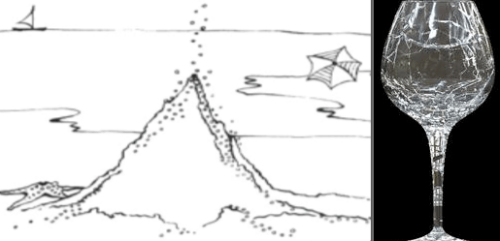
One classic way to illustrate this is by using the analogy of grains of sand falling on a sand pile. Eventually, small and large avalanches begin to occur at different frequencies that follow a power law.

sandpile1

The study of complex systems is often called the study of history. The sand pile becomes increasingly unstable over time as grains of sand cause “fingers of instability” to run through the structure, like fissures running across a wine glass or cracks in the earth as an earthquake unloads the built up tension. If you want to understand the vulnerability of the sand pile of a “Richter 9” earthquake, dissecting the falling grains will give you little insight. In other words, the answer lies in the past, in the evolution of the sand pile.

I make this point to reinforce the fact that the recent shooting and riots in Greece should be understood in context. The incident was  but one of several that befell Mount Olympus. As Katrin Verclas and others have commented (below) in response to this blog post, “the disenchantment of Greek students, the mistrust in and corruption of the right-wing government,”  as well as the “many acts of police brutality and incompetence through the years,” provides the historical context behind the shooting. “This is why people wouldn’t wait for the coronary report. There were many things wrong even before the shooting and the coronary report.”

Networks Analysis: One way to think about the impact of the information revolution on the ability of groups to mobilize and organize is to use the analogy of disease contagion, which also follows a power law distribution. As Clay Shirky writes, “The classic model for the spread of disease looks at three variables—likelihood of infection, likelihood of contact between any two people, and overall size of population. If any of those variables increases, the overall spread of disease increases as well.”

As a consequence of the information revolution, the likelihood of an individual receiving and broadcasting information is increasing significantly while the likelihood of any two people communicating is increasing exponentially; and world population is also growing at a furious pace. Since each of these three variables are increasing, the overall risk of protests increases as well.

The reason I raise this issue of power laws and epidemics of information is to address the issue of rumors. As Andrew Lam writes, “the streamlining of news [via Twitter and SMS] makes the story skeletal and thin, bordering on becoming rumor and hearsay.” Countering false rumors  in a highly connected network may require a systems approach since command-and-control is unlikely to work (short of switching the network off).

This is where the work by Malcom Gladwell, Mark Buchanan and and the Santa Fe Institute’s (SFI) research might shed some light on the viral cure for false rumors in the Twitter Age.

See also my follow up post on the Greek riots.

Patrick Philippe Meier

International News Coverage in a New Media World

I just had the pleasure of participating in a fascinating panel discussion on the decline of the foreign correspondent and the rise of citizen journalist. The event was hosted by the Institute for Public Diplomacy and Global Communications at George Washington University (GWU) and supported by the Broadcasting Board of Governors (BBG).

Jeffrey Hirschberg from BBG gave the opening remarks and GWU Professor Steve Roberts moderated the panel, which included Loren Jenkins, Senior Foreign Editor at NPR, Professor Sherry Ricchiardi, Senior Writer at the American Journalism Review (AJR) and Professor at Indian University’s School of Journalism, Bob Dietz with the Committee to Protect Journalists (CPJ), and myself.

Where to begin? I was definitely the only one on the panel without a formal background in journalism, possibly the only blogger, probably the only one with a YouTube account and most likely the only panelist on Twitter. Inevitably, then, I brought a slightly different perspective, but more importantly, I had the opportunity to learn a lot from my fellow panelists and to understand their perspective on the decline of foreign reporting. It was a truly rich conversation.

Professional journalists engaged in international news are increasingly concerned about the possibility of misinformation and manipulation that may originate from citizen journalists, e.g., through blogs, Twitter, etc. In my opinion, one of the defining roles of the mainstream media is to distinguish between fact and fiction, which means that they play an even more important role in the digital age. The question of journalist standards was also raised, or the lack thereof. within citizen journalism In my opinion, as international news reporting declines and citizen journalists continue to fill the void, the public will expect and come to demand that the latter meet some of the same standards practiced by mainstream media.

Having had the opportunity to interact with numerous bloggers with Global Voices and beyond, I emphasized the fact that reputation for many bloggers is everything. Her or his readership is a function of the person’s reputation and hence credibility and accountability. Over time, as Lauren mentioned, we come to “get to know” and trust a blogger even if we never meet in person. Journalists investigate stories by interviewing sources, there is no reason to discount citizen journalists as valuable sources.

The challenge of validating sources and information is not a new one. There is a trade off between volume of information and the ability to verify that information. This trade off, or continuum, becomes even more acute in rapidly changing situations like the recent carnage in Mumbai.

What we need to keep in mind, however, is that we each have different demands or needs for validity. If you found yourself in downtown Mumbai during the terrorist attacks, you would rather know about rumors spread via Twitter than not. Why? Because at least you’d be able to take precautionary measures should the rumor prove to be true.

Watching the unfolding tragedy from thousands of miles away in the comfort of our own homes, we have less need for expediency, we just want to know what really happened, the facts. However, our demand for facts and rigorous validation should not overshadow the fact that rumors and unverified reports from unknown sources can save lives.

Steve asked Bob whether his work on the protection of journalists should be expanded to citizen journalists. In his response, Bob preempted an important point I had planned to make; namely that the line between citizen journalism and digital activism is becoming increasingly blurred. In the past, documenting human rights abuses and broadcasting this documentation was rarely done by one individual. Today, thanks to YouTube, documenting events is the same as broadcasting events, which is alot about what advocacy is.

This is why it is increasingly important for citizen journalists in repressive environments to interact with digital activists and individuals engaged in strategic nonviolence. As a a fellow blogger of mine recently remarked about her experience covering the post-election violence in Kenya, there is a distinction between being able to speak out and being heard. In most contexts, the former is far easier than the latter. However, if you start being heard, and a government or regime starts to pay attention to what you are blogging, you become a target. It’s a catch 22. Bloggers need to learn from digital activists and strategic nonviolence movements about how to stay safe and how to make maximum use technology to get their message out.

I drew on several examples to highlight the important contribution that citizen journalists are making around the world, from Global Voices to Witness.org. I also highlighted HHI‘s recent work on crisis mapping Kenya to compare mainstream media reports with citizen journalism reports and crowdsourcing reports (via Ushahidi). In the context of Mumbai, I pointed to the incredible speed with which a Wikipedia page was created and maintained fully up to date, with some 900 edits taking place within the first 21 hours of the event. No mainstream media outfit could possibly mimic this crowdsourcing approach without reaching out to citizen journalists.

On Global Voices, I highlighted the important role they are playing in translating (and analyzing) a lot of local news (and other blogs) into English. With the decline in foreign reporting, mainstream media’s role in translating news will also decline. The amount of volume produced by Global Voices during the Mumbai attacks was trully stunning.

I brought up Witness.org because much of the conversation between panelists focused on print media, and how easy it was to mislead readers. Doctoring pictures, let alone footage, is not as easy. The case of Reuters and the doctored photograph of Israeli rockets firing on Lebanon is an exception and far from the rule. It is a very isolated incident when one considers the massive number of pictures printed every day in the mainstream press. Furthermore, I argued thanks to built-in cameras in mobile phones, dozens of different individuals can each take pictures of an event, which serves as a verification mechanism. We don’t need fewer citizen witnesses armed with cameras, we need more.

Two final points, or rather open ended questions for further discussion. First, if we are moving towards a more hyper-local approach to media reports, and if this happens across the globe, then why the concern? Isn’t someone’s local media another’s foreign media? Second, having counted Noam Chomsky’s Manufacturing Consent: The Political Economy of the Mass Media as one of my all time favorite books, how is the media changing now that the political economy is completely changing?

Patrick Philippe Meier

Links: Revolution 2.0, Mumbai Attacks, Response

  • Revolution 2.0 – Obama’s Web Tools Work for Others Too: If I had blogged about this Newsweek article, I would have been quite critical. First, we all know full well that technology can be used for good or ill. Second, the piece focuses exclusively on the negative effects of the Internet’s potential to empower marginalized groups. Third, as a colleague noted, “The writer thinks of marginalized groups like terrorists.  I think of marginalized groups like 90% of the world’s population.”
  • Mumbai Terrorists used Google Earth: In a first in terror strikes in the country, all the 10 terrorists involved in the Mumbai attack got familiar with the terrain of the city by using the Google Earth service, according to sources in the Maharashtra home ministry.
  • Mobiles and Twitter Play Key Role in Mumbai Reporting: Mobiles are yet again playing a key role in citizen reporting as terror attacks grip the Indian city of Mumbai.  Twitter, the microblogging service that is available in India, was especially instrumental in conveying first hand reports as the chaotic events were unfolding in the city.  Twitter users set up aggregator accounts at Mumbai, Bombay@BreakingNews and with the search tag #Mumbai.
  • Citizen Voices and Mumbai Attacks: When news from the developing world dominates the global news agenda, we get a lot of traffic on Global Voices. As the horrific events unfolded in Mumbai this past week, our authors, editors and tech staff began compiling accounts from blogs, Flickr, YouTube and Twitter feeds. You can get a good overview of the use of social media in reporting the Mumbai crisis on our special coverage page.

Event: International News Coverage in a New Media World

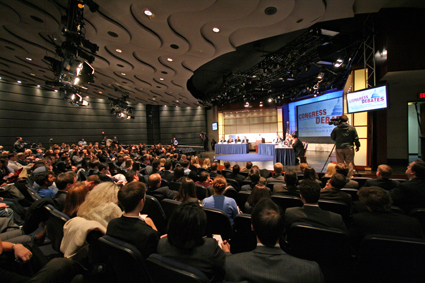
I’ve been invited by the Broadcasting Board of Governors (BBG) and George Washington University’s (GWU) Institute for Public Diplomacy and Global Communications to give a panel presentation on “International News Coverage in a New Media World: The Decline of the Foreign Correspondent and the Rise of the Citizen Journalist.”

gwu

The event will take place on December 10th to commemorate the 60th anniversary of the United Nations Universal Declaration of Human Rights.

Experts will examine the dramatic shift of traditional media away from foreign reporting, the growth of web-based citizen journalists, and their effects on coverage of international news and human rights issues.

I was originally planning to focus the bulk of my presentation on the role of new media in covering Kenya’s post-election violence but given the (still) current carnage in Mumbai and the unprecedented response of citizen journalists in covering the attacks, I’d like to present a comparative analysis of both events. To this end, I welcome any links/tips/suggestions you might have on what you consider to be the most striking (less obvious) issues worth highlighting.

Patrick Philippe Meier

Web 2.0 Tracks Attacks on Mumbai (Updated)

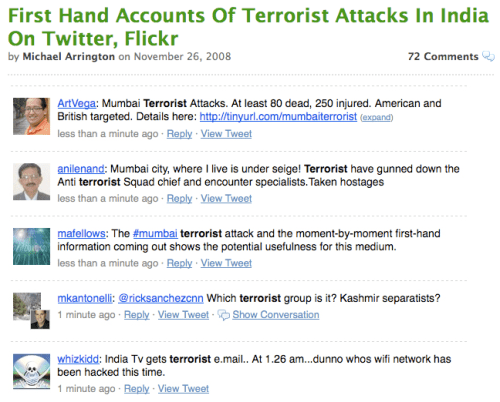
Twitter, Flickr, Wikipedia, YouTube – a few of the Web 2.0 & mobile applications tracking the Mumbai attacks in quasi real time along with the aftermath. Twitter was apparently faster than CNN in reporting the initial events, according to TechCrunch:

picture-61

From TechMacro: “the local authority advised TV channels to stop broadcasting sensitive information which may help terrorists tracking army’s movements. It is much less likely that the terrorists are now using Twitter to find way to escape.”

For live, crowdsourcing updates, see the following links on Twitter, Flickr, Wikipedia. The Wikipedia entry already includes a picture (probably taken with mobile phone) of one of the terrorists.

Wired also writes that “local bloggers at Metblogs Mumbai have new updates every couple of minutes. So do the folks at GroundReport. Dozens of videos have been uploaded to YouTube. But the most remarkable citizen journalism may be coming from “Vinu,” who is posting a stream of harrowing post-attack pictures to Flickr.”

Patrick Philippe Meier

Digital Media & Repressive Regimes: Global Internet Freedom Index

Karin Karlekar from Freedom House gave a really interesting presentation on the development of a Global Internet Freedom Index, or IGIF. She is planning a pilot study of 15 countries that will include analytical reports and numerical ratings.

picture-5

The index’s scoring system will be similar to the Freedom House media freedom index in order to facilitate for comparisons. The IGIF will include both Internet and mobile/phone text messaging. It will focus especially on transmission of news and political relevant communications, while acknowledging that some restrictions on harmful content may be legitimate.

The index is comprised of three general themes, each of which includes a number of (weighted) sub-indicators. The key components of the themes below is access to technology and the free flow of information/content.

  1. Obstacles to access
  2. Limits on content and communication
  3. Violation of individual online rights

One of the sub-indicators, for example, focuses on activism in order to capture local resistance and activism in addition to government restrictions.

I think this is an excellent initiative with the expected added value long term being the ability to identify competing trends between Repression 2.0 and Democracy 2.0. This goes to the heart of my dissertation topic and I hope to draw on the IGIF framework to inform my field research questions.

Patrick Philippe Meier

Digital Media & Repressive Regimes: Media Tactics

The second panel focused on the media tactics of regimes and opponents. Xiao Qiang gave the first presentation which addressed Chinese digital media controls and access to public expresssion. Rebecca MacKinnon presented the findings of her research on China’s censorship 2.0: how companies censor bloggers. The third talk, by Mahmood Enayat, focused on resistance 2.0: power and counter-power in Persian websphere.

img_0922

“In china,” says Xiao, the digital battle “is about controlling information space, both via censorship and propaganda.” The Internet is not just a medium, it’s a social space where netizens organize into communities, share, etc. The Chinese government seeks to control the “main melody” via censorship and disinformation. So Chinese cyberspace is a control space.

How do some Chinese seek to circumvent this control? A number of official Chinese journalists actually lead double-lives; working for the state-controlled media during the day, and blogging or participating in BBS forums at night. Political satire (“eGao”) is also used in response to Chinese media control. There is also an important gap in control between local and central authorities in terms of implementing censorship rules; there is also a timing factor that contributes to the control gap.

img_0929

Rebecca MacKinnon is a leading China expert, having been posted with CNN in Beijing for 9 years and now teaches in Hong King. “There are different kinds of Internet censorship,” says Rebecca, reminding us as well that the Great Firewall of China which filters websites outside China was coind by bloggers. In addition to filtering, Chinese authorities are known to delete websites, shut down domestic sites as well as data centers. Multinational Companies are complicit in Chinese internet censorship.

Rebecca and her team decided to test just how censored China’s different blogging websites really are. Using paragraphs with sensitive political language, they manually tested 15 blog hosting websites to test what content  were being filterred. The team used 108 different types of content and found huge variation in blogging platforms censoring, from one site filtering 56% content to another filtering only 0.9%; of the same content. There is also evidence that the filtering is not always automatic and indeed includes manual intervention.

In one interesting example, Rebbecca mentions a blog post by a former high-level Chinese political adviser. The post, entitled: “Letter to my Son: wishing for multiparty democracy in China.” The blog was highly political but did not use inflammatory language and therefore was not filtered. Out of curiousity, Rebecca copied and pasted articles from the main state-owned media, Xinhua, and found that some of the state’s own articles would get censored!

So why do we see so much variation in Internet filtering within China?

  • Instructions to companies from city or provincial state council inforation office internet section, interpreted diffently;
  • Different methods desvised for implementation;
  • Relationship between company management, investors and regulatory bodies;
  • Manager/editor’s relationship with local state council;

In conclusion, the Great Chinese Firewall is only part of Chinese Internet censorship. Domestic censorship is not centralized. Domestic web censorship is outsourced by government to the private sector. Censorship is inconsistent and it is usually possible to post your content on one platform, for at least a while.

What are the implications of this study? We need larger scale studies of domestic web censorship (including chat rooms, social networking sites, instant-messaging, mobile services, etc.). Unlike automated filtering tests, these tests require manual testing and constant analysis by Chinese speakers with contextual knowledge. We need surveys of web service company employees; also of users and bloggers about their experience.

Implication for activism: circumvention is important but its not the solution to the whole censorship problem. We need to educate bloggers and netizens about strategies to deal with censorship.

img_0932

Mahmood Enayat from the Oxford Internet Institute gave an entertaining presentation on the use of digital media in Iran. (NB: my notes for this section self-deleted, don’t ask). In any case, Mahmood’s presentation was engaging. He discussed the role of underground music one the one hand and the use of YouTube. My apologies to Enayat for this being so short.

Patrick Philippe Meier

Digital Media & Repressive Regimes: Reshaping Public Spheres

Andrew Puddephatt from Global Partners gave the first panel presentation here at the conference on digital media and repressive regimes. He focused on the issue of shaping digital media for human rights. The basic premise of Andrew’s talk is that access to information is a human right. The problem is how we get there.

picture-31

What I took from his talk was that:

  • We should steer away from talking about the media, since there’s no longer such a think. While he didn’t use the following language, I think he would agree: instead of the media, we now have a digital/communication ecosystem, which displays nonlinear dynamics and is by definition more complex;
  • While digital media enthusiasts see digital technologies as a great liberating force, and while these technologies can certainly be disruptive, it’s a two-way street: censorship of content and surveillance are both on the rise;
  • It is meaningless to talk about right to communication if people don’t have access to communication technologies. We have to think about infrastructure;
  • Google shape protocols for search; protocols are commercial secrets, shaped by forces that anything but transparent;
  • We need a digital/communication infrastructure that foster creativity and innovation;
  • All evidence points to the suggestion that the mobile phone will be the key communication tool of our century. The most exciting technology development is being made in this area;
  • New media undermine repressive structures, they are transgressive. However, democratic governments are also worried about the potential impact in the West;
  • Extremists have been empowered thanks to new media;
  • The main challenge is persuading democratic governments that while there are people out there who wish to use new media for ill, the digital media revolution nevertheless has for the first time the potential to create a genuine public sphere.

_____________________________________________

Robert Guerra of Freedom House gave the second talk of the day, which focused on Internet freedom, online activism and emerging threats. Robert argues that we should expect to see threats to internet freedom emerging as a response to the ground gained by digital activists. Just as we may be moving towards Democracy 2.0, we’re about to be introduced (if we haven’t already) to Repression 2.0.

In Egypt freedom of association is only allowed for groups of 5 or less, otherwise larger gatherings are illegal by law. Online activism allows activists to get around this and to do so by the thousand and new media in repressive regimes can promote nonviolent confrontation. So in one regard, online activism presents fewer risks.

_____________________________________________

The framing of Democracy 2.0 versus Repression 2.0 was a useful springboard for my presentation as third speaker of the day. My talk focused on the idea of “digital resistance” which I define as the intersection between digital activism and strategic nonviolent action against repressive regimes. The question I pose is whether digital resistance poses a threat to repressive rule, or vice versa? Why or why not?

There are more and more anecdotes and qualitative case studies available that describe successful instances of digital activism; see those documented on DigiActive, for example. What do all these examples add up to? Can we start measuring the aggregate impact of digital activism on repressive rule? How might we analyze quantitatively the qualitative, anecdotal impact of digital resistance, or lack thereof?  In other words, are we likely to see the fall of Repression 2.0 like we did of Communism? See this previous blog entry for some preliminary thoughts on the question.

Patrick Philippe Meier