Maptivism: Live Tactical Mapping for Protest Swarming

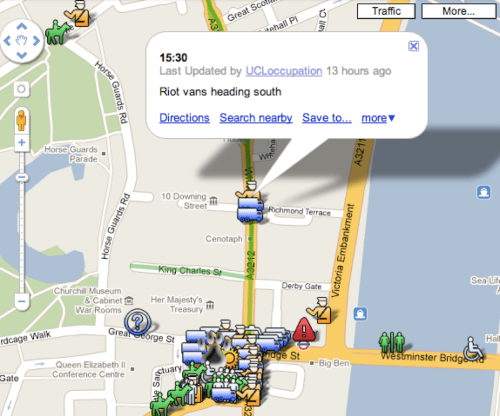
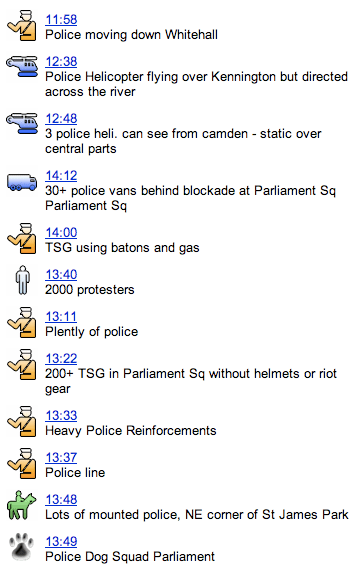
My colleague Adeel Khamisa from GeoTime kindly shared this news story on how student protesters created a live tactical map to outwit police in London during yesterday’s demonstrations.

Check out these real time updates:

The students also caught the following picture:

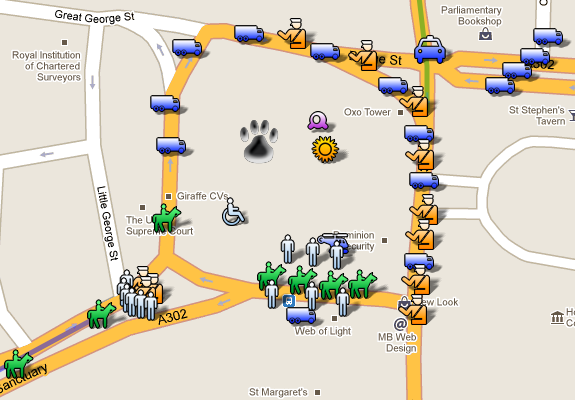
The map depicts the tactics employed by the students:

The limits of using Google Maps

As I looked closer at the map, it occurred to me how much this resembles a computer game with moving characters. The strategy employed by the police can be discerned by the pattern below.

But I doubt that students were able to update their Google map in real-time directly from their mobile phones, let alone via SMS, Twitter, Smartphone App, camera phone or Facebook. Nor can they subscribe to alerts and receive them directly via an automated email or SMS. Indeed, it appears they were using Google Forms to “crowdsource” information and this Twitter account to disseminate important updates.

This is why I got in touch with the group and recommended that they think of using Crowdmap (free and open source):

Or GroundCrew (partially free, not open source):

See the following links for more info on Maptivism:

WikiLeaks of Mass Disruption: Get Ready for the Clone Wars

Anyone who claims that Julian Assange has no plan is (net) deluded. Read this excellent piece by Aaron Bady that details Julian’s political theory. Whether or not you agree with his theory of conspiracy, there is a method to the “madness”. And this “madness” is about to trigger the proliferation of WMD’s, WikiLeaks of Mass Disruption. Get ready for the Clone Wars.

Why? Have a look at what happened to the music industry. As Ori Brafman and Rod Beckstrom wrote in “The Spider and the Starfish,” the biggest players with the best lawyers in the world went up against P2P file-sharing companies like Napster and Grokster. But as the labels were repeatedly winning lawsuits, “the overall problem of music piracy was getting worse and worse. It wasn’t that the labels weren’t vigilant enough. It was actually the exact opposite—the labels were adding fuel to the fire with every new lawsuit. The harder they fought, the stronger the opposition grew.”

When Napster was shut down, more decentralized P2P file-sharing sites began to spring up that became harder to eliminate, e.g., eDonkey, eMule, etc. The same will  happen with Wikileaks. As the group becomes increasingly targeted, they will become more decentralized and will inevitably spawn “copy-cats”. And not just technology copy-cats, but legal-copy cats; as participants at NewsFoo repeatedly noted, WikiLeaks is a legal-hack, distributing servers across liberal democracies. (Meanwhile, by the way, the US government will become more centralized and closed).

Just yesterday I proposed  a “Humanitarian Wikileaks” on Twitter and got numerous enthusiastic replies, DM’s and emails. And check out this site (OpenLeaks) still under construction (updated just 2 weeks ago), owned by CINIPAC Webhosting: Offshore, Secure, Anonymous.”

What’s going to happen next? Read these “8 Principles of Decentralization.” WikiLeaks is just the first generation. Future spin-off’s will become more specialized, sophisticated and will make fewer mistakes. Julian is often criticized for focusing primarily on the US. What people fail to understand is that all he has to do (and has done) is to trigger the Clone Wars to bring this disruption to many other shores.

On a personal note, I’m less worried by WikiLeaks than the actions that “open” democracies are taking to eliminate the initiative.

Updated: As is widely known, the US government and Amazon forced the wikileaks.org domain off the Web:

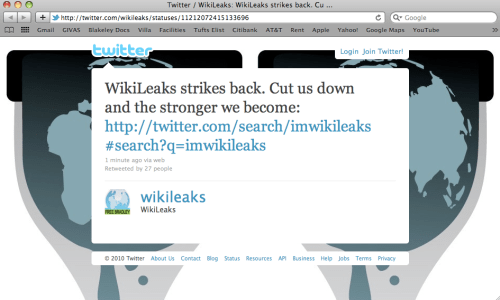
Here is WikiLeaks’ response:

See also: Former WikiLeaks Activists to Launch New Whistleblowing Site from the Spiegel Online and WikiLeaks: Moving Target by Renesys blog.

Quick, Stop All Ushahidi Deployments in Egypt!

Has the world gone crazy? There are now at least five Ushahidi deployments in Egypt. Somebody stop this proliferation before things really gets out of control. This is ridiculous, who knows what could happen!

Oh how I long for the days of  expensive, proprietary software that prevented the widespread use of commercial platforms by the unwashed masses. Life was good back then, and simple. Only external organizations with millions of dollars of funding could monitor elections. Centralized, top-down hierarchical control was such a blessing. You’d think that those using Ushahidi in Egypt would at least make their deployments password protected. But no, they have the nerve to share their data publicly. The nerve.

Someone please force these groups to use one (and only one) platform and to use a password. In fact, people should be required to apply for permission to use an Ushahidi platform by completing a 10-page form, providing 5 references along with a financial statement for the past 3 years. They should also sign a binding contract that obliges them not to share any data publicly. The golden rule should be one platform per country per year. All this needs to be controlled. Seriously, don’t people understand the consequences of democratizing tools for trans-parency and accountability?

Just look at what’s happening in Eygpt. Ushahidi was never used in the country before the lead up to the country’s Parliamentary Elections. But now, because the platform is both free and open source, no fewer than 5 different groups have decided to add more transparency to the elections. How irresponsible is that? I mean, this is only going to give people more ideas on how to hold their government accountable in the future.

Indeed, there may end up being twice as many platforms during the Presidential Elections next year as a result. And then what? This will just make each platform weaker since the data will be split across platforms. (Down with open data!). Don’t people understand that they can’t just do whatever they want? (Down with more choices!). Doesn’t anyone care about our rules anymore? The masses need to listen to us and do as we say. Oh how I do miss the good old days. Sigh.

This careless proliferation of Ushahidi platforms in Egypt will only add more data (down with more data!), which means even more monitoring of the government’s actions during the elections (down with transparency!). The first Ushahidi platform that was launched already has 351 mapped reports and the other four platforms have already mapped a total of 461 reports. This is terrible. The additional data means that triangulating some reports may be possible, either manually or by using Swift River.

This needless proliferation also means that many more issues will be monitored. At least the first Ushahidi platform that was launched didn’t have a specific category on women. But the platform launched by the Independent Coalition for Election Observation includes a category on women. And that platform is only in Arabic! Don’t people understand that election monitoring is supposed to be for English-speaking outsiders, i.e., the West?

It gets worse. The Muslim Brotherhood is also using the platform to create more transparency around the elections. As the screenshot below reveals, they even have the audacity to monitor and map assaults on journalists, observers and human rights organizations. This is worse than blogging. But don’t get me started on blogs. The fact that anyone can blog is a travesty and an assault on everything we hold holly. The printing press? Don’t even go there.

Crisis Mapper Anahi Ayala Iacucci clearly disagrees with me in her blog post on this topic. She writes that the whole point of Ushahidi is “to make it available to everybody to be able to have their voices heard, to allow for sharing of information. If people have some doubts please read the Ushahidi website: ‘Ushahidi builds tools for democratizing information, increasing transparency and lowering the barriers for individuals to share their stories.'”

Again, has the world gone crazy? My ultimate nightmare, however, are APIs and RSS feeds. These allow data from different Ushahidi platforms to be easily shared. Just look at the screenshot below and you’ll understand my concerns. I was able to create one list of all reports simply by cutting and pasting the five website links into my Google Reader. This link will take you to a public website with one list of integrated reports from all five platforms updated in real-time. If you’d like to add this to your own Google Reader, use this Atom Feed.

And if this isn’t disturbing enough, people can actually subscribe to automated email alerts of incoming reports based on specific areas of interest. I also hear a rumor that each Ushahidi platform comes with a unique key and that swapping keys allows for the automatic sharing of data between two or more Ushahidi platforms. Networked Ushahidi platforms. The nerve. Maybe the Egyptian government will be able to crack down on these platforms and curb this proliferation of transparency. After all, the US government has already invested billions of dollars to keep this repressive regime in power.

How to Evaluate Success in Digital Resistance: Look at Guerrilla Warfare

The Iranian protests of 2009 are still framed as a failure. The same goes for the 2007 protests in Burma and other nonviolent movements that have combined digital technologies with civil resistance (digital resistance). Are these efforts really failures or are we simply looking through the wrong lens? What characterizes success in digital activism?

The international community and mainstream media seem to think that success means full-out regime change and overnight transitions to democracy, rule of law and respect for human rights. This state-centric framework is the wrong one to use if the goal is to critically assess the success of resistance movements. We should instead be looking at digital resistance through the lens of guerrilla warfare, or “little war” in Spanish.

Guerrilla warfare is characterized by small, highly mobile groups that employ military tactics to harass a larger enemy, striking and withdrawing almost immediately. Hit-and-run tactics against supply chains and disrupting communication lines is a guerrilla favorite.

Tactically, guerrillas avoid confrontation with larger enemy forces and seek instead to attack smaller, weaker groups to minimize losses and exhaust the opposition. They seek the support of local populations in the process. Their goal is to weaken the enemy and eventually to undermine the state’s ability to prosecute the war; victory by attrition.

Civil resistance movements use guerrilla warfare. Their tactics and strategies are almost identical. The majority of guerrilla actions do not use violence. Given the similarities between civil resistance and guerrilla campaigns, we should look into how the latter are evaluated. If we used today’s media frames to evaluate passed successful resistance movements, they would all be failures.

The history of nonviolent struggle shows that movements which were counted out when major repression first hit – such as Solidarity in Poland in 1981 and nonviolent South African anti-apartheid strikers and boycotters in the mid-1980’s – were, a few years later, on the winning side (1).

This means that an evaluation framework for digital resistance should include a broader time frame and have a more micro-level focus. We should be looking at a group’s ability to organize an underground movement, recruit, spread propaganda, elicit support from the local population, employ a rich mix of tactics to over time to harass, provoke and delegitimize a repressive regime, and a group’s ability to continue existing even after government crack downs.

On this latter point, for example, “a more comprehensive and accurate frame on [Iran and Burma] would have reminded us that such shows of force are used only when a regime feels threatened, that is, when it perceives itself in a position of potential weakness if opposition is permitted to gain any foothold” (2).

Weighing the Scales: The Internet’s Effect on State-Society Relations

The Chair of my dissertation committed, Professor Dan Drezner just published this piece in the Brown Journal of World Affairs that directly relates to my dissertation research. He presented an earlier version of this paper at a conference in 2005 which was instrumental in helping me frame and refine my dissertation question. I do disagree a bit with the paper’s approach, however.

Professor Drezner first reviews the usual evidence on whether the Internet empowers coercive regimes at the expense of resistance movements or vice versa. Not surprisingly, this perusal doesn’t point to a clear winner. Indeed, as is repeatedly stated in the academic discourse, “parsing out how ICT affects the tug-of-war between states and civil society activists is exceedingly difficult.”

Drezner therefore turns to a transaction costs metaphor for insight. He argues that “metaphorically, the problem is akin to the one economists faced when predicting how the communications revolution would affect the optimal size of the firm.” I’m not convinced this is an appropriate metaphor but lets proceed and summarize his reasoning on firm size in any case.

Economists argue that the size of a firm is a function of transaction costs. “If these costs of market exchange exceed those of more hierarchical governance structures—i.e., firms—then hierarchy would be the optimal choice. With the fall in communication costs, economists therefore predicted an associated decline in firm size. “There were lots of predictions about how the communications revolution would lead to an explosion in independent entrepreneurship.”

But Drezner argues that decreasing communication costs (a transaction cost) has not affected aggregate firm size: “Empirically, there has been minimal change.” Unfortunately, he doesn’t cite any literature to back this claim. Regardless, Drezner concludes that firm size has not significantly changed because “the information revolution has lowered the organizational costs of hierarchy as well” and even “increased the optimal size of the firm” in some sectors. “The implications of this [metaphor] for the internet’s effect on states and civil society should be apparent.”

The problem (even if the choice of metaphor were applicable) is that these implications provide minimal insight into the debate on liberation technologies: large organizations or institutions have the opportunity to scale thanks to the Internet; meaning that government monitoring becomes more efficient and sophisticated, making it “easier for the state to anticipate and regulate civic protests.” More specifically, “repressive regimes can monitor opposition websites, read Twitter feeds, and hack e-mails—and crack down on these services when necessary.” Yes, but this is already well known so I’m not sure what the transaction metaphor adds to the discourse.

That said, Drezner does recognize that the Internet could have a “pivotal effect” on state-society relations with respect to “authoritarian and semi-authoritarian states that wish to exploit the economic possibilities of the information society.” Unfortunately, he doesn’t really expand on this point beyond the repeating the “Dictator’s Dilemma” argument. But he does address the potential relevance of “information cascades” for the study of digital activism in non-permissive environments.

“An informational cascade takes place when individuals acting in an environment of uncertainty strongly condition their choices on     what others have done previously. More formally, an information cascade is a situation in which every actor, based on the observations of others, makes the same choice independent of his/her private information signal. Less formally, an information cascade demonstrates the power of peer pressure—many individuals will choose actions based on what they observe others doing.”

So if others are not protesting, you are unlikely to stick your neck out and start a protest yourself, particularly against a repressive state. But Drezner argues that information cascades can be reversed as a result of a shock to the system such as an election or natural disaster. These events can “trigger spontaneous acts of protest or a reverse in the cascade,” especially since “a little bit of public information can reverse a long-standing informational cascade that contributed to citizen quiescence.” In sum,  “even if people may have previously chosen one action, seemingly little information can induce the same people to choose the exact opposite action in response to a slight increase in information.”

This line of argument seems to cast aside what has been learned about civil disobedience. Drezner suggests that reverse information cascades can catalyze spontaneous protests. Perhaps, but are these “improvised” protests actually effective in achieving their stated aims? The empirical evidence from the literature on civil resistance suggests otherwise: extensive planning and strategizing is more likely to result in success then unplanned spontaneous protests. If I find out that it’s cooler in the frying pan than the fire, will I automatically jump into said pan? A little bit of additional information without prior planning on how to leverage that information into action can be dangerous and counterproductive.

For example:

“The spread of information technology increases the fragility of information cascades that sustain the appearance of authoritarian control. This effect creates windows of opportunity for civil society groups.”

Yes, but this means little if these groups are not adequately prepared to deliberately exploit weaknesses in authoritarian control and cash in on this window of opportunity.

“At moments when a critical mass of citizens recognizes their mutual dissatisfaction with their government, the ability of the state to repress can evaporate.”

Yes, but this rarely happens completely spontaneously. Undermining the pillars of power of a repressive state takes deliberate and calculated work with an appropriate mix of tactics and strategies to delegitimize the regime. There is a reason why civil resistance is often referred to as (nonviolent) guerrilla warfare. The latter is not random or haphazard. Guerilla campaigns are carefully thought through and successful actions are meticulously planned.

Drezner argues that, “Extremists, criminals, terrorists, and hyper-nationalists have embraced the information society just as eagerly as classical liberals.” Yes, this is already well known but the author doesn’t make the connection to training and planning on the part of extremists. As Thomas Homer-Dixon notes in his book The Upside of Down: “Extremists are often organized in coherent and well-coordinated groups that have clear goals, distinct identities, and strong internal bonds that have grown around a shared radical ideology. As a result, they can mobilize resources and power effectively.” Successful terrorists do not spontaneously terrorize! Furthermore, they create information cascades as much as they react to them.

In conclusion, Drezner criticizes the State Department’s Civil Society 2.0 Initiative. State presumes that technologies will primarily help the “good guys” and  “assumes that the biggest impediment to the flowering of digital liberalism comes from the heavy hand of the state.” (He doesn’t say what the biggest impediment is, however). Drezner ends his piece with the following: “It is certainly possible that the initiative fails because of the coercive apparatus of a repressive government. It is equally likely, however, that the initiative succeeds—in empowering illiberal forces across the globe.” This is already well known. I’m not sure that one needs a transaction metaphor or to refer to the dictator’s dilemma, information cascades, spontaneous protests and extremist groups to reach this conclusion.


Stop Crowdsourcing? Remember, Remember the Fifth of November…

… because a man can fail. He can be caught. He can be killed and forgotten.
But four hundred years later an idea can still change the world. I’ve witnessed firsthand the power of ideas. I’ve seen people kill in the name of them; and die defending them. But you cannot kiss an idea, cannot touch it or hold it.
Ideas do not bleed, it cannot feel pain, and it does not love.
V for Vendetta, 2006

The power of crowdsourcing crisis information has little to do with the people behind Ushahidi. If individuals, communities, organizations want to crowdsource and access  information, they’ll find a way regardless of the challenges or the number of blog posts that try to stop them. Cynics warned that the  printing press and telephone would lead society to ruin. They failed to stem an idea more powerful than them. They’ll fail again. Information wants to be free, and people want the freedom to source and access this information. Increasingly, these people include grassroots activists, seasoned humanitarian professionals, students, established media groups, local organizations, volunteer networks and amateur professionals. Cynics will realize that their voices have long been drowned out by the voices of the many drawn by the power of an idea.

The Digital Disruption: Connectivity and the Diffusion of Power

Google’s Eric Schmidt and Jared Cohen published this piece in the November/December 2010 issue of Foreign Affairs. It was a notable step up from the “Cyberspace and Democracy” article in the same issue. In any case, Eric and Jared address the same core questions I am writing my dissertation on so here’s my take on what they had to say.

I far prefer the term “connection technologies” over “liberation technologies”. I also appreciate the authors’ emphasis on the diffusion of power via mini-rebellions as opposed to full-out regime change and overnight transitions to democracy. Any serious student or practitioner of strategic nonviolent action knows full well that power is not monolithic but defuse—even in the most autocratic regimes. Repression is driven by obedience. As Gene Sharp noted in “The Politics of Nonviolent Action”:

By themselves, rulers cannot collect taxes, enforce repressive laws and regulations, keep trains running on time, prepare national budgets, direct traffic, manage ports, print money, repair roads, keep markets supplied with food, make steel, build rockets, train the police and army, issue postage stamps or even milk a cow. People provide these services to the ruler through a variety of organizations and institutions. If people would stop providing these skills, the ruler could not rule.

This is why power is necessarily diffuse in every single society. Rulers operate thanks to just a few key pillars of support including: the police, military, civil service, educational system, organized religion, media, business and financial communities, etc. These pillars are only there because of obedience—and individuals comprising these pillars always have the power to withdraw their support. In strategic nonviolent action, obedience is regarded as the heart of political power. Indeed, if people do not obey, the decision-makers cannot implement their decisions, simple as that.

Manifestations of disobedience are most powerful when public, which is where mini-rebellions come in. These can slowly but surely erode the pillars of support temporarily propping repressive regimes. Eric and Jared write that, “taken one by one, these effects may be seen as impractical or insignificant, but together they constitute a meaningful change in the democratic process.” Ah, but there’s the rub. How does one string a series of mini-rebellions into more than just a series of mini-rebellions? Otherwise, digital activists run the risk of winning the battles but losing the war.

Here is why lessons learned and best practices from the long history of nonviolent civil resistance and guerrilla warfare are crucial. This was the crux of my response to Malcom Gladwell’s article in The New Yorker. Civil resistance takes careful planning, grand strategy to tactics and specific methods. Successful civil resistance movements are not organized spontaneously! Concerted and meticulous planning is key.

There are two principles of strategic planning:

Strategic sequencing of tactics: “The strategic selection and sequencing of a variety of nonviolent tactics is essential. Tactics should be directly linked to intermediate goals which in turn flow from the movement’s or campaign’s grand strategy. There are over 198 documented types of nonviolent tactics, and each successful movement invents new ones” (1).

Tactical capacity building: “Successful movements build up their capacity to recruit and train activists, gather material resources, and maintain a communications network and independent outlets for information, such as encrypted emails, short-text messaging, an underground press, and alternative web sites. This also involves detailed campaign and tactical planning, and efficient time management. Time is perhaps the most important resource in a struggle” (2).

This is why I disagree with Eric and Jared when they write that “in many of these cases, the only thing holding the opposition back is the lack of organizational and communications tools, which connection technologies threaten to provide cheaply and widely.” The tools themselves won’t make up for any lack of organizational or communication skills, planning, strategy, and so on.

Towards the end of their article, the authors note that, “these kinds of cat-and-mouse games will no doubt continue…” referring to the dynamic between repressive regimes and resistance movements. The point is hardly whether or not this dynamic will continue. The more serious question has to do with what drives this dynamic, what factors influence whether or not the cat has the upper hand?

If you’re interested in learning more about civil resistance and strategic disruption, I highly recommend reading these short books:


Democracy in Cyberspace: What Information Technology Can and Cannot Do

Stunning. How can an article like this still be published in 2010 let alone in a peer-reviewed journal? Is the study of digital activism so shallow and superficial? Have we really learned nothing? This article could have been published years ago and even then one wonders what the added value would have been.

I wrote a blog post last year called “Breaking News: Repressive Regimes use Technology to Repress” to poke fun at those who sensationalize stories about digital repression. They make these anecdotes seem surprising and stupefying: “Who would have thought?!” is the general tone. The equivalent in a car magazine would be: “Wow! Cars can be used for Drive By Shootings and Picnics in the Park.” And speaking of anecdotes, articles like this one in Foreign Affairs is why I wrote that data hell and anecdotal heaven series on digital activism a while back. But still the discourse changes little.

Check out these groundbreaking “insights” from the Foreign Affairs article:

  • “… cyberspace is a complex space, and technological advances are not substitute for human wisdom.” Go figure
  • “… the tools of modern communications satisfy as wide a range of ambitions and appetites as their 20th century ancestors did, and many of these ambitions and appetites do not have anything to do with democracy.” Are you sure?
  • “Techno-optimists appear to ignore the fact that these tools [of modern communication] are value neutral; there is nothing inherently pro-democratic about them.’ Never thought of that
  • “[These technologies] are a megaphone, and have a multiplier effect, but they serve both those who want to speed up the cross-border flow of information and those who want to divert or manipulate it.” No way, who would have thought?
  • “If technology has helped citizens pressure authoritarian governments in several countries, it is not because the technology created a demand for that change. That demand must come from public anger at authoritarian rule.” That’s ridiculous
  • “Citizens are not the only ones active in cyberspace. The state is online, too, promoting it’s own ideas and limiting what the average user can see and do. Innovations in communications technology provide people with new sources of information and new opportunities to share ideas, but they also empower governments to manipulate the conversation and to monitor what people are saying.” Since when do governments have access to the Internet?
  • “China, Iran, Myanmar, North Korea, Saudi Arabia, and other authoritarian states cannot halt the proliferation of weapons of modern communications, but they can try to monitor and manipulate them for their own purposes.” But why would they do that?

There is little depth or analytical rigor to this piece. The contribution to the literature is close to nil. Lets hope this will be the last of its kind. The study of digital activism has got to move beyond sweeping generalizations and vague truisms. We know that governments use technology to repress, enough with broken-record-publications.

What we need is more granular, data-driven analysis and mixed methods research, which is why the Global Digital Activism Dataset (GDADS) project is long overdue. Ethan Zuckerman and Clay Shirky are both advisers to this initiative because they recognize that without more empirically grounded research, articles like this one in Foreign Affairs will continue to be published.

Technologies and Practice for the Prevention of Mass Atrocity Crimes

I’ve waited years for a conference like this: “Early Warning for Protection: Technologies and Practice for the Prevention of Mass Atrocity Crimes.”

This high-level conference combines my main areas of interest: conflict early warning, crisis mapping, civilian protection and technology. I’ll be giving a keynote presentation on “The Potential of New Technologies in Conflict Early Warning” at this conference next week, and I’m particularly looking forward to the panel that will follow, co-organized with my colleague Phoebe Wynn-Pope.

The conference will explore a number of issues.

  • What is the role of new technologies in conflict early warning and how do they interact with more traditional monitoring systems?
  • How can we harness, coordinate, and utilize the sometimes overwhelming amount of information available?
  • What systems and mechanisms need to be put in place to ensure effective early-warning is given?
  • How does the humanitarian sector work effectively with communities at risk once early-warning has been sounded?
  • How can a change in attitude and behavior at a policy level be brought about in a way that forestalls a descent to violence?

In preparing for the presentation, I started re-reading some papers I had written several years ago including this one from 2008: “Bridging Multiple Divides in Early Warning and Response: Upgrading the Role of Information and Communication Technology” (PDF). I will base my presentation in part on this paper and welcome any feedback readers may have. If you don’t have time to read a 25-page paper, here’s a short summary in bullet point format:

  • The field of conflict early warning has largely been monopolized by academics who are obsessed with forecasting conflict.
  • Operational conflict early warning systems are little more than glorified databases.
  • The conflict early warning community’s track-record in successfully predicting (let alone preventing) armed conflict is beyond dismal.
  • State-centric and external approaches to conflict early warning and rapid response have almost systematically failed.
  • The disaster early warning community have long advocated for a people-centered approach to early warning given the failures of top-down, institutional methods.
  • The disaster early warning community has been an early adopter of new technologies, particularly those engaged in public health.
  • The purpose of a people-centered approach is to empower individuals so they can mitigate the impact of a disaster on their livelihoods and/or to get out of harm’s way.
  • Preparedness and contingency planning are core to a people-centered approach since natural hazards like earthquakes can’t be easily predicted let alone stopped.
  • Given the dismal failure of conflict early warning systems, the conflict prevention community should make conflict preparedness and contingency planning a top priority.
  • Precedents for a people-centered approach to conflict early warning  exists in the fields of strategic nonviolent action and digital activism.
  • More importantly, communities that experienced conflict have developed sophisticated coping strategies to evade and survive.
  • Some of these communities already use technologies to survive.

I will expand on these points with several real-world examples and, more importantly, will combine these with what I have learned over the past two years, specifically in terms of crisis mapping, new technologies and civilian resistance. I’m excited to put all of my thoughts together for this conference, and I especially look forward to feedback from readers and conversing with participants.


Crowdsourcing the Angry Skies: The SKYWARN Volunteer Network

SKYWARN is a volunteer network of 290,000 trained storm spotters who provide localized weather reports to the US National Weather Service (NWS).  The concept was developed in the late 1960s and comprises a network volunteers who report “wind gusts, hail size and cloud formations that could signal a developing tornado” where they live.

According to Weather.gov, “the information provided by SKYWARN spotters, coupled with Doppler radar technology, improved satellite and other data, has enabled NWS to issue more timely and accurate warnings for tornadoes, severe thunderstorms and flash floods.”

This illustrates how crowdsourcing can be combined with “techsourcing” to provide better results.

Who Are SKYWARN volunteers?

Volunteers include police and fire personnel, dispatchers, EMS workers, public utility workers and other concerned private citizens. Individuals affiliated with hospitals, schools, churches, nursing homes or who have a responsibility for protecting others are also encouraged to become a spotter. NWS encourages anyone with an interest in public service and access to communication to join the SKYWARN program. (1)

Why Join SKYWARN?

There can be no finer reward than to know that their efforts have given communities the precious gift of time–seconds and minutes that can help save lives. (2)

How Are Volunteers Trained?

NWS has 122 local Weather Forecast Offices, each with a Warning Coordination Meteorologist, who is responsible for administering the SKYWARN program in their local area. Training is conducted at these local offices and covers:

  • Basics of thunderstorm development
  • Fundamentals of storm structure
  • Identifying potential severe weather features
  • Information to report
  • How to report information
  • Basic severe weather safety

Classes are free and typically two hours long. To find out when a SKYWARN class will be conducted in local your area, contact your local Warning Coordination Meteorologist. (3)

What else?

In some areas where Emergency Management programs do not provide storm weather reports, people have organized SKYWARN groups that work independent of a parent government agency and feed valuable information to NWS. While this provides the radar meteorologist with much needed input, the circuit is not complete if the information does not reach those who can activate sirens or local broadcast systems.  To this end, SKYWARN also distributes information from the National Weather Service. (4)

So What?

There has been much talk about the potential role of “Volunteer Technical Communities” in the context of disaster response. VTCs, as they are now called, came to the fore in the wake of the Haiti earthquake when their crisis mapping efforts helped the US Marine Corps and US Coast Guard save lives. VTC is the new buzzword, but technology-able volunteer communities have been around for decades. SKYWARN has been active for almost half-a-century.

As my colleagues and I continue to operationalize the Standby Volunteer Task Force (see this blog post and recent article on CNN), it behooves us to learn as much as possible from others who have set up volunteer networks in the past and in other sectors. The SKYWARN example shows how volunteer networks can interface with formal organizations in an effective manner.

The Spotter Network is a newer and less formal volunteer community that is not sanctioned or affiliated with the NWS or any other government agency. Nevertheless, “several National Weather Service employees and other officials have taken an interest in the capabilities [that this network] brings to them to integrate ground truth provided by spotters into their operational responsibilities. All at zero cost to them.”

The National Weather Service has responded positively to increasing public participation by launching the eSpotter, a system “developed to enhance and increase timely & accurate online spotter reporting and communications between spotters and their local weather forecast offices. The use of the system is currently available for trained spotters and emergency managers.”

Conclusion & Recommendations

  • Volunteer groups and government organizations can work together.
  • Volunteers networks include professionals as well as amateurs.
  • Training is an integral component of volunteer technical networks.
  • Government participation is key to leveraging volunteer groups.
  • Government can provide the infrastructure for collaboration.
  • Government reps should sit on the board of volunteer networks.
  • Generating unique data sets will get government attention. Fancy technology, bravado and media coverage won’t.