Analyzing Call Dynamics to Assess the Impact of Earthquakes

Earthquakes can cripple communication infrastructure and influence the number of voice calls relayed through cell phone towers. Data from cell phone traffic can thus be used as a proxy to infer the epicenter of an earthquake and possibly the needs of the disaster affected population. In this blog post, I summarize the findings from a recent study carried out by Microsoft Research and the Santa Fe Institute (SFI).

The study assesses the impact of the 5.9 magnitude earthquake near Lac Kivu in February 2008 on Rwandan call data to explore the possibility of inferring the epicenter and potential needs of affected communities. Cellular networks continually generate “Call Data Records (CDR) for billing and maintenance purposes” which can be used can be used to make inferences following a disaster. Since the geographic spread of cell phones and towers is not randomly distributed, the authors used methods to capture propagating uncertainties about their inferences from the data. This is important to prioritize the collection of new data.

The study is based on the following 3 assumptions:

1. Cell tower traffic deviates statistically from the normal patterns and trends in case of an unusual event.
2. Areas that suffer larger disruptions experience deviations in call volume that persist for a longer period of time.
3. Disruptions are overall inversely proportional to the distance from the center(s) of a catastrophe.

Based on these assumptions, the authors develop algorithms to detect earthquakes, predict their epicenter and infer opportunities for assistance. The results? Using call data to detect when in February 2008 the earthquake took place yields a highly accurate result. The same is true for predicting the epicenter. This means that call activity and cell phone towers can be used as a large-scale seismic system.

As for inferring hardest hit areas, the authors find that their “predicted model is far superior to the baseline and provides predictions that are significantly better for k = 3, 4 and 5″ where k represents the number of days post-earthquake. In sum, “the results highlight the promise of performing predictive analysis with existing telecommunications infrastructure.” The study is available on the Artificial Intelligence for Development (AI-D) website.

In the future, combining call traffic data with crowdsourced SMS data (see this study on Haiti text messages) could perhaps provide even more detailed information on near real-time impact and needs following a disaster. I’d be very interested to see this kind of study done on call/SMS data before, during and after a contested election or major armed conflict. Could patterns in call/SMS data in one country provide distinct early warning signatures for elections and conflict in other crises?

How Crowdsourced Data Can Predict Crisis Impact: Findings from Empirical Study on Haiti

One of the inherent concerns about crowdsourced crisis information is that the data is not statistically representative and hence “useless” for any serious kind of statistical analysis. But my colleague Christina Corbane and her team at the European Commission’s Joint Research Center (JRC) have come up with some interesting findings that prove otherwise. They used the reports mapped on the Ushahidi-Haiti platform to show that this crowdsourced  data can help predict the spatial distribution of structural damage in Port-au-Prince. The results were presented at this year’s Crisis Mapping Conference (ICCM 2010).

The data on structural damage was obtained using very high resolution aerial imagery. Some 600 experts from 23 different countries joined the World Bank-UNOSAT-JRC team to assess the damage based on this imagery. This massive effort took two months to complete. In contrast, the crowdsourced reports on Ushahidi-Haiti were mapped in near-real time and could “hence  represent an invaluable early indicator on the distribution and on the intensity of building damage.”

Corbane and her co-authors “focused on the area of Port-au-Prince (approximately 9 by 9 km) where a total of 1,645 messages have been reported and 161,281 individual buildings have been identified, each classified into one of the 5 different damage grades.” Since the focus of the study is the relationship between crowdsourced reports and the intensity of structural damage, only grades 4 and 5 (structures beyond repair) were taken into account. The result is a bivariate point pattern consisting of two variables: 1,645 crowdsourced reports and 33,800 damaged buildings (grades 4 and 5 combined).

The above graphic simply serves as an illustrative example of the possible relationships between simulated distributions of SMS and damaged buildings. The two figures below represent the actual spatial distribution of crowdsourced reports and damaged buildings according to the data. The figures show that both crowdsourced data and damage patterns are clustered even though the latter is more pronounced. This suggests that some kind of correlation exists between the two distributions.

Corbane and colleagues therefore used spatial point pattern process statistics to better understand and characterize the spatial structures of crowdsourced reports and building damage patterns. They used the Ripley’s K-function which is often considered “the most suitable and functional characteristic for analyzing point processes.” The results clearly demonstrate the existence of statistically significant correlation between the spatial patterns of crowdsourced data and building damages at “distances ranging between 1 and 3 to 4 km.”

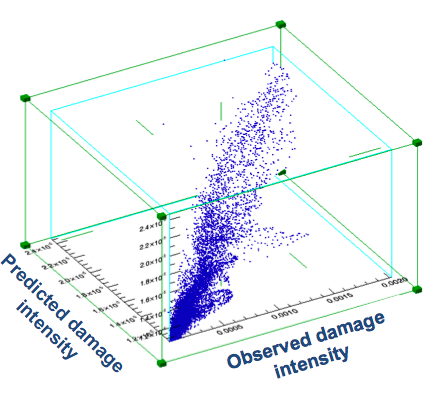
The co-authors then used the marked Gibbs point process model to “derive the conditional intensity of building damage based on the pairwise interactions between SMS [crowdsourced reports] and building damages.” The resulting model was then used to compute the predicted damage intensity values, which is depicted below with the observed damage intensity.

The figures clearly show that the similarity between the patterns exhibited by the predictive model and the actual damage pattern is particularly strong. This visual inspection is confirmed by the computed correlation between the observed and predicted damage patterns shown below.

In sum, the results of this empirical study demonstrates the existence of a spatial dependence between crowdsourced data and damaged buildings. The results of the analysis also show how statistical interactions between the patterns of crowdsourced data and building damage can be used for modeling the intensity of structural damage to buildings.

These findings are rather stunning. Data collected using unbounded crowdsourcing (non-representative sampling) largely in the form of SMS from the disaster affected population in Port-au-Prince can predict, with surprisingly high accuracy and statistical significance, the location and extent of structural damage post-earthquake.

The World Bank-UNOSAT-JRC damage assessment took 600 experts 66 days to complete. The cost probably figured in the hundreds of millions of dollars. In contrast, Mission 4636 and Ushahidi-Haiti were both ad-hoc, volunteer-based projects and virtually all the crowdsourced reports used in the study were collected within 14 days of the earthquake (most within 10 days).

But what does this say about the quality/reliability of crowdsourced data? The authors don’t make this connection but I find the implications particularly interesting since the actual content of the 1,645 crowdsourced reports were not factored into the analysis, simply the GPS coordinates, i.e., the meta-data.

My Thoughts on Gladwell’s Article in The New Yorker, Part 2

The first part of my response to Gladwell’s article in The New Yorker explained why principles, strategies and tactics of civil resistance are important for the future of digital activism. In this second part, I address Gladwell’s arguments on high vs. low risk activism, weak vs. strong ties and hierarchies vs networks.

According to Stanford sociologist Doug McAdam, the civil rights movement represented “high-risk activism” which requires “strong-ties”. By strong-ties, McAdam refers to the bonds of friendship, family, relationships, etc. These social ties appear to be a necessary condition for recruiting and catalyzing a movement engaged in high-risk activism. “What mattered more was an applicant’s degree of personal connection to the civil-rights movement.” Indeed, you’re more likely to join a rally if your close friends are going. “One study of the Red Brigades, the Italian terrorist group of the nineteen-seventies, found that seventy per cent of recruits had at least one good friend already in the organization.”

In contrast, Gladwell argues that “the platforms of social media are built around weak ties.” The problem with evangelists of social media, according to him, is that they “believe a Facebook friend is the same as a real friend.” In addition, while “social networks are effective at increasing participation,” they only do so by “lessening the level of motivation that participation requires.”

Gladwell then adds the “networks versus hierarchies argument” to further his point. Strategic nonviolent action requires organization, planning and authority structures. Social media, on the other hand, “are not about this kind of hierarchical organization.” This is a “crucial distinction between traditional activism and its online variant,” says Gladwell.

Facebook and the like are tools for building networks, which are the opposite, in structure and character, of hierarchies. Unlike hierarchies, with their rules and procedures, networks aren’t controlled by a single central authority. Decisions are made through consensus, and the ties that bind people to the group are loose. This structure makes networks enormously resilient and adaptable in low-risk situations.

But it is simply a form of organizing which favors the weak-tie connections that give us access to information over the strong-tie connections that help us persevere in the face of danger. It shifts our energies from organizations that promote strategic and disciplined activity and toward those which promote resilience and adaptability. It makes it easier for activists to express themselves, and harder for that expression to have any impact.

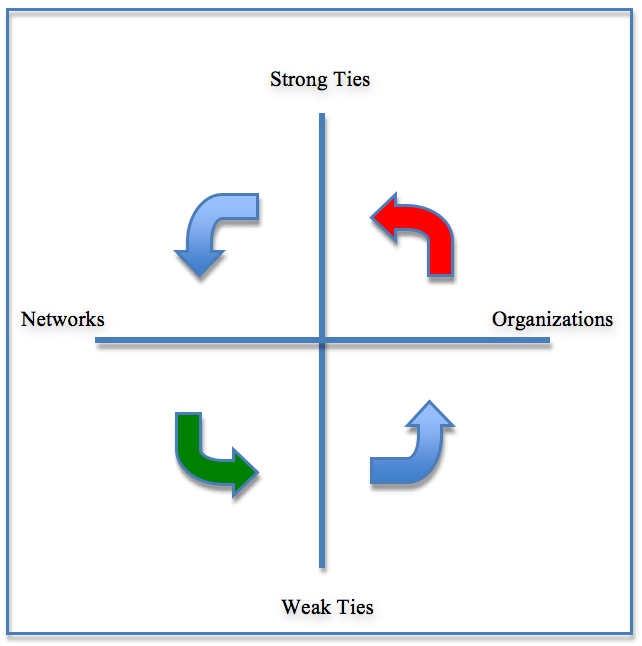
I tried to summarize Gladwell’s arguments in the diagram below and would be interested in feedback. The red arrow represents high-risk activism and the green low-risk. As per his argument, high-risk activism requires both strong ties and high levels of organization.

Gladwell makes a compelling case and one that I largely agree with, but not completely. Would the four colleague students who instigated the first wave of protests in North Carolina during the Winter of 1960 have turned down the opportunity to use email, SMS, Facebook or Twitter? Would their use of social media tools have caused their movement to fail? Would the strong-ties these students shared be diluted as a result of also being friends on Facebook? I personally doubt it, they would still have shown up at Woolworth.

Gladwell is right to distinguish between high-risk and low-risk activism but this is a false dichotomy. Not everyone in society faces the same kinds of risks, nor do they face the same levels of risk all the time. Total war in the Clausewitzian sense only holds true for thought-experiments. Indeed, a recent study study found that, “The average percentage of area covered by civil war […] is approximately 48%, but the average amount of territory with repeated fighting is considerably smaller at 15%.”

So if communities face a range of risks that span from low to high, then one would want to leverage both strong-ties and weak-ties along with appropriate organizational forms, offline tactics and social media tools. This means that both networks and hierarchies are needed; and that neither organizational form need remain static over time since risks are not static. Indeed, an effective social movement needs organizations that promote strategic and disciplined activity and networks that promote resilience and adaptability. Both are absolutely key to the practice of strategic nonviolent action.

There’s no doubt that the civil rights movement represented high-risk activism. Does this mean that the same methods used in the 1960s would work for high-risk activism in a country like Egypt, North Korea or even in Cambodia during the genocide that killed an estimated 1.2 to 1.7 million people?  Can the US media of the 1960s really be compared to North Korean media? As my colleague David Faris noted in a recent email exchange on Gladwell’s article,

The initial sit-ins may have been launched by a small group of people impervious to the danger, but they grew to 70,000 not only because close friends were doing it, but also because people saw acquaintances protesting, and decided that the level of risk required to participate had fallen. This is important because in the U.S. in 1960 the media were willing to report on these events. This is not the case across the authoritarian world, where news relayed by text and Twitter may be the only reliable source of information apart from your immediate circle of friends. By relaying information about the preferences of your weak ties, social media provide individuals with more accurate pictures of the preference-sets of other members of their community.

New social media tools don’t dictate the organizational form of the movement, they simply create more options. So a hierarchical organization can very well use new media platforms to conduct their own highly centralized movement. It’s just like the Ushahidi platform, it is a tool, not a methodology. If a group of protesters don’t put any serious time into planning their campaigns, identifying key strategies and tactics, training, drafting contingency measures, fund raising, etc., then the presence of social media tools will not explain why their protests are ineffective. It would be too easy of an excuse.

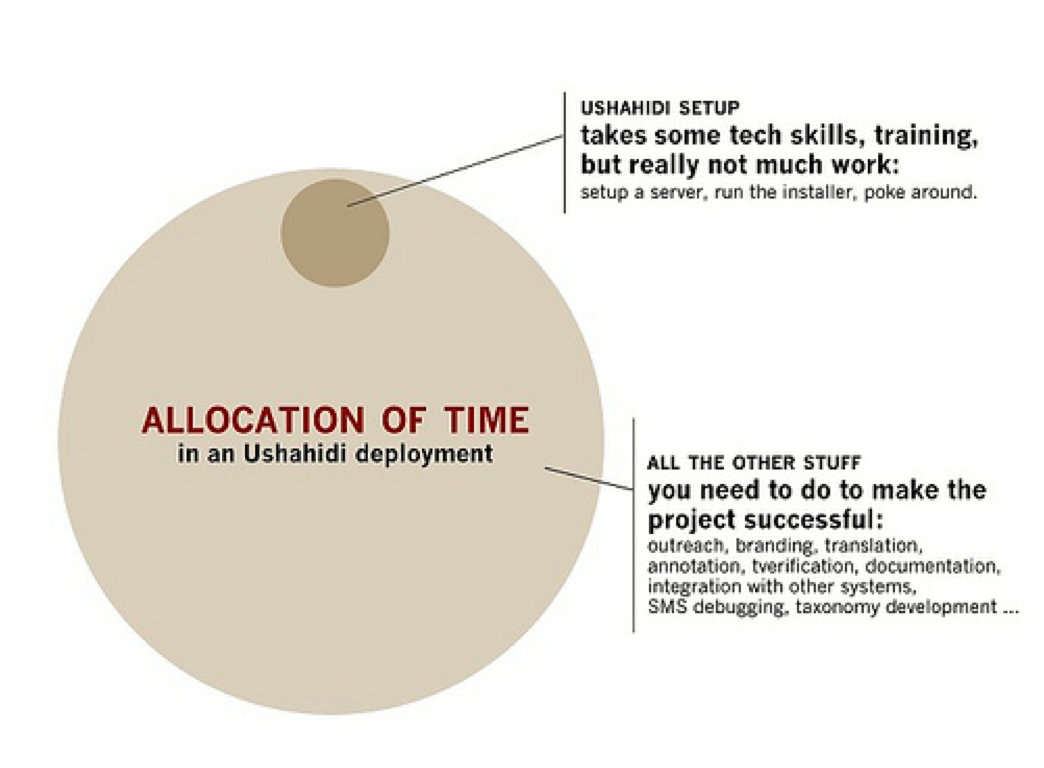
Ushahidi is only 10% of the solution

Here’s a graphic designed by my colleague Chris Blow that shows why technology is at most 10% of the solution (the context is Ushahidi but the principle applies more broadly). If a movement doesn’t take on “all the other stuff”, then it doesn’t matter whether members are part of a network, a centralized organization, have weak-ties or strong-ties, or whether they are in a high-risk or low-risk environment. They are unlikely to succeed.

My Thoughts on Gladwell’s Article in The New Yorker

Malcom Gladwell’s article “Small Change: Why the Revolution Will Not be Tweeted,” was forwarded to me by at least half-a-dozen colleagues after it was published just three days ago. I have purposefully not read other people’s responses to this piece so that I could write down my own observations before being swayed by those of others.

So what do I think? Finally, someone else is calling attention to the importance of  civil resistance (strategic nonviolent action) in the context of new digital technologies! This intersection is what I’m most excited about when it comes to the new tools of social media.

Gladwell uses the example of the civil rights movement, which in his own words was an example of “high-risk activism” and “also crucially, strategic activism: a challenge to the establishment mounted with precision and discipline.” Indeed, “the civil-rights movement was more like a military campaign than like a contagion.” Gladwell is spot on, strategic nonviolent action is nonviolent guerrilla warfare. If I’m not trained in civil resistance, then I can still use all the technology I want but the tools won’t necessarily make me more effective or make up for my lack of skills in nonviolent warfare.

But most tend to completely skip over the rich lessons learned from the long history of nonviolent action because they are more excited about the tools. As Gladwell notes, “Where activists were once defined by their causes, they are now defined by their tools.” But these tools were never used in the vast majority of protests in the history of the world. See this piece by the Global Post on “How to Run a Protest without Twitter.”

I specifically blogged about this issue two years ago in a post entitled: “Digital Resistance: Between Digital Activism and Civil Resistance.” Some excerpts:

The future of political activism in repressive environments belongs to those who mix and master both digital activism and civil resistance—digital resistance. Digital activism brings technical expertise to the table while civil resistance offers rich tactical and strategic competence.

At the same time, however, the practice of digital activism is surprisingly devoid of tactical and strategic know-how. In turn, the field of civil resistance lags far behind in its command of new information technologies for strategic nonviolent action.

In this blog post, I called attention to the work of Gene Sharp who is considered by many as one of the most influential scholars in the field of civil resistance. His book, Waging Nonviolent Struggle, is a must-read for anyone interested in strategic nonviolent action. I argue that digital activism needs  much stronger grounding in the tactics and strategies of nonviolent civil resistance. That is why I followed up with a second blog post in 2008 on “Gene Sharp, Civil Resistance and Technology.”

In The Politics of Nonviolent Action, Gene identifies 198 methods of nonviolent protest and persuasion. The majority of these can be amplified by modern communication technologies. What  follows is therefore only a subset of 12 tactics linked to applied examples of modern technologies. I very much welcome feedback on this initial list, as I’d like to formulate a more complete taxonomy of digital resistance and match the tactic-technologies with real-world examples from DigiActive’s website.

So when starting from the principles, strategies and tactics of civil resistance, I do think that the tools of social media can act as multiplier effect in a nonviolent campaign. Gladwell rightly likens the civil rights movement to a military campaign. And communication is central to the effectiveness of nonviolent campaigns. In fact, some of the most successful nonviolent campaigns detailed in numerous case studies turned on the ability to get accurate, timely information. The literature on military history also demonstrates that “success in counter-guerrilla operations almost invariably goes to the force which receives timely information.”

Effective civil resistance requires sound intelligence and strategic estimates. But Gladwell only dwells on the role of new technologies in the context of recruitment. He doesn’t consider the effect of new tools on information sharing and information cascades. And if Gladwell had the time to read more of McAdam’s work, he’d have come across other relevant causal mechanisms described in the literature that are relevant to the discussion.

I plan to follow up with a second post based on Gladwell’s piece to address his points on strong versus weak ties and hierarchies versus networks.

Crowdsourcing the Analysis of Satellite Imagery for Disaster Response

I recently got a call from a humanitarian colleague in the field who asked whether it would be possible to crowdsource the basic analysis of satellite imagery.  They wanted to know because their team was sitting on a pile of satellite imagery but did not have the time or  staff to go through the high-resolution pictures. They wanted to use the imagery to identify where IDPs were located in order to know where to send aid via helicopters.

My colleague’s question reminded me of the search for Steve Fossett, a famous adventurer who went missing in September 2007 after taking off from a small airport in Nevada in a small single-engine airplane. The area where Steve went missing is particularly rugged terrain. The search and rescue aircraft were not able to find any sign of wreckage. However, high-resolution satellite imagery from GeoEye enabled Amazon to produce a Help Find Steve Fossett website, allowing volunteers to search small sections of the available imagery.

“This is an approach to more rapidly search a large area of imagery using many eyeballs of people around the world. A similar technique was used to search for Jim Gray, a Microsoft scientist who went missing on his sailboat off the coast of California.”

Micro-tasking the analysis of satellite imagery has already been done.  So why not in the context of disaster response? One could add this feature to a platform like Crowdflower, which is already being used as a plugin to micro-task the processing of text messages from disaster affected areas. Instead of text, volunteers would see a small subsection of satellite imagery. They’d be asked whether they could see any evidence of individuals in the imagery and if so how many approximately they can make out. A simple 5-minute guide on how to identify people and approximate population size using satellite imagery could be put on YouTube for volunteers to watch before getting started.

Like any type of micro-tasking approach (a.k.a. mechanical turk service), one could triangulate answers to maintain some level of quality control. For example, only when 10 volunteers each tag an image as having individuals in it would the picture be processed as such. The same would apply to the population ranged estimated in a given image. This wouldn’t necessarily produce perfect results, but it would take the bulk of the load off the shoulders of humanitarian on the ground. It would act as a first filter.

Of course the obvious question that arises is security and privacy. There are several ways this could be addressed. First, images would be stripped of any GPS coordinates. Second, images would be sliced up in small bits to prevent easy recognition of the territory. Third, a volunteer would not be given contiguous slices so they couldn’t piece together more information from the satellite imagery. These measures won’t provide 100% security and privacy. The only way to achieve that would be to use bounded crowdsourcing, i.e., only have trusted individuals analyze the imagery.

A Survey on Repression vs Liberation: Does Technology Make a Difference?

I’m getting started on the second half of my dissertation research. This will comprise a series of semi-structured interviews with individuals who are knowledgeable about the impact of information and communication technologies in four countries under authoritarian rule. These countries include: Burma, Iran, Ukraine and Zimbabwe.

I’ll be looking to interview at least 10 individuals per country case study. That means a total of 40 interviews between now and December. I also want to interview an additional 10 individuals who are not necessarily experts in one country per se but are particularly well informed about the overall subject matter. These 50 individuals will represent a mix of political activists, digital activists, technologists and academics who are either from the countries in question or experts on these countries.

I’d be most grateful for suggestions on which 50 individuals you might recommend touching base with. I already have a list about of about 30 but would like to compare this with reader suggestions. Please email me at patrick @ irevolution dot net. Obviously, I’m aware of the sensitivities around interviewing those colleagues who may be based in the countries in question. I will of course take appropriate precautions based on guidance from digital security professionals. Interviewees will remain anonymous in my own notes and these notes will be destroyed following my write-up which will be devoid of specific details and personal identifiers. Obviously, anyone I approach (directly or indirectly) can turn down the interview request.

I’d also be very interested in getting feedback on the survey questions I propose to ask. The ultimate question I want to answer is whether access to new ICTs empowers coercive regimes at the expense of resistance movements or vice-versa? The associated set of questions  below are based on a conceptual framework grounded on a comprehensive literature review. While these have already been approved by my dissertation chair, I’m keen to get a crowdsourced opinion. Feel free to add your thoughts on the comments section below or email them to me if you prefer.  Note that I will use more conversational language when posing the questions below. Thank you very much.

Mobilizing Structures
1. Are more individuals participating in social resistance? Why/why not? If so, how and is this changing?
2. Is the resistance becoming more contentious? Why/why not?
3. Are resistance movements better organized? Why/why not?

Opportunity Structures
4.
Do social resistance groups have more or less access to the political system? Why/why not?
5. Is state control of information communication increasing opportunity costs? Why/why not?

Digital Activism
6. How have resistance groups used ICTs to organize and mobilize? If so, how?
7. Have ICTs been critical to the success of social resistance activities? Why/why not?
8. How have state officials used ICTs to control resistance groups?
9. Have ICTs been critical to the success of controlling resistance activities? Why/why not? And if so, how?
10. Would you characterize the competition between coercive states and social movements as a game of cat-and-mouse? Why/why not? If so, who do you think is winning and why?

New Dataset Represents Breakthrough for Crisis Mapping Analysis

The Peace Research Institute in Oslo (PRIO) has just released the latest version of the Armed Conflict Location and Event Dataset (ACLED), which I blogged about last year here. The new peer-reviewed paper on this latest release is available here and you can watch ACLED’s presentation at the 2009 International Conference on Crisis Mapping (ICCM 2009) right here. The unit of analysis for ACLED is “an individual event that occurred at a given location.”

This new version has geo-referenced data for 50 unstable countries from 1997 through to 2010. The real breakthrough here is not just the scope of geographical coverage but more importantly how incredibly up to date the data is. I’m excited about this because it is rare that academic datasets can actually inform policy or operational response in a timely way. Academic datasets are generally outdated.

PRIO’s updated dataset codes the “actions of rebels, governments, and militias within unstable states, specifying the exact location and date of battle events, transfers of military control, headquarter establishment, civilian violence, and rioting.” As the authors note, the dataset’s “disaggregation of civil war and transnational violent events allow for research on local level factors and the dynamics of civil and communal conflict.”

Indeed, “micro-level datasets allow researchers to rigorously test sub-national hypotheses and to generate new causal arguments that cannot be studied with country-year or static conflict-zone data.” The authors identify four distinctive advantages of disaggregating local conflict event-data:

  1. Data can be aggregated to any desired level for analysis;
  2. The types of conflict events (e.g. battles or civilian violence) can be analyzed separately or in tandem;
  3. The actors within a conflict can be grouped or analyzed separately;
  4. The dynamics of national or regional war clusters can be addressed together.

The academic paper that discusses this new release of ACLED doesn’t go into much geospatial analysis but the dataset will no doubt catalyze many  analytical studies in the near future. One preliminary finding, however, shows that using country-level data can lead to biased results when studying conflict dynamics. “The average percentage of area covered by civil war from the data sample is approximately 48%, but the average amount of territory with repeated fighting is considerably smaller at 15%. Further, most conflicts initially start out as very local phenomena.”

The Best Part of ICCM 2010, Not.

I facilitated a self-organized session on launching a Standby Crisis Mappers Task Force  at the Annual Meeting of Crisis Mappers. I blogged about this idea before the International Conference on Crisis Mapping (ICCM 2010). Talk about a mistake and a missed opportunity.

I had clearly mentioned in my blog post and in my opening remarks that I was going to experiment with a model to set up a more formal volunteer network using the Ushahidi platform because that’s the tool I know best and because the bulk of this network already exists; because that’s what I can guarantee and take responsibility for getting  done—and not just talk about endlessly saying  wouldn’t it be nice if… At no point did I suggest that the other technology groups could not do the same. On the contrary, I invited them to step up to the plate and do the same, to take responsibility; take ownership.

The reaction from our humanitarian colleagues was largely positive with some important constructive advice. Not so with one of the technology groups present. The response from this group was that we couldn’t be the first to focus on preparedness more actively because of perception issues, i.e., that the Standby Force would be synonymous with Ushahidi and thence favored by UN colleagues who would adopt the platform instead of the other technology platforms.

My response? I immediately apologized for my faux-pas and promptly proposed not to call this initiative the Crisis Mappers Task Force. I vouched to be more explicit that the standby volunteer group I’m personally working to set up with a few colleagues would first and foremost be a network trained on the Ushahidi platform and surrounding ecosystem, e.g., OpenStreetMap, Google Earth, etc.  because that’s what we’re good at. And as one of my colleagues who has trained more volunteer Crisis Mappers than anyone else said, “When I’m training volunteers it is never only on the Ushahidi platform, we have to use several other important platforms to make all this work.”

After this comment, I once again invited this other tech group (and everyone else present) to strengthen our initiative by setting up a joint standby network in collaboration with ours. I clearly said we would happily share our lessons learned on the volunteer model we are testing. No one has a monopoly on preparedness!

But that wasn’t good enough for this tech group. They also said we couldn’t go ahead and recruit, formalize and train a volunteer network on the Ushahidi platform because they would miss out on consulting opportunities and funding. Note: at no point did I ever suggest that this volunteer network would request funding or that we have a monopoly over the volunteer network we are recruiting. Again, the point was/is to use Ushahidi to experiment and test a standby model for volunteer engagement. Indeed, any other tech group is more than welcome to train the volunteers we’re recruiting on their own platforms.  Indeed, if someone else had proposed a Standby Volunteer Network dedicated to crisis mapping before me, I would have joined theirs immediately and offered to train their network tomorrow.

But did this technology group step up to the plate and offer to train the volunteers we’re recruiting? No. Were they pro-active and did they take the opportunity to join and strengthen the initiative? No. Did they make any commitment whatsoever? No, they just did not want us to move forward and implement a core principle of disaster response: preparedness. I have little patience with this kind of positioning and jockeying. Needless to say, I don’t think our humanitarian colleagues were particularly impressed either.

So where does this leave us? Where we started: my colleagues are pressing forward to formalize a standby volunteer network around the Ushahidi platform, which again does not prevent other groups from doing the same and/or joining the initiative. This network of Ushahidi users largely exists already, we’re simply formalizing it so we can be better prepared. We absolutely want the volunteers we recruit to be conversant with the rich ecosystem of different humanitarian technologies that are of interest to them.

I don’t know how much more clear of a signal I can possibly send: please join us and help us strengthen this network.

If this particular tech group I’m referring to doesn’t step up to the plate and instead chooses to criticize others who take initiative, then they ought to know that the real perception issue here is this: humanitarian colleagues  and others  who were present at the session will perceive this particular tech group as being insincere about disaster preparedness.

The UN’s Global Survey of Early Warning Systems commissioned by the former UN Secretary General and carried about by the UN International Strategy for Disaster Reduction (UNISDR) defines the purpose of people-centered early warning systems as follows:

To empower individuals and communities threatened by hazards to act in sufficient time and in an appropriate manner so as to reduce the possibility of personal injury, loss of life, damage to property and the environment, and loss of livelihoods.

I was at the Third International Conference on Early Warning (EWC3) in 2006 where this report was first presented publicly. The key to effective people-centered early warning systems is preparedness. We want to empower an online community to use a wide mix of Crisis Mapping tools to act in sufficient time and in an appropriate manner (with guidance from the humanitarian community) to reduce the possibility of personal injury, loss of life, damage to property and the environment and loss of livelihoods for those threatened by hazards.

If I could train volunteers on 5 different platforms, I would. But I can’t because I’m not an expert on the other platforms and I already have a full time job (and then some). That’s why I took the initiative to organize the pre-conference Crisis Mapping Training Session at ICCM 2010. If we had had more space, time and timely funding, I would have organized an all day training on a dozen platforms and would happily do so on a regular basis. So I’m trying to play my role in this but I will absolutely not take responsibility for others who don’t step up and act  but instead complain because my colleagues and I are choosing to act.

No one has a monopoly on preparedness.

My Introductory Remarks at ICCM 2010

Below is the “speech” I gave to open the 2010 International Conference on Crisis Mapping (ICCM 2010) in Boston on October 1, 2010.

____________________________________

Welcome the 2010 International Conference on Crisis Mapping! This is truly a remarkable turnout, thank you for making the time to join us today. We had expected some 200 participants to show up, but we got double. If you’re new to the Crisis Mappers Network, welcome to the team! It’s really great to have you and we very much look forward to your contributions. If you were with us for last year’s conference, it’s wonderful to have you back after what has certainly been a defining year for Crisis Mapping.

Indeed, the Crisis Mappers Network has grown substantially since we last met. We now have close to 1,000 members in over 30 countries. There are more than 100 organizations represented in this auditorium today. The Crisis Mappers website itself has been accessed from no fewer than 104 countries. The purpose of this international network is to catalyze communication, collaboration and partnerships between members. Our mission is to advance the study and practice of Crisis Mapping worldwide. We do this by organizing the annual International Conference on Crisis Mapping, which brings together high level policymakers, seasoned humanitarian and human rights practitioners, the technology community including both private sector and nonprofit groups, and the academic, research community.

We also pursue our mission by providing our members with an active social networking platform, CrisisMappers.net, where they can blog, engage in discussion forums, watch a unique set of video presentations on crisis mapping projects and contribute to regular webinars. In addition, the Crisis Mappers Network provides an active list-serve for members to communicate and collaborate, especially during crises.

Indeed, this list-serve, the Crisis Mappers Google Group, played a pivotal role in the hours, days and weeks following the earthquake in Haiti. Members of the Network exchanged thousands of emails on this list-serve, sharing critical information ranging from satellite imagery and GIS data to contact lists for key organizations and personnel, important logistics data, locations of IDP camps, and so on. I highly recommend reading this study conducted by my colleague Jen Ziemke which provides hundreds upon hundreds of detailed examples on exactly how members of this network collaborated in the response.

The disaster response to Haiti was indeed unprecedented in a number of ways. One was the number of technology platforms deployed (many from scratch) in the wake of the disaster. Another distinctive element was the volunteer network that sprung into action on a range of projects in collaboration with members of the Crisis Mappers Network. In fact, hundreds of students from this University, The Fletcher School plus undergraduate students, were actively involved in the response. And many of them are here with us in this auditorium today.

In addition, we know that some 2,000 volunteers in about 40 countries were also engaged in the Crisis Mapping efforts, many of them from the Haitian Diaspora. None of these volunteers were ever physically in Haiti but they were still an important part of the operational response thanks to the open collaborative networks they created and the free, open source mapping technologies they used.

The unprecedented nature of this response represents an important opportunity.  At the same time, because many aspects of the response to Haiti were unprecedented, this also means they were necessarily reactive, ad hoc and unprepared. Yet the response nevertheless demonstrated a clear potential. It is now up to the members of this network to grab the opportunity that exists and turn this potential into actuality. The political will is there on all sides to collaborate and learn from each other. The technology community is becoming a more important actor in both the humanitarian and human rights space. The volunteer networks are not new per se but the collaboration between dedicated volunteers and the technology community has certainly created a number of new opportunities for disaster response and beyond.

So the question now is, how do we take these informal, distributed and ad hoc networks and allow them to interface effectively and in a timely way with structured humanitarian organizations? Some colleagues and I believe that one way to do so is by setting up a Standby Crisis Mappers Task Force composed of skilled and experienced volunteers and humanitarian professionals who have been engaged in previous Crisis Mapping operations. We hope that other professional volunteer communities like some friends at CrisisCommons who are interested in mapping will help us to strengthen this initiative.

Now, it is important to remember that Haiti was and remains an outlier. We were indeed very lucky in that information security and government oversight played a limited role. It truly was an open effort. Contrast this to the challenges of crisis mapping in places like Pakistan, Afghanistan, Burma, Liberia or the Sudan. It is these challenges that we must also address at this International Conference on Crisis Mapping. So as we plan for the future, we can and should be inspired by Haiti but we must be careful not to use the response to Haiti as the only model for crisis mapping. Indeed, the title of this year’s conference is Haiti and Beyond.

And this is why senior representatives of many important humanitarian organizations are here today because they want to engage the new opportunities that do exist and they understand the challenges that necessarily come with exploring new territory. Key members of the technology community are also here because they too want to engage and learn how to become more effective and reliable partners in the humanitarian space. Seasoned humanitarian and human rights practitioners are also in the auditorium, and many of them participated in yesterday’s Crisis Mapping Training Session because they recognize the value of expanding their own skill set to leverage the new technologies that are coming online.

Some of the key volunteers from the responses to Haiti, Chile and Pakistan are also here because they are committed to formalizing and professionalizing their role in this more multipolar system. And guess what? A number of these volunteers were already planning to pursue a career in the humanitarian space before Haiti. And others, who weren’t planning to beforehand, are now inspired to pursue a career path in this sector. So these volunteer networks are looking to the humanitarian community for mentorship and guidance.

Finally, the research community and media are both here today as well because they are looking for ways to bring this innovation and inspiration back into the classroom and to a broader audience.

So I think you’ll agree with me when I say that we have many of the right people here in the room today to catalyze the new collaboration and partnerships that will enable all of us to be more adaptive and effective actors in the humanitarian space. Indeed, the opportunity is well within our grasp.

And this opportunity would clearly not be possible were it not for every single one of you choosing to be present here in this auditorium right now. So thank you once again for your time and for joining us. You are the conference. And this opportunity would certainly not be possible without the tremendous sponsorship support that the Crisis Mappers Network has received for this annual Conference on Crisis Mapping. Let me then take this opportunity to thank our following friends: Humanity United, the Knight Foundation, the Open Society Institute, the US Institute of Peace, ESRI, Google, the Hitachi Center at the Fletcher School, Ushahidi, the World Bank, the Human Security Institute at the Fletcher School, the Institute for Global Leadership at Tufts University, the GIS Center at Tufts University and last but not least, GeoTime. So if you see any of our friends during the breaks today, please do take a moment to thank them in person.

Like last year, the co-organizing institutions for the Crisis Mapping Conference are the Harvard Humanitarian Initiative (HHI) and John Carrol University. Many, many thanks indeed to both. I would also like to thank Jen Ziemke, my fellow co-organizer for the conference. This conference series would not exist had Jen not actually suggested the idea 3 years ago. So Jen, thank you very much for a brilliant idea! Finally, I want to express my huge gratitude to all our phenomenal volunteers who have once again gone above and beyond to save the day. You all know who you are, thank you very very much.

And now on with the show! We have a very interesting series of presentations lined up for you this morning and afternoon. We’ll kick off shortly with the first session of Ignite Talks. These talks are 5 minutes a piece with 20 powerpoint slides that automatically forward every 15 seconds. And there’s no stopping! This should definitely be very entertaining or a complete mess. The first session will focus primarily on Haiti and then shift to broader issues. The second session of Ignite Talks, which are scheduled for this afternoon, will look at the opportunities and challenges of crisis mapping beyond Haiti.

In between these Ignite sessions, we will have plenty of breaks for you to network with each other and engage the speakers in person.

We will also have some special remarks from UN Assistant Secretary General Dr. Choi who is the first Chief Information Technology Officer for the United Nations Secretariat. Our Keynote speaker this year is Mr. Kurt Jean-Charles, the CEO of Solutions, a Haitian software company that was directly involved in the disaster response following the earthquake. My colleague Jen Ziemke will introduce both of our distinguished guests more formally before their presentations.

Finally, we have an exciting display of projects and technologies for you at this year’s Technology and Analysis Fair which will kick off this afternoon following the second session of Ignite Talks. This will be a great opportunity for us to learn more about new crisis mapping technologies and projects.

If you plan to Tweet and/or blog about the presentations today, please do and please use the hashtag “ICCM10” And feel free to use the CrisisMappers.net website to publish or cross post your blog posts, to chat live about the presentations, and so on.

Thanks very much for listening.

Standby Crisis Mappers Task Force: Apply Now!

Please click here to apply to the Crisis Mappers Volunteer Task Force.

_______________________________________________________

The disaster response to Haiti was unprecedented in terms of volunteer buy-in and contribution. It was also reactive. The hundreds of volunteers who rallied to the cause were certainly able and committed but one of the main challenges during the first few weeks was the need to train and maintain this informal network. The humanitarian community openly recognizes the important role that volunteer networks can play in crisis response. What they need now are guarantees that a trained and professionalized volunteer force can be on standby and activated within hours. The good news? Many of the volunteers I interacted with during the response to Haiti, Chile and now Pakistan are eager to join a professionalized volunteer standby team.

So what exactly are we waiting for? I posed this question to my colleagues George Chamales and Rob Munro in San Francisco yesterday. Indeed, there’s no reason to wait. We can get started now so we can take this initiative to the upcoming International Conference on Crisis Mapping (ICCM 2010) and get feedback from participants. The challenge, as mentioned in my previous blog post on Disaster Relief 2.0, is to find a way to interface an informal distributed network of volunteers with a highly organized and structured organization like UN OCHA. Three types of reliable networks are needed for this interface: (1) Tech Team; (2) Task Team; and (3) Crowd Force Team.

On the technical side, what colleagues and I have found to be particularly important is to have a group of software developers who are already highly experienced in deploying platforms like Ushahidi, FrontlineSMS, Sahana, etc. This is not about building new tools from scratch. The point here is to rapidly customize existing tools that have already seen action. On the Ushahidi side, there are more and more seasoned Ushahidi developers. These individuals are the ones who made the deployments in Haiti, Chile and Pakistan possible. This network of core technical and reliable volunteers doesn’t need to be large and it already exists.

What this group needs, however, is a support team that can take specific technical tasks given to them for implementation, e.g., fixing an important bug, etc. That way, the core team can focus on rapidly developing customized Ushahidi plugin’s and so on. We need to create a roster of standby software dev’s who are already qualified and ready to support the core team. This group largely exists already, but we need to formalize, professionalize and publicize this information on a dedicated site and turn them into a standby force.

The second type of standby group needed is the Task Team. These are individuals who are not software developers but savvy in media monitoring, geo-referencing, mapping, blogging on updates, etc. These individuals already exist, they played an invaluable role in contributing their time and skills to the responses in Haiti, Chile and Pakistan. Again, it’s just a matter of formalizing, professionalizing and publicizing the information, i.e., to render visible the capacity and assets that already exists, and to have them on standby.

This core task-based team also needs a strong support team for back-up, especially during the first few days of an emergency. This is where the Crowd Force Team comes in. This important team doesn’t need prior-training; only Internet access, browsing experience, an interest in online maps, news, etc. Perhaps most importantly, members of the Crowd Force Team are known for their energy, commitment, team-player attitude and can-do mentality.

We want to formalize this Standby Crisis Mappers Task Force in a professional manner. This means that individuals who want to be part of Tech, Task or Crowd Force Team need to apply. We will first focus on the Ushahidi platform. In the case of the Tech and Task team, interested applicants need to clearly demonstrate that they have the experience necessary to be part of the Standby Task Force. I would actually want to include representatives from the humanitarian community to participate in vetting the candidates who apply. Individuals who want to join the Crowd Force Team will also need to apply so we can keep a roster of the people power available along with their skill set.

There’s no reason we can’t do this. If we learned anything from Haiti, it’s that Community Emergency Response Teams (CERTs) don’t need to be physically present to contribute to disaster response thanks to online social networking tools and open source platforms like Ushahidi, etc. They can be part of the online community. We need CERTs 2.0 and just like traditional response teams, they should be trained and ready.

My experienced colleagues George Chamales and Anahi Ayala will lead the Technical and Task Teams respectively. Anahi will also coordinate the Crowd Force Team. They will help select the applicants, set up the appropriate communication channels and keep a calendar of which members of their teams are available for rapid response on a daily basis. Jaroslav Valuch and I will support George and Anahi in their efforts.

Please click here to apply to the Crisis Mappers Volunteer Task Force. Once we have developed a robust model for interfacing with the humanitarian community using the Ushahidi platform, we hope to work with other colleagues from FrontlineSMS, Sahana, etc., so that their qualified volunteers can be part of this dedicated Task Force.