The Digital Origins of Dictatorship and Democracy

I defended my dissertation proposal in early 2008 but the majority of the literature most relevant and helpful to my doctoral research surfaced in 2009 and 2010. So I’m rather grateful to the PhD program at The Fletcher School for letting me run with my chosen dissertation topic given the limited empirical literature to draw on back then.

The best new book I’ve come across since my proposal is Philip Howard’s “The Digital Origins of Dictatorship and Democracy: Information Technology and Political Islam,” which was published just a few months ago. Howard seeks to answer the following question: “What is the causal recipe for democratization, and are information technologies an important ingredient?” More specifically, “The goal of this book is to analyze the ways in which new information technologies have contributed to democratic entrenchment or transition in countries with large Muslim communities.”

Howard demonstrates that “technology diffusion has had a crucial causal role in improvements in democratic institutions” and “that technology diffusion has become, in combination with other factors, both a necessary and sufficient cause of democratic transition or entrenchment.” Howard concludes: “Clearly the Internet and cell phones have not on their own caused a single democratic transition, but it is safe to conclude that today, no democratic transition is possible without information technologies.”

The book is getting superb reviews, and that is absolutely no surprise. This is truly the best book I’ve read on the topic of my dissertation thus far. Why? Howard’s research design and mixed-methods approach is by far the most rigorous one in the literature to date. I therefore plan to dedicate a few blog posts to summarize Howard’s approach and findings, starting here with the book’s prologue: “The Revolution in the Middle East will be Digitized,” which focuses on the Green Revolution in Iran. Below are some excerpts and commentary that reflect some of the key arguments from this first section of the book.

One of the main roles that information and communication technologies (ICTs) played in Iran was dissemination, which had a second-order effect on increasing levels of participation both in the streets and online.

“Opposition campaign managers in Iran consistently say that such Internet applications allow them to get messages out as never before and thereby organize bigger and bigger campaign rallies. Without access to broadcast media, savvy opposition campaigners turned social media applications like Facebook from minor pop culture fads into a major tool of political communication.”

“During the protests, even the most apolitical bloggers covered the demonstrations, and traffic at the dominant blogs swelled [and] social networking applications […] allowed even small enclaves to create content and reconnect with friends and family in Iran.”

“It does not matter that the number of bloggers, twitterers, or internet users may seem small, because in a networked social moment only a few ‘brokers’ need to be using these tools to keep everyone up to date.”

“These are the communication tools for the wealthy, urban, educated elites whose loyalties or defection will make or break authoritarian rule. Indeed, it is probably more useful to evaluate applications such as Twitter through the communities they support, rather than through tool features. […] Social movement scholars write that elite defection usually marks the end of an authoritarian regime.”

“In some ways the regime’s response was decidedly old media: expelling foreign correspondents, blocking phone lines, preventing the publication of daily newspapers, and accusing enemy governments of spreading misinformation.”

“They did not count on the large number of Iranians eager to submit their own content to international news agencies, and, perhaps more important, they did not realize that large numbers of Iranians would use social media to share their own personal stories of beatings, tear gas inhalation, and protest euphoria with each other.”

“Cyberactivism is no longer the unique provenance of isolated, politically motivated hackers. It is instead deeply integrated with contemporary social movement strategy and accessible to computer and mobile phone users with only basic skills: it is a distinguishing feature of modern political communication and a means of creating the élan that marks social change.”

Like Malcom Gladwell, Howard also addresses the role of strong and weak-ties in digital activism. To learn more about Gladwell’s point of view (and mine) regarding the question of social ties, please see my previous blog post here.

“Millions of people took to the streets in the week after the election results were announced and certainly not all were using Twitter. The majority of them, however, were responding to both strong and weak network ties and to the digital technologies designed to maintain those ties.”

“The unprecedented activation of weak social ties brought the concerns of disaffected youth, cheated voters, and beaten protesters to the attention of the mullahs. The result was a split within the ruling establishment on how to deal with the insurgency, how to proceed with counting ballots, and how to credibly authorize Ahmadinejad to take power.”

Howard’s balanced approach to the impact of ICTs on democracy is one of the main strengths of his book.

“So the country has one of the world’s most vibrant social media communities and the most concentrated broadcast media system in the Muslim world. Why, then, has the digital revolution in Iran not had the type of clear political outcomes or institutional consequences seen in other authoritarian regimes?”

“The answer, in part, is that while such information technologies have become a fundamental infrastructure for journalists and civil society groups, they are a necessary but not sufficient causal condition for contemporary regime change. So based on real-world experience, what is the causal recipe for democratization, and are information technologies an important ingredient?”

“In the language of fuzzy sets ways, Iran’s postelection insurgency was almost an example of a digital revolution. In is unlikely that protests would have lasted as long, raised so much international support, and had such an impact on domestic politics had it not been for mobile phones and the internet. The internet did not cause the insurgency, and it is probably a truism to say that no contemporary democratic revolution in the Middle East will happen without the internet. In times of political crisis, banal tools for wasting time, like Twitter and YouTube, become the supporting infrastructure of social movements. As one ethnic Azeri blogger told me, the regime has learned that the Internet makes collective action possible.”

“Technology alone does not cause political change—it did not in Iran’s case. But it does provide new capacities and impose new constraints on political actors. New information technologies do not topple dictators; they are used to catch dictators off-guard.”

That last paragraph resonates with me and relates to this idea of information cascades that Dan Drezner has written about here. The momentary window of opportunity that reversals information cascades offer can be used to catch dictators off-guard. This explains why preparedness and training is important.

So what ultimately was the actual impact of the 2009 protests? According to Howard,

“Digital media sustained protests well beyond what pundits expected. Indeed, this new information infrastructure gave social movement leaders the capacity not only to reach out to sympathetic audiences overseas but also to reach two important domestic constituencies: rural, conservative voters who had few connections to the urban chaos; and the clerical establishment.”

“Most important, the Internet gave the social movement access to the clerical establishment through weak ties of social networks that connected mullahs to Iranians on the street.”

“Iran’s street protests failed to topple their government. But just as important, the world’s most technologically advanced censors failed to manage the government’s election crisis. And the region’s dictators have a new concern: their own tech-savvy, disaffected youth.”

“The world has seen interest in change expressed from within Iran, and this may prove to be the most destabilizing outcome of the protests. The regime’s brutalities streamed around the globe. The world saw the dissent; the regime knows the world saw the dissent.”

This idea of shared awareness appeals to me a lot, not least because of my work on the Ushahidi platform since the tool—when used correctly—can generate shared awareness. But why is shared awareness even important in this context?

As Shirky recently noted here, “social media tools provides participants with ’shared awareness,’ the ability of each member of a group to not only understand the situation at hand but also understand that everyone else does, too.” Dan Drezner takes it one step further, arguing here that, “the ability of the state to repress can evaporate […] at moments when a critical mass off citizens recognizes their mutual dissatisfaction with their government.”

For me, one of the most salient points that Howard makes in the prologue to this book is this: “The initial conditions for social movement organizing are very different from those of the pre-internet era.” Here are some other key take-aways:

“In contemporary systems of political communication, citizens turn to the Internet as a source of news and information in times of political crisis. It is not only that online social networking services are influential as a communications media; rather, they are now also a fundamental infrastructure for social movements. And the Internet globalizes local struggles.”

“Information and communication technologies are the infrastructure for transposing democratic ideals from community to community. They support the process of learning new approaches to political representation, of testing new organizational strategies, and of cognitively extending the possibilities and prospects for political transformation from one context to another.”

“But it would be a mistake to tie any theory of social change to a particular piece of software. In the summer of 2009 the Iranian insurgency was very much shaped by several digital communication tools, which allowed social movements within the country to organize protests and exchange information and made it possible for those groups to maintain contact with the rest of the world.”

“Traditional radio and televised appeals did not figure in the mobilization, and they are not very important to understanding what happened in Iran last summer.”

“If new information technologies such as mobile phones and the Internet provided the communications infrastructure for mobiliza- tion, was the lack of democratic transition a technological or social failing?”

This last question is spot on and for me the correct way to phrase the debate on digital activism in repressive environments. The question can also be applied to deployments of the Ushahidi platform, i.e., is the lack of impact of an Ushahidi deployment a technological or social failing?

Howard makes a number of points in his prologue that made me think about the Ushahidi and SwiftRiver platforms. For example,

“Authoritarian regimes always conduct propaganda battles over broadcast media. But what is the regime countermeasure for the chilling effects of a plea from someone in your social network who has been a victim of police brutality?”

“Rafsanjani developed a plan for ad hoc exit polling by mobile phones. Deliberative democracy theorists argue that independent exit polling is a key logistical feature of healthy election practices. This probably explains why disabling mobile phone services is so important for discouraging any organized measurement of how rigged a contemporary election may be.”

“Specialty Persian news channels in Los Angeles received hundreds of digital videos daily, and YouTube became the repository for the digitally captured, lived experiences of the chaotic streets of Tehran. On June 20, Neda Agha-Soltan was shot dead at a demonstration, and her death was caught on several mobile phone cameras.”

Crisis Mapping by Fire: Satellite Imagery Analysis of Kenya’s Election Violence

My brother Brice just sent me a very interesting study that combines satellite imagery and field reporting to analyze Kenya’s 2008 election violence. The peer-reviewed piece is entitled “Violence and Exodus in Kenya’s Rift Valley, 2008: Predictable and Preventable?” and was pub- lished in the Journal of East African Studies.

Given the use of satellites to monitor the referendum in Sudan, this blog post reviews the methodology and insights gained from the Kenya analysis. I’ll do this by providing key excerpts from the study along with my own commentary. This case study is of particularly interest to me since I was in Kenya the time and because that was when the first Ushahidi platform was launched. For more information on the use of satellite imagery to document human rights abuses, I highly recommend Amnesty International’s Science for Human Rights Explorer.

I wasn’t aware how much scrambling for information was going on in the humanitarian community:

“Over the first days, and then weeks following the December election, information about the outbreak and extent of violence was fragmented and difficult to access. Even those tasked with responding most rapidly to violence and displacement faced problems in interpreting information that was frequently distorted by rumour and misinformation.”

Interesting to know that humanitarians were facing some of the same challenges as crowdsourcing presents. Would using SwiftRiver have made a difference to try and assess the validity of the information they were collecting?

“In the early days of January 2007, UN agencies and other humanitarian bodies had numerous sources reporting that tens of thousands of people had been displaced and dozens killed across the country, yet details on the extent, location, and chronology of the violence were hard to establish, making it difficult for these agencies to plan an effective response.”

Note the need for location and time-stamped information. Would drawing on reports from the Ushahidi platform have helped? See my co-authored study on Crisis Mapping Kenya’s Election Violence. That said, this was the first time that Ushahidi was deployed in Kenya so the reports may not have been of the highest quality.

“The Kenya Red Cross Society (KRCS), for example, implemented the election contingency plan it had put in place prior to the December polls, but staff could not confirm reports of violence, and could not deliver essential food and relief items to those people displaced by the fighting because of roadblocks mounted by protestors. Even after carrying out a helicopter assessment mission on 1 January 2008, the KRCS still found it difficult to present an overall picture of the location and timing of the violence.”

So UN agencies in Kenya turned to satellite imagery.

“In response to the challenges facing them in January 2007, UN agencies in Kenya asked UNOSAT to produce a series of maps showing the likely location of election-related violence in the west of the country. UNOSAT has a variety of satellite imaging data available to them, but one tool used to map conflict situations is data on active fires. Fire plays an important role in forcing people from their homes and terrorizing local populations, so the location of active burn sites in a conflict zone offers a reasonable indicator of where violence and displacement is occurring.”

“Indeed, upon examining available fire data from Kenya for 27 December to 3 January, staff at UNOSAT noticed unusual patterns of fires on tea plantations—areas where fire is never normally employed for agricultural management. They then carried out further analysis, and created maps of areas where, according to a chronological and spatial evaluation of the fire data, it was ‘probable that a majority of detected fires are directly or indirectly linked to the civil unrest’.”

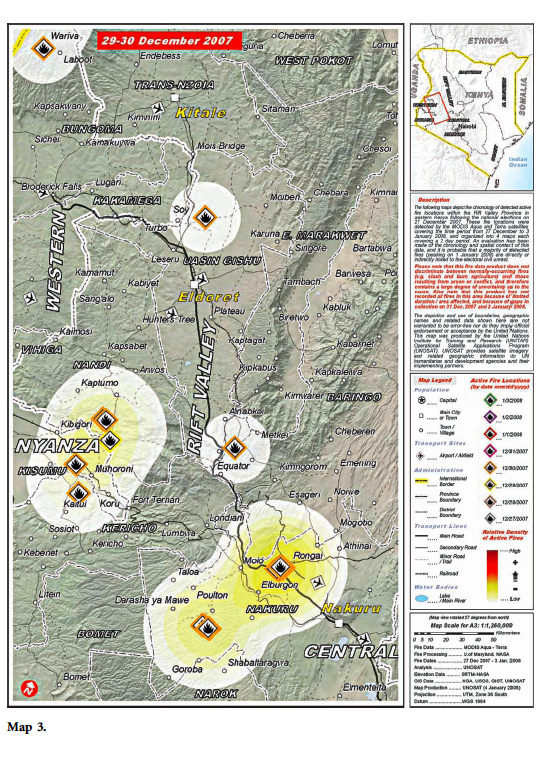
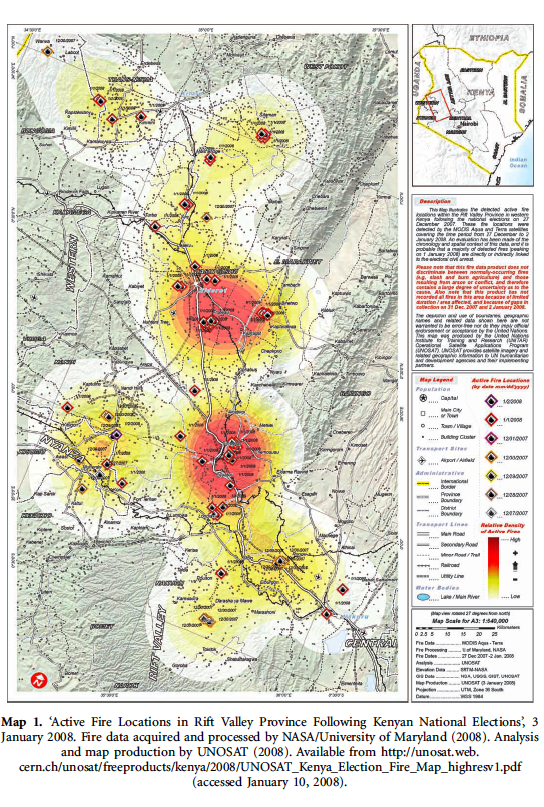
“The result was five maps covering a portion of Rift Valley Province from Nakuru to Kitale, as well as the eastern edges of Nyanza and Western Provinces. Map 1 provides an aggregate view of all active fire locations from 27 December 2007 to 3 January 2008.”

“Maps 2-5 show fires on specific days during that period. Each of the diamonds on the maps represents an area of a square kilometre that contained an active fire location at the time a satellite passed overhead. Fires generally have to cover an area of about fifty square metres to be noticed by this technology, though intensity can affect this. The colouring in the background, on the other hand, is a function of the relative clustering of active fire locations—purely a tool to direct the map-reader and not an indication of fire intensity.”

“Apart from demonstrating the geographical dimensions of the arson and conflict occurring in the area, the maps also begin to provide a general chronology of events into which more specific accounts from witness testimonies and other sources can be integrated. UNOSAT’s four chronological maps (Maps 2-5) cover the majority of the eight day period: 27-28 December, 29-30 December, 1 January, and 2!3 January, and provide powerful visuals of how events unfolded.”

“It is important to bear in mind that gaps in data collection occurred on 31 December and 2 January, and that satellite imagery captures what is happening in a particular fraction of a second—data acquisition times generally occurred around 10:30 a.m., 1:30 p.m., and 11 p.m. Kenyan local time. Bearing this in mind, it is possible using the maps to begin to understand the broad pattern of the escalation of the violence over the period.”

The authors of the study point out some limitations:

“These maps are visually compelling, but we should note that they ‘hide’ important dimensions of the violence—on a map all fires look the same. Violence in urban areas, for instance, differed markedly from that in rural areas, and these maps do not represent this difference. Another example is how little these maps reveal about the increasingly serious situation in Mt Elgon.”

This limitation is inherent to static maps, not so for live crisis maps that are interactive and dynamic.

“The mark of a single fire in the southern part of the district included on two of the maps does not stand out from the other fire locations. However, we know from other sources that violence in Mt Elgon continued to increase in severity after the elections. If violence was occurring on the Chebyuk land settlement schemes on Mt Elgon at this time, then it did not involve fires of sufficient magnitude to be detected by this satellite technology.”

“The mapping of fires can therefore tell us only part of the story. Cohesive explanations of specific situations can only begin to emerge if we triangulate the evidence provided by the maps with other kinds of information. This research is continuing, but at this stage we can offer a preliminary analysis that highlights several significant points:

  • Even before the first wave of violence in the Rift Valley was sparked by the announcement of the presidential poll result on 30 December 2007, conflict had already broken out in some areas over the two days between the closure of the polls and the announcement of the presidential result. This correlates with evidence in media and human rights reports that some majimboist activists planned violence after the election regardless of the outcome of the vote.
  • Over the hours following Kivuitu’s announcement of Kibaki’s victory, violence broke out in several different locations across the province, some of this undoubtedly a spontaneous reaction to the alleged ‘theft’ of the election, and targeted against persons associated with the PNU and its allies. However, many other attacks were evidently planned and orchestrated. Kikuyu-settled areas of Eldoret were ablaze within two hours of Kibaki’s re-election, armed Kalenjin men arriving in lorries to carry out the attacks. These assaults were not confined to ‘aliens’, but included attacks upon properties owned by ex-president Moi and his close Kalenjin associates, including Nicholas Biwott, whose KANU party had made an electoral pact with PNU.
  • The locations of this first major wave of violence in the first week of January show a clear spatial pattern: the outbreaks were invariably in places where non-indigenous populations were living. The targets of this violence were predominantly Kikuyu and Kisii communities, who were identified as PNU supporters. Though many attacks were murderous, the main purpose was to ‘chase away’ the victims. By 6 January, the Kenya Red Cross estimated a national figure of 211,000 persons internally displaced in violence since 30 December, the vast majority of these being within Rift Valley.
  • The violence accordingly coalesced in two types of location: the first was larger and smaller towns, where populations are ethnically more mixed and where businesses are concentrated—for example the rapid upsurge of conflict in and around Eldoret. The second was on rural settlement schemes, where land has been purchased or leased by farmers from a wide range of ethnic groups—for example, Burnt Forest, Ndalat, and the Molo area of Nakuru District. The settlement schemes at Burnt Forest, the scene of dreadful violence in the 1990s, were completely cut off by road barricades by the morning of 1 January, impeding the work of relief agencies, in what was clearly an organized and coordinated assault.”

This study clearly shows the added value of combining satellite imagery analysis with reporting from the ground. This analysis was all carried out retroactively, however. To this end, lets hope that the Satellite Sentinel Project, which I blogged about here, and Sudan Vote Monitor, which uses the Ushahidi platform, will be sharing information to allow for near real-time integrated analysis.

New Publications on Haiti, Crowdsourcing and Crisis Mapping

Two new publications that may be of interest to iRevolution readers:

MIT’s Journal, Innovations: Technology, Governance, Globalization just released a special edition focused on Haiti which includes lead articles by President Bill Clinton and Digicel’s CEO Denis O’Brien. My colleague Ida Norheim-Hagtun and I were invited to contribute the following piece: Crowdsourcing for Crisis Mapping in Haiti. The edition also includes articles by Mark Summer from Inveneo and my colleague Josh Nesbit from Medic:Mobile.

The SAIS Review of International Affairs recently published a special edition on the cyber challenge threats and opportunities in a networked world, which includes an opening article on Internet Freedom by Alec Ross. My colleague Robert Munro and I were invited to submit write the following piece: The Unprecedented Role of SMS in Disaster Response, which focuses specifically on Haiti. Colleagues from Havard University’s Berkman Center also had a piece on Political Change in the Digital Age, which I reviewed here.

Please feel free to get in touch if you’d like copies of the articles on Haiti. In the meantime, here is a must-read for everyone working in Haiti: “Foreign Friends, Leave January 12th to Haitians.”

Impact of Technology on Democracy and Activism: Findings from Multiple Statistical Studies

Chapter 2 of my dissertation consists of a literature review on the impact of the Internet and mobile phones on democracy and activism. The first part of this literature view focuses specifically on analyzing the results from all the peer-reviewed quantitative studies that currently exist on the topic. The second part reviews more micro-level qualitative research. Part 1 is available here as a 7-page PDF. Part 2 will be available shortly.

Here is the list of studies reviewed in Part 1:

Eyck, Toby. 2001. “Does Information Matter? A research note on information technologies and political protest,” Social Science Journal, 38(2001): 147-160.

Howard, Philip. 2010. The Digital Origins of Dictatorship and Democracy: Information Technology and Political Islam. (Oxford University Press: Oxford, England).

Groshek, Jacob. 2010. “A Time-Series, Multinational Analysis of Democratic Forecasts and Internet Diffusion,” International Journal of Communication, 4(2010): 142-174.

Groshek, Jacob. 2009. “The Democratic effects of the Internet, 1994-2003: A Cross-National Inquiry of 152 countries,” The International Communication Gazette, 71(3): 115-136.

Meier, Patrick. 2011. “The Impact of the Information Revolution on Protest Frequency in Repressive Contexts,” doctoral dissertation, The Fletcher School, Tufts University.

Miard, Fabien. 2009. “Call for Power: Mobile Phones as Facilitators of Political Activism,” paper presented at the 50th Annual Convention of the International Studies Association (ISA), February 2009, New York.

I’m particularly keen on getting feedback on my draft, especially if you think I’ve missed a statistical study or find any errors in my analysis. Thank you.


Will Using ‘Live’ Satellite Imagery to Prevent War in the Sudan Actually Work?

Update: Heglig Crisis 2012, Border Clashes 2012, Invasion of Abyei 2012

The Satellite Sentinel Project has hired private satellites to monitor troop movements around the oil-rich region of Abyei during the upcoming Sudanese referendum and prevent war. The images and analysis will be made public on the Project’s website. George Clooney, who catalyzed this joint initiative between Google, UNOSAT, the Enough Project, Trellon and my colleagues at the Harvard Humanitarian Initiative (HHI), calls this the anti-genocide paparazzi:

“We want them to enjoy the level of celebrity attention that I usually get. If you know your actions are going to be covered, you tend to behave much differently than when you operate in a vacuum.”

The group hopes that they can deter war crimes by observing troop buildups and troop movements in advance. If successful, the project would accomplish an idea first proposed more than half-a-century ago  by US President Dwight Eisenhower during a US-Soviet Summit in Paris at the height of the Cold War. Eisenhower announced his plan to “submit to the United Nations a proposal for the creation of a United Nations aerial surveillance to detect preparations for attack.” Interestingly, Eisenhower had crafted this idea five years earlier as part of his Open Skies Proposal, which actually became a treaty in 2002:

“The Treaty establishes a regime of unarmed aerial observation flights over the entire territory of its participants. The Treaty is designed to enhance mutual understanding and confidence by giving all participants, regardless of size, a direct role in gathering information about military forces and activities of concern to them. Open Skies is one of the most wide-ranging international efforts to date to promote openness and transparency of military forces and activities.”

If you want to find out more about Eisenhower’s efforts, please see my blog post on the subject here.

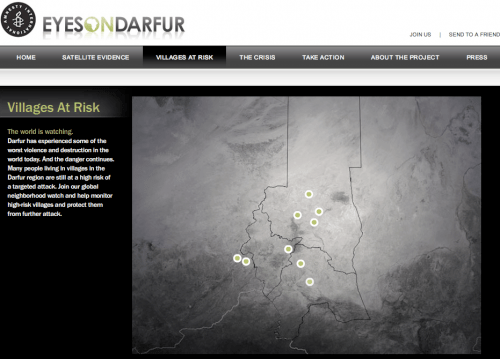
So there is some precedence for what Clooney is trying to pull off. But how is the Sentinel project likely to fare as a non-state effort? Looking at other non-state actors who have already operationalized Eisenhower’s ideas may provide some insights. Take Amnesty International’s “Eyes on Darfur” initiative, which “leverages the power of high- resolution satellite imagery to provide unim- peachable evidence of the atrocities being committed in Darfur–enabling action by private citizens, policy makers and international courts.”

According to Amnesty, the project “broke new ground in protecting human rights by allowing people around the world to literally ‘watch over’ and protect twelve intact, but highly vulnerable, villages using commercially available satellite imagery.” The imagery also enabled Amnesty to capture the movement of Janjaweed forces. Amnesty claims that their project has had a deterrence effect. Apparently, the villages monitored by the project have not been attacked while neighboring ones have. That said, at least two of the monitored villages were removed from the site after reported attacks.

Still Amnesty argues that there have been notable changes in decisions made by the Bashir government since “Eyes on Darfur” went live. They also note that the government of Chad cited their as one of the reasons they accepted UN peacekeepers along their border.

In my blog post on Eisenhower’s UN surveillance speech I asked whether the UN would ever be allowed to monitor and detect preparations for attack using satellite imagery. I now have my answer given that UNOSAT is involved in the Sentinel Project which plans to “deter the resumption of war between North and South Sudan” by providing an “early warning system to deter mass atrocities by focusing world attention and generating rapid responses on human rights and human security concerns” (Sentinel). But will these efforts really create an effective deterrence-based “Global Panopticon”?

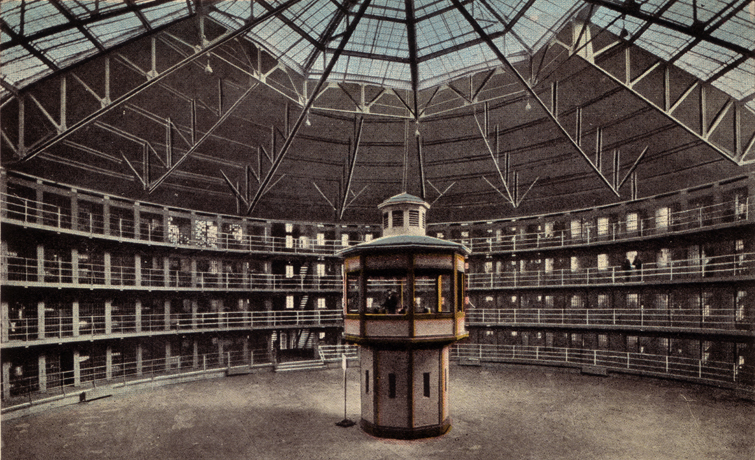
French philosopher Michel Foucault has famously written on the role of surveillance as an instrument of power. “He cites the example of Jeremy Bentham’s ‘Panopticon,’ an architectural model for a prison enabling a single guard, located in a central tower, to watch all of the inmates in their cells.  The ‘major effect of the Panopticon,’ writes Foucault, is ‘to induce in the inmate a state of conscious and permanent visibility that assures the automatic functioning of power.'”

According to Foucault, the Panopticon renders power both “visible and unverifiable”: Visible: the inmate will constantly have before his eyes the tall outline of the central tower from which he is being spied upon. Unverifiable: the inmate must never know whether he is being looked at at any one moment; but he must be sure that he may always be so. But potential perpetrators of the violence in the Sudan do not actually see the  outline of the satellites flying overhead. They are not being directly harassed by high-powered “cameras” stuck into their faces by the anti-genocide paparazzi. So the power is not directly visible in the traditional sense. But who exactly is the inmate in or connected to Abyei in the first place?

There are multiple groups in the area with different agendas that don’t necessarily tie back to the Sudanese government in Khartoum. The Arab Misseriya tribe has thus far remained north during this dry season to avert confrontation with the Ngok Dinka in the Southern part of Abyei. These nomadic tribes typically carry Kalashnikovs to guard their cattle. So distinguishing these nomads from armed groups prepared to raid and burn down villages is a challenge especially when dealing with satellite imagery. Using UAV’s may be more useful and cheaper. (Note that monitoring the location and movement of cattle could be insightful because cattle issues are political in the area).

If armed groups who intend to burn down villages are the intended inmates, do they even know or care about the Satellite Sentinel Project? The ICC has already struggled to connect the chain of command back to the Sudanese government. Besides, the expected turn-around time to develop the satellite imagery is between eight to twenty-four hours. Getting armed men on a truck and raiding a village or two doesn’t take more than a few hours. So the crimes may already have been committed by the time the pictures come in. And if more heavy military machinery like tanks are rolled in, well, one doesn’t need satellite imagery to detect those.

As scholars of the panopticon have noted, the successful use of surveillance has to be coupled with the threat of punishment for deviant acts. So putting aside the issue of who the intended inmates are, the question for the Sentinel Project is whether threats of punishment are perceived by inmates as sufficiently real enough for the deterrence to work. In international relations theory, “deterrence is a strategy by which governments threaten an immense retaliation if attacked, such that aggressors are deterred if they do not wish to suffer great damage as a result of an aggressive action.”

This means that official state actors need to step up and publicly pledge to carry out the necessary punishment if the satellite imagery collected by Sentinel provides evidence of wrong-doing. The ICC should make it crystal clear to all inmates (whoever they are) that evidence from the satellite imagery will be used for prosecution (and that they should care). There also need to be armed guards in  “the tower” who are proximate enough to be deployed and have the political will to use force if necessary. Or will the anti-genocide paparazzi’s many eyes be sufficient to keep the peace? It’s worth remembering that the Hollywood paparazzi haven’t exactly turned movie stars into alter boys or girls. But then again, they’d probably get away with a whole lot more without the paparazzi.

US spy satellites have no doubt monitored conflict-prone areas in the past but this  hasn’t necessarily deterred major crimes against humanity as far as I know. Of course, the imagery collected has remained classified, which means the general public hasn’t been able to lobby their governments and the international community to act based on this information and shared awareness.

The Sentinel Project’s open source approach changes this calculus. It may not deter the actual perpetrators, but the shared awareness created thanks to the open data will make it more difficult for those who can prevent the violence to look the other way. So the Satellite Sentinel Project may be more about keeping our own governments accountable to the Responsibility to Protect (R2P) than deterring actors in the Sudan from committing further crimes.

How will we know if Clooney succeeds? I’m not quite sure. But I do know that the Sentinel Project is a step in the right direction. More evidence is always more compelling than less evidence. And more public evidence is even better. I have no doubt therefore that Eisenhower would back this Open Skies project.

p.s. It is worth noting that the satellite imagery of Sri Lankan forces attacking civilians in 2009 were dismissed as fake by the Colombo government even though the imagery analysis was produced by UNOSAT.

Why Crowdsourcing and Crowdfeeding may be the answer to Snowmageddon

The state response to the massive snow storm in NY was predictably slow and not up to the task. The New York Times reported that “streets across vast stretches of the city remained untouched, leaving tens of thousands of residents unable to get to jobs and many facing long waits for ambulances and other emergency services.” In addition 911 dispatchers fielded tens of thousands of calls with a backlog of more than one thousand at one point and “at least 200 ambulances got stuck on unplowed streets or were blocked by abandoned cars.”

This centralized top-down approach to disaster response is meant to be effective and to save lives, but it has cost lives instead and will continue to do so until we realize that a more distributed and decentralized approach facilitated by digital technology is a better mach for the complexity of disaster response. Indeed, findings from a recent study commissioned by the Red Cross reveal that 75% of people now expect an almost-immediate response after posting a call for help on a social media platform during a disaster.

The Red Cross and other humanitarian organizations are particularly troubled by this figure. They shouldn’t be. It is high time that crisis response organizations start viewing the public as part of the team. One way to do so is to create an open marketplace for crowdsourcing crisis response.

The real first responders are those who are affected by a disaster, i.e., the local residents, not state officials. We could post second responders (official disaster responders) at the corner of every street but this would require tens of thousands of additional responders at a prohibitive cost. Clearly, official response teams can’t always be there. But the crowd, the crowd is always there. One answer to our Snowmageddon woes is therefore to help the crowd help itself.

Hence this Ushahidi deployment:

This kind of service enables affected residents to map their needs and for those less affected to map how they can help. You don’t need to be a disaster response professional to help your neighbor dig out their car. Imagine how many ambulances could have been dug out if the crowd were better connected to swarm the response. Recall the example in Estonia where volunteers organized online to start a mass garbage cleanup campaign. Some 50,000 all showed up on one day and collected over 10,000 tonnes of garbage.

As I’ve written before, there’s a lot that disaster affected populations can (and already do) to help each other out in times of crisis. What may help is to combine the crowdsourcing of crisis information with what I call crowdfeeding in order to create an efficient market place for crowdsourcing response. By crowdfeeding, I mean taking crowdsourced information and feeding it right back to the crowd. Surely they need that information as much if not more than external, paid responders who won’t get to the scene for hours or days.

We talk about top-down and bottom-up approaches. Crowdfeeding is a “bottom-bottom” approach; horizontal, meshed communication for local rapid response. Information of the crowd, by the crowd and for the crowd. For the marketplace to work at the technical level, users should easily be able to map their needs or map the resources they have to help others. They should be able to do this via webform, SMS, Twitter, smart phone apps, phone call, etc.

But users shouldn’t have to keep looking back at the map to check whether anyone has posted offers to help in their area, or vice versa. They should get an automated email and/or text message when a potential match is found. The matching should be done by a simple algorithm, a Match.com for crowdsourcing crisis response. (Just like online dating, users should take appropriate precautions when contacting their match). On a practical level, this marketplace will work best if it draws many traders. That’s why the data should be easily shared across platforms.

New Yorkers are a resilient bunch so the City should leverage the goodwill that exists by helping the crowd connect and help itself. They set up an online marketplace for crowdsourcing needs and crisis response and let New Yorkers participate in their own response.

Latest Empirical Findings on Democratic Effects of the Internet

Jacob Groshek from Iowa State University recently published the latest results from his research on the democratic effects of the Internet in the International Journal of Communication. A copy of Groshek’s study is available here (PDF).

Groshek published an earlier study in 2009 which I blogged about here. In this latest set of findings, Groshek concludes that “Internet diffusion was not a specific causal mechanism of national-level democratic growth during the timeframe analyzed,” which was 1994-2003. The author therefore argues that “the diffusion of the Internet should not be considered a democratic panacea, but rather a component of contemporary democratization processes.” Interestingly, these conclusions seem to contradict his findings from 2009.

The purpose of this blog post is to summarize Groshek’s research so I can include it in my dissertation’s literature review. What follows therefore are some excerpts that summarize Groshek’s research design and methodology. I also add my thoughts on the study and the implications of the findings.

Some Background:

“Technological developments, especially communicative ones, have long been positioned — and even romanticized — as powerful instruments of democracy (Dunham, 1938; Lerner, 1958). This tradition goes back at least as far as the printing press and its contribution to democratic movements of past centuries (Schudson, 1999) in relation to conceptions of the public sphere and the fourth estate (Jones, 2000). Over the course of the past century, telegraphs, telephones, radios, and televisions were all introduced as “new” media, and each of these technologies were often ascribed broad potential for enhancing democratic development around the world (Becker, 2001; Navia & Zweifel, 2006; Spinelli, 1996).”

The Methodology:

“Though there are many ways to operationalize democracy and measure the prevalence of media technologies, this study relies principally on macro-level time–series democracy data from an historical sample that includes 72 countries, reaching back as far as 1946 in some cases, but at least from 1954 to 2003. From this sample, a sequence of ARIMA (autoregressive integrated moving average) time–series regressions were modeled for each country for at least 40 years prior to 1994.”

“These models were then used to generate statistically-forecasted democracy values for each country, in each year from 1994 to 2003. A 95% confidence interval with an upper and lower democracy score was then constructed around each of the forecasted values using dynamic mean squared errors. The actual democracy scores of each country for each year from 1994 to 2003 were then compared to the upper and lower values of the confidence interval.”

The Results:

“Based on the statistical findings, three countries that demonstrated democracy levels greater than those statistically predicted  [Croatia, Indonesia and Mexico] were selected for brief contemporary historical analyses to identify whether the Internet acted as a specific causal mechanism that may have contributed to democratization processes. These case study evaluations were basic overviews of historical events, figures, and policies that placed these findings into context to better specify what precise role, if any, the Internet had on the increases in democracy observed in these three countries that were greater than they had been predicted to be, statistically.”

Interestingly, out of the 72 countries studied, the only one with democracy scores significantly below the statistically predicted score was Belarus.

“While the purpose of this study is to more specifically assess the possibility that Internet diffusion might be linked to democratic growth, the case of Belarus provides an important counterbalance to that concept. This is because, starting with 1995, the actual democracy score was less than the predicted democracy score — and it remained below the predicted values through 2003, even though Internet diffusion reached approximately 14% by the end of the time frame investigated. Thus, it is evident that less democratic countries can invest in increasing Internet diffusion and still constrict democratic development.”

What about Croatia, Indonesia and Mexico?

“A circumspect approach to understanding the role Internet diffusion played in Croatia’s democratization is to recognize that, by most accounts, it was an important factor that helped determine the trajectory of political development in this country. It was not, however, the defining feature of this democratic transition, which was set in motion years earlier by a coalescing of events and political figures that also transcended Croatia’s national boundaries (Hampton, 2007).”

“Indonesia had observed actual democracy levels greater than that of the predicted confidence interval from 1999 to 2003. Yet, for nearly all of the timeframe investigated here, Indonesian media development was tightly restricted by the government and subject to severe censorship (Eick, 2007), so it seems unlikely that the diffusion of the Internet would be a critical democratic agent. In addition, the diffusion of the Internet was a paltry 0.44 people per 100 in 1999, when the democracy level spiked through the upper confidence interval of the predicted value.”

“[In the final case, it is] impossible to summarily conclude that Mexico was more democratic precisely due to Internet diffusion than it would have been had the Internet not diffused, at least when considering institutionalized national level democracy. This is because the transnational civil society network pioneered by the Zapatistas was more about élites who had Internet access and how the Zapatistas tapped this group and projected their ideological views through the Internet, even though, in Mexico, the Internet only reached a tiny portion of the general population. Therefore, it was not high levels of Internet diffusion among the Mexican citizens in 1994, but rather influential Internet users that contributed democratic change during that time period.”

In Conclusion:

“The results of the investigations undertaken in this study yield no conclusive evidence that the democratic growth from 1994 to 2003 was due singularly, or even primarily, to the diffusion of the Internet.”

Side note: I personally don’t know anyone or of any empirical study that claims that democratic growth around the world is singularly or even primarily due to the Internet. Do you?

“It is therefore prudent to consider the Internet a potentially potent but underutilized democratic tool, one that is only as useful as the citizens who employ and implement it for political purposes (Schudson, 2003). Thus far, the Internet has not been diffused or activated to an extent that this technology has sustained the third democratic wave (Huntington, 1991). Importantly, virtuosity and democratic agency are not inherent in media technologies, no matter how interactive or participatory. Rather, these exist in individuals, and in the crucial applications and uses they make of communicative technologies (Nord, 2001; Schudson, 1999, 2003).”

“Thus, the general conclusion of this study is that the Internet has not catalyzed transformative, national-level democratic growth, although there is some reason to believe that it may contribute to these changes, as the cases of Mexico and Croatia exhibit. This finding, of course, does not rule out the possibility that there may be national-level democratic effects related to Internet diffusion in the future, nor does it rule out possible effects on personal or other sub-national levels.”

It’s great to see more data-driven research on this topic and be spared (albeit temporarily) anecdote-laden and chronically repetitive popular media reports on technologies being either all-liberating or all-repressive. A possible corollary to Groshek’s  findings is that the use of the Internet by repressive regimes did not lead to a statistically significant decrease in expected democracy scores.  In other words, dictators may love the web, but that romance ain’t having a macro-level impact on the level of repression.

Obviously, multiple factors contribute to democratic processes and transitions. The more interesting questions, in my opinion, are these: what are the underlying drivers of protest movements and how might new technologies accelerate those drivers and/or create new ones? Along these lines, how do tactics and strategies from civil resistance benefit from using new technologies? Does the careful, planned and innovative use of these technologies in social protests provide activists with a competitive edge they didn’t have in the past?

Update: My colleague Mary Joyce makes an excellent point regarding the time span covered by the analysis, i.e., through to 2003. As she rightly notes, major social media platforms used for activism, like YouTube (2005), Facebook (2004) and Twitter (2006), were created after 2003. See her blog post here for more of her analysis on Groshek’s work.

The Political Power of Social Media

Clay Shirky just published a piece in Foreign Affairs on “The Political Power of Social Media.” I’m almost done with writing my literature review of digital activism in repressive states for my dissertation so this is a timely write-up by Clay who also sits on my dissertation committee. The points he makes echo a number of my blog posts and thus provides further support to some of the arguments articulated in my dissertation. I’ll use this space to provide excerpts and commentary on his 5,000+ word piece to include in my literature review.

“Less than two hours after the [Philippine Congress voted not to impeach President Joseph Estrada], thousands of Filipinos […] converged on Epifanio de los Santos Avenue, a major crossroads in Manila. The protest was arranged, in part, by forwarded text messages reading, ‘Go 2 EDSA. Wear blk.’ The crowd quickly swelled, and in the next few days, over a million people arrived, choking traffic in downtown Manila.”

“The public’s ability to coordinate such a massive and rapid response — close to seven million text messages were sent that week — so alarmed the country’s legislators that they reversed course and allowed the evidence to be presented. Estrada’s fate was sealed; by January 20, he was gone. The event marked the first time that social media had helped force out a national leader. Estrada himself blamed ‘the text-messaging generation’ for his downfall.”

“As the communications landscape gets denser, more complex, and more participatory, the networked population is gaining greater access to information, more opportunities to engage in public speech, and an enhanced ability to undertake collective action. In the political arena […] these increased freedoms can help loosely coordinated publics demand change.”

See this blog post on Political Change in the Digital Age: The Prospect of Smart Mobs in Authoritarian States.

“The Philippine strategy has been adopted many times since. In some cases, the protesters ultimately succeeded, as in Spain in 2004, when demonstrations organized by text messaging led to the quick ouster of Spanish Prime Minister José María Aznar, who had inaccurately blamed the Madrid transit bombings on Basque separatists. The Communist Party lost power in Moldova in 2009 when massive protests coordinated in part by text message, Facebook, and Twitter broke out after an obviously fraudulent election.”

“There are, however, many examples of the activists failing, as in Belarus in March 2006, when street protests (arranged in part by e-mail) against President Aleksandr Lukashenko’s alleged vote rigging swelled, then faltered, leaving Lukashenko more determined than ever to control social media. During the June 2009 uprising of the Green Movement in Iran, activists used every possible technological coordinating tool to protest the miscount of votes for Mir Hossein Mousavi but were ultimately brought to heel by a violent crackdown. The Red Shirt uprising in Thailand in 2010 followed a similar but quicker path: protesters savvy with social media occupied downtown Bangkok until the Thai government dispersed the protesters, killing dozens.”

“The use of social media tools — text messaging, e-mail, photo sharing, social networking, and the like — does not have a single preordained outcome. Therefore, attempts to outline their effects on political action are too often reduced to dueling anecdotes.”

Clay picks up on some of my ongoing frustration with the “study” of digital activism. He borrows his dueling analogy from some of my earlier blog post of mine in which I chide the popular media for sensationalizing anecdotes. See for example:

“Empirical work on the subject is also hard to come by, in part because these tools are so new and in part because relevant examples are so rare. The safest characterization of recent quantitative attempts to answer the question, Do digital tools enhance democracy? (such as those by Jacob Groshek and Philip Howard) is that these tools probably do not hurt in the short run and might help in the long run — and that they have the most dramatic effects in states where a public sphere already constrains the actions of the government.”

Reading this made me realize that I need to get my own empirical results out in public in the coming weeks. As part of my dissertation research, I used econometric analysis to test whether an increase in access to mobile phones and the Internet serves as a statistically significant predictor of anti-government protests. So I’ll add this to my to-do list of blog posts and will also share my literature review in full as soon as I’m done with that dissertation chapter.

In the meantime, have a look at the Global Digital Activism Dataset (GDADS) project that both Clay and I are involved in to spur more empirical research in this space.

Although the story of Estrada’s ouster and other similar events have led observers to focus on the power of mass protests to topple governments, the potential of social media lies mainly in their support of civil society and the public sphere — change measured in years and decades rather than weeks or months. [We] should likewise assume that progress will be incremental and, unsurprisingly, slowest in the most authoritarian regimes.

I wrote up a blog post just a few weeks ago on “How to Evaluate Success in Digital Resistance: Look at Guerrilla Warfare,” which makes the same argument. Clay goes on to formulate two perspectives on the role of social media in non-permissive environments, the instrumentalist versus environmental schools of thought.

“The instrumental view is politically appealing, action-oriented, and almost certainly wrong. It overestimates the value of broadcast media while underestimating the value of media that allow citizens to communicate privately among themselves. It overestimates the value of access to information, particularly information hosted in the West, while underestimating the value of tools for local coordination. And it overestimates the importance of computers while underestimating the importance of simpler tools, such as cell phones.”

“According to [the environmental view], positive changes in the life of a country, including pro-democratic regime change, follow, rather than precede, the development of a strong public sphere. This is not to say that popular movements will not successfully use these tools to discipline or even oust their governments, but rather that U.S. attempts to direct such uses are likely to do more harm than good. Considered in this light, Internet freedom is a long game, to be conceived of and supported not as a separate agenda but merely as an important input to the more fundamental political freedoms.”

One aspect that I particularly enjoy about Clay’s writings is his use of past examples from history to bolster his arguments.

“One complaint about the idea of new media as a political force is that most people simply use these tools for commerce, social life, or self-distraction, but this is common to all forms of media. Far more people in the 1500s were reading erotic novels than Martin Luther’s “Ninety-five Theses,” and far more people before the American Revolution were reading Poor Richard’s Almanack than the work of the Committees of Correspondence. But those political works still had an enormous political effect.”

“Just as Luther adopted the newly practical printing press to protest against the Catholic Church, and the American revolutionaries synchronized their beliefs using the postal service that Benjamin Franklin had designed, today’s dissident movements will use any means possible to frame their views and coordinate their actions; it would be impossible to describe the Moldovan Communist Party’s loss of Parliament after the 2009 elections without discussing the use of cell phones and online tools by its opponents to mobilize. Authoritarian governments stifle communication among their citizens because they fear, correctly, that a better-coordinated populace would constrain their ability to act without oversight.”

Turning to the fall of communism, Clay juxtaposes the role of communication technologies with the inevitable structural macro-economic forces that lifted the Iron Curtain.

“Any discussion of political action in repressive regimes must take into account the astonishing fall of communism in 1989 in eastern Europe and the subsequent collapse of the Soviet Union in 1991. Throughout the Cold War, the United States invested in a variety of communications tools, including broadcasting the Voice of America radio station, hosting an American pavilion in Moscow  […], and smuggling Xerox machines behind the Iron Curtain to aid the underground press, or samizdat.”

“Yet despite this emphasis on communications, the end of the Cold War was triggered not by a defiant uprising of Voice of America listeners but by economic change. As the price of oil fell while that of wheat spiked, the Soviet model of selling expensive oil to buy cheap wheat stopped working. As a result, the Kremlin was forced to secure loans from the West, loans that would have been put at risk had the government intervened militarily in the affairs of non-Russian states.”

“In 1989, one could argue, the ability of citizens to communicate, considered against the background of macroeconomic forces, was largely irrelevant. Communications tools during the Cold War did not cause governments to collapse, but they helped the people take power from the state when it was weak. […]. For optimistic observers of public demonstrations, this is weak tea, but both the empirical and the theoretical work suggest that protests, when effective, are the end of a long process, rather than a replacement for it.”

Clay also emphasizes the political importance of conversation over the initial information dissemination effect:

“Opinions are first transmitted by the media, and then get echoed by friends, family members, and colleagues. It is in this second, social step that political opinions are formed. This is the step in which the Internet in general, and social media in particular, can make a difference. As with the printing press, the Internet spreads not just media consumption but media production as well — it allows people to privately and publicly articulate and debate a welter of conflicting views.”

How about the role of social media in organization and coordination?

“Disciplined and coordinated groups, whether businesses or govern-ments, have always had an advantage over undisciplined ones: they have an easier time engaging in collective action because they have an orderly way of directing the action of their members. Social media can compensate for the disadvantages of undisciplined groups by reducing the costs of coordination. The anti-Estrada movement in the Philippines used the ease of sending and forwarding text messages to organize a massive group with no need (and no time) for standard managerial control. As a result, larger, looser groups can now take on some kinds of coordinated action, such as protest movements and public media campaigns, that were previously reserved for formal organizations.”

I’m rather stunned by this argument: “Social media can compensate for the disadvantages of undisciplined groups by reducing the costs of coordination.” Seriously? If a group is unorganized and undisciplined, advocating that it use social media—particularly in a repressive environment—is highly inadvisable. Turning an unorganized and undisciplined mob into a flash mob thanks to social media tools does not make it a smart mob. Clay’s argument directly contradicts the  rich empirical research that exists on civil resistance in authoritarian states.

“For political movements, one of the main forms of coordination is what the military calls ‘shared awareness,’ the ability of each member of a group to not only understand the situation at hand but also understand that everyone else does, too. Social media increase shared awareness by propagating messages through social networks.”

Top 10 Posts of 2010

Here are the Top 10 iRevolution Posts of 2010!

1. The Future of News: Mobilizing the Masses to Write First Draft of History

2. How to Run a Successful Crowdsourcing Project

3. The Starfish and the Spider: 8 Principles of Decentralization

4. Haiti and the Power of Crowdsourcing

5. The Digital Disruption: Connectivity and the Diffusion of Power

6. The Unprecedented Role of SMS in Disaster Response

7. How Crowdsourced Data Can Predict Crisis Impact

8. My Thoughts on Gladwell’s Piece in The New Yorker

9. WikiLeaks of Mass Disruption: Get Ready for the Clone Wars

10. Maptivism: Live Tactical Mapping for Protest Swarming

Happy Holidays!

Political Change in the Digital Age: The Prospect of Smart Mobs in Authoritarian States

The latest edition of the SAIS Review of International Affairs is focused on cyber threats and opportunities. My Stanford colleague Rob Munro and I contributed a piece on crowdsourcing SMS for crisis response. Colleagues at Harvard’s Berkman Center wrote this piece on political change in the digital age—specifically with respect to authoritarian and semi-authoritarian regimes. Their research overlaps considerably with my dissertation so what follows is a short summary of their article.

Bruce Etling, Robert Faris and John Palfrey basically argue that policymakers and scholars have been focusing too narrowly on the role of digital technology in providing unfiltered access to the Internet and independent sources of information. They argue that “more attention should be paid to the means of overcoming the difficulties of online organization in the face of authoritarian governments in an increasingly digital geopolitical environment.” The authors thus seek to distinguish between flow of information and social organization facilitated by digital tools.

“While information and organizing are inextricably linked—photographs and videos play an important and growing role in empowering and motivating social activists—it is helpful to consider them separately as the use of technology entails different opportunities and challenges for each.”

They therefore develop a simple analytical framework to describe the interaction between civil society, media and governments in different types of regimes.

They argue that to understand the role of digital tools on democratic processes, “we must better understand the impact of the use of these tools on the composition and role of civil society.” Etling, Faris and Palfrey therefore assess the influence of digital technologies on the formation and activities of civil society groups—and in particular mobs, movements and civil society organizations. See Figure 2 below.

The authors claim that “hierarchical organizations with strong networks—the mainstay of civil society in consolidated democracies—are not a viable option in authoritarian states.” No news there. They write that civil society organizations (CSOs) are therefore easy targets since their “offline activities are already highly regimented and watched by the state.”

The protests in Burma and Iran are characterized by a “grey area between a flash mob and social movement” and efforts at digital organizing in these cases have been largely ineffective, according to the authors. They do have hope for smart mobs, however, given their ability to emerge organically and take governments by surprise: “In a few cases, the ability of a mob to quickly overwhelming unprepared governments has been successful.” They cite the case of Estrada in the Philippines, also the Philippines and Kyrgyzstan. The authors don’t elaborate on any of these anecdotes (see my rant on the use of anecdotes in the study of digital activism here).

As iRevolution readers will know, I’m not an advocate of spontaneous protests in the context of authoritarian states. I have argued time and time again that digital activists need more dedicated training in civil resistance and nonviolent action, which emphasizes planning and preparation. The Berkman authors write that success is “likely determined not by the given technology tool, but by the human skill and facility in using the networks that are being mobilized.” Likely? More like “definitely not determined by the technology.”

The authors also write that successful movements:

“… appear to combine the best of ‘classic’ organizing tactics with the improvisation, or “jazz” that is enabled by new Internet tools; for example, constantly updated mobile mapping tools […]. It is less clear how far online organizing and digital communities will be allowed to push states toward drastic political change and greater democratization, especially in states where offline restrictions to civic and political organization are severe. As scholars, we ought to focus our attention on the people involved and their competencies in using digitally-mediated tools to organize themselves and their fellow citizens, whether as flash mobs or through sustained social movements or organizations, rather than the flow of information as such.”

The Berkman scholars are mistaken in their reference to improvisation and jazz. As anyone interested in music will know, playing jazz—and acquiring the skills for jazz improv—takes years of training and hard work. It is therefore foolhardy to advocate for spontaneous mob action in repressive environments or to romanticize their power. The authors only dedicate one sentence to this concern: “Poorly organized mass actions are highly unpredictable and easily manipulated.”

In closing, I’d like to link this Berkman paper to the ongoing conversations around WikiLeaks. As the authors note, the best illustration of the threat that new information flows pose to authoritarian governments is their reaction to it.