FSI09: Failed States and Civil Resistance

My former Professor Richard Shultz gave the fourth presentation at the Fletcher Summer Institute (FSI) for the Advanced Study of Nonviolent Conflict 2009.

Shultz placed his presentation into context by noting that he has radically changed his syllabi and created new courses in order reflect the changing global security. While security traditionally focused on armed groups, we are now focusing increasingly on non-state armed groups and more recently on non-state non-armed groups. Furthermore, violence is a subset of force. In other words, nonviolence is another force that needs to be studied within the context of failed states and civil resistance.

Authority, according to Professor Shultz is based on two characteristics: legitimacy and coercion. He addressed these within the context of strong states and weak states on the one hand and strong societies and weak societies on the other.

There are two types of strong states: those based on strong institutions of coercion not restricted by law; versus those in which the population grants or agrees that the government needs strong institutions of coercion and extraordinary powers. Whether a society is strong or weak depends on how legitimate they view the state. This produces a framework with 4 quadrants or cells (e.g., strong state, strong society).

Not surprisingly, the framework prompted discussions on whether the notions of legitimacy, consent, coercion, etc., were really so clear cut. One participant noted that whether or not a state’s institutions of coercion or strong or weak depends on what period of history we’re interest in. Also, if coercive institutions are “weak”, that may actually be due to the fact that society was able to foster political transition. Finally, states are not monolithic, the strength of states and societies will vary substantially within a country’s territorial borders.

I had hoped that the presentation would be more linked to the topic of civil resistance. For example, how do civil resistance strategies and tactics need to change depending on which cell a state falls in? Moreover, I had hoped that the presentation would address how one might engage in civil resistance in failed states, such as Somalia.

Patrick Philippe Meier

FSI09: Strategic Planning & Tactical Choices in Civil Resistance

This was my favorite presentation yet at the Fletcher Summer Institute (FSI) for the Advanced Study of Nonviolent Conflict 2009. However, WordPress totally wiped my post half-way through the talk when I tried to save the draft. Grrr. Lesson learned, draft blog posts in a text editor first.

Hardy Merriman‘s excellent presentation drew from Gene Sharp‘s 198 nonviolent tactics, which he classified into three categories: Protest and Persuasion (shift perception); Noncooperation (shift behavior, particularly effective when scaled); and Nonviolent intervention (shift status quo). Tactics can be classified in other ways as well. For example, they can be categorized into intended outcomes; or into concentration and dispersion tactics.

Planning and strategizing is imperative. Many movements fail because they were poorly planned and/or sequenced. In addition, brave actions that get media attention but result in the activist’s arrest are not advised. Tactical innovation is critical such as alternative leadership. This means adapting and keeping the asymmetric advantage.

An interesting conversation ensued regarding the process of defining strategy, operations and tactics in a nonviolent movement.  Unlike the hierarchical, top-down process in the military, resistance movements need to front load the conversation on strategy, to set up a planning committee and de-federalize the decision-making process vis-a-vis operations and tactics. Indeed, these decisions need to be made locally to tap into local knowledge and know-how.

How does one evaluate civil resistance movements? Assess whether tactics advance operational goals and whether the latter converge towards the established strategy. The best case scenario is to devise a series of tactics that don’t appear to be coherent by the adversary but ultimately come together to accomplish the movement’s operational goals and strategy.

The use of technology was also addressed. How does new technology help a civil resistance movement? Does it make tactical decisions easier or more difficult? One participant noted that sometimes one cannot not use these technologies, particularly in countries where physical assembly is illegal.

Another participant cautioned that tactical autonomy is potentially restricted with instant communication between activists engaged in street action and those coordinating the action. He noted a case he was involved in several years ago when he and colleagues took over a police station and secured the police radio equipment. Police officers in the streets who tried to radio for instructions were unable to and were not sure what to do.

One participant also mentioned that activists can use government surveillance to their advantage by spreading misinformation.

The topic of young people came up as well in the context of technology. Young people are often more tech savvy than adults and also early adapters of technology. One participant thus opined that the side with the young people is likely to win over the side without young people.

Another participant referred to the popular book “The Starfish and the Spider” to contrast the organizational structure of repressive regimes versus resistance movements. I’ve got some good notes on this book, so do email me if you’d like a copy of my notes. I’m glad that this book came up as it delves into one of my other passions, the study of complexity science and complex systems.

Patrick Philippe Meier

FSI09: Geopolitical Constraints vs Opportunities in Civil Resistance

This is the second presentation at the Fletcher Summer Institute (FSI) for the Advanced Study of Nonviolent Conflict 2009. The presentation focuses on “The Geopolitical Constraints and Opportunities for Civil Resistance.” Note that you can also follow #FSI09 on Twitter.

The thesis of this talk is that changes in geopolitical forces accelerate the frequency of nonviolent conflict. (My question is whether this claim is even falsifiable?).

The use of nonviolent strategies is ascendant and nonviolent movements are influenced by geopolitical forces. Geopolitics describes international politics in geographic terms, i.e., “the term has applied primarily to the impact of geography on politics.”

The weakened role of the state in international politics may in part explain the rise of civil resistance. (Note that I disagree with the argument that states are less significant actors). Fundamental trends in communication technologies and the global media may also explain this rise. In addition, the notion of “soft power” is in line with the strategies and tactics employed in resistance movements.

Perhaps the most compelling argument for me vis-a-vis the rise of nonviolent resistance is the promotion of democracy via global institutions and norms; the focus on democratic peace theory and civil society networks. That said, I’m still not sure how drawing on geopolitics as a framework to situate and explain civil resistance adds to our understanding of nonviolent conflict.

Moreover, as one participant noted, shouldn’t we frame the question as follows: how do social movements influence geopolitics, rather than vice versa?

In any case, I’m glad to note that much of the conversation generated by the presentation focused on the impact of communication technology on geopolitics while keeping a healthy dose of skepticism. One participant made a comment that I make all the time; namely that networks of activists are more likely to learn and adapt to changes in technology than centralized, hierarchical regimes are.

Somewhat surprisingly, the concept of the dictator’s dilemma was overlooked.

The dictator’s dilemma suggests that globalization has produced a lucrative global information economy that repressive regimes are interested in exploiting. However, as they gear the domestic economy to take advantage of the information economy, they give up some control on how technology is used within their borders.

One final note, I think there is an evolutionary dynamic at play, just like there is with warfare. We describe Al Qaeda’s approach as fourth generation warfare, i.e., decentralized tactics, since this give the group an asymmetric advantage over a more centrlaized military power such as the US.

In other words, Al Qaeda’s approach make logical sense. In this same way, perhaps more movements recognize that nonviolent civil resistance is indeed a Force More Powerful.

Patrick Philippe Meier

FIS09: Introduction to Civil Resistance

My notes on the opening presentation at the Fletcher Summer Institute (FSI) for the Advanced Study of Nonviolent Conflict 2009. You can also follow #FSI09 on Twitter.

Using the term “nonviolence” is often unhelpful and counterproductive. The term denotes an ethical stance that opens up all kinds of philosophical debates. Instead of using this adjective, we should use the verb “civil resistance” which denotes the use of highly disruptive actions by the many against the few.

Some quotes

“Power concedes nothing and it never will. Find out just what any people will quietly submit to, and you have found out the exact measure of injustice and wrong which will be imposed upon them,  and these will continue until they are resisted.” – Frederick Douglass

“Any people anywhere, being inclined and having hte power, have the right to rise up, and shake off the existing government, and form a new one that suits them better.” – Abrahm Lincon

Leo Tolstoy predicted that “public opinion” would change the “whole structure of life” making violence “superfluous”.

“England can hold India only by consent. We can’t rule it by the sword.” – Sir Charles Innes

“The sudden dramatic breakdown of power that ushers in  revolutions reveals in a flash how civil obedience-to laws, to rulers, to institutions – is but the outward manifestation of support and consent.” – Hannah Arendt

Gandhi was not shy about using direct analogies to violent conflict, he referred to “nonviolent weapons” such as active interference, protests and resignations. Gene Sharp added the following categories: Protest/Persuasion; Noncooperation; Intervention.

Depriving the oppressor of consent reduces his legitimacy. The refusal to cooperate increases the costs of holding control. The legitimacy of the system drops while costs of maintaining the status quo increases, which prompts enforcers of the system to doubt its endurance (and possibly switch sides).

Nonviolent force was a key factor in 50 of the 67 political transitions between 1970-2005. However, there have been failures in nonviolent action, the most spectacular of which was Tienanmen. Nonviolent action often fails when it has not been planned.

Emergent properties of civil resistance

The following are key emergent properties that each activist should understand and practice.

  • Consent
    • Confers legitimacy
    • Recasts the idea of power
    • Creates space to resist.
  • Reason
    • Respect the citizen’s mind
    • Stimulates creative thinking
    • Persuasion, not coercion
    • Signals honestly, credibility
    • Instills “reason to believe”.
  • Self-Rule
    • Swaraj (ruling yourself)
    • “Constructive work”
    • Self-organization
    • Planning
    • Nonviolent discipline.
  • Representation
    • Acertaining and presenting people’s grievances
    • Listening, delegating and inviting participation
    • Humility, not hierarchy
    • Solidarity of all, not heroism of the few.
  • Resilience
    • Tactical mobilization, strategic sustainability
    • Momentum-driving action
    • Existential stakes: identifying with the cause
    • Certitude of faith in eventual success.
  • Force
    • Strategic/tactical skills
    • Target foe’s capacities
    • Disperse initiative
    • Divide loyalty structure
  • Transformation
    • No monolithic enemies
    • From destruction to debate
    • Justice only by rule of law
    • Everyone as stakeholder
    • Ends reflected in means

There are still those who argue for political violence. These arguments boil down to two points:

  • Necessary as a means to an end. “Oppression cannot be demolished except in a hail of bullets.” Bin Laden
  • Virtuous, as redemption or apotheosis. “Death is truth.” Bin Laden

Proponents of violence always have to find ways to justify death. But death is simply not popular. Nevertheless, there is a market for terror. However, a new study of 323 violent and nonviolent campaigns, 1900 to 2006: violence campaigns succeeded in 26% of cases; Nonviolent campaigns succeeded in 53% of cases.

Questions & Answers

One participant from a repressive country emphasized how important it is to make friends with the security forces, they are not the real enemy, they are simply following orders. If you prevent them from following orders, they get into trouble. So let them know you understand that and simply ask that they do not hit, push, beat as hard as they can. On the contrary, ask them to beat lightly and even pretend.

Nonviolent tactics are also being adopted by groups that do not seek to advance democratic principles and human rights. Does this pose a problem for the future of nonviolent action if repressive regimes begin using nonviolent tactics to repress? Not necessarily since a  repressive regime would not be able to scale these tactics. For these tactics to have impact, they must be viewed by the majority as legitimate and necessary.

In a case like Gaza, how does one increase the appeal of nonviolent action when everyone is armed? The mainstream media and citizen journalists can change the frame of the “logic” of violence. In my opinion, we need more gendered analysis of armed violence. Clearly, the concepts of masculinity and violence are closely tied. Perhaps nonviolence is perceived as more feminine? How do we change this?

A participant emphasized the need to equate civil resistance as guerrilla warfare without the violence. In other words, military discipline is integral to the success of nonviolent action.

One participant countered the argument that violence is attractive. People often turn to violence because they’ve witnessed violence, because they are driven by vengeance. However, fear also drives fear and paralysis. I would add a cost-benefit angle to this. Some groups in the Sudan have turned to organized violence because their options vis-a-vis other livelihoods have virtually vanished, in part because of the ecological crisis.

Patrick Philippe Meier

Is Crime Mapping the Future of Crisis Mapping?

My new fascination is crime mapping.

The field of crisis mapping may still in its infancy, but crime mapping, relatively speaking, is a mature science. I have no doubt that many of the best practices, methods and software platforms developed for crime mapping are applicable to crisis mapping. This is why I plan to spend the next few months trying to get up to speed on crime mapping. If you’re interested in learning more about crime mapping, here’s how I’m getting up to speed.

First, I’m following the CrimeReports blog and Twitter feed.

Second, I got in touch with Professor Timothy Hart who is co-editor of the peer-reviewed journal Crime Mapping for some guidance. He suggested that a good place to start is with the primary criminology theory, from which many of the ideas found in the field of crime mapping grew.

To this end, Tim kindly recommended the following book:

In terms of the applied side of crime mapping, Tim recommended this book to gain a better understanding of theory in practice:

Third, I’ve registered to attend the 10th Crime Mapping Research Conference being held in New Orleans this August. And to think that I’m just co-organizing the first International Conference on Crisis Mapping, ICCM 2009. Yes, we’re 10 years behind. Just have a look at a sample of the presentations lined up:

  • The Spatial Dependency of Crime Dispersion.
  • A Time Geographic Approach to Crime Mapping.
  • Space-time Hotspots and their Prediction Accuracy.
  • Using Cluster Analysis to Identify Gang Mobility Patterns.
  • Defining Hotspots: Adding an Explanatory Power to Hotspot Mapping.
  • Application of Spatial Scan Statistic Methods to Crime Hot Spot Analysis.
  • Applying Key Spatial Theories to Understand Maps and Preventing Crime.
  • Using a Spatial Video to Capture Dynamically Changing Crime Geographies.

Fourth, I’m keeping track of news articles that refer to crime mapping, like the Wall Street Journal’s recent piece entitled “New Program Put Crime Stats on the Map.” According to the article,

Police say they use the sites to help change citizens’ behavior toward crime and encourage dialogue with communities so that more people might offer tips or leads. Some of the sites have crime-report blogs that examine activity in different locales. They also allow residents to offer tips and report crimes under way.

Is crime mapping the future of crisis mapping? Regardless of the answer, we have a lot to learn from our colleagues in the field of crime mapping as I plan to demonstrate in future blog posts. In the meantime, I hope that donors in the humanitarian and human rights communities realize that tremendous potential of crisis mapping given the value of added of maps for crime analysis.

Patrick Philippe Meier

GeoTime: Crisis Mapping Analysis in 3D

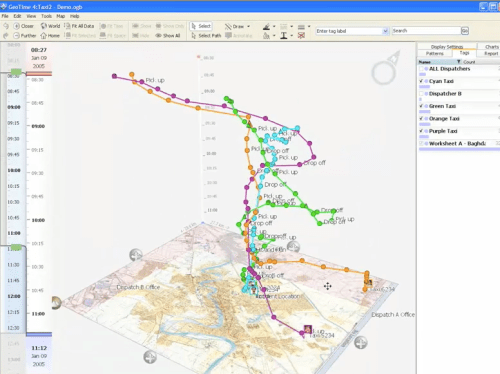
I just came across GeoTime, a very neat GIS platform for network analyis in time and space. GeoTime is developed by a company called Oculus and does a great job in presenting an appealing 3D visual interface for the temporal analysis of geo-referenced data. The platform integrates timeline comparisons, chart statistics and network analysis tools to support decision making. GeoTime also includes plug-ins for Excel and ArcGIS.

GeoTime

GeoTime includes a number of important functionalities including:

  • Movement trails: to display the history and behavior as paths in space-time;
  • Animation: to play back sequences and see how events unfold. Both the direction and speed of the animation can be adjusted.
  • Pattern recognition: to automatically identify key behaviors.
  • Annotate and Sketch: to add notes directly in the scene and save views as reports.
  • Fast Maps: to automatically adjust level of detail.
  • Interactive Chain and Network Analysis: to identify related events.

GeoTime2

Below is an excerpt of a video demo of GeoTime which is well worth watching to get a sense of how these functionalities come into play:

The demo above uses hurricane data to highlight GeoTime’s integrated functionalities. But the application can be used to analyze a wide range of data such as crime incidents to identify patterns in space and time. A demo for that is avaiable here.

GeoTime3

My interest in GeoTime stems from it’s potential application to analyzing conflict datasets. Problem is, the platform will set you back a cool $3,925. They do have a university rate of $1,675 but what’s missing is a rate for humanitarian NGOs or even a limited trial version.

Patrick Philippe Meier

An Analytical Framework to Understand Twitter’s use in Iran?

The digital activism and resistance witnessed in Iran go to the heart of my dissertation research, which asks whether the information revolution empowers coercive regimes at the expense of resistance movements or vice versa? Iran is one of my case studies for my upcoming field research in addition to Burma, Tunisia and Ukraine.

Introduction

There have been a number of excellent blog posts on the intersection between technology and resistance in Iran, and especially on the use of Twitter. The mainstream press is also awash with references to Twitter’s role. For example, Agence France Presse (AFP) recently cited my research in this piece entitled “Twitter Streams Break Iran News Dam.”

However, what I haven’t seen in the blogosphere and mainstream press is the application of an analytical and theoretical framework to place Twitter’s use in Iran into context.

For example, just how important is/was Twitter’s role vis-a-vis the mobilization and organization of anti-government protests in Iran? We can draw on anecdotes here and there but this process is devoid of any applied social science methodology.

This post seeks to shed light on how, when and why information and communication technologies (ICTs) are used by resistance movements in repressive environments. The framework I draw on (summarized below) is informed by Kelly Garrett’s excellent publication on “Protest in an Information Society: A Review of the Literature on Social Movements and New ICTs” (2006).

Framework

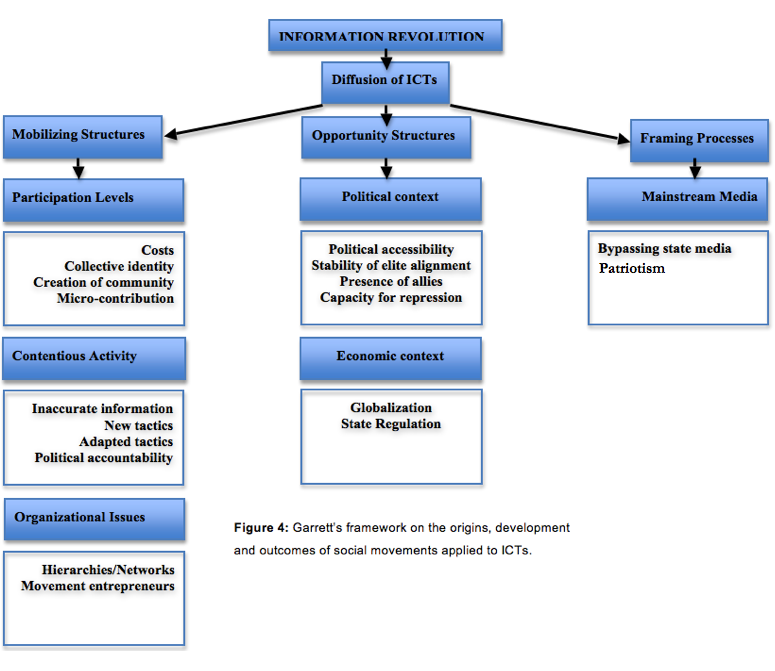
The framework seeks to “explain the emergence, development and outcomes of social movements by addressing three interrelated factors: mobilizing structures, opportunity structures and framing processes”  within the context of ICTs. (The figure below is excerpted from my dissertation, hence the figure 4 reference).

PhDFramework

  • Mobilizing Structures are the mechanisms that facilitate organization and collective action. These include social structures and tactical repertoires.
  • Opportunity Structures are conditions that favor social movement activity. For example, these include factors such as the state’s capacity and propensity for repression.
  • Framing Processes are “strategic attempts to craft, disseminate, and contest the language and narratives used to describe a movement.”

These three factors should be further disaggregated to facilitate analysis. For example, mobilizing structures can be divided into categories susceptible to the impact of ICTs:

  • Participation levels (recruitment);
  • Contentious activity;
  • Organizational issues.

These sub-indicators are still to broad, however. Take, for example, participation levels; what is participation a function of? What underlying mechanisms are facilitated or constrained by the wider availability and use of ICTs? Participation levels may change as a function of three factors:

  • Reduction of participation costs;
  • Promotion of collective identity;
  • Creation of community.

These activities are of course not mutually exclusive but often interdependent. In any case, taking the analysis of ICTs in repressive environments to the tactical level facilitates the social science methodology of process tracing.

Application

We can apply the above framework to test a number of hypotheses regarding Twitter’s use in Iran. Take Mobilizing Structures, for example. The following hypothesis could be formulated.

  • Hypothesis 1: The availability of Twitter in Iran increased participation levels, contentious activity and organizational activity.

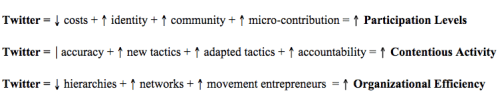
Using process tracing and the above framework, one could test hypothesis 1 as follows:

hypo1

These causal chains, or “micro theories,” are posited with the “⎥” marker to signify that the causal relationship is contended. The direction of the arrows above reflects the theoretical narratives extracted from the theoretical framework presented above. Note that the above “micro” theories are general and not necessarily reflective of Twitter’s use in Iran.

Iran Case Study

When the arrows are tallied, the results suggest the following general theory: there is a direct and positive relationship between the impact of Twitter and the incidents of protests and riots. The next step is to test these “micro theories” in the context of Iran by actually “weighting” the arrows. And of course, to do so comparatively by testing the use of Twitter relative to the use of mobile phones and the Internet. Furthermore, the results of this hypothesis testing should be compared to those for Opportunity Structures and Framing Processes.

I plan to carry out field research to qualitatively test these hypotheses once the first phase of my dissertation is completed. The first phase is a large-N quantitative study to determine whether increasing access to ICTs in repressive regimes is a statistically significant predictor of anti-government protests.

Patrick Philippe Meier

How to Lie with Maps

I just finished reading Mark Monmonier‘s enjoyable book on “How to Lie with Maps” and thought I’d share some tidbits. Mark is the distinguished Professor of Geography at the Maxwell School of Syracuse University in New York.

In writing this book, Mark wanted to “make readers aware that maps, like speeches and paintings, are authored collections of information and also are also subject to distortions arising from ignorance, greed, ideological blindness, or malice.” Note that this second edition was published in 1996.

mapslie

Terminology

Mark uses some terms that made me chuckle at times. Take “cartographic priesthood,” for example, or “cartographic license.” Other terms of note include “cartopropaganda,” “cartographic disinformation and censorship,” and “cartographic security.”

Quotes

  • “The map is the perfect symbol of the state.”
  • “Maps can even make nuclear war appear survivable.”
  • “A legend might make a bad map useful, but it can’t make it efficient.”
  • “Maps are like milk: their information is perishable, and it is wise to check the date.”
  • “People trust maps, and intriguing maps attract the eye as well as connote authority.”
  • “Circles bring to the map a geometric purity easily mistaken for accuracy and authority.”
  • “Like guns and crosses, maps can be good or bad, depending on who’s holding them, who they’re aimed at, how they’re used, and why.”
  • “No other group has exploited the map as an intellectual weapon so blatantly, so intensely, so persistently, and with such variety [as the Nazis].”
  • “That maps drawn up by diplomats and generals became a political reality lends an unintended irony to the aphorism that the pen is mightier than the sword.”

Excerpts

“Even tiny maps on postage stamps can broadcast political propaganda. Useful both on domestic mail to keep aspirations alive and on international mail to suggest national unity and determination, postage stamps afford a small but numerous means for asserting territorial claims.”

“In 1668, Louis XIV of France commissioned three-dimensional scale models of eastern border towns, so that his generals in Paris and Versailles could plan realistic maneuvers. […] As late as World War II, the French government guarded them as military secrets with the highest security classification.” See picture.

louisxiv

“Government maps have for centuries been ideological statements rather than fully objective scientific representations of geographic reality. […] Governments practice two kinds of cartographic censorship—a censorship of secrecy to serve military defense and a censorship of  silence to enforce social and political values” (citing historian Brian Harley).

“Few maps symbols are as forceful and suggestive as the arrow. A bold, solid line might make the map viewer infer a well-defined, generally accepted border separating nations with homogeneous populations, but an arrow or a set of arrows can dramatize an attack across the border, exaggerate a concentration of troops, and perhaps even justify a ‘pre-emptive strike’.”

“Faulty map reading almost led to an international incident in 1988, when the Manila press reported the Malaysian annexation of the Turtle Islands.” The faulty map was “later traced to the erroneous reading of an American navigation chart by a Philippines naval officer who mistook a line representing the recommended deepwater route for ships passing the Turtle Islands for the boundary of Malaysia’s newly declared exclusive economic zone.”

Conclusion

“As display systems become more flexible, and more like video games, users must be wary that maps, however realistic, are merely representations, vulnerable to bias in both what they show and what they ignore.”

“Skepticism is especially warranted when a dynamic map supporting a simulation model pretends to describe the future.”

“Although electronic cartography may make complex simulations easier to understand, no one should trust blindly a map that acts like a crystal ball.”

Patrick Philippe Meier

How To Communicate Securely in Repressive Environments

Update: The information below is now out of date, please do not blindly rely on the strategies and technologies listed!

Important: Please check the excellent comments provided by iRevolution readers below for additional tactics/technologies and corrections. The purpose of this blog post was to inform and elicit feedback so thank you very much for improving on what I’ve written!

FYI – I tried keep an up-to-date guide based on the comments below but was too busy to continue. Please see this link (Doc).

I’m preparing to give a presentation at The Fletcher Summer Institute for the Advanced Study of Nonviolent Conflict (FSI 2009). The focus of my presentation will be on digital security, i.e., how to communicate safely and securely in repressive, non-permissive environments. I’d be very grateful for feedback on the information below.

Introduction

Core to effective strategic nonviolent action is the need to remain proactive and on the offensive; the rationale being that both the resistance movement and repressive regime have an equal amount of time allocated when the show-down begins. If the movement becomes idle at any point, this may give the regime the opportunity to regain the upper hand, or vice versa. The same principle is found in Clausewitz’s writings on war.

Nonviolent resistance movements are typically driven by students, i.e., young people, who are increasingly born digital natives. With expanding access to mobile phones, social networking software and online platforms for user-generated content such as blogs, the immediate financial cost of speaking out against repressive regimes is virtually nil. So resistance movements are likely to make even more use of new communication technology and digital media in the future. In fact, they already are.

At the same time, however, the likelihood and consequences of getting caught are high, especially for those political activists without any background or training in digital security. Indeed, recent research by Digital Democracy research suggests that organizational hierarchies are being broken down as youth adopt new technologies. While this empowers them they are also put at risk since they don’t tend to be as consequence-conscious as their adult counterparts.

Empire Strikes Back

It is no myth that repressive regimes are becoming increasingly more savvy in their ability to effectively employ sophisticated filtering, censoring, monitoring technologies (often courtesy of American companies like Cisco) to crack down on resistance movements. In other words, political activists need to realize that their regimes are becoming smarter and more effective, not dumber and hardly clueless.

That said, there are notable—at times surprising—loopholes. During the recent election violence in Iran, for example, facebook.com was blocked but not facebook.com/home.php. In any case, repressive regimes will continue to block more sites impose information blockades because they tend to view new media and digital technologies as a threat.

Perhaps technologies of liberation are a force more powerful?

In order to remain on the offensive against repressive regimes, nonviolent civil resistance movements need to ensure they are up to speed on digital security, if only for defense purposes. Indeed, I am particularly struck by the number of political activists in repressive regimes who aren’t aware of the serious risks they take when they use their mobile phones or the Internet to communicate with other activists.

Adaptive Learning

One way to stay ahead is to make the learning curve less steep for political activists and to continually update them with the latest tested tactics and technologies. To be sure, one way to keep the upper hand in this cyber game of cat-and-mouse is to continue adapting and learning as quickly as possible. We need to ensure that feedback mechanisms are in place.

There are clearly trade-offs between security and convenience or usability, particularly in the context of technologies. As DigiActive notes in the graphic below, the most secure tactics and technologies may not be the most convenient or easy to deploy. Most political activists are not tech-savvy.

This means that digital activists need to design tactics and technologies that are easy to learn and deploy.

The tactics and technologies listed in the next sections fall into all four different quadrants to one extent or another. It is important that political activists at minimum master the easy and convenient digital security tactics and technologies identified in this blog post.

ACmatrix

Recall that both sides are allocated an equal amount of time to plan and execute their operations. Accelerating the learning process is one way for activist networks to remain pro-active and stay ahead of the curve. This is in part is the role that DigiActive seeks to play. Unlike the hierarchical, centralized structures of repressive regimes, networks have more flexibility and feedback loops, which make them more adaptable.

The normative motivation behind my research on digital resistance is based on the recognition by “many scholars and practitioners […] that the techniques associated with strategic nonviolent social movements are greatly enhanced by access to modern information communication technologies, such as mobile telephony, short message service (SMS), email and the World Wide Web, among others” (Walker 2007).

The potential to leverage those techniques is what makes Digital Security so important to integrate in the strategic and tactical repertoire of civil resistance movements.

Digital Security

I define digital security (DS) in the context of digital resistance as the art and science of staying safe when communicating in non-permissive environments. The reason I call it both an art and a science is to emphasize that both tactics and technology play an important role in staying safe when facing repression.

So the DS framework I want to propose is two-pronged: tactics vs. technology, and safety vs. security. I call it the 4-square approach for obvious reasons:

4square

  • DS tactics: these can be “technology free” tactics as well as tactics that apply communication technology.
  • DS technologies: these include both high-tech and low-tech technologies that are designed to improve safe and secure communication in repressive environments.
  • Personal safety: in this context refers to physical, personal safety when communicating in non-permissive environments.
  • Data Security: refers to the security of the data when communicated from one devise to another.

As the graphic above suggests, personal safety and data security are a function of both tactics and technologies. For example, data security is best ensured when combining tactics and technologies.

What follows is a list of tactics and technologies for communicating safely and securely in repressive environments. The list is divided into technology categories and the bullet points are listed in order of relative convenience and easy to more complicated but more secure.

Note that the information below is in no way meant to be exhaustive, so pleasedo send suggestions! (See also the conclusion for a list of reference and suggestions on further reading).

Digital Security Tactics

As mentioned above, DS tactics come as both technology-free tactics and tactics that relate to communication technology. For example, making sure to pay for a sim card in cash and out of sight of security cameras is a technology-free tactic  that increases the chances of staying safe. Removing the batteries from your mobile phone to prevent it from being geo-located is a tactic that relates to the technology and also increases your safety.

DS tactics can also improve data security when communicating information. “Sneakernet” is a technology-free tactic to share information. The term is used to describe tactics whereby the transfer of electronic information such computer files is done by physically carryingremovable media such as hard drives and disk drives. In contrast, using encryption software for mobile phones is a tactic that uses technology. The communication may be intercepted by eavesdroppers but they may be unable to decipher the message itself.

These tactics are listed below along with a number of other important ones. Please keep in mind that tactics are case- and context-specific. They need to be adapted to the local situation.

  • Mobile Phones
    • Purchase your mobile phone far from where you live. Buy lower-end, simple phones that do not allow third-party applications to be installed. Higher-end ones with more functionalities carry more risk. Use cash to purchase your phone and SIM card. Avoid town centers and find small or second-hand shops as these are unlikely to have security cameras. Do not give your real details if asked; many shops do not ask for proof of ID.
    • Use multiple SIM cards and multiple phones and only use pay-as-you go options; they are more expensive but required for anonymity.
    • Remove the batteries from your phone if you do not want to be geo-located and keep the SIM card out of the phone when not in use and store in separate places.Use your phone while in a moving vehicle to reduces probability of geo-location.
    • Never say anything that may incriminate you in any way.
    • Use code.
    • Use Beeping instead of SMS whenever possible. Standard text messages are visible to the network operator, including location, phone and SIM card identifiers. According to this recent paper, the Chinese government has established 2,800 SMS surveillance centers around the country to monitor and censor text messages. The Chinese firm Venus Info Tech Ltd sells real-time content monitoring and filtering for SMS.
    • Use fake names for your address book and memorize the more important numbers. Frequently delete your text messages and call history and replace them with random text messages and calls. The data on your phone is only deleted if it is written over with new data. This means that deleted SMS and contact numbers can sometimes be retrieved (with a free tool like unDeleteSMS. Check your phone’s settings to see whether it can be set to not store sent texts messages and calls.
    • Eavesdropping in mobile phone conversations is technically complicated although entirely possible using commercially available technology. Do not take mobile phones with you to meetings as they can be turned into potential listening/tracking devices. Network operators can remotely activate a phone as a recording device regardless of whether someone is using the phone or whether the phen is even switched on. This functionality is available on US networks.
    • Network operators can also access messages or contact information stored on the SIM card. If surveillance takes place with the co-operation of the operator, little can be done to prevent the spying.
    • Mobile viruses tend to spread easily via Bluetooth so the latter should be turned off when not in use.
    • Using open Bluetooth on phones in group situations, e.g., to share pictures, etc., can be dangerous. At the same time, it is difficult to incriminate any one person and a good way to share information when the cell phone network and Internet are down.
    • Discard phones that have been tracked and burn them; it is not sufficient to simply destroy the SIM card and re-use the phone.
  • Digital Cameras
    • Keep the number of sensitive pictures on your camera to a minimum.
    • Add plenty of random non-threatening pictures (not of individuals) and have these safe pictures locked so when you do a “delete all” these pictures stay on the card.
    • Keep the battery out of the camera when not in use so it can’t be turned on by others.
    • Practice taking pictures without having to look at the view screen.
  • Computers/Laptops
    • Use passphrases for all your sensitive data.
    • Keep your most sensitive files on flash disks and find safe places to hide them.
    • Have a contingency plan to physically destroy or get rid of your computer at short notice.
  • Flash disks
    • Purchase flash disks that don’t look like flash disks.
    • Keep flash disks hidden.
  • Email communication
    • Use code.
    • Use passphrases instead of passwords and change them regularly. Use letters, numbers and other characters to make them “c0mpLeX!”. Do not use personal information and changer your passphrases each month. Do not use the same password for multiple sites.
    • Never use real names for email addresses and use multiple addresses.
    • Discard older email accounts on a regular basis and create new ones.
    • Know the security, safety and privacy policies of providers and monitor any chances (see terms of service tracker).
  • Browsers and websites
    • Turn off java and other potentially malicious add-ons.
    • Learn IP addresses of visited websites so that history shows only numbers and not names.
    • When browsing on a public computer, delete your private data (search history, passwords, etc.) before you leave.
    • When signing up for an account where you will be publishing sensitive media, do not use your personal email address and don’t give personal information.
    • Don’t download any software from pop-ups,  they may be malicious and attack your computer or record your actions online.
    • Do not be logged in to any sensitive site while having another site open.
  • VoIP
    • Just because your talking online doesn’t mean you are not under surveillance.
    • As with a cell or landline, use code do not give salient details about your activities, and do not make incriminating statements.
    • Remember that your online activities can be surveilled using offline techniques.  It doesn’t matter if you are using encrypted VOIP at a cyber cafe if the person next to you is an under-cover police officer.
    • When possible, do not make sensitive VOIP calls in a cyber cafe.  It is simply too easy for someone to overhear you. If you must, use code that doesn’t stand out.
  • Blogs and social networking sites
    • Know the laws in your country pertaining to liability, libel, etc.
    • When signing up for a blog account where you will be publishing sensitive content, do not use you personal email address or information.
    • In your blog posts and profile page, do not post pictures of yourself or your friends, do not use your real name, and do not give personal details that could help identify you (town, school, employer, etc.).
    • Blog platforms like wordpress allow uses to automatically publish a post on a designated date and time. Use this functionality to auto-publish on a different day when you are away from the computer.
    • On social networks, create one account for activism under a false but real-sounding name (so your account won’t be deleted) but don’t tell your friends about it.  The last thing you want is a friend writing on your wall or tagging you in a photo and giving away your identity.
    • Even if you delete your account on a social networking site, your data will remain, so be very careful about taking part in political actions (i.e., joining sensitive groups) online.
    • Never join a sensitive group with your real account.  Use your fake account to join activism groups. (The fake account should not be linked to your fake email).
    • Don’t use paid services.  Your credit card can be linked back to you.
  • File sharing
    • Use a shared Gmail account with a common passphrase and simply save emails instead of sending. Change passphrase monthly.
    • For sharing offline, do not label storage devices (CDs, flash drives) with the true content.  If you burn a CD with an illegal video or piece of software on it, write an album label on it.
    • Don’t leave storage devices in places where they would be easily found if your office or home were searched (i.e., on a table, in a desk drawer).
    • Keep copies of your data on two flash drives and keep them hidden in separate locations.
    • When thinking of safe locations, consider who else has access. Heavily-traveled locations are less safe.
    • Don’t travel with sensitive data on you unless absolutely necessary.  If you need to, make sure to hide it on your person or “camouflage” it (label a data CD as a pop music CD). See Sneakernet.
  • Internet Cafes
    • Assume you are being watched.
    • Assume computers at cyber cafes are tracking key strokes and capturing screenshots.
    • Avoid cyber cafes without an easy exit and have a contingency plan if you need to leave rapidly.

Digital Security Technologies

When combine with the tactics described above, the following technologies can help you stay safe and keep your data relatively more secure.

  • Mobile phones
    • Use CryptoSMS, SMS 007 or Kryptext to text securely (this requires java-based phones).
    • Use Android Guardian as soon as it becomes available.
    • Access mobile versions of websites as they are usually not blocked. In addition, connecting to mobile websites provides for faster connections.
  • Digital cameras
    • Use scrubbing software such as: JPEG stripper to remove the metadata (Exif data) from your pictures before you upload/email.
    • Have a safe Secure Digital Card (SD) that you can swap in. Preferably, use a mini SD card with a mini SD-SD converter. Then place the mini SD into a compatible phone for safekeeping.
  • Computers/Laptops
    • Use a different file type to hide your sensitive files. For example, the .mov file extension will make a large file look like a movie.
    • Mac users can use Little Snitch to track all the data that goes into and out of your computer.
    • From a technical perspective, there’s no such thing as the delete function. Your deleted data is eventually written over with new data. There are two common ways to wipe sensitive data from your hard drive or storage device. You can wipe a single file or you can wipe all of the ‘unallocated’ space on the drive. Eraser is a free and open-source secure deletion tool that is extremely easy to use.
  • Email communication
    • Use https when using Gmail.
    • Use encrypted email platforms such as Hushmail and RiseUp.
  • Browsers and websites
    • Use Firefox and get certain plugins to follow website tracking such as ghostery and adblock, adart to remove ads/trackers.
    • User Tor software or Psiphon to browse privately and securely.
    • I shan’t list access points for secure browsers, Proxy servers and VPNs here. Please email me for a list.
    • Always use https in “Settings/General/Browser Connection.”
  • VoIP
    • Use Skype but not TOM Skype (Chinese version). Note that Skype is not necessarily 100% secure since no one has access to the source code to verify.
    • Off The Record (OTR) is a good encryption plugin. For example, use Pidgin with OTR (you need to add the plug-in yourself).
    • Gizmo offer encryption for voice conversations, and then only if you are calling another VoIP user, as opposed to a mobile or landline telephone. However, because neither application is open-source, independent experts have been unable to test them fully and ensure that they are secure.
    • Adium is a free IM application for Macs with built-in OTR encryption that integrates most other IM applications.
  • Blogs and social networking platforms
    • There are no safe social networks.  The best way to be safe on a social network is fake account and a proxy server.
    • The anonymous blogging platform Invisiblog no longer exists, so the best bet now is WordPress + Proxy (preferably Tor) + anonymity of content.
    • Log out of facebook.com when not using the site.
  • File sharing
    • Use Drop.io to create a private, secure media sharing site.
    • Use BasecampHQ with secure/SSL option to create more specific usernames and passwords for each user or remote site.
  • Internet Cafe
    • Tor can be installed on flash disk and used at Internet cafe and also used from LiveCDs if flash drives are not allowed.
  • Other potential tech

Conclusion

The above material was collected in part from these sources:

As mentioned above, please send suggestions and/or corrections as well as updates. And again, please do check the comments below. Thanks! Patrick Philippe Meier

Part 7: A Taxonomy for Visual Analytics

This is Part 7 of 7 of the highlights from the National Visualization Analysis Center. (NVAC). Unlike previous parts, this one focuses on a May 2009 article. Please see this post for an introduction to the study and access to the other 6 parts.

Jim Thomas, the co-author of “Illuminating the Path: A Research and Development Agenda for Visual Analytics,” and Director of the National Visualization Analysis Center (NVAC) recently called for the development of a taxonomy for visual analytics. Jim explains the importance of visual analytics as follows:

“Visual analytics are valuable because the tool helps to detect the expected, and discover the unexpected. Visual analytics combines the art of human intuition and the science of mathematical deduction to perceive patterns and derive knowledge and insight from them. With our success in developing and delivering new technologies, we are paving the way for fundamentally new tools to deal with the huge digital libraries of the future, whether for terrorist threat detection or new interactions with potentially life-saving drugs.”

In the latest edition of VAC Views, Jim expresses NVAC’s interest in helping to “define the study of visual analytics by providing an order and arrangement of topics—the taxa that are at the heart of studying visual analytics. The reason for such a “definition” is to more clearly describe the scope and intent of impact for the field of visual analytics.”

Jim and colleagues propose the following higher-order classifications:

  • Domain/Applications
  • Analytic Methods/Goals
  • Science and Technology
  • Data Types/Structures.

In his article in VAC Views, Jim requests feedback and suggestions for improving the more detailed taxonomy that he provides in the graphic below. The latter was not produced in very high resolution in VAC Views and does not reproduce well here, so I summarize below whilst giving feedback.

VacViews

1. Domain/Applications

While Security (and Health) are included in the draft NVAC proposal as domains / applications, what is missing is Humanitarian Crises, Conflict Prevention and Disaster Management.

Perhaps “domain/applications” should not be combined since “applications” tends to be a subset of associated “domains” which poses some confusion. For example, law enforcement is a domain and crime mapping analysis could be considered as an application of visual analytics.

2. Analytic Methods/Goals

Predictive, Surveillance, Watch/Warn/Alert, Relationship Mapping, Rare Event Identification are included. There are a host of other methods not referred to here such as cluster detection, a core focus of spatial analysis. See the methods table in my previous blog post for examples of spatial cluster detection.

Again I find that combining both “analytic methods” and “goals” makes the classification somewhat confusing.

3. Scientific and Technology

This classification includes the following entries (each of which are elaborated on individually later):

  • Analytic reasoning and human processes
  • Interactive visualization
  • Data representations and theory of knowledge
  • Theory of communications
  • Systems and evaluations.

4. Data Types/Structures

This includes Text, Image, Video, Graph Structures, Models/Simulations, Geospatial Coordinates, time, etc.

Returning now to the sub-classifications under “Science and Technology”:

Analytic reasoning and human processes

This sub-classification, for example, includes the following items:

  • Modes of inference
  • Knowledge creation
  • Modeling
  • Hypothesis refinement
  • Human processes (e.g., perception, decision-making).

Interactive visualization

This is comprised of:

  • The Science of Visualization
  • The Science of Interaction.

The former includes icons, positioning, motion, abstraction, etc, while the latter includes language of discourse, design and art, user-tailored interaction and simulation interaction.

Data representations and theory of knowledge

This includes (but is not limited to):

  • Data Sourcing
  • Scale and Complexity
  • Aggregation
  • Ontology
  • Predictions Representations.

Theory of communications

This sub-classification includes for example the following:

  • Story Creation
  • Theme Flow/Dynamics
  • Reasoning representation.

Systems and evaluations

This last sub-classification comprises:

  • Application Programming Interface
  • Lightweight Standards
  • Privacy.

Patrick Philippe Meier