Evaluating Accuracy of Data Collection on Mobile Phones

The importance of data validation is unquestioned but few empirical studies seek to assess the possible errors incurred during mobile data collection. Authors Somani Patnaik, Emma Brunskill and William Thies thus carried out what is possibly the first quantitative evaluation  (PDF) of data entry accuracy on mobile phones in resource-constrained environments. They just presented their findings at ICTD 2009.

Mobile devices have become an increasingly important tool for information collection. Hence, for example, my interest in pushing forward the idea of Mobile Crisis Mapping (MCM). While studies on data accuracy exist for personal digital assistants (PDAs), there are very few that focus on mobile phones. This new study thus evaluates three user interfaces for information collection: 1) Electronic forms; 2) SMS and 3) voice.

The results of the study indicate the following associated error rates:

  • Electronic forms = 4.2%
  • SMS = 4.5%
  • Voice = 0.45%

For compartive purposes and context, note that error rates using PDAs have generally been less than 2%. These figures represent the fraction of questions that were answered incorrectly. However, since “each patient interaction consisted of eleven questions, the probability of error somewhere in a patient report is much higher. For both electronic forms and SMS, 10 out of 26 reports (38%) contained an error; for voice, only 1 out of 20 reports (5%) contained an error (which was due to operator transcription).

I do hope that the results of this study prompt many others to carry out similar investigations.  I think we need a lot more studies like this one but with a larger survey sample (N) and across multiple sectors (this study drew on just 13 healthworkers).

The UN Threat and Risk Mapping Analysis (TRMA) project I’m working on in the Sudan right now will be doing a study on data collection accuracy using mobile phones when they roll out their program later this month. The idea is to introduce mobile phones in a number of localities and not in neighboring ones. The team will then compare the data quality of both samples.

I look forward to sharing the results.

Patrick Philippe Meier

ICT for Development Highlights

Credit: http://farm2.static.flickr.com/1403/623843568_7fa3c0cbe9.jpg?v=0

For a moment there, during the 8-hour drive from Kassala back to Khartoum, I thought Doha was going to be a miss. My passport was still being processed by the Sudanese Ministry of Foreign Affairs and my flight to Doha was leaving in a matter of hours. I began resigning myself to the likelihood that I would miss ICT4D 2009. But thanks to the incredible team at IOM, not only did I get my passport back, but I got a one-year, mulitple re-entry visa as well.

I had almost convinced myself that missing ICT4D would ok. How wrong I would have been. When the quality of poster presentations and demo’s at a conference rival the panels and presentation, you know that you’re in for a treat. As the title of this posts suggest, I’m just going to point out a few highlights here and there.

Panels

  • Onno Purbo gave a great presentation on wokbolic, a  cost saving wi-fi receiver  antenna made in Indonesia using a wok. The wokbolic has as 4km range, costs $5-$10/month. Great hack.

wok

  • Kentaro Toyama with Microsoft Research India (MSR India) made the point that all development is paternalistic and that we should stop fretting about this since development will by definition be paternalistic. I’m not convinced. Partnership is possible without paternalism.
  • Ken Banks noted the work of QuestionBox, which I found very interesting. I’d be interested to know how they remain sustainable, a point made by another colleague of mine at DigiActive.
  • Other interesting comments by various panelists included (and I paraphrase): “Contact books and status are more important than having an email address”; “Many people still think of mobile phones as devices one holds to the ear… How do we show that phones can also be used to view and edit content?”

Demo’s & Posters

I wish I could write more about the demo’s and posters below but these short notes and few pictures will have to do for now.

dudes

  • Analyzing Statistical Relationships between Global Indicators through Visualization:

geostats

  • Numeric Paper Forms for NGOs:

paperforms

  • Uses of Mobile Phones in Post-Conflict Liberia:

liberiaphones

  • Improving Data Quality with Dynamic Forms

datavalidate

  • Open Source Data Collection Tools:

opensourcecollection

Patrick Philippe Meier

Crisis Mapping and Agent Based Models

The idea of combining crisis mapping and agent based modeling has been of great interest to me ever since I took my first seminar on complex systems back in 2006. There are few studies out there that ground agent based models (ABM) on conflict dynamics within a real-world geographical space. One of those few, entitled “Global Pattern Formation and Ethnic/Cultural Violence,” appeared in the journal Science in 2007.

Note that I take issue with a number of assumptions that underlie this study as well as the methodology used. That said, the study is a good illustration of how crisis mapping and ABM can be combined.

Introduction

The authors suggest that global patterns of violence arise due to “the structure of boundaries between groups rather than the groups themselves.” In other words, the spatial boundaries between different populations create a propensity for conflict, “so that spatial heterogeneity itself is predictive of local violence.”

The authors argue that this pattern is “consistent with the natural dynamics of “type separation,” a specific pattern formation also observed in physical and chemical phase separation. The unit of analysis in this study’s ABM, however, is the local ethnic “patch size,” which represents the smallest unit of ethnic members that act collectively as one.

The Model

A simple model of type separation assumes that individuals (or ethnic units) prefer to move to areas where more individuals of the same time reside. Playing the ABM yields progressively larger patches or “islands” of each ethnic group over time. The relationship between patch size and time follows a power law distribution, “a universal behavior that does not depend on many of the details of the model […].”

In other words, the model depicts scale invariant behavior, which implies that “a number of individual agents of the model can be aggregated into a single agent if time is rescaled correspondingly without changing the behavior at the larger scales.”

To model violent conflict, the authors assume that both highly mixed regions and well-segregated groups do not engage in violence. The rationale regarding the former being that in highly mixed regions, “groups of the same type are not large enough to develop strong collective identities, or to identify public spaces as associated with one or another group. When groups are much bigger, “they typically form self-sufficient entities that enjoy local sovereignty.”

To this end, the authors argue that partial separation with poorly defined boundaries fosters conflict when groups are of a size that allows them to impose cultural norms on public spaces, “but where there are still intermittent violations of these rules due to the overlap of cultural domains.” In other words, conflict is a function of population distribution and not of the “specific mechanism by which the population achieves this structure, which may include internally or externally directed migrations.”

The model is therefore founded on the principle that the conditions under which violent conflict becomes likely can be determined by census.

The Analysis

The authors used 1991 census data of the former Yugoslavia and the Indian census data from 2001 and converted the data into map form (see figure below), which they used in an ABM simulation. “Mathematically, the expected violence was determined by detecting patches consisting of islands or peninsulas of one type surrounded by populations of other types.”

mexicanhat

A wavelet filter that has a positive center and a negative surround (also called a Mexican hat filter) was used to detect and correlate the islands/peninsulas. scienceabm1

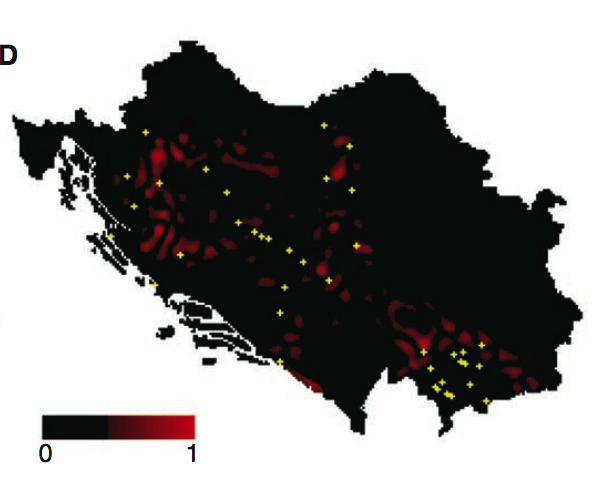
The red overlays depicted in Figure D above represents the maximum correlation over population types. The diameter of the positive region of the wavelet, i.e., “the size of the local population patches that are likely to experience violence,” is the main predictor of the model.

scienceabm2

To test the predictive power of their model, the authors compared the locations of red overlays with actual incidents of violence as reported in books, newspapers and online sources (the yellow dots in the crisis map below).

yugoabm

Their statistical results indicate that the Yugoslavia crisis map model has a correlation of 0.89 with reports. Moreover, “the predicted results are highly robust to parameter variation [patch size], with essentially equivalent agreement obtained for filter diameters ranging from 18 to 60 km […].”

The statistical results for the India crisis map model indicate a correlation of 0.98. The range of the patch size overlapped that of the former Yugoslavia but is shifted to larger values, up to 100km. This suggests that “regions of width less than 10km or greater than 100km may provide sufficient mixing or isolation to reduce the chance of violence.”

Conclusion

While the authors recognize the importance of social and institutional drivers of violence, they argue that, “influencing the spatial structure might address the conditions that promote violence described [in this study].” In sum, they suggest that, “peaceful coexistence need not require complete integration.”

What do you think?

Patrick Philippe Meier

Nation-State Routing: Globalizing Censorship

I just found an interesting piece on Internet censorship at arXiv, my favorite go-to place for scientific papers that are pre-publication. Entitled “Nation-State Routing: Censorship, Wiretapping and BGP,” this empirical study is possibly the first to determine the aggregate effect of national policies on the flow of international traffic.

As government control over the treatment of Internet traffic becomes more common, many people will want to understand how international reachability depends on individual countries and to adopt strategies either for enhancing or weakening the dependence on some countries.

Introduction

States typically impose censorship to prevent domestic users from reaching questionable content. Some censorship techniques, however, “may affect all traffic traversing an [Autonomous System].” For example, Internet Service Providers (ISPs) in China, Britain and Pakistan block Internet traffic at the Internet Protocol (IP) level by “filtering based on IP addresses and URLs in the data packets, or performing internal prefix hijacks, which could affect the international traffic they transit.”

The scope and magnitude of this affect is unclear. What we do know is that one may intentionally or by accident apply censorship policies to international traffic, as demonstrated by the global YouTube outage last year as a result of a domestic Pakistani policy directive.

Methodology

The authors therefore developed a framework to study interdomain routing at the nation-state level. They first adapted the “Betweeness Centrality” metric from statistical physics to measure the importance, or centrality, of each country to Internet reachability. Second, they designed, implemented and validated a Country Path Algorithm (CPA) to infer country-paths from a pair of source and destination IP addresses.

Findings

The table below shows Country Centrality (CC) computed directly from Trace Route (TR) and Border Gate Protocol (BGP). The closer the number is to one, the more impact that country’s domestic Internet censorship policies has on international Internet traffic.

arxivtable1

The second table below lists both Country Centrality (CC) and Strong Country Centrality (SCC). The latter measures how central countries are when alternative routes are considered. When SCC equals one, this suggests a country is completely unavoidable.

arxiv-table2

“Collectively, these results show that the ‘West’ continues to exercise disproportionate influence over international routing, despite the penetration of the Internet to almost every region of the world, and the rapid development of China and India.”

This last table below lists CC and SCC measures for authoritarian countries that are known for significant domestic censorship of Internet content. Aside from China, “these countries have very little influence over global reachability.”

arxiv-table3

Next Steps

The authors of the study point to a number of interesting questions for future research. For example, it would be interesting to know how the centrality result above change over time, i.e., which countries are becoming more central over time, and why?

Another important question is what economically driven strategies single countries (or small coalitions of countries) could adopt to increase their own centrality or to reduce that of other countries?

One final and particularly important question would to find out what fraction of domestic paths are actually routed through another country? This is important because the answer to this question would “provide insight into the influence that foreign nations have over a country’s domestic routing and security, and would shed light on […] whether warrantless tapping on links in one country to another might inadvertently capture some purely domestic traffic.”

Patrick Philippe Meier

Developing Swift River to Validate Crowdsourcing

Swift River is an Ushahidi initiative to crowdsource the process of data validation. We’re developing a Swift River pilot to complement the VoteReport India crowdsourcing platform we officially launched this week. As part of the Swift River team, I’d like to share with iRevolution readers what I hope the Swift River tool will achieve.

We had an excellent series of brainstorming sessions several weeks ago in Orlando and decided we would combine both natural language processing (NLP) and decentralized human filtering to get one step closer at validating crowdsourced data. Let me expand on how I see both components working individually and together.

Automated Parsing

Double-counting has typically been the bane of traditional NLP or automated event-data extraction algorithms. At Virtual Research Associates (VRA), for example, we would parse headlines of Reuters newswires in quasi real-time, which meant that a breaking story would typically be updated throughout the day or week.

But the natural language parser was specifically developed to automate event-data extraction based on the parameters “Who did what, to whom, where and when?” In other words, the parser could not distinguish whether coded events were actually the same or related. This tedious task was left to VRA analysts to carry out.

Digital Straw

The logic behind eliminating double counting (duplicate event-data) is inevitably reversed given the nature of crowdsourcing. To be sure, the more reports are collected about a specific event, the more likely it is that the event in question actually took place as described by the crowd. Ironically, that is precisely why we want to “drink from the fire hose,” the swift river of data gushing through the wires of social media networks.

We simply need a clever digital straw to filter the torrent of data. This is where our Swift River project comes in and why I first addressed the issue of double counting. One of the central tasks I’d like Swift River to do is to parse the incoming reports from VoteReport India and to cluster them into unique event-clusters. This would be one way to filter the cascading data. Moreover, the parser could potentially help filter fabricated reports.

An Example

For example, if 17 individual reports from different sources are submitted over a two-day period about “forged votes,” then the reports in effect self-triangulate or validate each other. Of course, someone (with too much time on their hands) might decide to send 17 false reports about “forged votes.”

Our digital straw won’t filter all the impurities, but automating this first-level filter is surely better than nothing. Automating this process would require that the digital straw automate the extraction of nouns, verbs and place names from each report, i.e., actor, action and location. Date and time would automatically be coded based on when the report was submitted.

Reports that use similar verbs (synonyms) and refer to the same or similar actors at the same location on the same day can then be clustered into appropriate event-clusters. More on that in the section on crowdsourcing the filter below.

More Filters

A second-level filter would compare the content of the reports to determine if they were exact replicas. In other words, if someone were simply copying and pasting the same report, Swift River could flag those identical reports as suspicious. This means someone gaming the system would have to send multiple reports with different wording, thus making it a bit more time consuming to game the system.

A third-level filter or trip-wire could compare the source of the 17 reports. For example, perhaps 10 reports were submitted by email, 5 by SMS and two by Twitter. The greater the diversity of media used to report an event, the more likely that event actually happened. This means that someone wanting to game the system would have to send several emails, text messages and Tweets using different language to describe a particular event.

A fourth-level filter could identify the email addresses, IP addresses and mobile phone numbers in question to determine if they too were different. A crook trying to game the system would now have to send emails from different accounts and IP addresses, different mobile phone numbers, and so on. Anything “looking suspicious” would be flagged for a human to review; more on that soon. The point is to make the gaming of the system as time consuming and frustrating as possible.

Gaming the System

Of course, if someone is absolutely bent on submitting fabricated data that passes all the filters, then they will.  But those individuals probably constitute a minority of offenders. Perhaps the longer and more often they do this, the more likely someone in the crowd will pick up on the con. As for the less die-hard crooks out there, they may try and game the system only to see that their reports do not get mapped. Hopefully they’ll give up.

I do realize I’m giving away some “secrets” to gaming the system, but I hope this will be more a deterrent than an invitation to crack the system. If you do happen to be someone bent on gaming the platform, I wish you’d get in touch with us instead and help us improve the filters. Either way, we’ll learn from you.

No one on the Swift River team claims that 100% of the dirt will be filtered. What we seek to do is develop a digital filter that makes the data that does come through palatable enough for public consumption.

Crowdsourcing the Filter

Remember the unique event-clusters idea from above? These could be visualized in a simple and intuitive manner for human volunteers (the crowd) to filter. Flag icons, perhaps using three different colors—green, orange and red—could indicate how suspicious a specific series of reports might be based on the results of the individual filters described above.

A green flag would indicate that the report has been automatically mapped on VoteReport upon receipt. An orange flag would indicate the need for review by the crowd while a red flag would send an alert for immediate review.

If a member of the crowd does confirm that a series of reports were indeed fabricated, Swift River would note the associated email address(es), IP address(es) and/or mobile phone number(s) and automatically flag future reports from those sources as red. In other words, Swift River would start rating the credibility of users as well.

If we can pull this off, Swift River may actually start to provide “early warning” signals. To be sure, if we fine tune our unique event-cluster approach, a new event-cluster would be created by a report that describes an event which our parser determines has not yet been reported on.

This should set off a (yellow) flag for immediate review by the crowd. This could either be a legitimate new event or a fabricated report that doesn’t fit into pre-existing cluster. Of course, we will get a number of false positives, but that’s precisely why we include the human crowdsourcing element.

Simplicity

Either way, as the Swift River team has already agreed, this process of crowdsourcing the filter needs to be rendered as simple and seamless as possible. This means minimizing the number of clicks and “mouse motions” a user has to make and allowing for short-cut keys to be used, just like in Gmail. In addition, a userfiendly version of the interface should be designed specifically for mobile phones (various platforms and brands).

As always, I’d love to get your feedback.

Patrick Philippe Meier

Threat and Risk Mapping Analysis in Sudan

Massively informative.

That’s how I would describe my past 10 days with the UNDP‘s Threat and Risk Mapping Analysis (TRMA) project in the Sudan. The team here is doing some of the most exciting work I’ve seen in the field of crisis mapping. Truly pioneering. I can’t think of  a better project to apply the past two years of work I have done with the Harvard Humanitarian Initiative’s (HHI) Crisis Mapping and Early Warning Program.

TRMA combines all the facets of crisis mapping that I’ve been focusing on since 2007. Namely, crisis map sourcing, (CMS), mobile crisis mapping (MCM), crisis mapping visualization (CMV), crisis mapping analytics (CMA) and crisis mapping platforms (CMP). I’ll be blogging about each of these in more detail later but wanted to provide a sneak previous in the meantime.

Crisis Map Sourcing (CMS)

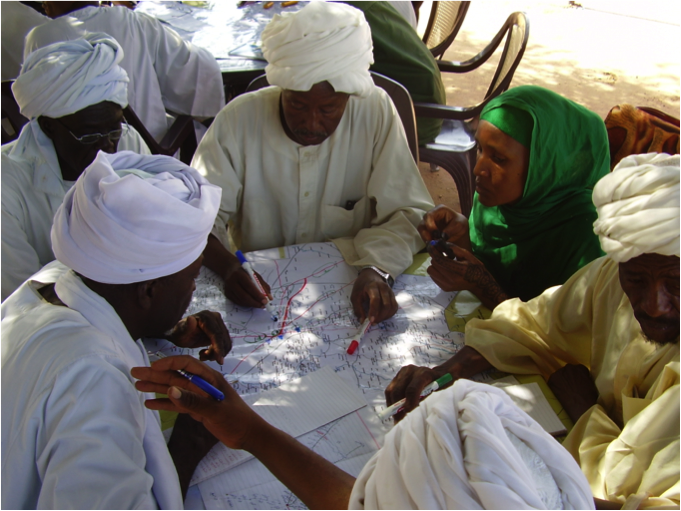
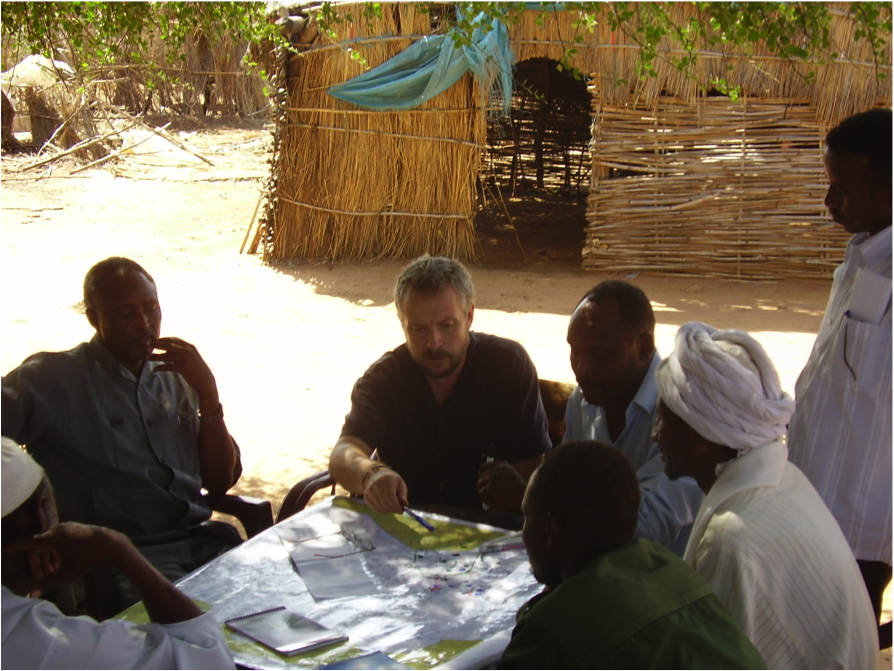
The team facilitates 2-day focus groups using participatory mapping methods. Participants identify and map the most pressing crisis factors in their immediate vicinity. It’s really quite stunning to see just how much conversation a map can generate. Rich local knowledge.

trma1

What’s more, TRMA conducts these workshops at two levels for each locality (administrative boundaries within a state): the community-level and at the state-level. They can then compare the perceived threats and risks from both points of view. Makes for very interesting comparisons.

trma2

In addition to this consultative approach to crisis map sourcing, TRMA has played a pivotal role in setting up an Information Management Working Group (IMWG) in the Sudan, which includes the UN’s leading field-based agencies.

What is truly extraordinary about this initiative is that each agency has formally signed an information sharing protocol to share their geo-referenced data. TRMA had already been using much of this data but the process until now had always been challenging since it required repeated bilateral efforts. TRMA has also developed a close professional relationship with the Central Bureau of Statistics Office.

Mobile Crisis Mapping (MCM)

The team has just partnered with a multinational communications corporation to introduce the use of mobile phones for information collection. I’ll write more about this in the coming weeks. Needless to say, I’m excited. Hopefully it won’t be too late to bring up FrontlineSMS‘s excellent work in this area, as well as Ushahidi‘s.

Crisis Mapping Visualization (CMV)

The team needs some help in this area, but then again, that’s one of the reasons I’m here. Watching first reactions during focus groups when we show participants the large GIS maps of their state is  really very telling. Lots more to write about on this and lots to contribute to TRMA’s work. I don’t yet know which maps can be made public but I’ll do my utmost best to get permission to post one or two in the coming weeks.

Crisis Mapping Analytics (CMA)

The team has produced a rich number of different layers of data which can be superimposed to identify visual correlations and otherwise hidden patterns. Perhaps one of the most exciting examples is when the team started drawing fault lines on the maps based on the data collected and their own local area expertise. The team subsequently realized that these fault lines could potential serve as “early warning” markers since a number of conflict incidents subsequently took place along those lines. Like the other crisis mapping components described above, there’s much more to write on this!

Crisis Mapping Platforms (CMP)

TRMA’s GIS team has used ArcGIS but this has been challenging given the US embargo on the Sudan. They therefore developed their own in-house mapping platforms using open-source software. These platforms include the “Threat Mapper” for data entry during (or shortly after) the focus groups and “4Ws” which stands for Who, What, Where and When. The latter tool is operational and will soon be fully developed. 4Ws will actually be used by members of the IMWG to share and visualize their data.

In addition, TRMA makes it’s many maps and layers available by distributing a customized DVD with ArcReader (which is free). Lots more on this in the coming weeks and hopefully some screenshots as well.

Closing the Feedback Loop

I’d like to add with one quick thought, which I will also expand on in the next few weeks. I’ve been in Blue Nile State over the past three days, visiting a number of different local ministries and civil society groups, including the Blue Nile’s Nomadic Union. We distributed dozens of poster-size maps and had at times hour long discussions while pouring over these maps. As I hinted above, the data visualization can be improved. But the question I want to pose at the moment is: how can we develop a manual GIS platform?

While the maps we distributed were of huge interest to our local partners, they were static, as hard-copy maps are bound to be. This got me thinking about possibly using transparencies to overlap different data/thematic layers over a general hard-copy map. I know transparencies can be printed on. I’m just not sure what size they come in or just how expensive they are, but they could start simulating the interactive functionality of ArcReader.

transparency

Even if they’re only available in A4 size, we could distribute binders with literally dozens of transparencies each with a printed layer of data. This would allow community groups to actually start doing some analysis themselves and could be far more compelling than just disseminating poster-size static maps, especially in rural areas. Another idea would be to use transparent folders like those below and hand-draw some of the major layers. Alternatively, there might a type of thin plastic sheet available in the Sudan.

I’m thinking of trying to pilot this at some point. Any thoughts?

folders

Patrick Philippe Meier
Ushahidi Comes to India for the Elections (Updated)

I’m very please to announce that the Ushahidi platform has been deployed at VoteReport.in to crowdsource the monitoring of India’s upcoming elections. The roll out followed our preferred model: an amazing group of Indian partners took the initiative to drive the project forward and are doing a superb job. I’m learning a lot from their strategic thinking.

picture-3

We’re also excited about developing Swift River as part of VoteReport India to apply a crowdsourcing approach to filter the incoming information for accuracy. This is of course all experimental and we’ll be learning a lot in the process. For a visual introduction to Swift River, please see Erik Hersman’s recent video documentary on our conversations on Swift River, which we had a few weeks ago in Orlando.

picture-5

As per our latest Ushahidi deployments, VoteReport users can report on the Indian elections by email, SMS, Tweet or by submitting an incident directly online at VoteReport. Users can also subscribe to email alerts—a functionality I’m particularly excited about as this closes the crowdsourcing to crowdfeeding feedback loop; so I’m hoping we can also add SMS alerts, funding permitted. For more on crowdfeeding, please see my previous post on “Ushahidi: From Crowdsourcing to Crowdfeeding.

picture-4

You can read more about the project here and about the core team here. It really is an honor to be a part of this amazing group. We also have an official VoteReport blog here. I also highly recommend reading Gaurav Mishra‘s blog post on VoteReport here and Ushahidi’s here.

Next Steps

  • We’re thinking of using a different color to depict “All Categories” since red has cognitive connotations of violence and we don’t want this to be the first impression given by the map.
  • I’m hoping we can add a “download feature” that will allow users to directly download the VoteReport data as a CSV file and as a KML Google Earth Layer. The latter will allow users to dynamically visualize VoteReports over space and time just like [I did here] with the Ushahidi data during the Kenyan elections.
  • We’re also hoping to add a feature that asks those submitting incidents to check-off that the information they submit is true. The motivation behind this is inspired from recent lessons learned in behavioral economics as explained in my blog post on “Crowdsourcing Honesty.

Patrick Philippe Meier
iRevolution One Year On…

I started iRevolution exactly one year ago and it’s been great fun! I owe the Fletcher A/V Club sincere thanks for encouraging me to blog. Little did I know that blogging was so stimulating or that I’d be blogging from the Sudan.

Here are some stats from iRevolution Year One:

  • Total number of blog posts = 212
  • Total number of comments = 453
  • Busiest day ever = December 15, 2008

And the Top 10 posts:

  1. Crisis Mapping Kenya’s Election Violence
  2. The Past and Future of Crisis Mapping
  3. Mobile Banking for the Bottom Billion
  4. Impact of ICTs on Repressive Regimes
  5. Towards an Emergency News Agency
  6. Intellipedia for Humanitarian Warning/Response
  7. Crisis Mapping Africa’s Cross-border Conflicts
  8. 3D Crisis Mapping for Disaster Simulation
  9. Digital Resistance: Digital Activism and Civil Resistance
  10. Neogeography and Crisis Mapping Analytics

I do have a second blog that focuses specifically on Conflict Early Warning, which I started at the same time. I have authored a total of 48 blog posts.

That makes 260 posts in 12 months. Now I know where all the time went!

The Top 10 posts:

  1. Crimson Hexagon: Early Warning 2.0
  2. CSIS PCR: Review of Early Warning Systems
  3. Conflict Prevention: Theory, Police and Practice
  4. New OECD Report on Early Warning
  5. Crowdsourcing and Data Validation
  6. Sri Lanka: Citizen-based Early Warning/Response
  7. Online Searches as Early Warning Indicators
  8. Conflict Early Warning: Any Successes?
  9. Ushahidi and Conflict Early Response
  10. Detecting Rumors with Web-based Text Mining System

I look forward to a second year of blogging! Thanks to everyone for reading and commenting, I really appreciate it!

Patrick Philippe Meier

Peer Producing Human Rights

Molly Land at New York Law School has written an excellent paper on peer producing human rights, which will appear in the Alberta Law Review, 2009. This is one of the best pieces of research that I have come across on the topic. I highly recommend reading her article when published.

Molly considers Wikipedia, YouTube and Witness.org in her excellent research but somewhat surprisingly does not reference Ushahidi. I thus summarize her main points below and draw on the case study of Ushahidi—particularly Swift River—to compare and contrast her analysis with my own research and experience.

Introduction

Funding for human rights monitoring and advocacy is particularly limited, which is why “amateur involvement in human rights activities has the potential to have a significant impact on the field.” At the same time, Molly recognizes that peer producing human rights may “present as many problems as it solves.”

Human rights reporting is the most professionalized activity of human rights organizations. This professionalization exists “not because of an inherent desire to control the process, but rather as a practical response to the demands of reporting-namely, the need to ensure accuracy of the information contained in the report.” The question is whether peer-produced human rights reporting can achieve the same degree of accuracy without a comparable centralized hierarchy.

Accurate documentation of human rights abuses is very important for building up a reputation as a credible human rights organization. Accuracy is also important to counter challenges by repressive regimes that question the validity of certain human rights reports. Moreover, “inaccurate reporting risks injury not only to the organization’s credibility and influence but also to those whose behalf the organization advocates.”

Control vs Participation

A successful model for peer producing human rights monitoring would represent an important leap forward in the human rights community. Such a model would enable us to process a lot more information in a timelier manner and would also “increase the extent to which ordinary individuals connect to human rights issues, thus fostering the ability of the movement to mobilize broad constituencies and influence public opinion in support of human rights.”

Increased participation is often associated with an increased risk of inaccuracy. In fact, “even the perception of unreliability can be enough to provide […] a basis for critiquing the information as invalid.” Clearly, ensuring the trustworthiness of information in any peer-reviewed project is a continuing challenge.

Wikipedia uses corrective editing as the primary mechanism to evaluate the accuracy of crowdsourced information. Molly argues that this may not work well in the human rights context because direct observation, interviews and interpretation are central to human rights research.

To this end, “if the researcher contributes this information to a collaboratively-edited report, other contributors will be unable to verify the statements because they do not have access to either the witness’s statement or the information that led the researcher to conclude it was reliable.” Even if they were able to verify statements, much of human rights reporting is interpretive, which means that even experienced human rights professionals disagree about interpretive conclusions.

Models for Peer Production

Molly presents three potential models to outline how human rights reporting and advocacy might be democratized. The first two models focus on secondary and primary information respectively, while the third proposes certification by local NGOs. Molly outlines the advantages and challenges that each model presents. Below is a summary with my critiques. I do not address the third model because as noted by Molly it is not entirely participatory.

Model 1. This approach would limit peer-production to collecting, synthesizing and verifying secondary information. Examples include “portals or spin-offs of existing portals, such as Wikipedia,” which could “allow participants to write about human rights issues but require them to rely only on sources that are verifiable […].” Accuracy challenges could be handled in the same way that Wikipedia does; namely through a “combination of collaborative editing and policies; all versions of the page are saved and it is easy for editors who notice gaming or vandalism to revert to the earlier version.”

The two central limitations of this approach are that (1) the model would be limited to a subset of available information restricted to online or print media; and (2) even limiting the subset of information might be insufficient to ensure reliability. To this end, this model might be best used to complement, not substitute, existing fact-finding efforts.

Model 2. This approach would limit the peer-production of human rights report to those with first-hand knowledge. While Molly doesn’t reference Ushahidi in her research, she does mention the possibility of using a website that would allow witnesses to report human rights abuses that they saw or experienced. Molly argues that this first-hand information on human rights violations could be particularly useful for human rights organizations that seek to “augment their capacity to collect primary information.”

This model still presents accuracy problems, however. “There would be no way to verify the information contributed and it would be easy for individuals to manipulate the system.” I don’t agree. The statement: “there would be no way to verify the information” is an exaggeration. There multiple methods that could be employed to determine the probability that the contributed information is reliable, which is the motivation behind our Swift River project at Ushahidi, which seeks to use crowdsourcing to filter human rights information.

Since Swift River deserves an entire blog post to itself, I won’t describe the project. I’d just like to mention that the Ushahidi team just spent two days brainstorming creative ways that crowdsourced information could be verified. Stay tuned for more on Swift River.

We can still address Molly’s concerns without reference to Ushahidi’s Swift River.

Individuals who wanted to spread false allegations about a particular government or group, or to falsely refute such allegations, might make multiple entries (which would therefore corroborate each other) regarding a specific incident. Once picked up by other sources, such allegations ‘may take on a life of their own.’ NGOs using such information may feel compelled to verify this information, thus undermining some of the advantages that might otherwise be provided by peer production.

Unlike Molly, I don’t see the challenge of crowdsourced human rights data as first and foremost a problem of accuracy but rather volume. Accuracy, in many instances, is a function of how many data points exist in our dataset.

To be sure, more crowdsourced information can provide an ideal basis for triangulation and validation of peer produced human rights reporting-particularly if we embrace multimedia in addition to simply text. In addition, more information allows us to use probability analysis to determine the potential reliability of incoming reports. This would not undermine the advantages of peer-production.

Of course, this method also faces some challenges since the success of triangulating crowdsourced human rights reports is dependent on volume. I’m not suggesting this is a perfect fix, but I do argue that this method will become increasingly tenable since we are only going to see more user-generated content, not less. For more on crowdsourcing and data validation, please see my previous posts here.

Molly is concerned that a website allowing peer-production based on primary information may “become nothing more than an opinion site.” However, a crowdsourcing platform like Ushahidi is not an efficient platform for interactive opinion sharing. Witnesses simply report on events, when they took place and where. Unlike blogs, the platform does not provide a way for users to comment on individual reports.

Capacity Building

Molly does raise an excellent point vis-à-vis the second model, however. The challenges of accuracy and opinion competition might be resolved by “shifting the purpose for which the information is used from identifying violations to capacity building.” As we all know, “most policy makers and members of the political elite know the facts already; what they want to know is what they should do about them.”

To this end, “the purpose of reporting in the context of capacity building is not to establish what happened, but rather to collect information about particular problems and generate solutions. As a result, the information collected is more often in the form of opinion testimony from key informants rather than the kind of primary material that needs to be verified for accuracy.”

This means that the peer produced reporting does not “purport to represent a kind of verifiable ‘truth’ about the existence or non-existence of a particular set of facts,” so the issue of “accuracy is somewhat less acute.” Molly suggests that accuracy might be further improved by “requiring participants to register and identify themselves when they post information,” which would “help minimize the risk of manipulation of the system.” Moreover, this would allow participants to view each other’s contributions and enable a contributor to build a reputation for credible contributions.

However, Molly points out that these potential solutions don’t change the fact that only those with Internet access would be able to contribute human right reports, which could “introduce significant bias considering that most victims and eyewitnesses of human rights violations are members of vulnerable populations with limited, if any, such access.” I agree with this general observation, but I’m surprised that Molly doesn’t reference the use of mobile phones (and other mobile technologies) as a way to collect testimony from individuals without access to the Internet or in inaccessible areas.

Finally, Molly is concerned that Model 2 by itself “lacks the deep participation that can help mobilize ordinary individuals to become involved in human rights advocacy.” This is increasingly problematic since “traditional  ‘naming and shaming’ may, by itself, be increasingly less effective in its ability to achieve changes state conduct regarding human rights.” So Molly rightly encourages the human rights community to “investigate ways to mobilize the public to become involved in human rights advocacy.”

In my opinion, peer produced advocacy faces the same challenges as traditional human rights advocacy. It is therefore important that the human rights community adopt a more tactical approach to human rights monitoring. At Ushahidi, for example, we’re working to add a “subscribe-to-alerts” feature, which will allow anyone to receive SMS alerts for specific locations.

P2P Human Rights

The point is to improve the situational awareness of those who find themselves at risk so they can get out of harm’s way and not become another human rights statistic. For more on tactical human rights, please see my previous blog post.

Human rights organizations that are engaged in intervening to prevent human rights violations would also benefit from subscribing to Ushahidi. More importantly, the average person on the street would have the option of intervening as well. I, for one, am optimistic about the possibility of P2P human rights protection.

Patrick Philippe Meier

Crowdsourcing in Crisis: A More Critical Reflection

This is a response to Paul’s excellent comments on my recent posts entitled “Internews, Ushahidi and Communication in Crisis” and “Ushahidi: From Croudsourcing to Crowdfeeding.”

Like Paul, I too find Internews to be a top organization. In fact, of all the participants in New York, the Internews team in was actually the most supportive of exploring the crowdsourcing approach further instead of dismissing it entirely. And like Paul, I’m not supportive of the status quo in the humanitarian community either.

Paul’s observations are practical and to the point, which is always appreciated. They encourage me revisit and test my own assumptions, which I find stimulating. In short, Paul’s comments are conducive to a more critical reflection of crowdsourcing in crisis.

In what follows, I address all his arguments point by point.

Time Still Ignored

Paul firstly notes that,

Both accuracy and timeliness are core Principles of Humanitarian Information management established at the 2002 Symposium on Best Practices in Humanitarian Information Exchange and reiterated at the 2007 Global Symposium +5. Have those principles been incorporated into the institutions sufficiently? Short answer, no. Is accuracy privileged at the expense of timeliness? Not in the field.

The importance of “time” and “timeliness” was ignored during both New York meetings. Most field-based humanitarian organizations dismissed the use of  “crowdsourcing” because of their conviction that “crowdsourced information cannot be verified.” In short, participants did not privilege timeliness at the expense accuracy because they consider verification virtually impossible.

Crowdsourcing is New

Because crowdsourcing is unfamiliar, it’s untested in the field and it makes fairly large claims that are not well backed by substantial evidence. Having said that, I’m willing to be corrected on this criticism, but I think it’s fair to say that the humanitarian community is legitimately cautious in introducing new concepts when lives are at stake.

Humanitarian organizations make claims about crowdsourcing that are not necessarily backed by substantial evidence because crowdsourcing is fairly new and untested in the field. If we use Ushahidi as the benchmark, then crowdsourcing crisis informaiton is 15 months old and the focus of the conversation should be on the two Ushahid deployments (Kenya & DRC) during that time.

The angst is understandable and we should be legitimately cautious. But angst shouldn’t mean we stand back and accept the status quo, a point that both Paul and I agree on.

Conflict Inflamation

Why don’t those who take the strongest stand against crowdsourcing demonstrate that Ushahidi-Kenya and Ushahidi-DRC have led to conflict inflammation? As far we know, none of the 500+ crowdsourced crisis events in those countries were manufactured to increase violence. If that is indeed the case, then skeptics like Paul should explain why we did not see Ushahidi be used to propagate violence.

In any event, if we embrace the concept of human development, then the decision vis-à-vis whether or not to crowdsource and crowdfeed information ultimately lies with the crowd sourcers and feeders. If the majority of users feel compelled to generate and share crisis information when a platform exists, then it is because they find value in doing so. Who are we to say they are not entitled to receive public crisis information?

Incidentally, it is striking to note the parallels between this conversation and skeptics during the early days of Wikipedia.

Double Standards

I would also note that I don’t think the community is necessarily holding crowdsourcing to a higher standard, but exactly the same standard as our usual information systems – and if they haven’t managed to get those systems right yet, I can understand still further why they’re cautious about entertaining an entirely new and untested approach.

Cautious and dismissive are two different things. If the community were holding crowdsourcing to an equal standard, then they would consider both the timeliness and accuracy of crowdsourced information. Instead, they dismiss crowdsourcing without recognizing the tradeoff with timeliness.

What is Crisis Info?

In relation to my graphic on the perishable nature of time, Paul asks

What “crisis information” are we talking about here? I would argue that ensuring your data is valid is important at all times, so is this an attack on dissemination strategies rather than data validation?

We’re talking about quasi-real time and geo-tagged incident reporting, i.e., reporting using the parameters of incident type, location and time. Of course it is important that data be as accurate as possible. But as I have already argued, accurate information received late is of little operational value.

On the other hand information that has not been yet validated but received early gives those who may need the information the most (1) more time to take precautionary measures, and (2) more time to determine its validity.

Unpleasant Surprises

On this note, I just participated in the Harvard Humanitarian Initiative (HHI)’s Humanitarian Action Summit  (HAS) where the challenge of data validation came up within the context of public health and emergency medicine. The person giving the presentation had this to say:

We prefer wrong information to no information at all since at least we can at least take action in the case of the former to determine the validity of the information.

This reminds me of the known unknowns versus unknown unknowns argument. I’d rather know about a piece of information even though I’m unable to validate it rather than not know and be surprised later in case it turns out to be true.

We should take care not to fall into the classic trap exploited by climate change skeptics. Example: We can’t prove that climate change is really happening since it could simply be that we don’t have enough accurate data to arrive at the correct conclusion. So we need more time and data for the purposes of validation. Meanwhile, skeptics argue, there’s no need to waste resources by taking precautionary measures.

Privileging Time

It also strikes me as odd that Patrick argues that affected communities deserve timely information but not necessarily accurate information. As he notes, it may be a trade-off – but he provides no argument for why he privileges timeliness over accuracy.

I’m not privileging one over the other. I’m simply noting that humanitarian organizations in New York completely ignored the importance of timeliness when communicating with crisis-affected communities, which I still find stunning. It is misleading to talk about accuracy without talking about timeliness and vice versa. So I’m just asking that we take both variables into account.

Obviously the ideal would be to have timely and accurate information. But we’re not dealing with ideal situations when we discuss sudden onset emergencies. Clearly the “right” balance between accuracy and timeliness depends who the end users are and what context they find themselves in. Ultimately, the end users, not us, should have the right to make that final decision for themselves. While accuracy can saves lives, so can timeliness.

Why Obligations?

Does this mean that the government and national media have an obligation to report on absolutely every single violation of human rights taking place in their country? Does this mean that the government and national media have an obligation to report on absolutely every single violation of human rights taking place in their country?

I don’t understand how this question follows from any of my preceding comments. We need to think about information as an ecosystem with multiple potential sources that may or may not overlap. Obviously governments and national media may not be able to—or compelled to—report accurately and in a timely manner during times of crises. I’m not making an argument about obligation. I’m just making an observation about there being a gap that crowdsourcing can fill, which I showed empirically in this Kenya case study.

Transparency and Cooperation

I’m not sure it’s a constructive approach to accuse NGOs of actively “working against transparency” – it strikes me that there may be some shades of grey in their attitudes towards releasing information about human rights abuses.

You are less pessimistic than I am—didn’t think that was possible. My experience in Africa has been that NGOs (and UN agencies) are reluctant to share information not because of ethical concerns but because of selfish and egotistical reasons. I’d recommend talking with the Ushahidi team who desperately tried to encourage NGOs to share information with each other during the post-election violence.

Ushahidi is Innovation

On my question about why human rights and humanitarian organizations were not the one to set up a platform like Ushahidi, Paul answers as follows.

I think it might be because the human rights and humanitarian communities were working on their existing projects. The argument that these organisations failed to fulfill an objective when they never actually had that objective in the first place is distinctly shakey – it seems to translate into a protest that they weren’t doing what you wanted them to do.

I think Paul misses the point. I’m surprised he didn’t raise the whole issue of innovation (or rather lack thereof) in the humanitarian community since he has written extensively about this topic.

Perhaps we also have to start thinking in terms of what damage might this information do (whether true or false) if we release it.

I agree. At the same time, I’d like to get the “we” out of the picture and let the “them” (the crowd) do the deciding. This is the rationale behind the Swift River project we’re working on at Ushahidi.

Tech-Savvy Militias

Evidence suggests that armed groups are perfectly happy to use whatever means they can acquire to achieve their goals. I fail to see why Ushahidi would be “tactically inefficient, and would require more co-ordinating” – all they need to do is send a few text messages. The entire point of the platform is that it’s easy to use, isn’t it?

First of all, the technological capacity and sophistication of non-state armed groups varies considerably from conflict to conflict. While I’m no expert, I don’t know of any evidence from Kenya or the DRC—since those are our empirical test cases—that suggest tech-savvy militia members regularly browse the web to identify new Web 2.0 crowdsourcing tools they can use to create more violence.

Al Qaeda is a different story, but we’re not talking about Al Qaeda, we’re talking about Kenya and the DRC. In the case of the former, word about Ushahidi spread through the Kenyan blogosphere. Again, I don’t know of any Kenyan militia groups in the Rift Valley, for example, that monitors the Kenyan blogosphere to exploit violence.

Second of all, one needs time to learn how to use a platform like Ushahidi for conflict inflammation. Yes, the entire point of the platform is that it’s easy to use to report human rights violations. But it obviously takes more thinking to determine what, where and when to text an event in order to cause a particular outcome. It requires a degree of coordination and decision-making.

That’s why it would be inefficient. All a milita would need to do is fire a few bullets from one end of a village to have the locals run the other way straight into an ambush. Furthermore, we found no evidence of hate SMS submitted to Ushahidi even though there were some communicated outside of Ushahidi.

Sudan Challenges

The government of Sudan regularly accuses NGOs (well, those NGOs it hasn’t expelled) of misreporting human rights violations. What better tool would the government have for discrediting human rights monitoring than Ushahidi? All it would take would be a few texts a day with false but credible reports, and the government can dismiss the entire system, either by keeping their own involvement covert and claiming that the system is actually being abused, or by revealing their involvement and claiming that the system can be so easily gamed that it isn’t credible.

Good example given that I’m currently in the Sudan. But Paul is mixing human rights reporting for the purposes of advocacy with crisis reporting for the purposes of local operational response.

Of course government officials like those in Khartoum will do, and indeed continue to do, whatever the please. But isn’t this precisely why one might as well make the data open and public so those facing human rights violations can at least have the opportunity to get out of harms way?

Contrast this with the typical way that human rights and humanitarian organizations operate—they typically keep the data for themselves, do not share it with other organizations let alone with beneficiaries. How is data triangulation possible at all given such a scenario even if we had all the time in the world? And who loses out as usual? Those local communities who need the information.

Triangulation

While Paul fully agrees that local communities are rarely dependent on a single source of information, which means they can triangulate and validate, he maintains that this “is not an argument for crowdsourcing.” Of course it is, more information allows more triangulation and hence validation. Would Paul argue that my point is an argument against crowdsourcing?

We don’t need less information, we need more information and the time element matters precisely because we want to speed up the collection of information in order to triangulate as quickly as possible.

Ultimately, it will be a question of probability whether or not a given event is true, the larger your sample size, the more confident you can be. The quicker you collect that sample size, the quicker you can validate. Crowdsourcing is a method that facilitates the rapid collection of large quantities of information which in turn facilitates triangulation.

Laughing Off Disclaimers

The idea that people pay attention to disclaimers makes me laugh out loud. I don’t think anybody’s accusing affected individuals of being dumb, but I’d be interested to see evidence that supports this claim. When does the validation take place, incidentally? And what recourse do individuals or communities have if an alert turns out to be false?

Humanitarians often treat beneficiaries as dumb, not necessarily intentionally, but I’ve seen this first hand in East and West Africa. Again, if you haven’t read “Aiding Violence” then I’d recommend it.

Second, the typical scenario that comes up when talking about crowdsourcing and the spreading of rumors has to do with refugee camp settings. The DRC militia story is one that I came up with (and have already used in past blog posts) in order emphasize the distinction with refugee settings.

The scenario that was brought up by others at the Internews meeting was actually one set in a refugee camp. This scenario is a classic case of individuals being highly restricted in the variety of different information sources they have access to, which makes the spread of rumors difficult to counter or dismiss.

Crowdsourcing Response

When I asked why field-based humanitarian organizations that directly work with beneficiaries in conflict zones don’t take an interest in crowdsourced information and the validation thereof, Paul responds as follows.

Yes, because they don’t have enough to do. They’d like to spend their time running around validating other people’s reports, endangering their lives and alienating the government under which they’re working.

I think Paul may be missing the point—and indeed power—of crowdsourcing. We need to start thinking less in traditional top-down centralized ways. The fact is humanitarian organizations could subscribe to specific alerts of concern to them in a specific and limited geographical area.

If they’re onsite where the action is reportedly unfolding and they don’t see any evidence of rumors being true, surely spending 15 seconds to text this info back to HQ (or to send a picture by camera phone) is not a huge burden. This doesn’t endanger their lives since they’re already there and quelling a rumor is likely to calm things down. If we use secure systems, the government wouldn’t be able to attribute the source.

The entire point behind the Swift River project is to crowdsource the filtering process, ie, to distribute and decentralizes the burden of data validation. Those organizations that happen to be there at the right time and place do the filtering, otherwise they don’t and get on with their work. This is the whole point behind my post last year on crowdsourcing response.

Yes, We Can

Is there any evidence at all that the US Embassy’s Twitter feed had any impact at all on the course of events? I mean, I know it made a good headline in external media, but I don’t see how it’s a good example if there’s no actual evidence that it had any impact.

Yes, the rumors didn’t spread. But we’re fencing with one anecdote after the other. All I’m arguing is that two-way communication and broadcasting should be used to counter misinformation;  meaning that it is irresponsible for humanitarian organizations to revert to one-way communication mindsets and wash their hands clean of an unfolding situation without trying to use information and communication technology to do something about it.

Many still don’t understand that the power of P2P meshed communication can go both ways. Unfortunately, as soon as we see new communication technology used for ill, we often react even more negatively by pulling the plug on any communication, which is what the Kenyan government wanted to do during the election violence.

Officials requested that the CEO of Safaricom switch off the SMS network to prevent the spread of hate SMS, he chose to broadcast text messages calling for peace, restraint and warning that those found to be creating hate SMS would be tracked and prosecuted (which the Kenyan Parliament subsequently did).

Again, the whole point is that new communication technologies present a real potential for countering rumors and unless we try using them to maximize positive communication we will never get sufficient evidence to determine whether using SMS and Twitter to counter rumors can work effectively.

Ushahidi Models

In terms of Ushahidi’s new deployment model being localized with the crowdsourcing limited to members of a given organization, Paul has a point when he suggests this “doesn’t sound like crowdsourcing.” Indeed, the Gaza deployment of Ushahidi is more an example of “bounded crowdsourcing” or “Al Jazeera sourcing” since the crowd is not the entire global population but strictly Al Jazeera journalists.

Perhaps crowdsourcing is not applicable within those contexts since “bounded crowdsourcing” may in effect be an oxymoron. At the same time, however, his conclusion that Ushahidi is more like classic situation reporting is not entirely accurate either.

First of all, the Ushahidi platform provides a way to map incident reports, not situation reports. In other words, Ushahidi focuses on the minimum essential indicators for reporting an event. Second, Ushahidi also focuses on the minimum essential technology to communicate and visualize those events. Third, unlike traditional approaches, the information collected is openly shared.

I’m not sure if this is an issue of language and terminology or if there is a deeper point here. In other words, are we seeing Ushahidi evolve in such a way that new iterations of the platform are becoming increasingly similar to traditional information collection systems?

I don’t think so. The Gaza platform is only one genre of local deployment. Another organization might seek to deploy a customized version of Ushahidi and not impose any restrictions on who can report. This would resemble the Kenya and DRC deployments of Ushahidi. At the moment, I don’t find this problematic because we haven’t found signs that this has led to conflict inflammation. I have given a number of reasons in this blog post why that might be.

In any case, it is still our responsibility to think through some scenarios and to start offering potential solutions. Hence the Swift River project and hence my appreciating Paul’s feedback on my two blog posts.

Patrick Philippe Meier