Digital Resistance: Between Digital Activism and Civil Resistance

The fields of digital activism and civil resistance are converging. In fact, they must if either is to remain effective. Repressive regimes are becoming increasingly savvier in their ability to employ information technologies to censor, monitor and intercept communication. These regimes also have recourse to nontechnical means of coercion such as intimidation, imprisonment and torture. To this end, the future of political activism in repressive environments belongs to those who mix and master both digital activism and civil resistance—digital resistance.

Digital activism brings technical expertise to the table while civil resistance offers rich tactical and strategic competence. At the same time, however, the practice of digital activism is surprisingly devoid of tactical and strategic know-how. In turn, the field of civil resistance lags far behind in its command of new information technologies for strategic nonviolent action. This means, for example, that digital activists are often unprepared to deal with violent government crackdowns while those engaged in civil resistance remain unaware that their communication is traced.

ICNC_Fletcher

It is therefore imperative that both communities participate in joint trainings and workshops to address the gaps that currently exist. This is why I am introducing the study of civil resistance to DigiActive and why I’d really like to provide digital activism training at the 2009 Fletcher Institute for the Advanced Study of Nonviolent Conflict. I am happy to report that both communities are eager to exchange lessons learned and best practices. The purpose of this blog post is thus to further cross-fertilize both fields of practice.

I have gone through my growing library of books on nonviolent conflict to identify specific references to communication and technology. Unfortunately, there were few references. Indeed, as Brian Martin (2001) remarked, “searching through writings on nonviolence, there is remarkably little attention to technology, so it is worth mentioning those few writers who deal with it.”

Gene Sharp is considered by many as one of the most influential scholars in the field of civil resistance. His book, Waging Nonviolent Struggle, is a must-read for anyone interested in strategic nonviolent action. The following are excerpts that I found relevant to digital resistance.

Arguments are often made in favor of secrecy in nonviolent struggles in order to surprise the opponents and to catch them unprepared to counter the resistance actions. This is of dubious validity [since] modern communications technologies makes secrecy very difficult to maintain.

Yes and no. Repressive regimes are becoming increasingly savvy in their ability to intercept and block dissident communications but civilian resisters can take important precautions to ensure secrecy and anonymity in their communications. These precautions comprise both technical and tactical measures. DigiActive seeks to integrate both in its trainings.

The participants need to feel constantly part of a much larger movement that gives them, personally, support and strength to continue their resistance. They need to feel that others continue in solidarity with them. This is helped by regular contacts and demonstrations of ‘togetherness.’

Clearly, communications technologies can help foster solidarity as recently witnessed during the anti-FARC protests organized using Facebook. In some contexts, like Egypt, mass meetings, marches or symbols of unity are not permitted by the regime. Indeed, it is forbidden for more than three people to congregate. The Internet can provide a safer space for resistance movements to meet. Again, however, there are important technical and tactical ways to remain safe in cyberspace (and mobilespace).

How can we help accelerate the evolution of digital resistance? One possibility, as outlined by Gilliam de Valk (1993), is to identify and prioritize proposals for research. Gilliam’s book, Research on Civilian-Based Defence, describes in detail 24 areas for major research projects into civilian resistance. While Martin (2001) notes that most of the 24 projects are social rather than technological, two in particular stand out:

  • Collection of information about technologies of repression and what can be done to opposed them.
  • An examination of the influence of the new information technologies on the capacity for both repression and social defense.

As Director for Applied Research at DigiActive, a global all-volunteer initiative, I intend to make these two areas of research a priority for 2009. To this end, I invite scholars and activists to contribute their thoughts and research on digital resistance. Please stay tuned for a future post on the intersection between digital resistance and Clay Shiry’s work on “The Power of Organizing without Organization.”

Patrick Philippe Meier

Job: Satellite Imagery & Conflict Specialist

The European Union’s Information Support for Effective and Rapid External Action (ISFEREA) is looking for a conflict specialist post-doc researcher. I haven’t posted job openings before but this one from my colleagues at the Joint Research Center (JRC) is especially relevant to iRevolution’s focus.

Background: ISFEREA develops techniques for automatic image processing of digital images acquired via satellite platforms as well as methodologies to explore the links between conflict risk and the exploitation (and degradation) of natural resources such as minerals. In particular, very high resolution (VHR) sensors with meter and sub-meter spatial resolution are being tested for multi-spectral and multi-temporal analysis.

Applications fields are related to human security, conflict resource monitoring, post-disaster damage assessment, and analysis of human settlements, including temporary settlements and refugee camps

The candidate will conduct research on conflict risk modelling and links between natural resources and conflicts. She/he would contribute to:

  1. Collecting, organizing and analyzing all available data sources on conflicts, political tensions/crises, and some types of natural resources;
  2. Developing modelling scenarios and applying them to study the relationships between natural resources and armed conflicts as well as political instability.

The position presumes the will and the interest of the candidate to publish the results of his/her work in peer reviewed publications.

Requirements: University degree in political or social sciences; PhD degree in similar discipline or 5 years of relevant work experience, especially in conflict studies; good knowledge of at least one of the following three regions: African Great Lakes, Horn of Africa and Central Asia; good oral and written communication skills in English; team player and collaborative, proactive in research, capacity to learn and adaptability to stress.

Duration: 36 months

Applications Due: before 11 Jan, 2009 – 23:59:59 CET

Please follow this link for further information.

Patrick Philippe Meier

Links: Blogger Rebels, Maps 2.0, Cold War KML

  • Bloggers the New Rebels in Vietnam: With fast, free wireless Internet now available at cybercafes and universities across Vietnam, bloggers are increasingly challenging censorship and the ruling Communist Party.
  • A Tweet from Foggy Bottom: Colleen Graffy, Deputy assistant secretary of state for public diplomacy, on using Twitter for public diplomacy 2.0.
  • Rent-A-Coder: An international marketplace where buyers can acquire custom software (as well as writing, graphic design, and other services) in a safe and business-friendly environment.
  • Futures Map for 2009: An interesting trends map that integrates a variety of important issues for humanitarian strategists in an appealing visual format.

Top 5 iRevolution Posts of 2008

Here are the five most popular posts of 2008 on iRevolution:

  1. The Past and Future of Crisis Mapping
  2. Crisis Mapping Kenya’s Election Violence
  3. SMS and Web 2.0 for Mumbai Early Warning
  4. Intellipedia for Humanitarian Warning/Response
  5. Tracking Genocide by Remote Sensing

Happy Holidays!

Patrick Philippe Meier

Conference – New Challenges for Human Rights Communications

HURIDOCS

I was just invited to participate on a panel at the Human Rights Information and Documentation Systems, International (HURIDOCS) Conference in Geneva, February 25-27, 2009.

The panel will be part of Plenary IV: Trends in Information Technology and Human Rights. The other panelists include my good friend Lars Bromley from AAAS and:

  • Florence Devouard, Chair Emeritus of the Wikimedia Foundation
  • Dan Brickley, developer of Semantic Web technologies
  • Jan Kleijsen, Director of Human Rights Standard Setting, Council of Europe

Lars will also be leading a workshop on “Satellite Imagery and Mapping” which I look forward to attending. I also plan to attend Sam Gregory’s workshop on “Video Advocacy“. Sam is the Program Director of Witness.

I plan to sit in on Plenary III entitled: Drawing Together the Common Information Needs. I’m particularly interested in uses of satellite imagery by the International Criminal Court (ICC) and have had several conversations on this with my colleague Russ Schimmer based on his remote sensing work in Darfur.

Another perk of attending this conference is that the LIFT Conference will be taking place on the same days at the same location. So I really hope to attend some of the LIFT panels if time permits.

Patrick Philippe Meier

Snap Mobs of the World Unite – A Better Taxonomy? (Udpated)

Economist3

A writer for The Economist interviewed me earlier in the week for his article entitled “Rioters of the World Unite” sparked by the recent Greek riots. In the article, the author asks whether it is possible to imagine an Anarchist International comparable to the then Communist International, “a trans-national version of the inchoate but impassioned demonstrations that have ravaged Greece this month?”

While I’m not convinced that the word “anarchist” is an appropriate label for the rioters in Athens (more on that later), the author is certainly correct that the kind of “psychological impulse behind the Greek protests […] can now be transmitted almost instantaneously, in ways that would make the Bolsheviks very jealous. These days, images (moving as well as still) spread faster than words; and images, of course, transcend language barriers.”

E-communications are now a familiar feature in pro-democracy protests against dictators. Equally fast-moving, say specialists, is the role of technology in what might be called “undemocratic protests”: violent acts in prosperous, networked societies.

Leaving aside the need to distinguish between protests and riots, I find the notion of “undemocratic protests” rather interesting although I’m not sure whether the qualifier “undemocratic” necessarily adds clarity. What is undemocratic about Hungarian youths in 2006 using “blogs to aggregate visual evidence of police brutality” and “distributing an audio recording of the prime minister admitting government corruption?”

This brings us to the issue of developing an appropriate taxonomy, as I noted in response to some excellent questions in the comments section of my blog post on the “Greek Riots, Facebook, Twitter and SMS.” (Incidentally, I should have included Second Life where a memorial was erected “giving its users a glimpse of real-life material from the riots”).

I think we need a better taxonomy for today’s new media. Individuals who find themselves in the middle of the action and send text messages or camera shots from their phones are not journalists in the conventional sense of the word. Adding “citizen” in front of journalism is perhaps too simplistic.

First of all, in repressive contexts, “citizen journalists” are not really citizens of their country; they tend to be marginalized, oppressed and persecuted. The term “civilian journalism” may be more apt. But we’ve already established that the qualifier “journalism” muddies the waters.

The Greek students rioting in the streets of Athens could not be described as a “smart mob” either. I wouldn’t use the term “dumb mobs” because I don’t find that any more accurate than describing the rioters as anarchists. Indeed, I think The Economist article gets it particularly wrong on that note:

The shooting and ensuing riots in Greece must be understood in the context of the “disenchantment of Greek students, the mistrust in and corruption of the right-wing government,”  as well as the “many acts of police brutality and incompetence through the years. This is why people wouldn’t wait for the coronary report. There were many things wrong even before the shooting and the coronary report” (see previous blog post).

In this context, then, perhaps a term like “snap mobs” might be more useful. Snap implies quick and plays on terms like “snapshot” and “snap judgment” which is a better description of the student-led riots in Greece.

As the article in The Economist suggests, what happened in Athens is bound to happen again in different forms across the world, i.e., rumors spreading and leading to chaos or worse, bloodshed. This may eventually drive the point home that text messages and Tweets should simply not be taken at face value.

I do think that as foreign reporting continues to decline, we will see the rise of  a professional class of citizen journalists and as a consequence, readers will expect the latter to operate at standards akin to that of the mainstream media today. At the same time, I suspect the mainstream media will shift towards a more investigative-journalism mode as consequence of increasing “snap mob” behavior.

Patrick Philippe Meier

Humanitarian Assistance Training Simulator

Howard Rheingold, who is on my “shadow dissertation committee”, recently flagged this very neat training simulator called Virtual Peace for students interested in humanitarian response. The platform brings together digital learning technologies and serious gaming for humanitarian aid education.

VP6

Students and educators enter an immersive, multi-sensory game-based environment that simulates real disaster relief and conflict resolution conditions in order to learn first-hand the necessary tools for sensitive and timely crisis response. […] The simulation developed by these partners takes as its model the real-life events following a major natural disaster: Hurricane Mitch, which devastated much of Central America in 1998.

VP2

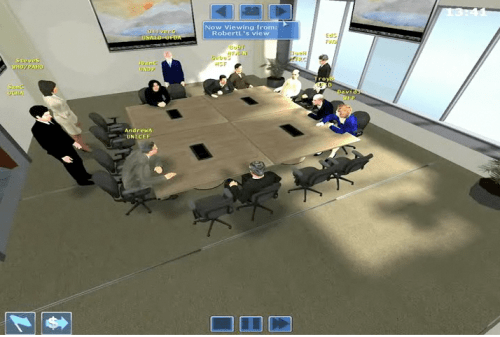
When playing the game, students who represent governments, the United Nations (UN) and nongovernmental organizations, meet in the Virtual Peace simulation. As part of the simulation, students are responsible for providing and coordinating aid to the two countries hardest hit by Hurricane Mitch: Honduras and Nicaragua. Students carry out background research on the scenario in order to represent one of 16 different humanitarian organizations such as Medecins Sans Frontieres (MSF), the Office of Foreign of Affairs of Nicaragua, USAID and the World Health Organization (WHO).

By playing the game together, the students are responsible for navigating the challenges and pathways to effective response. Each student assumes her or his role as an avatar designed to look like actual persons in the international aid community. They converse via voice and text channels in the game space which is designed to look like the real venues where these representatives might convene. Students present their views to the group at large and then (within the virtual space) break out into smaller groups for planning and negotiation.

VP3

In addition to allowing students to use real life diplomatic and conflict resolution skills, students and teachers can bookmark specific instances in the game that can be referred back to for learning purposes when debriefing the simulation. This allows them to assess whether certain goals were met, if students properly represented the values and views of their government or organization and how they can work more effectively in the future.

VP5

By extending to educators the multi-sensory nature of the digital media, Virtual Peace becomes much more than just an extension of a role-playing exercise. Ultimately, it is a cutting edge interdisciplinary platform for creative learning, uniting the technologies of the future and the experiences of the past. For more on virtual training for humanitarian response, see my blog post on 3D Crisis Mapping for Disaster Simulation Training.

I like the fact that Virtual Peace has “transformed video game technology previously used for army training simulations into an innovative tool for international humanitarian aid education.” In addition, I like the combination of the serious game with the social networking platform, Ning. This would be a neat addition to the Humanitarian Studies Initiative (HSI) seminar co-taught by the Harvard Humanitarian Initiative (HHI).

Indeed, I wish Virtual Peace had been around in 2006 when I taught an undergraduate course on “Disaster and Conflict Early Warning Systems” because Duke University actually offers a seminar on “Policy Anlaysis for Development” that uses Virtual Peace as a pedagogical tool.

The pictures and accompanying text above were taken from this Virtual Peace video demo:

Patrick Philippe Meier

Africa’s Crossborder Conflicts on Google Earth

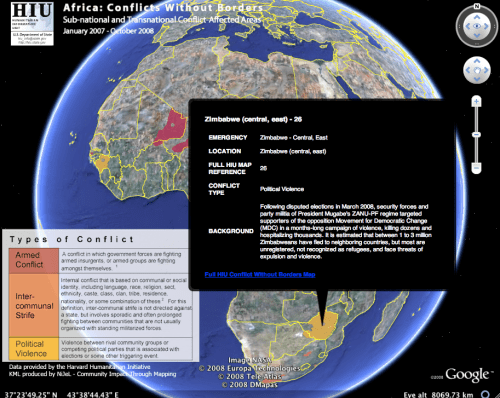
This post is an update on the Humanitarian Information Unit’s (HIU) crisis map of crossborder conflicts in Africa. Dennis King at HIU kindly shared with me the shapefiles for the static conflict map so we could create a Google Earth layer from the data. When I write “we”, I actually mean my colleague Lela Prashad who is the co-Executive Director at NiJeL.org.

NiJeL is a member of CrisisMappers and they are doing some phenomenal work in the mapping space. In fact, they have two excellent projects in the Top 15 of USAID’s Development 2.0 Challenge. When Dennis King agreed to share the HIU data, I therefore turned to Lela to create the Google Earth layer.

HIU

The main conclusion to draw from this little exercise is that time matters. Not exactly earth shattering news but let me spell it out nevertheless. Because the underlying data is static, visualizing the data on Google Earth is not as compelling as mapping dynamic event-data, such as HHI’s Crisis Map of Kenya’s Post-Election Violence. That said, the Google Earth layer at least provides the user with far more “spatial freedom” than the PDF version.

HIU2

The Google Earth layer is available here for download. The Harvard Humanitarian Initiative (HHI) and I hope to collaborate with NiJeL again in early 2009 to create a dynamic (space-time) crisis map of the recent Georgia/Russia conflict. In the mean time, many, many thanks to both Lela and Dennis for their time and kind support.

Patrick Philippe Meier

Africa’s Crossborder Conflicts on Google Earth

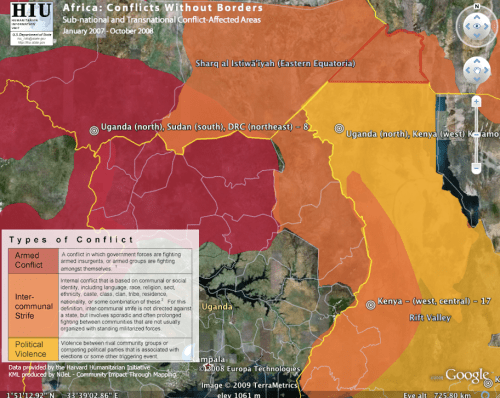
This post is an update on the Humanitarian Information Unit’s (HIU) crisis map of crossborder conflicts in Africa. Dennis King at HIU kindly shared with me the shapefiles for the static conflict map so we could create a Google Earth layer from the data. When I write “we”, I actually mean my colleague Lela Prashad who is the co-Executive Director at NiJeL.org.

NiJeL is a member of CrisisMappers and they are doing some phenomenal work in the mapping space. In fact, they have two excellent projects in the Top 15 of USAID’s Development 2.0 Challenge. When Dennis King agreed to share the HIU data, I therefore turned to Lela to create the Google Earth layer.

HIU

The main conclusion to draw from this little exercise is that time matters. Not exactly earth shattering news but let me spell it out nevertheless. Because the underlying data is static, visualizing the data on Google Earth is not as compelling as mapping dynamic event-data, such as HHI’s Crisis Map of Kenya’s Post-Election Violence. That said, the Google Earth layer at least provides the user with far more “spatial freedom” than the PDF version.

HIU2

The Google Earth layer is available here for download. The Harvard Humanitarian Initiative (HHI) and I hope to collaborate with NiJeL again in early 2009 to create a dynamic (space-time) crisis map of the recent Georgia/Russia conflict. In the mean time, many, many thanks to both Lela and Dennis for their time and kind support.

Patrick Philippe Meier

Greek Riots, Facebook, Twitter and SMS (Updated)

I am particularly interested in riots since part of my doctoral research focuses on the strategic and tactical uses of digital technology to organize, mobilize and coordinate protest events in repressive contexts. On this note, Alternet just published this piece by Andrew Lam on the “Greek Riots and the News Media in the Age of Twitter,” which echoes some of the issues raised during the panel discussion I participated in last week in  DC on the decline of foreign reporting and rise of citizen journalism.

The Greek riots are a classic case of iRevolutions in the making, i.e., individuals and networks (hyper) empowered by linking technologies like Facebook, Twitter and SMS. What follows first are my thoughts on the two main points that the Andrew highlights in his piece. The second part of this post sheds light on the dynamics of riots by drawing on complexity science and Clay Shirky’s work.

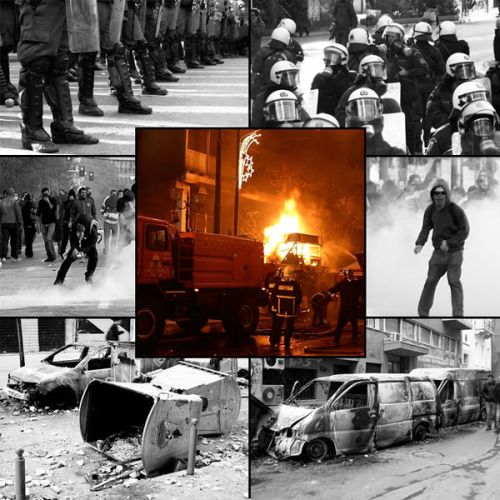
greekriotmontage

Initial Conditions: The riots were sparked after a 15-year old student “died from a gunshot wound in his heart, inflicted by a policeman following an altercation between a police patrol and a small group of youths in Athens” (1). Thousands of young people took to the streets after quickly spreading the news via Facebook, Twitter and SMS.

But as Andrew points out, no one bothered to verify or investigate the police officer’s claim that he was innocent: “When the coroner’s report came out several days later, it said the bullet was dented, meaning it ricocheted before hitting the teenager, but the information changed nothing. Athens had been burning for several nights, and the people, whose rage fueled the flames, couldn’t care less for facts.”

These valid points aside, my first question is what took the coroner so long? Extracting a bullet (pardon the morbidity) is not exactly brain surgery.  If said coroner had a mobile phone, s/he could have taken a picture of the dented bullet and shared it as widely as possible hoping that it would go viral. I have no idea how effective that would have been, but it’s a thought. The second question I have is whether any investigative journalists were pressing the coroner to get on with it?

Future Conditions: Andrew notes that “professional front line reporters may very well be on the way to being redundant in a world where, according to Reuters Director of News Media Development, Chris Cramer, ‘Every key event going forward will be covered by members of the public, and not by traditional journalists.’” (I just checked the Wikipedia page on the riots and it was edited close to 200 times within 48 hours of the shooting).

However, as I mentioned during last week’s panel, the mainstream media has an increasingly more important social service to play in the Twitter Age: distinguishing fact from fiction. Andrew is thus spot on when he writes that “the role of the mature news organization […] is to filter real news from pseudo news, rather than treating all content as equal.”

Complexity Science: Power laws are a defining signature of complex systems. The Richter scale, which relates earthquake frequencies to magnitude, is probably the most well known power law. As we all know, there are many small tremors every day but only a few major earthquakes every century. As it happens, protests such as strikes also follow a power law distribution. See for example this piece by Michael Bigs in the American Journal of Sociology. Here’s the abstract:

Historians have persistently likened strike waves to wildfires, avalanches, and epidemics. These phenomena are characterized by a power-law distribution of event sizes. This kind of analysis is applied to outbreaks of class conflict in Chicago from 1881 to 1886. Events are defined as individual strikes or miniature strike waves; size is measured by the number of establishments or workers involved. In each case, events follow a power law spanning two or three orders of magnitude. A similar pattern is found for strikes in Paris from 1890 to 1899. The “forest fire” model serves to illustrate the kind of process that can generate this distribution.

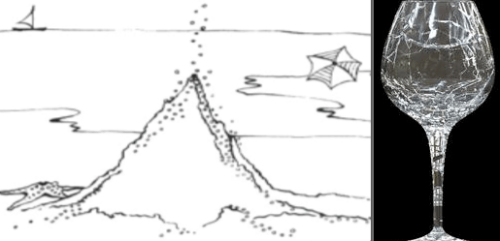
One classic way to illustrate this is by using the analogy of grains of sand falling on a sand pile. Eventually, small and large avalanches begin to occur at different frequencies that follow a power law.

sandpile1

The study of complex systems is often called the study of history. The sand pile becomes increasingly unstable over time as grains of sand cause “fingers of instability” to run through the structure, like fissures running across a wine glass or cracks in the earth as an earthquake unloads the built up tension. If you want to understand the vulnerability of the sand pile of a “Richter 9” earthquake, dissecting the falling grains will give you little insight. In other words, the answer lies in the past, in the evolution of the sand pile.

I make this point to reinforce the fact that the recent shooting and riots in Greece should be understood in context. The incident was  but one of several that befell Mount Olympus. As Katrin Verclas and others have commented (below) in response to this blog post, “the disenchantment of Greek students, the mistrust in and corruption of the right-wing government,”  as well as the “many acts of police brutality and incompetence through the years,” provides the historical context behind the shooting. “This is why people wouldn’t wait for the coronary report. There were many things wrong even before the shooting and the coronary report.”

Networks Analysis: One way to think about the impact of the information revolution on the ability of groups to mobilize and organize is to use the analogy of disease contagion, which also follows a power law distribution. As Clay Shirky writes, “The classic model for the spread of disease looks at three variables—likelihood of infection, likelihood of contact between any two people, and overall size of population. If any of those variables increases, the overall spread of disease increases as well.”

As a consequence of the information revolution, the likelihood of an individual receiving and broadcasting information is increasing significantly while the likelihood of any two people communicating is increasing exponentially; and world population is also growing at a furious pace. Since each of these three variables are increasing, the overall risk of protests increases as well.

The reason I raise this issue of power laws and epidemics of information is to address the issue of rumors. As Andrew Lam writes, “the streamlining of news [via Twitter and SMS] makes the story skeletal and thin, bordering on becoming rumor and hearsay.” Countering false rumors  in a highly connected network may require a systems approach since command-and-control is unlikely to work (short of switching the network off).

This is where the work by Malcom Gladwell, Mark Buchanan and and the Santa Fe Institute’s (SFI) research might shed some light on the viral cure for false rumors in the Twitter Age.

See also my follow up post on the Greek riots.

Patrick Philippe Meier