Tag Archives: SMS

Gene Sharp, Civil Resistance and Technology

Major civil nonviolent campaigns are twice as likely to lead to sustainable democratic transitions than violent campaigns. This conclusion comes from a large-N statistical study carried out by my colleague Maria Stephan (PhD Fletcher ’06) and Erica Chenoweth. Recently published in International Security, the study notes that civil resistance movements have achieved success 55% of the time while only 28% of violent campaigns have succeeded.

Another colleague, Chris Walker (MALD Fletcher ’07), wrote in his excellent Master’s Thesis that “techniques associated with strategic nonviolent social movements are greatly enhanced by access to modern information communication technologies, such as mobile telephony, short message service (SMS), email and the World Wide Web, among others.”

It stands to reason, then, that increasing access to modern communication technologies may in turn up the 55% success rate of nonviolent campaigns by several percentage points. To this end, the question that particularly interests me (given my dissertation research) is the following: What specific techniques associated with civil resistance can tactical uses of modern communication technologies amplify?

This is the question I recently posed to Dr. Peter Ackerman—another Fletcher Alum (PhD ’76) and the founding Chair of the International Center for Nonviolent Conflict (ICNC)—when I described my dissertation interests. When Peter suggested I look into Gene Sharp’s work on methods of nonviolent action, I replied “that’s exactly what I intend to do.”

In The Politics of Nonviolent Action, Gene identifies 198 methods of nonviolent protest and persuasion. The majority of these can be amplified by modern communication technologies. What  follows is therefore only a subset of 12 tactics linked to applied examples of modern technologies. I very much welcome feedback on this initial list, as I’d like to formulate a more complete taxonomy of digital resistance and match the tactic-technologies with real-world examples from DigiActive’s website.

  • Quickie walkout (lightning strike): Flashmob
  • Hiding, escape, and false identities: Mobile phone, SMS

Do please let me know (in the comments section below) if you can think of other communication technologies, Web 2.0 applications, examples, etc. Thanks!

Patrick Philippe Meier

Top 5 iRevolution Posts of 2008

Here are the five most popular posts of 2008 on iRevolution:

  1. The Past and Future of Crisis Mapping
  2. Crisis Mapping Kenya’s Election Violence
  3. SMS and Web 2.0 for Mumbai Early Warning
  4. Intellipedia for Humanitarian Warning/Response
  5. Tracking Genocide by Remote Sensing

Happy Holidays!

Patrick Philippe Meier

Snap Mobs of the World Unite – A Better Taxonomy? (Udpated)

Economist3

A writer for The Economist interviewed me earlier in the week for his article entitled “Rioters of the World Unite” sparked by the recent Greek riots. In the article, the author asks whether it is possible to imagine an Anarchist International comparable to the then Communist International, “a trans-national version of the inchoate but impassioned demonstrations that have ravaged Greece this month?”

While I’m not convinced that the word “anarchist” is an appropriate label for the rioters in Athens (more on that later), the author is certainly correct that the kind of “psychological impulse behind the Greek protests […] can now be transmitted almost instantaneously, in ways that would make the Bolsheviks very jealous. These days, images (moving as well as still) spread faster than words; and images, of course, transcend language barriers.”

E-communications are now a familiar feature in pro-democracy protests against dictators. Equally fast-moving, say specialists, is the role of technology in what might be called “undemocratic protests”: violent acts in prosperous, networked societies.

Leaving aside the need to distinguish between protests and riots, I find the notion of “undemocratic protests” rather interesting although I’m not sure whether the qualifier “undemocratic” necessarily adds clarity. What is undemocratic about Hungarian youths in 2006 using “blogs to aggregate visual evidence of police brutality” and “distributing an audio recording of the prime minister admitting government corruption?”

This brings us to the issue of developing an appropriate taxonomy, as I noted in response to some excellent questions in the comments section of my blog post on the “Greek Riots, Facebook, Twitter and SMS.” (Incidentally, I should have included Second Life where a memorial was erected “giving its users a glimpse of real-life material from the riots”).

I think we need a better taxonomy for today’s new media. Individuals who find themselves in the middle of the action and send text messages or camera shots from their phones are not journalists in the conventional sense of the word. Adding “citizen” in front of journalism is perhaps too simplistic.

First of all, in repressive contexts, “citizen journalists” are not really citizens of their country; they tend to be marginalized, oppressed and persecuted. The term “civilian journalism” may be more apt. But we’ve already established that the qualifier “journalism” muddies the waters.

The Greek students rioting in the streets of Athens could not be described as a “smart mob” either. I wouldn’t use the term “dumb mobs” because I don’t find that any more accurate than describing the rioters as anarchists. Indeed, I think The Economist article gets it particularly wrong on that note:

The shooting and ensuing riots in Greece must be understood in the context of the “disenchantment of Greek students, the mistrust in and corruption of the right-wing government,”  as well as the “many acts of police brutality and incompetence through the years. This is why people wouldn’t wait for the coronary report. There were many things wrong even before the shooting and the coronary report” (see previous blog post).

In this context, then, perhaps a term like “snap mobs” might be more useful. Snap implies quick and plays on terms like “snapshot” and “snap judgment” which is a better description of the student-led riots in Greece.

As the article in The Economist suggests, what happened in Athens is bound to happen again in different forms across the world, i.e., rumors spreading and leading to chaos or worse, bloodshed. This may eventually drive the point home that text messages and Tweets should simply not be taken at face value.

I do think that as foreign reporting continues to decline, we will see the rise of  a professional class of citizen journalists and as a consequence, readers will expect the latter to operate at standards akin to that of the mainstream media today. At the same time, I suspect the mainstream media will shift towards a more investigative-journalism mode as consequence of increasing “snap mob” behavior.

Patrick Philippe Meier

Greek Riots, Facebook, Twitter and SMS (Updated)

I am particularly interested in riots since part of my doctoral research focuses on the strategic and tactical uses of digital technology to organize, mobilize and coordinate protest events in repressive contexts. On this note, Alternet just published this piece by Andrew Lam on the “Greek Riots and the News Media in the Age of Twitter,” which echoes some of the issues raised during the panel discussion I participated in last week in  DC on the decline of foreign reporting and rise of citizen journalism.

The Greek riots are a classic case of iRevolutions in the making, i.e., individuals and networks (hyper) empowered by linking technologies like Facebook, Twitter and SMS. What follows first are my thoughts on the two main points that the Andrew highlights in his piece. The second part of this post sheds light on the dynamics of riots by drawing on complexity science and Clay Shirky’s work.
greekriotmontage

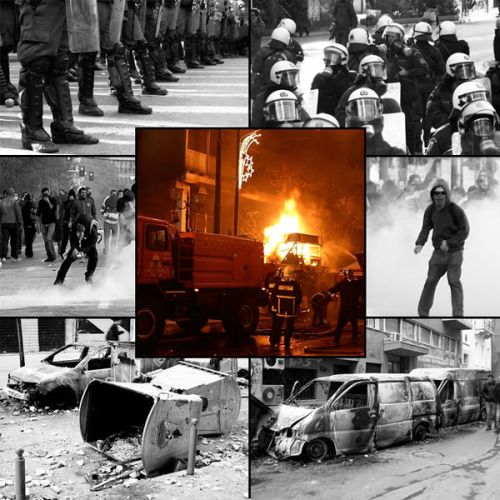
Initial Conditions: The riots were sparked after a 15-year old student “died from a gunshot wound in his heart, inflicted by a policeman following an altercation between a police patrol and a small group of youths in Athens” (1). Thousands of young people took to the streets after quickly spreading the news via Facebook, Twitter and SMS.

But as Andrew points out, no one bothered to verify or investigate the police officer’s claim that he was innocent: “When the coroner’s report came out several days later, it said the bullet was dented, meaning it ricocheted before hitting the teenager, but the information changed nothing. Athens had been burning for several nights, and the people, whose rage fueled the flames, couldn’t care less for facts.”

These valid points aside, my first question is what took the coroner so long? Extracting a bullet (pardon the morbidity) is not exactly brain surgery.  If said coroner had a mobile phone, s/he could have taken a picture of the dented bullet and shared it as widely as possible hoping that it would go viral. I have no idea how effective that would have been, but it’s a thought. The second question I have is whether any investigative journalists were pressing the coroner to get on with it?

Future Conditions: Andrew notes that “professional front line reporters may very well be on the way to being redundant in a world where, according to Reuters Director of News Media Development, Chris Cramer, ‘Every key event going forward will be covered by members of the public, and not by traditional journalists.’” (I just checked the Wikipedia page on the riots and it was edited close to 200 times within 48 hours of the shooting).

However, as I mentioned during last week’s panel, the mainstream media has an increasingly more important social service to play in the Twitter Age: distinguishing fact from fiction. Andrew is thus spot on when he writes that “the role of the mature news organization […] is to filter real news from pseudo news, rather than treating all content as equal.”

Complexity Science: Power laws are a defining signature of complex systems. The Richter scale, which relates earthquake frequencies to magnitude, is probably the most well known power law. As we all know, there are many small tremors every day but only a few major earthquakes every century. As it happens, protests such as strikes also follow a power law distribution. See for example this piece by Michael Bigs in the American Journal of Sociology. Here’s the abstract:

Historians have persistently likened strike waves to wildfires, avalanches, and epidemics. These phenomena are characterized by a power-law distribution of event sizes. This kind of analysis is applied to outbreaks of class conflict in Chicago from 1881 to 1886. Events are defined as individual strikes or miniature strike waves; size is measured by the number of establishments or workers involved. In each case, events follow a power law spanning two or three orders of magnitude. A similar pattern is found for strikes in Paris from 1890 to 1899. The “forest fire” model serves to illustrate the kind of process that can generate this distribution.

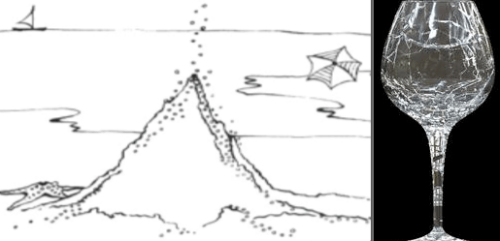
One classic way to illustrate this is by using the analogy of grains of sand falling on a sand pile. Eventually, small and large avalanches begin to occur at different frequencies that follow a power law.
sandpile1

The study of complex systems is often called the study of history. The sand pile becomes increasingly unstable over time as grains of sand cause “fingers of instability” to run through the structure, like fissures running across a wine glass or cracks in the earth as an earthquake unloads the built up tension. If you want to understand the vulnerability of the sand pile of a “Richter 9” earthquake, dissecting the falling grains will give you little insight. In other words, the answer lies in the past, in the evolution of the sand pile.

I make this point to reinforce the fact that the recent shooting and riots in Greece should be understood in context. The incident was  but one of several that befell Mount Olympus. As Katrin Verclas and others have commented (below) in response to this blog post, “the disenchantment of Greek students, the mistrust in and corruption of the right-wing government,”  as well as the “many acts of police brutality and incompetence through the years,” provides the historical context behind the shooting. “This is why people wouldn’t wait for the coronary report. There were many things wrong even before the shooting and the coronary report.”

Networks Analysis: One way to think about the impact of the information revolution on the ability of groups to mobilize and organize is to use the analogy of disease contagion, which also follows a power law distribution. As Clay Shirky writes, “The classic model for the spread of disease looks at three variables—likelihood of infection, likelihood of contact between any two people, and overall size of population. If any of those variables increases, the overall spread of disease increases as well.”

As a consequence of the information revolution, the likelihood of an individual receiving and broadcasting information is increasing significantly while the likelihood of any two people communicating is increasing exponentially; and world population is also growing at a furious pace. Since each of these three variables are increasing, the overall risk of protests increases as well.

The reason I raise this issue of power laws and epidemics of information is to address the issue of rumors. As Andrew Lam writes, “the streamlining of news [via Twitter and SMS] makes the story skeletal and thin, bordering on becoming rumor and hearsay.” Countering false rumors  in a highly connected network may require a systems approach since command-and-control is unlikely to work (short of switching the network off).

This is where the work by Malcom Gladwell, Mark Buchanan and and the Santa Fe Institute’s (SFI) research might shed some light on the viral cure for false rumors in the Twitter Age.

See also my follow up post on the Greek riots.

Patrick Philippe Meier

Iran: Mullahs Impose Restrictions on SMS

Mobile phone users in Iran who wish to use the SMS feature on their mobile phones will now be required to apply for security clearance by the Ministry of of Intelligence and Security.

Sending SMS deemed contrary to national security will be punishable by law. Any change of address by the subscriber of the service must be reported promptly to the relevant authorities. It is the security agents who decide which SMS are in breach of national security .

In October, A number of senior officials of the Iranian regime’s Ministry of Culture and Islamic Guidance (MCIG), the main body for imposing censorship, have expressed its deep concern over the use of SMS messaging by the Iranian Resistance’s network inside Iran (source).

Some 20 million text messages are sent every day in Iran according to some sources. Will the new regulation have a significant impact on that number? If so, will the regime care at all about the loss of revenue?

Patrick Philippe Meier

Two Way SMS Gateway on a USB Stick with Drupal

Just got word of this from a good friend of mine, Drew Bennett, a Fletcher School alumnus (F’08). Development Seed has been developing some very neat communications solutions. It’s tempting to write about all their creative projects but I’ll try my best to limit myself to one in particular which draws on new open source tools to make decentralized data collection more effective. From the developers themselves:

The release of the SMS Framework 1.0, along with the road map for a 1.1 version, is making Drupal a more attractive platform for organizations that need powerful, decentralized data collection tools. This recent work shows that using Drupal can give you a serious foundation to integrate sms applications and tools with a website. I want to expand on Will’s recent post about building a two way SMS Gateway on a USB drive and show how Drupal can act as a data hub for collecting data and messaging via sms.

We are interested in this because tools that can integrate with sms like this will be especially helpful for international development agencies with on the ground operations. For example, this functionality could allow an election monitoring organization to use sms to track reports from observers at polling stations or help a public heath organization to monitor when patients take medicine via sms messages sent from personal or public cell phones. It could even assist a disaster response organization to track the status of its team on the ground team through their handsets.

This tool could be particularly interesting for field based organizations operating in conflict zones as well. See also the group’s introductory overview of all their other projects here (PDF), which includes some very interesting dynamic mapping platforms.

Patrick Philippe Meier

Mobile Spying Software Sophistication

Computerworld New Zealand reports that spying programs for mobile phones are likely to grow in sophistication and stealth as the business around selling the tools grows.

There is increasing evidence that money from selling the tools will create a stronger incentive for more accomplished programmers to get into the game, which could make the programs harder to detect. The prediction follows what has happened with the malware writers in the PC market. Many hackers are now in the business of selling easy-to-use tools to less technical hackers rather than hacking into PCs themselves.

One of the latest tools on the market is Mobile SpySuite, which some believe is the first spy tool generator for mobiles. It sells for US$12,500. The number of mobile spyware programs pales in comparison to the number of such programs available for PCs. However, mobile spying programs are harder to track, since security companies don’t see as many samples circulating on the internet as they do of malicious software for PCs.

Some of the more well-known spy programs are Neo-call and FlexiSpy. Neo-call is capable of secretly forwarding SMS (Short Message Service) text messages to another phone, transmitting a list of phone numbers called, and logging keystrokes. FlexiSpy has a neat, web-based interface that shows details of call times, numbers and SMSes, and it can even use a phone’s GPS (Global Positioning System) receiver to pinpoint the victim’s location.

I’m not too worried though, SecureSMS would have those forwarded SMS texts encrypted. And besides, as SpySuite increases it’s market share, this will increase customer demand for tighter data security. Companies like CellTrust will move in and offer anti-spying tools. And so on, and so on. In other words, we’re likely to see the dynamic observed vis-a-vis PCs, i.e., the basic dynamic of evolutionary biology: adaptation.

Patrick Philippe Meier

Iraq goes Mobile

There was little difference between the Internet and the regular postal mail system when Saddam Hussein was in power. Emails would be sent to a central monitoring unit which would screen the content and determine whether to forward it on to the intended recipient. According to Ameer, the replies to these emails were also censored and would sometimes take weeks to get through, if ever. As for the few Internet cafes that existed (in hotels), communication was regularly monitored and some websites blocked.

This recalls the days of the Soviet Union where centralization was also taken to an extreme. As Brafman and Beckstrom note, if someone in Siberia made a phone call to a comrade living just a hundred miles away, the call would be routed through Moscow. In fact, all phone calls were routed through Moscow. Evidently, the Soviets weren’t the first and certainly not the last to impose central control of communication lines. The expression “All roads lead to Rome” reflected the Roman Empire’s highly centralized transportation system, which in a way was also the information super roadway of the day.

Iraq had no mobile phone network prior to the US invasion, and as Ameer notes, even satellite phone were banned. Today, there are three mobile networks and a dozen Internet Service Providers, which means millions of users. And despite the violence, ISPs continue to roll out Internet and modern telephony systems across the war torn country. Is an Iraqi Smart Mob potentially in the making?

Patrick Philippe Meier

GSM versus People Power in Africa

Let’s force GSM tariffs down. Join a mass protest switch off ur fone on fri sept 19 ’03. They’ll lose millions. It worked in US & Argentina. Spread Dis txt.

It’s been close to 5 years since the Great GSM Boycott in Nigeria. Some claim that up to 75% of mobile phone users switched off their phones on 9/13 in widespread protests that were regarded as much of a charge against the Nigerian state as it was a statement of protest vis-a-vis the country’s corrupt telecommunication companies. Many disaffected users even drew parallels between the activities of the phone companies and those of oil companies which operate in the country’s delta region and are known for conniving with the Nigerian state.

Following the boycott, the companies set off on a charm offensive to win back their clientèle after acknowledging that a substantial number of customers did switch off their phones. The companies did give in to a number of customer demands but found other ways to compensate for the drop in revenue (by shifting additional costs to users). An important positive impact of the boycott was the noticeable increased determination of the National Communications Commission to enforce the sector’s basic regulations.

One question in particular came to mind when reading Odabare’s account of the Great Boycott: If a tactic as basic as switching off a mobile phone apparently worked in the US, Argentina and Nigeria, then why haven’t we seen additional copycat tactics since that have proved successful?

Patrick Philippe Meier

SMS = Secure Messaging Service = iRevolution?

WirelessWeek: Analysts predicted SMS revenues of up to $80 billion worldwide in 2007, with the number of text messages expected to reach a whopping 1.8 trillion by 2010.

CellTrust was founded in 2006 by a group of Internet security experts who wanted to place security high on the mobile agenda taking a proactive approach. This week, they rolled out SecureSMS, the first global secure SMS Gateway. Users can now meet security compliance standards with a cost effective solution providing military strength encryption. The service includes a remote wipe API which means that when a handset is lost or stolen, the user can remotively wipe the handset. The secure SMS Gateway is available in 160 countries worldwide.

This is precisely the technology that I’ve been waiting for and with the revenue stream in the billions of dollars, it’s only a matter of time before sending encrypted texts messages becomes standard operating procedures for Smart Mobs and nonviolent movements alike. SecureSMS may soon be synomimous with the iRevolution. Will this change the balance of power between repressive regimes and social resistance networks? Or will coercive states find a way to block this kind of functionality? Stay tuned.

Patrick Philippe Meier